What Are the Best Blinds for a Window Over the Kitchen Sink?

Authored By Michael Turner -30 Years Home Improvement Expertise | Updated 2026 | BlindShades.pro
Updated on July 14, 2026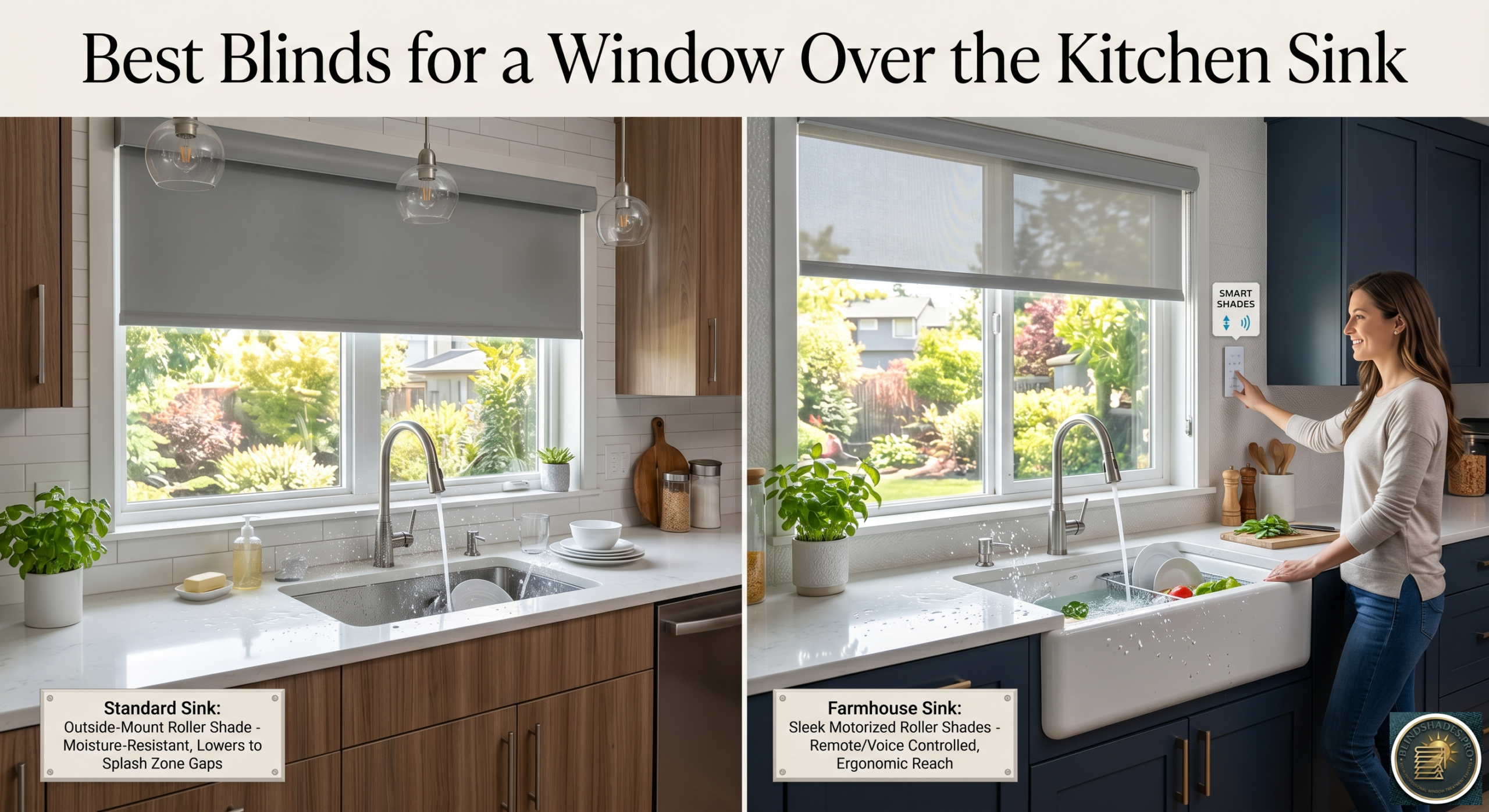
⭐ Quick Answer — What Are the Best Blinds for a Window Over the Kitchen Sink?
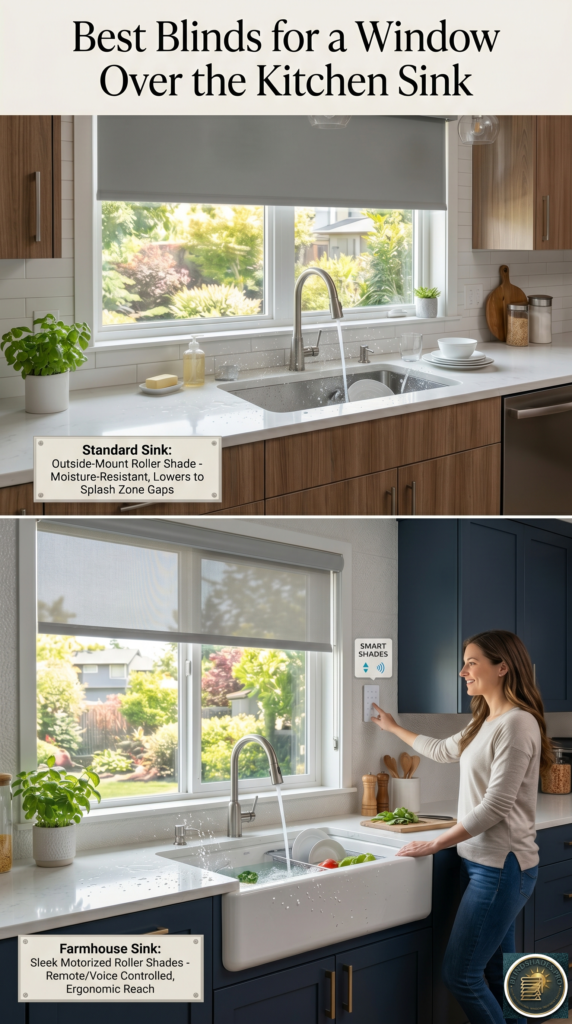
- The Reach Geometry Determines the Operation Type: The best blinds for a kitchen sink window depend on the sink type. Standard drop-in sink (22–24 inch depth): cordless PVC vinyl roller — the reach over the basin is manageable with one arm. Farmhouse or apron-front sink (27–33 inch depth, 30–36 inch reach to window): motorized or voice-controlled only — leaning the full upper body over a hard wet apron surface to reach a manual blind is both impractical and a slip risk. Specify Alexa or Google voice control for the most hygienic hands-free operation over the sink
- Drop the Blind to the Counter — Not the Sill: The kitchen tap splashes water within a 6–12 inch radius from the basin impact point. The window sill sits 2–8 inches above the counter — meaning the lower window glass and sill are directly in the splash zone. A blind that terminates at the sill leaves a gap at the bottom through which splash reaches uncovered glass daily. When ordering: specify the drop length as the distance from the headrail to 1–2 inches above the counter surface — not the window height. Outside-mount PVC vinyl touching the counter level closes the splash zone gap completely
- Use Dish Soap — Not Vinegar: Every guide says “use mild cleaner or vinegar.” Vinegar (acetic acid, pH 2.5) dissolves calcium mineral deposits but does NOT remove cooking grease — it is not a degreaser. Dish soap is a surfactant-based degreasing detergent that breaks down and lifts polymerised cooking fats. Apply dish soap with warm water on a microfibre cloth, wipe, rinse with clean damp cloth, dry. For aluminium slat blinds: vinegar also degrades the anodised oxide layer over time — dish soap is safe for both aluminium and PVC
- The West-Facing Sink Window Problem: A rear-facing kitchen sink window often faces west or southwest — receiving direct low-angle afternoon sun (3–5pm) at eye level during dish washing. The solution is not a blackout roller (loses the garden view) — it is a solar shade at 3–5% openness. This reduces glare by 75–85% while preserving the outward view and providing daytime one-way privacy. Pair with an opaque secondary roller for night use
- The Frosted Film Alternative — No Reaching Required: For homeowners who want no blind mechanism above the sink at all, marine-grade frosted film applied to the lower 12–18 inches of the window glass provides permanent privacy with no moving parts, no cords, no grease-collecting mechanism, and no reaching over the sink. Transmits 80–90% of natural light. Pair with a solar shade roller above the film line for upper-window glare control
- Best Sources: Motorized PVC roller (farmhouse sink) → SelectBlinds motorized range · Cordless vinyl roller (standard sink) → Blindsgalore kitchen range · Frosted film → 3M decorative window film
⚠️ The Outside Mount Sill-Cover Advantage and the Blind Length Calculation: For any blinds for a kitchen sink window, outside mount is the correct specification — not inside mount. The window frame and sill above a kitchen sink accumulate grease splatter daily. Inside mount leaves the frame and sill visible and exposed below the raised blind. Outside mount covers the frame and sill entirely. And the blind length calculation is critical: a standard kitchen has a counter at 36 inches, a window sill at 38–44 inches, and a headrail at 50+ inches for outside mount. The distance from headrail to counter is 14–16 inches for a typical outside-mount configuration — significantly shorter than the window height suggests. Order the blind drop as headrail-to-counter minus 1–2 inches — not the window glass height. Ordering the wrong length leaves the gap open at the bottom and the blind floating above the counter level with exposed wet sill beneath. For the full outside-mount vs inside-mount guide for kitchen windows, see What Are the Best Blinds for Kitchen Windows. See the full blind length calculation below.
💡 Motorized Blinds for Kitchen Sink Windows — The Hygiene Operation Order: For blinds for a kitchen sink window that are motorized, operation hygiene matters. Ranked from most to least hygienic: (1) Voice control (Alexa/Google/Apple Home) — no touching required, operate with soiled hands by voice; (2) Motion sensor trigger — blind lowers automatically when sink area is occupied; (3) Smartphone app — requires touching the phone but avoids the blind mechanism; (4) Wall switch — fixed surface, away from the wet zone but requires touch; (5) Manual cordless lift bar — direct contact with the blind in proximity to wet and greasy hands. The motor in Zone K1 above the sink is in a high-steam environment during every hot-water use — specify IP44-rated integrated tube motors for Zone K1 motorized sink window installation. For the complete IP rating guide for motorized blinds in wet environments, see Are Motorized Blinds Safe for a Bathroom (the IP rating framework applies identically to kitchen Zone K1). See the full motorized hygiene guide below.
📖 Read the complete guide below for: the reach-over-wet-surface geometry table (standard sink 22–24 inches vs farmhouse 30–36 inches with operation recommendation for each), the tap splash radius (6–12 inches from basin impact point and its relationship to blind bottom-edge positioning), the blind length calculation for over-sink windows (headrail to counter not window height), why dish soap removes kitchen grease and vinegar does not, the west-facing sink window solar shade specification for garden view preservation, the motorized hygiene operation ranking (voice/motion/app/switch/manual), the IP44 motor requirement for Zone K1, and the frosted film lower-half plus solar shade upper-half combination for no-moving-parts sink window privacy.
Related guides: the sink window is one of three kitchen zones — our kitchen buying guide maps all three, plus the over-sink reach problem in full.
Blinds for a Kitchen Sink Window – The Reach-Over-Wet-Surface Problem
Definition: The reach-over-wet-surface problem is the operational challenge of manually adjusting a window blind that requires the operator to lean over a wet, active kitchen sink to reach the blind’s lift cord, pull bar, or bottom rail.
This is the specification driver for kitchen sink window blinds that no competitor guide explains, yet it determines the most important feature decision: corded vs cordless vs motorized.
The reach geometry by sink type:
| Sink Type | Sink Depth | Reach Distance to Window | Recommended Operation |
|---|---|---|---|
| Drop-in single bowl | 22-24 inches | Moderate – one-arm reach | Cordless lift bar |
| Drop-in double bowl | 22-24 inches | Moderate – centre of sink is far | Cordless lift bar |
| Undermount single bowl | 24-26 inches | Moderate-far – no front lip | Cordless or motorized |
| Farmhouse/apron front | 27-33 inches | Far – apron extends to cabinet face | Motorized or voice control |
| Belfast sink | 28-34 inches | Far – deep exposed front | Motorized or voice control |
For a standard drop-in sink: The operator stands at the counter edge, reaches over 22-24 inches of sink, and can grasp a cordless lift bar at the blind’s bottom rail. This reach is achievable without leaning in a way that risks contacting wet surfaces. A cordless roller shade with a bottom rail lift bar is adequate.
For a farmhouse or apron-front sink: The apron face of the sink projects forward to the cabinet face line. The operator stands 30-36 inches from the window. Reaching forward to grasp any manual control requires leaning the full upper body over a wet, hard porcelain or fireclay surface. Water on the apron front creates slip risk. For a farmhouse sink, motorized operation – voice controlled via Alexa, Google, or Apple Home, or operated by wall switch – is the most practical specification.
The Splash Radius – How It Determines Blind Lower-Edge Positioning
All guides say “get waterproof material.” None quantify where the water actually goes.
The kitchen tap splash zone: A standard kitchen mixer tap running at moderate pressure creates splash within a 6-12 inch radius from the impact point in the sink basin. The window sill above a kitchen sink is typically positioned 2-8 inches behind the tap (depending on counter depth from back wall and window placement).
This means:
- The lower 6-12 inches of window glass above the sill is within the active splash zone of the tap
- Water droplets reach the lower window glass and sill during normal washing-up activity
- A blind that does not reach the counter when fully lowered leaves a gap at the bottom of the window where splash can pass freely to the glass and sill
The bottom-edge specification: For any blind installed above a kitchen sink, the bottom rail of the blind when fully lowered should reach within 1-2 inches of the counter surface. This closes the splash-zone gap and prevents water from reaching uncovered window glass.
The outside-mount caution for fabric blinds: An outside-mount roller shade that is lowered to counter height allows the shade fabric’s bottom edge to rest on or near the wet counter surface. For a PVC vinyl roller shade – the waterproof material is unaffected by counter contact. For a fabric roller shade – contact with a wet counter transfers moisture to the fabric lower edge, creating a mold risk at the bottom of the fabric panel.
For the general kitchen blind outside mount guidance, see What Are the Best Blinds for Kitchen Windows.
The Blind Length Calculation for Over-Sink Windows
The kitchen sink window presents a unique measurement challenge. Unlike other windows where the blind terminates at the sill or floor, the over-sink blind must be specified to reach close to the counter surface – a measurement that most ordering forms do not specifically address.
The measurement sequence:
- Measure from the window sill (or intended headrail position for outside mount) to the counter surface directly below the window
- For inside mount: the blind length = this measurement minus 1-2 inches (the shade does not need to reach the sill exactly; it needs to reach close to the counter)
- For outside mount: the headrail is mounted above the window casing; measure from the headrail position to the counter surface; this is the blind’s drop length
- Standard kitchen window height: 24-36 inches. Standard sill height: 38-44 inches. Counter height: 36 inches. The distance from sill to counter is typically 2-8 inches – surprisingly small.
- An outside-mount blind with the headrail at 50 inches above the floor needs a drop length of 14-16 inches to reach within 2 inches of the 36-inch counter – significantly shorter than the window’s natural height suggests
The practical implication: Many homeowners order a blind for the window height without accounting for the counter below. The blind’s lower edge, when fully extended, terminates at the sill – leaving a 2-8 inch gap between the sill and the counter that is both aesthetically poor and allows splash to reach uncovered window glass.
When ordering any blind for a kitchen sink window: specify the drop length as the distance from the headrail position to 1-2 inches above the counter surface, not the distance from headrail to sill or headrail to floor.
The Correct Cleaning Agent – Dish Soap, Not Vinegar
This is the most commonly given wrong advice for kitchen window blinds.
The standard recommendation across all guides: White vinegar solution or mild cleaner.
Why vinegar is wrong for kitchen grease: White vinegar (acetic acid, pH 2.5) is effective at dissolving calcium carbonate deposits (limescale and mineral buildup) and killing mold spores. It is the correct agent for bathroom blinds where the primary surface deposit is calcium from hard water and organic dust.
Cooking grease is not calcium carbonate. Aerosolised cooking lipids that deposit on kitchen blind slats are polymerised fats and oils. Acetic acid (vinegar) does not chemically emulsify or saponify these lipid compounds. White vinegar applied to a greasy kitchen blind slat does not remove the grease – it removes any mineral deposits on top of the grease layer and leaves the grease film intact.
The correct agent: Dish soap (washing-up liquid). Dish soap is a surfactant-based degreasing detergent specifically formulated to emulsify and lift polymerised cooking fats from surfaces. Applied with warm water, dish soap:
- Breaks the bond between cooking grease and the blind slat surface
- Lifts and suspends the grease in the rinse water
- Leaves the slat surface completely grease-free after rinsing
The correct protocol for kitchen sink window blinds:
- Remove the blind (if possible) or work in situ
- Apply warm water with a few drops of dish soap to a microfibre cloth
- Wipe each slat or the roller surface with the soapy cloth
- Follow with a clean damp cloth (warm water only)
- Dry with a dry cloth or allow to air dry
Caution for aluminium blinds: Vinegar degrades anodised aluminium over time by dissolving the protective oxide layer. Dish soap is safe for anodised aluminium and is the correct cleaning agent for both aluminium and PVC kitchen sink window blinds.
The Over-Sink Window Orientation – Afternoon Sun and the View While Washing Up
Many homeowners consider the window above the kitchen sink as primarily a privacy challenge. It is equally a light management and experience challenge.
The typical over-sink window orientation: In residential construction, the kitchen sink is most commonly positioned on the rear wall of the home (facing the back garden or yard). In northern hemisphere homes, the rear of a home faces a range of orientations depending on the house position. The most common rear-facing kitchen windows face south, southeast, or southwest – receiving direct afternoon or evening sun.
The west-facing sink window problem: A kitchen sink window facing west or southwest receives direct low-angle afternoon sun (from approximately 3pm to 6pm) at precisely the time of day when the kitchen is most actively used for meal preparation and washing up. This sun enters at working height – directly at eye level for someone standing at the sink. The glare from a west-facing sink window during evening cooking and cleaning is one of the most common kitchen comfort complaints.
The solar shade solution for over-sink glare: A solar shade at 3-5% openness installed above the kitchen sink provides:
- 75-85% glare reduction from direct afternoon sun
- Preservation of the outward garden or yard view (the primary benefit of a sink window position)
- No privacy loss during daylight hours (solar shade daytime one-way vision)
- Full privacy when lowered after dark (with an opaque secondary roller)
For the kitchen solar shade night privacy problem (the same luminance reversal covered in Guide #48 for bathrooms), see Can Solar Shades Be Used in a Bathroom – The Night Privacy Problem which explains the physics — the same principle applies at a kitchen sink window.
Motorized Blinds for Kitchen Sink Windows – The Hygiene Specification
For a sink window where motorized operation is specified, the hygiene dimension specific to kitchens affects the correct motor choice.
The soiled-hands operation problem: A person operating a kitchen sink blind during cooking or washing up typically has wet, soapy, or food-soiled hands. Manual operation (reaching to grab a lift bar or wall switch) transfers grease and food residue to the blind’s lift mechanism or the wall switch surface. Over months of use, a greasy lift bar or wall switch becomes an unhygienic surface and a cleaning challenge.
The most hygienic operation methods (in order):
- Voice control (Alexa/Google/Apple Home): No touching required. The blind operates by spoken command. The most hygienic specification for a kitchen sink window.
- Motion sensor trigger: A motion sensor positioned above the sink triggers the blind to lower when the sink area is occupied and raise when the area is clear. No interaction required.
- App control (smartphone): Operated from a phone – cleaner than touching a wall switch but less hygienic than voice if the phone is also on the counter.
- Wall switch: Better than a manual lift bar (the switch surface is away from the sink) but requires touching with potentially soiled hands.
- Manual cordless lift bar: Requires direct contact with the blind’s wet and greasy proximity zone. Least hygienic for an active cooking kitchen.
The motor moisture specification for Zone K1: For a motorized blind installed above a kitchen sink (Zone K1), the motor is in a high-steam environment during every use of the hot tap or boiling water. For motorized kitchen sink window blinds: specify integrated tube motors with at minimum IP44 rating. For the full IP rating guide for motorized blinds in humid environments, see Are Motorized Blinds Safe for a Bathroom – Waterproofing, IP Ratings and Smart Home.
Frosted Film – The No-Moving-Parts Sink Window Alternative
For homeowners who want privacy above the kitchen sink without any blind mechanism, marine-grade or standard interior frosted film applied to the lower portion of the sink window provides:
- Permanent privacy from the splash zone height upward
- No reaching over the sink for any operation
- No moving parts to collect grease
- No mechanism to corrode in the splash zone
- 80-90% light transmission through the frosted portion
- The ability to pair with an upper-zone roller shade for light control above the frosted band
The specification for over-sink frosted film: Apply frosted film to the lower 12-18 inches of the window glass (the privacy zone aligned with standing counter-height observer). Leave the upper portion of the window clear for light or install a solar shade roller above the film line for glare control.
For heavily splashed windows where the film is in direct water contact daily – specify a moisture-rated film with a solvent-based adhesive rather than standard pressure-sensitive adhesive, which can lift at the edges in sustained moisture conditions.
The Complete Kitchen Sink Window Blind Specification
| Scenario | First Choice | Second Choice | Operation | Avoid |
|---|---|---|---|---|
| Standard drop-in sink | PVC vinyl roller outside mount | Baked enamel aluminium | Cordless lift bar | Corded, fabric, real wood |
| Farmhouse/apron front sink | Motorized PVC vinyl roller | Motorized baked enamel aluminium | Voice/app control | Manual (reach too far) |
| West-facing sink (afternoon glare) | Solar shade + opaque secondary | PVC vinyl roller (light-filtering) | Cordless or motorized | Blackout (loses view) |
| Deep farmhouse + privacy + glare | Motorized solar shade + secondary | Frosted film lower + solar shade upper | Voice control | Any manual corded |
| Rental/no-drill installation | Tension rod roller shade (inside mount) | Tension rod café curtain | Manual | Standard bracket mount |
| No-moving-parts preference | Frosted film lower + solar shade upper | Frosted film full window | None required | Any blind with mechanism |
Where to Order
For PVC vinyl roller shade (primary sink window specification): Blindsgalore vinyl roller shade – see blindsgalore.com/kitchen. Specify: cordless, outside mount, PVC vinyl (not fabric), drop length measured to counter surface not sill.
For motorized PVC vinyl roller (farmhouse sink specification): SelectBlinds motorized roller shade – see selectblinds.com/motorized-blinds. Specify: Alexa/Google compatible, IP44 motor, PVC vinyl fabric. Confirm motor charging port moisture specification.
For frosted film alternative: 3M interior window film – see 3m.com window films decorative range for moisture-rated interior film options appropriate for the splash zone above a kitchen sink.
Related guides: For complete buying advice, see our kitchen window blinds buying guide.
Frequently Asked Questions
What are the best blinds for a window over the kitchen sink? The best blinds for a kitchen sink window are PVC vinyl roller shades for standard drop-in sinks and motorized PVC vinyl roller shades for farmhouse or apron-front sinks. PVC vinyl has a single flat non-porous surface with zero grease absorption that wipes completely clean with dish soap and warm water. The key specification requirements are outside mount to cover the grease-collecting window frame and sill, cordless or motorized to avoid a cord hanging over the wet sink, and a drop length specified to reach within 1 to 2 inches of the counter surface to close the splash zone gap below the window.
Why does a farmhouse sink need motorized blinds? A farmhouse or apron-front kitchen sink has a front face that extends to the cabinet face line, positioning the operator 30 to 36 inches from the window when standing at the sink. Reaching any manual blind control over this distance requires leaning the full upper body over a hard wet porcelain or fireclay surface, creating slip and fall risk and contact with wet surfaces. Motorized or voice-controlled operation allows the blind to be adjusted by spoken command or app with no reaching over the sink required.
Should I use vinegar or dish soap to clean kitchen sink window blinds? Use dish soap with warm water, not white vinegar, to clean kitchen sink window blinds. Vinegar is acetic acid, which dissolves calcium mineral deposits from hard water but does not emulsify or remove polymerised cooking grease – the primary deposit on kitchen blinds. Dish soap is a surfactant-based degreasing detergent that breaks down cooking fat and lifts it from the slat surface. For aluminium blinds specifically, repeated vinegar application degrades the anodised oxide layer over time. Apply dish soap with warm water on a microfibre cloth, wipe each surface, follow with a clean damp cloth, and dry.
How far down should a kitchen sink window blind go when fully lowered? The bottom edge of a kitchen sink window blind should reach within 1 to 2 inches of the counter surface when fully lowered. This closes the splash zone gap below the window – the area within 6 to 12 inches of the window sill that receives water droplets from the kitchen tap during normal use. A blind that terminates at the sill leaves a gap at the bottom of the window where tap splash reaches uncovered glass. When ordering, specify the drop length as the distance from the headrail position to 1 to 2 inches above the counter surface, not the window height alone.
Can I use frosted film instead of a blind for a kitchen sink window? Yes – frosted film applied to the lower portion of the kitchen sink window provides permanent privacy without any moving parts, cords, grease-collecting mechanisms, or reaching-over-the-sink operation. Apply the film to the lower 12 to 18 inches of the window glass at standing privacy height. The film transmits 80 to 90 percent of natural light while eliminating sightlines. A solar shade roller mounted above the frosted film zone provides glare control for the upper window without any over-sink operation. For windows receiving strong direct tap splash, specify moisture-rated film with solvent-based adhesive rather than standard pressure-sensitive adhesive.
Related Guides on BlindShades.pro
- The Best Kitchen Window Blinds and Shades Buying Guide
- What Are the Best Blinds for Kitchen Windows
- Can You Use Roman Shades in a Kitchen
- How Do You Clean Greasy Kitchen Blinds
- What Are the Best Window Treatments for a Kitchen Near a Stove
By Michael Turner | 30 Years Home Improvement Expertise | Updated 2026 | BlindShades.pro
