Best Pleated Shades (2026): The Complete Buying Guide to Pleats, Pockets, and Picking Right

Authored By Michael Turner -30 Years Home Improvement Expertise | Updated 2026 | BlindShades.pro
Updated on July 21, 2026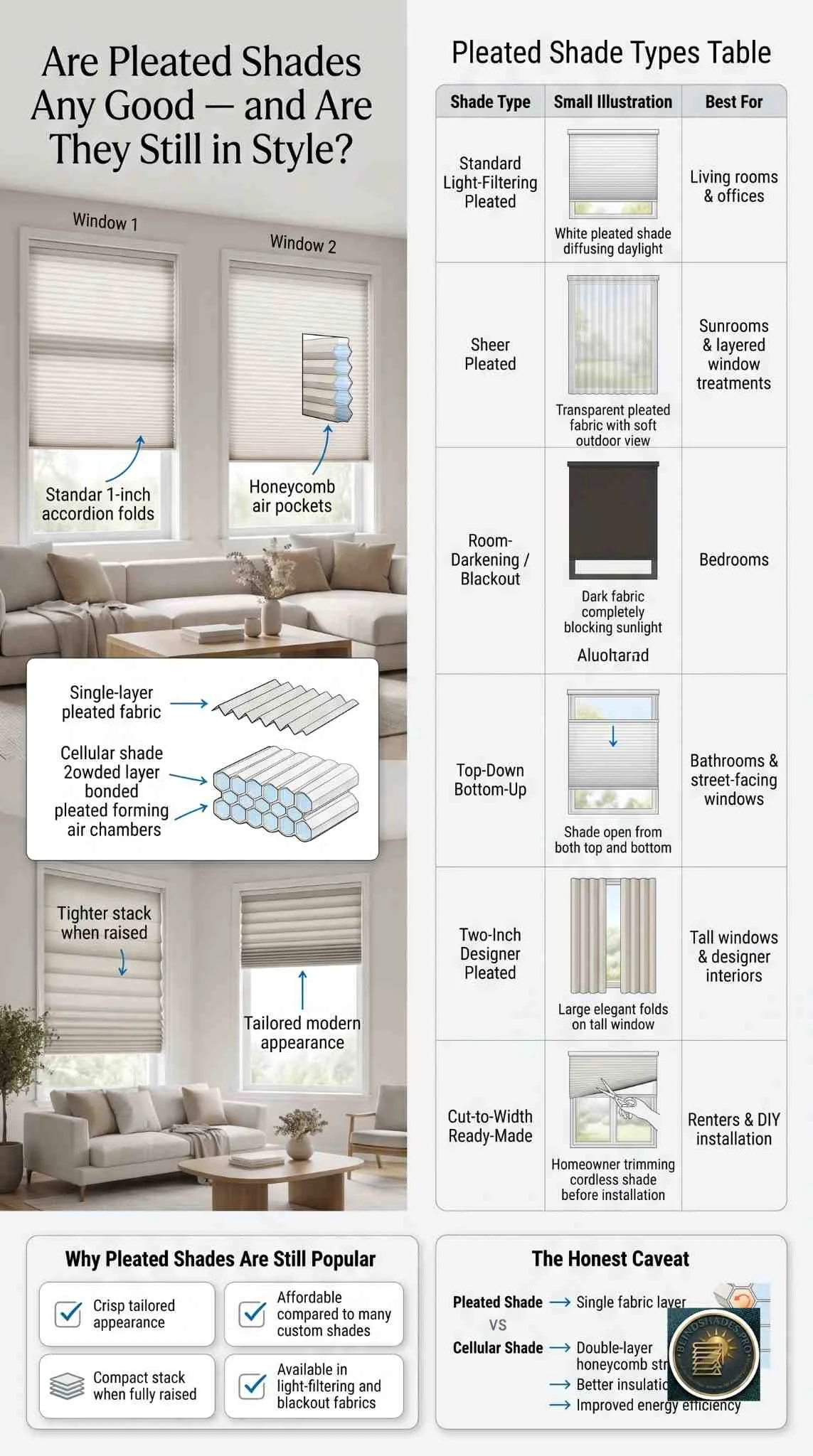
By Michael Turner — 30 years in window treatments
The best pleated shades are crisp single-layer fabric shades that deliver eighty percent of a cellular shade’s everyday performance at roughly half the price — the cordless top-down bottom-up pleated class rated four point seven across two thousand nine hundred reviews leads the market, the five-dollar IKEA Schottis anchors the budget floor, and the only question that genuinely decides the purchase is whether your rooms need the honeycomb air pocket you’d be paying extra for. This guide answers that question in sixty seconds, maps every pleat size to its window, and names the brands whose pleats still stand crisp in year five.
Key Takeaways
- Pleated shades are the value play of the soft-shade family. A single zigzag layer of stiffened fabric costs meaningfully less than the same window in honeycomb — the market’s own listings run from around five dollars ready-made to the low hundreds custom — and the visual from the room side is nearly identical.
- The cellular question decides the purchase, not the brand question. Insulation rooms and bedrooms justify the honeycomb premium; hallways, offices, RVs, and mild-climate windows usually don’t — the Sixty-Second Cellular Question below settles it before you shop.
- The strongest verified pick is a crossover. The cordless top-down bottom-up pleated shade rated four point seven across roughly two thousand nine hundred reviews at Blindster brings the privacy-plus-light trick to the pleated price class.
- Pleat size is a design decision with mechanical consequences. Nine-sixteenths-inch pleats suit small panes, one-inch is the all-rounder, and two-inch pleats — now offered on select Graber FashionPleat fabrics — read as tailored drapery on tall glass.
- Durability lives in the fabric, not the price tag. IKEA’s own thirty-nine-dollar HORNVALLMO rates three point six across nearly four hundred reviews — below its five-dollar Schottis sibling — proof that spending more only pays when it buys stiffened, bonded fabric and a warrantied cord path.
⭐ Quick Answer — The Best Pleated Shades
The best pleated shades deliver most of a cellular shade’s everyday performance at roughly half the price — chosen with the Pleat Test: Pocket (do you need cellular’s air layer?), Pleat (which size fits the glass?), and Place (which rooms pleated honestly serves):
- Best overall: the cordless top-down bottom-up pleated class — four point seven across roughly twenty-nine hundred reviews, from around thirty-three dollars on promotion — the mechanism explained in the top down bottom up blinds guide.
- Best budget: the IKEA Schottis at around five dollars, four point four across more than forty-two hundred reviews — while IKEA’s own dearer HORNVALLMO rates three point six, proof that fabric, not price, is the quality signal.
- Best custom: Bali’s pleated program — four point seven across two hundred fifty-four reviews at Blindsgalore, corroborated on the Home Depot custom listing.
- The decision that matters: pay for the honeycomb only when the window’s job is warmth or a pitch-dark bedroom — the sixty-second version is in this guide, the full head-to-head in our pleated vs cellular comparison; even Bob Vila’s top result for this search is a cellular pick.
- Same product, two names: this guide owns the buying decision — rooms, installation, cleaning, and repairs live in the pleated blinds buying guide.
Quick Specification Reference
| Specification | Typical range for pleated shades |
|---|---|
| Construction | Single layer of stiffened, pleat-set polyester fabric |
| Pleat sizes | Nine-sixteenths inch, one inch, and two inch |
| Price class | Around five dollars ready-made to the low hundreds custom (words-only; see retailer table) |
| Light control | Sheer, light filtering, room darkening, and linered blackout |
| Lift options | Cordless, top-down bottom-up, continuous loop, motorized on custom lines |
| Insulation | Modest — a single air film; the honeycomb pocket is the cellular upgrade |
| Stack depth | The tightest stack in the soft-shade family — pleats compress nearly flat |
| Care | Dust and vacuum; most are not machine washable (see the care spoke) |
Read the complete guide below for: whether pleated shades are actually any good, the Pleat Test framework, the Sixty-Second Cellular Question, our six verified picks, the Durability Register of brands that last, the pleat-size decision, the cordless and top-down bottom-up options, the blackout truth, the retailer map, and the pleated-shades-versus-pleated-blinds naming answer.
Are Pleated Shades Any Good — and Are They Still in Style?
Yes on both counts, with one honest caveat: pleated shades are the crisp, affordable, tight-stacking choice, and their single layer is also exactly why cellular shades were invented.
The two questions people ask most about this category deserve direct answers. Pleated shades are good — American Blinds, whose store rating runs four point eight across six hundred eighty-one reviews, describes the category’s versatility across transparent, light-filtering, and blackout fabrics, and the review bases on the picks below back the durability of the modern stiffened-polyester construction. And they are in style: the crisp horizontal pleat reads more tailored than a flat roller and less puffy than a honeycomb, which is why designer lines keep them alive at the top of the market.
The caveat is structural. A pleated shade is one layer of zigzag fabric; a cellular shade bonds two pleated layers into honeycomb pockets that trap air. That one difference drives everything in the next section.
| Type of pleated shade | What it is | Best for |
|---|---|---|
| Standard light-filtering pleated | Single stiffened fabric layer, one-inch pleat | Living areas, offices, the default choice |
| Sheer pleated | Translucent fabric, view-softening | Sun rooms, layered looks |
| Room-darkening and linered blackout | Opaque or liner-backed fabric | Bedrooms — with the liner caveat covered below |
| Top-down bottom-up pleated | Dual rails, opens from either end | Bathrooms, street-facing rooms |
| Two-inch designer pleated | Deeper tailored fold on select fabrics | Tall windows, drapery-adjacent looks |
| Cut-to-width ready-made | Trimmable header, cordless | Renters and fast installs |
The Pleat Test: Pocket · Pleat · Place
Three questions in order — do you need the air pocket, which pleat size fits the glass, and which rooms are you buying for — and the purchase picks itself.
Pocket. The cellular question, settled in the next section. Answer it first, because it decides whether you’re in this guide or the cellular and honeycomb shades guide at all.
Pleat. Size is covered in its own section below — small panes take small pleats, tall glass takes deep ones, and the all-rounder is one inch.
Place. Pleated shades serve some rooms brilliantly and others only adequately, and the honest map looks like this:
| Room | Pleated verdict | Why |
|---|---|---|
| Living and dining rooms | Excellent | Tight stack, tailored pleat, light-filtering fabrics shine |
| Home office | Excellent | Glare control without cave darkness |
| Bathroom | Good — with the TDBU format | Privacy up top, light below; moisture favors polyester over paper |
| Bedroom | Good with a blackout liner, better in cellular | The liner section below explains the edge-glow truth |
| Kitchen | Good | Easy-dusting fabrics; keep clear of the stove zone |
| Cold-climate windows | Adequate — cellular wins here | The air pocket earns its premium on insulation |
| RVs and campers | Excellent | The lightest, tightest-stacking soft shade on the road |
That RV row comes with a pedigree: the SERP’s own owner community — a Holiday Ramblers group discussing pleated replacements — points to Graber’s EvenPleat and FashionPleat lines, both available in one-inch pleats with select two-inch fabrics, as the fitment standard.
The Sixty-Second Cellular Question
Pay for the honeycomb when the window’s job is warmth or silence; keep the difference when the job is light, looks, or a tight stack — that is the whole decision.
Here is the strange truth about this market: two of the top editorial results for the best pleated shades are not about pleated shades. Bob Vila’s ranking article, updated August 2025, awards its top pick to a cordless honeycomb cellular shade, and a trade blog’s Hunter Douglas roundup from April 2025 answers the pleated question with the Sonnette — which Hunter Douglas builds as a roller shade. When the search results keep changing the subject to other products, buyers deserve the comparison laid out straight:
| Factor | Pleated (single layer) | Cellular (honeycomb) | Who wins |
|---|---|---|---|
| Price for the same window | Lower — often close to half | Higher | Pleated |
| Insulation | A single air film at the glass | Trapped-air pockets; the r-value story | Cellular — and honestly so |
| Stack when raised | Compresses nearly flat | Thicker stack | Pleated |
| Cord shadow | Visible cord holes on classic builds | Cords routed inside the cells | Cellular — see the cord-visibility note |
| Look from the room | Crisp tailored zigzag | Softer, rounded face | Taste — pleated reads sharper |
| Moisture rooms | Dries fast, nothing to trap vapor | Pockets can hold humid air | Pleated |
| Bedroom darkness | Needs a liner | Blackout cell fabrics native | Cellular |
Sixty seconds, applied: insulation-critical windows and dark bedrooms justify the honeycomb premium; nearly everything else — living spaces, offices, RVs, baths, rentals — is pleated territory, and the savings per window are real, as why pleated shades cost less than cellular breaks down line by line. The full head-to-head lives in our pleated versus cellular shades comparison, the scenario-by-scenario call in when to choose pleated instead of cellular, and the r-value numbers the honeycomb marketing leans on get their honest treatment there too.
Best Pleated Shades — Our Picks
Six picks verified against live listings and review bases as of July 2026, thin bases flagged, and one warning row the retailer would rather we skip.
| Pick | Product | Rating and review base | Price class (words) | Why it wins |
|---|---|---|---|---|
| Best Overall | Blindster Cordless Top Down Bottom Up Pleated (Oxford line) | Four point seven across roughly two thousand nine hundred reviews | Around thirty-three dollars on promotion | The largest verified base among true pleated products, with the TDBU trick included |
| Best Budget | IKEA Schottis | Four point four across more than four thousand two hundred reviews | Around five dollars | The category’s rating champion per dollar; trims to width |
| Best Cut-to-Width | StyleWell Cordless Light Filtering | Four point five across roughly seven hundred fifty-seven reviews at Home Depot | Around forty-one dollars | Ready-made speed with a warrantied cordless lift |
| Best Custom | Bali custom pleated program | Four point seven across two hundred fifty-four reviews at Blindsgalore, corroborated at four point three across four hundred twenty-two on the Home Depot custom listing | Around ninety dollars on promotion | The brand-custom lane with two independent review bases agreeing |
| Best Specialty | Redi Shade Original Arch Light Filtering pleated fabric | Four point three across roughly one thousand two hundred reviews | Around twenty-five dollars | The arch problem solved in pleated fabric at a ready-made price |
| Best Designer | Hunter Douglas pleated lines (dealer channel) | No public review base — stated plainly; the April 2025 trade coverage of the brand’s pleated program is the reference | Dealer quote | Fabric depth and the two-inch tailored look at the top of the market |
The warning row: IKEA’s HORNVALLMO, at around forty dollars, rates three point six across three hundred ninety-seven reviews — below the five-dollar Schottis from the same store. Price is not the quality signal in this category; fabric is, which is the Durability Register’s whole subject. Two SERP products with five-star ratings on four to six reviews were left off this table — bases that thin verify nothing.
The Best Overall’s top-down bottom-up mechanism — why it changes bathrooms and street-facing rooms — is explained in the top down bottom up blinds guide, and its bathroom-specific case in TDBU pleated shades for bathroom windows.
The Durability Register: Which Pleated Brands Actually Last
Durability in pleated shades comes from three build details — pleat-set fabric stiffness, bonded (not stitched) pleat edges, and a warrantied cord path — and the brands below are the ones whose construction still stands crisp in year five.
Buyers increasingly ask this exact question — which specific pleated brands are known for durability and high-quality construction — and it deserves a register, not a shrug:
| Brand and line | Construction signal | The durability case |
|---|---|---|
| Graber EvenPleat and FashionPleat | One-inch pleats across both lines, select two-inch fabrics on FashionPleat | The RV owner community’s fitment standard — pleat retention proven in the hardest environment shades face: vibration, heat cycles, daily use |
| Bali custom pleated | Pleat-set polyester, brand warranty, dual retail review bases | Four point seven and four point three across independent channels — consistency across sellers is itself a durability signal |
| Blindster Oxford pleated | Cordless TDBU rail hardware | Two thousand nine hundred buyers deep and holding four point seven — rail mechanisms are where cheap pleated shades die first |
| Hunter Douglas pleated program | Dealer-installed, fabric-first engineering | The top of the fabric market; note carefully that the brand’s Sonnette is a roller shade, not a pleated — a confusion even the trade coverage repeats |
| StyleWell (Home Depot house line) | Cut-to-width with a genuine cordless warranty | The rare house brand whose review base (seven hundred fifty-seven and climbing) survives scrutiny |
| IKEA Schottis | Stiffened paper-adjacent pleat, clip installation | Durable for its class and price — but a class below everything above it; its HORNVALLMO sibling shows IKEA’s fabric tier is the weaker buy |
Three construction checks travel with the register: pinch a pleat — stiffened fabric springs back, cheap fabric creases; check whether pleat edges are heat-bonded or merely pressed; and ask where the lift cords run, because visible cord holes are both a light leak and the failure point, a detail small enough to have its own coverage in cord visibility in pleated shades.
What Pleat Size Should You Choose?
Match the pleat to the pane: nine-sixteenths for small glass, one inch for almost everything, two inch for tall windows that want a drapery presence.
| Pleat size | Window match | The visual effect |
|---|---|---|
| Nine-sixteenths inch | Small panes, door glass, shallow frames | Fine texture, quiet presence |
| One inch | The all-rounder — standard windows | The classic crisp pleat; both Graber lines lead here |
| Two inch | Tall and wide glass, formal rooms | Deep tailored folds; FashionPleat’s select-fabric option |
The deeper the pleat, the more the fabric matters — a two-inch fold in limp fabric collapses within a season. The complete sizing walkthrough, including how pleat size interacts with inside-mount depth, is in what pleat size should I choose.
Cordless, Top-Down Bottom-Up, and the Bathroom Case
Cordless is now the default and the safety baseline; top-down bottom-up is the feature worth paying for on any window a neighbor can see.
Every pick in this guide’s table is cordless — the category moved with the ANSI/WCMA A100.1 stock-product safety standard, and pleated shades took to it well because the light fabric needs little lifting force. The upgrade decision is TDBU:
| Lift option | What it does | Worth it when |
|---|---|---|
| Standard cordless | Bottom rail lifts from the bottom | Default; nothing to snag, nothing for kids to reach |
| Top-down bottom-up | Both rails move — light in over privacy | Bathrooms, street-facing rooms, desks under windows |
| Continuous loop | Chain-driven for very tall shades | Tall stairwell glass on custom orders |
| Motorized | App and remote control on custom lines | High windows; see the motorized guides for the ecosystem |
The bathroom is where TDBU pleated earns its keep — privacy at eye level with daylight above the sightline, in a fast-drying single-layer fabric — the full case, including moisture-resistant fabric choices, is in TDBU pleated shades for bathroom windows, with the wider room context in the bathroom window blinds and shades guide.
Can Pleated Shades Be Blackout?
Yes — with a bonded liner, and with the honest physics stated: the fabric goes fully opaque, while the edges and cord holes still glow without side treatment.
Blackout in a single-layer pleated shade means a liner bonded to the room-side fabric. It works — the fabric itself passes no light — but two glow paths remain: the perimeter gap of any inside-mounted shade, and the cord holes on classic corded builds (one more argument for cordless). Buyers comparing their options should weigh the linered-pleated route against blackout cellular, where the cell structure closes the cord path natively; that exact matchup is scored in blackout pleated versus blackout cellular, and the liner construction question in can pleated shades be blackout. For the whole dark-room toolkit beyond pleats, the blackout blinds and shades guide is the parent reference — the permanent-tier picks named there by Wirecutter’s May 2025 blackout testing set the benchmark linered pleats are measured against.
Where to Buy Pleated Shades
Each retailer owns a different tier of this market — the map, with verified store signals.
| Retailer | What they own | Verified signal |
|---|---|---|
| Blindster | The TDBU pleated value tier | The four point seven, twenty-nine-hundred-review Oxford line |
| Home Depot | StyleWell cut-to-width plus the Bali custom program | Seven hundred fifty-seven reviews on StyleWell; four hundred twenty-two on Bali custom |
| Blindsgalore | Brand-custom depth (Bali, Graber) | Store rating four point seven across four thousand six hundred reviews |
| IKEA | The five-dollar Schottis floor | Four point four across forty-two hundred — skip the HORNVALLMO tier |
| Lowe’s | Ready-made pleated and paper-pleated crossover stock | The house Project Source lane for budget windows |
| American Blinds / Blinds.com / JustBlinds | Online custom pleated with frequent promotions | Store ratings four point eight across six hundred eighty-one (American); promotion-cycle pricing on the others |
| Costco (Bali program) | Member-priced custom | Ninety-day returns on the Bali pleated program |
| Dealer channel | Hunter Douglas pleated lines | Quote-based; the two-inch designer tier |
One pricing rule carries over from every custom category we cover: list prices are anchors and the promotion price is the real price — the SERP itself shows discounts of twenty to fifty percent running on half the custom listings on any given day.
Pleated Shades or Pleated Blinds — Which Guide Do You Need?
Same product, two names, two jobs: this guide owns the buying decision under the American term, and our pleated blinds guide owns living with them.
In US retail the product is a pleated shade; the same product travels as a pleated blind in UK usage and in plenty of American search habits. We keep both registers deliberately: this page is the buying decision — picks, brands, pleat sizes, the cellular question — while the pleated blinds buying guide carries the ownership register: room-by-room fit, installation, cleaning, and the repair family, including the fix for the classic pleated failure covered in pleated blinds won’t stay up. Care questions sit between the two — start with are pleated shades machine washable before any wash-day experiments. And for glare-sensitive workplaces, the specifier angle — including hygiene-focused fabrics — is in pleated shades for commercial offices.
Related Buying Guides
- The Best Pleated Blinds Buying Guide — the ownership register: rooms, install, care, repair
- The Best Cellular & Honeycomb Shades Guide — when the air pocket wins
- The Best Top Down Bottom Up Blinds Guide — the mechanism behind our top pick
- The Best Blackout Blinds & Shades Guide — the full dark-room toolkit
- The Best Bathroom Window Blinds & Shades Guide — the room where TDBU pleated shines
Supporting Articles — The Pleated Shades Cluster
- Pleated Shades vs Cellular Shades — The Complete Comparison
- What Pleat Size Should I Choose for My Windows
- Blackout Pleated vs Blackout Cellular — Which Is Better Value
- Why Are Pleated Shades Cheaper Than Cellular
- Can Pleated Shades Be Blackout — The Liner Guide
- TDBU Pleated Shades for Bathroom Windows
- When to Choose Pleated Instead of Cellular
- Are Pleated Shades Machine Washable
- Cord Visibility in Pleated Shades — The Light-Leak Detail
- Pleated Shades for Commercial Offices — Hygiene and Glare
Frequently Asked Questions
What are the best pleated shades?
The best pleated shades are the Blindster cordless top-down bottom-up pleated line — four point seven across roughly two thousand nine hundred reviews, from around thirty-three dollars on promotion — with the IKEA Schottis at around five dollars as the budget benchmark and Bali’s custom pleated program, rated four point seven across two hundred fifty-four reviews at Blindsgalore, as the made-to-measure lane.
Are pleated shades any good?
Yes — modern stiffened-polyester pleated shades are durable, stack tighter than any other soft shade, and cost meaningfully less than cellular for the same window. Their single-layer construction is the one honest limit: for insulation-critical windows and pitch-dark bedrooms, the cellular air pocket earns its premium.
What is the difference between pleated shades and cellular shades?
A pleated shade is one zigzag layer of fabric; a cellular shade bonds two pleated layers into honeycomb pockets that trap air. The pocket buys insulation, native blackout fabrics, and hidden cords; the single layer buys a lower price, a tighter stack, a crisper pleat, and faster drying in moisture rooms.
Are pleated shades still in style?
Yes — the crisp tailored pleat is the design argument for the category, sitting between a flat roller and a rounded honeycomb, and designer programs keep two-inch pleated fabrics at the top of the market. The look dates only when the fabric sags, which is a construction problem, not a style one.
What pleat size should I choose?
One inch for almost every standard window — it is the size both Graber lines lead with. Choose nine-sixteenths for small panes and door glass, and two inch for tall or formal windows where a deeper tailored fold reads as drapery; deeper pleats demand stiffer fabric to hold their shape.
Can pleated shades be blackout?
Yes, with a bonded blackout liner — the fabric itself then passes no light. The remaining glow paths are the perimeter gap of any inside mount and the cord holes on corded builds, which is one more reason every pick in this guide is cordless; buyers wanting native blackout construction should compare the linered route against blackout cellular.
