Blackout Pleated vs Blackout Cellular — Which Is Better Value?

Authored By Michael Turner -30 Years Home Improvement Expertise | Updated 2026 | BlindShades.pro
Updated on July 16, 2026
⭐ Quick Answer — Blackout Pleated vs Blackout Cellular Shades
- Fabric Blackout Performance: Equal — both block 100% of light through the material when blackout-rated. The fabric opacity is not what you are paying extra for with cellular
- Price — Blackout Pleated: $50–$75/window mid-range (blackout-lined cordless) — available at SelectBlinds, Blindsgalore, Bali (Home Depot)
- Price — Blackout Cellular: $90–$150/window mid-range (double-cell cordless) — 40–60% more expensive than blackout pleated at the same quality tier
- What the Cellular Premium Buys: Insulation (R-4.80 vs R-2.60–R-3.00) + sound dampening (honeycomb cells absorb noise) — NOT additional darkness, which is already equal
- ROI on the Premium: At a $150/month energy bill — the cellular insulation saving (~10%) = $180/year. The $400–$750 premium for 10 windows pays off in approximately 2–3 years in cold climates
- Best Sources: Blackout cellular — SelectBlinds double-cell, Blinds Chalet with side channels, UBlockout sealed system. Blackout pleated — Blindsgalore blackout-lined cordless
⚠️ The Insight Every Competitor Guide Misses — and the Climate Rule: When both shades are blackout-rated, fabric opacity is equal. The extra cost of blackout cellular pays for insulation and sound — not for more darkness. And the ROI calculation depends entirely on your climate: in cold climates (Minnesota, Maine, New England) with energy bills over $150/month — the cellular premium pays off in ~2–3 years. In mild climates (Florida, Southern California) with lower bills — the cellular premium may never pay off and blackout-lined pleated is the better value specification. See the full value framework below.
💡 Nursery Exception and the Gap Management Factor: For nurseries on noisy streets — blackout cellular wins regardless of climate because it addresses both darkness and sound simultaneously. Research from the American Academy of Pediatrics shows sleep environment quality affects infant sleep duration. And for either product — the fabric alone is not enough for true blackout. Complete darkness requires outside mount + side channels + cassette headrail. These gap management elements matter equally for both blackout pleated and blackout cellular. See the complete blackout system guide below.
📖 Read the complete guide below for: why blackout fabric is the equalizer, how each product achieves blackout (liner vs engineered cell fabric), full price table by tier, the ROI energy saving calculation ($180/year at $150/month bill), cold climate vs mild climate geographic distinction, sound dampening as a blackout bedroom synergy, which product better supports the complete 4-element blackout system, the middle-ground specification, and the honest verdict with affiliate recommendations.
The Most Important Insight — Blackout Fabric Is the Equalizer
This is the framing that every competitor comparison misses — and it is the key to making the correct blackout buying decision.
When you compare light-filtering pleated shades versus light-filtering cellular shades — the differences are significant across all dimensions: fabric opacity, insulation, sound, and price.
When you compare BLACKOUT pleated versus BLACKOUT cellular — the fabric performance becomes equal.
Both a blackout-lined pleated shade and a blackout cellular shade use fabric rated at 100% opacity. Light does not transmit through either material. The reader who is comparing these two products specifically for blackout performance should understand that the blackout fabric itself is not the differentiator — everything else is.
The differences that remain when both are blackout:
| Factor | Blackout Pleated | Blackout Cellular |
|---|---|---|
| Fabric opacity | 100% — blackout | 100% — blackout |
| Insulation R-value | R-2.60–R-3.00 (with liner) | R-4.80 (double cell) |
| Sound dampening | None | Meaningful |
| Mid-range price | $50–$75/window | $90–$150/window |
| Price premium | — | 40–60% more |
| Blackout via | Added blackout liner | Engineered cell fabric |
| Cleaning | Easier | More complex |
The buying decision comes down to: Does the insulation and sound dampening performance of blackout cellular justify paying 40–60% more when the blackout performance is identical?
How Each Product Achieves Blackout — The Construction Difference
This distinction matters for durability and cleaning — and no competitor explains it for the blackout version specifically.
Blackout pleated shade: A standard pleated shade (single layer of fabric) with a blackout liner bonded or sewn to the back of the pleated fabric. The blackout liner is typically a dense opaque backing — white or off-white on the window side. The liner adds weight, structure, and opacity to what would otherwise be a light-filtering fabric.
Durability implication: The liner is an additional layer bonded to the fabric. Over time — particularly with frequent raising and lowering — the liner can begin to separate from the face fabric, particularly at the pleat fold lines. This is more likely with lower-quality liner bonding. Specify double-stitched or fully-bonded liner construction for long-term durability.
Cleaning implication: The blackout liner backing is typically not washable. Spot cleaning only. The liner absorbs moisture and can wrinkle permanently if soaked.
Blackout cellular shade: The blackout performance is built directly into the cell structure — the fabric layers that form the honeycomb cells are themselves opaque, eliminating the need for a separate added liner. The blackout is structural rather than additive.
Durability implication: No separate liner to delaminate. The blackout performance is inherent to the cell fabric construction. More durable for long-term blackout performance under frequent use.
Cleaning implication: The honeycomb cells trap dust and cannot be soaked. Compressed air or a cool hairdryer to remove internal dust. According to Bali Blinds, cellular shades should not be placed in situations where staining is likely — the cells trap contaminants that cannot be removed from inside the structure.
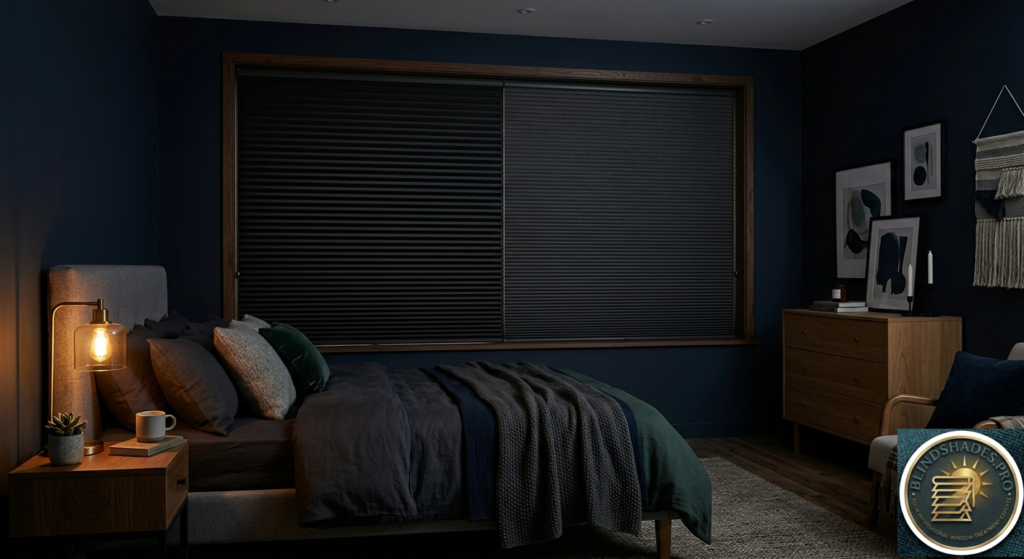
dark and peaceful atmosphere, warm bedside lamp, modern interior
The Price Comparison — Blackout Versions Specifically
Most competitor articles compare general pleated versus cellular pricing. Here is the specific comparison for blackout versions:
Blackout pleated shade price (per window, standard 36 × 48 inch, cordless):
| Quality Tier | Blackout Pleated | Blackout Cellular (Single Cell) | Blackout Cellular (Double Cell) |
|---|---|---|---|
| Budget | $25–$40 | $40–$60 | $55–$80 |
| Mid-range | $50–$75 | $70–$100 | $90–$150 |
| Premium | $90–$140 | $120–$180 | $150–$250 |
The premium calculation:
- Budget tier: Cellular costs approximately $15–$40 more per window than pleated blackout
- Mid-range tier: Cellular costs approximately $40–$75 more per window
- Premium tier: Cellular costs approximately $30–$110 more per window
For a 10-window home at mid-range pricing:
- Blackout pleated total: $500–$750
- Blackout cellular (double cell) total: $900–$1,500
- Premium paid for cellular: $400–$750
The question the ROI section below answers is: does the energy saving from cellular’s superior insulation justify this premium?
The ROI Calculation — Does the Cellular Premium Pay Off?
According to Blindsgalore, cellular shades can reduce heating and cooling energy bills by 10–20% compared to uncovered windows. Applying this specifically to the blackout product comparison:
The energy saving calculation:
| Scenario | Monthly Energy Bill | 10% Saving | Annual Saving | 20% Saving | Annual Saving |
|---|---|---|---|---|---|
| Mild climate home | $80 | $8 | $96 | $16 | $192 |
| Standard home | $150 | $15 | $180 | $30 | $360 |
| Cold climate / large home | $250 | $25 | $300 | $50 | $600 |
The payback period at mid-range pricing ($500 cellular premium for 10 windows):
| Energy Saving | Annual Saving | Payback Period |
|---|---|---|
| 10% on $150/month bill | $180/year | 2.8 years |
| 15% on $150/month bill | $270/year | 1.9 years |
| 10% on $250/month bill | $300/year | 1.7 years |
The honest interpretation: If your monthly heating and cooling bill is $150 or higher and you live in a cold or hot climate where window insulation makes a meaningful difference — the blackout cellular shade premium pays for itself in approximately 2–3 years. The remaining lifetime of the shade (typically 10–15 years) generates net savings.
If your energy bills are low — mild climate, well-insulated home, or small number of windows treated — the payback period extends significantly and the blackout-lined pleated shade is the better value specification.
Cold Climate vs Mild Climate — The Geographic Distinction
No competitor makes this distinction clearly. It is arguably the single most important factor in the blackout pleated vs blackout cellular value decision.
In cold climates (Minnesota, Maine, Michigan, Colorado, New York, New England):
- Heating season runs 5–7 months
- Window heat loss is a major contributor to heating bills
- The R-4.80 of double cellular versus R-2.60–3.00 of blackout-lined pleated is a meaningful performance gap
- Cellular blackout is the correct value specification
In mild climates (Florida, Southern California, Hawaii, coastal Texas):
- Heating and cooling loads are lower throughout the year
- Window insulation makes a smaller proportional contribution to energy bills
- The energy saving from cellular’s superior R-value is smaller
- The ROI calculation often favours the blackout pleated shade
- Blackout-lined pleated is frequently the better value specification in mild climates
The practical test: Check your average monthly electricity or gas bill. If it is consistently over $150 and your home has significant window area — cellular blackout is the better long-term value. If it is under $100 and your home is well-insulated already — blackout-lined pleated shade is the better value.
Sound Dampening — The Blackout Bedroom Synergy
This benefit is mentioned in general pleated vs cellular comparisons but is almost never discussed specifically in the blackout context — where it matters most.
The bedroom blackout connection: The primary use case for blackout shades is sleep — bedrooms, nurseries, and any sleeping space. Sleep quality is affected by both light AND sound. A blackout cellular shade addresses both simultaneously.
- The opaque blackout fabric eliminates light through the material
- The honeycomb air cells absorb and dampen external noise — traffic, neighbours, early morning activity
What blackout pleated cannot do: A blackout-lined pleated shade provides complete fabric opacity but no meaningful sound dampening. The single fabric layer (even with a blackout liner) absorbs negligible sound energy.
The nursery application: Research from the American Academy of Pediatrics indicates that sleep environment darkness is a meaningful factor in infant sleep duration. For a nursery on a noisy street — blackout cellular shade provides the dual benefit: darkness for sleep quality AND sound dampening for sleep depth. This makes blackout cellular the correct nursery specification regardless of climate, because the sound benefit adds value that the ROI calculation above does not capture.
Gap Management — The Factor That Matters as Much as Fabric
For either blackout product — achieving true complete darkness requires more than blackout fabric alone. This applies equally to both blackout pleated and blackout cellular.
The 4-element complete blackout system:
- Blackout fabric (both products provide this)
- Outside mount (covers the frame perimeter gap)
- Side channels (seals side edges of the shade)
- Cassette headrail (seals the top above the fabric roll)
Which product better supports the complete system: Blackout cellular shades from specialist suppliers like UBlockout, Blinds Chalet, and Hunter Douglas offer the full 4-element system as a standard or available configuration. The complete blackout system is more widely available and more commonly specified for cellular products.
Blackout pleated shades can also be specified with outside mount and some side channel options — but the full sealed side channel system is less commonly available from pleated shade suppliers.
The verdict on gap management: For buyers who need the absolute maximum darkness — a specialist blackout cellular shade with sealed side channels and cassette headrail is the correct specification. For buyers who need good darkness (outside mount + blackout fabric) without the need for sealed side channels — either product delivers equivalent performance.
The Honest Verdict — Which Is Better Value?
Blackout Cellular Is Better Value When:
- You live in a cold or hot climate with monthly energy bills over $150
- The bedroom or nursery is on a noisy street where sound dampening adds sleep value
- You want the complete sealed blackout system (side channels + cassette) and will keep the shade for 10+ years
- The long-term ROI (2–3 year payback) fits your planning horizon
Best blackout cellular sources: SelectBlinds cordless double-cell blackout cellular, Blinds Chalet blackout cellular with side channels, UBlockout for the complete sealed system. Pricing from $70–$250 per window depending on system specification.
Blackout Pleated Is Better Value When:
- You live in a mild climate with energy bills under $100/month
- The blackout bedroom or nursery is in a quiet location where sound dampening adds no value
- Budget is the primary driver — 40–60% savings across multiple windows is the decision factor
- The window is in a room that will be redecorated within 5 years — the lower investment makes sense
Best blackout pleated sources: SelectBlinds blackout-lined cordless pleated shade, Bali Blinds (Home Depot) with blackout liner option, Blindsgalore cordless pleated with blackout liner. Pricing from $50–$140 per window at mid-range to premium.
The Middle-Ground Specification
If you want the fabric performance of blackout pleated at a lower cost AND a meaningful insulation improvement — specify a blackout-lined pleated shade with outside mount. This provides:
- 100% blackout fabric opacity (matches cellular)
- Outside mount eliminates the frame perimeter light gap
- R-2.60–R-3.00 insulation (better than unlined pleated, lower than cellular)
- Approximately 40–60% lower cost than blackout cellular
For most mild-climate buyers — this is the sweet spot specification.
Related guides: the insulation gap between open pleats and closed cells is half this comparison — the full thermal picture is in our thermal insulated blinds guide.
Frequently Asked Questions
Is blackout pleated or blackout cellular better for a bedroom? For a bedroom in a cold climate on a noisy street — blackout cellular is better value because it addresses both light and sound simultaneously, and the insulation ROI pays off within 2–3 years. For a bedroom in a mild climate on a quiet street — blackout-lined pleated shade is better value at 40–60% lower cost with equivalent blackout fabric performance.
Do blackout pleated and blackout cellular block the same amount of light? Yes — through the fabric itself. Both blackout-rated products block 100% of light through the material. The remaining light enters through gaps — at the sides, top, and bottom — which are addressed by outside mount, side channels, and cassette headrail. These gap management elements apply equally to both products.
How much more does blackout cellular cost than blackout pleated? At mid-range pricing for a standard 36 × 48 inch window — a blackout-lined pleated shade costs approximately $50–$75 versus $90–$150 for a double-cell blackout cellular shade. This is a 40–60% premium for cellular. For a 10-window home — the difference is approximately $400–$750.
Does blackout cellular really save energy compared to blackout pleated? According to Blindsgalore, cellular shades reduce heating and cooling energy use by 10–20% compared to uncovered windows. The R-value difference between blackout cellular (R-4.80) and blackout-lined pleated (R-2.60–R-3.00) represents a meaningful insulation improvement. At a $150/month energy bill — a 10% saving equals $180/year. The $400–$750 cellular premium over pleated pays off in approximately 2–3 years in this scenario.
Is blackout cellular better for a nursery than blackout pleated? Yes — for most nursery applications. Research from the American Academy of Pediatrics indicates that sleep environment darkness is a meaningful factor in infant sleep duration and quality. Blackout cellular provides both darkness AND sound dampening via the honeycomb air cells — addressing the two primary nursery sleep environment factors simultaneously. Blackout pleated provides darkness only. For nurseries on noisy streets — blackout cellular is the correct specification regardless of climate.
Why does blackout pleated use a liner while cellular does not? Blackout pleated shades add a blackout liner — a dense opaque backing — to a standard pleated fabric to achieve opacity. Blackout cellular shades use specifically engineered opaque fabric woven into the cell structure itself — the blackout is structural. The cellular approach is more durable long-term since there is no separate liner to delaminate at fold lines. The pleated liner approach is less expensive but requires quality stitching to prevent liner separation over time.
Related Guides on BlindShades.pro
- The Best Pleated Shades Buying Guide — full pleated shade specification guide
- The Best Cellular Shades Buying Guide — cellular shades in full depth
- The Best Bedroom Blinds & Shades Buying Guide — the complete 4-element blackout system
- The Best Blackout Blinds & Shades Buying Guide — blackout specification across all product types
- Pleated Shades vs Cellular Shades — The Honest R-Value and Price Comparison — the general comparison with full R-value table
- Can Pleated Shades Be Blackout — The Liner Upgrade Guide — liner specification in full depth
By Michael Turner | 30 Years Home Improvement Expertise | Updated 2026 | BlindShades.pro
