The Best Cellular & Honeycomb Shades Buying Guide

Authored By Michael Turner -30 Years Home Improvement Expertise | Updated 2026 | BlindShades.pro
Updated on July 18, 2026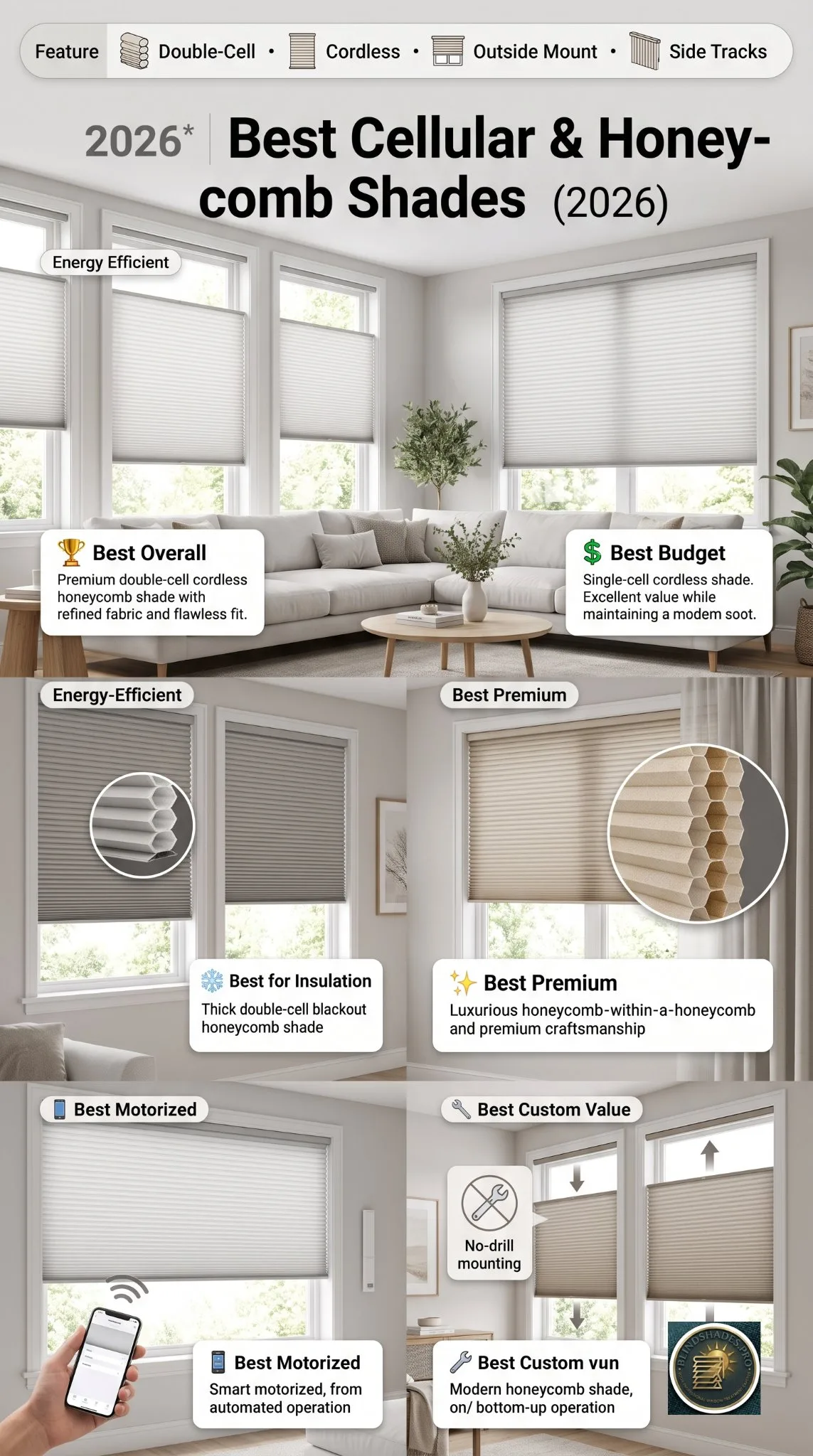
By Michael Turner | 30 years in window treatments
The best cellular and honeycomb shades are the ones that meet the U.S. Department of Energy’s conditions, not the ones that quote its numbers. Every guide in this category cites the same two figures — 40 percent less heat loss, 60 percent less solar heat gain. Both are real. Both come from the DOE. And both describe a shade that is tightly installed, running in side tracks, and actually operated. Almost nobody sells that configuration, and almost nobody buys it. The gap between the published number and your window is not the fabric. It is the mount, the certification, and whether anyone ever touches the shade.
🎯 5 Key Takeaways
- The famous numbers measure two different things. The DOE reports that tightly installed cellular shades cut heat loss through windows by 40 percent or more in heating seasons, which equates to about 10 percent heating energy savings. Separately, in cooling seasons they cut unwanted solar heat by up to 60 percent. Neither figure is your utility bill.
- Side tracks are the specification that unlocks the claim. The DOE states plainly that cellular shades operating on side tracks are the most effective at increasing a window’s R-value. Standard inside mount leaks at both edges.
- AERC certification is the only independent verification, and most brands do not carry it. AERC rates U-factor, solar heat gain coefficient, visible transmittance, and air leakage. It does not rate R-value, which is why manufacturer R-value claims conflict with one another.
- A shade that never moves saves nothing. The DOE reports that 75 percent of residential window coverings remain in the same position every day.
- Cellular and honeycomb are the same product. The two names are marketing, not engineering — which is why the same search engine names a different “best” brand depending on which word you type.
⭐ Quick Answer
The best cellular honeycomb shades are the ones that meet the Department of Energy’s conditions, not the ones that quote its numbers. Double-cell, cordless, mounted outside the opening, and ideally running in side tracks.
- Know what the numbers measure. The DOE reports tightly installed cellular shades cut heat loss through windows by 40 percent or more — equating to about 10 percent heating energy savings — and cut unwanted solar heat gain by up to 60 percent. Two mechanisms, two seasons, neither one your bill. See whether cellular shades are worth it.
- Side tracks unlock the claim. The DOE states shades operating on side tracks are most effective at raising a window’s R-value. Standard inside mount leaks at both edges.
- Check AERC before you check the price. AERC rates U-factor, solar heat gain coefficient, visible transmittance and air leakage — not R-value. Without it, an energy claim is unverified.
- Buy double-cell 9/16 inch by default. Triple-cell earns its premium only in extreme cold or on single-pane glass. Compare single cell vs double cell.
- A shade that never moves saves nothing. The DOE reports 75 percent of residential window coverings stay in the same position every day, which is why motorization and top-down/bottom-up matter more than cell count.
Utilities have started to agree on which product performs: Minnesota became the first state to add AERC-certified cellular shades to its Technical Reference Manual. For bedroom darkness rather than energy, start with how to get true blackout from cellular shades.
Best Sources: U.S. Department of Energy Energy Saver (heat loss, solar gain, side tracks, coverings that never move); Oak Ridge National Laboratory and Pacific Northwest National Laboratory (field studies cited in the DOE’s cellular shades factsheet); Attachments Energy Rating Council (independent ratings); U.S. Consumer Product Safety Commission and the Window Covering Manufacturers Association (ANSI/WCMA A100.1-2018); Bob Vila (product testing, August 2025); Blindsgalore and Blinds Chalet (retail pricing and ratings); Levolor and Costco/Bali (product specifications); 3 Day Blinds (Grand Cell and Twin Cell terminology, November 2025).
Related guides: cellular is the dominant host for the TDBU mechanism — see our top down bottom up buying guide for when the lift upgrade is worth it.
Quick Specification Reference
| Specification | The short answer |
|---|---|
| Cell count | Double-cell 9/16 inch for most US homes; triple only for extreme cold or single-pane glass |
| Cell size | 9/16 inch is the residential default; 3/4 inch or larger for cold climates and big windows |
| Certification | Look for AERC. Without it, energy claims are unverified marketing |
| Mount | Outside mount with overlap. Inside mount leaks at both edges by design |
| Closure | Side tracks plus a valance is the configuration DOE’s numbers describe |
| Lift | Cordless is the stock standard under ANSI/WCMA A100.1-2018 |
| Minimum depth | 1.5 inches single-cell, 2 inches double-cell, 2.5 inches TDBU, 3 inches motorized |
| The claim | 40 percent less heat loss, about 10 percent heating energy savings — DOE, conditional |
⚠️ The Reality Check: the 40 and 60 percent figures are not retailer invention. They are the DOE’s, and they measure conduction in winter and radiation in summer. What retailers omit are the DOE’s conditions: tightly installed, tight fit, side tracks.
💡 The Top Gap Problem: cordless cellular shades leave a visible band of exposed frame at the headrail when fully raised. In a blackout bedroom that band is a line of light across the full width of the window. It is preventable at the point of order and unfixable afterwards.
📖 Read the complete guide below for: what each DOE number actually measures, what AERC does and does not rate, single versus double versus triple cell, the cell size guide from 3/8 inch to 1-1/4 inch, the closure problem that decides whether you get the published performance, lift systems and child safety, six brand picks with honest assessments, where to buy, mounting depths, and ten FAQs answering every question Google surfaces on this topic.
What Is the Difference Between Cellular and Honeycomb Shades?
None. They are the same product under two names, and the fact that Google returns a different “best brand” depending on which word you type tells you how little the rankings rest on.
Google asks this in its People Also Ask box, which is the tell. Manufacturers use both terms interchangeably. “Cellular” describes the air cells in cross-section. “Honeycomb” describes what those cells look like. There is no construction difference, no performance difference, and no price difference.
Here is what makes it worth stating. Searched on the same afternoon, Google’s AI Overview named Windowsandgarden the best overall cellular shade — sourcing Bob Vila — and named Hunter Douglas Duette Architella the best overall honeycomb shade. Same product category, same day, two different champions, because the summaries reflect whoever wrote most recently rather than anything measured. Across roughly twenty ranking results on those two searches, not one cites the Department of Energy, and not one mentions AERC.
That is the vacuum this guide fills. For the honest cost-benefit case, see our full breakdown of whether cellular shades are worth it.
Are Honeycomb Shades Worth It? What the DOE Numbers Actually Measure
Yes, in the right conditions — and the conditions are the entire story. The 40 percent and 60 percent figures describe two separate physical mechanisms, and neither one is a utility bill.
The Department of Energy publishes this on its Energy Saver pages: in heating seasons, tightly installed cellular shades can reduce heat loss through windows by 40 percent or more, which equates to about 10 percent heating energy savings. In cooling seasons, cellular shades can reduce unwanted solar heat through windows by up to 60 percent, reducing total solar gain to 20 percent when installed with a tight fit.
Read those two sentences carefully and the marketing collapses.
| The number | What it measures | Season | What it is not |
|---|---|---|---|
| 40 percent or more | Reduction in heat loss through the window, by conduction | Heating | Not your heating bill. DOE translates it to about 10 percent heating energy savings |
| About 10 percent | Heating energy savings for the home | Heating | The figure that actually reaches your budget |
| Up to 60 percent | Reduction in unwanted solar heat gain, by radiation | Cooling | A different mechanism entirely. Not additive with the 40 percent |
| Solar gain to 20 percent | What still gets through with a tight fit | Cooling | Requires the tight fit; a loose inside mount does not qualify |
| Almost 25 percent | Reduction in heating energy needs, ORNL field studies | Heating | A laboratory house, not a typical retrofit |
Every qualifier in the DOE’s text is doing work. Tightly installed. Tight fit. And the sentence the entire industry omits: the DOE states that cellular shades which operate on side tracks are the most effective at increasing the R-value of windows. Field research behind these figures runs through Oak Ridge National Laboratory’s Yarnell Station house and Pacific Northwest National Laboratory’s Lab Homes, documented in the DOE’s own cellular shades factsheet.
Then there is the finding that undoes all of it. The DOE reports that 75 percent of residential window coverings remain in the same position every day. A perfectly specified, side-tracked, AERC-certified double-cell shade that nobody raises in the morning and lowers at dusk delivers a fraction of its rated performance. This is why the DOE recommends automation and top-down/bottom-up operation in the same breath as it recommends the shades themselves.
The Four C’s of Cellular Performance
The Four C’s of Cellular Performance: Certification, Cell count, Closure, Control. Miss any one and the DOE’s number is not yours. Every buying guide on this topic covers the second one and ignores the other three.
| The C | The question | Most buyers get | What the DOE figure assumes |
|---|---|---|---|
| Certification | Is the energy claim independently verified? | An unrated shade | Tested performance |
| Cell count | Single, double, or triple? | Single or double | Adequate either way |
| Closure | Are the edges and headrail sealed? | Inside mount, no tracks, top gap | Tight fit, side tracks |
| Control | Does anybody operate it? | Left in one position | Seasonal, scheduled operation |
Cell count is the only one the market discusses, and it is the least important of the four. A triple-cell shade with open side gaps hanging permanently at half-mast will underperform a single-cell shade in side tracks that somebody actually raises at sunrise. For the arithmetic on whether the top tier earns its premium, see are triple-cell shades worth it.
Related guides: honeycomb insulation works twice as hard against a thin camper wall — which cells suit a rig, and what beats them on weight, is covered in the best RV blinds and shades for campers.
What Is AERC Certification, and Why Does No Cheap Brand Have It?
AERC is the only independent verification of window-attachment energy performance in the United States. It rates U-factor, solar heat gain coefficient, visible transmittance, and air leakage — and it does not rate R-value, which is exactly why manufacturer R-value claims contradict one another.
Related guides: a bay window multiplies the honeycomb’s insulation case by three sun-facing sides — the corner clearance math and per-panel plan are in the complete bay window blinds and shades guide.
The Attachments Energy Rating Council was established with Department of Energy support to bring standardised, third-party energy ratings to products that had never had any. Its rated categories, as listed by the DOE’s Building America Solution Center, cover interior and exterior storm windows, blinds, cellular shades, roller shades, pleated shades, and solar screens. Cellular shades are on that list. That matters, because most window coverings are not.
Recognition is spreading beyond the label. Minnesota became the first state to add AERC-certified cellular shades to its Technical Reference Manual, meaning utilities there now count them as a verified efficiency measure — on the strength of ORNL findings that cellular shades can reduce heating energy needs by almost 25 percent.
| Metric | Rated by AERC? | Who publishes it | What to do with it |
|---|---|---|---|
| U-factor | Yes | AERC certified products | Compare directly between rated products |
| Solar heat gain coefficient | Yes | AERC certified products | The number that matters in cooling climates |
| Visible transmittance | Yes | AERC certified products | How much daylight survives |
| Air leakage | Yes | AERC certified products | Where the top gap and side gap show up |
| R-value | No | Manufacturers, unverified | Treat as marketing, not specification |
This is why you will find one retailer publishing an R-value of roughly 2 to 4 for a double-cell shade and another publishing over 5 for the same construction. Nobody is auditing those numbers. The DOE does say that insulated cellular shades are typically considered to have the highest R-values of all window coverings — a comparative statement, not a specification.
The practical rule: if energy performance is your reason for buying, check AERC’s database for the specific fabric before you order. Hunter Douglas and Norman are the names most likely to appear there. Levolor, Bali, Chicology, Windowsandgarden and Select Blinds are, at the time of writing, not brands whose cellular lines you should assume are rated.
Related guides: honeycombs are the engine of a larger thermal system — cell counts, side-track seals, honest R-value ranges and the winter-vs-summer map are in the complete thermal insulated blinds guide.
Single Cell vs Double Cell vs Triple Cell — Which Should You Buy?
Double-cell 9/16 inch for most American homes. Single-cell where budget or headroom rules. Triple-cell only for extreme cold or single-pane glass.
3 Day Blinds, writing in November 2025, describes the market’s own vocabulary for this: a Grand Cell is a single large cell for a bold modern look and strong thermal performance; a Twin Cell stacks two smaller cells. Hunter Douglas’s Duette Architella takes the idea further with a honeycomb nested inside a honeycomb.
| Application | Cell count | Reasoning |
|---|---|---|
| Moderate climate, living room | Single cell | Light control plus meaningful thermal gain at lowest cost |
| Moderate climate, bedroom | Single or double | Double if blackout is also a priority |
| Cold climate, any room | Double cell | The default across the northern tier |
| Extreme cold, large windows | Double or triple | Where the temperature differential justifies the stack |
| Single-pane glass, any climate | Double or triple | Baseline heat transfer is high enough to reward the upgrade |
| Modern double-pane, mild climate | Single cell | Baseline is already low; the payback stretches |
| Best balance for most US homes | Double cell 9/16 inch | The specification to default to |
The honest tradeoff is stack height. A double-cell shade is heavier and stacks deeper than a single-cell, which matters on tall windows and on any window where you want the raised shade clear of the glass. Our full comparison of single cell vs double cell shades works through the R-value conflict between retailers in detail.
What Cell Size Should You Choose?
9/16 inch unless you have a specific reason. Larger cells insulate better and stack taller; smaller cells stack lower and insulate less.
Cell size is the diameter of each individual honeycomb chamber. It changes both how the shade looks and how much still air it traps. Costco’s Bali Essentials line, listed at roughly fifty-one dollars, uses 3/8 inch single cells — the thinnest construction on either search result, sold on the strength of an insulation claim.
| Cell size | Texture and stack | Best for |
|---|---|---|
| 3/8 inch | Finest texture, lowest stack | Limited headroom, sidelights, budget lines |
| 9/16 inch | Balanced | The US residential default |
| 3/4 inch | Visible cell, taller stack | Cold climates, larger windows |
| 1 inch | Bold texture | Cold climates, large glass areas |
| 1-1/4 inch | Maximum cell, most visible | Maximum insulation from cell geometry alone |
Closure — The Specification That Decides Everything
Closure is where the DOE’s number is won or lost. An inside-mounted cordless shade leaks at both side edges and over the headrail, and no fabric upgrade closes either gap.
Three separate leaks, and the industry names none of them.
The side gap. An inside-mounted shade is manufactured narrower than the opening so that it can operate. That clearance is a vertical channel of air exchange and daylight down each edge, present from the moment of installation. Side tracks — also called side channels or guide rails — capture the fabric edge and eliminate it. This is the configuration the DOE singles out as most effective at raising a window’s R-value.
The top gap. Cordless spring mechanisms cannot draw the fabric fully into the headrail, leaving a band of exposed frame when the shade is raised. In a light-filtering living room it is cosmetic. In a blackout bedroom it is a line of daylight across the entire window width. Order a valance, specify outside mount so the gap sits above the glass, or add pleats. For diagnosis and remedy, see why cellular shades have a gap at the top.
The mount. Inside mount looks tidier and performs worse. Outside mount with generous overlap moves both the side gap and the top gap off the glass.
| Configuration | Light control | Energy performance | Verdict |
|---|---|---|---|
| Inside mount, no tracks | Side and top leaks | Below the published figure | The default. The problem |
| Inside mount plus valance | Top leak closed | Marginal gain | Half a fix |
| Outside mount with overlap | Both leaks moved off glass | Good | The sensible minimum |
| Side tracks plus valance | Near-complete closure | What the DOE figure describes | The specification to buy |
For the full procedure, see how to get true blackout from cellular shades.
Cordless, Motorized, or Top-Down Bottom-Up?
Cordless is the stock standard by law. TDBU is the feature the DOE effectively endorses. Motorized is the only one that fixes the shade nobody moves.
Under ANSI/WCMA A100.1-2018, developed by the Window Covering Manufacturers Association with the U.S. Consumer Product Safety Commission, all stock window coverings sold in stores and online must be cordless or have inaccessible or short cords, which the CPSC defines as eight inches or less. The standard took effect December 15, 2018, and WCMA states stock products account for more than eighty percent of coverings sold in the United States and Canada. Cellular shades are consequently among the safest coverings in a home with young children.
| Lift | How it behaves | Energy consequence |
|---|---|---|
| Cordless spring | Push up, pull down; holds at any height | Leaves the top gap; drifts if the spring is weak |
| Top-down / bottom-up | Two rails, independent | DOE notes TDBU allows the most effective daylight control |
| Motorized | Remote, app, or schedule | The only lift that answers the 75 percent problem |
| Corded | Legacy, custom only | Draws fully to the headrail; a cord in the room |
That last row matters. If three quarters of coverings never move, a scheduled motor — opening at sunrise to admit solar warmth in winter, closing at dusk to hold it — is not a luxury feature. It is the feature that converts a rated shade into a performing one. If a cordless shade will not hold its height, our guide to why a cordless cellular shade won’t stay up covers the spring diagnosis.
Who Makes the Best Honeycomb Shades? Our Picks
Chosen on certification, closure options, and lift — not on fabric libraries. Every product below is real and currently sold. Prices move constantly, so where one appears it is attributed to a named source.
| Category | Product | Why it wins | Where to buy |
|---|---|---|---|
| Best Overall | Windowsandgarden Cordless Honeycomb Cellular Shades | Bob Vila’s tested Best Overall, August 2025: build quality, colour range, cordless operation | Amazon |
| Best Budget | Chicology Cordless Honeycomb Cellular Shades | Bob Vila’s Best Bang for the Buck; functional cordless at the lowest tier | Amazon |
| Best for Insulation | Bali Blackout Insulated Cellular Shades | Double-cell options, aluminium rails; the insulation pick on both search results | Lowe’s, Costco |
| Best Premium | Hunter Douglas Duette Architella | Honeycomb-within-a-honeycomb; the brand most likely to hold an AERC rating; side channels available | Hunter Douglas dealers |
| Best Motorized | Serena by Lutron Motorized Cellular Shades | Scheduling is the fix for the 75 percent problem; Alexa, Google and Siri | Lutron, dealers |
| Best Custom Value | Select Blinds Honeycomb Cellular Shades | Click2Fit no-drill hardware and TDBU; renter-friendly | selectblinds.com |
Two honest notes. Best Overall is Bob Vila’s verdict, not an energy verdict — Windowsandgarden is an online brand with no AERC listing, chosen for build and value. And Best Premium is the only pick where the certification question has a good answer. If your reason for buying is the DOE figure rather than the look, the premium tier is where verification lives, and the side channels that unlock the figure are sold there.
The brand comparison buyers actually run is covered in Duette vs Levolor cellular shades.
What Are the Best Cellular Shade Brands, by Tier?
Premium buys verification. Mid-market buys reliability. Budget buys light control and nothing more.
| Tier | Brands | AERC likely? | Honest assessment |
|---|---|---|---|
| Premium | Hunter Douglas, Norman | Yes | Verified performance, side channels, precision cell geometry |
| Mid-market | Levolor, Bali, Veneta | No | Reliable mechanisms and accurate sizing; energy claims unverified |
| Online value | Blindsgalore, Select Blinds, Blindster | No | Blindsgalore holds a 4.7 store rating from roughly 4,600 ratings, listing cellular shades from roughly fifty-four to six hundred seventy-two dollars |
| Budget | Chicology, Achim, Windowsandgarden | No | Adequate light control; treat insulation claims as unverified |
Levolor lists its custom cellular shades at roughly two hundred thirty-three dollars in over 300 colours and fabrics. Blinds Chalet, holding a 4.7 store rating from roughly 1,100 ratings, lists its honeycomb range at roughly one hundred fifty-seven to three hundred forty dollars. Costco’s Bali Essentials 3/8 inch single cell is listed at roughly fifty-one dollars with 90-day returns. None of these three publishes an AERC rating alongside the price.
Related guides: cellular fabric is the cordless spring’s natural partner — why, and how the mechanism behaves across every shade family, is in our cordless blinds buying guide.
Where Should You Buy Cellular Shades?
Buy premium from a dealer who will quote side channels. Buy everything else wherever the sizing is accurate.
Home Depot and Lowe’s carry Levolor and Bali respectively, and both handle custom orders reliably — ask specifically about the valance option on any blackout order. Costco’s Bali programme is the cheapest credible route into a single-cell shade. Blindsgalore, Select Blinds and Blinds.com dominate online custom, with the widest TDBU selection anywhere; order fabric samples before committing, because opacity photographs badly. Hunter Douglas dealers remain the only source of Duette, of AERC-rated fabrics, and of the side-track systems that make the DOE’s arithmetic real.
Reddit and Bogleheads threads on this topic surface the same conclusion from owners: the cheap custom shades fit and function, and nobody who bought them can tell you what they saved.
| Headrail | Minimum inside-mount depth |
|---|---|
| Single-cell standard | 1.5 inches |
| Double-cell standard | 2 inches |
| Top-down / bottom-up | 2.5 inches |
| Motorized | 3 inches |
| Side channel system | 2.5 inches plus channel width |
What Are the Drawbacks of Cellular Shades?
Crushable cells, a top gap, mildew in damp rooms, and an energy claim that most installations never earn.
Google asks this directly, and the retailers answer it in a single line before returning to the benefits.
The cells are the product and they are fragile. Compress a cell with finger pressure and the geometry deforms permanently; the air pocket that does the insulating never fully recovers. Never machine wash, never steam, never submerge the headrail. See why cellular shade cells get crushed or creased.
Humidity is the second. Sealed cells in a bathroom trap moisture and grow mildew inside a chamber you cannot reach. Moisture-resistant fabric specification is not optional there — the detail is covered in cellular shades for bathrooms.
Third, they have no tilt. Like a Roman or roller shade, a cellular shade is up or down. TDBU is the closest thing the category offers to graduated control, and it is a genuinely good answer.
Fourth, and most expensive: the energy performance you were sold is conditional on a mount most people will not buy and an operating habit most people do not have. For cold-climate buyers where the numbers do carry, see best cellular shades for cold climates.
Related guides: the honeycomb’s most famous specialty act is the sunburst — why it rules curved glass, the half-width test, and the operable versions are all in the complete arched and specialty window blinds guide.
Related guides: the cellular format’s two-fabric flagship — light-filtering days, blackout nights, one headrail — is covered in the complete day night blinds guide.
Related Buying Guides
- The Best Roller Shades Buying Guide — the primary alternative for most windows
- The Best Roman Shades Buying Guide — decorative fabric, no verified insulation
- The Best Pleated Blinds Buying Guide — the same stack, without the insulating cells
- The Best Roller Blinds Buying Guide — functional applications
- The Best Vertical Blinds Buying Guide — for sliding doors
- The Best Panel Track Blinds Buying Guide — purpose-built for wide openings
Supporting Articles — Cellular & Honeycomb Shades
- Why Do My Cellular Shades Have a Gap at the Top?
- Why Won’t My Cordless Cellular Shade Stay Up?
- Why Are My Cellular Shade Cells Crushed or Creased?
- Single Cell vs Double Cell Cellular Shades
- Hunter Douglas Duette vs Levolor Cellular Shades
- Are Cellular Shades Worth It for Energy Savings?
- Are Triple-Cell Cellular Shades Worth the Extra Cost?
- Best Cellular Shades for Cold Climates
- Cellular Shades for Bathrooms
- How to Get True Blackout from Cellular Shades
Related guides: For complete buying advice, see our thermal and insulated blinds guide.
Frequently Asked Questions
Who makes the best honeycomb shades? It depends which word you search. Google’s AI Overview names Hunter Douglas Duette Architella for honeycomb shades and Windowsandgarden for cellular shades, on the same day, for the same product. Hunter Douglas is the brand most likely to hold an AERC rating and to offer the side channels the DOE’s energy figures assume. Windowsandgarden was Bob Vila’s tested Best Overall in August 2025 on build and value rather than certified performance.
What are the best cellular shade brands? By tier: Hunter Douglas and Norman at premium, where AERC certification and side-channel systems live; Levolor, Bali and Veneta at mid-market for reliable mechanisms and accurate sizing; Blindsgalore, Select Blinds and Blindster online for custom value; Chicology, Achim and Windowsandgarden at budget. Only the premium tier lets you verify an energy claim independently.
Are honeycomb shades worth it? For light control, child safety and comfort, yes. For energy savings, only if you meet the DOE’s conditions. The DOE reports that tightly installed cellular shades cut heat loss through windows by 40 percent or more, equating to about 10 percent heating energy savings, and cut unwanted solar heat gain by up to 60 percent with a tight fit. It also notes that shades running on side tracks are most effective. A loose inside-mount shade left permanently at half-mast earns none of that.
What is the difference between cellular and honeycomb shades? Nothing. The two terms describe the same product and are used interchangeably by every manufacturer and retailer in the US market. “Cellular” refers to the air cells; “honeycomb” refers to their hexagonal shape in cross-section. There is no construction, performance, or price difference between a shade sold under one name and the other.
What are the drawbacks of cellular shades? The cells crush permanently under finger pressure and cannot be steamed, machine washed, or submerged. Cordless models leave a light gap at the headrail when raised. Sealed cells trap moisture and can grow mildew in bathrooms. There is no tilt, so the shade is open or closed. And the advertised energy performance is conditional on a tight fit and side tracks that most installations do not have.
What is AERC certification and why does it matter? The Attachments Energy Rating Council, established with Department of Energy support, is the only body providing independent, standardised energy ratings for window attachments in the US. It rates U-factor, solar heat gain coefficient, visible transmittance and air leakage. It does not rate R-value. Without an AERC rating, a manufacturer’s energy performance claim has not been independently verified — which is why published R-values for identical constructions conflict between retailers.
Do cellular shades really save energy? Yes, conditionally and modestly. The DOE’s figure of about 10 percent heating energy savings is the one that reaches your bill; the 40 percent figure describes heat loss through the window itself. Oak Ridge National Laboratory field studies found cellular shades can reduce heating energy needs by almost 25 percent, and Minnesota became the first state to add AERC-certified cellular shades to its Technical Reference Manual. The DOE also reports that 75 percent of residential window coverings never move, which is where most of the theoretical saving is lost.
Is Bali or Veneta better? Both are mid-market brands and neither publicly advertises an AERC rating, so neither lets you verify an energy claim. Bali is sold through Lowe’s and Costco, including the Bali Essentials 3/8 inch single-cell line listed at roughly fifty-one dollars. Veneta is sold through Blinds.com. The decision that matters more than the badge is cell count, closure, and whether the shade offers side tracks.
What is the most popular cellular shade color? No retailer publishes sales data by colour, so any specific answer you read is invented. What is verifiable is the breadth on offer: Levolor advertises over 300 colours and fabrics on its custom cellular line. Warm neutrals — white, linen, oat, sand — dominate current fabric libraries, with cool greys receding.
Which cellular shades are best for energy efficiency? Double-cell or triple-cell construction, the largest cell size you can accept visually, running in side tracks, mounted outside the opening with a valance, from a brand carrying an AERC rating. That is the configuration the DOE’s numbers describe. Hunter Douglas and Norman are the brands where all of those specifications can be ordered together.
