Best Panel Track Blinds: The Complete Buying Guide (2026)

Authored By Michael Turner -30 Years Home Improvement Expertise | Updated 2026 | BlindShades.pro
Updated on July 10, 2026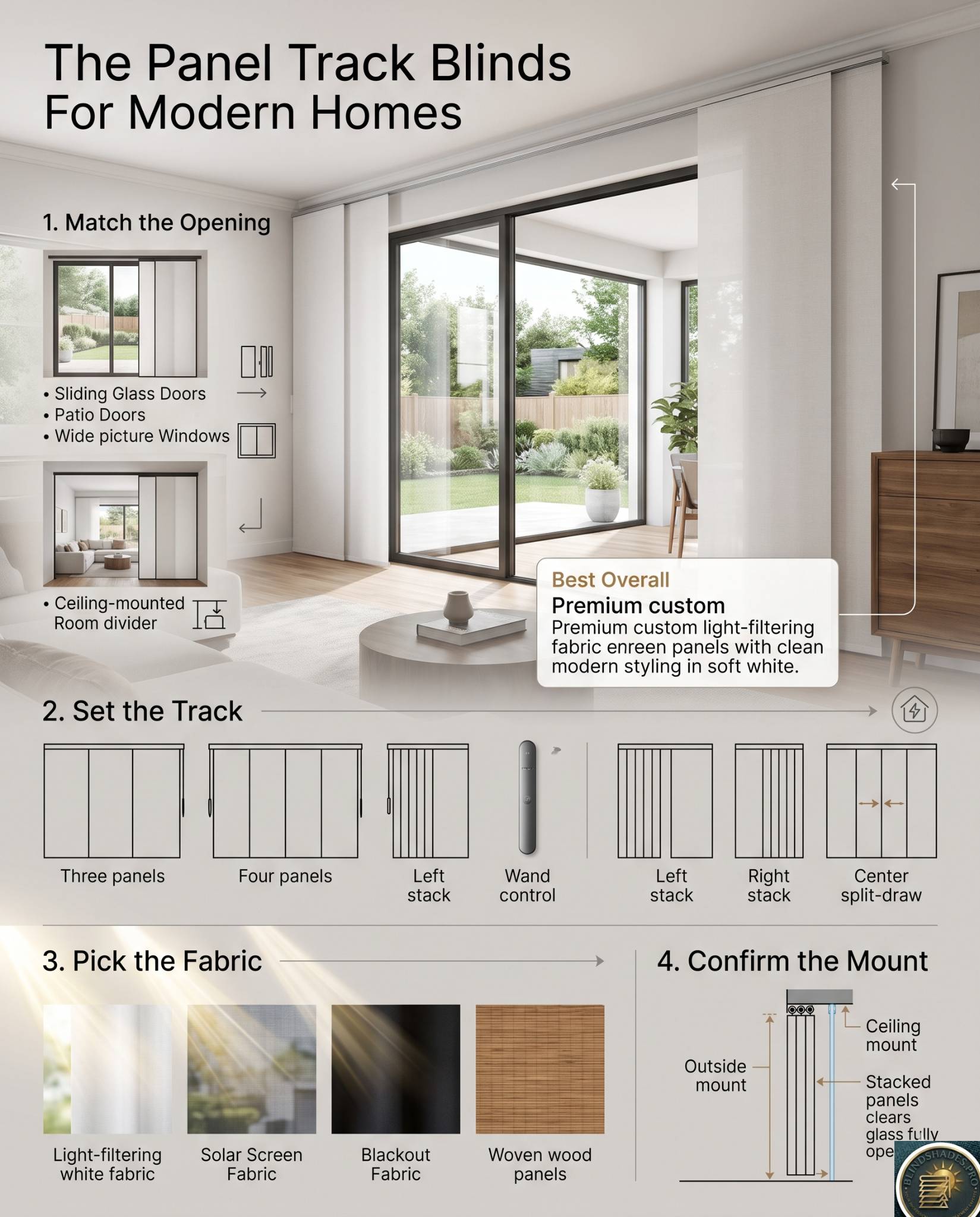
Authored by Michael Turner — 30 Years of Home Improvement Expertise | BlindShades.pro
The best panel track blinds use wide fabric panels that glide along a track to cover sliding glass doors, patio doors, and large or wide windows with a clean, modern look that traditional vertical blinds cannot match. For most homes, custom fabric panels in a light-filtering weave from a trusted brand like Bali or Blindsgalore are the best all-round choice; woven wood panels add natural warmth, solar-screen fabric controls glare while keeping the view, and blackout fabric darkens bedrooms. Ceiling-mounted, the same panels double as stylish room dividers. The right choice comes down to four decisions: the opening you are covering, the track setup, the fabric, and the mount. This guide walks through all four, names real-brand picks by category, and links to everything you need to measure, install, and maintain them.
Key Takeaways
- Panel track blinds are built for big openings. Wide fabric panels glide side to side on a track, making them ideal for sliding glass doors, patio doors, wide windows, and openings of roughly 36 inches or more.
- They are the modern answer to vertical blinds. Instead of narrow tilting slats, they use clean, wide panels with no clatter and fewer parts to break, for a contemporary, gallery-like look.
- Fabric, not tilt, sets the light level. Panels do not tilt; you choose light filtering, solar screen, blackout, or woven wood at purchase, then slide the panels open or closed.
- The same system divides rooms. Ceiling-mounted, panel track blinds work beautifully as a sliding room divider or closet cover in studios, offices, and open-concept spaces.
- Four decisions get you the right set. Match the opening, choose the track setup and stack direction, pick the fabric, and confirm the mount, and the rest follows.
⭐ Quick Answer
The best panel track blinds use wide fabric panels that glide on a track to cover sliding glass doors, patio doors, and wide windows. Choosing the right set comes down to four decisions.
- Match the opening: sliding glass doors, patio or French doors, wide windows, or a ceiling-mounted room divider, the uses Blindsgalore highlights.
- Set the track: choose the panel count, the stack direction (left, right, or split-draw), and wand or motorized control.
- Pick the fabric: light filtering, solar screen, blackout, or woven wood, since the panels do not tilt and the fabric sets the light level, as Hunter Douglas notes.
- Confirm the mount: outside or ceiling mount is the norm, leaving room for the panels to stack clear of the glass, per The Shade Store.
- Best overall: custom light-filtering fabric panels from a trusted brand like Bali or Blindsgalore. Measure first with how to measure for panel track blinds, see picks for sliding glass doors, or compare panel track vs vertical blinds.
Quick Specification Reference
The essentials at a glance.
| Specification | Typical range |
|---|---|
| Best for | Sliding doors, patio doors, wide windows, dividers |
| Panel width | About 15 to 26 inches each (varies by product) |
| Panels per slider | Usually 4 to 6 |
| Minimum opening | Best on roughly 36 inches and wider |
| Materials | Fabric, solar screen, woven wood/natural |
| Opacity options | Light filtering, room darkening, blackout |
| Stack direction | Left, right, or split-draw (center) |
| Control | Wand, continuous cord loop, or motorized |
| Mount | Outside, ceiling, or inside (depth permitting) |
| Light control | By fabric opacity (panels do not tilt) |
Read the Complete Guide Below For:
A clear explanation of what panel track blinds are and how they differ from vertical blinds; the four-step Panel Track Buying Path that gets you the right set; how to match the opening, choose your track setup and stack direction, pick the right fabric, and confirm the mount; our category picks from real, widely available brands; a quick panel track vs vertical blinds comparison; a For Offices and Specifiers section for commercial use and room dividers; and links to everything you need to measure, install, clean, and repair them, plus an honest look at whether they are worth it.
What Are Panel Track Blinds?
Wide fabric panels that slide, instead of narrow slats that tilt.
Panel track blinds, also called sliding panels or panel glide blinds, are window treatments made of wide, flat fabric panels that hang from a track and glide horizontally, stacking neatly to one side when open. They were designed to solve a specific problem: covering wide openings like sliding glass doors and oversized windows, where standard blinds and shades fall short. Where vertical blinds use many narrow, tilting vanes, panel track blinds use a few broad panels for a smoother, more contemporary look, often described as a moving accent wall. Because the panels slide on the same axis as a sliding door, access is seamless: slide the panels aside and walk through. The trade-off is that panels do not tilt, so light control comes from the fabric you choose rather than from angling slats.
The Panel Track Buying Path
Four decisions, in order, get you the right set: Opening, Track, Fabric, Mount.
Choosing panel track blinds is simple once you take it in order. First, match the opening you are covering, since that sets the size and number of panels. Second, choose your track setup, the stack direction and control. Third, pick the fabric and opacity that deliver the light and privacy you want. Fourth, confirm the mount. Work through these four in sequence and the right configuration becomes clear. The sections below walk through each step.
Step 1: Match the Opening
The opening decides the size, the panel count, and even the mount.
Panel track blinds shine on wide openings. Start by identifying which you are covering, because it shapes every later choice:
| Opening | Why panel track fits | Notes |
|---|---|---|
| Sliding glass / patio door | Panels glide on the same axis as the door | The most common use; plan stack direction around the active door |
| French doors | Split-draw opens from the center | Choose a center stack |
| Wide or oversized window | One cohesive treatment, no seams between shades | Great for walls of glass |
| Room divider | Ceiling-mount to separate open space | No bottom track; see the divider guide |
| Closet or storage opening | Lightweight, sleek alternative to bulky doors | Trimmable panels |
For the most common case, a sliding glass door, the panels stack to one side so you can step through; our dedicated guide to panel track blinds for sliding glass doors covers picks and stack planning in detail. For separating open-plan spaces, the same system ceiling-mounts as a partition, covered in panel track blinds as a room divider. Panel track works best on openings of roughly 36 inches or more; for small or standard windows, a roller or cellular shade is usually a better fit.
Step 2: Choose Your Track Setup
Decide the stack direction, the panel count, and the control.
Once you know the opening, set up the track. Three choices matter here: which way the panels stack, how many panels you need, and how you operate them.
Stack direction determines where the panels gather when open:
| Stack direction | Best for |
|---|---|
| Left or right (one-way) | A door where you exit from one side |
| Split-draw (center) | French doors, symmetry, or a centered view |
| Off-window stack | Maximizing the clear view (panels park off the glass) |
Panel count depends on the opening width and the panel width, which varies by product. As a rough guide:
| Opening width | Typical panels |
|---|---|
| Up to about 4 feet | 3 panels |
| About 4 to 6 feet | 4 panels |
| About 6 to 8 feet | 5 panels |
| About 8 feet and wider | 6 or more |
Control type is how you move the panels:
| Control | How it works | Best for |
|---|---|---|
| Wand | Push the wand to slide panels | Simple, safe, cord-free |
| Continuous cord loop | Pull a tensioned looped cord | Wide or heavy panels |
| Motorized | Remote, app, or voice control | Large, high, or smart-home setups |
Cordless wand control is the safest choice for homes with children or pets, since there are no accessible cords, and motorization is the premium step up for very wide or hard-to-reach openings.
Step 3: Pick the Fabric
With panel track, the fabric is the light control.
Because the panels do not tilt, the fabric you choose sets the light and privacy. This is the most important style and performance decision:
| Fabric | Light control | Best for |
|---|---|---|
| Light filtering | Soft, diffused daylight | Living rooms, everyday privacy |
| Room darkening | Most light blocked | Media rooms, naps |
| Blackout | Near-total darkness | Bedrooms, nurseries |
| Solar screen | Cuts glare and UV, keeps the view | Sunny rooms, offices, screens |
| Woven wood / natural | Gentle filtered light, texture | Organic, warm interiors |
Fabric panels offer the widest range of colors and opacities, solar screens protect floors and furniture from fading while preserving a view to the outside, and woven wood panels in bamboo, grasses, and reeds bring natural warmth. Many lines let you coordinate the same fabric across roller and Roman shades on nearby windows for a cohesive room. If you are weighing texture and material, our picks below name strong options in each category.
Step 4: Mount and Fit
Outside or ceiling mount is the norm, with room to stack.
Panel track blinds are usually mounted outside the opening or to the ceiling, both because the track needs a flat, level surface and because the panels need room to stack clear of the glass when open. Inside mount is possible where the frame is deep enough, but it is less common for this product. A few fit essentials: the track must be perfectly level for the panels to glide smoothly, you need to leave stack-back space to one side so the open panels do not block the view, and the height measurement includes the headrail. Getting these numbers right is the difference between smooth operation and a treatment that drags or gaps, so follow the full method in how to measure for panel track blinds before you order, and then how to install panel track blinds when your order arrives.
Best Panel Track Blinds: Our Picks
Real, widely available options chosen by category — not lab-tested by us.
These are real products selected for how well each suits its purpose, how widely available it is, and its verified reputation. We have not run independent lab tests; confirm current pricing, sizes, fabrics, and the cordless or motorized option before buying.
| Category | Pick | Why it fits |
|---|---|---|
| Best Overall | Bali Sliding Panels | Wide texture range, trusted brand |
| Best for Sliding Doors | Blindsgalore Envision Light Filtering | Soft glow, custom-built for doors |
| Best Natural / Woven | Levolor Panel Track in Woven Woods | Bamboo and grasses, organic warmth |
| Best Premium / Designer | Hunter Douglas Skyline Gliding Panels | Hundreds of fabrics, refined look |
| Best Budget / Renter | GoDear Design or CHICOLOGY | In-stock, trimmable, cordless |
| Best Motorized | Graywind Motorized Panel Track | Remote and smart-home control |
- Best Overall — Bali Sliding Panels. A trusted, custom-built system with a wide range of fabric and natural textures, balancing quality and value for most sliding doors and wide windows.
- Best for Sliding Doors — Blindsgalore Envision Light Filtering. Custom-built light-filtering panels that give a soft, even glow with privacy, a dependable pick for the most common use case.
- Best Natural / Woven — Levolor Panel Track in Woven Woods. Natural bamboo, grass, and reed panels that bring earthy texture and warmth to a modern room.
- Best Premium / Designer — Hunter Douglas Skyline Gliding Window Panels. A refined, designer-grade system with an extensive fabric, opacity, and texture selection for a high-end finish.
- Best Budget / Renter — GoDear Design or CHICOLOGY. In-stock, adjustable-width, trimmable cordless panels that install easily and suit rentals and quick projects, with Certified Best for Kids cordless options.
- Best Motorized — Graywind Motorized Panel Track. Battery or wired motorized panels with remote and smart-home control for large, tall, or hard-to-reach openings.
Disclosure: this section contains affiliate links. Prices are indicative tiers, not quotes, and vary by size, fabric, and retailer. We never publish fabricated prices, specifications, or testing claims.
Panel Track Blinds vs Vertical Blinds
Both slide side to side; the difference is modern fabric versus adjustable slats.
The most common cross-shop is vertical blinds, since both cover sliding doors and wide windows by moving horizontally. Here is the short version:
| Factor | Panel Track Blinds | Vertical Blinds |
|---|---|---|
| Look | Modern, wide fabric panels | Traditional, narrow slats |
| Light control | Fabric opacity, no tilt | Slats tilt for precise control |
| Privacy | No gaps when closed | Small gaps when tilted |
| Cost | Higher | Lower |
| Repair | Replace a panel | Replace individual slats |
| Stack space | Needs more | Stacks compactly |
| Noise | Quiet | Slats can clatter |
In short, panel track wins on modern looks, tighter privacy, and quiet operation, while vertical blinds win on precise tilt-adjustable light and lower cost. The full breakdown is in panel track blinds vs vertical blinds, and if neither is quite right, see alternatives to panel track blinds.
For Offices and Specifiers
Panel track is a practical choice for commercial spaces and partitions.
Beyond the home, panel track blinds suit offices, conference rooms, lobbies, and open-plan spaces, both as window coverings for large glazing and as ceiling-mounted dividers that separate zones without permanent walls. For commercial projects, window treatments fall under CSI MasterFormat Division 12 (Furnishings), and specifiers should confirm the relevant certifications on each product’s documentation rather than assume them. The ones that commonly matter for fabric panels are NFPA 701 flame resistance for contract fabrics, ANSI/WCMA A100.1 for window-covering cord safety, and GREENGUARD certification for low chemical emissions in occupied spaces; cordless and motorized controls satisfy cord-safety requirements cleanly by removing accessible cords. For solar-screen fabrics, the openness factor governs the balance of glare control, view, and UV reduction. Honest note: exact flame ratings, openness factors, and emissions figures vary by fabric and finish, so request the manufacturer’s cut sheet for project-exact values rather than relying on category generalizations. For dividing open offices and studios, the ceiling-mount approach is covered in panel track blinds as a room divider.
Installation, Care, and Repair
Easy to live with, and easy to fix.
One of the quiet advantages of panel track blinds is how low-maintenance they are. Installation is a DIY-friendly job of mounting a level track and attaching the panels by their hook-and-loop carriers, walked through in how to install panel track blinds. Cleaning is simple: dust the panels and clean the track, with the full method, including which fabrics can and cannot be spot-cleaned, in how to clean panel track blinds. If you ever need to take them down for cleaning, painting, or a move, see how to remove panel track blinds. And if the panels stop gliding smoothly, the most common and easily fixed complaint, the troubleshooting steps are in how to fix panel track blinds that will not slide.
Are Panel Track Blinds Worth It?
Worth it for the right opening; not for every window.
Panel track blinds are clearly worth it for sliding glass doors, patio doors, wide or floor-to-ceiling windows, and modern room dividers, where their clean look, smooth operation, and seamless wide coverage genuinely outperform the alternatives. They are less suited to small or standard windows, very tight budgets, traditional interiors, or situations needing precise, all-day light fine-tuning, since the panels do not tilt and they cost more than vertical blinds. We weigh the full case in are panel track blinds worth it, so you can match the decision to your space.
Related guides: For complete buying advice, see our ceiling track systems guide.
Related Buying Guides
- Best Vertical Blinds Buying Guide
- Best Mini Blinds Buying Guide
- Best Roller Shades Buying Guide
- Best Roller Blinds Buying Guide
Best Sources
- Blindsgalore — on panel track blinds as the modern answer to vertical blinds for wide windows and sliding doors, fabric, solar screen, and woven wood materials, stack options, and ceiling-mount room dividers.
- Hunter Douglas — on Skyline gliding window panels with hundreds of fabric, texture, and opacity options, stack and top-treatment customization, and patio-door applications.
- SelectBlinds — on choosing the number of wide panels, stack direction, wand, cord-loop, or motorized control, and adding a valance or cornice to conceal the track.
- The Shade Store — on inside versus outside mount, minimum mount depth, continuous-loop versus split-draw control, and track color choices.
- House Digest — on panel track shades as a stylish, weighted alternative to vertical blinds for sliding doors, with solar fabrics and R-value-rated thermal options.
- Budget Blinds — on panel track and roller-on-track systems, free-floating, side-stack, and split-stack configurations, and woven wood and solar options.
- Hunker — on panel track blinds typically using four to six panels for a slider, split-center opening for French doors, and their modern, minimalist look.
- Blinds Chalet — on the pros and cons of panel track blinds, limited tilt light control, stack-back space, and suitability for large openings over small windows.
Complete Panel Track Blinds Guide: All 10 Articles
Everything in this cluster, in one place.
Fix and install:
- How to Measure for Panel Track Blinds — the buy-bridge: outside-mount measuring and stack-space planning.
- How to Install Panel Track Blinds — mounting a level track and attaching the panels.
- How to Clean Panel Track Blinds — dusting, spot cleaning, and keeping the track gliding.
- How to Remove Panel Track Blinds — taking the panels and track down safely.
- How to Fix Panel Track Blinds That Will Not Slide — diagnosing and fixing a sticking glide.
Compare and learn:
- Best Panel Track Blinds for Sliding Glass Doors — picks and stack planning for the top use case.
- Panel Track Blinds vs Vertical Blinds — the full head-to-head comparison.
- Panel Track Blinds as a Room Divider — ceiling-mounting panels to separate open spaces.
- Alternatives to Panel Track Blinds — better options by priority and room.
- Are Panel Track Blinds Worth It? — an honest verdict on value.
Frequently Asked Questions
What are the best panel track blinds?
For most homes, custom light-filtering fabric panels from a trusted brand like Bali or Blindsgalore are the best all-round panel track blinds, balancing quality, look, and value. For natural warmth, choose woven wood panels such as Levolor in Woven Woods; for a premium designer finish, Hunter Douglas Skyline gliding panels; for rentals and budgets, in-stock trimmable cordless panels from GoDear Design or CHICOLOGY; and for large or hard-to-reach openings, a motorized system like Graywind. The best choice depends on your opening, the fabric and opacity you need, and whether you want manual or motorized control.
What are panel track blinds used for?
Panel track blinds are used to cover wide openings where standard blinds fall short: sliding glass doors, patio and French doors, and large or oversized windows. Their wide fabric panels glide along a track and stack to one side, giving seamless coverage with a clean, modern look. Ceiling-mounted, the same system also works as a sliding room divider in studios, offices, and open-concept spaces, or as a lightweight alternative to bulky closet doors. They are best on openings of roughly 36 inches or wider.
Do panel track blinds provide good privacy and light control?
Yes, though differently from slatted blinds. Because the panels do not tilt, light control and privacy come from the fabric you choose rather than from angling slats. Light-filtering fabric gives soft daytime privacy with a glow, room-darkening and blackout fabrics block most or nearly all light for bedrooms, and solar screens cut glare and UV while preserving the view. When closed, the overlapping panels provide consistent privacy with no gaps. You choose the light level at purchase by selecting the fabric opacity, then slide the panels open or closed.
How many panels do I need for a sliding glass door?
Most sliding glass doors use four to six panels, depending on the door width and the panel width, which varies by product. As a rough guide, openings up to about four feet use three panels, four to six feet use four, six to eight feet use five, and wider openings use six or more. When you order custom panel track blinds, the manufacturer calculates the exact number based on your measurements to ensure proper overlap and smooth stacking, so measuring accurately first is essential.
Are panel track blinds better than vertical blinds?
Neither is simply better; they suit different priorities. Panel track blinds offer a cleaner, more modern look with wide fabric panels, tighter privacy with no gaps, and quiet operation, making them ideal for contemporary spaces. Vertical blinds offer precise tilt-adjustable light control, a lower price, and easily replaceable individual slats, but can look more traditional and may clatter. For a modern wide-glass or sliding-door look, panel track wins; for budget and fine light control, vertical blinds do. The full comparison is in our panel track blinds versus vertical blinds guide.
Can panel track blinds be used as a room divider?
Yes, and it is one of their most popular non-window uses. Ceiling-mounted, panel track blinds separate open-plan spaces without permanent construction: section off a home office, divide a studio apartment, screen a sleeping area, or conceal storage and laundry. The panels have no bottom track, hanging freely with small weight bars to keep them straight, and they stack open to reclaim the full space when you want it. The clean, flat panels look intentional and modern rather than makeshift.
