The Best Bay Window Blinds & Shades Buying Guide 2026

Best bay window blinds 2026: individual blinds per pane; corner gap problem; cellular shades slim headrail; plantation shutters bay posts; bow window spec; measuring protocol.
By the Editorial Team at BlindShades.pro | Updated 2026 | 30 Years of Home Improvement Expertise
Key Takeaways:
- Bay windows and bow windows are architecturally similar but distinct: a bay window typically has three sections — a larger centre picture window flanked by two smaller windows angled toward it, most commonly at 135 degrees — while a bow window has four to five (sometimes six) windows all the same size arranged in a gentle outward curve; The Shade Store (May 2026) confirms the practical implication: “while the construction of these bay and bow windows is different, the same window treatment options usually work for both”; the shared functional challenge is that every bay or bow window consists of multiple angled panels, each of which requires its own separate blind, shade, or shutter — Graber Blinds confirms the governing rule: “each window in the set requires a separate shade, blind, or shutter, and those different angles pose a challenge because the window treatments installed on each of the separate windows can potentially interfere with neighbouring window treatments if you don’t properly account for those angles”
- The corner gap problem is the central technical challenge of every bay window blind installation and the reason treatment selection starts with the window’s geometry and depth, not with aesthetics: where adjacent blind headrails meet at the angled corner junction between panes, there is a structural gap that no treatment eliminates entirely but some treatments manage far better than others; dwellifyhome.com (February 2026) identifies the angle collision problem: “why it matters: the tighter the angles, the more likely the blinds can collide at the corners when you raise or tilt them”; SmartWings (January 2026) confirms the two critical measurement inputs that determine which treatments are feasible before any style decision is made: “because bay windows are angled and often have limited mounting depth, not all window treatments perform equally well; the best blinds and shades for bay windows are those that require minimal depth, stack neatly when raised, and follow the window’s shape without leaving large light gaps”; depth determines whether inside mount is possible; the angle between panes determines whether adjacent treatment headrails will collide at the corner; both must be verified before ordering
- Cellular honeycomb shades are the most widely recommended bay window treatment and the reason is specific to the geometry of bay windows: SmartWings (January 2026) confirms: “cellular shades are often the top choice for bay windows because of their compact headrail and slim profile”; the compact headrail is the key — where a standard 2-inch faux wood blind headrail projects forward from the frame and collides with the adjacent headrail at the angled corner, a cellular shade headrail sits within a much smaller profile that clears the angle more cleanly; buyhomeblinds.com (April 2026) confirms the specification for shallow frames: “ideal in limited spaces and shallow sills: 1-inch cellular shade or faux wood blinds; they both have slim profiles reducing corner gaps and can be easily fitted into shallow frames”; the honeycomb cellular insulation benefit is particularly valuable for bay windows because the increased glass surface area creates a larger thermal transfer zone than flat walls — Budget Blinds confirms: “if you want to improve insulation and regulate temperature, the composition and structure of cellular shades are unparalleled”
- Plantation shutters are the premium bay window treatment and the only one that makes adjacent panes appear as a continuous built-in architectural feature: Norman USA (March 2026) confirms the key bay-window-specific shutter advantage: “the special bay window posts make individual shutters appear as a single unit for a more cohesive look for your room”; unlike blinds or shades that hang individually from each frame, plantation shutters mounted with bay window posts create a structural connection between adjacent shutter panels that visually unifies the entire bay — each panel can still be opened and closed independently while the overall appearance reads as a single fitted treatment following the bay’s exact geometry; West Country Shutters (December 2025) identifies the fundamental shutter advantage over fabric treatments at bay windows: “unlike bay window blinds that hang down and block the view, shutters embrace and highlight your windows’ unique shape and characteristics”; custom shutters are built to the exact angles of each specific bay window — box bay, standard angled bay, or Georgian-style — with the louver direction and panel configuration matching the architecture
- Measuring bay windows for blinds requires a different protocol from measuring standard flat windows and the specific steps that differ are: Graber Blinds confirms that every window in the bay set must be measured separately because they are rarely identical even in new construction; Factory Direct Blinds confirms the cardboard trick for determining bracket clearance at the angled corners: cut six pieces of cardboard to the approximate depth of the headrail, position them so their front edges meet as if they are actual headrails, and mark the point at the back of the cardboard where the headrail ends — the blind for the left and right panes is then measured from this mark to the outside edge of each frame, and the centre blind between the two marks; dwellifyhome.com (February 2026) specifies why depth is the first measurement: “second, measure depth; depth tells you whether you can do an inside mount with a neat, tucked-in look, or whether the blind will stick out and feel bulky”; blinds.com confirms the minimum inside mount depth at 3/4 inch; Blinds.com also confirms that for outside mount above the window openings, cellular shades, Roman shades, or 1-inch wood or faux wood blinds are the recommended treatments
⭐ Quick Answer — The Best Bay Window Blinds & Shades Buying Guide 2026
- Bay vs Bow, the Corner Gap Problem, and Why Every Pane Needs Its Own Separate Treatment: The best bay window blinds specification starts with two structural facts that govern every treatment decision before any style consideration. Bay vs bow: a bay window has three sections — a larger centre panel flanked by two smaller windows angled toward it, most commonly at 135 degrees — while a bow window has four to six sections all the same size arranged in a gentle outward curve; The Shade Store (May 2026) confirms: “while the construction of these bay and bow windows is different, the same window treatment options usually work for both.” The individual per-pane rule: Graber Blinds states the governing principle directly — “each window in the set requires a separate shade, blind, or shutter, and those different angles pose a challenge; because the window treatments installed on each of the separate windows can potentially interfere with neighbouring window treatments if you don’t properly account for those angles and the dimensions of the window treatments you are using; get any of these factors wrong and you have window treatments that interfere with each other’s operation.” One large blind spanning the entire bay is possible as an outside mount covering the full alcove width, but the standard specification is individual per-pane treatments that follow the bay’s geometry. The corner gap problem: where adjacent blind headrails meet at the angled corner junction between panes, there is a structural gap — the tighter the angle between adjacent panes, the more likely adjacent headrails will physically collide when operated; DwellifyHome.com (February 2026) confirms: “the tighter the angles, the more likely the blinds can collide at the corners when you raise or tilt them”; two inputs determine treatment compatibility before any style decision: frame depth (minimum 3/4 inch for inside mount — Blinds.com confirmed) and the angle between panes; treatments with compact slim headrails produce the smallest corner gap; treatments with wider projecting headrails produce a larger gap and are more prone to corner collision
- The Five Best Bay Window Treatments Ranked — and Why Cellular Shades Lead on a Specification That Only Bay Windows Create: The best bay window blind material ranking is not the same as the ranking for standard flat windows, because the corner gap problem introduces a headrail profile criterion that flat windows do not have. 1 — Cellular honeycomb shades (most popular): SmartWings (January 2026) confirms: “cellular shades are often the top choice for bay windows because of their compact headrail and slim profile”; the compact headrail is not incidental — it is the primary specification advantage for bay windows; where a standard 2-inch faux wood blind headrail projects forward and risks collision at the angled corner, a cellular shade headrail clears the angle with the smallest gap of any fabric treatment; available in light-filtering, room-darkening, and blackout; TDBU option for privacy at the bottom and light from the top; double-cell versions provide R-values up to 6 or 7 for meaningful insulation across the enlarged glass surface area that bay windows create. 2 — 1-inch faux wood or aluminium blinds: buyhomeblinds.com (April 2026) confirms: “ideal in limited spaces and shallow sills: 1-inch cellular shade or faux wood blinds; they both have slim profiles reducing corner gaps”; the 1-inch slat specification is preferable to 2-inch for bay windows precisely because of the slimmer headrail and reduced corner gap; strong privacy with slatted light control. 3 — Roller shades: Graber Blinds confirms roller shades as “the simplest most straightforward solution” for bay windows; slim tube headrail; clean modern profile; gap trade-off at side edges of each panel at the corner. 4 — Roman shades: DwellifyHome.com (February 2026) confirms: “soft and tailored, popular for bay window living rooms”; fold alignment across all three panes is the key discipline. 5 — Plantation shutters (premium): custom-fitted to exact bay angles; Norman USA bay posts unite panels as one cohesive unit; see bullet 4 for full shutter analysis. For the full treatment ranking, see What Are the Best Blinds for Bay Windows
- How to Measure Bay Windows for Blinds — The Six Steps That Differ From Standard Window Measurement: Measuring bay window blinds correctly requires six steps, two of which are unique to bay windows and not required for standard flat windows. Step 1 — Depth check first: measure the depth of each pane frame from the front edge to the glass; inside mount requires a minimum 3/4-inch depth (Blinds.com confirmed); if any pane is below this threshold, outside mount is required. Step 2 — The cardboard corner clearance test (unique to bay windows): Factory Direct Blinds confirms: “cut 6 pieces of cardboard; position them so their front edges meet as if they are actual blind headrails; make a pencil mark at the back of the cardboard where the headrail will end; measure the left and right blinds from this mark to the outside where you want the headrail to end; measure the centre blind between the marks”; this test prevents the most common bay window blind error — ordering blinds that physically collide at the angled corner when operated. Step 3 — Width per pane separately: DwellifyHome.com (February 2026) confirms: “measure each pane separately; don’t assume both side windows match; I’ve seen bays where the left pane is half an inch narrower than the right, and that’s enough to create a noticeable gap.” Step 4 — Height per pane separately. Step 5 — Round to nearest 1/8 inch; order Inside Mount. Step 6 — Cord position on outer side of each side blind — placing the cord on the outer side (away from centre) avoids cord crowding at the angled corner junction. For the complete protocol with common error examples, see How Do You Measure a Bay Window for Blinds
- Plantation Shutters, Curtains on Bay Windows, and the One-Blind-Across Question: Three bay window decisions that every buyer considers and that most guides get partially wrong. Plantation shutters — the built-in case: Norman USA (March 2026) identifies the bay-window-specific shutter advantage: “the special bay window posts make individual shutters appear as a single unit for a more cohesive look for your room”; bay posts are structural connectors between adjacent shutter frames that visually unify the entire bay while each panel still opens and closes independently; West Country Shutters (December 2025) confirms the fundamental advantage over fabric treatments: “unlike bay window blinds that hang down and block the view, shutters embrace and highlight your windows’ unique shape and characteristics; our shutters are always custom-made to fit your bay windows, whether you have a box bay window, angled bay window, Georgian-style window, PVC window, or uniquely shaped window”; for the full shutter specification, see Can You Put Plantation Shutters in a Bay Window. Curtains — the nuanced position: Norman USA states “curtains are not the best window coverings for bay windows” based on the pooling problem of fabric panels at angled corners; however, curtains work well when hung on a bay window curtain rod with angled corner joints that follows the exact shape of the bay, or on a flexible curtain track; Ooble (January 2026) confirms: “a bendable curtain track is one of the most straightforward solutions for hanging curtains in a bay window; it lets your curtains glide smoothly from one end to the other”; Curtarra.com (August 2025) confirms the 4-panel designer approach: “use a custom bay window curtain rod; hang 4 panels — 2 for the centre big window, one for each side window — a built-in look that turns the bay into an inviting destination”; for the full hanging guide, see How Do You Hang Curtains on a Bay Window. One blind across: possible as an outside-mount treatment spanning the full alcove width, but the standard specification is individual blinds per pane; one across conceals the bay’s projection rather than following and complementing it; correct for box bay seating nooks and blackout bedroom bays; for the full analysis, see Can You Put One Blind Across a Bay Window
- Privacy Without Blocking Light, Angled Side Panel Specification, and the Bow Window Treatment Difference: Three additional bay window blind decisions that require specific guidance. Privacy without blocking light: TDBU cellular shades are the most effective bay window privacy-plus-light solution — lower the top section of each shade to admit diffused light from above the eye-level sightline zone while keeping the bottom section closed against ground-level views from outside; slat-tilt on faux wood or aluminium blinds angles light off the ceiling while preventing horizontal sightlines; sheer curtains layered over individual blinds provide daytime diffused privacy with operational blind control below; plantation shutters with louvers angled provide adjustable privacy at any time; for the full specification, see How Do You Add Privacy to a Bay Window Without Blocking Light. Angled side panel specification: the two side panels of a standard bay require specific care that the centre panel does not — the side headrail must clear the corner angle to the centre headrail; the cord or wand must be positioned on the outer side (away from centre) to avoid crowding at the corner; tilt rods on slatted blinds may contact the adjacent centre headrail if clearance is insufficient; cellular shades and 1-inch mini blinds are the safest specifications for tight-angle side panels; for the full side panel guide, see What Blinds Work Best for Angled Bay Window Side Panels. Bow windows: require more individual treatments (4-6 vs 3 for a bay); all panels the same size; gentler angle means reduced corner collision risk; Blinds.com recommends 1-inch wood or faux wood blinds for the shallow frames common in bow windows; motorized operation is particularly practical for bow windows (Budget Blinds confirmed) — operating five or six individual pane treatments manually multiple times daily is impractical; JoeyzShopping.com (December 2025) reports the bay and bow window market is expected to reach USD 653.7 million by 2034, reflecting growing investment in quality window treatments for these architectural features; for the full bow window specification, see What Are the Best Window Treatments for a Bow Window
- Best Sources: “Each window in the set requires a separate shade blind or shutter; angles pose a challenge; get any of these factors wrong and you have window treatments that interfere with each other’s operation; roller shade is simplest most straightforward solution for bay windows” → Graber Blinds — best options for bay window blinds · “Cellular shades often top choice for bay windows because of their compact headrail and slim profile; bay windows angled with limited mounting depth; best blinds require minimal depth stack neatly when raised follow window shape without large light gaps” → SmartWings — bay window blinds and shades (January 2026) · “Bay window typically 3 angled windows; bow window typically curved 4-5 windows all same size; same treatment options usually work for both; wood blinds suit living and dining rooms; cellular shades feature lengths and light-filtering options” → The Shade Store — bay window blinds and shades (May 2026)
📚 The 10 Bay Window Blind Topics Covered In This Buying Guide:
1. What Are the Best Blinds for Bay Windows? — Full treatment ranking; cellular compact headrail advantage; plantation shutters bay posts; faux wood 1-inch vs 2-inch; roller shades gap trade-off; Roman shades fold alignment
2. How Do You Measure a Bay Window for Blinds? — Six-step protocol; depth check first; cardboard corner clearance test; measure each pane separately to nearest 1/8 inch; cord position on outer side of side panels; order Inside Mount
3. Can You Put One Blind Across a Bay Window? — When it works (box bay nook; blackout bedroom) vs when it does not (standard angled bay); outside mount covering the alcove analysis; per-pane vs single treatment full comparison
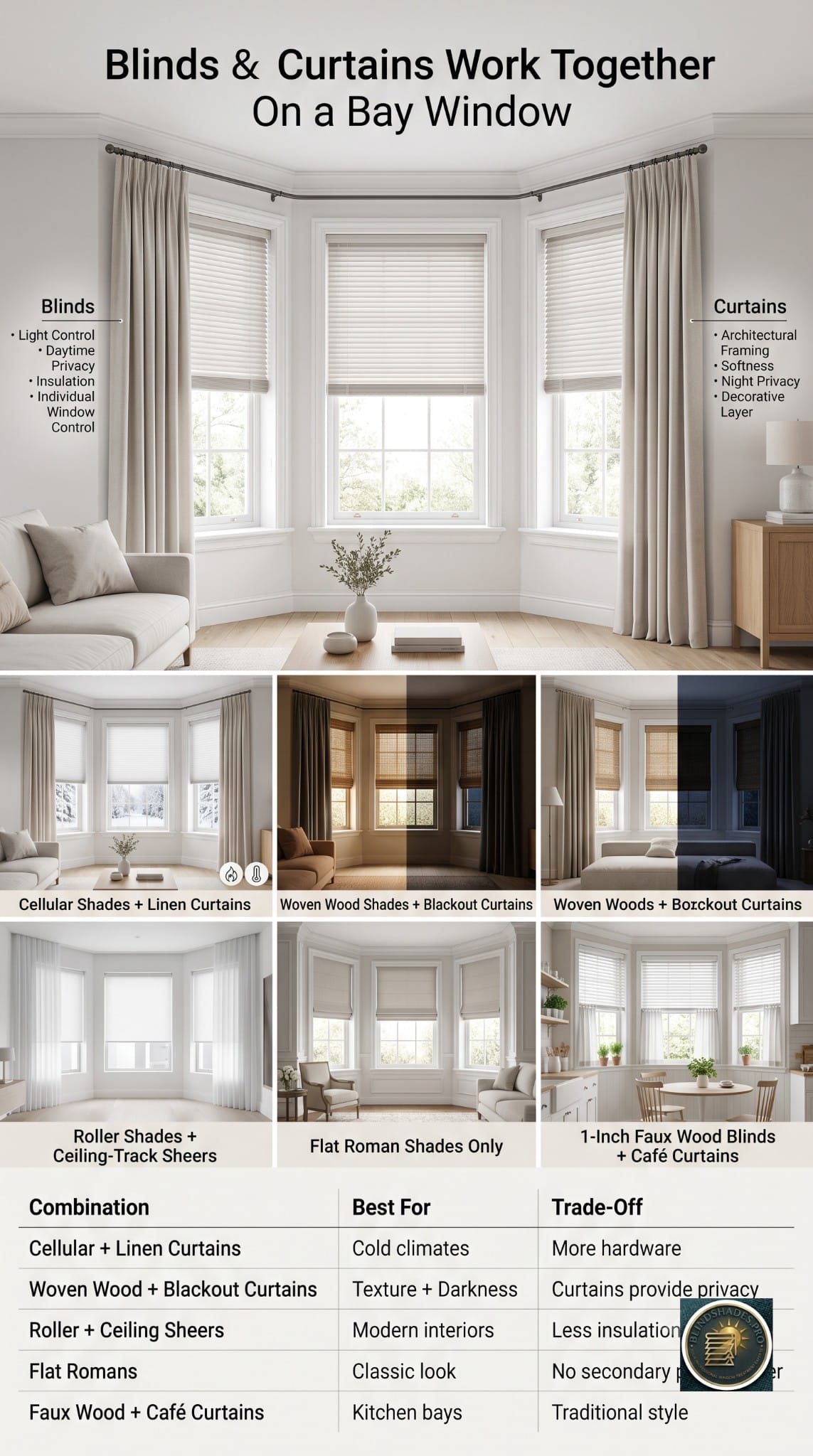
4. What Are the Best Curtains for a Bay Window? — Norman USA “curtains not best” position explained; when angled rod and flexible track solve the corner pooling problem; layering curtains with blinds; sheer curtain plus blind combinations
5. How Do You Hang Curtains on a Bay Window? — Bay window curtain rod with corner joints; flexible bendable curtain track (Ooble Jan 2026); mount 4-6 inches above frame; 4-panel designer approach (Curtarra Aug 2025); one spanning rod for alcove coverage
6. Can You Put Plantation Shutters in a Bay Window? — Yes; Norman USA bay posts unite adjacent panels as single unit; custom angles for any bay type; West Country Shutters Dec 2025; independent panel operation; built-in architectural look vs cost
7. What Are the Best Window Treatments for a Bow Window? — Bay vs bow distinction; 4-6 same-size panels; gentler angles; 1-inch faux wood for shallow frames (Blinds.com); curved curtain rod; motorized for simultaneous operation (Budget Blinds)
8. How Do You Add Privacy to a Bay Window Without Blocking Light? — TDBU cellular most effective; slat-angle technique bounces light off ceiling; sheer curtain layer over blinds; shutters with louvers angled; privacy ranking from maximum light to full coverage
9. What Blinds Work Best for Angled Bay Window Side Panels? — Corner clearance constraint; cord on outer side of each side panel; tilt rod overlap risk; cellular shades and 1-inch mini blinds for tight corners; headrail profile comparison by corner gap size
10. Are Cellular Shades Good for Bay Windows? — Compact headrail as the #1 bay window advantage; R-value insulation across enlarged glass surface; TDBU for privacy plus light; light-filtering to blackout; motorized for simultaneous operation of all panels
💡 Bay Window Blind Specification at a Glance — Best Bay Window Blinds by Priority: Corner gap minimum (tight angles or shallow frames): cellular honeycomb shades — compact headrail; smallest corner gap of any fabric treatment; slim profile for shallow frames; TDBU option available. Classic slatted look (standard depth frames): 1-inch faux wood blinds — slim headrail; strong privacy; better corner clearance than 2-inch; 2-inch only where depth and angle allow without collision. Clean modern look: roller shades — slim tube headrail; understand the side-edge gap trade-off at corners. Soft fabric look: Roman shades — independent panels per pane; maintain consistent raising height across all panes for aligned fold lines. Premium built-in (longest lifespan): plantation shutters — Norman USA bay posts unite panels; custom angles; no headrail corner gap; each louver adjustable. Curtains (layered approach): angled bay curtain rod or flexible bendable track following the bay shape; OR stationary curtain panels outside the alcove on a straight wall rod framing the bay while individual blinds per pane provide function. One blind across: outside mount only; conceals bay projection; correct for box bay seating nooks or blackout bedroom bays only. Measuring rule (Graber Blinds + Factory Direct confirmed): depth check first; cardboard corner test for headrail clearance; each pane measured separately; round to nearest 1/8 inch; order Inside Mount; cord on outer side of each side panel. Bow windows: same treatments as bay; 4-6 panels instead of 3; all same size; 1-inch slats for shallow frames (Blinds.com); motorized for simultaneous operation (Budget Blinds confirmed).
📖 Read the complete guide below for: bay vs bow distinction (bay = 3 angled panes; bow = 4-6 same-size gradual curve; same treatments; The Shade Store May 2026); the individual per-pane rule (Graber Blinds confirmed; one across is outside-mount only); the corner gap problem and two geometry inputs (frame depth minimum 3/4 inch; angle between panes; headrail profile determines gap size); the five treatment rankings (cellular compact headrail #1; 1-inch faux wood; roller shades; Roman shades; plantation shutters bay posts); the six-step measuring protocol (depth check; cardboard corner clearance test; each pane separately; 1/8 inch; Inside Mount; cord on outer side); plantation shutters bay posts uniting adjacent panels (Norman USA Mar 2026; West Country Shutters Dec 2025); curtains on bay windows (Norman USA “not best” position; when angled rod and flexible track solve the corner problem; Ooble Jan 2026 bendable track; 4-panel designer approach Curtarra Aug 2025); one blind across (when and when not); angled side panel cord position and tilt rod overlap; bow windows (1-inch faux wood for shallow frames; motorized simultaneous; 4-6 panels); TDBU cellular for privacy without blocking light; and the bay and bow window market projected at USD 653.7 million by 2034.
Bay Window vs Bow Window — The Distinction That Changes the Treatment Count
The first question that determines how many separate window treatments you need.
The best bay window blinds specification starts with identifying which type of projecting window you have:
Bay window: Three sections. A larger centre picture window flanked by two smaller side windows angled toward it. The most common angle is 135 degrees between the centre and each side panel, though 90-degree (box bay) configurations also exist. The three panes are typically different sizes — the centre is the widest; the sides are narrower. Three separate window treatments required.
Bow window: Four to six sections. All panels are usually the same size, arranged in a gentle outward curve. Budget Blinds confirms: “a bow window is a four to five-section window, where each section is usually a casement window, all the same size.” Four to six separate treatments required — more than a standard bay window and with more individual measurements.
The Shade Store (May 2026) confirms the practical treatment implication: “while the construction of these bay and bow windows is different, the same window treatment options usually work for both.” The distinction matters primarily for treatment count, measurement approach, and the choice of curtain hardware.
Blinds.com confirms the bow window specification nuance: “because of the way the sections are separated, the biggest challenge is finding window treatments that fit shallow enough to closely meet the angles where the windows all come together.”
The Corner Gap Problem — Why Bay Window Treatment Selection Starts With Geometry, Not Style
The structural challenge that eliminates certain treatments before any aesthetic decision is made.
At every angled corner junction between adjacent bay window panes, where two headrails meet at less than 180 degrees, there is a gap. No treatment eliminates this gap entirely — but the size of the gap, and whether the headrails of adjacent treatments physically collide when operated, depends entirely on the depth and profile of the treatment chosen.
Graber Blinds states the fundamental bay window rule: “Each window in the set requires a separate shade, blind, or shutter, and those different angles pose a challenge. Because the window treatments installed on each of the separate windows can potentially interfere with neighbouring window treatments if you don’t properly account for those angles and the dimensions of the window treatments you are using. Get any of these factors wrong and you have window treatments that interfere with each other’s operation.”
The two geometry inputs that determine treatment compatibility:
1 — Frame depth: The space from the front of the window frame to the glass. Inside mount requires a minimum of 3/4 inch depth (Blinds.com confirmed); many bay window frames are shallower than standard flat windows. If depth is insufficient for inside mount, outside mount is required — which changes the headrail projection and the corner gap calculation.
2 — Corner angle: The tighter the angle between adjacent panes, the less clearance there is for adjacent headrails before they collide. A 135-degree bay (the most common) has more clearance than a 90-degree box bay. Treatments with compact, narrow headrails are less prone to collision; treatments with wide, projecting headrails are more prone.
DwellifyHome.com (February 2026) confirms the collision principle: “why it matters: the tighter the angles, the more likely the blinds can collide at the corners when you raise or tilt them.”
Treatment headrail profiles by corner-gap performance:
| Treatment | Headrail Profile | Corner Gap | Best For |
|---|---|---|---|
| Cellular shades | Slim (most compact) | Smallest | All bay types |
| Roller shades | Slim tube | Small | Wider angles |
| Roman shades | Medium | Moderate | Wider angles |
| 1-inch faux wood | 1-inch slat + headrail | Moderate | Shallow frames |
| 2-inch faux wood | 2-inch slat + wider headrail | Larger | Deeper frames |
| Plantation shutters | Frame-fitted (no headrail) | Structural only | All bay types |
The Five Best Bay Window Treatment Options — Ranked
1 — Cellular (Honeycomb) Shades — Best All-Around
SmartWings (January 2026) confirms the cellular shade advantage for bay windows directly: “cellular shades are often the top choice for bay windows because of their compact headrail and slim profile.” The compact headrail is not an incidental benefit — for bay windows it is the primary specification advantage. A slim cellular headrail clears the corner junction between panes with the smallest gap of any fabric treatment.
Why cellular shades lead for bay windows:
- Compact headrail minimises the corner gap problem
- Single-cell and double-cell options; double-cell provides R-values up to 6 or 7 for meaningful insulation across the enlarged glass area of a bay
- TDBU (top-down bottom-up) option: lower the top section for natural light from above the sightline height while keeping the bottom section closed for privacy at street level
- Available in light-filtering, room-darkening, and blackout fabrics
- Cordless standard; motorized available for simultaneous operation of all bay panels
- Buyhomeblinds.com (April 2026) confirms: “ideal in limited spaces and shallow sills: 1-inch cellular shade or faux wood blinds; they both have slim profiles reducing corner gaps”
For the full cellular shade bay window specification, see Are Cellular Shades Good for Bay Windows.
2 — Faux Wood or Wood Blinds (Classic Slatted Look; 1-Inch for Shallow Frames)
Faux wood and wood blinds are one of the most consistently recommended bay window treatments because the horizontal slatted design “accentuates the verticality of each window” (The Shade Store, May 2026) and coordinates naturally with the bay’s architectural character.
1-inch vs 2-inch slats for bay windows: Buyhomeblinds.com (April 2026) confirms the slat width specification for bay windows: 1-inch slats are preferable for shallow sills and tight corner angles; the slim profile reduces corner gap and fits frames too shallow for 2-inch options. 2-inch slats provide better light control per slat but require more frame depth and create a larger corner gap.
DwellifyHome.com (February 2026) confirms: “Venetian and faux wood blinds: strong privacy and light control, especially with slimmer slats.”
3 — Roller Shades (Clean Modern Look)
Roller shades provide a minimal modern profile with a slim tube headrail that handles corner angles reasonably well. Graber Blinds confirms: “the simplest, most straightforward solution for nearly any window is a roller shade; they are especially useful for bay windows because of their simple operation and, if properly measured and installed, they will not interfere with neighbouring shades.”
DwellifyHome.com (February 2026) identifies the key roller shade trade-off for bay windows: “roller shades: clean look, best when you understand the gap trade-off” — the gap at the side edges of each roller shade panel is visible when the shade is raised, particularly at the angled corner where adjacent panels sit close together.
4 — Roman Shades (Soft; Fabric Look)
Roman shades are “soft and tailored, popular for bay window living rooms” (DwellifyHome.com February 2026). The fabric folds up as the shade raises, creating a decorative stack at the top. SmartWings (January 2026) confirms Roman shades as suitable for bay windows: “combining the elegance of drapery with the simplicity of a shade system.”
The key Roman shade consideration for bay windows is fold alignment: if three Roman shades in the bay are all open to the same height, the horizontal fold lines should align across all three panes for a unified appearance. This requires consistent fabric and consistent raising discipline.
5 — Plantation Shutters (Premium; Built-In; Architectural)
Plantation shutters are the premium bay window treatment. Norman USA (March 2026) confirms: “The special bay window posts make individual shutters appear as a single unit for a more cohesive look for your room.” This is the defining bay-window-specific shutter advantage — structural bay posts connect adjacent shutter frames, giving the entire bay a continuous built-in appearance that no blind or shade can replicate.
West Country Shutters (December 2025) confirms the functional advantage over fabric treatments: “unlike bay window blinds that hang down and block the view, shutters embrace and highlight your windows’ unique shape and characteristics; our shutters are always custom-made to fit your bay windows, whether you have a box bay window, angled bay window, Georgian-style window, PVC window, or uniquely shaped window.”
Custom shutters are built to the exact angles of the specific bay. Each shutter panel opens and closes independently while the bay posts maintain structural and visual cohesion between adjacent panels.
For the full plantation shutter bay window specification, see Can You Put Plantation Shutters in a Bay Window.
One Blind Across a Bay Window — When It Works and When It Does Not
The debate every bay window owner considers and what the evidence actually shows.
The appeal of one large treatment spanning the entire bay is understandable — a single roller shade or curtain rod across all three panes creates visual simplicity and eliminates the corner gap entirely.
Factory Direct Blinds (January 2026) identifies the trade-off: “one cohesive treatment” across the entire bay requires outside mount spanning the wall surface on both sides of the bay; the blind covers not just the glass but also the wall sections between panes; the result is a flat treatment that ignores and conceals the bay’s projection rather than following and complementing it.
When one blind across a bay window works:
- Box bay windows where the side panes are at 90 degrees and the alcove is used as a reading nook or seating area — one wide roller shade across the front of the alcove treats the space as a room-within-a-room
- Outside-mounted blackout treatment for a bedroom bay where the priority is complete light elimination and the angled architecture is secondary
- Bow windows where the curve is gentle enough that one curved curtain rod across the arc is practical
When individual blinds per pane is the correct specification:
- Standard 135-degree angled bay windows where individual treatments per pane follow the window geometry and maintain the bay’s architectural identity
- Any bay where the angled side windows are separately framed with wall or pillar sections between them — each pane requires its own treatment
- Plantation shutters always require individual per-pane installation; bay posts connect them visually but each panel is physically mounted in its own frame
For the full analysis, see Can You Put One Blind Across a Bay Window.
Curtains on Bay Windows — When They Work and When They Do Not
Norman USA says curtains are not the best choice, but the complete picture is more nuanced.
Norman USA (March 2026) states a widely quoted position on bay window curtains: “For these reasons, curtains are not the best window coverings for bay windows.” The concern is that standard straight curtain rods do not follow the bay’s angles, fabric panels pool awkwardly in the corners, and curtains that span the full bay (hung outside the alcove) conceal rather than complement the architecture.
The complete picture is more nuanced:
When curtains are the wrong choice for a bay window:
- Hung on individual short rods over each pane with fabric panels that bunch at the angled corners
- Heavy floor-length panels on rods that span the flat wall outside the alcove — these conceal the bay projection entirely
When curtains work well with bay windows:
- A bay window curtain rod with angled corner joints that follows the exact shape of the bay — Wayfair confirms: “bay window curtain rods are singular rods with an angled shape that matches the shape of the bay window”; panels hang from the angled rod and follow the bay geometry
- A flexible curtain track system — Ooble (January 2026) confirms: “a bendable curtain track is one of the most straightforward solutions for hanging curtains in a bay window; it’s designed to follow the shape of your bay, whether that’s curved or angled; it lets your curtains glide smoothly from one end to the other”
- Layered with individual blinds or shades: stationary curtain panels hung on the flat wall outside the alcove frame the bay visually while cellular shades or roller shades on each individual pane provide functional light and privacy control
Curtarra.com (August 2025) confirms the designer panel approach: “use a custom bay window curtain rod specifically designed to follow the angles of the bay; hang 4 panels — 2 panels for the centre big window, one panel for each side window — a built-in look that turns the bay into an inviting destination.”
For the full curtain bay window specification, see What Are the Best Curtains for a Bay Window and How Do You Hang Curtains on a Bay Window.
Measuring Bay Windows for Blinds — The Protocol That Differs From Standard Windows
Why bay window measurement requires additional steps that standard window guides skip.
DwellifyHome.com (February 2026) states the first rule of bay window measurement: “measure each pane separately; don’t assume both side windows match; I’ve seen bays where the left pane is half an inch narrower than the right, and that’s enough to create a noticeable gap.”
The bay window measuring protocol (Factory Direct Blinds confirmed):
Step 1 — Depth check: Measure the depth of each pane frame from the front edge to the glass. Inside mount requires a minimum 3/4 inch depth (Blinds.com confirmed). If any pane is below this threshold, outside mount is required for that pane — and for visual consistency, outside mount should be applied across all panes.
Step 2 — The cardboard corner clearance test: Cut six pieces of cardboard to approximately the same depth as the headrail of your chosen treatment. Position the cardboard pieces so their front edges meet at each angled corner, as if they are actual headrails. Mark the point at the back of the cardboard where the headrail will end. This mark tells you exactly where the bracket for the left and right panes must be positioned so the adjacent headrails clear each other at the corner.
Step 3 — Width measurement per pane: Measure each pane at its widest point (typically the width of the glass opening for inside mount). Round to the nearest 1/8 inch. Factory Direct Blinds confirms: “measure the left and right blinds from the place you made the mark to the outside where you want the headrail to end; measure the centre blind between the marks.”
Step 4 — Height measurement per pane: Measure each pane separately from top to bottom. Heights may vary across the bay.
Step 5 — Order inside mount: Factory Direct Blinds confirms: “order blinds marked as Inside Mount” — the manufacturer applies deductions for operating clearance.
Step 6 — Cord position: For the side panes, the cord position should typically be on the outer side of each blind (away from the centre) to avoid cord crowding at the angled corner where adjacent headrails meet.
For the full measuring protocol including templates and common errors, see How Do You Measure a Bay Window for Blinds.
Angled Side Panels — The Specific Challenge of Bay Window Side Windows
Why the side panels of a bay window need specific treatment choices that the centre does not.
The two angled side panels of a standard bay window present treatment challenges that the flat centre panel does not:
1 — The corner clearance constraint: The side panel headrail must fit within the frame width and clear the angle to the adjacent centre panel headrail. Any treatment with a wide or forward-projecting headrail risks collision at the corner junction. Cellular shades and 1-inch mini blinds are the two treatments that most consistently clear the corner on standard 135-degree bay angles.
2 — The operating cord position: For slatted blinds on the side panels, the cord or wand should be on the outer side — the side facing the wall, away from the centre panel — to avoid the cord hanging in the angled gap between adjacent treatments.
3 — The tilt rod overlap: When tilting a slatted blind on the side panel, the extended tilt rod can contact the adjacent centre blind headrail if there is insufficient clearance. Mini blinds with short wand tilt systems are less prone to this than long tilt rod systems.
DwellifyHome.com (February 2026) confirms the treatment recommendation for tight angles: “cellular (honeycomb) shades: great for tight corners and better insulation.” For bay windows with tighter-than-standard angles, cellular shades are the safest specification for the angled side panels.
For the full side panel specification, see What Blinds Work Best for Angled Bay Window Side Panels.
Bow Window Treatments — How They Differ From Bay Window Specification
When the window has four or more panes and a gentle curve rather than angular corners.
The Shade Store (May 2026) confirms the bay-to-bow transition: “a bay window typically has three angled windows; a bow window is typically curved and has four or five windows, all of which are usually the same size.”
Key bow window treatment differences from standard bay windows:
More panels, same specification rule: A 5-pane bow window requires five separate treatments. Blinds.com recommends 1-inch wood or faux wood blinds as the best options for bow windows due to the shallow frames that often accompany the more numerous bow panels — each panel has less width than a standard bay side panel.
Gentler angles, easier corner clearance: The more gradual curve of a bow window means each adjacent headrail meets at a more obtuse angle than in a standard 135-degree bay, reducing corner collision risk.
Curved curtain hardware: For bow window curtains, a curved curtain rod matching the radius of the bow is more visually successful than an angled jointed rod. JoeyzShopping.com (December 2025) recommends: “roller shades on each individual window pane, then frame the entire bow with stationary curtain panels hung on a straight rod just outside the bay.”
Motorized for simultaneous operation: Budget Blinds confirms motorized is particularly practical for bow windows: “motorized to open and shut via remote control or wireless wall switch” — operating five to six individual pane treatments by hand multiple times daily is inconvenient; motorized allows all panels to operate simultaneously.
For the full bow window treatment specification, see What Are the Best Window Treatments for a Bow Window.
Privacy Without Blocking Natural Light — The Bay Window-Specific Challenge
Why bay windows create a specific privacy-light tension that flat windows do not.
Bay windows project outward from the house wall, placing the glass closer to the street, path, or garden than a standard window. This typically increases the privacy requirement — particularly for the angled side panels that face obliquely toward neighbours or the approach path — while the primary appeal of the bay is the natural light it provides.
Solutions ranked by light preservation:
TDBU cellular shades: The most effective bay window privacy-plus-light solution. Lower the top section of each shade to admit diffused light from above the eye-level sightline zone while keeping the bottom section closed against ground-level and mid-level views from outside. WindowDecor.com (January 2026) confirms: “cellular shades provide an extra layer of insulation that helps regulate the amount of light entering the room.”
Slat angle on faux wood or aluminium blinds: Tilting slats upward from the inside bounces light off the ceiling while preventing horizontal sightlines from outside — the same technique confirmed for other ground-floor privacy applications. Effective for daytime privacy without closing the blind.
Sheer curtains plus individual blinds: A sheer curtain layer over each pane or across the bay frame provides daytime privacy through diffusion while the underlying slatted blind or shade provides additional privacy control when needed.
Plantation shutters with louvers angled: SmartWings (September 2025) confirms: “for a timeless, sophisticated look, shutters are a top choice; they add a stately charm to any bay window and offer excellent control over light and privacy.”
For the full privacy-without-blocking-light specification, see How Do You Add Privacy to a Bay Window Without Blocking Light.
The 10 Bay Window Blinds Articles in This Buying Guide
Each topic below is covered in depth in its own dedicated article:
- What Are the Best Blinds for Bay Windows? — Full treatment ranking; cellular shades compact headrail advantage; plantation shutters bay posts; faux wood 1-inch vs 2-inch; roller shades gap trade-off; Roman shades fold alignment; when each is the correct specification
- How Do You Measure a Bay Window for Blinds? — Six-step protocol; depth check first; cardboard corner clearance test; measure each pane separately; round to 1/8 inch; cord position for side panels; inside mount order instructions
- Can You Put One Blind Across a Bay Window? — When it works (box bay seating nook; blackout bedroom bay) and when it does not (standard angled bay; architectural showcase); outside mount covering the alcove analysis; per-pane vs single treatment comparison
- What Are the Best Curtains for a Bay Window? — Norman USA “curtains are not best” position explained; when curtains work (angled rod; flexible track; layered with blinds); bay window curtain rod with corner joints; 4-panel designer approach (Curtarra Aug 2025)
- How Do You Hang Curtains on a Bay Window? — Bay window curtain rod vs flexible track; mount 4-6 inches above frame; curved rod alignment; bendable track system (Ooble Jan 2026); one large spanning rod pros and cons; extra centre brackets for wide spans
- Can You Put Plantation Shutters in a Bay Window? — Yes; Norman USA bay posts unite adjacent panels; custom angles for any bay type; West Country Shutters confirmed Dec 2025; louver control; independent panel operation; built-in architectural look vs cost
- What Are the Best Window Treatments for a Bow Window? — Bay vs bow distinction; 4-6 panels; same size panes; gentler angles; 1-inch faux wood for shallow frames (Blinds.com); curved curtain rod; motorized for simultaneous operation (Budget Blinds)
- How Do You Add Privacy to a Bay Window Without Blocking Light? — TDBU cellular most effective; slat angle technique; sheer curtain layer over blinds; shutters with louvers angled; privacy ranking from maximum light to full coverage
- What Blinds Work Best for Angled Bay Window Side Panels? — Corner clearance constraint; cord position on outer side; tilt rod overlap risk; cellular shades and 1-inch mini blinds for tight corners; treatment comparison by headrail profile and corner gap size
- Are Cellular Shades Good for Bay Windows? — Compact headrail as #1 bay window advantage; R-value insulation across enlarged glass surface; TDBU for privacy and light; light-filtering to blackout; motorized for simultaneous operation; bay window market to USD 653.7 million by 2034 (JoeyzShopping Dec 2025)
Frequently Asked Questions
What are the best blinds for a bay window? Cellular honeycomb shades are the most widely recommended bay window treatment because their compact headrail minimises the corner gap at the angled junction between panes — the primary structural challenge of all bay window blind installations. Plantation shutters are the premium choice: custom-fitted to exact bay angles and connected by Norman USA bay posts that make adjacent panels appear as a single cohesive unit. For a classic slatted look, 1-inch faux wood blinds fit shallow frames and reduce corner gap better than 2-inch versions. Roller shades provide a clean minimal profile with a slim tube headrail. Every pane requires its own separate treatment — one blind across the entire bay is a secondary outside-mount approach, not the standard specification.
Do you need individual blinds for each bay window pane? Yes, in almost all cases. Graber Blinds confirms: “each window in the set requires a separate shade, blind, or shutter.” The angled geometry of bay windows means that a single treatment spanning all three panes would require outside mounting across the full bay alcove width, covering the wall sections between panes and concealing the architecture. Individual per-pane treatments follow the window geometry, complement the bay’s architectural character, and allow independent operation of each section.
What is the corner gap problem in bay windows? The corner gap is the structural gap between adjacent blind headrails at the angled junction between adjacent bay window panes. It is caused by the headrails projecting from each frame and meeting at an angle less than 180 degrees, leaving a gap where adjacent treatments cannot physically meet. Treatments with compact, slim headrails (cellular shades, 1-inch mini blinds) produce the smallest corner gap. Treatments with wider or more forward-projecting headrails (2-inch faux wood) produce a larger gap. The depth of the window frame and the angle between panes determine how large the gap is for any given treatment.
What is the difference between a bay window and a bow window? A bay window has three sections — a larger centre panel flanked by two smaller angled side panels, most commonly at 135-degree angles. A bow window has four to six sections, all the same size, arranged in a gentle outward curve. The Shade Store confirms that the same window treatment types work for both. The primary practical difference is treatment count: a standard bay needs three separate treatments; a bow window needs four to six. Bow windows may also have shallower frames than bay windows, making 1-inch slat treatments more common.
Related Buying Guides on BlindShades.pro
- The Best Arched & Specialty Windows Buying Guide
- The Best Sidelights & Front Door Blinds Buying Guide
- The Best Sliding Glass Door Blinds & Shades Buying Guide
- The Best French Door Blinds & Shades Buying Guide
- The Best Bedroom Blinds & Shades Buying Guide
By Michael Turner | 30 Years Home Improvement Expertise | Updated 2026 | BlindShades.pro