How Do You Add Privacy to a Bay Window Without Blocking Light?

Authored By Michael Turner -30 Years Home Improvement Expertise | Updated 2026 | BlindShades.pro
Updated on June 4, 2026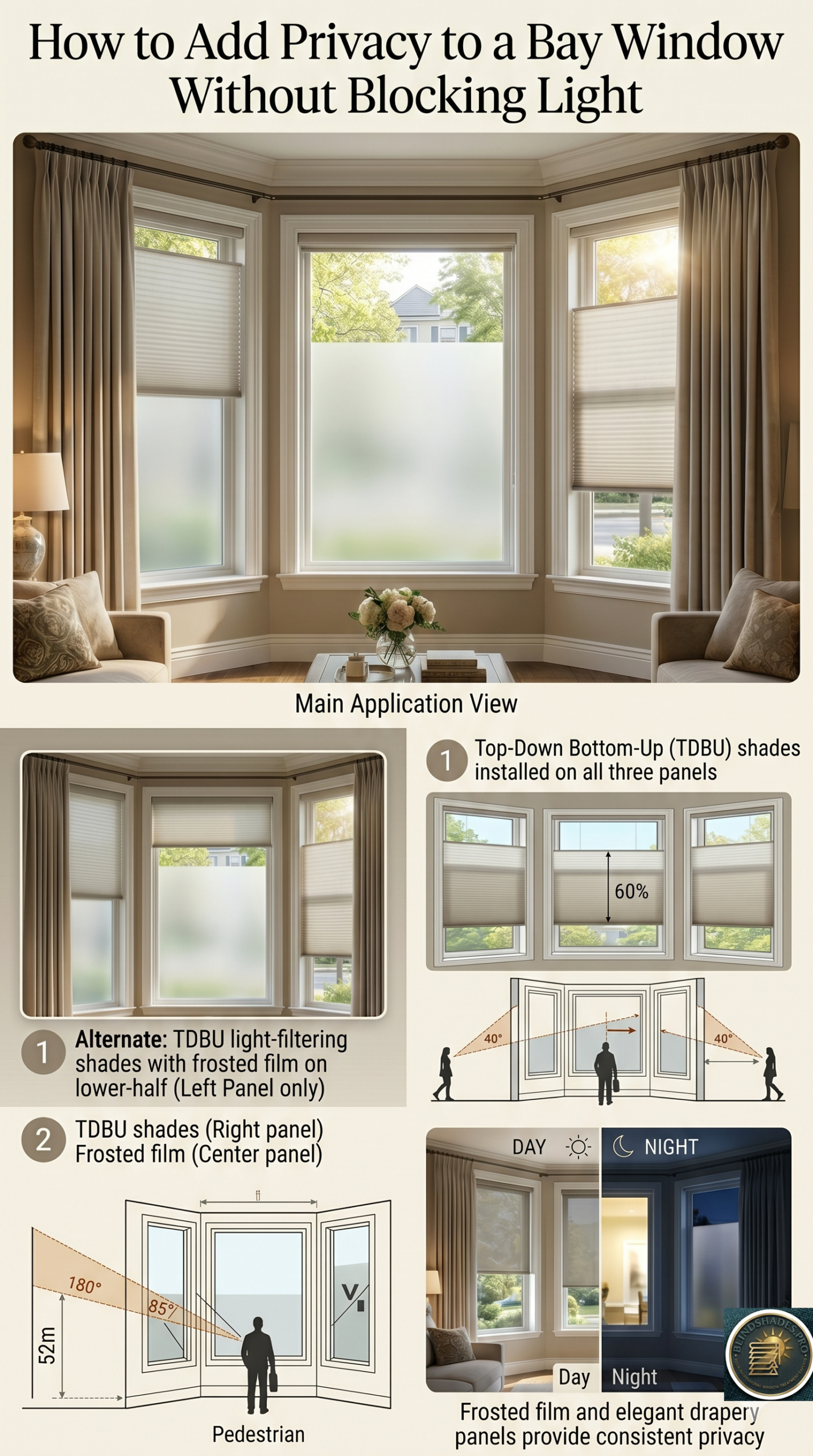
Key Takeaways:
- The center panel of a bay window has a direct sightline from exterior observers standing at street level; the side panels angled at 30 to 45 degrees have oblique sightlines that naturally reduce exterior visibility; a homeowner can use a stronger privacy treatment on the center panel (where the direct sightline exists) and a lighter treatment or no treatment on the side panels (where the angled position provides natural visual protection), preserving more natural light from the sides while addressing the primary privacy concern at the center
- Solar shades provide excellent daytime bay window privacy without blocking light at 3 to 5 percent openness on the center panel; at 3 percent openness, exterior observers cannot clearly see in during daylight hours while the inside maintains outdoor visibility; however, ANY solar shade at any openness factor fails at nighttime when interior lights are on — the effect reverses and exterior observers can see in more clearly than through untreated glass; never rely on solar shades alone for nighttime privacy on a street-facing bay window
- A top-down bottom-up (TDBU) shade on a bay window provides the highest privacy-to-light ratio of any operable treatment: raise the shade from the bottom to cover only the lower 60 percent of the glass (approximately the lower 36 inches of a 60-inch panel); this blocks the primary ground-level sightline from exterior observers standing at street level while the upper 40 percent of the glass (24 inches) admits full, unobstructed natural light from above
- Three individual privacy treatments installed in a bay window leave corner light gaps of approximately 1.5 to 2.5 inches at each angled corner junction where adjacent panels meet; at night with interior lighting, these corner gaps glow and allow exterior observers to see strips of interior light along both bay corners; apply frosted film at the corner junction or specify an outside-mount treatment extending past the frame edges to eliminate the corner privacy gaps
- Frosted film preserves 60 to 80 percent of visible light as diffuse soft illumination and provides consistent day-and-night privacy through physical light scattering; a 5 percent solar shade preserves only approximately 5 percent of visible light as direct view; frosted film is superior for light preservation at any time of day and is the only single-treatment option that provides full-time privacy without requiring a secondary layer for nighttime coverage
⭐ Quick Answer — How Do You Add Privacy to a Bay Window Without Blocking Light?
- The Sightline Geometry — Not All Bay Window Panels Need the Same Privacy Treatment: The most effective approach to bay window privacy without blocking light starts with the sightline. The center panel of a 3-panel bay window faces directly outward toward the street — an exterior observer at the sidewalk can look straight through into the room. This panel requires the strongest privacy treatment. The side panels angle away at 30 to 45 degrees — an observer standing directly in front of the home has a highly oblique sightline through the side panels, seeing mostly the edge of the room rather than the main interior. This means side panels need a lighter treatment, or just lower-half coverage. Optimal configuration: full frosted film or 3–5% solar shade on the center panel (direct sightline); lower-half frosted film or 5–7% solar shade on the side panels (oblique sightline). This asymmetric approach preserves approximately 80 to 90 percent of total bay window light vs the 60 to 80 percent of full coverage on all three panels
- The Solar Shade Openness Guide by Panel Position and Bay Orientation: Selecting the right openness factor is the key specification decision for bay window privacy without blocking light using solar shades. Center panel facing the street (direct sightline): 3 to 5 percent openness — Blindsgalore confirms 5% is “the most common choice balancing view, glare reduction, and daytime privacy in most living rooms, dining rooms, and kitchens.” Side panels at 45 degrees (oblique sightline): 5 to 7 percent — the oblique angle already reduces exterior visibility; tighter weave not required. South and west-facing center panel: 1 to 3 percent — maximum privacy and glare control for sun-exposed positions. North-facing panels: 7 to 10 percent acceptable — less direct solar radiation; higher openness preserves more view and light. Color by orientation: darker fabric (charcoal, dark bronze) for south/west-facing bays — clearer outward view and better glare control. Lighter fabric (ivory, warm white) for north-facing bays — reflects more visible light back into the interior, keeping the room brighter
- The TDBU Lower-60% Rule — Maximum Light Preserved with Effective Privacy: A top-down bottom-up shade is the highest privacy-to-light-ratio operable treatment for bay window privacy without blocking light. Exterior observers standing at street level have a sightline entering through the LOWER portion of the bay window glass — at eye level to the interior. The upper portion of the bay window (above approximately 5 feet from the floor) is above the typical standing exterior sightline. The optimal TDBU configuration: raise the shade from the bottom to cover approximately the lower 60 percent of each panel — for a 60-inch tall panel: raise 36 inches, leave 24 inches open at the top. The 36-inch lower section blocks the primary ground-level sightline. The upper 24 inches of clear glass admits full unobstructed natural light from above — more light than any frosted film or shade fabric treatment on the full panel. Specify TDBU cellular shades for this configuration; they also add R-3 to R-4 insulation per panel
- The Night Reversal Warning and the Corner Light Gap Problem: Two nighttime privacy failures specific to bay windows. (1) Solar shade night reversal: any solar shade at any openness factor reverses its privacy effect at night when interior lights are on. Blindsgalore confirms: “No. Solar shades give privacy during the day only. At night, with interior lights on, people outside can see in through any openness factor.” A street-facing bay window is typically the most prominent feature on the home’s facade — the nighttime reversal is more visible here than at any less prominent window. For full nighttime privacy: layer solar shades with drapes, or specify frosted film. (2) Corner light gap: three individual privacy treatments leave gaps of approximately 0.75 to 2.5 inches at each angled corner junction. At night with interior lighting, these corner gaps glow — strips of interior light visible along both bay corners from outside. Solutions: apply frosted film at the corner junction glass; specify outside-mount treatments extending past frame edges; or install a continuous valance covering the corner gaps
- Frosted Film vs Solar Shade — The Light Preservation Comparison: Frosted film is the superior single treatment for bay window privacy without blocking light when interior brightness is the priority. Frosted film transmits 60 to 80 percent of visible light as soft diffuse ambient illumination and provides consistent day-and-night privacy through physical light scattering — its mechanism does not depend on exterior vs interior light levels. A 5 percent solar shade transmits approximately 5 percent of visible light as a direct outward view and provides daytime privacy only. Frosted film therefore preserves approximately 12 to 16 times more visible light than a 5 percent solar shade while providing equivalent or better privacy including nighttime. Full comparison: frosted film 60–80% light; light-filtering cellular 25–35%; sheer curtains 40–60%; 7% solar shade ~7%; 5% solar shade ~5%; 3% solar shade ~3%; 1% solar shade ~1%. For rooms where interior brightness is the primary concern alongside privacy, frosted film is the correct specification
- Best Sources: Solar shade openness factor comparison guide (1% through 14%; darker fabric for clearer view; nighttime failure confirmed) → Blindsgalore solar shade openness guide · Solar shade daytime vs nighttime privacy analysis → Blinds Chalet solar shade privacy guide · Day vs night privacy distinction and layering solutions → Fredericksburg Window Decor privacy guide
⚠️ The Asymmetric Partial Coverage Approach and the Complete Options Table: The most light-preserving bay window privacy without blocking light configuration applies treatments asymmetrically. Center panel (direct street sightline): full frosted film or 3 to 5 percent solar shade or TDBU cellular covering lower 60 percent. Side panels at 45 degrees (highly oblique sightline): lower-half frosted film only — from the sill to approximately the panel midpoint; the upper half of each side panel remains clear glass at 100 percent light transmission. Net result: approximately 80 to 90 percent of total bay window light preserved with effective ground-level privacy across all three panels. The complete ranked options table: frosted film (60 to 80 percent light; day and night privacy). TDBU cellular lower 60 percent (100 percent light in upper 40 percent; effective ground-level privacy). Light-filtering cellular (25 to 35 percent light; day and night). Sheer curtains (40 to 60 percent light; partial daytime only). 7 percent solar shade (~7 percent light; daytime only). 5 percent solar shade (~5 percent light; daytime only; clearer view). 3 percent solar shade (~3 percent light; maximum daytime privacy; limited view). For the full bay window treatment selection including headrail interference test, depth chart by treatment type, and the 24-square-foot glass area energy calculation, see What Are the Best Blinds for Bay Windows. See the full sightline geometry guide below.
💡 The Full Nighttime Privacy Solution and the Corner Gap Repair Protocol: For full nighttime bay window privacy without blocking light during the day, the layered approach is the most effective: solar shades (3 to 5 percent) on the center panel and 5 to 7 percent on the side panels handle daytime glare and privacy with an outward view; floor-length drapes on a rod from main wall to main wall close at night for complete coverage. Fredericksburg Window Decor confirms: “For nighttime privacy, consider layered treatments such as sheer curtains paired with heavier drapes or blinds you can close after sunset.” The corner light gap repair protocol for existing bay window installations: cut strips of frosted film to approximately 3 to 4 inches wide; apply them along the corner angle at each interior bay junction, covering the gap between adjacent panel frames; the film fills the triangular gap between adjacent treatments, eliminating the nighttime glow at the corners. For new installations: specify outside-mount shades extending 1 to 2 inches beyond the frame on each side; the extended shade covers the corner gap entirely. The continuous valance option: install a continuous decorative valance across all three panels; the valance masks the corner gap from interior view and reduces the light leakage at the top portion of the corner angle. For the specific window seat clearance specifications, radiator clearance rules, and the three-layer system applicable when adding curtains as the nighttime layer over bay window solar shades, see What Are the Best Curtains for a Bay Window. See the full corner gap fix below.
📖 Read the complete guide below for: the bay window sightline geometry (center panel = direct street sightline; side panels at 30 to 45 degrees = oblique; asymmetric treatment intensity), the 5 options ranked by light preserved (frosted film 60-80% / TDBU lower-60% with 100% in upper section / cellular 25-35% / sheers 40-60% / solar 3-7%), the solar shade openness guide by panel position and bay orientation (center 3-5%; oblique side 5-7%; south/west 1-3%; north 7-10%; darker fabric for south/west; lighter for north), the TDBU lower-60% configuration (36 inches of 60-inch panel; 24-inch clear upper section), the solar shade nighttime reversal on prominent street-facing bay windows, the corner light gap glow and its solutions (frosted film strips; outside mount; continuous valance), the asymmetric partial coverage approach (full center + lower-half sides = 80-90% total light), and the lux comparison (frosted film 12-16 times more light than 5 percent solar shade).
Bay Window Privacy Without Blocking Light — The Sightline Geometry
The most important insight absent from all competitor guides — not all bay window panels need the same privacy treatment.
A standard single window has one sightline into the room from exterior observers. A bay window has three panels at different angles to the street, creating three different sightlines with different privacy implications.
The center panel — the primary sightline: The center panel of a 3-panel bay window faces directly outward toward the street. An exterior observer standing on the sidewalk in front of the home can look directly through the center panel into the room at eye level. This is the highest-exposure panel and requires the strongest privacy treatment.
The side panels — naturally oblique sightlines: The side panels of a bay window angle away from the street at 30 or 45 degrees. An exterior observer standing directly in front of the home looking toward a 45-degree side panel has a sightline at a 45-degree angle to the glass — highly oblique. Interior content visible through an oblique sightline is significantly reduced: the observer sees mostly the edge of the room rather than the main interior space.
The practical implication: For bay window privacy without blocking light, optimal light preservation uses different treatment intensities for different panels:
- Center panel: stronger privacy treatment — full frosted film, 3–5% solar shade, or TDBU cellular shade
- Side panels: lighter treatment — lower-half frosted film only, 7–10% solar shade, or sheers alone
This asymmetric approach preserves significantly more natural light than applying identical full-panel privacy treatments across all three panels.
Bay Window Privacy Without Blocking Light — The 5 Options Ranked
Ranked by visible light preserved with effective privacy:
| Treatment | Light Preserved | Day Privacy | Night Privacy | Best Panel |
|---|---|---|---|---|
| Frosted film (full panel) | 60–80% (diffuse) | YES | YES | Center panel; bath bays |
| TDBU cellular (lower 60% only) | 100% in upper 40% | YES | Partial (lower blocked) | All panels |
| Light-filtering cellular shade | 25–35% (filtered) | YES | Partial | All panels; insulation priority |
| 3% solar shade | ~3% (direct view out) | YES | NO | Center panel; south/west bays |
| 5% solar shade | ~5% (clear view out) | YES | NO | Center + side panels |
| Sheer curtains | 40–60% (diffuse) | Partial (softer) | NO | All panels; decorative |
Option 1 — Frosted Film (Best Day-and-Night Privacy with High Light Preservation)
Frosted film applied to bay window glass transmits 60 to 80 percent of visible light as soft diffused ambient illumination while providing consistent full-time privacy through physical light scattering. Shade Brothers confirms: frosted film “lets sunlight in but obscures direct visibility, creating a bright yet private environment.”
Why frosted film outperforms solar shades for bay window privacy without blocking light: Solar shades provide daytime privacy only. At night when interior lights are on, the one-way visibility effect reverses: the interior becomes brighter, exterior observers see in, and the shade becomes effectively transparent from outside. Blindsgalore confirms: “No. Solar shades give privacy during the day only. At night, with interior lights on, people outside can see in through any openness factor.”
Frosted film provides privacy through physical diffusion — it scatters light regardless of which side is brighter. It works equally at 2 PM and at 11 PM.
Application for bay windows:
- Cut to the glass shape of each panel
- For the center panel: full panel frosted film
- For the side panels: lower-half only (see partial coverage section below)
- At corner junctions: apply film to extend slightly into the corner angle to seal the corner gap
Cost: $20–$80 per bay window panel
Option 2 — TDBU Cellular Shade (Best Privacy-to-Light Ratio of Any Operable Treatment)
A top-down bottom-up (TDBU) cellular shade allows the shade to be raised from the bottom to cover only the lower portion of the window while the upper portion remains open glass — admitting full-intensity natural light from above.
The bay window TDBU protocol: Exterior observers standing at street level have a sightline that enters the bay window through the LOWER portion of the glass — at eye level to the interior. The upper portion of the bay window (above approximately 5 feet from the floor) is above the exterior observer’s typical standing-eye-level sightline.
The optimal configuration: Raise the TDBU shade from the bottom to cover approximately the lower 60 percent of each panel:
- 60-inch tall panel: raise shade 36 inches from bottom; leave upper 24 inches open
- This blocks the primary ground-level sightline while the open upper 40% of the glass provides full, unobstructed natural light from above
- The light admitted through the clear upper portion is equivalent to the entire top portion of the window with no treatment
This TDBU lower-60% configuration preserves significantly more natural light than any full-panel treatment while providing effective privacy against street-level observers.
Option 3 — Solar Shade (Best Daytime Privacy with View Maintained)
Solar shades provide daytime one-way visibility — occupants see out while exterior observers cannot see clearly in — through the light differential mechanism: exterior daylight is brighter than interior ambient light, creating a one-way mirror effect.
The openness factor guide by bay panel position:
| Panel Position | Recommended Openness | Reason |
|---|---|---|
| Center panel (direct sightline, south/west-facing) | 1–3% | Maximum daytime privacy; south/west orientation adds glare control priority |
| Center panel (direct sightline, north-facing) | 3–5% | Privacy maintained; less solar gain concern |
| Side panels at 45 degrees | 5–7% | Oblique sightline already reduces exterior visibility; higher openness preserves more view and light |
| Side panels at 30 degrees | 3–5% | Slightly less oblique; moderate openness appropriate |
Blindsgalore confirms: “5% openness is the most common choice. The 5% level balances view, glare reduction, and daytime privacy well enough to work in most living rooms, dining rooms, and kitchens.”
The color effect by bay orientation: For south-facing and west-facing bay windows: specify darker solar shade fabric (charcoal, dark bronze, dark beige). Blindsgalore confirms: “Darker solar shade fabrics often provide a clearer outward view during the day and can be especially effective for glare reduction.” Darker fabrics also absorb more solar radiation, keeping the bay cooler.
For north-facing bay windows: lighter solar shade fabric (warm white, ivory, light linen) reflects more visible light back into the room, making the interior feel brighter behind the shade.
The nighttime limitation for bay windows: A bay window is typically the most prominent window on the front facade of a home. An exterior observer approaching the house at night directly faces the bay window as the primary visible element. Any solar shade — at any openness — reverses its privacy effect at night when interior lights are on. This reversal is more consequential for a prominent street-facing bay window than for a less visible side window. For full nighttime privacy: layer solar shades with drapes or add frosted film.
Option 4 — Light-Filtering Cellular Shade (Privacy Plus Insulation)
Light-filtering cellular shades on individual bay panels transmit 25 to 35 percent of incoming light as filtered ambient illumination. They provide daytime and nighttime privacy (the opaque cellular fabric blocks the interior/exterior light differential that causes solar shade nighttime reversal).
Blindschalet confirms: “cellular shades are excellent here. They ensure you can get dressed without worry while still waking up to natural light if you choose light-filtering fabrics.”
The bay window consideration: Cellular shades also add R-3 to R-4 insulation per panel — relevant for south and west-facing bays where solar heat gain is significant. The trade-off: cellular shades transmit only 25–35% of light vs frosted film at 60–80%. If light preservation is the priority, frosted film is the better choice; if insulation is also a goal, cellular shades are appropriate.
Option 5 — Sheers (Decorative Daytime Privacy; Insufficient Alone)
Sheer curtains transmit 40 to 60 percent of visible light as soft diffused illumination and provide partial daytime privacy — reducing the clarity of the interior view without fully obscuring it. Covering Windows notes: “sheer curtains act like frosted glass — they diffuse sunlight.”
Sheers alone are insufficient for bay window privacy without blocking light for two reasons:
- They do not fully obscure interior visibility — motion and silhouettes remain visible from close range
- They provide no nighttime privacy
The appropriate use: Sheers work correctly as Layer 2 of the three-layer system described in Article 43-4 — a curved rod at the bay opening holds sheers for daytime softness while Layer 1 (inside-mount cellular per panel) and Layer 3 (opaque drapes) handle the full privacy requirement.
The Corner Light Gap — The Bay Window Privacy Leakage Problem
The privacy failure unique to bay windows — absent from all privacy guides.
When three individual privacy treatments are installed in a bay window, a gap exists at each angled corner junction where the frame of one panel meets the frame of the adjacent panel. At a 30 or 45-degree junction:
- A roller shade creates a combined corner gap of approximately 1.5 to 2.5 inches (Article 43-1 established this)
- A Roman shade or cellular shade creates a combined corner gap of approximately 0.75 to 1.5 inches
The nighttime privacy implication: When all three bay window blinds or shades are closed at night with interior lighting on, these corner gaps glow — interior light leaks through the angular junctions and creates a visible strip of illumination at each bay corner from outside. An exterior observer at the correct angle can see slivers of interior movement through these corner gaps.
The solutions:
- Frosted film at the corner angles: Apply a strip of frosted film to the glass at each corner junction — the film covers the angled gap between adjacent panel frames, filling the privacy leakage point
- Outside-mount treatments: Specify each treatment with an outside mount extending past the frame edges; the extended treatment covers the frame gap, eliminating the corner leakage
- Continuous valance or cornice box: A continuous valance across all three panels hides the corner gaps at the top; the shade fabric below fully covers each panel’s glass
The Asymmetric Partial Coverage Approach
The most light-preserving bay window privacy configuration — absent from all guides.
For maximum light preservation with effective privacy, apply treatments asymmetrically based on each panel’s sightline:
Center panel (direct sightline): Full-panel frosted film OR 3–5% solar shade OR TDBU cellular covering the lower 60%
Side panels at 45 degrees (highly oblique sightline): Lower-half frosted film only (from the sill to approximately the panel midpoint) — the film covers the ground-level sightline zone while the upper half of the side panels remains clear glass admitting full, unobstructed natural light at an angle into the room
The light preservation advantage:
- Full coverage on all three panels: 60–80% of light preserved (frosted film)
- Asymmetric approach (full center + lower-half sides): the side panels’ upper halves (approximately 50% of side panel area) admit 100% of light; the side panels’ lower halves transmit 60–80% via frosted film; the center panel transmits 60–80%
- Net result: approximately 80–90% of total bay window light preserved with effective ground-level privacy across all three panels
The Lux Reference — Understanding How Much Light Each Option Preserves
The quantified comparison absent from all bay window privacy guides.
| Treatment | Light Preserved | Interior Light Quality |
|---|---|---|
| No treatment (clear glass) | 100% | Full direct natural light |
| Frosted film | 60–80% | Soft diffuse ambient light |
| Light-filtering cellular shade | 25–35% | Filtered ambient light |
| Sheer curtains | 40–60% | Soft diffuse light |
| 7% solar shade | ~7% (direct view out) | Dim; primarily outward view |
| 5% solar shade | ~5% (clear outward view) | Very dim; clear outward view |
| 3% solar shade | ~3% (strong privacy) | Very dim; limited outward view |
| 1% solar shade | ~1% (near blackout) | Near-blackout |
The conclusion for bay window privacy without blocking light: Frosted film preserves approximately 10 to 25 times more interior light than a 3–5% solar shade while providing equivalent or better privacy (day and night vs daytime only). For bay windows where interior brightness is the priority alongside privacy, frosted film is the superior single-treatment option.
Where to Order
For solar shade openness factor guide and bay window daytime privacy options: Blindsgalore at blindsgalore.com/blog/index.php/beyond-basics/solar-screen-openness-factor-explained — the most detailed published guide to solar shade openness selection; 1% through 14% comparison; darker fabric for clearer outward view; nighttime limitation confirmed.
For solar shade privacy daytime vs nighttime analysis: Blinds Chalet at blindschalet.com/expert-advice/eaa-166-do-solar-screen-shades-provide-privacy.html — privacy performance by openness factor; nighttime reversal explanation; lower openness for street-facing ground-floor windows; layering recommendation.
For the day vs night privacy distinction and layering solutions: Fredericksburg Window Decor at fredericksburgwindowdecor.com/blog/whats-the-best-way-to-add-privacy-without-blocking-all-the-light — daytime vs nighttime privacy as different problems; layering solutions; sheer + drapes for full coverage; solar shades for day; blackout layer for night.
Frequently Asked Questions
How do you add privacy to a bay window without blocking light? To add privacy to a bay window without blocking light, match the treatment intensity to each panel’s sightline geometry. The center panel facing the street directly needs the strongest privacy: frosted film preserves 60 to 80 percent of light as diffuse illumination while providing day-and-night privacy, or a 3 to 5 percent solar shade provides excellent daytime privacy with an outside view. The angled side panels receive oblique sightlines and need lighter treatment: lower-half frosted film on the side panels preserves the full upper-half light while covering the ground-level sightline zone.
Why do solar shades fail for bay window privacy at night? Solar shades fail for bay window privacy at night because their privacy mechanism depends on a light level differential. During the day, exterior light is brighter than interior and the shade fabric creates a one-way visibility effect. At night with interior lights on, interior light becomes brighter than exterior, reversing the effect and making the interior visible to exterior observers. Blindsgalore confirms: “No. Solar shades give privacy during the day only. At night, with interior lights on, people outside can see in through any openness factor.” Because a bay window is typically the most prominent feature on a home’s facade, this nighttime reversal is particularly consequential.
What is the TDBU approach for bay window privacy without blocking light? The TDBU approach for bay window privacy without blocking light raises the shade from the bottom to cover only the lower 60 percent of each panel (approximately 36 of 60 inches), blocking the primary ground-level sightline from exterior observers while leaving the upper 40 percent of the glass as clear, unobstructed natural light. Exterior observers at street level look through the lower portion of the window glass into the room at eye level. The upper portion of the bay window glass above approximately 5 feet from the floor is above the typical exterior standing sightline and provides minimal additional privacy benefit when covered.
What is the corner light gap problem for bay window privacy treatments? The corner light gap problem occurs when three individual privacy treatments are installed in a bay window, leaving a gap of approximately 0.75 to 2.5 inches at each angled corner junction where adjacent panel frames meet. At night with interior lighting, interior light leaks through these corner gaps and glows at the bay corners from outside, allowing exterior observers to see strips of interior light along both bay corners. Solutions include applying frosted film to the corner junction glass, specifying outside-mount treatments extending past the frame edges, or installing a continuous valance that covers the corner gap area.
How much light does frosted film preserve compared to solar shades for bay window privacy? Frosted film preserves approximately 60 to 80 percent of visible light as soft diffuse ambient illumination while providing full-time day-and-night privacy. A 5 percent solar shade preserves approximately 5 percent of visible light as a direct outward view but provides daytime privacy only. Frosted film therefore preserves approximately 12 to 16 times more visible light than a 5 percent solar shade while providing equivalent or better privacy including nighttime coverage.
Related Guides on BlindShades.pro
- The Best Bay Window Blinds & Shades Buying Guide
- What Are the Best Blinds for Bay Windows
- What Are the Best Curtains for a Bay Window
- What Blinds Work Best for Angled Bay Window Side Panels
- Are Cellular Shades Good for Bay Windows
By Michael Turner | 30 Years Home Improvement Expertise | Updated 2026 | BlindShades.pro
