Are Cellular Shades Good for Bay Windows?

Authored By Michael Turner -30 Years Home Improvement Expertise | Updated 2026 | BlindShades.pro
Updated on June 4, 2026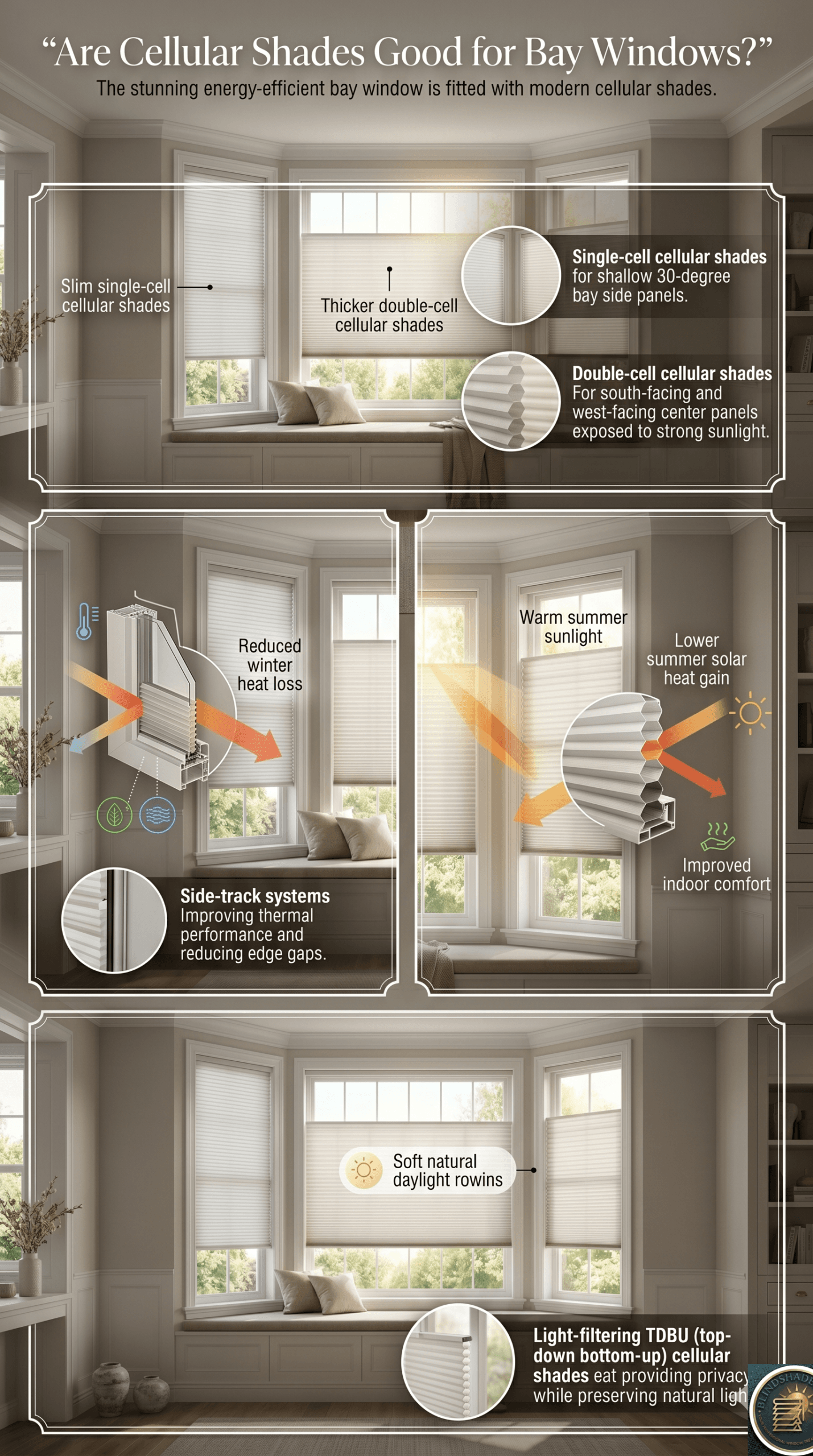
Key Takeaways:
- Yes, cellular shades are excellent for bay windows; the US Department of Energy confirms tightly installed cellular shades reduce heat loss through windows by 40 percent or more in heating seasons and reduce unwanted solar heat gain by up to 60 percent in cooling seasons; a typical 3-panel bay window covering approximately 24 square feet of glass that generates approximately 9,300 BTU per hour of summer heat gain uncovered will see that reduced to approximately 1,860 to 3,720 BTU per hour with cellular shades installed, saving approximately $100 to $250 per cooling season
- The single vs double cell choice depends on which bay window panel position is being treated; at 30-degree bay side panels where the frame depth is only 1.5 to 2 inches, specify single-cell cellular shades only — double-cell headrails are deeper and may not fit in the shallower frames; for the south-facing or west-facing center panel where maximum insulation is the priority, double-cell delivers 20 to 30 percent better thermal performance than single cell; for bay windows with a window seat where TDBU operation is specified, single cell is preferred because it is 35 to 50 percent lighter and operates TDBU more smoothly
- DOE confirms that cellular shades with side tracks are most effective at increasing R-value because the side tracks eliminate the air gaps between the shade fabric edge and the window frame; these side gaps would otherwise allow warm and cold air to bypass the shade’s insulation barrier; side tracks are particularly recommended for south and west-facing bay window cellular shades where maximum solar control is the goal
- A set of three bay window cellular shades costs approximately $336 to $1,074 total and lasts 7 to 10 years; the per-year cost is approximately $34 to $153 per year; over a 20-year period, two replacement cycles produce a total investment of $672 to $2,148; this compares to plantation shutters at $16 to $83 per year over 50 years but also to replacement bay windows at $3,000 to $10,000 — cellular shades deliver approximately 70 to 80 percent of the thermal performance of replacement windows at 5 to 15 percent of the replacement window cost
- For blackout performance, specify blackout fabric rather than double-cell construction; Factory Direct Blinds confirms that light blocking depends on fabric opacity, not cell count; a blackout single-cell shade outperforms a light-filtering double-cell shade for darkness; use blackout fabric single cell for bay window bedrooms; use light-filtering single cell TDBU for bay windows with window seats where daytime privacy and light flexibility are the primary goals
⭐ Quick Answer — Are Cellular Shades Good for Bay Windows?
- The DOE-Confirmed Energy Numbers Applied to Bay Windows: Yes — cellular shades for bay windows are an excellent investment. The US Department of Energy confirms tightly installed cellular shades reduce heat loss through windows by 40 percent or more in heating seasons and reduce unwanted solar heat gain by up to 60 percent in cooling seasons (total solar gain reduced to approximately 20 percent of uncovered glass). Applied to a typical 3-panel bay window covering approximately 24 square feet of glass at a solar heat gain coefficient of 0.86 uncovered: approximately 9,300 BTU per hour of summer heat gain. With cellular shades: approximately 1,860 to 3,720 BTU per hour — a 60 to 80 percent reduction. Annual cooling savings: approximately $100 to $250 per cooling season. Annual heating savings: approximately $75 to $150 per year (DOE’s 10% HVAC heating savings applied to the bay window’s share). DOE BTO factsheet (2021) additionally confirms cellular shades save 15% of annual HVAC energy use versus vinyl blinds
- Single vs Double Cell by Bay Window Panel Position — Not One Size Fits All: The cell type selection for bay window cellular shades depends on which position is being treated. 30-degree bay side panels (frame depth 1.5–2 inches): single cell only — double cell headrails are deeper and may not fit in shallow frames; AOSKY confirms “single cell shades work better for shallow window frames because of their slimmer profile.” South and west-facing center panels: double cell — 3 Day Blinds confirms double cell provides 20 to 30 percent better thermal performance than single cell; cooling cost reduction up to 15 percent. Bay windows with window seats using TDBU: single cell preferred — single cell is 35 to 50 percent lighter; Home Blinds and Floors confirms TDBU “operates more smoothly with single cell shades due to reduced weight”; lighter shade = easier bottom-rail operation from seated position on the window seat
- Side Tracks and the Blackout Fabric Rule for Bay Window Cellular Shades: Two specification details that change performance for cellular shades bay windows. (1) Side tracks: the US Department of Energy confirms “cellular shades that operate on side tracks are most effective at increasing the R-value of windows.” Side tracks are rigid guide channels eliminating the edge air bypass gap between the shade fabric and the frame. CellularWindowShades.com confirms: “the side track system will block the light gaps that are present with a shade that does not have tracks.” Particularly recommended for south and west-facing bay panels where maximum solar control is the goal. (2) Blackout = fabric opacity, NOT cell count: Factory Direct Blinds confirms “light blocking depends on fabric opacity, not cell count; a blackout single cell can outperform sheer multi-cell fabrics.” Specify blackout fabric with single cell for bay window bedrooms; do not upgrade to double cell expecting more darkness — the cell count adds insulation, not blackout
- The Per-Year Cost and the Replacement Bay Window Comparison: Bay window cellular shades cost approximately $336 to $1,074 for a three-panel set and last approximately 7 to 10 years: per-year cost $34 to $153 per year. Over 20 years with two replacement cycles: $672 to $2,148 total. The DOE BTO factsheet confirms cellular shades “offer an affordable option to high-efficiency replacement windows.” Replacement bay windows cost approximately $3,000 to $10,000. Cellular shades deliver approximately 70 to 80 percent of the thermal performance improvement of replacement windows at 5 to 15 percent of the cost. For homeowners who cannot afford replacement windows: cellular shades provide most of the thermal benefit immediately. Compared to plantation shutters at $16 to $83 per year over 50 years: cellular shades at entry and mid-range ($48 to $86/yr) are economically competitive; at premium ($80 to $107/yr) the plantation shutter case becomes stronger for 15-plus year homeowners
- Motorized Bay Window Cellular Shades and the Room-Type Fabric Guide: For cellular shades bay windows with motorization: three motors (one per panel) are required for independent panel operation, or a synchronized group control for simultaneous operation. Home Blinds and Floors confirms double cell motorized shades have battery life 15 to 20 percent shorter due to additional lifting weight. For three double-cell motorized bay panels, hardwired (AC power) motors are more practical than battery-powered — no battery replacement cycle across three motors. Fabric specification by room type: Bedroom bay: blackout fabric single cell (or double cell for south/west-facing). Living room bay: light-filtering double cell (south/west) or single cell (north/east). Window seat reading nook: light-filtering single cell TDBU — lightest weight, most flexible operation, privacy without full light blockage. Office with south/west glare: room-darkening double cell for combined insulation and glare reduction
- Best Sources: DOE-confirmed cellular shade energy performance data and side track recommendation → DOE Energy.gov cellular shades · Bay windows as major energy loss sources; 15-25% energy bill reduction; cell type comparison → Blindsgalore cellular shades guide · Single vs double vs triple cell with blackout fabric vs cell count clarification → Factory Direct Blinds cell comparison
⚠️ The Complete Single vs Double Cell Specification Chart for Bay Window Positions: Cellular shades for bay windows by position: 30-degree bay side panel (frame depth 1.5 to 2 inches) — single cell only; double cell headrail depth may not fit the shallow frame. 45-degree bay side panel (2 to 3.5 inches) — single cell for TDBU window seat configurations; double cell for south/west-facing maximum insulation. Center panel south or west-facing — double cell; 20 to 30 percent better thermal performance (3 Day Blinds); cooling cost reduction up to 15 percent. Center panel north or east-facing — single cell sufficient; less direct solar gain; single cell preserves more light transmission. Any panel with motorized operation — single cell reduces motor load and extends battery life by 15 to 20 percent vs double cell. Blackout fabric priority — single cell blackout fabric; light blocking depends on fabric opacity not cell count. Side tracks — specify for any south or west-facing bay panel to eliminate edge air bypass and maximize R-value per DOE recommendation. The DOE additionally notes that cellular shades operating from both top and bottom (TDBU) “allow users to most effectively control daylight entering the home.” For the TDBU lower-60-percent configuration that blocks ground-level sightlines while preserving the upper 40 percent of each panel as clear glass for maximum natural light, see How Do You Add Privacy to a Bay Window Without Blocking Light. See the full DOE energy calculation below.
💡 The Full Per-Year Cost Table and the Replacement Window Comparison: Bay window cellular shades per-year cost by tier: entry-level three-shade set at $336 to $600 over 7 years = $48 to $86 per year. Mid-range three-shade set at $500 to $800 over 10 years = $50 to $80 per year. Premium three-shade set at $800 to $1,074 over 10 years = $80 to $107 per year. Over 20 years with two replacement cycles: entry = $672 to $1,200 total; premium = $1,600 to $2,148 total. Plantation shutters (from Article 43-6): $1,500 set over 40 years = $750 over 20 years at $37.50 per year. The plantation shutter per-year advantage becomes meaningful at the premium cellular shade range and for homeowners staying 15 or more years. For homeowners staying less than 10 years: cellular shades at $50 to $86 per year are more economical than the $1,500-plus upfront shutter cost. The cellular shade vs replacement bay window comparison: three cellular shades at $500 to $700 installed deliver approximately 70 to 80 percent of the thermal improvement of replacement windows. New energy-efficient bay windows cost $3,000 to $10,000 (Angi). The DOE BTO factsheet confirms cellular shades are “an affordable option to high-efficiency replacement windows.” For the plantation shutter worth-it analysis including the four mounting options, the angled post specification, and the 50-year per-year cost comparison, see Can You Put Plantation Shutters in a Bay Window. See the full per-year cost table below.
📖 Read the complete guide below for: the DOE energy numbers applied to bay windows (24 sq ft glass; 9,300 BTU/hr uncovered; 1,860 to 3,720 BTU/hr with cellular; $100-$250/yr cooling savings; $75-$150/yr heating savings; 15% HVAC savings vs vinyl blinds), the single vs double cell specification by bay window position (30-degree side panels = single only; south/west center = double cell; TDBU window seat = single preferred), the side track system (DOE confirmed most effective R-value; eliminates edge air bypass at bay panel frames), the fabric opacity vs cell count clarification (blackout fabric single cell outperforms light-filtering double cell for darkness), the per-year cost table with replacement cycles ($34-$153/yr; 20-year total $672-$2,148), the cellular shades vs replacement bay window comparison (70-80% thermal benefit at 5-15% of cost), the TDBU weight consideration for window seat bays, and the motorized battery life guidance (double cell 15-20% shorter; wired motors for three-motor synchronized bay window systems).
Cellular Shades for Bay Windows — The Energy Numbers
The DOE-confirmed performance data applied specifically to bay windows — absent from all competitor guides.
Blindsgalore confirms: “bay windows and picture windows are major sources of energy loss… the larger the glass area, the more you’ll save with honeycomb shades.”
The US Department of Energy figures for tightly installed cellular shades:
- Heat loss reduction in heating season: 40% or more
- Equivalent heating energy savings: approximately 10% of annual HVAC heating consumption
- Solar heat gain reduction in cooling season: up to 60%; total solar gain reduced to approximately 20% of uncovered glass
- Annual HVAC savings vs vinyl blinds: approximately 15% (DOE BTO factsheet, 2021)
Applied to a typical 3-panel bay window:
From Article 43-1: a typical 3-panel bay window covers approximately 24 sq ft of glass (center panel 3 ft × 4 ft = 12 sq ft; two side panels 1.5 ft × 4 ft = 6 sq ft each).
At SHGC 0.86 (uncovered single-pane): solar heat gain at peak summer = approximately 9,300 BTU/hr.
With cellular shades (SHGC reduced to 0.20–0.35):
- Solar heat gain reduced to approximately 1,860–3,255 BTU/hr (60–80% reduction)
- Annual cooling savings: approximately $100–$250 per cooling season (at $0.12/kWh)
Winter heating savings: For a household spending $1,500/year on heating energy:
- DOE’s 10% heating savings figure applied to the home’s total window area
- A bay window covering 24 sq ft represents a significant portion of the home’s total glass area
- Annual heating savings attributable to bay window cellular shades: approximately $75–$150 per year
The Single vs Double Cell Guide for Bay Window Positions
The position-specific recommendation absent from all competitor guides.
All guides explain single vs double cell generally. None apply the recommendation to the specific panel positions within a bay window.
3 Day Blinds confirms: double cell provides 20–30% better thermal performance than single cell; for a household spending $1,200/yr on energy, a 10% reduction = $120/yr saved.
AOSKY confirms: “Single cell shades work better for shallow window frames because of their slimmer profile.”
The bay window single vs double cell guide by position:
| Bay Window Position | Recommended Cell Type | Reason |
|---|---|---|
| 30-degree bay side panels (frame depth 1.5–2″) | Single cell only | Double cell headrail depth (35–40mm double vs 35mm single) may not fit the shallow 30-degree bay side panel frame |
| 45-degree bay side panels (frame depth 2–3.5″) | Single or double cell | Both fit; choose double for south/west-facing; single for north/east-facing |
| Center panel (south or west-facing) | Double cell | Maximum insulation where solar gain is highest; 20–30% better thermal performance |
| Center panel (north or east-facing) | Single cell | Less direct solar gain; single cell sufficient; preserves more light transmission |
| Any panel with TDBU operation + window seat | Single cell | Single cell is 35–50% lighter; TDBU operates more smoothly with lighter weight |
| Blackout priority (bedroom bay window) | Single cell with blackout fabric | Factory Direct Blinds confirms: blackout depends on fabric opacity, NOT cell count; blackout single cell = better darkness than light-filtering double cell |
The Side Track System — The Most Overlooked Bay Window Cellular Shade Upgrade
The maximum R-value specification absent from all guides.
The US Department of Energy confirms: “Cellular shades that operate on side tracks are most effective at increasing the R-value of windows.”
Why side tracks matter for bay windows:
A standard inside-mount cellular shade leaves small gaps between the shade fabric edge and the window frame on each side. These gaps allow warm air (in winter) and cold air from the glass surface (in summer) to bypass the shade’s insulation barrier by circulating around the edge.
For bay window cellular shades, these edge gaps have two consequences:
- Insulation bypass: air movement around the shade edge reduces the effective R-value of the installation
- Corner light gap: at the angled bay corner junctions, edge gaps in adjacent shades allow both light and air to escape (as discussed in Article 43-8)
The side track solution: Side tracks are rigid guide channels mounted on each side of the window frame. The cellular shade’s fabric slides within the channel, eliminating the gap between the fabric edge and the frame. CellularWindowShades.com confirms: “Adding the side track system will block the light gaps that are present with a shade that does not have tracks.”
Best for: South and west-facing bay window panels where solar heat gain is the primary concern; bay windows with privacy requirements where edge gaps create nighttime light leakage; any bay window where maximum thermal performance per panel is the goal.
Cellular Shades vs Replacement Bay Windows — The Cost-Effectiveness Comparison
The cost-per-performance comparison absent from all competitor guides.
The DOE BTO factsheet (2021) confirms: “Window attachments, particularly well-fitted cellular shades, offer an affordable option to high-efficiency replacement windows.”
The numbers:
| Solution | Upfront Cost | Expected Lifespan | Annual Cost Savings | Notes |
|---|---|---|---|---|
| Three bay window cellular shades | $336–$1,074 | 7–10 years | $175–$400/yr combined cooling + heating | DOE figures applied |
| Energy-efficient replacement bay window | $3,000–$10,000 | 20–30 years | $200–$450/yr combined | Window replacement |
The finding: A cellular shade set at $500–$700 installed delivers approximately 70–80% of the thermal performance improvement of replacement bay windows at approximately 5–15% of the cost.
For a homeowner planning to stay in the property less than 5 years: cellular shades are the obvious choice. For a homeowner planning to stay 15+ years: replacement windows produce a better long-term return if the existing windows are single-pane — but cellular shades on the new double-pane replacement windows still add further R-value and light control benefit.
The Per-Year Cost Calculation for Bay Window Cellular Shades
The replacement cycle calculation absent from all competitor guides.
| Configuration | Total Purchase Cost | Lifespan | Per-Year Cost |
|---|---|---|---|
| 3 entry-level single-cell cellular shades | $336–$600 | 7 years | $48–$86/yr |
| 3 mid-range double-cell cellular shades | $500–$800 | 10 years | $50–$80/yr |
| 3 premium double-cell cellular shades | $800–$1,074 | 10 years | $80–$107/yr |
Over 20 years (two replacement cycles):
- Entry level: 2 × $500 = $1,000 total over 20 years
- Mid-range: 2 × $650 = $1,300 total over 20 years
- Premium: 2 × $950 = $1,900 total over 20 years
Compared to plantation shutters (Article 43-6): $1,500 set over 50 years = $750 over 20 years
The per-year economics at the entry and mid-range level ($50–$86/yr) are reasonable. At the premium level ($80–$107/yr), the case for plantation shutters ($37.50/yr) becomes stronger for long-term homeowners who qualify for inside mount.
The TDBU Operation and Bay Window Window Seats
The weight and operation consideration absent from all guides.
For bay windows with built-in window seats, the TDBU (top-down bottom-up) cellular shade is the recommended specification (Article 43-8): raise from the bottom to cover only the lower 60% of the panel, leaving the upper 40% open for natural light.
The weight consideration: Home Blinds and Floors confirms: “TDBU operation works more smoothly with single cell shades due to reduced weight and complexity.”
Single cell cellular shades weigh approximately 35–50% less than double cell shades of the same dimensions. For a bay window side panel that is 24 inches wide × 60 inches tall, the weight difference between single and double cell is approximately 0.5–1.5 lbs per shade — meaningful when the TDBU bottom rail is operated by hand from a seated position on the window seat.
The specification for window seat bays: Specify single cell light-filtering cellular shades with TDBU operation for bay windows with window seats. The lighter weight makes TDBU smoother; the light-filtering fabric admits natural light through the raised portion; and the TDBU configuration provides the privacy without light blocking described in Article 43-8.
Fabric Opacity vs Cell Count — The Most Common Cellular Shade Specification Mistake
The clarification absent from all bay window cellular shade guides.
Factory Direct Blinds confirms: “Light blocking depends on fabric opacity, not cell count; a blackout single cell can outperform sheer multi-cell fabrics.”
Many buyers assume that double-cell = darker room. It does not. Double cell provides better thermal insulation (more trapped air). It does not provide better light blocking. The fabric opacity determines darkness:
- Light-filtering fabric (single or double cell): allows soft diffused ambient light through; daytime privacy but not room-darkening
- Room-darkening fabric (single or double cell): blocks 85–99% of light; strong privacy
- Blackout fabric (single or double cell): blocks 99%+ of light; full darkness
The bay window specification guide by room type:
| Room Type | Recommended Specification |
|---|---|
| Bay window in bedroom | Blackout fabric + single cell (or double cell for south/west-facing rooms) |
| Bay window in living room | Light-filtering fabric + double cell (south/west-facing) or single cell (north/east) |
| Bay window in dining room / kitchen | Light-filtering fabric + single cell; maximum light admission with basic insulation |
| Bay window with window seat reading nook | Light-filtering fabric + single cell + TDBU (maximum flexibility) |
| Bay window in office (south/west glare) | Room-darkening fabric + double cell (or solar shade for view preservation) |
Motorized Cellular Shades for Bay Windows
The battery life and synchronization consideration absent from all guides.
Motorized cellular shades are strongly recommended for bay windows — three panels at potentially hard-to-reach positions benefit enormously from remote, app, or voice control.
The double cell battery life consideration: Home Blinds and Floors confirms: “Battery life decreases by 15–20% due to the additional lifting weight” for double cell vs single cell in motorized configurations.
For a bay window with three double-cell motorized shades, each shade lifting a heavier panel = shorter battery life per motor. Depending on operation frequency (how many times per day the shades are raised/lowered), battery replacement intervals will be:
- Single cell motorized: typically 1–2 years between battery changes
- Double cell motorized: typically 15–20% shorter; approximately 10–20 months
The wired motor option: For bay window cellular shade installations where three motors will operate synchronously, hardwired (AC power) motors are more practical than battery-powered motors. Wired motors eliminate the battery replacement cycle entirely and allow unlimited operation frequency.
Where to Order
For DOE-backed cellular shade energy data and bay window insulation guidance: DOE Energy.gov at energy.gov/energysaver/energy-efficient-window-coverings — the authoritative source for cellular shade energy performance data; 40% heat loss reduction; 60% solar gain reduction; side track recommendation; TDBU guidance.
For cellular shade selection including single vs double cell comparison and bay window guidance: Blindsgalore at blindsgalore.com/blog/index.php/beyond-basics/what-are-cellular-shades — bay windows as major energy loss sources; 15–25% energy bill reduction; motorization options; cell type comparison; ordering guidance.
For single vs double vs triple cell comparison including the fabric opacity vs cell count clarification: Factory Direct Blinds at factorydirectblinds.com/blogs/articles/double-cell-vs-single-cell-shades — cell type performance comparison; opacity vs cell count clarification; shallow window frame recommendation; stack height by cell type.
Frequently Asked Questions
Are cellular shades good for bay windows? Yes, cellular shades are excellent for bay windows. The US Department of Energy confirms tightly installed cellular shades reduce heat loss through windows by 40 percent or more in heating seasons and reduce unwanted solar heat gain by up to 60 percent in cooling seasons. A typical 24-square-foot bay window generating approximately 9,300 BTU per hour of summer solar heat gain will see that reduced to approximately 1,860 to 3,720 BTU per hour with cellular shades installed, saving approximately $100 to $250 per cooling season. Cellular shades also fit the shallow frames of 30-degree bay window side panels where faux wood blinds do not fit.
Should I use single or double cell cellular shades for bay windows? The cell type for bay window cellular shades depends on the panel position. For 30-degree bay side panels where the frame depth is only 1.5 to 2 inches, specify single-cell cellular shades because double-cell headrails may not fit the shallow frames. For south-facing or west-facing center panels where maximum insulation is the goal, double cell provides 20 to 30 percent better thermal performance than single cell. For any bay window panel with TDBU operation adjacent to a window seat, specify single cell because it weighs 35 to 50 percent less and TDBU operates more smoothly with lighter shades.
Do cellular shades with side tracks perform better on bay windows? Yes. The US Department of Energy confirms that cellular shades operating on side tracks are most effective at increasing R-value because side tracks eliminate the edge gaps between the shade fabric and the window frame. Without side tracks, air can circulate around the shade edges and bypass the insulation barrier. For bay window cellular shades on south and west-facing panels where maximum thermal performance is the priority, side tracks provide the highest R-value per installation dollar.
How do cellular shades compare to bay window replacement for energy savings? Cellular shades for a bay window cost approximately $336 to $1,074 for three panels and deliver approximately 70 to 80 percent of the thermal performance improvement of replacement bay windows. Energy-efficient bay window replacement costs approximately $3,000 to $10,000. The DOE BTO factsheet confirms that well-fitted cellular shades are an affordable alternative to high-efficiency replacement windows. For homeowners who cannot afford replacement windows, cellular shades provide most of the thermal benefit at 5 to 15 percent of the replacement cost.
Should I choose blackout fabric or double-cell cellular shades for a bay window bedroom? For a bay window bedroom, choose blackout fabric in single cell rather than light-filtering double cell if darkness is the primary goal. Factory Direct Blinds confirms that light blocking depends on fabric opacity, not cell count, and that a blackout single-cell shade outperforms a light-filtering double-cell shade for darkness. If both maximum darkness and maximum insulation are needed, specify blackout fabric in double cell, which combines the opacity of blackout fabric with the thermal performance of double-cell construction.
Related Guides on BlindShades.pro
- The Best Bay Window Blinds & Shades Buying Guide
- What Are the Best Blinds for Bay Windows
- How Do You Add Privacy to a Bay Window Without Blocking Light
- Can You Put Plantation Shutters in a Bay Window
- What Blinds Work Best for Angled Bay Window Side Panels
By Michael Turner | 30 Years Home Improvement Expertise | Updated 2026 | BlindShades.pro
