TDBU Pleated Shades for Bathroom Windows — 30–50% Less Than TDBU Cellular, Same Privacy. But the Top Only Lowers Halfway

Authored By Michael Turner -30 Years Home Improvement Expertise | Updated 2026 | BlindShades.pro
Updated on July 13, 2026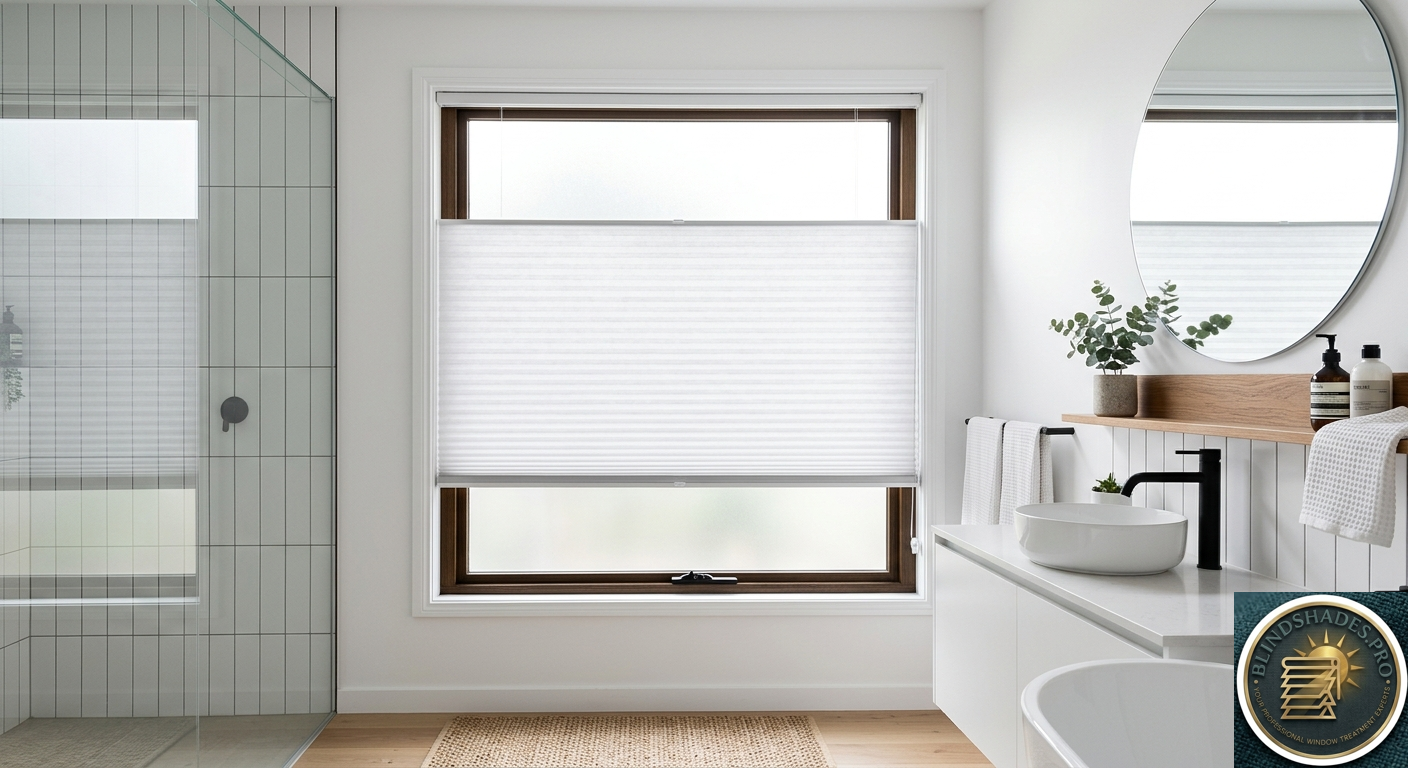
⭐ Quick Answer — TDBU Pleated Shades for Bathroom Windows
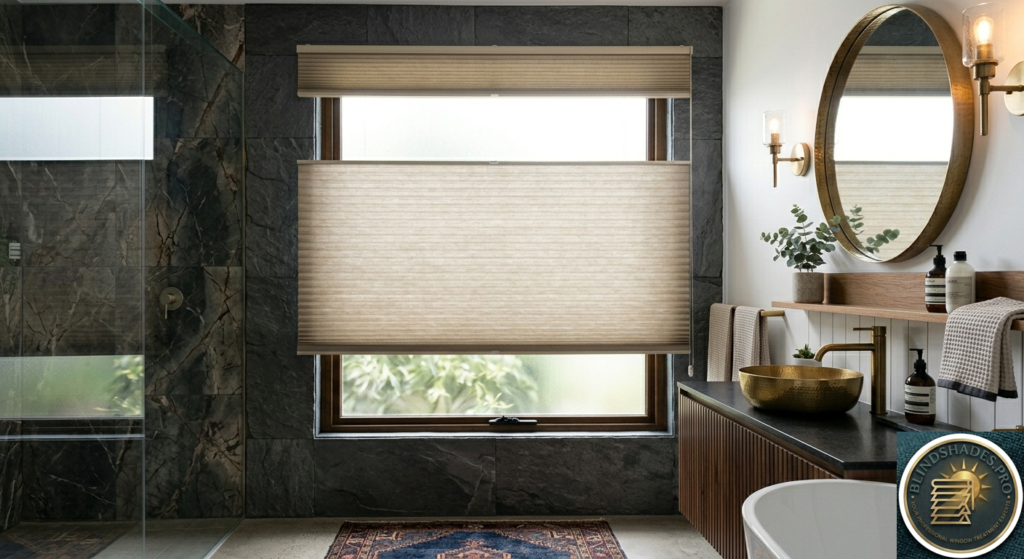
- The Mechanism: Raise the bottom rail for eye-level privacy · Lower the top rail for sun control · Leave the upper glass open for natural daylight — all independently adjustable
- How High to Raise the Bottom Rail: Bathtub / shower privacy → 12–18 inches · Standing privacy (upper floor) → 24–30 inches · Standing privacy (ground floor facing street) → 36–42 inches
- Cost vs TDBU Cellular: TDBU pleated = $35–$65/window · TDBU cellular (single cell) = $50–$80 · TDBU cellular (double cell) = $70–$120 — pleated costs 30–50% less with the same privacy-plus-daylight function
- Why Pleated Beats Cellular in Bathrooms: Cellular honeycomb cells trap moisture in bathroom steam (per Bali Blinds) · Single-layer pleated fabric dries faster · Insulation benefit of cellular less meaningful in a small, shower-heated bathroom
- Best sources: Blinds Chalet cordless TDBU pleated ($35–$65) · SelectBlinds TDBU cordless pleated ($40–$75) · Blindsgalore TDBU pleated outside mount ($35–$70)
- Fabric: 100% polyester synthetic only — no natural fibres in bathrooms · Light-filtering in white or cream to maximise daylight reflection
⚠️ Two Critical Bathroom TDBU Limitations to Know Before Ordering: (1) On cordless TDBU pleated shades, the top rail can only be lowered halfway — per Blinds Chalet’s product specification. For most bathroom applications (where you mainly raise the bottom for privacy) this is fine. If you need the top to lower more than halfway — specify TDBU cellular instead. (2) Specify outside mount — inside mount TDBU shades leave side gaps between the shade and the frame. Per Blinds Chalet, “inside mount looks built-in but leaves small side gaps.” In a bathroom these gaps create a sightline from outside that defeats the privacy purpose entirely. Mount 2–3 inches beyond the frame on each side. See the full limitations guide below.
💡 The Bathroom Privacy Geometry — and Wet-Hand Operation: The critical privacy zone in a bathroom is standing height and below (60–66 inches from the floor for a standing adult). Raising the bottom rail to 24–36 inches blocks this zone completely while leaving 60–70% of the window glass open for daylight above. And specify cordless for bathrooms — cords accumulate mildew in steam environments and create hazards on wet floors. The cordless mid-rail handle operates easily with wet hands and keeps the operating mechanism hygienic. See the full privacy positioning guide below.
📖 Read the complete guide below for: why TDBU is the ideal bathroom mechanism, the full privacy geometry table (3 scenarios with specific heights), why pleated beats cellular for bathrooms (cost + moisture), the halfway top-rail limitation explained, outside mount requirement for bathroom side gap privacy, fabric selection for bathroom moisture, wet-hand cordless handle guidance, and pricing by supplier.
Related guides: the best top down bottom up shades guide — the Band-Fabric-Lift Test, sightline geometry, and verified picks.
Why TDBU Is the Ideal Bathroom Window Mechanism
Most bathroom windows present a specific privacy challenge that standard bottom-up shades cannot solve elegantly: the window needs to provide privacy from outside viewers while still admitting natural light into what is typically one of the darker rooms in a home.
A standard shade lowers from the top. To get privacy — lower until the shade covers the lower portion of the glass where sightlines from street level are the concern. But this also blocks the upper portion of the glass where natural light enters. The result is a dark, private bathroom.
TDBU reverses this trade-off entirely:
- Bottom rail raised from the sill: Blocks the ground-level sightline where a pedestrian or neighbour’s view could enter. The critical privacy zone for a bathroom — standing height and below — is covered.
- Top rail left at the headrail: The entire upper portion of the glass above eye level remains unobstructed. Daylight floods in from above.
- The result: A bathroom that is simultaneously private at sightline level and bright from overhead natural light — precisely the combination that standard bottom-up shades cannot deliver.
According to Factory Direct Blinds, “each bathroom is an excellent application for top down bottom up blinds since you can block the lower portion while still allowing natural light from above.”
Why Pleated Rather Than Cellular for Bathroom TDBU
Most TDBU guides — including Blinds Chalet’s own product page — recommend cellular shades as the most popular TDBU option. This is correct for living rooms and bedrooms where insulation is a priority. For bathrooms specifically — the value case shifts toward pleated.
The bathroom-specific insulation argument:
Cellular shades earn their premium through R-4.80 insulation performance (double cell). In a bathroom — the window is typically small (12–36 inches wide), the room is rarely occupied for extended periods, and the room is heated by the shower itself rather than by the window treatment. The insulation benefit of cellular shades is real but less meaningful in a bathroom than in a bedroom or living room.
The bathroom-specific moisture argument:
Cellular shades in humid environments accumulate moisture inside their honeycomb cells. According to Bali Blinds, cellular shades should not be placed in situations where they might be stained or exposed to sustained moisture. A bathroom shower generates steam that a pleated shade handles better — the single fabric layer dries more quickly and does not trap moisture inside cell structures.
The price comparison at typical bathroom window dimensions:
| Product | Mid-Range Price (24×36 inch window) |
|---|---|
| Standard pleated shade | $20–$35 |
| TDBU pleated shade | $35–$60 |
| TDBU cellular (single cell) | $50–$80 |
| TDBU cellular (double cell) | $70–$120 |
The verdict: TDBU pleated at $35–$60 per bathroom window delivers the same privacy-plus-daylight function as TDBU cellular at $50–$120 — at 30–50% lower cost — without the moisture-trapping cellular cell risk in a humid environment.
The Bathroom Privacy Geometry — How High to Raise the Bottom Rail
This is the specific positioning guidance no competitor provides — and it is the single most practically useful piece of information for a bathroom TDBU installation.
For standing shower / bathing privacy (standard bathroom layout):
A standing adult at a bathroom window is approximately 60–66 inches tall. The critical external sightline into a bathroom from street level enters below approximately 60 inches from the floor.
Raise the bottom rail 30–36 inches from the sill to block the standing-height privacy zone while leaving the upper 50–60% of the window open for daylight.
For ground-floor bathroom facing a footpath or street:
The sightline angle is steeper — a pedestrian at street level can see slightly higher through a ground-floor window than a same-level viewer.
Raise the bottom rail 36–42 inches from the sill to account for the steeper ground-to-window sightline angle.
For bathtub or shower privacy specifically:
A person in a bathtub or sitting in a walk-in shower is at approximately 24–36 inches from the floor. The privacy zone extends to this lower height.
Raise the bottom rail only 12–18 inches from the sill to block the bathtub sightline while maximising daylight through the upper glass.
The practical positioning guide:
| Privacy Scenario | Raise Bottom Rail | Upper Glass Open |
|---|---|---|
| Standing bathroom (ground floor) | 36–42 inches | ~50–60% of window |
| Standing bathroom (upper floor) | 24–30 inches | ~60–70% of window |
| Bathtub / walk-in shower | 12–18 inches | ~70–80% of window |
| Maximum privacy (all heights) | Full height | 0% — same as standard shade |
The “Top Can Only Be Lowered Halfway” Limitation
This is the most important TDBU pleated shade constraint that no competitor comparison article explains — and it is specifically noted on the Blinds Chalet product page for cordless TDBU pleated shades.
The limitation: On cordless TDBU pleated shades, the top can only be lowered halfway down. The top rail (floating rail) can descend to the approximate midpoint of the window height — it cannot be brought all the way to the sill.
What this means for bathroom use:
For most bathroom privacy applications — lowering the top halfway is not a significant constraint. The primary bathroom TDBU use is raising the bottom for privacy, not lowering the top. The top rail adjustment is typically used to control the exact height of the upper daylight band — reducing it for very bright sun angles.
When this limitation IS a constraint:
If you need the top rail to descend to within 12–18 inches of the sill — for example, in a bathroom receiving intense direct afternoon sun where significant top-down coverage is needed — the cordless TDBU pleated shade’s half-way limitation may not meet your needs. In this case — specify TDBU cellular, which does not have the same half-way limitation on the top rail travel.
Alternative solution: A corded TDBU pleated shade (rather than cordless) typically allows greater top rail travel — in some configurations down to within 8–12 inches of the sill. For bathrooms where top-rail travel beyond halfway is needed — confirm corded TDBU availability and travel distance with the supplier before ordering.
The Side Gap Issue — Why Outside Mount Matters for Bathroom Privacy
Inside-mount TDBU shades in a bathroom leave side gaps — small spaces between the shade edge and the window frame on each side. According to Blinds Chalet, “inside mount looks built-in but leaves small side gaps.”
In a living room: Side gaps are an aesthetic minor issue — some light enters but privacy is not significantly compromised.
In a bathroom: Side gaps are a privacy failure. Light entering through a 1-inch side gap creates a clear sightline into the bathroom from the correct external angle — exactly the privacy failure the TDBU shade was installed to prevent.
The bathroom TDBU outside mount specification:
Mount the TDBU shade 2–3 inches wider than the frame on each side and 2–3 inches above the top of the frame. The shade now covers the frame perimeter on all sides, eliminating the side and top edge privacy gaps.
Outside mount and the TDBU mechanism:
The three-rail TDBU system (headrail + floating mid-rail + bottom rail) installs identically in outside mount versus inside mount — the brackets are surface-mounted to the wall rather than inside the frame. The mechanism operation is identical. Outside mount adds no operational complexity and costs nothing extra.
Fabric Selection for Bathroom TDBU Pleated Shades
The bathroom environment imposes specific fabric requirements regardless of whether the shade is standard or TDBU. Two factors apply:
Factor 1 — Moisture resistance: Specify 100% synthetic fabric — polyester or polyester-blend. Natural fibre fabrics (cotton, linen, bamboo) absorb moisture and develop mildew in sustained bathroom steam exposure. Synthetic fabrics dry quickly and resist mildew growth.
Factor 2 — Opacity for privacy: For a bathroom TDBU pleated shade — light-filtering fabric is typically the correct specification. The TDBU mechanism provides the privacy by positioning the bottom rail at the appropriate height. The fabric itself does not need to be opaque — the geometry of the raised bottom rail provides privacy.
However — if the bathroom window faces a neighbouring window at the same height, or if privacy is needed even when the shade is fully raised — specify room-darkening or blackout liner fabric in addition to the TDBU mechanism.
Recommended fabric specification: 100% polyester woven fabric, light-filtering, in a neutral colour that maximises daylight reflection. White, cream, or pale grey. Available from SelectBlinds, Blindsgalore, and Blinds Chalet in TDBU pleated shade construction.
The Wet-Hand Operation Question
Bathrooms are the only room in the home where window shade operation routinely happens with wet hands — from the sink, shower, or bathtub. This creates two considerations for TDBU pleated shades specifically:
Consideration 1 — Cordless handle grip: TDBU cordless shades use small handles on both the mid-rail (for bottom-up operation) and the headrail (for top-down operation). These handles must be gripable with wet hands. Most cordless TDBU handles are moulded plastic — adequate for wet-hand operation. Confirm the handle type before ordering if this is a specific concern.
Consideration 2 — Cord contamination for corded TDBU: If specifying a corded TDBU pleated shade (for greater top-rail travel) — the operating cords accumulate bathroom moisture and can develop mildew on the cord surface over time. Cordless is preferred for bathrooms specifically because it eliminates the cord as a mildew accumulation surface.
The recommendation: Specify cordless TDBU for all bathroom applications. The half-way top-rail limitation is acceptable for most bathroom use cases, and the hygiene and safety advantages of cordless (no accessible cords on wet bathroom floors) outweigh the operational flexibility of corded.
Where to Order — Affiliate Recommendations
For TDBU pleated shades with moisture-resistant synthetic fabric:
- Blinds Chalet — offers cordless TDBU pleated shades with 1-inch woven polyester fabric; TDBU upgrade available at checkout; note the halfway top-rail limitation
- SelectBlinds — TDBU cordless pleated shades with multiple fabric options; light-filtering and room-darkening available; custom sizing; free fabric samples
- Blindsgalore — TDBU pleated shades in synthetic fabric; outside mount option; mid-range pricing
Pricing guide for TDBU pleated shades (bathroom typical size 18–36 inches wide):
| Supplier | Approximate Price Range |
|---|---|
| Blinds Chalet cordless TDBU pleated | $35–$65/window |
| SelectBlinds TDBU cordless pleated | $40–$75/window |
| Blindsgalore TDBU cordless pleated | $35–$70/window |
Frequently Asked Questions
Are TDBU pleated shades good for bathroom windows? Yes — TDBU pleated shades are one of the best value bathroom window specifications available. They provide ground-level privacy by raising the bottom rail while leaving the upper glass open for natural light — the specific combination bathrooms need. They cost 30 to 50 percent less than TDBU cellular shades and handle bathroom moisture better because the single pleated fabric layer dries more quickly than cellular honeycomb cells that trap moisture internally.
How high should I raise the bottom rail of a TDBU shade in a bathroom? The correct height depends on the privacy scenario. For standing bathroom privacy on the ground floor — raise the bottom rail 36 to 42 inches from the sill. For standing bathroom privacy on an upper floor — 24 to 30 inches. For bathtub or walk-in shower privacy specifically — 12 to 18 inches from the sill is sufficient to block the seated sightline while leaving 70 to 80 percent of the window open for daylight.
Can the top of a TDBU pleated shade be lowered all the way to the sill? No — on cordless TDBU pleated shades, the top rail can only be lowered approximately halfway down the window per Blinds Chalet’s product specification. For most bathroom applications this is not a constraint because the primary use is raising the bottom rail for privacy. If you need the top rail to travel below the halfway point — specify TDBU cellular shade or a corded TDBU pleated shade and confirm the travel distance with the supplier.
Should I use inside or outside mount for a bathroom TDBU shade? Outside mount is recommended for bathroom TDBU shades. Inside mount leaves side gaps between the shade edge and the window frame — in a bathroom these side gaps create a sightline from outside that defeats the privacy purpose. Outside mount positioned 2 to 3 inches beyond the frame on each side eliminates the side privacy gaps entirely.
Why is TDBU pleated better value than TDBU cellular for bathrooms? Two reasons specific to bathrooms: first, the insulation benefit of cellular shades (R-4.80 vs R-2.60 for pleated) is less meaningful in a small bathroom that is heated by the shower and rarely occupied for extended periods. Second, cellular honeycomb cells trap moisture in humid bathroom environments per Bali Blinds’ guidance, while single-layer pleated fabric dries more quickly. At 30 to 50 percent lower cost, TDBU pleated delivers the same privacy and daylight function without the moisture risk.
What fabric should I choose for a bathroom TDBU pleated shade? Specify 100 percent polyester or polyester-blend synthetic fabric. Avoid natural fibres including cotton, linen, and bamboo which absorb moisture and develop mildew in sustained bathroom steam. Light-filtering fabric in white or cream maximises daylight reflection into the bathroom. Room-darkening or blackout liner fabric is appropriate if the window faces a neighbouring window at the same height.
Related Guides on BlindShades.pro
- The Best Pleated Shades Buying Guide — full pleated shade specification guide
- The Best Bathroom Window Blinds & Shades Buying Guide — full bathroom window treatment guide
- The Best Top Down Bottom Up Blinds Buying Guide — TDBU across all product types in full depth
- Can Pleated Shades Be Blackout — The Liner Upgrade Guide — blackout liner for bathroom privacy windows
- Pleated Shades vs Cellular Shades — The Honest R-Value and Price Comparison — the full comparison including moisture considerations
By Michael Turner | 30 Years Home Improvement Expertise | Updated 2026 | BlindShades.pro
