The Best Top Down Bottom Up Blinds & Shades: Band, Fabric, and Lift Before Brand

Authored By Michael Turner -30 Years Home Improvement Expertise | Updated 2026 | BlindShades.pro
Updated on July 17, 2026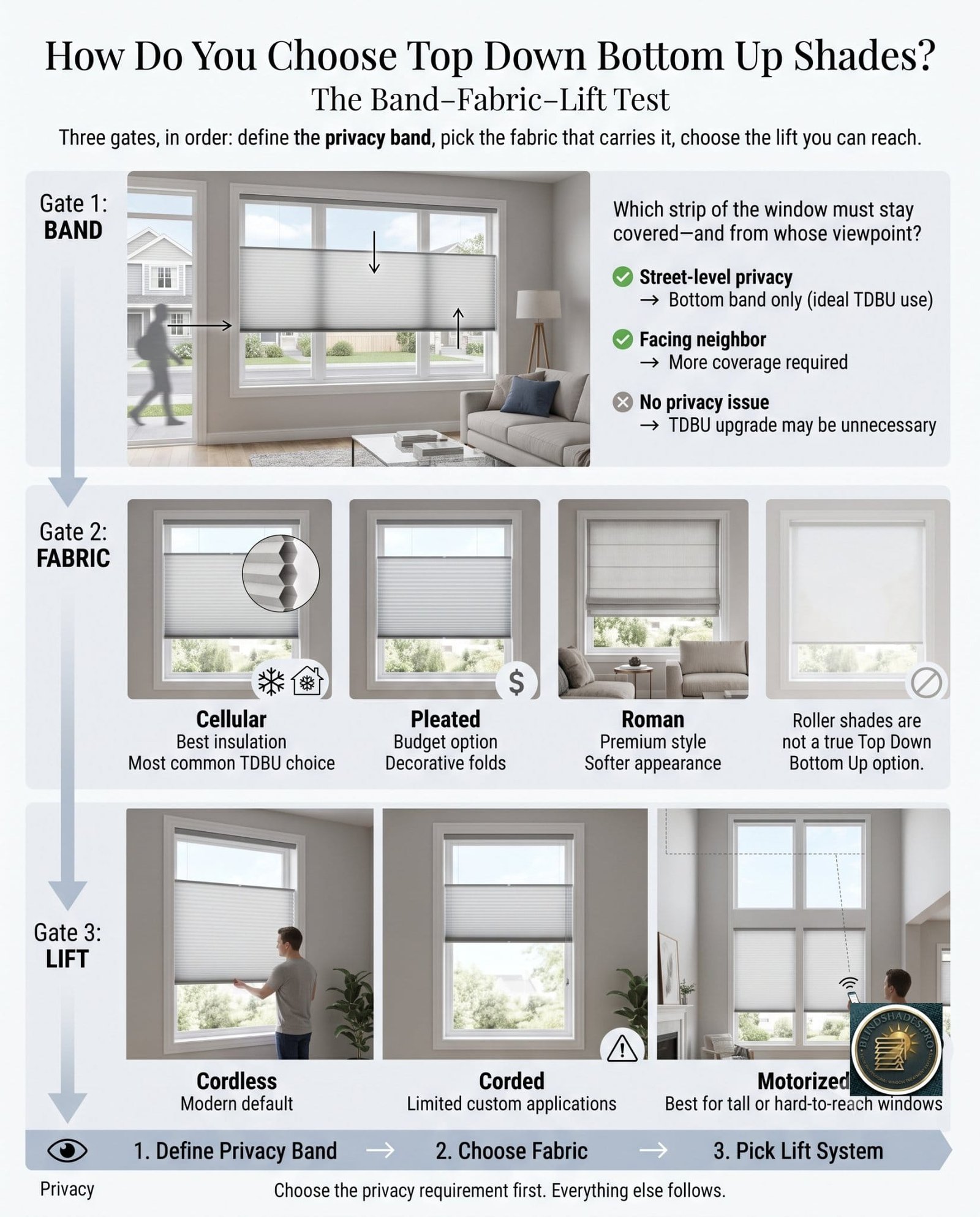
Authored by Michael Turner — 30 Years of Home Improvement Expertise | BlindShades.pro | Complete Buying Guide, Updated for 2026
The best top down bottom up shades are chosen by answering three questions the shade itself is built around: which band of the window must stay covered, which fabric carries the mechanism, and which lift you will actually live with. Top-down-bottom-up (TDBU) is not a product type — it is a mechanism that lets the shade open from the top for daylight while the bottom stays raised for privacy, and it is sold across cellular, pleated, and Roman fabrics. The stable shortlist across independent testing and Google’s own AI answer: Windowsandgarden’s cordless honeycomb line at the budget end, SelectBlinds and Blindster in the custom-value middle, and Hunter Douglas Duette at the premium end with Vignette carrying the soft Roman look. This guide is mechanism-first — our pleated and cellular guides cover those fabrics in depth; this page covers the lift feature that transforms all of them — and it runs the three gates, the verified picks, the sightline geometry that makes a half-open window private, and the corded-shade truth the forums keep getting wrong.
⭐ Quick Answer — The Best Top Down Bottom Up Shades
The best top down bottom up shades are chosen at three gates — Band (which strip of the window must stay covered), Fabric (cellular, pleated, or Roman), and Lift (cordless, corded, or motorized):
- Top picks by gate: Windowsandgarden cordless honeycomb for budget (Bob Vila’s Best Overall cellular shade, Aug 2025), SelectBlinds for value custom (its blackout line praised by Wirecutter, May 2025), Blindster’s 4.8-rated custom TDBU line, and Hunter Douglas Duette at the premium end.
- Privacy is an angle: a viewer below your sill cannot see over a half-raised band — why TDBU wins street-facing rooms, ground-level glass, and bathrooms.
- Fabric reality: cellular is the dominant TDBU host and insulation leader — the full fabric family lives in the cellular & honeycomb shades guide — while true TDBU roller shades effectively do not exist.
- Corded shades are restricted, not illegal: the ANSI/WCMA A100.1 standard moved stock products cordless; custom corded survives with safety limits — the modern default is mapped in the best cordless blinds & shades guide.
- Worth-it rule: pay the TDBU upcharge only on windows with a sightline to defeat — and mix standard shades everywhere else.
Related guides: bamboo TDBU exists too — the weave, liner and material decisions behind it are in the woven wood & bamboo guide.
Key Takeaways
- TDBU is a mechanism, not a fabric. The same lift feature sells on cellular shades (the dominant and most insulating host, and per Blindsgalore the most popular TDBU choice), pleated shades (the budget sibling), and Roman shades (the soft premium tier) — so choose the band and lift first, then the fabric that carries them.
- Privacy is an angle, not a percentage. A viewer standing below your sill line cannot see over a half-raised band — the geometric reason TDBU works so well for street-facing rooms, bathrooms, and ground-level basements, and why a facing second-story neighbor changes the math completely.
- The picks carry double independent citations. Windowsandgarden’s cordless honeycomb line is both Google’s top budget answer and Bob Vila’s Best Overall cellular shade (August 2025), while SelectBlinds — Google’s value pick, with prices cited from roughly forty to one hundred fifty dollars by size — also earned Wirecutter’s praise (May 2025) for the best-looking blackout shade they evaluated.
- Corded TDBU shades are restricted, not illegal. The top-voted answer in the freshest ranking forum thread claims corded blinds are now against the law; the truth is the ANSI/WCMA A100.1 safety standard pushed stock products cordless while custom corded options survive with cord-safety limits — a distinction that matters for tall windows and anyone who cannot reach a floating top rail.
- The upcharge buys geometry, and it is worth it in specific rooms. TDBU costs more than the same shade without the feature; it earns that premium where the privacy band does daily work — bathrooms, street-facing living rooms, east bedrooms — and wastes it on windows nobody can see into anyway.
Quick Specification Reference
| Spec | The short answer |
|---|---|
| What TDBU means | The shade lowers from the top and raises from the bottom — daylight above, privacy below, both adjustable |
| The three gates | Band (which strip must stay covered) → Fabric (cellular, pleated, or Roman) → Lift (cordless, corded, motorized) |
| Dominant fabric | Cellular/honeycomb — the most popular TDBU host per Blindsgalore, and the insulation leader |
| Other fabrics | Pleated (budget), Roman (soft premium); true TDBU roller shades effectively do not exist |
| Lift options | Cordless standard; corded restricted-but-available custom; motorized for tall windows |
| Best rooms | Bathrooms, street-facing living rooms, east-facing bedrooms, ground-level and basement windows, sidelights and tall narrow glass |
| The honest limits | Light leaks above a lowered top rail; wide spans can sag over years; floating rails need reach or a motor |
| Blackout capable | Yes, in blackout cell fabrics — with the same edge-leak caveats as any shade |
| Price band | Budget stock through custom mid-range to dealer premium — stated in words throughout, per our no-fabricated-prices rule |
| Store-rating snapshot | Blindster 4.6 across roughly 6,600 reviews; Blindsgalore 4.7 across roughly 4,600; SelectBlinds 4.0 across roughly 15,000 |
Read the complete guide below for: the Band–Fabric–Lift Test that replaces brand-first shopping; six verified picks with independent-tester citations; the sightline geometry that makes a half-open window fully private; the fabric matrix across cellular, pleated, Roman, and the roller reality check; the corded-shade truth behind the forum myth; the honest trade-offs table; the worth-it verdict by room; and the where-to-buy comparison across every store rating on this market.
What Are the Best Top Down Bottom Up Shades? Our Picks
Six verified picks — the best top down bottom up shades at each gate, every one carrying a citation that is not ours.
| Pick | Product | Gate it wins | The attributed case |
|---|---|---|---|
| Best Overall Budget | Windowsandgarden Cordless Honeycomb Cellular (TDBU option) | Fabric + price | The rare double citation: Google’s AI answer names it the top-rated budget TDBU pick, and Bob Vila’s cellular-shade testing (August 18, 2025) ranked the same line Best Overall for build quality and easy installation |
| Best Bang for the Buck | Chicology Cordless Honeycomb Cellular | Price | Bob Vila’s Best Bang for the Buck in the same August 2025 test — the budget runner-up when Windowsandgarden sizes sell out |
| Best Value Custom | SelectBlinds Cellular TDBU | Band + custom sizing | Google’s value-and-customization pick with prices cited from roughly forty to one hundred fifty dollars by size; the maker’s blackout credibility is independently backed by Wirecutter (May 27, 2025), which called SelectBlinds’ Classic Cordless Blackout the best-looking shade it evaluated and among the most effective light-blockers |
| Best-Rated Custom | Blindster Custom TDBU line | Lift + service terms | The strongest product rating on this page: 4.8 out of 5 across roughly 2,313 reviews, backed by a 4.6 store rating across roughly 6,600 reviews and a sixty-day return window per Blindster’s listing |
| Best Premium | Hunter Douglas Duette | Fabric (energy) + Lift (motorized) | Google’s luxury answer: industry-leading energy efficiency, deep customization, motorization, and the mechanism polish the brand is known for |
| Best Soft / Roman | Hunter Douglas Vignette Modern Roman (TDBU) | Fabric (style) | The AI answer’s light-filtering pick: classic Roman fabric folds with full TDBU operation for glare control |
Read the table by your gates. A bathroom or street-facing room starts at the custom rows, where exact sizing keeps the privacy band tight; a budget whole-house refresh starts at Windowsandgarden and Chicology; a design-led living space starts at Vignette; and a tall or hard-to-reach window starts at Duette with motorization. One market note the ratings table makes unavoidable: SelectBlinds’ 4.0 store rating across roughly fifteen thousand reviews is the weakest of the three custom houses despite its strong product reputation — order samples and read recent reviews for your specific fabric before committing, whichever house you choose.
How Do You Choose Top Down Bottom Up Shades? The Band–Fabric–Lift Test
Three gates, in order: define the privacy band, pick the fabric that carries it, choose the lift you can reach.
| Gate | The question | What the answer decides |
|---|---|---|
| Band | Which strip of the window must stay covered — and from whose viewpoint? | Street-level sightlines need only a bottom band (TDBU’s home case); a level facing window needs more coverage; no sightline at all means the TDBU upcharge is wasted |
| Fabric | Cellular, pleated, or Roman? | Cellular for insulation and the widest TDBU market; pleated for budget; Roman for soft premium style; roller is not a real TDBU option |
| Lift | Cordless, corded, or motorized — and can you reach the top rail? | Cordless is the modern default; corded survives as a restricted custom option; motorized is the honest answer for tall windows where a floating rail is out of reach |
The gates exist because TDBU shopping fails in a specific way: buyers fall in love with the mechanism, then discover the mechanism was the wrong variable. The freshest forum threads on this exact search are all lift-gate casualties — a thirty-plus-comment thread hunting corded TDBU under a mistaken legal belief, a Bogleheads thread trying to retrofit remote control onto a mechanism the buyer cannot reach. Google’s own AI answer for this query ends by asking three questions it cannot answer for you — light filtering or blackout, standard or custom, budget per window — and those are the Fabric, Band, and price expressions of the same three gates. Run them in order and the rest of this page fills in each one with data.
A scope note for clarity, because this site covers the neighboring categories in depth: this guide is mechanism-first. For fabric-first deep dives, the cellular and honeycomb shades guide and the pleated shades guide own their materials; this page owns the lift feature that transforms both.
How Can a Half-Open Window Be Fully Private? Sightline Geometry
Privacy is an angle problem, not a coverage problem — and TDBU is the only mechanism built on that fact.
Here is the geometry no listing explains. A person standing on the sidewalk below your window cannot see over a barrier that sits above their eye-line’s intersection with your glass: lower the top of a TDBU shade a third of the way, and the remaining band covers everything a ground-level viewer could ever reach, while the top third pours in sky light. The steeper the angle — second-floor rooms over a street, ground-floor rooms behind a setback, basement windows at grade — the smaller the band you need and the more daylight you keep. That is the entire TDBU value proposition stated as physics: the shade sells light and privacy at the same time only when the threat is below you.
The same geometry defines where TDBU underdelivers. A facing window at your level defeats the trick — the neighbor’s eye-line crosses your glass horizontally, so the light gap at the top is also a viewing gap at night with interior lights on. In those rooms TDBU still earns its keep as a daylight manager, but the privacy claim needs a sheer layer or a smarter fabric choice behind it.
| Scenario | Sightline reality | The TDBU verdict |
|---|---|---|
| Street-facing living room, viewers at ground level | Eye-lines rise and die against the bottom band | The signature TDBU room — a one-third top drop keeps full daytime privacy |
| Bathroom | Short viewing angles, frosted or high glass common | The classic case; the full room plan lives in the bathroom blinds and shades guide and the TDBU-specific build in top down bottom up shades for bathrooms |
| East-facing bedroom | Morning glare high, privacy needs low at dawn | Drop the top for sunrise control; the full morning-light strategy is in the east-facing bedroom window treatment guide |
| Ground-level and basement windows | Passersby effectively at or above the glass | Reverse geometry — here the bottom band matters most; the below-grade specifics are in cellular shades for basement windows |
| Sidelights and tall narrow glass | Full-height exposure beside a door | TDBU’s tall-window strength; the narrow-glass build is covered in cellular shades for sidelights |
| Facing neighbor at your level | Horizontal eye-line crosses the light gap | TDBU manages glare, not secrets — layer it or choose fabric opacity accordingly |
One deliberate design consequence falls out of the geometry: measure the privacy band before ordering, not after. Stand where the viewer stands, note where their sightline meets your glass, and add a hand’s width — that is the band the bottom section must always cover, and it tells you whether an inside-mount TDBU with a tight fit or a larger outside-mount is the right call.
Which Fabric Should You Choose — Cellular, Pleated, Roman, or Roller?
The mechanism is fabric-agnostic; your insulation, budget, and style are not.
| Fabric | TDBU availability | Strengths | Watch for | Best for |
|---|---|---|---|---|
| Cellular / honeycomb, single cell | The market default — Blindsgalore calls cellular the most popular TDBU choice | Insulation, clean look, blackout options | Single cell flexes more on wide spans | Most rooms, most budgets |
| Cellular, double cell | Widely available | Best insulation, stiffer rails on wide TDBU spans | Costs more | Big windows, energy-first buyers — the cell-count decision is settled in single cell vs double cell shades |
| Pleated | Common, cheapest TDBU entry | Lightest, least expensive | No cell insulation; sheerer at night | Budget refreshes — the fabric trade-off is mapped in pleated vs cellular shades and the choose-pleated case in when to choose pleated instead of cellular |
| Roman | Premium tier — Hunter Douglas Vignette is the reference | Soft folds, designer presence, glare control | Price; fabric weight on very tall drops | Living rooms and design-led spaces |
| Roller | Effectively not available as true TDBU | — | A roller wraps around a tube at the top; it physically cannot lower from the top while raising from the bottom. Listings pairing “top down” with rollers describe different products | If the roller look is the goal, our blackout roller vs cellular bedroom comparison covers what rollers actually do best |
Two honest notes the matrix compresses. First, the blackout question: TDBU and blackout coexist happily in blackout cell fabrics, but the mechanism adds a second leak line — the seam where the middle rail parks — on top of the edge leaks every shade has; buyers chasing true darkness should read how to get true blackout from cellular shades and treat the room, not just the window, per the blackout blinds and shades guide. Second, the search box keeps asking about IKEA: flat-pack retailers’ blind lineups change by market and rarely include true TDBU cellular product — verify the current local range before planning around it rather than trusting a stale forum answer.
Are Corded Top Down Bottom Up Shades Illegal? The Corded Question
No — restricted is not illegal, and the difference decides who can actually use a TDBU shade.
The freshest high-ranking community thread on this search — thirty-plus comments, roughly three months old — opens with a hunt for corded TDBU shades and a top-voted answer declaring that corded blinds are now against the law. That answer is wrong in a way that matters. The reality: the window-covering industry’s ANSI/WCMA A100.1 safety standard drove stock (off-the-shelf) products to cordless designs because accessible cords are a documented child-strangulation hazard, while custom-order corded products remain available with cord-safety restrictions such as tension devices and limited cord accessibility. Nothing prohibits owning or using corded shades; the market for new stock product simply moved cordless.
Why anyone still wants the cord is TDBU-specific: this mechanism has two rails, and the top one floats mid-window when deployed. On a standard-height window, cordless TDBU is genuinely pleasant — grab the rail, glide it. On a tall window, the lowered top rail can sit beyond arm’s reach, and the “cordless” experience becomes a reach pole or a step stool twice a day. That is the honest engineering case behind the corded hunt, and it has three answers ranked by household:
| Lift | Legal / market status | The TDBU-specific reality | Choose it when |
|---|---|---|---|
| Cordless | The stock-market standard under ANSI/WCMA A100.1 | Excellent at reachable heights; the floating-top-rail reach problem appears on tall glass | Default — especially any room children use; the full cordless market is mapped in the best cordless blinds and shades guide |
| Corded (custom) | Available with cord-safety restrictions — restricted, not illegal | Solves reach mechanically; cords must be tensioned and kept inaccessible | Adult-only households with tall windows and no motor budget |
| Motorized | Fully available; the premium answer | Deletes the reach problem entirely — both rails move by remote, app, or schedule | Tall windows, skylights-adjacent installs, accessibility needs; the route, power, and protocol decision is the motorized and smart blinds guide |
The two-year-old Bogleheads thread asking about remote-controlled TDBU was ahead of the market’s answer: motorization is not a luxury add-on to this mechanism, it is the accessibility fix for its one ergonomic flaw. Hunter Douglas builds it into Duette at the premium end, and the custom online houses now quote motorized TDBU as a standard option — price it against years of reach-pole mornings before dismissing it.
What Are the Honest Trade-Offs of Top Down Bottom Up Shades?
Four real costs come with the mechanism — every one manageable, none disclosed on a product page.
| Trade-off | What actually happens | The mitigation |
|---|---|---|
| The top light gap | With the top rail lowered, light (and at night, a viewing line) passes above it | Use the band geometry — drop the top only as far as the sightline allows; layer sheers where a level neighbor faces you |
| The middle-rail seam | The parked middle rail creates a horizontal leak line in blackout builds | Blackout cell fabric plus room-level darkness strategy; true-black sleepers should read the blackout guides linked above |
| Rail sag on wide spans | Two rails mean twice the hardware carrying fabric weight; very wide TDBU shades can bow over years | Double-cell fabric for stiffness, two shades on one wide opening, quality hardware from the higher-rated houses |
| The upcharge and the reach | The mechanism costs more than the same shade without it, and tall windows put the floating rail out of reach | Pay the premium only where the privacy band works daily (next section); motorize tall glass |
None of these is a reason to skip the mechanism — they are the reasons to buy it deliberately. The pattern worth noticing: all four trade-offs concentrate in the same places (very wide glass, very tall glass, true-blackout demands), which means a standard-sized street-facing window — the exact scenario TDBU was invented for — experiences essentially none of them.
Are Top Down Bottom Up Shades Worth the Extra Cost?
Worth it where the privacy band works daily; wasted where nobody can see in anyway.
| Window situation | Does the band do daily work? | Verdict on the upcharge |
|---|---|---|
| Street-facing living or dining room | Yes — every daylight hour | Worth it; this is the mechanism’s home |
| Bathroom | Yes — privacy is non-negotiable, light is precious | Worth it; the category’s strongest case |
| East bedroom / glare-managed office | Yes — the top drop is a daily sun tool | Worth it |
| Ground-level, basement, sidelight glass | Yes — geometry favors the band | Worth it |
| Upper-floor rooms facing open sky or private yards | No — nothing to hide from | Skip the feature; put the money into fabric (double cell) instead |
| True-blackout media rooms | Partially — the seam works against you | Spend on blackout architecture first, TDBU second |
The math is simpler than a calculator: the TDBU premium on a custom cellular shade is a modest slice of the order, and it buys a capability no amount of fabric spending replicates — but only in rooms with a sightline to defeat. Put plainly, the best top down bottom up shades are the ones installed only on the windows where the band earns its keep. Audit each window against the verdict table before checking the TDBU box on all of them; most whole-house orders should be mixed, with the feature concentrated on the exposed facade and standard shades everywhere else. That single decision routinely funds the double-cell upgrade on the windows that need it.
Where Is the Best Place to Buy Top Down Bottom Up Shades?
Every serious seller publishes a store rating — for once, the market lets you compare the houses directly.
| Channel | Examples | The numbers on record | Wins when |
|---|---|---|---|
| Custom online — best rated | Blindster | Product line rated 4.8 across roughly 2,313 reviews; 4.6 store rating across roughly 6,600; sixty-day returns | Service-terms shoppers; the strongest rating package in the category |
| Custom online — widest catalog | Blindsgalore | 4.7 store rating across roughly 4,600 reviews; cellular flagged as its most popular TDBU choice | Fabric range and free thirty-day returns per its listing |
| Custom online — value scale | SelectBlinds | Google’s value pick, roughly forty-to-one-hundred-fifty-dollar band by size; 4.0 store rating across roughly 15,000 reviews | Price-first custom buys — with the recent-review homework noted in our picks section |
| Big-box | The Home Depot, Lowe’s | Category guide published May 12, 2026; stock and special-order lines | Standard sizes, weekend timelines, easy returns |
| Budget stock / marketplace | Windowsandgarden, Chicology via Amazon | Bob Vila’s Best Overall and Best Bang for the Buck (August 18, 2025) | Standard windows, whole-house refreshes on a budget |
| Premium dealer | Hunter Douglas (Duette, Vignette) | Google’s luxury citation for energy efficiency and motorization | Engineering-first buys, motorized tall glass, designer fabrics |
The channel logic mirrors every custom category we cover, with one TDBU-specific addition: because the privacy band depends on exact fit, the best top down bottom up shades for exposed street-facing windows come from the custom channel even when the budget rows tempt — an inch of slop around a stock shade is an inch of sightline. Flip it for upper floors: stock sizes on private-facing windows keep the blended cost of a whole-house order sane. Sample programs are free or near-free at all three custom houses; order the same fabric from two of them and judge the cell stiffness in hand before placing a large order.
Related guides: the category’s best-selling TDBU is a no-tools cellular — every screwless way to mount one is in the best no drill blinds guide.
Supporting Articles in This Cluster
- Top Down Bottom Up Pleated Shades for Bathroom Windows
- Top Down Bottom Up Shades for Bathrooms
- Pleated vs Cellular Shades
- When to Choose Pleated Instead of Cellular
- Single Cell vs Double Cell Shades
- How to Get True Blackout from Cellular Shades
- Cellular Shades for Sidelights
- Cellular Shades for Basement Windows
- Best Window Treatment for an East-Facing Bedroom
- Blackout Roller vs Cellular Shades for Bedrooms
Related Buying Guides
- The Best Cellular & Honeycomb Shades Buying Guide
- The Best Pleated Shades Buying Guide
- The Best Cordless Blinds & Shades Buying Guide
- The Best Blackout Blinds & Shades Buying Guide
- The Best Motorized & Smart Blinds Buying Guide
- The Best Bathroom Window Blinds & Shades Buying Guide
Related guides: yes, TDBU day-night combos exist — the dual-fabric side of that answer, Norman’s dual smartfit class included, is in the best day night blinds guide.
Frequently Asked Questions
What are top down bottom up shades?
Top down bottom up (TDBU) shades are window shades with two moving rails: the bottom rail raises like any shade, and the top rail also lowers from the headrail, opening a daylight band at the top of the window while the body of the shade keeps covering the glass below. The result is simultaneous natural light and privacy — sky light pours over the top while the raised band blocks sightlines from below. The mechanism is sold on cellular, pleated, and Roman fabrics from both stock and custom makers.
Are top down bottom up shades worth it?
The best top down bottom up shades earn their upcharge wherever the privacy band does daily work: street-facing living rooms, bathrooms, east-facing bedrooms, ground-level and basement glass, and tall narrow windows like sidelights. In those rooms the mechanism delivers light and privacy at the same time — something no standard shade can do at any price. It is not worth the upcharge on upper-floor windows facing open sky or a private yard, where nothing needs hiding; audit window by window and mix TDBU with standard shades across a whole-house order.
Are corded blinds illegal now?
No. The ANSI/WCMA A100.1 window-covering safety standard moved stock (off-the-shelf) products to cordless designs because accessible cords are a child-safety hazard, but custom-order corded shades remain available with cord-safety restrictions such as tension devices. Owning and using corded blinds is not prohibited. For top down bottom up shades specifically, the corded question usually hides a reach problem — a lowered top rail on a tall window can sit beyond arm’s reach — and motorization is often the better modern answer than hunting for cords.
Can you get top down bottom up roller shades?
Effectively no. A roller shade wraps its fabric around a tube at the top of the window, so it physically cannot lower from the top while raising from the bottom — the tube is the top. Listings that pair “top down” language with roller products are describing different mechanisms. If you want the TDBU capability, cellular, pleated, and Roman fabrics carry it; if you want the roller look, choose it for what rollers do best and manage privacy with fabric opacity instead.
Does IKEA sell top down bottom up shades?
Flat-pack retail blind lineups change frequently by market and rarely include true TDBU cellular product, so verify the current local range directly rather than relying on forum answers that may be years old. As a rule, genuine TDBU shades come from the custom online houses (SelectBlinds, Blindster, Blindsgalore), big-box special order, budget stock brands like Windowsandgarden and Chicology, and premium dealers like Hunter Douglas.
What is the best budget top down bottom up shade?
The budget consensus is unusually strong: Windowsandgarden’s cordless honeycomb cellular line is both Google’s top-rated budget TDBU answer and Bob Vila’s Best Overall cellular shade from its August 2025 testing, cited for build quality, easy installation, and reliability. Chicology’s cordless honeycomb line — Bob Vila’s Best Bang for the Buck in the same test — is the natural runner-up when sizes or colors sell out. For custom sizing on a budget, SelectBlinds’ TDBU cellular range was cited in the roughly forty-to-one-hundred-fifty-dollar band by size.
By Michael Turner | 30 Years Home Improvement Expertise | Updated 2026 | BlindShades.pro
