When Should I Choose Pleated Instead of Cellular — The Honest Decision Guide

Authored By Michael Turner -30 Years Home Improvement Expertise | Updated 2026 | BlindShades.pro
Updated on May 11, 2026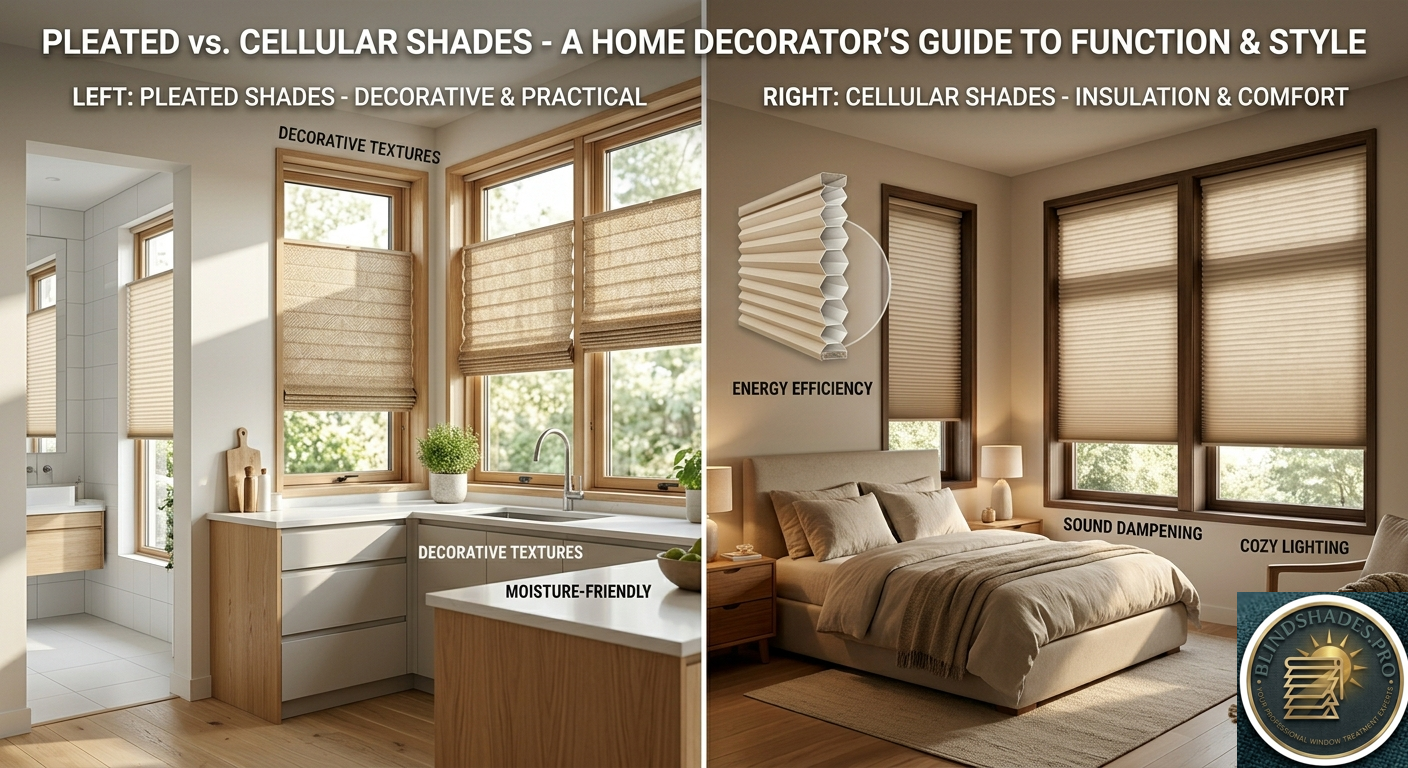
⭐ Quick Answer — When Should I Choose Pleated Instead of Cellular?
- Pattern or Textured Fabric Required: Cellular physically cannot be made from pattern fabric, textured weaves, linen-look, botanical prints, or organic materials — it is a manufacturing constraint, not a preference. If the fabric matters, pleated is the only option
- Kitchen or Bathroom Window: Cellular honeycomb cells trap airborne grease (kitchens) and moisture (bathrooms) permanently inside the cell structure per Bali Blinds. Single-layer pleated fabric dries and cleans completely. Always specify pleated in these rooms
- Mild Climate / Energy Bill Under $100/month: At $80/month × 10% cellular saving = $96/year. The cellular premium of $400–$750 for 10 windows takes 4.2–7.8 years to pay back — frequently beyond the product’s useful life in that room
- Planning to Move or Redecorate Within 5 Years: The cellular energy ROI doesn’t transfer when you move or redecorate. Spending 30–50% more on cellular before the payback period is realised is a sunk cost
- Commercial, Healthcare, or Institutional: Pleated dominates by default — widest antimicrobial and NFPA 701 fabric availability, broadest institutional colour matching, and $10,500–$16,500 saved per 300-window facility vs double-cell cellular
- Best Sources: SelectBlinds (widest fabric selection, free samples) · Blindsgalore (pattern/textured weaves + outside mount) · Graber via dealer (1″ and 2″ EvenPleat, lifetime warranty)
⚠️ The Scoring Framework — Get Your Specific Answer in 60 Seconds: Score 1 point for each statement that applies: □ pattern/textured fabric required · □ kitchen or bathroom window · □ energy bill under $100/month · □ planning to move or redecorate within 5 years · □ commercial, healthcare, or institutional application · □ north-facing or deeply shaded window (no direct sun) · □ fabric design matters more than thermal performance. Score 0–1: cellular may be right. Score 2–3: calculate the specific ROI for your bill and climate. Score 4–5: pleated is the better value specification. Score 6–7: pleated is definitively correct. Per Graber Blinds — “if you’re looking for something lively, bold, or unique, pleated shades might be your best choice.” See the full scoring framework below.
💡 Pleated Is Not the Budget Compromise — It Is the Correct Specification for These Situations: Every competitor guide frames this as “cellular is probably better for most people.” That framing misleads buyers in the 7 situations above. For pattern fabric, moisture-prone rooms, mild climates, short ownership horizons, and commercial applications — pleated shades are not a compromise, they are the definitively correct specification. And the liner upgrade path narrows the insulation gap: a blackout-lined pleated shade at $50–$75/window provides R-2.60–R-3.00 — meaningfully improved insulation at 30–50% less than double-cell cellular at $80–$120. Per Strickland’s Home: pleated R-2.20 standard / R-2.60–R-3.00 with liner / vs double-cell cellular R-4.80. See the liner upgrade guide below.
📖 Read the complete guide below for: the 7 specific situations where pleated is the definitively correct choice, the mild-climate energy ROI calculation ($96/year at $80/month = 4.2–7.8 year payback), the 5-year ownership horizon argument, the pattern-fabric manufacturing constraint explained, the commercial/institutional default case, the 7-point scoring framework with 4-band result, the situations where cellular is definitively correct, and where to order based on your decision.
The Honest Starting Point — When to Stop Comparing and Just Choose Pleated
Most pleated-vs-cellular guides spend 80% of their words making the case for cellular. This is the guide that makes the honest case for when pleated is the correct answer — clearly, specifically, and without hedging.
Pleated shades are not the “budget compromise.” For a specific set of buyer situations — they are the definitively correct specification. Identifying which situations those are is the purpose of this guide.
The 7 Situations Where Pleated Is the Correct Choice
Situation 1 — You Want Pattern Fabric, Texture, or Any Non-Neutral Colour
This is not a preference. It is a manufacturing constraint.
Cellular shade manufacturing requires specific engineered fabrics — fabrics that can be bonded at precise contact points to form the honeycomb cell structure. These engineered fabrics are limited to solid colours and basic neutral weaves. The bonding process physically cannot be performed on pattern fabrics, textured wovens, linen-look materials, organic textures, botanical prints, or specialty fabrics.
According to Graber Blinds, “what really makes pleated shades special is the many available colors, patterns, and textures” — a fabric breadth that cellular shades structurally cannot match.
The practical test: If you are looking at the fabric selection for cellular shades and thinking “I wish there were more interesting options” — you are looking at the wrong product. Switch to pleated immediately. The constraint is not the retailer’s catalogue; it is the manufacturing physics.
When this applies:
- Farmhouse, cottage, or organic interior styles where texture is central to the design
- Formal rooms where pattern fabric makes a design statement (dining rooms, drawing rooms, home libraries)
- Children’s rooms where pattern fabric creates the intended visual environment
- Any room where a specific fabric — not just any fabric — matters to the design outcome
Situation 2 — The Room Is a Kitchen, Bathroom, or Any Moisture-Prone Space
This is the most commonly overlooked pleated-wins situation — and the one where choosing cellular causes the most expensive regret.
The cellular moisture problem: Bali Blinds specifically warns against cellular shades in situations where they might be stained or exposed to sustained moisture. The honeycomb cells trap airborne grease particles (in kitchens) and moisture (in bathrooms) inside the cell structure. These materials accumulate inside the cells between cleaning cycles and cannot be removed from inside the honeycomb structure by any standard cleaning method.
What happens over time: Kitchen cellular shades develop a permanent accumulated grease residue inside the cells within 2–3 years of regular use. Bathroom cellular shades in shower-adjacent windows develop moisture retention inside the cells that promotes mould growth.
Why pleated is correct in these rooms: Single-layer pleated fabric has no internal structure to trap moisture or grease. The fabric surface dries quickly after exposure to steam. Surface cleaning removes contaminants completely. A pleated shade in a kitchen or bathroom at $30–$50 per window mid-range that lasts 10+ years is far better value than a cellular shade at $80–$120 per window that requires early replacement due to internal contamination.
Situation 3 — Your Climate Is Mild and Your Energy Bill Is Under $100/Month
This is the ROI calculation that determines whether the cellular insulation premium ever pays off — and it differs dramatically by geography.
The calculation:
According to Blindsgalore, cellular shades reduce heating and cooling energy use by 10–20%. At an $80/month energy bill (typical mild-climate home), a 10% saving equals $8/month = $96/year. The cellular premium over pleated for 10 windows at mid-range = $400–$750.
Payback period: $400–$750 ÷ $96/year = 4.2–7.8 years to break even.
At a $100/month bill with 15% saving: $15/month = $180/year. Payback = 2.2–4.2 years. Marginal.
Mild climate states where pleated is almost always better value: Florida, southern Texas, Arizona, southern California, Hawaii, Louisiana, Mississippi, Alabama, Georgia (coastal), South Carolina (coastal)
In these states — where heating seasons are short or nonexistent and HVAC efficiency is high — the energy saving from cellular R-4.80 vs pleated R-2.20 is minimal in practice and frequently does not pay back before the product is replaced.
Cold climate states where cellular is worth the premium: Minnesota, Wisconsin, Michigan, Maine, Vermont, New Hampshire, upstate New York, Montana, Wyoming, Colorado (mountains)
In these states — with 5–7 month heating seasons and energy bills regularly over $150/month — the cellular insulation premium pays back in 2–3 years and is a sound investment.
The honest guidance: Check your average monthly energy bill. Under $100 — pleated. Over $150 — cellular worth considering. Between $100–$150 — calculate based on your specific window count.
Situation 4 — You Plan to Redecorate or Move Within 5 Years
This is the ownership timeline argument that no competitor guide addresses — and it matters for millions of buyers.
The ROI reset problem: The energy savings from cellular shades accrue over time. At a $150/month bill with 10% savings = $180/year, the $400–$750 cellular premium on 10 windows takes 2.2–4.2 years to recover. But this recovery only works if you keep the shades for the full payback period.
If you redecorate the room before the payback period: You are replacing the cellular shades before the energy savings have recovered the premium. You have effectively paid the cellular premium as a sunk cost with no ROI.
The situations where this applies:
- Renting — you will leave the shades when you move (and not recoup the energy savings)
- Planning to sell the home within 3–5 years — buyers do not pay more for cellular shades; the ROI doesn’t transfer
- Planning to redecorate a room within 3–5 years — changing the colour scheme or furniture frequently means changing the window treatments
- Newly furnished room in a transitional design style — these rooms are updated more frequently than traditional or permanent spaces
The correct specification in these situations: Pleated shade at 30–50% lower cost. Save the premium for the next redecoration cycle when you make a longer-term specification decision.
Situation 5 — The Application Is Commercial, Healthcare, or Institutional
This is the situation where pleated doesn’t just compete with cellular — it wins by default.
Why pleated dominates institutional settings:
According to our analysis in the commercial antimicrobial specification guide — pleated shades are the dominant window treatment in USA healthcare facilities, schools, and institutional offices for three structural reasons:
Reason 1 — Antimicrobial fabric availability: The widest range of ASTM G21-certified antimicrobial fabrics is available in pleated construction. Cellular manufacturing is constrained to specific engineered fabrics that limit antimicrobial options.
Reason 2 — NFPA 701 fire-rated fabric availability: Commercial buildings must meet NFPA 701 flame resistance requirements. The broader fabric range available for pleated construction means more fire-rated options — including fire-rated antimicrobial combinations.
Reason 3 — Cost at institutional scale: Commercial antimicrobial pleated at $55–$85/window versus double-cell cellular at $90–$140/window means $10,500–$16,500 saved across a 300-window healthcare facility — without sacrificing antimicrobial performance, fire-rating, or colour-specification range.
The institutional verdict: For any commercial, healthcare, educational, or government specification — specify pleated unless a documented building performance reason requires cellular’s specific insulation performance.
Situation 6 — The Window Receives No Direct Sun (North-Facing or Deeply Shaded)
The insulation argument for cellular shades is strongest in windows that receive significant solar exposure — where the R-4.80 performance meaningfully reduces solar heat gain (shading coefficient 0.21–0.35 vs 0.60 for pleated).
For windows with no or minimal direct sun:
- North-facing windows in the northern hemisphere — no direct sun year-round
- East-facing windows in afternoon and evening hours
- Windows shaded by overhangs, balconies, or mature trees
- Interior-facing windows (atrium-facing, interior corridor windows)
In these windows — the solar heat gain reduction advantage of cellular is significantly reduced because there is minimal solar heat gain to reduce. The R-value insulation performance still applies for winter heat loss, but for mild-climate homes this may not be sufficient justification for the premium.
The practical test: If you stand at the window during the brightest sun period of the day and the shade does not glow with transmitted sunlight — the window lacks significant direct solar exposure. In this condition the cellular shading coefficient advantage is minimal.
Situation 7 — The Fabric Design Matters More Than the Specification
This is the overarching situation that captures any buyer whose primary requirement is the window treatment’s appearance rather than its thermal performance.
Cellular shades look similar to pleated shades from the front — both show an accordion fold. But the fabric catalogue for cellular shades is a small fraction of the fabric catalogue for pleated shades.
The fabric breadth test: Compare the fabric options at SelectBlinds or Blindsgalore for (a) their cellular shade range and (b) their pleated shade range. The number of fabrics, patterns, textures, and colours available for pleated shades consistently outnumbers cellular by a ratio of 3:1 to 5:1 depending on the supplier.
If any of the following are true — choose pleated:
- You have a specific fabric in mind that you want to find a shade in
- You want to match a specific room colour that cellular neutrals do not offer
- You want texture (linen, grasscloth-look, jacquard) that cellular construction cannot accommodate
- The window treatment is a deliberate design element, not just a functional covering
The Decision Scoring Framework
Score 1 point for each statement that applies to your situation:
Score 1 point for each:
- The fabric I want is patterned, textured, or a non-neutral colour
- The window is in a kitchen, bathroom, or moisture-prone space
- My average monthly energy bill is under $100
- I plan to move or redecorate within 5 years
- The application is commercial, healthcare, or institutional
- The window faces north or is deeply shaded with no direct sun
- The design appearance of the fabric matters more than the thermal performance
Result:
| Score | Recommendation |
|---|---|
| 0–1 | Cellular shades — insulation and sound performance are your priority |
| 2–3 | Mixed — calculate the specific energy ROI for your bill and climate |
| 4–5 | Pleated shades — the cellular premium is unlikely to deliver positive ROI |
| 6–7 | Pleated shades definitively — cellular is the wrong specification |
The Situations Where Cellular Is Definitively Correct
For completeness — the situations where choosing pleated would be the wrong decision:
Choose cellular when:
- Cold climate (Minnesota, Maine, Michigan, upstate New York, Colorado mountains) with energy bills over $150/month AND you plan to keep the shades for 7+ years
- Primary bedroom or nursery on a noisy street where sound dampening complements the blackout function
- Long-term ownership (10+ years) in a cold-climate home where the energy ROI fully accrues
- The window is a living room or bedroom where the insulation performance and sound absorption are the specific priorities — not the fabric
Where to Order Based on Your Decision
If you chose pleated — best sources:
- SelectBlinds — widest fabric selection at mid-range pricing; free fabric samples; cordless and NeatPleat upgrade available
- Blindsgalore — strong mid-range pleated program; pattern fabrics and textured weaves available; outside mount and liner upgrades
- Graber (via dealer) — best premium pleated shade programme; 1″ Fashion Pleat and 1″ and 2″ EvenPleat (NeatPleat equivalent); lifetime warranty on mechanisms
If you chose cellular — best sources:
- SelectBlinds — double-cell cordless cellular at competitive mid-range pricing; outside mount available
- Blinds Chalet — blackout cellular with side channels for complete blackout system
- Hunter Douglas Applause — premium cellular with the most complete motorized and cordless options
Frequently Asked Questions
When is pleated shade the better choice over cellular? Pleated shades are the better choice in seven specific situations: when pattern or textured fabric is required (cellular cannot be made from these); when the room is a kitchen or bathroom where cellular cells trap moisture and grease; when the climate is mild with energy bills under $100/month and the energy ROI of cellular likely never pays off; when you plan to move or redecorate within 5 years before the cellular ROI is realised; when the application is commercial, healthcare, or institutional where pleated dominates by default; when the window receives no direct sun and cellular’s solar shading advantage is minimal; and when the fabric design is the primary requirement.
Is pleated shade always the budget option? No — the “pleated is for budget buyers” framing is misleading. Pleated shades cost 30–50% less because their manufacturing process is simpler — not because the fabric quality, mechanism quality, or installation quality is inferior. For buyers whose priorities align with what pleated delivers (fabric variety, lower cost, moisture resistance, commercial suitability), pleated is not a compromise — it is the definitively correct specification.
Does cellular always win in cold climates? In cold climates with high energy bills — cellular’s insulation premium is justified and typically pays off within 2–3 years. But even in cold climates — if the room is a kitchen, bathroom, or a room where fabric pattern is important — pleated may still be the correct specification. Climate is one factor, not the only factor. According to Strickland’s Home thermal research, the R-value of pleated shades is approximately R-2.20 versus R-4.80 for double-cell cellular — this gap matters in cold climates but may not override other specification priorities.
Can I add insulation to a pleated shade to close the gap with cellular? Yes — adding a blackout liner improves a pleated shade’s R-value from approximately R-2.20 to R-2.60–R-3.00, which narrows (but does not close) the gap with single-cell cellular at R-3.50–R-4.30. For mild-climate buyers where the full cellular R-4.80 performance is not required — a blackout-lined pleated shade at $50–$75/window provides meaningful insulation improvement at 30–50% less than double-cell cellular.
Are pleated shades better for pattern fabrics than cellular? Yes — and this is not a preference but a manufacturing constraint. Cellular shade manufacturing requires specific engineered fabrics that can be bonded to form the honeycomb cell structure. Pattern fabrics, textured wovens, linen-look materials, organic textures, and botanical prints cannot go through the cellular bonding process. According to Graber Blinds, pleated shades offer “fresh patterns and on-trend colors” alongside “richly textured fabrics” — a catalogue breadth that cellular construction physically cannot match. If pattern or texture matters — pleated is the only option.
Related Guides on BlindShades.pro
- The Best Pleated Shades Buying Guide — the complete pleated shade specification guide
- The Best Cellular Shades Buying Guide — cellular shades in full depth for when cellular is the right choice
- Pleated Shades vs Cellular Shades — The Honest R-Value and Price Comparison — the full side-by-side technical comparison
- Why Are Pleated Shades Cheaper Than Cellular — the manufacturing cost difference explained
- Blackout Pleated vs Blackout Cellular — Which Is Better Value? — the blackout-specific comparison with ROI calculation
By Michael Turner | 30 Years Home Improvement Expertise | Updated 2026 | BlindShades.pro
