The Best French Door Blinds & Shades: Swing, Style, and System Before Brand

Authored By Michael Turner -30 Years Home Improvement Expertise | Updated 2026 | BlindShades.pro
Updated on July 19, 2026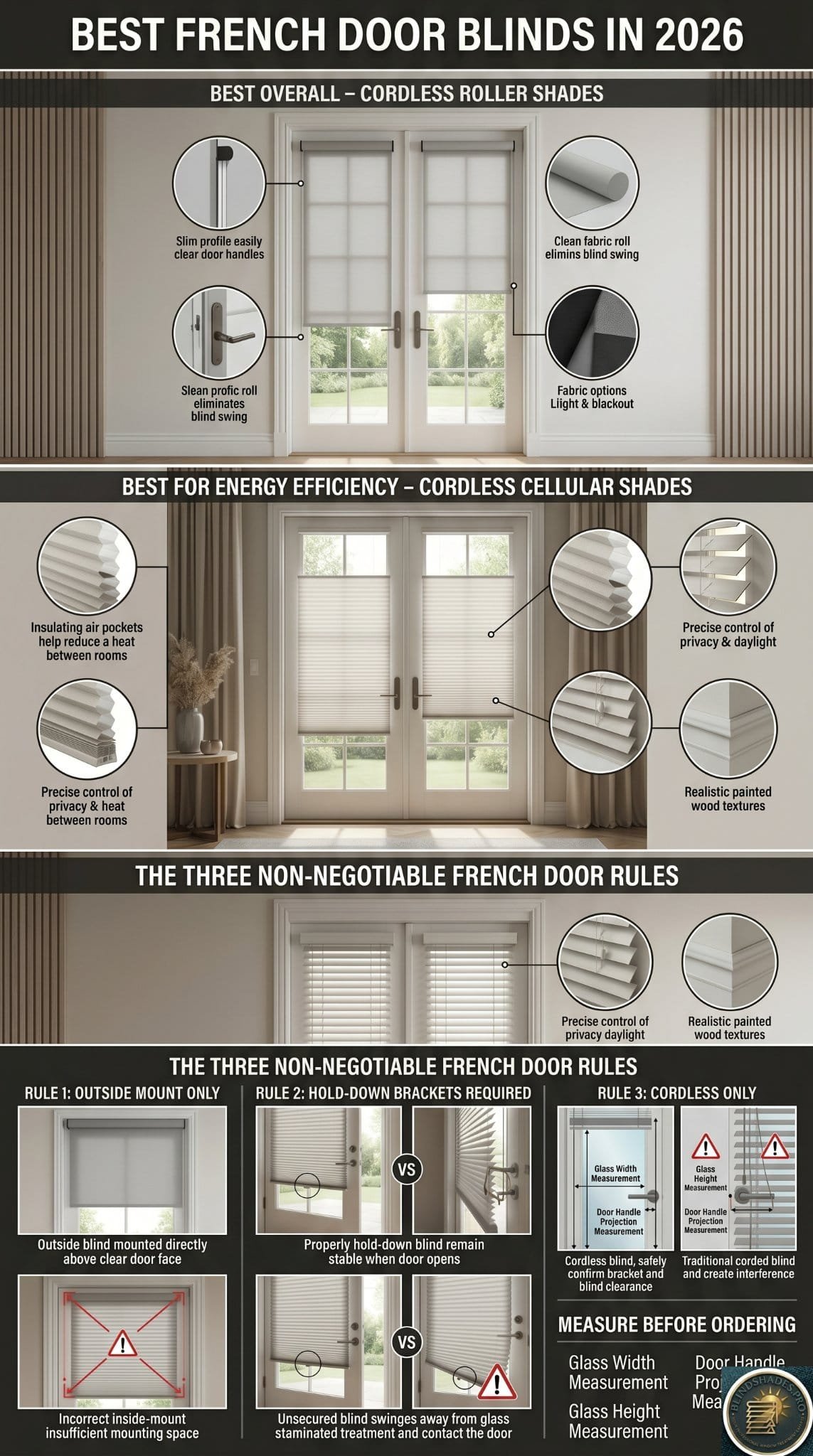
Authored by Michael Turner — 30 Years of Home Improvement Expertise | BlindShades.pro | Complete Buying Guide, Updated for 2026
The best French door blinds are engineered around one fact no window ever faces: the surface they hang on accelerates. A French door swings, stops, and slams — so this category invented its own rules (outside mounts on the door face, profiles slim enough to clear the handle, hold-down brackets at the bottom) and its own hardware (tracked systems that pin the shade to rails, magnetic mounts for steel doors, and blinds sealed between the glass itself). The market’s style verdicts are stable — cordless cellular leads for insulation and blackout, slim rollers win lever-handle doors, one-inch faux wood keeps tiltable control, and flat-fold Romans bring the softness (mounted above the door, per the community’s top-voted method) — but the decisions that actually determine whether you love or curse a French-door treatment are mechanical: how it anchors against the swing, whether the profile clears your specific handle, and whether you want the shade hung on the door, tracked to it, or enclosed inside the glass. This guide runs all three.
⭐ Quick Answer — The Best French Door Blinds & Shades
The best french door blinds are chosen at three gates — Swing (the mounting mechanics of a moving door), Style (which type for the room), and System (hung, tracked, or enclosed):
- The three mounting rules: outside mount on the door face, a profile under one inch to clear the handle, and hold-down brackets at the bottom — the flap fix explained in French door blinds and the swinging problem.
- The style consensus: cordless cellular leads (insulation up to blackout, cell sizes on record at SelectBlinds), slim rollers win lever-handle doors, and one-inch faux wood keeps tiltable control per Blindsgalore’s french-door verdict.
- The tracked upgrade: systems like Hunter Douglas’s Duette with TrackGlide anchor the shade to rails — no flap at any door speed, and the only hung-family answer to side-halo light on blackout doors.
- The enclosed exit: between-glass blinds — retrofit add-on frames around one hundred forty-five dollars or factory integral units — never flap and never need dusting; the decision is in blinds between French door glass.
- Measure the handle, not just the glass: glass-to-handle-back depth enforces the one-inch rule, and the hinge side sweeps closer than it looks — the method is in how to measure French door blinds.
Key Takeaways
- A French door is a moving wall. Every open and close accelerates whatever hangs on it — unanchored shades sway, slap the glass, and walk their brackets loose — which is why the category’s three rules exist: outside mount on the door face (door stiles leave no reveal for inside mounts), a profile under one inch to clear the handle, and hold-down brackets anchoring the bottom rail.
- The style verdicts are settled; the room decides. Cordless cellular is the consensus lead — insulation, light control up to blackout, and low protrusion, in cell sizes from 9/16-inch to 3/4-inch per the category’s own spec pages — with slim rollers for lever-handle doors, one-inch faux wood for tiltable control, and flat-fold Romans for softness, ideally mounted above the door per the top-voted community method.
- There are three architectures, not one. Hung on the door face (cheapest, every style, lives with the swing), tracked to the door (Duette TrackGlide and SmartFit-class systems that pin the shade to rails — no flap, minimal halo), or enclosed between the glass (retrofit add-on frames around one hundred forty-five dollars, or factory integral units) — and no ranking page frames the choice this guide is built on.
- No-drill is a real route here. Steel and fiberglass French doors take magnetic mounting systems gladly, tension and damage-free hardware handles rentals, and the demand is loud enough to show in this market’s own related searches — with honest weight limits attached.
- Measure the handle, not just the glass. The one measurement that decides everything is glass-to-handle-back depth — lever handles sit closer than knobs — plus coverage overlap beyond the glass on every side and jamb clearance on the hinge side through the full swing arc.
Quick Specification Reference
| Spec | The short answer |
|---|---|
| The three gates | Swing (mounting mechanics for a moving door) → Style (which type for which room job) → System (hung, tracked, or enclosed; drill or no-drill) |
| The three mounting rules | Outside mount on the door face · profile under one inch past the handle · hold-down brackets at the bottom |
| The style consensus | Cordless cellular first (insulation + blackout), slim roller for lever handles, one-inch faux wood for tilt, Roman mounted above the door for softness |
| The architectures | Hung on the door · tracked/attached (TrackGlide, SmartFit class) · enclosed between glass (add-on frames or factory integral) |
| No-drill routes | Magnetic systems on steel/fiberglass doors; damage-free hardware for rentals |
| The key measurement | Glass-to-handle-back depth (lever vs knob), plus overlap beyond the glass and hinge-side jamb clearance |
| Bedroom French doors | Blackout cellular with side management — the door version of the bedroom halo fight |
| Price band | Flat-pack pleated entries in single-digit dollars through custom tracked systems — stated in words throughout, per our no-fabricated-prices rule |
| Store-rating snapshot | Blindsgalore 4.7 across roughly 4,600; watch-outs on this SERP: door-mounted Romans at 3.8 and a stock roller at 3.3 |
| The boundary | Swinging French doors live here; traversing sliding doors are a different machine with their own guide |
Read the complete guide below for: the Swing–Style–System Test; six verified picks; the moving-wall mechanics behind the category’s rules; the measuring method; the style-by-room matrix; the hung-tracked-enclosed architecture decision; the no-drill and magnetic playbook; the French-vs-sliding boundary; and the where-to-buy comparison with two ratings warnings.
What Are the Best French Door Blinds & Shades? Our Picks
Six verified picks for the best French door blinds — one per system, because a hung shade, a tracked shade, and an enclosed blind are three different purchases.
| Pick | Product / system | Job it wins | The attributed case |
|---|---|---|---|
| Best Overall | Cordless cellular for French doors | Insulation + light control on any door | The market consensus across the category pages — lightweight, low protrusion, blackout-capable, with cell sizes from 9/16-inch to 3/4-inch on the spec pages; the community’s endorsed door-specific honeycomb systems carry the same verdict |
| Best Premium Tracked | Hunter Douglas Duette with TrackGlide | The flap-free door | The AI-cited anchored system: the shade rides rails that keep it perfectly in place on swinging doors — the tracked architecture’s flagship |
| Best Budget Slim | Cordless roller for French doors | Lever-handle doors, tight clearances | The slimmest-profile verdict, with ready-made door rollers cited around sixty-four dollars at the big-box tier |
| Best Tiltable | Slim one-inch faux wood | Daytime light steering + privacy | The AI’s tilt-control pick — one-inch slats clear hinges and handles where two-inch slats cannot; the door-specific wood lines at the custom houses are the on-record examples |
| Best Soft | Flat-fold Roman, mounted above the door | Living and dining French doors | The top-voted community method (roughly twenty-seven votes): mount Romans above the doors so the fabric never rides the swing — wise, because door-mounted Roman SKUs on this SERP rate 3.8 |
| Best Enclosed | ODL Add-On Blinds for raised-frame doors | Zero-dust, zero-flap permanence | The between-glass retrofit route ranking in this market around one hundred forty-five dollars — blinds sealed in their own frame over the glass, no swing forces at all |
Read the table by system first: hung picks (rows one, three, four) obey the three mounting rules below; the tracked pick buys its way out of the flap problem; the enclosed pick exits the problem entirely. Style deep-dives live in their home guides — cellular shades for French doors for the lead pick, the fabric family in the cellular hub, slats in the faux wood hub, and softness in the Roman shades hub. For the fastest answer — picks only — best blinds for French doors stays the quick list; this page is the full decision.
Related guides: the entry’s other glass problem — the narrow lites flanking the door — has its own width rules and enclosed options in our sidelight blinds guide.
How Do You Choose French Door Blinds? The Swing–Style–System Test
Three gates in order: solve the moving door, match the room, then pick the architecture.
| Gate | The question | What the answer decides |
|---|---|---|
| Swing | How will this treatment survive a surface that accelerates — and does it clear your specific handle and hinge arc? | The mounting spec: outside mount, sub-one-inch profile, hold-downs — or a tracked/enclosed system that retires the problem |
| Style | What is the room job — bedroom blackout, living-room filtering, kitchen-adjacent wipeability? | The type: cellular, roller, faux wood, or Roman — the AI answer’s own first question, answered by room below |
| System | Hung on the door, tracked to it, or enclosed in the glass — and drilled or no-drill? | The architecture and the budget shape; steel doors and rentals route to magnetic and damage-free hardware |
The gates exist because French-door regrets are almost always Swing-gate skips wearing style choices: the beautiful Roman that slapped the glass on every close until the rings loosened (an anchoring miss the above-door mounting method prevents), the two-inch faux wood that clashed the lever handle on day one (a clearance miss one measurement would have caught), and the drilled steel door that now carries four sealed holes and a magnetic system anyway (a System miss). Google’s answer for this exact search asks two questions it cannot answer — bedroom or living area, lever handles or knobs — and they are the Style and Swing gates verbatim. The sections below arm all three, starting with the physics.
Why Do French-Door Shades Flap — and How Do You Anchor Them?
The door is a moving wall: every rule this category has exists because the mounting surface accelerates.
Hang a shade on a wall and gravity is the only force it ever meets. Hang it on a French door and it lives on a surface that accelerates, travels through an arc, and stops — sometimes gently, sometimes with the full authority of a draft or a hurried teenager. The physics is unforgiving: the door stops, the shade keeps moving. Unanchored, it sways and slaps the glass on every cycle, the repeated jolts walk screws loose over months, and a light shade in a real slam can whip hard enough to mark the door. That single fact writes all three of the category’s rules:
| The rule | The physics behind it |
|---|---|
| Outside mount, on the door face above the glass | Door stiles and rails leave little or no reveal depth — there is nothing to inside-mount into; the door face is the only real estate |
| Profile under one inch | The shade must pass behind the handle’s swing-and-grip zone; lever handles sit closer to the glass than knobs, which is why the AI answer asks which you have |
| Hold-down brackets at the bottom | Anchoring the bottom rail turns the shade from a pendulum into a panel — the flap disappears because the shade now moves with the door instead of reacting to it |
Two refinements complete the mechanics. Hinge-side clearance: the shade and its brackets must clear the door jamb through the entire swing arc — measure with the door fully open, not closed, because the hinge side sweeps closer to the frame than intuition suggests. And the anchoring hierarchy runs from bracket pins (standard hold-downs) through side tensions to full tracks: the tracked systems in the architecture section are simply this table taken to its conclusion, rails that anchor the shade on all four sides. The complete diagnosis of a shade that already flaps, bangs, or has walked loose — including the retrofit fixes — is in French door blinds and the swinging problem.
How Do You Measure a French Door for Blinds?
One depth measurement decides the purchase; three coverage measurements decide the result.
| Measurement | How | Why it rules |
|---|---|---|
| Glass-to-handle-back depth | Straightedge across the glass; measure to the innermost point of the handle’s grip zone | The under-one-inch profile rule is really this number — if your handle sits three-quarters of an inch off the glass, your shade’s stack must be slimmer than that |
| Glass width + overlap | Glass width plus roughly an inch to an inch and a half per side where the stile allows | Coverage past the glass kills the side glow; the stile is your overlap budget |
| Glass height + headrail and hold-down room | Glass height plus the headrail above and hold-down brackets below | The shade covers glass; the hardware needs door-face real estate above and below it |
| Hinge-arc clearance | Open the door fully; check bracket-to-jamb distance through the sweep | The hinge side sweeps closer than it looks — brackets that clear a closed door can strike an open one |
| The above-door alternative | For Romans and any soft treatment: measure the wall above the door frame instead | The top-voted community method — mount above the doors entirely, and the fabric never rides the swing (works only where the door swings inward clear of it) |
Order once, measured twice: the full step-by-step with diagrams and the worksheet lives in how to measure French door blinds, and it is the five minutes that prevents the two most common returns in this category (handle clash and hinge strike).
Blackout Bedroom Door or Bright Living Room? The Style-by-Room Matrix
The AI answer’s first question, answered: the room job picks the type before the brand.
| Room job | The type | The build |
|---|---|---|
| Bedroom French doors — blackout | Blackout cellular, tracked if the budget allows | The door version of the bedroom halo fight: blackout fabric plus side management (tracks beat hold-downs here); the tier system and the two-layer logic live in the bedroom blinds guide |
| Living and dining — filtered light + view | Light-filtering cellular or slim roller; Roman above the door for softness | The daytime doors: keep the light, manage the glare, and let the top-voted Roman method carry the style |
| Kitchen-adjacent French doors | Wipeable: slim faux wood or vinyl roller | Grease-zone rules follow the door; the physics is in the kitchen guide |
| Privacy-first doors — street- or neighbor-facing | Cellular or roller in privacy fabrics; top-down builds where sky is wanted | The sightline treatment, door-specific, is French door window treatments for privacy |
| High-traffic family doors | Tracked systems or enclosed blinds | Where the door cycles constantly, buy out of the flap problem entirely — the next section’s subject |
| The front-door cousin | Same rules, smaller glass | Door-glass treatments for entry doors are their own build: best blinds for front door glass and the flanking glass in the sidelights guide |
Hung, Tracked, or Enclosed? The Three Architectures
The decision this market sells piecemeal but never frames — where the shade lives determines everything else.
| Architecture | How it works | Wins | The honest costs |
|---|---|---|---|
| Hung on the door face | Standard outside mount + hold-downs; every style available | Cheapest; the whole style catalog; replaceable on a whim | Lives with swing forces; edge glow at the sides; the handle-clearance dance |
| Tracked / attached | The shade rides anchored rails on the door — the Duette TrackGlide class, and the door-designed honeycomb systems the community endorses | No flap at any door speed; near-zero side halo (the blackout-door answer); clean travel | Premium price; fabric choices narrower; committed installation |
| Enclosed — between the glass | Blinds sealed inside: retrofit add-on frames that mount over existing raised-frame door glass (the route ranking on this market around one hundred forty-five dollars), or factory integral units in replacement doors | Zero dusting forever; zero swing forces; child-safe by construction; the busy-household answer | Fixed forever — no style changes, no fabric softness; tilt-and-lift only; repairs mean the unit |
The decision rules are honest and short. Choose hung when budget leads or style variety matters — most doors, most of the time. Choose tracked when the door is high-traffic or the room needs blackout: rails are the only hung-family answer to the side halo, which is why the premium systems exist. Choose enclosed when permanence is the feature: no cleaning, no flapping, nothing for children to reach — the retrofit add-on route works on existing raised-frame doors, and the full between-glass decision (retrofit vs factory-sealed, what fails and what it costs) is in blinds between French door glass, with the whole product family — including integral units for windows — in the integral and between-glass blinds guide.
Can You Install French-Door Blinds Without Drilling?
Yes — and on steel doors, the no-drill route is often the better engineering.
| Door material | The no-drill answer | The honest limit |
|---|---|---|
| Steel (most modern exterior French doors) | Magnetic mounting systems — brackets grip the door skin itself | Holds light and mid-weight shades well; verify the magnet rating against the shade weight; the door-specific systems are covered in magnetic blinds for French doors |
| Fiberglass | Adhesive-mount and tension hardware | Adhesives want clean, cured paint and patience; heavy shades still want screws |
| Wood | Damage-free hardware exists, but wood takes small screws gracefully | The rental exception: where the lease says no holes, the light-shade + adhesive route works |
| Any door, enclosed route | The add-on between-glass frames screw to the raised frame — or come as no-drill clamp systems on some models | Check the specific frame system; “no-drill” varies by door profile |
The demand behind this section is visible in this market’s own related searches — magnetic shades and no-drilling are both there — and the honest engineering point deserves stating: on a steel door, magnets that grip the entire bracket footprint can out-behave screws driven into thin door skin, which strip and leak. Weight is the whole game: magnetic and adhesive systems hold cellular and light rollers happily and heavy wood blinds badly. The full category — tension, magnetic, and damage-free hardware across every window and door type — is the no-drill, tension, and magnetic blinds guide.
Related guides: magnets hold to steel — which is why magnetic minis own metal French doors; the full mount-by-frame decision is in our no drill blinds buying guide.
French Door or Sliding Door — Which Guide Do You Need?
They share a wall and a search result, and they are different machines.
A French door swings: its treatment must ride an accelerating surface, which is this entire guide. A sliding door traverses: nothing can hang on the moving panel at all, so its treatments hang from the wall or ceiling and move aside — vertical blinds, panel tracks, and drapery that stack clear of the traffic path. The confusion is constant because hinged-and-sliding patio doors sell side by side, but the buying logic barely overlaps: verticals, the sliding world’s classic, are a poor French-door answer (they cannot mount on the swinging panel and wall-mounting blocks the swing) except in the doorway-adjacent builds covered in vertical blinds for French doors, and panel tracks serve French doors only as room-side layers, per panel track blinds for French doors. If your door glides, your guide is the best sliding glass door blinds and shades — the next hub in this series — and the system-level comparisons live with the vertical blinds hub and the panel track hub.
Where Is the Best Place to Buy French Door Blinds & Shades?
A custom-leaning category — because the handle measurement is yours alone — with two ratings warnings.
| Channel | The record | Wins when |
|---|---|---|
| Custom online, French-door lines | Blindsgalore’s French-door page (4.7 across roughly 4,600; the roller/faux/cellular verdict) and the door-specific wood and cellular lines; SelectBlinds’ French-door options with the cell-size range on record | The default — door treatments live and die on exact fit |
| Premium tracked | Hunter Douglas Duette + TrackGlide via dealers | High-traffic doors, blackout bedrooms, the flap-free brief |
| Big-box & marketplace stock | Ready-made door rollers around sixty-four dollars; door cellulars in the mid-forty-dollar class; IKEA’s flat-pack pleated entry at 4.1 across roughly 2,500 | Rentals, budget doors, the try-it tier |
| Enclosed retrofit | The ODL add-on class around one hundred forty-five dollars at big-box | Raised-frame doors headed for zero-maintenance |
| The warning rows | Door-mounted Roman SKUs on this SERP rate 3.8 across roughly a hundred reviews each — and the recurring stock roller sits at 3.3 across roughly 347 | A door cycles the mechanism daily and shows every sag at eye level; check the exact SKU’s rating twice here |
Shop with the spec sheet this guide built: the handle-depth number, the overlap budget, hold-downs in the box (or a tracked system that makes them obsolete), cordless as default on any door a child can reach, and the architecture decision made before the style scroll begins.
Supporting Articles in This Cluster
- Best Blinds for French Doors — the quick-picks list
- Cellular Shades for French Doors
- French Door Blinds and the Swinging Problem
- How to Measure French Door Blinds
- French Door Window Treatments for Privacy
- Magnetic Blinds for French Doors
- Blinds Between French Door Glass
- Vertical Blinds for French Doors
- Panel Track Blinds for French Doors
- Best Blinds for Front Door Glass
Related Buying Guides
- The Best Sliding Glass Door Blinds & Shades Buying Guide — the traversing sibling
- The Best Cellular & Honeycomb Shades Buying Guide
- The Best Integral & Between-Glass Blinds Guide
- The Best No-Drill, Tension & Magnetic Blinds Buying Guide
- The Best Sidelights & Front Door Blinds Buying Guide
- The Best Faux Wood Blinds Buying Guide
- The Best Roman Shades Buying Guide
Frequently Asked Questions
What are the best blinds for French doors?
Cordless cellular shades lead the category — lightweight, low-protrusion, insulating, and available up to blackout, in door-specific cell sizes — with slim cordless rollers as the budget pick for lever-handle doors, one-inch faux wood where tiltable light control matters, and flat-fold Romans (mounted above the door, per the top-voted community method) for softness. Whatever the style, the mounting spec is non-negotiable: outside mount on the door face, a profile under one inch to clear the handle, and hold-down brackets at the bottom — or step up to a tracked system that anchors the shade to rails and retires the flap problem entirely.
How do you stop French door blinds from flapping and banging?
Anchor the bottom: hold-down brackets fix the bottom rail to the door so the shade moves with the door instead of swinging against it — that single addition converts a pendulum into a panel. If the shade has already walked its screws loose, remount with proper anchors and add the hold-downs; if the door is high-traffic or the flap drives you mad, the tracked systems (rails on both sides) are the permanent cure, and enclosed between-glass blinds exit the problem altogether. The full diagnosis and retrofit fixes are in our swinging-blinds spoke.
How do you measure a French door for blinds?
Four numbers: glass-to-handle-back depth (the measurement that enforces the under-one-inch profile rule — lever handles sit closer than knobs), glass width plus an inch to an inch and a half of overlap per side as the stile allows, glass height plus room for the headrail above and hold-downs below, and hinge-side jamb clearance checked with the door fully open, because the hinge side sweeps closer than it looks. For above-door Roman mounting, measure the wall above the frame instead. Measure twice; handle clash and hinge strike are this category’s two classic returns.
Can you put blinds on French doors without drilling?
Yes. Steel French doors take magnetic mounting systems gladly — brackets that grip the door skin, often out-behaving screws driven into thin steel — and fiberglass and rental doors route to adhesive and damage-free hardware. The honest limit is weight: magnetic and adhesive mounts hold cellular shades and light rollers well and heavy wood blinds poorly, so match the system’s rating to the shade. The other no-drill route is enclosed: add-on between-glass frames clamp or screw to the raised frame rather than the door face.
What about blackout for bedroom French doors?
Blackout cellular is the fabric, and side management is the fight — a hung shade on a door leaks light at every edge exactly like a bedroom window shade, but hold-downs alone cannot close the side gaps. The door answer is a tracked system (rails seal the sides as they anchor the shade) or the enclosed route; either pairs naturally with the bedroom’s two-layer logic — a curtain layer across the whole door wall — covered in our bedroom guide’s halo section.
Are between-glass blinds worth it for French doors?
For the right household, decisively. Enclosed blinds — retrofit add-on frames over existing raised-frame door glass (around one hundred forty-five dollars per door on this market) or factory integral units in replacement doors — never need dusting, never flap, and put nothing within a child’s reach. The trade is permanence: tilt-and-lift control only, no fabric softness, no style changes without changing the unit. Choose them for high-traffic family doors and allergy-conscious households; choose hung or tracked fabric where the room wants softness or seasonal change.
By Michael Turner | 30 Years Home Improvement Expertise | Updated 2026 | BlindShades.pro
