What Are the Best Panel Track Blinds for French Doors?

Authored By Michael Turner -30 Years Home Improvement Expertise | Updated 2026 | BlindShades.pro
Updated on June 12, 2026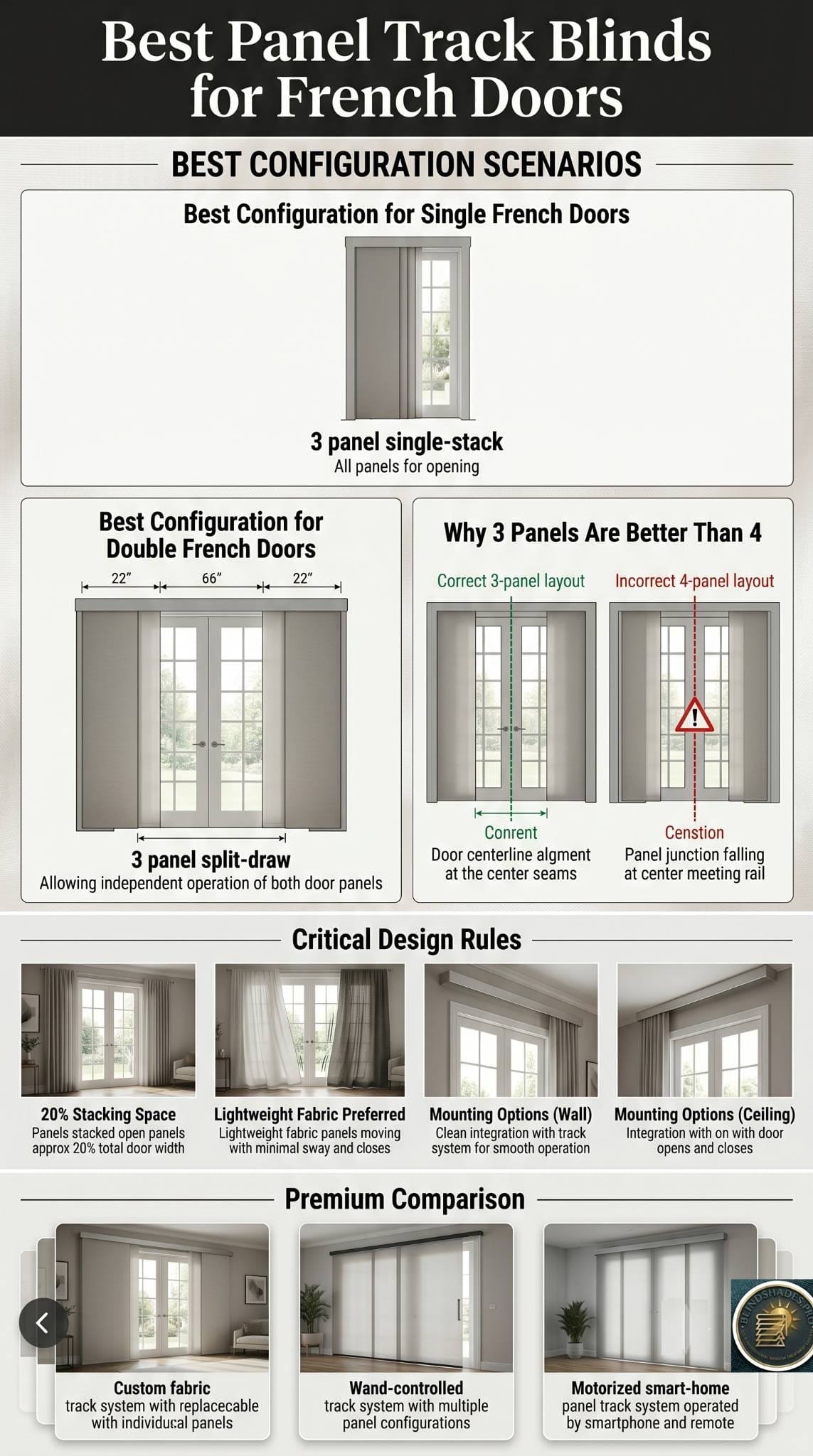
Key Takeaways:
- Panel track blinds for French doors mount on the wall or ceiling above the door frame — neither door carries any hardware; both doors swing freely; the panels are stationary when the doors open; the operational consequence for inswing French doors is identical to vertical blinds: the panels must be traversed to one side before the door opens into the room; for outswing French doors no traverse is required before opening; panel track panels are the modern architectural upgrade from vertical blind vanes — same traverse-to-clear operation, wider panels (18 to 24 inches vs 3.5-inch vanes), fewer panels traversed, cleaner contemporary look
- The stack space calculation before ordering: plan for approximately 20% of the total blind width as stacking space; for a standard 60-inch double French door with 3-inch wall overlap each side = 66 inches total; 20% of 66 inches = approximately 13 inches of wall space needed beside the door frame for stacking; for single stack to one side, 13 inches of unobstructed wall space must be available beside the door; for split draw, 6 to 7 inches are needed on each side; Blindsgalore (March 2026) confirms: “plan for about 20% of your door width”
- For a standard double French door, 3 panels is the correct panel count specification: total width of approximately 66 inches (60 inches opening plus 3 inches wall overlap each side) divided by 3 panels = 22-inch panels — within the optimal 18 to 24 inch range; divided by 5 panels = 13-inch panels (too narrow for the clean look panel track is chosen for); divided by 4 panels = 16.5-inch panels (below the 18-inch minimum recommended range); 3 panels is the specification for standard double French doors
- The center seam panel overlap problem on double French doors: a 4-panel configuration on a 66-inch opening places a panel overlap junction at exactly 33 inches — the center seam between the two door panels; opening either door pushes this overlap junction and can snag the adjacent panel; a 3-panel configuration on a 66-inch opening places panel junctions at 22 inches and 44 inches — neither falls at the 33-inch center seam; always verify that no panel edge lands within 2 inches of the door center seam before ordering
- Individual panel replacement for panel track blinds costs approximately $20 to $60 per panel if the original fabric is still in production; when a fabric is discontinued, exact color matching across different production runs is not guaranteed even with the same color code; order one or two spare panels at initial purchase and store them flat; this eliminates the color-matching and discontinuation problem for future replacements; Blindsgalore allows replacement panel orders on their custom-built panel track systems
⭐ Quick Answer — What Are the Best Panel Track Blinds for French Doors?
- How Panel Track Blinds Work on French Doors and How They Compare to Vertical Blinds: Panel track blinds for French doors mount on the wall or ceiling above the door frame — neither door carries any hardware; both doors swing freely beneath the stationary track. The operational consequence for inswing French doors is identical to vertical blinds: the panels must be traversed to one side before the door can be opened into the room. For outswing French doors, no traverse is required before opening. The difference from vertical blinds is entirely visual and operational: panel tracks use 18 to 24-inch wide fabric panels (3 panels for a standard 60-inch double door) versus 3.5-inch vertical vanes (approximately 17 vanes for the same opening); Blindsgalore (March 2026) confirms panel widths are “usually 18-24 inches each, gliding smoothly along a sleek track — no individual slats clicking together, just smooth quiet panels creating clean lines.” Traversing 3 wide panels is significantly faster than 17 individual vanes. Panel tracks also eliminate the rattle and vane-to-vane contact noise that vertical blinds produce when the door opens. Best overall specification for standard double French doors: Blindsgalore custom panel track, 3 panels, 22-inch width, split draw, wall or ceiling mount, solar or light-filtering fabric
- The Stack Space Calculation — Run Before Ordering Any Panel Track for French Doors: Blindsgalore (March 2026) confirms the universal stacking space rule: “plan for about 20% of your door width.” Applied to French door scenarios for panel track blinds: standard 60-inch double French door with 3-inch wall overlap each side = 66-inch total blind width. Stacking space required: 20% of 66 = 13 inches for single stack to one side; 6 to 7 inches on each side for split draw. The stacking space beside the door frame must be free of light switches, outlet plates, adjacent door frames, and furniture. For inswing French doors, a further constraint applies: the stacked panels must not occupy wall space within the door panel’s 90-degree swing arc; position the stack so it begins at least 3 inches from the door frame edge to allow the door panel to open fully without contacting the stacked panels. Split draw (6 to 7 inches per side) is almost always easier to accommodate beside French door frames than single stack (13 inches one side) and is the recommended configuration for double inswing French doors
- The 3-Panel Count and the Center Seam Calculation — The Specification Absent from Every Guide: For a standard 60-inch double French door with 66-inch total blind width, the panel count determines both panel width and whether a panel overlap junction falls at the door’s center seam. 3 panels × 22 inches = 66 inches: panel width in the optimal 18 to 24-inch range; panel junctions at 22 and 44 inches; the door center seam falls at approximately 30 inches from the left edge; junctions are 8 inches clear of the seam — no contact problem. 4 panels × 16.5 inches = 66 inches: panel width below the 18-inch minimum recommended range AND panel junctions at 16.5, 33, and 49.5 inches; the 33-inch junction is only 3 inches from the 30-inch center seam; when either French door opens, the door edge pushes this junction and can snag the adjacent panel. 5 panels × 13.2 inches = 66 inches: too narrow — loses the clean architectural look panel track is selected for; begins to look like wide vertical blind vanes. 3 panels is the correct specification for a standard 60-inch double French door. For any door width, verify that no panel junction falls within 3 inches of the center seam before confirming the panel count. Blinds To Go confirms: “Typical configurations use 3 to 5 panels with consistent overlap for smooth coverage”
- Fabric Choice for French Door Panel Track Applications and Individual Panel Replacement: Two French door panel track specifications absent from all product guides. (1) Fabric for French door vibration: panel track fabric for French doors should be lighter-weight than for sliding patio doors; French doors create vibration from opening and closing that sliding doors do not; lighter polyester light-filtering or solar screen fabrics respond to door vibration by swaying slightly and returning to position quickly; heavier natural linen and grasscloth weaves create less visible movement under vibration but sway more slowly; for south or west-facing patio French doors specify solar fabric (Blinds To Go confirms “solar fabrics manage heat and UV while preserving outward view”); for bedroom French doors specify blackout fabric (Graywind confirms “overlapping panels minimize light leakage for enhanced shading”). (2) Individual panel replacement: panel track panels are custom-built to order from fabrics that may be discontinued; if a panel is damaged months later and the original fabric has been discontinued, exact color matching across different production runs is not guaranteed even with the same color code; order 1 to 2 spare panels at initial purchase and store them flat; individual replacement panels cost approximately $20 to $60 per panel from Blindsgalore and The Shade Store when the fabric is still in production
- The Panel Track vs Door-Mounted Cellular Shade Decision for French Doors: Panel track blinds for French doors and door-mounted cellular shades are both valid French door treatments but serve different scenarios. Panel track (wall or ceiling-mounted, stationary): no door-face hardware; clean door appearance; requires traverse before opening inswing doors; requires adequate wall stacking space; better for double inswing French doors where mounting two matching door-face blinds with independent hold-downs on each door is operationally complex. Door-mounted cellular shade (travels with door): no traverse required; requires hold-down brackets; blind visible on door face; better for single French doors where the panel track traverse requirement runs every time the single door is used. The decision rule: double inswing French doors = panel track is the more practical specification; single inswing French door = door-mounted cellular shade is more convenient; outswing French doors of any configuration = either works well. For the complete comparison of all French door blind mounting options see [What Are the Best Blinds for French Doors](/guide/best-blinds-for-french-doors/)
- Best Sources: 18-24 inch panel widths, 20% stacking space rule, split draw, fabric cleaning — vacuum panels and dust tracks monthly → Blindsgalore panel track vs vertical blind guide · 12-20 inch panels, 3-5 panel configurations, wand control, solar fabric heat management, overlap reduces snagging → Blinds To Go panel track buying guide · Motorized 2-10 panel configurations (even numbers for center-open), 58-177 inch width, app and remote control → Graywind motorized panel track blinds
⚠️ The Edge Light Gap and Bottom Weight Bar Floor Clearance for Panel Track French Door Installations: Two panel track blind installation details specific to French door applications. (1) Edge light gap at door frame: panel track panels overlap each adjacent panel by 0.5 to 1 inch when closed, eliminating light gaps between panels; however, the panels terminate at the headrail edges; if the headrail is sized exactly to the door opening with no wall overlap, light enters from 1 to 2 inch gaps at each side of the door frame where the hinges and frame hardware are; the solution: extend the headrail 3 to 4 inches beyond the door frame on each side so the first and last panels cover the door frame edge gaps; for inswing French doors, confirm the headrail extension on the hinge side does not extend into the door’s swing arc (the door panel swings to approximately 1 to 2 inches from the wall beside the frame; a 3-inch extension provides adequate coverage without entering the swing path). (2) Bottom weight bar floor clearance: panel track panels have a bottom weight bar that keeps each panel hanging flat and prevents curling; specify the panel length so the bottom weight bar terminates approximately 0.5 inches above the floor; this is identical to the vertical blind vane length specification; for inswing French doors, the bottom weight bar must not contact the floor during the door’s swing (a door that bumps the weight bar would push the panel rather than pass beneath it). Factory Direct Blinds (January 2026) confirms: “Whether you have French doors, sliding doors, or wide windows, choosing the right mounting style depends on whether you have decorative trim you want to highlight or if you prefer full coverage for both visual appeal and practicality.” For the complete installation protocol after ordering, see How Do You Install Blinds on French Doors. See the full stack space calculation below.
💡 Motorized Panel Track Specification for French Doors and the Full Top Brand Comparison: Motorized panel track blinds for French doors eliminate the traverse-before-opening requirement for inswing French doors — panels traverse automatically on remote press or app command, removing the daily manual traverse step that makes wall-mounted panel tracks operationally similar to door-mounted cellular shades in frequency of interaction. Graywind motorized panel track: single-stack = 2 to 5 panels (any number); center-open = 6 to 10 panels (even numbers only, minimum 6); remote and app control; width range 58 to 177 inches for motorized. The motorized specification for double inswing French doors: 4-panel center-open is a valid motorized configuration (even number required for center-open) at 16.5-inch panel width — but the center seam junction calculation still applies; confirm panel junctions clear the door center seam even in motorized configurations. Top brand comparison: Blindsgalore = custom fabric, individual replacement panels available, split draw and single stack, wand or motorized; Blinds To Go = 12 to 20-inch widths, 3-5 panels, wand only (all cordless), in-store measurement service; Graywind = best motorized value, 21 color options, Alexa and Google Home compatible, 58-177 inch motorized range; The Shade Store = premium custom, exclusive designer fabrics, most precise custom sizing, replacement panel program; Budget Blinds = natural woven eco-friendly options. Manual vs motorized for French door panel track: manual wand is adequate for outswing French doors (no traverse required before opening); motorized is recommended for double inswing French doors where daily traverse is required before every door opening — the automation removes a repetitive manual step. For the complete vertical blind vs panel track comparison including the traverse-before-opening requirement and vane vs panel width trade-offs, see What Are the Best Vertical Blinds for French Doors. See the full panel count calculation below.
📖 Read the complete guide below for: how panel track blinds compare to vertical blinds for French doors (same traverse-to-clear operation; 3 panels vs 17 vanes; no rattle), the stack space calculation (20% of door width; 13 inches single stack for 66-inch opening; 6-7 inches per side for split draw; 3-inch clearance from door frame for inswing swing arc), the panel count and panel width formula (3 panels = 22 inches = correct; 4 = 16.5 inches too narrow + center seam junction problem; 5 = 13 inches too narrow), the center seam calculation (4-panel junction at 33 inches = 3 inches from 30-inch seam; 3-panel junctions at 22 and 44 inches = 8 inches clear), fabric choice for French door vibration (lighter fabrics reduce panel sway; solar for south/west-facing; blackout for bedroom), individual panel replacement ($20-$60 per panel; discontinuation risk; order 1-2 spare panels flat at initial purchase), edge light gap (headrail 3-4 inches beyond door frame each side; inswing swing arc check on hinge side), and the panel track vs door-mounted cellular decision (double inswing = panel track; single inswing = door-mounted cellular).
Best Panel Track Blinds for French Doors — How They Differ from Vertical Blinds
Why panel track blinds are the 2026 architectural upgrade for French doors — and what stays exactly the same.
<strong>Panel track blinds for French doors</strong> share one fundamental characteristic with vertical blinds on French doors: they both mount on the wall or ceiling above the door frame, and both require traversal before an inswing French door can be opened. The door panels swing freely beneath the stationary track on either system.
The differences are entirely visual and operational efficiency:
| Factor | Panel Track Blinds | Vertical Blinds (89mm vanes) |
|---|---|---|
| Panel/vane width | 18–24 inches | 3.5 inches (89mm) |
| Panel/vane count for 60-inch opening | 3 panels | ~17 vanes |
| Traverse speed | 3 wide panels to move | 17 individual vanes |
| Visual style | Contemporary/architectural | Classic/traditional |
| Individual replacement | $20–$60 per panel | $5–$25 per vane |
| Light gaps between panels | Minimal (0.5-inch overlap) | Minimal (vane overlap) |
| Rattle from door vibration | None (heavy fabric, no inter-panel contact) | Yes (vane-to-vane contact) |
| Fabric options | Full range including natural woven | Fabric or vinyl vanes |
| 2026 trend direction | Growing (replacing vertical) | Declining in residential |
Blindsgalore (March 2026) confirms: panel track blinds bring “contemporary style to sliding doors” with panels “usually 18-24 inches each, gliding smoothly along a sleek track. No individual slats clicking together. Just smooth, quiet panels creating clean lines.”
For the full vertical blind vs panel track comparison for French door applications, see our guide on What Are the Best Vertical Blinds for French Doors.
The Stack Space Calculation — The Pre-Order Check Most Buyers Skip
The math every panel track buying guide does for sliding doors but never for French doors specifically.
Blindsgalore confirms the universal rule: “plan for about 20% of your door width” for stacking space. Applying this to French door scenarios:
Standard Double French Door (60-inch opening)
Total blind width: 60-inch opening + 3-inch wall overlap each side = 66 inches Stack space required: 20% of 66 = 13.2 inches
For single stack to one side: 13 inches of unobstructed wall space is required beside the door frame on the stack side. This wall space must be free of light switches, outlet plates, adjacent door frames, or furniture that would block the stacked panels.
For split draw: Half the stack on each side = approximately 6 to 7 inches required on each side. This is much easier to accommodate beside a French door frame and is the recommended configuration for double inswing French doors.
Single French Door (36-inch opening)
Total blind width: 36-inch opening + 3-inch overlap each side = 42 inches Stack space required: 20% of 42 = 8.4 inches
For a single French door, 8 to 9 inches of wall space is needed on the stack side. Stack toward the hinge wall — this keeps the stacked panels away from the door handle and away from the door’s swing arc on the handle side.
The Inswing Door Swing Arc Constraint
For inswing French doors, an additional constraint applies: the stacked panels must not occupy wall space within the door panel’s 90-degree swing arc. When an inswing French door opens to its full position, the door panel is parallel to the wall beside the door. The door panel thickness (approximately 1.5 to 2 inches) plus any panel track bottom weight bar position must clear the stacked panels.
The practical rule: position the panel track stack so it begins at least 3 inches from the door frame edge (the door frame face, not the glass edge). This provides clearance for the door panel to open fully without contacting the stacked panels.
The Panel Count Calculation for French Doors
The worked example absent from every panel track buying guide.
The Formula
Panel width = Total blind width ÷ Panel count
Target panel width: 18 to 24 inches (the optimal range for the clean, architectural look panel track is chosen for; below 16 inches begins to look narrow and vertical-blind-like; above 26 inches becomes operationally heavy for manual wand operation)
Standard Double French Door — Worked Example
Total blind width: 66 inches (60-inch opening + 3-inch wall overlap each side)
| Panel Count | Individual Panel Width | In Target Range? | Issue |
|---|---|---|---|
| 3 panels | 22 inches | ✅ YES | Correct specification |
| 4 panels | 16.5 inches | ⚠️ Borderline | Below 18-inch minimum; also places junction at center seam (see below) |
| 5 panels | 13.2 inches | ❌ NO | Too narrow; looks like wide vertical blind vanes |
3 panels is the correct specification for a standard double French door. Blinds To Go confirms: “Typical configurations use 3–5 panels with consistent overlap for smooth coverage.”
Single French Door — Worked Example
Total blind width: 42 inches (36-inch opening + 3-inch overlap each side)
| Panel Count | Individual Panel Width | In Target Range? |
|---|---|---|
| 2 panels | 21 inches | ✅ YES |
| 3 panels | 14 inches | ❌ Too narrow |
2 panels is the correct specification for a standard single French door. Split draw with 2 panels creates a clean center-opening appearance; single stack works equally well.
The Center Seam Problem — Why Panel Count Matters More Than Width Alone
The panel overlap junction calculation absent from all panel track guides.
For a double French door, the center seam between the two door panels falls at a specific position. On a standard 60-inch double door with 3-inch wall overlap on each side, the center seam falls at:
Center seam position = (Total blind width ÷ 2) − left wall overlap = (66 ÷ 2) − 3 = 30 inches from the left headrail edge
(Or equivalently: 30 inches from the right headrail edge)
Panel junction positions by panel count:
| Panel Count | Junction Positions (from left edge) | Does a junction land near 30-inch center seam? |
|---|---|---|
| 3 panels (22-inch each) | 22 inches, 44 inches | NO — nearest junction is at 22 inches (8 inches clear) |
| 4 panels (16.5-inch each) | 16.5, 33, 49.5 inches | YES — 33-inch junction is 3 inches from 30-inch center seam |
| 5 panels (13.2-inch each) | 13.2, 26.4, 39.6, 52.8 inches | Close — 26.4-inch junction is 3.6 inches from seam |
The 4-panel problem: A 4-panel configuration places a panel overlap junction at 33 inches — only 3 inches from the 30-inch center seam. When the left French door opens, it pushes the right side of the left half of the blind toward the center; if a panel overlap junction is near the door seam, the door edge can push against this junction and snag the adjacent panel.
The 3-panel solution: Panel junctions at 22 inches and 44 inches provide 8 inches of clearance on each side of the 30-inch center seam. No panel edge is in the door’s contact zone.
The ordering rule: before finalizing panel count, calculate junction positions and confirm no junction falls within 3 inches of the door center seam.
Fabric Choice for French Door Panel Track Applications
Why French door vibration creates a different fabric specification from sliding door applications.
Panel track guides universally discuss fabric options for sliding patio doors, where the covering is stationary and the door glides past it. French door panel tracks are also stationary, but French doors create vibration from opening and closing that sliding doors do not.
Lighter Fabrics — Recommended for Most French Door Applications
Lighter-weight fabrics (polyester light-filtering, solar screen) respond to door vibration by swaying slightly and then returning to position. They do not transmit vibration to the panel track hardware or create inter-panel contact.
Best for:
- Living room and dining room French doors with moderate traffic
- Any French door where panel movement from door vibration is acceptable
Heavier Fabrics — For Premium Look, Secondary Doors
Heavier fabrics (natural linen, grasscloth, thick woven textures) create less visible movement from door vibration (their mass resists deflection) but when they do sway, they return to position more slowly. They are also more challenging to traverse manually due to their weight.
Best for:
- Low-traffic French doors (formal rooms, secondary entrance)
- Outswing French doors where no traverse is required before opening
Solar Fabric — For South and West-Facing French Doors
Blinds To Go confirms: “Solar fabrics manage heat and UV while preserving outward view.” For south or west-facing French doors with direct afternoon sun exposure, solar fabric reduces solar heat gain through the open glass without sacrificing the view. Solar panel track fabric maintains visibility through the panel at normal interior light levels.
Best for:
- Patio-facing living room French doors with afternoon sun
- Any French door where maintaining a view while controlling heat is the priority
Blackout Fabric — For Bedroom French Doors
Room-darkening or full blackout panel track fabric for bedroom French doors. Graywind confirms: “overlapping panels minimize light leakage for enhanced shading, privacy, insulation, and UV protection.” Combined with a 3-4 inch wall overlap beyond the door frame on each side, blackout panel track panels can achieve near-complete light blocking from a wall-mounted track.
Individual Panel Replacement — The Repairability Decision
The spare panel order recommendation absent from all panel track buying guides.
Unlike vertical blind vanes ($5–$25 individually and always in production), panel track panels are custom-built to order from fabric that may be discontinued. When a panel track panel is damaged:
If the original fabric is still in production: Contact the original retailer for a single replacement panel at the same dimensions. Cost: approximately $20–$60 per panel (Blindsgalore and The Shade Store both offer replacement panel programs). The replacement panel will match if it comes from the same production run; slight variation across production runs is possible even with the same color code.
If the original fabric has been discontinued: Exact replacement is not possible. Options: (1) order a new close-match fabric in a replacement panel and accept a slight variation (visible difference may be minimal); (2) order a full new set of replacement panels in a new fabric to achieve a consistent look.
The ordering rule: When placing your initial panel track order for French doors, add one or two extra panels at the same fabric, dimensions, and color code. Store them flat (not rolled — rolling can crease the fabric weave). The cost of two extra panels ($40–$120) is the insurance premium against discontinuation and production run variation.
The Edge Light Gap and the 3-4 Inch Overlap Rule
Why panel track panels alone are not enough for full coverage on a French door frame.
Panel track panels overlap each adjacent panel by approximately 0.5 to 1 inch when closed. This inter-panel overlap eliminates light gaps between panels. However, the panels themselves terminate at the edge of the panel track headrail. If the headrail is sized exactly to the door opening (no wall overlap), there will be 1 to 2 inch light gaps at each side of the door frame where the door frame hardware and hinges are visible.
The solution: Extend the panel track headrail 3 to 4 inches beyond the door frame on each side. This overlap ensures:
- The first panel covers the door frame hardware on the hinge side
- The last panel covers the door frame hardware and gap on the handle side
- No edge light gap is visible between the panel track edge and the wall
For inswing French doors: confirm the headrail extension on the hinge side does not extend into the door’s swing arc. The door’s swing arc beside the door frame is typically 1 to 2 inches; the headrail can safely extend 3 to 4 inches past the door frame edge without entering the swing path.
The Panel Track vs Door-Mounted Cellular Shade Decision
The French door-specific comparison absent from all panel track guides.
Panel track blinds and door-mounted cellular shades are both valid French door treatments but serve different installation scenarios:
| Scenario | Panel Track (Wall-Mounted) | Door-Mounted Cellular Shade |
|---|---|---|
| Double inswing French door | ✅ Better — no door-face hardware on either door; single headrail covers both panels | ⚠️ Requires two separate blinds, each with hold-downs, each individually released before opening |
| Single inswing French door | ⚠️ Requires traverse before every opening | ✅ Better — travels with door; no traverse required; one product |
| Double outswing French door | ✅ Good — no traverse required; clean look | ✅ Good — travels with door; no traverse required |
| Limited wall space beside door | ⚠️ May not have adequate stacking space | ✅ Door-mounted; no wall stacking space needed |
| Available wall stacking space | ✅ Panel track works well | N/A |
| Renter scenario | ✅ Wall mount (holes in wall acceptable) | ✅ Door mount (fewer holes; hold-downs only) |
The decision rule for French doors:
- Double inswing French doors = panel track is the practical choice; one system covers both doors; neither door carries hardware
- Single French door = door-mounted cellular shade is more convenient (no traverse required every time the door is used)
For a full comparison of all French door blind options including door-mounted treatments, see What Are the Best Blinds for French Doors.
Top Panel Track Blind Brands for French Doors
Blindsgalore — Best Custom French Door Panel Track
Custom-built to exact dimensions; full fabric library including solar, sheer, room-darkening, and natural woven; individual replacement panels available; split draw and single stack configurations; wand or motorized operation. Blindsgalore’s panel track system allows precise panel width specification — critical for the 3-panel French door calculation.
Blinds To Go — Best Mid-Market French Door Panel Track
Blinds To Go offers 3 to 5 panel configurations with widths from 12 to 20 inches; wand control only (no cord — all cordless as of their current line); overlap minimizes snagging; sturdy carriers designed for daily use; in-store measurement service available. Their panel widths starting at 12 inches allow flexibility for narrower French door openings.
Graywind — Best Motorized French Door Panel Track
Graywind motorized panel track: 2–5 panel single-stack OR 6–10 panel (even numbers only) center-open configurations; remote and app control; available 58–177 inches total width. For double inswing French doors where daily traverse is required, motorized panel track eliminates the manual traverse step entirely — panels traverse automatically on remote press before or after the door is opened.
The Shade Store — Best Premium French Door Panel Track
Premium custom panel tracks with precise overlap specification and wide fabric library including exclusive designer textiles. Higher price point but best fabric quality range and most precise custom sizing.
Frequently Asked Questions
What are the best panel track blinds for French doors? The best panel track blinds for French doors are 3-panel, wall or ceiling-mounted systems for double French doors, with split draw for double inswing configurations. For standard 60-inch double French doors, 3 panels of 22 inches each provide the optimal look and avoid placing a panel junction at the door center seam. Blindsgalore, Blinds To Go, and Graywind are the top panel track brands for French door applications in 2026.
How do panel track blinds work on French doors? Panel track blinds mount on the wall or ceiling above the French door frame. Neither door carries any hardware. The wide fabric panels glide along the track and stack to one side (or split from center) to clear the door opening. For inswing French doors, the panels must be traversed before opening the door, as they hang in the space the door swings through. For outswing French doors, no traverse is required before opening.
How much wall space do I need for panel track blinds on French doors? Plan for approximately 20% of the total blind width as stacking space. For a standard double French door with 66 inches of total blind width, 13 inches of wall space is needed on the stack side for single stack, or 6 to 7 inches on each side for split draw. Blindsgalore confirms the 20% stacking space rule. The stacking space must be clear of light switches, outlet plates, and furniture.
How many panels do I need for panel track blinds on double French doors? For a standard 60-inch double French door, 3 panels is the correct specification. Three 22-inch panels provide optimal visual proportion (within the 18 to 24 inch target range) and avoid placing a panel overlap junction at the door center seam. Four panels place a junction at approximately 33 inches — near the center seam where it can snag when the door opens.
Can I replace individual panels if one is damaged on my French door panel track? Yes, if the original fabric is still in production. Individual replacement panels cost approximately 20 to 60 dollars per panel from most custom panel track retailers. To protect against fabric discontinuation, order one to two spare panels at the time of initial purchase and store them flat.
Related Guides on BlindShades.pro
- The Best French Door Blinds & Shades Buying Guide
- What Are the Best Blinds for French Doors
- What Are the Best Vertical Blinds for French Doors
- How Do You Install Blinds on French Doors
- Are Cellular Shades Good for French Doors
- How Do You Stop French Door Blinds From Swinging
By Michael Turner | 30 Years Home Improvement Expertise | Updated 2026 | BlindShades.pro
