What Window Treatments Give French Doors the Most Privacy?

Authored By Michael Turner -30 Years Home Improvement Expertise | Updated 2026 | BlindShades.pro
Updated on June 12, 2026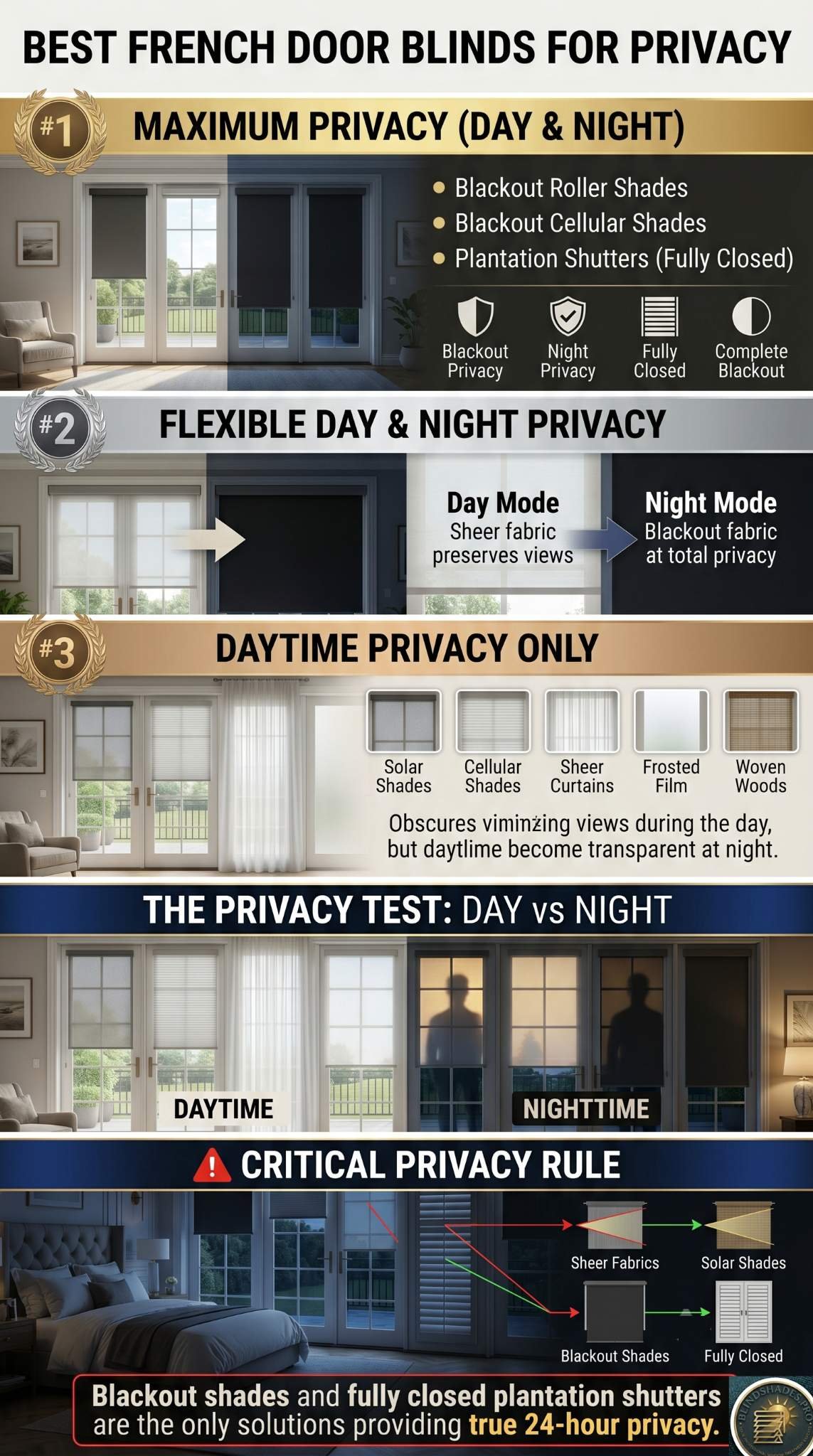
Key Takeaways:
- The most important French door privacy fact most guides omit: every sheer, light-filtering, solar, and semi-translucent window treatment provides daytime privacy only — when interior lights are on after dark, the one-way optical effect reverses and people outside can see through these materials into the lit room; the only treatments that maintain genuine privacy both day AND night on French doors are opaque/blackout materials: blackout roller shades, blackout cellular shades, blackout Roman shades, plantation shutters with louvers closed, and blackout curtains; all other treatments fail at nighttime privacy with interior lights on
- The privacy inversion threshold is determined by the brightness differential between interior and exterior: when exterior is brighter than interior (daytime), solar/sheer treatments create a mirror effect from outside; when interior is brighter than exterior (any illuminated room after dark), this effect reverses; ClimatePro (February 2025) confirms: “reflective window film doesn’t work at night — you will need other means of creating privacy”; this applies equally to solar shades, sheer curtains, light-filtering cellular shades, frosted film, and woven wood without blackout lining
- Interior French doors (room dividers, office glass panels, hallway glass) need completely different privacy treatments from exterior patio French doors; interior doors have no weather exposure and both sides are at the same temperature; the privacy concern is between household occupants, not from the street; sheer or light-filtering treatments provide adequate privacy between interior spaces while preserving borrowed light; using blackout treatments on interior French doors defeats their architectural purpose (connecting spaces with visual light flow)
- For street-facing bedroom French doors where eye-level privacy from the street is the specific concern, a TDBU (top-down bottom-up) blackout cellular shade is the correct specification: raise the shade from the bottom to cover the eye-level lower 60% of the glass (blocking the view of the bed from street level) while the upper glass admits sky light from above eye height; VelaBlinds (October 2025) confirms TDBU is “the only configuration that gives you daylight with full privacy” for this application
- The double roller day/night system (sheer layer plus blackout layer on one headrail) solves the French door depth constraint that prevents standard layering approaches: standard windows can accommodate two separate shade systems at different headrail depths; French door glass panels have only 0.5 to 1.5 inches of mounting space — insufficient for two separate headrails; the double roller day/night system provides sheer for daytime privacy and a dedicated blackout layer for nighttime privacy, both from one slim headrail that fits the French door mounting space
⭐ Quick Answer — What Window Treatments Give French Doors the Most Privacy?
- The Most Important French Door Privacy Fact Most Guides Get Wrong — The Night Reversal: The most critical fact for French door window treatments privacy is the night reversal: every sheer, light-filtering, solar, and semi-translucent treatment provides daytime privacy only. After dark when interior lights are on, the one-way optical effect fully reverses — people outside can see through these materials into the lit room as if the treatment were barely there. ClimatePro (February 2025) confirms: “Privacy window film doesn’t work at night — you will need other means of creating privacy.” VelaBlinds (October 2025) confirms: “Nighttime privacy requires different solutions because interior lighting creates silhouette effects through light-filtering materials — activities inside become visible as shadows.” The only treatments that maintain genuine privacy both day AND night are opaque/blackout materials: blackout roller shades, blackout cellular shades, blackout Roman shades, plantation shutters with louvers fully closed, and blackout curtains/drapes. Every solar shade (any openness factor), every sheer curtain, every light-filtering cellular shade, every frosted film, every woven wood shade without blackout lining, and every zebra/banded blind — all fail at nighttime privacy with interior lights on. For maximum all-hours French door privacy, blackout is the only correct specification
- The Complete Privacy Score — 18 French Door Treatments Rated Day and Night: The French door window treatment privacy score by treatment type, daytime and nighttime: Blackout roller shade (99%+ opacity) = excellent day AND night; blackout cellular = excellent day AND night (adds insulation); blackout Roman shade = excellent day AND night (fold edges minor light at folds when raised); plantation shutters (louvers fully closed) = excellent day AND good night (minor leakage at louvre joints); double roller day/night (blackout layer) = excellent day AND night with sheer option for daytime. Room-darkening roller = excellent day AND good night (light transmission at edges). Plantation shutters (45-degree louvre) = good day AND good night. Frosted/etched film = good day AND partial night (silhouettes visible). Solar shade 1% openness = good day AND NO nighttime privacy (full reversal). Light-filtering cellular = fair day AND NO night. Woven wood unlined = fair day AND NO night. Sheer curtain = fair day AND NO night. Zebra/banded (opaque bands) = fair day AND NO night (sheer sections of loop always visible). One-way reflective film = good day AND NO night. AAA Blind and Shutter Factory (January 2026) confirms: “Blackout roller shades are made from dense opaque materials blocking up to 99% of natural light AND stopping interior light from leaking out” — the dual function of blocking incoming and outgoing light is what makes blackout the definitive French door night privacy solution
- Privacy by Viewing Angle — TDBU for Street-Facing Bedrooms, Full Coverage for Garden-Elevated Views: The viewing angle determines the correct French door privacy treatment specification. Street-facing French door (horizontal eye-level viewing): a TDBU (top-down bottom-up) blackout cellular shade is the optimal specification — raise from the bottom to cover the lower 60 to 70% of the glass, blocking the street-level view of the room interior and any furniture or bed at floor height; the upper glass remains uncovered, admitting sky light from above eye height; VelaBlinds confirms TDBU “allows the shade to be raised from the bottom for additional natural sunlight filtration and outdoor view while maintaining full privacy.” Garden-facing French door (elevated neighbor viewing angle): a neighbor with an upstairs window, raised deck, or hillside position looks DOWN toward the French door; a TDBU shade that covers the lower glass and leaves the upper glass open is counterproductive — the elevated neighbor looks over the covered lower zone into the uncovered upper zone; specify full-coverage blackout treatment for garden-facing French doors with any elevated viewing angle; plantation shutters angled downward also block elevated angles. For the complete TDBU cellular shade specification for French doors, see [Are Cellular Shades Good for French Doors](/guide/cellular-shades-for-french-doors/)
- Interior vs Exterior French Doors — Completely Different Privacy Specifications: Interior and exterior French door window treatments require completely different privacy specifications — a detail absent from all competitor guides. Exterior French doors (patio, entrance, garden): privacy concern = street, neighbors, passersby; both day AND night privacy required; weather exposure relevant to material selection; blackout or room-darkening treatment for nighttime use; solar shade acceptable for office/study with daytime-only occupancy; double roller day/night system for rooms used at all hours. Interior French doors (room dividers, office glass panels, hallway glass): privacy concern = other occupants within the same home; weather exposure irrelevant; sheer or light-filtering treatment is adequate (blocks casual glancing while preserving the borrowed light that makes glass-panel interior doors architecturally valuable); using blackout on interior French doors defeats their primary function of transmitting light between connected spaces; the exception is a bedroom interior French door facing a bright hallway where room-darkening prevents light intrusion during sleep. Bringnox (March 2026) confirms cellular shades and roller shades are the best all-around French door options — but the specific opacity must match the interior vs exterior application
- The Double Roller Solution for All-Day Privacy on Depth-Constrained French Doors: Standard window layering for all-day French door window treatment privacy uses two separate shade systems — a sheer shade for daytime and a blackout shade for nighttime, installed at different headrail depths. French doors make this impossible: French door glass panels have only 0.5 to 1.5 inches of flat mounting space above the glass, insufficient for two separate headrails at different depths. Bottom Dollar Blinds (May 2026) confirms the solution: “We install dual rollers on French doors to manage the intense Texas sun AND provide nighttime security.” The double roller day/night system places two independent fabrics — a sheer or solar layer and a dedicated blackout layer — on a single slim headrail that fits within the French door’s shallow mounting space. The sheer layer provides daytime privacy with outward view; the blackout layer provides nighttime privacy with interior light containment; both fabrics operate independently with four operating positions. This is the only French door treatment that delivers both daytime sheer aesthetics and genuine nighttime blackout privacy without requiring two separate headrail installations. For the complete double roller specification for French doors, see [What Are the Best Blinds for French Doors](/guide/best-blinds-for-french-doors/)
- Best Sources: Privacy window film fails at night; “reflective window film doesn’t work at night”; static cling film removable and renter-friendly → ClimatePro privacy window film at night guide · Blackout roller shades block 99% of light AND stop interior light from leaking out; interior lighting makes home visible at night → AAA Blind and Shutter Factory day vs night privacy guide · Nighttime privacy requires different solutions; silhouettes visible through light-filtering materials; TDBU for daylight with full privacy → VelaBlinds privacy window blinds guide
⚠️ Plantation Shutter Louvre Angle and the “See Out at Night Without Being Seen” Use Case: Two French door privacy specifications absent from all competitor guides. (1) Plantation shutter louvre angle optimization: plantation shutters on French doors use adjustable horizontal louvre slats that can be tilted to three key privacy positions. 45-degree upward tilt: “angling slats upward at 45 degrees gives privacy without cutting brightness” (AllThingsSnug confirmed) — a person at eye level outside sees the underside of the slats rather than through the gaps; from inside, diffused overhead light enters; this is the optimal living room daytime privacy position. 45-degree downward tilt: slats angle downward; a person at eye level can see through the gaps (less privacy from direct eye-level view) but an elevated neighbor looking down sees the top surface of the slats (blocked) — the correct position for garden-facing French doors with elevated viewing angles. Fully closed: maximum privacy in all directions; correct for nighttime and bedroom use. French door plantation shutters must use a bi-fold or single-panel design that clears the door handle arc when the door is opened — confirm handle clearance before ordering. (2) The see-out-at-night use case: for primary entrance French doors that face the front approach, a sheer treatment in a dark interior with a lit exterior creates one-way outward visibility — the homeowner can see approaching visitors without turning on interior lights (which would reverse the privacy effect). Solasolv confirms one-way blinds “work best during the day” but the same physics applies at night when exterior is brighter than interior: dark interior looking through sheer treatment to lit exterior = the homeowner can see out while remaining invisible from outside. Critical limitation: this only works with a dark interior; as soon as interior lights turn on, privacy is lost — this is a “checking who’s at the door” scenario only, not an ongoing nighttime privacy solution. See the full 18-treatment privacy score table below.
💡 Permanent Privacy Film for French Doors and the Complete Application Table: Permanent privacy film applied directly to the French door glass provides continuous French door window treatment privacy at all times without operation. Three film types: (1) Frosted static cling film (renter-friendly, removable): adheres through static electricity — no glue, no residue on removal; daytime = good privacy (direct view obscured); nighttime = partial privacy (silhouettes visible through frosted glass with interior lights on); ClimatePro confirms static cling film is “affordable, DIY-friendly, and removable.” (2) Adhesive frosted or decorative film: more permanent and durable; difficult to remove without residue; appropriate for owned properties. (3) Blackout film: completely opaque — glass panel becomes solid dark surface; maximum privacy day and night; eliminates the visual transparency entirely; appropriate for utility French doors, workshops, or any location where the glass view function is not needed. French door glass edge consideration: film applied to glass only, not to the door stile or molding; ensure coverage extends to the full glass edge to prevent viewing lanes at the sides of the panel. Complete application table by use case: Living room patio French door (day and night use) = double roller day/night system (sheer layer day, blackout night). Bedroom street-facing (eye-level privacy + sky light) = TDBU blackout cellular. Bedroom garden-facing (elevated neighbor) = full-coverage blackout roller or cellular. Home office (daytime only) = solar shade 1-3% openness (confirm nighttime use — add blackout if needed). Kitchen French door = light-filtering roller or vinyl mini-blind (wipe-clean required). Interior room divider = single-cell light-filtering cellular. Renter scenario (no drilling) = magnetic blind (steel door) or static cling frosted film for glass panels. Permanent privacy without operation = frosted adhesive film or blackout film. For the complete installation guide for any selected treatment, see How Do You Install Blinds on French Doors. See the full privacy decision table by room below.
📖 Read the complete guide below for: the night privacy reversal (every sheer/solar/light-filtering/frosted treatment fails with interior lights on; only blackout maintains 24-hour privacy), the 18-treatment privacy score table (daytime and nighttime ratings for all major French door treatment types), interior vs exterior French door specification (interior = sheer adequate; exterior = blackout for night use), garden-elevated vs street-eye-level viewing angles (TDBU for street; full coverage for elevated), permanent film options (static cling renter-friendly; adhesive permanent; blackout opaque), plantation shutter louvre angles (45-degree upward = privacy without blocking overhead light; downward = elevated angle privacy; closed = maximum), the see-out-at-night use case (dark interior + lit exterior = one-way outward visibility for entrance security), and the double roller solution for French door depth constraints (one headrail = sheer layer + blackout layer; solves 0.5-1.5 inch mounting space limitation).
French Door Window Treatments Privacy — The Day vs Night Problem Every Guide Gets Wrong
The privacy reversal at night is the single most important French door privacy fact — and it is absent from nearly every buying guide.
Every French door has glass panels. Every glass panel is subject to the same optical physics: light travels from the brighter environment to the dimmer environment. The observer on the brighter side cannot see through — the glass reflects. The observer on the darker side can see through clearly.
Daytime (exterior brighter than interior): Sunlight makes the exterior significantly brighter than a typical lit or partially lit room interior. Solar shades, sheer curtains, light-filtering cellular shades, and reflective window film all create a one-way mirror effect from outside — the person on the street sees their own reflection, not the room interior. You can see out; they cannot see in.
After dark with interior lights on (interior brighter than exterior): The effect fully reverses. The lit room is now the brighter environment. The dark exterior is the dimmer environment. Every translucent material on the glass — solar shade, sheer curtain, light-filtering cellular, frosted film — now transmits light outward. The person on the street sees the lit room through the treatment as if it were barely there.
ClimatePro (February 2025) confirms: “Privacy window film is great for daytime but needs additional solutions for nighttime privacy, like curtains or blinds. In short, reflective window film doesn’t work at night.”
VelaBlinds (October 2025) confirms: “Nighttime privacy requires different solutions because interior lighting creates silhouette effects through light filtering materials. Activities inside become visible as shadows against illuminated fabric surfaces.”
AAA Blind & Shutter Factory (January 2026) confirms the only solution: “Blackout roller shades are made from dense, opaque materials… blocking up to 99% of natural light and stopping interior light from leaking out.”
The practical consequence for French door window treatment selection: If any room behind your French doors is occupied and illuminated after sunset, the privacy treatment must be opaque — not semi-transparent, not light-filtering, not solar. Any translucent material on French door glass at night with interior lights on provides zero genuine privacy from exterior viewing.
The Complete Privacy Score — Every French Door Treatment Rated Day and Night
The quantified framework absent from every French door privacy guide.
| Treatment | Daytime Privacy | Nighttime Privacy (Interior Lit) | Notes |
|---|---|---|---|
| Blackout roller shade (99%+ opacity) | ✅ Excellent | ✅ Excellent | Maximum all-hours privacy; stops interior light from leaking out |
| Blackout cellular shade | ✅ Excellent | ✅ Excellent | Same as blackout roller + added insulation value |
| Blackout Roman shade | ✅ Excellent | ✅ Excellent | Fabric folds reveal some light at fold edges when raised |
| Plantation shutters (louvers closed) | ✅ Excellent | ✅ Good | Minor light leakage at louvre joints; full closure = near-blackout |
| Blackout curtain/drape | ✅ Excellent | ✅ Excellent | Best for aesthetic; requires wall rod mount (not door mount) |
| Double roller day/night (blackout layer) | ✅ Excellent | ✅ Excellent | Sheer layer for day; blackout layer for night; both from one headrail |
| Room-darkening roller shade | ✅ Excellent | ✅ Good | Some light transmission at edges; not 100% opaque |
| Room-darkening cellular shade | ✅ Excellent | ✅ Good | Similar to room-darkening roller |
| Plantation shutters (45-degree louvre) | ✅ Good | ✅ Good | Angled slats reduce but don’t eliminate nighttime visibility |
| Frosted/etched window film | ✅ Good | ⚠️ Partial | Daytime direct view blocked; nighttime silhouettes visible |
| Solar shade (1% openness factor) | ✅ Good | ❌ None | Mirror effect daytime only; full visibility reversal at night |
| Solar shade (3–5% openness factor) | ✅ Fair | ❌ None | Same reversal; more visible at night than 1% |
| Light-filtering cellular shade | ✅ Fair | ❌ None | Silhouettes clearly visible at night with interior lights |
| Woven wood shade (unlined) | ✅ Fair | ❌ None | Gaps in weave visible in both directions at night |
| Sheer curtain | ✅ Fair | ❌ None | Near-invisible privacy at night when lit |
| Zebra blind (opaque bands aligned) | ✅ Fair | ❌ None | Sheer sections of continuous loop visible from outside at night |
| One-way reflective film | ✅ Good | ❌ None | Daytime only; fully reverses at night |
| No treatment | ❌ None | ❌ None | Full transparency both directions |
Interior vs Exterior French Doors — Two Different Privacy Specifications
The distinction absent from all French door privacy guides.
Exterior French Doors — The Full Privacy Challenge
Patio French doors, entrance French doors, garden French doors: the privacy concern is the street, neighbors, passersby, and intruders. Both day and night privacy matter. Weather exposure is relevant to material selection.
The correct specification for exterior French doors:
- Primary bedroom, living room at night: blackout roller shade, blackout cellular, double roller day/night system, or plantation shutters
- Living room during the day: solar shade for daytime privacy with outward view (confirm nighttime privacy need — if room is used at night, add a second blackout treatment or specify double roller)
- Year-round weather exposure: specify UV-stable materials; RPET slats or UV-treated fabrics for south/west-facing doors
Interior French Doors — Completely Different Requirements
Room dividers between a study and living room, hallway glass panels between a corridor and bedroom, office glass partitions: the privacy concern is other occupants in the same home. Weather exposure is irrelevant. The visual connection between spaces is often desired.
The correct specification for interior French doors:
- Light-filtering cellular or sheer roller shade: provides visual privacy from casual glancing between spaces while preserving the borrowed light that makes glass-panel interior French doors architecturally valuable; no blackout needed
- NOT blackout: using blackout on interior French doors defeats the primary benefit of glass panel interior doors — light transmission between connected spaces
- NOT solar shade: solar shades provide a one-way effect only when there is a daylight differential between spaces; between two interior rooms, no such differential reliably exists; a solar shade on an interior French door typically provides limited privacy in either direction
- The exception: an interior French door between a media/projection room and a hallway benefits from room-darkening treatment (prevents hallway light intrusion during screenings)
Privacy by Viewing Angle — Garden vs Street Facing
Why TDBU works for one application and not the other.
Street-Facing French Doors — Horizontal Eye-Level Privacy
A street-facing French door has passersby walking past at eye level — the privacy concern is horizontal, at approximately 5 feet from floor level. A TDBU blackout cellular shade is the ideal specification:
- Raise from the bottom to cover the lower 60% of the glass (blocking the eye-level view of the room interior and any furniture or bed at floor height)
- The upper 40% of the glass remains uncovered — admitting sky light and elevated views that do not compromise privacy
VelaBlinds (October 2025) confirms: “Top Down/Bottom Up shades feature a lift style that allows the shade to be raised from the bottom for additional natural sunlight filtration and outdoor view while maintaining full privacy.”
For the complete TDBU cellular shade specification for French doors, see our guide Are Cellular Shades Good for French Doors.
Garden-Facing French Doors — Elevated Angle Privacy
A garden-facing French door has neighbors who may have elevated viewing positions — an upstairs window, a raised deck, a hillside property, or simply someone standing on a step above the door. The elevated viewing angle is above the horizontal plane.
Why TDBU fails here: With TDBU, the lower glass is covered and the upper glass is open. An elevated neighbor looking down toward the French door can see OVER the covered lower zone into the upper uncovered zone — exactly where the TDBU left the glass exposed. A TDBU shade that provides street-level privacy may provide none at all against a slightly elevated garden view.
The correct specification for garden-facing elevated privacy:
- Full-coverage room-darkening or blackout treatment (roller shade, cellular shade, or curtain) covering the entire glass panel height
- OR plantation shutters with louvres angled downward (to block elevated viewing angles from above)
Plantation Shutter Louvre Angle — Optimizing French Door Privacy
The specific louvre angle specification absent from all French door plantation shutter guides.
Plantation shutters on French doors use a full-height shutter panel mounted over the door glass on the door face. The horizontal louvre slats can be tilted to any angle from open (horizontal = maximum light, minimum privacy) to closed (vertical = maximum privacy, minimum light).
The three key louvre positions for French door privacy:
45 degrees upward tilt (privacy without darkness): AllThingsSnug confirms: “Angling slats upward at 45 degrees gives privacy without cutting brightness.” When slats angle upward, a person at eye level outside the door looks at the underside of the slats — they cannot see through the gaps into the room. From inside, diffused overhead light enters through the gaps from above. This is the optimal daytime privacy position for living room French doors where natural light is valued.
45 degrees downward tilt (elevated angle privacy): When slats angle downward, a person at eye level outside sees through the gaps into the room (limited privacy from direct eye level). However, a person looking down from above (elevated neighbor, deck, or upstairs window) sees the top surface of the slats — blocked. Downward tilt is the correct specification for garden-facing French doors with elevated neighbor viewing angles.
Fully closed (maximum privacy): Slats rotate to vertical position — essentially a solid panel with minimal gaps at louvre joints. Maximum privacy in all directions. Correct for bedrooms, nighttime use, and any situation where complete privacy is the goal.
French door shutter specification: Full-height plantation shutters on French doors require a bi-fold or single-panel design that clears the door handle when opened. Confirm the shutter panel swings clear of the door handle arc before ordering.
Permanent Privacy Solutions for French Doors
Static cling film, adhesive film, and blackout film — the renter and permanent solutions for French door glass.
Permanent privacy film is applied directly to the glass panel of the French door. Unlike window treatments that can be raised, lowered, or opened, permanent film provides continuous privacy at all times without any operation.
Three film types for French doors:
Frosted/etched static cling film (renter-friendly, removable): Provides permanent-appearing privacy without a permanent adhesive commitment. The film adheres through static electricity — no glue, no residue on removal. Daytime privacy: good (direct view obscured; shapes/silhouettes still visible through frosted surface). Nighttime privacy: partial (silhouettes more visible with interior lights on — frosted glass is still semi-translucent). ClimatePro confirms static cling film is “affordable, DIY-friendly, and removable.”
Adhesive frosted or decorative film: Similar privacy level to static cling but with an adhesive backing — more permanent and more durable. Difficult to remove without residue. Appropriate for owned properties where the glass privacy solution is a permanent decision.
Blackout film: Completely opaque — the glass panel becomes a solid dark surface. Maximum privacy both day and night. Eliminates the visual transparency of the glass entirely. Appropriate for French doors in utility rooms, workshops, or any location where the view through the glass is not wanted. Not appropriate for French doors where the glass serves an architectural light or view function.
The French door glass edge consideration: Film is applied to the glass surface only — not to the door stile or molding around the glass. For French doors with very narrow glass panels (18 to 22 inches wide), the film coverage reaches effectively to the panel edges. For any glass panel, ensure the film extends to the full edge of the glass without leaving an untreated border, which would create visible viewing lanes at the sides.
The “See Out at Night Without Being Seen” Application
The French door privacy use case no guide addresses — maintaining security visibility after dark.
For primary entrance French doors that face the front approach of a home, there is a specific privacy use case: the homeowner wants to see who is approaching at night without turning on interior lights (which would reverse the privacy effect and enable outside-to-inside visibility).
The optical condition for one-way nighttime visibility: One-way see-out visibility at night requires exterior to be brighter than interior. When the interior is dark and the exterior has porch light, street light, or other exterior illumination: a sheer or semi-sheer treatment on the French door glass provides outward visibility from inside while maintaining privacy from outside.
The specification: For primary entrance French doors where security visibility is valued: specify a solar shade (3–5% openness factor) or light-filtering roller shade. When the homeowner is positioned in a dark interior looking through the treatment to the lit exterior, they can see approaching visitors. Approaching visitors cannot see into the dark interior.
The critical limitation: This one-way nighttime visibility only works when the homeowner intentionally keeps the interior dark. As soon as interior lights are turned on, the effect reverses and privacy is lost. This treatment is appropriate for a brief “checking who is at the door” scenario, not for ongoing nighttime privacy with interior lights on.
For ongoing nighttime privacy with interior lights on, blackout is the only correct specification.
The Double Roller Solution — Solving French Door Depth Constraints for All-Day Privacy
Why standard layering approaches fail on French doors and the one-product solution that works.
The standard approach to all-day privacy on windows is layered window treatments: a sheer shade or curtain for daytime privacy and a blackout shade for nighttime privacy, installed at different depths from the glass.
Why this layered approach fails on French doors: Standard windows have a window frame with 2.5 to 4 inches of mounting depth — enough for two separate shade headrails at different depths. French door glass panels have 0.5 to 1.5 inches of mounting space above the glass. Mounting two separate headrails at different depths is not feasible in this space.
Bottom Dollar Blinds (May 2026) confirms the solution: “We install dual rollers on French doors to manage the intense Texas sun AND provide nighttime security.” The dual roller day/night system places two independent fabrics (sheer/solar and blackout) on a single slim headrail that fits within the French door’s shallow mounting space.
How the double roller solves the French door layering problem:
- One headrail: fits in the 0.5 to 1.5 inch mounting space above French door glass
- Two independent fabrics: sheer/solar layer for daytime privacy with outward view; dedicated blackout layer for nighttime privacy
- Four operating positions: sheer only, blackout only, both together, or both raised
- No depth compromise: the dual headrail is only marginally deeper than a single shade headrail
For the complete double roller day/night system specification for French doors, see our guide: What Are the Best Blinds for French Doors.
The Privacy Decision by Room — Correct Specification by French Door Application
| French Door Location | Privacy Requirement | Correct Treatment | Why |
|---|---|---|---|
| Living room, patio-facing | Daytime + nighttime | Double roller day/night OR room-darkening roller | Sheer for TV glare control; blackout when room is in use at night |
| Bedroom, street-facing | Eye-level nighttime | TDBU blackout cellular | Covers eye-level glass; admits sky light above |
| Bedroom, garden-facing (elevated neighbor) | Full nighttime | Full-coverage blackout cellular or roller | TDBU fails against elevated angle; full coverage required |
| Home office, patio-facing | Daytime screen glare + privacy | Solar shade (1–3% openness) | Daytime only use; solar adequate; confirm if room used at night with lights on |
| Dining room, patio-facing | Decorative + daytime | Woven wood or Roman shade (with blackout lining if used at night) | Style priority; blackout lining adds nighttime privacy if needed |
| Kitchen French door | Daytime only | Light-filtering roller or solar shade | No nighttime privacy expectation; wipe-clean material required |
| Interior French door (room divider) | Privacy between occupants | Light-filtering cellular or sheer roller | Preserves borrowed light; blackout defeats the glass purpose |
| Interior French door (bedroom to hallway) | Blackout for sleeping | Blackout cellular (3/8-inch) | Blocks hallway light during sleep |
| Primary entrance, security visibility | Night identification of visitors | Solar shade (3–5%) in dark interior | One-way outward visibility when interior dark; must add blackout for privacy when lights on |
| Utility room French door | Full permanent | Blackout film or blackout cellular | Permanent; no daytime view or light needed |
Frequently Asked Questions
What window treatments give French doors the most privacy? For maximum all-hours privacy on French doors, the top treatments are blackout roller shades, blackout cellular shades, and plantation shutters with louvers closed — all of which maintain privacy both during the day and at night when interior lights are on. For privacy with daytime sheer flexibility, the double roller day/night system provides a sheer layer for daytime and a dedicated blackout layer for nighttime, both from one headrail sized for the French door’s shallow mounting space.
Why do solar shades not provide privacy at night on French doors? Solar shades create a one-way mirror effect only when the exterior is brighter than the interior. During the day, sunlight makes the exterior much brighter, so the reflective outer surface prevents outside-to-inside viewing. After dark with interior lights on, the interior becomes the brighter environment, and the one-way effect reverses — people outside can see into the lit room through the solar shade. ClimatePro confirms: “Reflective window film doesn’t work at night.” This applies equally to all translucent treatments including sheer curtains, light-filtering cellular shades, and frosted film.
What is the best treatment for bedroom French doors facing the street? For street-facing bedroom French doors, a TDBU (top-down bottom-up) blackout cellular shade is the optimal specification. Raise the shade from the bottom to cover the lower 60 to 70% of the glass — blocking the street-level view of the bed while the upper glass admits sky light from above eye height. For garden-facing bedroom French doors with elevated neighbor viewpoints, specify full-coverage blackout because TDBU leaves the upper glass exposed to elevated viewing angles.
What is the difference between daytime and nighttime French door privacy? Daytime privacy (exterior brighter than interior): any translucent treatment — solar shade, sheer curtain, light-filtering cellular, frosted film — provides meaningful privacy because the brighter exterior creates a reflective effect on the treatment surface. Nighttime privacy (interior lit, exterior dark): only opaque treatments maintain privacy. Every translucent material transmits interior light outward, making the lit room visible to anyone outside. AAA Blind and Shutter Factory confirms blackout materials stop interior light from leaking out and block outside visibility simultaneously.
Can I get French door privacy without blocking all the light? Yes, with two approaches. During the day: solar shades (1–3% openness factor) provide excellent privacy with outward view and full natural light transmission. Double roller day/night systems provide sheer daytime privacy with outward view. At night when light control matters for privacy: use the blackout layer of the double roller system or a TDBU cellular shade in the covering position. Plantation shutters with louvers at 45 degrees provide both light transmission and daytime privacy simultaneously.
Related Guides on BlindShades.pro
- The Best French Door Blinds & Shades Buying Guide
- What Are the Best Blinds for French Doors
- Are Cellular Shades Good for French Doors
- Can You Put Blinds Between French Door Glass
- How Do You Stop French Door Blinds From Swinging
- How Do You Measure French Doors for Blinds
By Michael Turner | 30 Years Home Improvement Expertise | Updated 2026 | BlindShades.pro
