Are Magnetic Blinds Good for French Doors?

Authored By Michael Turner -30 Years Home Improvement Expertise | Updated 2026 | BlindShades.pro
Updated on July 15, 2026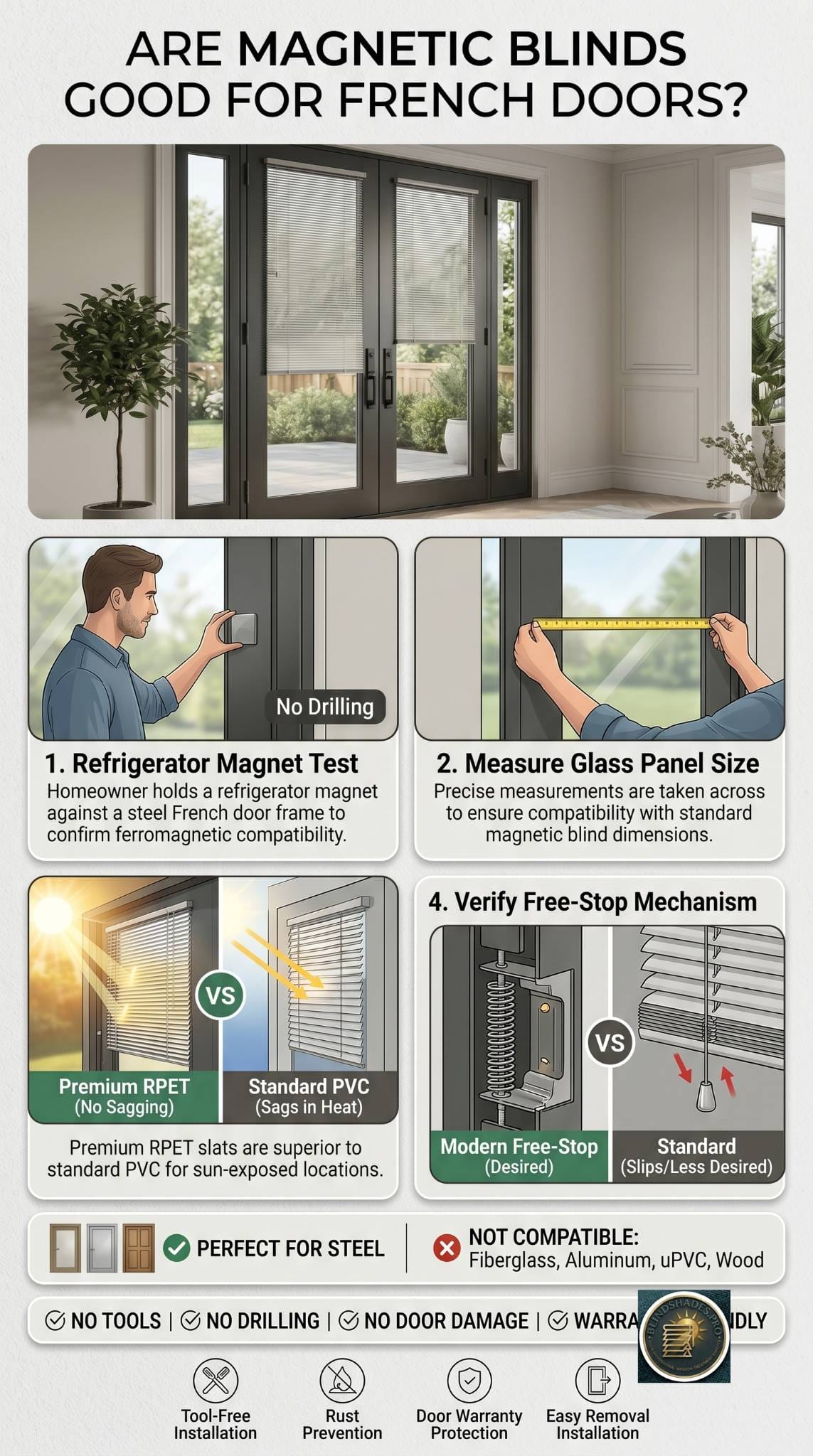
Key Takeaways:
- Magnetic blinds are good for French doors ONLY if the door frame is ferromagnetic steel; before purchasing, hold any standard refrigerator magnet against the door frame; if it sticks firmly, the door is ferromagnetic steel and magnetic blinds will work; if it does not stick (even on a door that looks metallic), the frame may be fiberglass, aluminum, or uPVC — none of which are ferromagnetic; aluminum in particular looks and feels like metal but is completely non-ferromagnetic; fiberglass steel-look doors are extremely common and will not hold a magnetic blind
- The most common failure mode for magnetic blinds on French doors is slipping: the blind gradually descends from its set height during daily door operation (door opening, closing, and minor slamming); the solution is a free-stop spring mechanism in the headrail that holds the blind at any height through continuous spring tension rather than a notched cord-lock system; cord-lock systems have 3 to 5 preset positions and can slip when door vibration dislodges the lock; always confirm whether the product uses a free-stop spring or a standard cord-lock before purchasing
- RPET slats (recycled polyethylene terephthalate) are 2.5 times more durable than standard PVC slats and do not warp or yellow under direct afternoon sunlight; HomeToSight confirms this for the REGAL estate MagMount; for south-facing or west-facing patio French doors with direct sun exposure, RPET slats maintain dimensional stability while standard PVC slats begin to yellow and warp within 12 to 24 months; specify RPET slat material for any sun-exposed steel French door
- Standard residential steel entry doors have a hollow construction: a steel skin of 24 to 26 gauge thickness (0.020 to 0.024 inches) over a polyurethane foam core; the magnets in the blind headrail attach to this thin steel skin only; budget magnetic blinds use ceramic (ferrite) magnets which may have insufficient holding force on thin steel skin under door slam dynamic loads; premium magnetic blinds (REGAL estate MagMount) specify neodymium (NdFeB) magnets which maintain position through door slam vibration; confirm the magnet type before purchasing
- Magnetic blinds are only available in a narrow range of standard door glass panel sizes — most commonly 25 × 42 inches and 25 × 72 inches for standard French door half-light and full-light glass panels; if your French door has a non-standard glass panel dimension, standard magnetic blinds will not fit and you will need a drill-mount or adhesive-mount system instead; measure your glass panel width and height before purchasing any magnetic blind product
⭐ Quick Answer — Are Magnetic Blinds Good for French Doors?
- Yes — But Run the Refrigerator Magnet Test Before Ordering Anything: Magnetic blinds for French doors are good when the door frame is ferromagnetic steel — and only then. The most common and most expensive buyer mistake: fiberglass doors look and feel exactly like steel entry doors (same surface finish, same weight) but are completely non-ferromagnetic; a magnet will not hold. The pre-purchase test: hold any standard refrigerator magnet against the door frame where the blind headrail would mount; remove your hand. If the magnet sticks firmly without support, the door is ferromagnetic steel and magnetic blinds will work. If the magnet slides off or holds weakly, the door is fiberglass, aluminum, uPVC, or wood — none of which support magnetic blind mounting. HomeToSight (1 month ago) confirms: “You cannot drill into a steel door frame without voiding warranties or creating rust points” — this is precisely why magnetic blinds exist as the only correct no-drill specification for steel French doors. For non-steel French doors, the correct no-drill system is an adhesive-mount or tension-mount blind; see [What Are the Best Blinds for French Doors](/guide/best-blinds-for-french-doors/) for the full comparison
- The Free-Stop Spring Mechanism — The Single Most Important Specification to Confirm: The most common failure mode for magnetic blinds on French doors is slipping — the blind gradually descends from its set height during daily door operation. The cause is the cord-lock mechanism used in budget magnetic blinds: cord-lock systems hold the blind at 3 to 5 preset notched positions; when the door opens, slams, or vibrates, this notched lock can disengage, and the blind slides downward. The solution is a free-stop spring mechanism: a continuous tension spring inside the headrail holds the blind at any position along its full range through constant spring force — no notched lock to disengage. HomeToSight confirms: “look for a free-stop spring mechanism that holds the blind at any height without slipping.” The REGAL estate MagMount uses a free-stop spring mechanism alongside neodymium magnets. How to identify free-stop spring in product listings: look for “free-stop,” “anywhere stop,” “spring lift,” or “no-cord tension” in the product description; if the listing only says “cordless” without specifying the tension mechanism, contact the retailer to confirm before purchasing. This is the specification that separates magnetic blinds that maintain their position through years of daily door use from blinds that require constant adjustment
- Neodymium vs Ferrite Magnets — Why the Magnet Type Determines Whether the Blind Holds on a Hollow Steel Door: French door magnetic blinds attach to a steel skin that is only 24 to 26 gauge thick (0.020 to 0.024 inches) over a hollow polyurethane foam core — not solid steel. Budget magnetic blinds use ceramic ferrite magnets which may have insufficient holding force on this thin steel skin under the dynamic load of a door opening and closing multiple times daily. Premium systems specify neodymium (NdFeB) magnets — rare-earth magnets with significantly stronger holding force per unit size that maintain position through door slam vibration. REGAL estate MagMount specifies neodymium magnets in the headrail assembly; HomeToSight confirms the “strong magnetic headrail and hold-down brackets keep blinds stable when doors open and close.” How to identify the magnet type: check the product specification for “neodymium,” “rare-earth,” or “NdFeB”; if the specification only says “magnetic” without specifying the grade, assume ferrite. For any primary entrance steel French door operated 10 or more times per day, neodymium is the correct specification
- RPET vs PVC Slats — The Material That Determines Whether the Blind Survives a South or West-Facing Door: For sun-exposed steel French door magnetic blinds, slat material determines the useful service life. HomeToSight confirms: “For high-traffic doors, recycled RPET composite slats are 2.5x more durable than PVC and resist warping from sun exposure.” Standard PVC slats on a south or west-facing French door begin yellowing within approximately 12 months and warping (individual slats bowing, creating gaps in the closed position) within 18 to 24 months; once warped, PVC slats cannot be straightened — full blind replacement is required. RPET (recycled polyethylene terephthalate, made from recycled plastic bottles) has a denser molecular structure, is UV-stable, warp-resistant, and moisture-resistant. REGAL estate MagMount product page confirms: “Made from 65% recycled RPET — moisture-resistant, warp-resistant, and up to 2.5x more durable than standard PVC.” Specification rule by door orientation: south-facing or west-facing steel French door = specify RPET slats; north or east-facing door with limited direct sun = standard PVC acceptable. Specify RPET for any door where afternoon sun reaches the glass directly
- Size Limitations and the Sidelight Incompatibility — Two Pre-Purchase Checks After the Magnet Test: Two additional pre-purchase checks for magnetic blinds for French doors that are absent from all product listings. (1) Size limitation: magnetic blinds are only available in standard door glass panel sizes — most commonly 25 × 42 inches (standard half-light French door glass), 25 × 72 inches (full-light), 22 × 64 inches, and 30 × 64 inches; if your French door glass panel is a non-standard dimension (for example, 27 × 58 inches on a specialty door), standard magnetic blinds will not fit and you must use a drill-mount or adhesive-mount system with custom sizing; measure your glass panel width and height before ordering. (2) Sidelight incompatibility: sidelights beside steel French doors are typically framed in uPVC, aluminum, or wood — NOT steel; magnets will not hold on these frames; magnetic blinds cover the steel door panels only; sidelights require a separate adhesive-mount or tension-mount blind system; Bringnox (December 2025) confirms: “uPVC frames work with adhesive mounts and tension systems” and “metal frames suit magnetic blinds perfectly”
- Best Sources: REGAL estate MagMount specification (neodymium magnets, free-stop spring, RPET slats, hold-down brackets, 2.5× PVC durability), steel door drilling risk → HomeToSight best French door blinds · No-drill mounting by frame material (uPVC = adhesive, wood = adhesive, metal = magnetic, glass = suction clips) → Bringnox no-drill French door blinds guide · Magnetic blind installation and removal, renter-friendly, style options → Curtain Rod Store magnetic blinds guide
⚠️ The Ferromagnetic Test Table and the Door Material Decision Framework: Before ordering any magnetic blind for a French door, confirm the door material using the refrigerator magnet test and this reference table: Steel residential entry door: ferromagnetic = YES; magnetic blinds = YES; drill-mount = NO (voids warranty + creates rust). Fiberglass door (steel-look finish): ferromagnetic = NO; magnetic blinds = NO; drill-mount = YES (with care); note: fiberglass is the most common source of buyer confusion because steel-look fiberglass doors are nearly identical in appearance to steel doors. Aluminum door or frame: ferromagnetic = NO (aluminum is non-ferromagnetic despite being a metal); magnetic blinds = NO; use adhesive-mount. uPVC / vinyl door: ferromagnetic = NO; magnetic blinds = NO; adhesive-mount or tension-mount required. Wood door: ferromagnetic = NO; drill-mount standard. Wood door with steel Z-brace or steel core insert: partially ferromagnetic at the brace location only; magnetic blinds may hold at the steel brace but not at wood sections; not reliable. The correct product by door type: steel door = REGAL estate MagMount or equivalent neodymium magnetic system; fiberglass door = standard drill-mount cellular or roller shade; uPVC door = adhesive-mount no-drill system; wood door = standard drill-mount. For the complete French door blind selection guide including all door types, see What Are the Best Blinds for French Doors. See the full pre-purchase test guide below.
💡 The Complete Worth-It Verdict by Use Case: Magnetic blinds for French doors are the correct specification for a specific set of conditions and the wrong specification for everything else. Where magnetic blinds are worth it: primary entrance steel French door where drilling voids warranty or creates rust risk; renter situation where no holes can be made; temporary or seasonal blind where easy snap-off removal is needed; glass panel dimensions match a standard magnetic blind size (25 × 42 or 25 × 72 most common). Specification checklist for the best result: (1) neodymium (NdFeB) magnets — not ferrite/ceramic; (2) free-stop spring mechanism — not cord-lock; (3) RPET slats — not standard PVC for any south or west-facing door; (4) dual magnetic hold-down brackets at the bottom rail — essential to prevent blind swinging on door movement; (5) measure glass panel and confirm size matches a standard option before ordering. Where magnetic blinds are NOT worth it: fiberglass, aluminum, uPVC, or wood French doors (magnets won’t hold — use the correct system for your door type); non-standard glass panel dimensions (custom sizing not available for magnetic systems); rooms where true blackout is required (most magnetic blinds are room-darkening only; full blackout cellular requires drill-mount with hold-down brackets and outside mount overlap). Top product: REGAL estate MagMount — neodymium magnets, free-stop spring, RPET slats, dual hold-down brackets; $45 to $65 at Walmart; available in 25 × 42 and 25 × 72 inches; 4.7 stars from 98+ verified reviews. For the installation sequence and hold-down bracket placement after installation, see How Do You Install Blinds on French Doors. See the full worth-it comparison table below.
📖 Read the complete guide below for: the refrigerator magnet pre-purchase test (fiberglass, aluminum, and uPVC all fail; ferromagnetic steel only), the steel door drilling risk (voids manufacturer warranty; creates rust entry points), the neodymium vs ferrite magnet distinction (neodymium holds on 24-26 gauge steel skin through door slam; ferrite may slip on thin steel), the free-stop spring vs cord-lock mechanism (cord-lock slips on door vibration — 3 to 5 preset positions only; free-stop spring holds at any height), RPET vs PVC slat durability (RPET 2.5× more durable; UV-stable; no warping under direct sun; PVC yellows 12 months, warps 18-24 months on south/west-facing door), handle clearance (magnetic blinds sized to glass panel naturally clear door handle), sidelight incompatibility (uPVC/aluminum sidelight frames are not ferromagnetic — different mounting system required), and the standard size limitation (25×42 and 25×72 most common; non-standard glass = different product type).
Related guides: magnetic mounting is the no-drill lane of a three-architecture decision — see the complete guide to French door blinds.
Are Magnetic Blinds Good for French Doors — The Two Pre-Purchase Tests
Run both tests before ordering. One miss makes the product non-functional. Both are 30 seconds.
Test 1 — The Refrigerator Magnet Ferromagnetic Test
<strong>Magnetic blinds for French doors</strong> work on one specific door material: ferromagnetic steel. They do not work on aluminum, fiberglass, uPVC, or wood — regardless of how metallic those materials may look or feel.
The test: Take any standard refrigerator magnet (the flat promotional type works well) and hold it firmly against your French door frame in the area where the blind headrail would mount — typically above the glass panel. Remove your hand.
- Magnet sticks firmly without support: the door frame is ferromagnetic steel; magnetic blinds will work
- Magnet holds weakly or falls off: the door frame is not ferromagnetic or has an insulating coating; magnetic blinds will NOT hold adequately
- Magnet does not stick at all: the door is fiberglass, aluminum, uPVC, or wood; magnetic blinds will not work
The door types that fail this test most frequently:
| Door Material | Ferromagnetic? | Magnetic Blind Works? |
|---|---|---|
| Steel (residential entry door) | YES | YES |
| Fiberglass steel-look door | NO | NO |
| Aluminum door or frame | NO | NO |
| uPVC / vinyl door | NO | NO |
| Wood door (timber) | NO | NO |
| Wood door with steel Z-brace | Partially | Unreliable |
The most common buyer mistake: Fiberglass doors are manufactured to look and feel exactly like steel. They have the same smooth painted surface, the same weight (approximately), and the same appearance. Many homeowners with fiberglass doors are surprised to discover a magnet does not stick to them. If your door is fiberglass, magnetic blinds will not work — you need an adhesive-mount or standard drill-mount system.
HomeToSight confirms: “You cannot drill into a steel door frame without voiding warranties or creating rust points” — this is WHY magnetic blinds exist for steel doors specifically.
Test 2 — The Glass Panel Dimension Check
Magnetic blinds are only available in a limited range of standard sizes:
| Standard Size | Fits |
|---|---|
| 25 × 42 inches | Standard half-light French door glass |
| 25 × 72 inches | Standard full-light French door glass |
| 22 × 36 inches | Narrow half-light |
| 22 × 64 inches | Narrow full-light |
| 30 × 64 inches | Wide glass panel |
Measure your French door glass panel width and height before purchasing. If your glass dimensions fall outside these standard sizes (for example, 27 × 58 inches for a specialty door), standard magnetic blinds will not fit. In this case, a custom-sized drill-mount or adhesive-mount blind is the correct solution. See What Are the Best Blinds for French Doors for the full French door blind selection guide.
Why Steel French Doors Cannot Be Drilled — The Warranty and Rust Risk
The specific reason magnetic blinds are the only correct specification for steel doors.
Residential steel entry doors have two reasons drilling is problematic:
Reason 1 — Manufacturer warranty voiding: Most steel door manufacturers state in their warranty terms that drilling into the door slab for any purpose (including window treatment hardware) voids the structural warranty. This is because drilling creates a stress point in the steel skin that can become a crack initiation site under repeated door slam impact.
Reason 2 — Rust entry point: Steel rusts when the protective coating (primer + paint) is breached. A drill hole through the painted steel skin exposes raw steel to moisture. In humid climates, coastal areas, or any location where condensation forms on the door, the drill hole becomes a rust entry point. Rust progresses from the inside out — the surface may look fine while rust spreads beneath the paint. TheBlindRus (November 2025) confirms magnetic blinds for steel doors “attach without drilling and stay put when doors swing open.”
The magnetic blind solution: The entire mounting system attaches to the steel surface through magnetic attraction — no penetration of the steel skin, no warranty risk, no rust entry. REGAL estate MagMount’s description confirms: “QuickInsta MagMount blinds snap securely onto metal and steel doors with no tools or drilling required.”
Neodymium vs Ferrite Magnets — Why the Magnet Type Determines Whether the Blind Stays Up
The specification detail absent from all product pages — determines performance on hollow steel doors.
Residential steel entry doors are hollow-core: a steel skin of 24 to 26 gauge thickness (0.020 to 0.024 inches) over a polyurethane foam insulation core. This thin steel skin is what the magnetic blind headrail attaches to. The dynamic load of a door opening and closing creates vibrational force that budget magnets may not be able to maintain position against.
Ferrite (ceramic) magnets:
- Standard grade magnets used in budget magnetic blinds
- Lower holding force per unit size
- May slip on thin steel skin (24–26 gauge) when subjected to door slam vibration
- Adequate for light-use doors in protected indoor locations; potentially insufficient for primary entrance steel French doors operated multiple times daily
Neodymium (NdFeB) magnets:
- Premium rare-earth magnets; significantly stronger holding force than ferrite for the same physical size
- Maintain position through door slam vibration on 24–26 gauge steel skin
- REGAL estate MagMount specifies neodymium magnets in the headrail assembly
- The correct specification for primary entrance steel French doors operated 10+ times per day
How to identify which type a product uses: Check the product specification page or packaging. Look for “neodymium,” “rare-earth,” or “NdFeB” in the magnet specification. If the specification only says “magnetic” without specifying the magnet grade, assume ferrite.
The Free-Stop Spring Mechanism — The Feature That Prevents Slipping
Why magnetic blinds on French doors require this specific headrail feature — absent from all guides.
HomeToSight confirms: “Look for a free-stop spring mechanism that holds the blind at any height without slipping.”
Standard cord-lock mechanism (budget magnetic blinds): A cord-lock system locks the blind at specific notched positions — typically 3 to 5 preset heights along the full range. The cord is pulled to a specific tension angle to engage the lock. When the door slams or vibrates from being closed firmly, the vibrational energy can dislodge the lock mechanism from its notched position, causing the blind to gradually slip downward. This is the most common complaint about budget magnetic blinds: “the blind works on day one but gradually creeps down over weeks of daily use.”
Free-stop spring mechanism (premium magnetic blinds): A continuous tension spring inside the headrail holds the blind at any position through constant spring force — not through a notched lock. The spring provides equal holding resistance at all heights. Door slam vibration does not dislodge a spring tension system because there is no locking mechanism to disengage. The blind holds wherever you leave it, at any height, through years of daily door operation.
The REGAL estate MagMount specification: HomeToSight confirms the REGAL estate uses a free-stop spring mechanism alongside neodymium magnets — the combination of premium magnetic attachment and spring tension hold addresses both the magnetic holding problem and the slipping problem.
How to identify free-stop spring in product listings: Look for “free-stop,” “anywhere stop,” “spring lift,” or “no-cord tension” in the product description. If the product description only mentions “cordless” without specifying the tension mechanism, contact the retailer to confirm.
RPET vs PVC Slats — The Material That Matters for Sun-Exposed Steel Doors
Why standard PVC slats fail on south and west-facing steel French doors within 24 months.
HomeToSight confirms: “For high-traffic doors, recycled RPET composite slats (as used in magnetic mounts) are 2.5x more durable than PVC and resist warping from sun exposure.”
PVC (standard polyvinyl chloride) slats:
- Petroleum-based; susceptible to UV degradation
- In direct afternoon sunlight on a south or west-facing door: yellowing typically begins within 12 months; warping (bowing of individual slats) within 18 to 24 months
- Warped PVC slats no longer lie flat in the closed position, creating visible gaps that reduce privacy and light control
- Once warped, PVC slats cannot be straightened; full blind replacement is required
RPET (recycled polyethylene terephthalate) slats:
- Made from recycled plastic bottles (same polymer as plastic water bottles)
- Denser molecular structure than PVC; higher UV stability
- 2.5× more impact-resistant than standard PVC (HomeToSight confirmed)
- Warp-resistant under direct afternoon sunlight
- Moisture-resistant — relevant for steel doors that experience condensation in winter
The practical specification rule:
- South-facing French door: specify RPET slats; standard PVC will warp within 24 months
- West-facing French door: specify RPET slats; direct afternoon sun is the most intense UV exposure
- North or east-facing French door: standard PVC acceptable; limited direct sun exposure
REGAL estate MagMount product page confirms: “Made from 65% recycled RPET — moisture-resistant, warp-resistant, and up to 2.5x more durable than standard PVC blinds.”
Handle Clearance for Magnetic Blinds on French Doors
Why magnetic blinds on French doors naturally solve the handle clearance problem that affects drill-mount blinds.
For standard drill-mount blinds on French doors, the handle projection measurement and headrail depth calculation (covered in How Do You Measure French Doors for Blinds) is a critical pre-order step.
Magnetic blinds solve this problem automatically:
Why handle clearance is less of an issue for magnetic blinds: Magnetic blinds are sized to the glass panel dimensions — not to the full door width including stiles. A standard French door glass panel is typically 22 to 27 inches wide, while the door handle is mounted on the door stile (the vertical wood member beside the glass) — outside the glass panel boundary. A magnetic blind sized to the glass panel is typically 1 to 2 inches narrower than the stile-to-stile width, naturally clearing the handle on both sides.
The lever handle check: Confirm that when the slats are tilted to their widest open angle, the slat tips do not reach the lever handle on the side of the door. For a 25-inch-wide magnetic blind on a door with a lever handle at 26 inches from the glass edge, the slat tip at full tilt angle will not reach the handle. For unusually narrow stiles where the handle is very close to the glass edge, measure the distance from the glass edge to the handle body and confirm the magnetic blind’s slat length in the tilted position does not exceed this distance.
Sidelights Adjacent to Steel French Doors — Why Magnetic Blinds Don’t Work Here
The product incompatibility most homeowners only discover after ordering — absent from all guides.
Many steel French door installations include sidelight panels on one or both sides of the main door. These sidelights are narrow fixed glass panels set into the wall beside the door.
Sidelight frame materials: Sidelights are typically:
- uPVC or vinyl framed (NOT ferromagnetic — magnets will not hold)
- Aluminum framed (NOT ferromagnetic)
- Wood framed (NOT ferromagnetic)
- Steel framed (ferromagnetic — magnets will work, but less common)
The practical consequence: If you have steel French doors with adjacent non-steel sidelights and need blinds for both, magnetic blinds work for the doors but NOT for the sidelights. Sidelights require a different mounting system.
Bringnox (December 2025) confirms the correct sidelight solutions: “uPVC frames work with adhesive mounts and tension systems; wooden frames accept adhesive mounts well; glass-only mounting uses suction or specialized clips that attach directly to the glass pane.”
The correct approach for a steel French door with uPVC sidelights:
- Main door: magnetic blind (REGAL estate MagMount or equivalent)
- Sidelights: adhesive-mount or tension-mount cellular shade or pleated shade
The Worth-It Verdict
| Factor | Magnetic Blind | Standard Drill-Mount Blind |
|---|---|---|
| Suitable for steel doors | YES — the correct solution | NO — voids warranty, creates rust |
| Suitable for wood doors | NO | YES |
| Suitable for fiberglass doors | NO | YES (with care) |
| Suitable for uPVC doors | NO | NO (no grip in hollow frame) |
| Installation time | Under 2 minutes | 15–30 minutes |
| Tools required | None | Drill, level, screwdriver |
| Custom sizing available | NO — standard sizes only | YES — custom to any dimension |
| Renter-friendly | YES — no damage | YES if holes acceptable |
| Slat material options | Standard PVC or RPET | Full range available |
| Light control | Room-darkening standard | Full range available |
| Long-term hold (free-stop spring) | YES (specify premium) | YES (built-in mechanism) |
| Price range | $25–$80 (standard sizes) | $50–$200+ (custom) |
Verdict: Magnetic blinds are good for French doors when the door is ferromagnetic steel AND the glass panel dimensions match a standard magnetic blind size. They are the correct specification for steel doors — the only mounting solution that avoids warranty voiding and rust risk. They are NOT suitable for fiberglass, aluminum, uPVC, or wood doors regardless of appearance. Specify RPET slats, neodymium magnets, and a free-stop spring mechanism for primary entrance steel French doors. For the full comparison of all French door blind mounting options, see What Are the Best Blinds for French Doors.
Top Magnetic Blind Products for Steel French Doors
REGAL Estate MagMount — Best Overall for Steel French Doors
HomeToSight (1 month ago) confirms: the MagMount uses neodymium magnets in the headrail and dual magnetic hold-down brackets at the bottom rail; free-stop spring mechanism holds at any height; RPET slats (65% recycled) — 2.5× more durable than PVC; warp-resistant, moisture-resistant. Available in 25×42 and 25×72 inches. $45–$65 at Walmart.
Collections Etc Easy Install Magnetic Mini Blinds — Best Budget
Available at major retailers including Lowe’s; ferrite magnets (specify premium neodymium for high-traffic applications); standard PVC slats; cord-lock mechanism (susceptible to slipping on high-traffic doors); adequate for secondary or interior steel French doors with light daily use. $20–$35 at Lowe’s.
Achim Home Furnishings Magnetic Mini Blinds — Mid-Range Option
Widely available at Home Depot and Wayfair; standard cord mechanism; PVC slats; magnetic headrail and hold-down brackets; works reliably on steel doors for moderate daily use. $30–$50.
Related guides: For complete buying advice, see our cordless blinds and shades guide and no-drill, tension and magnetic blinds guide.
Frequently Asked Questions
Are magnetic blinds good for French doors? Magnetic blinds are good for French doors with ferromagnetic steel frames. They are the only correct mounting solution for steel doors where drilling would void the manufacturer’s warranty or create rust entry points. Before purchasing, hold a standard refrigerator magnet against the door frame — if it sticks firmly, magnetic blinds will work. If it does not stick (common on fiberglass, aluminum, and uPVC doors), magnetic blinds will not function.
How do I know if my French door is steel for magnetic blinds? Hold any standard refrigerator magnet against the door frame. If it sticks firmly without support, the door is ferromagnetic steel and magnetic blinds will work. If the magnet does not stick or falls off, the door is fiberglass, aluminum, uPVC, or wood. Fiberglass doors often look identical to steel doors but are completely non-ferromagnetic and will not hold magnetic blinds.
Why do magnetic blinds on French doors slip down over time? Budget magnetic blinds use a standard cord-lock mechanism that holds the blind at 3 to 5 preset notched positions. Door slam vibration and daily operation dislodge the notched lock, causing the blind to gradually slip downward. The solution is a free-stop spring mechanism, which holds the blind at any height through continuous spring tension rather than a lockable notch. Look for “free-stop” or “anywhere stop” in the product specification.
What is the difference between RPET and PVC slats in magnetic blinds? RPET (recycled polyethylene terephthalate) slats are 2.5 times more durable than standard PVC and are UV-stable, meaning they resist yellowing and warping under direct afternoon sunlight. Standard PVC slats on south or west-facing doors begin yellowing within 12 months and warping within 18 to 24 months. For any sun-exposed steel French door, specify RPET slats. REGAL estate MagMount uses 65% recycled RPET confirmed by HomeToSight.
Can I use magnetic blinds on the sidelights beside my steel French doors? Only if the sidelight frames are ferromagnetic steel. Most sidelight frames are uPVC, aluminum, or wood — none of which are ferromagnetic. For non-steel sidelights, use adhesive-mount or tension-mount blinds instead. Magnetic blinds work on the main steel door panels; the sidelights require a different mounting system.
Related Guides on BlindShades.pro
- The Best French Door Blinds & Shades Buying Guide
- What Are the Best Blinds for French Doors
- Can You Put Blinds Between French Door Glass
- How Do You Measure French Doors for Blinds
- How Do You Install Blinds on French Doors
- How Do You Stop French Door Blinds From Swinging
By Michael Turner | 30 Years Home Improvement Expertise | Updated 2026 | BlindShades.pro
