Best Outdoor Patio Blinds 2026: The Buyers Guide

Authored By Michael Turner -30 Years Home Improvement Expertise | Updated 2026 | BlindShades.pro
Updated on July 19, 2026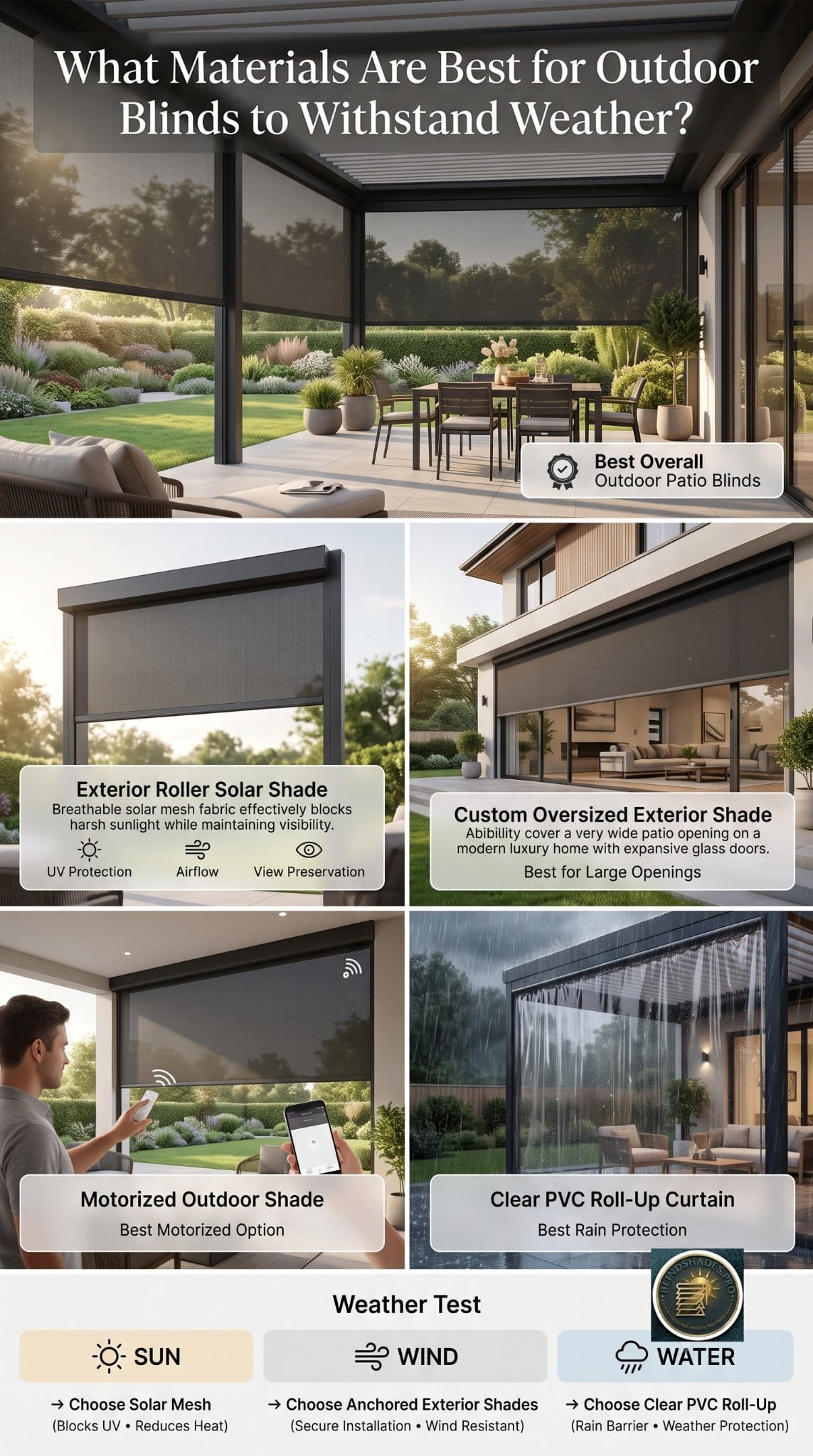
By Michael Turner — 30 years in the window treatment industry
The best outdoor patio blinds are chosen by weather, not by looks: Sun picks the fabric (openness and UV grade), Wind picks the anchoring (tracks, hold-downs, and the discipline to retract), and Water picks the coverage class — because the mesh sun shade this entire market leads with is deliberately not waterproof. That last sentence is the one every catalog page omits, and it is where this buyers guide starts earning its name. Below: the Weather Test, the sun-versus-rain split, the wind engineering, the review bases behind a market one brand quietly dominates, and honest answers for the balcony, the screened porch, and the barbecue shack alike.
Key Takeaways
- One brand owns this category’s evidence: Coolaroo’s outdoor rollers carry review bases of seventy-one hundred, three thousand, and five-hundred-plus across the retail grid — and the year’s biggest editorial roundup crowned them anyway.
- Mesh passes water on purpose. Solar-screen fabric is engineered to breathe — that is why it survives wind — so “waterproof outdoor shades” is a different product class: solid PVC, clear vinyl, or an awning.
- Wind is a hardware problem, not a fabric problem. Side tracks, hold-down anchors, crank tension — and the one rule no listing prints: when the gusts come, the best shade is a retracted one.
- The outside-mount trick kills the width limit. Hang the shade in front of the opening rather than inside it and your patio’s odd dimensions stop mattering — the community’s own advice, formalized below.
- Beware same-brand traps: the maker with the seventy-one-hundred-review winner also sells a wheel-operated model rated three point two across two hundred seventy-eight. Review the product, not the logo.
⭐ Quick Answer — The Best Outdoor Patio Blinds
The best outdoor patio blinds are chosen by the Weather Test — Sun picks the mesh grade, Wind picks the anchoring, Water picks the class — because breathable sun mesh is deliberately not waterproof:
- The evidence king: Coolaroo’s outdoor rollers — four point six across roughly seventy-one hundred reviews, and this year’s editorial top pick at Bob Vila for blocking ninety percent of UV — with the openness science in the solar shades guide.
- The maker’s own claim: up to fifteen degrees of surface-temperature reduction and mold-resistant easy cleaning, stated at Coolaroo.
- The powered patio: motorized outdoor shades with side tracks — store rated four point eight across eight hundred seventy-seven at SmartWings — where a wind sensor enforces the retract rule; the case is made in the motorized and smart blinds guide.
- The rain answer: mesh passes water by design — waterproof means solid PVC or the twenty-six-dollar clear-vinyl roll-up carrying fourteen hundred reviews, the honest screened-porch conversion.
- The opening behind it all: coordinate the exterior shade with the slider’s interior treatment in the sliding glass door blinds guide.
Quick Specification Reference
| Specification | Outdoor & patio reality (2026) |
|---|---|
| The default product | Exterior roller sun shades in solar-screen mesh |
| The UV grades on the shelf | Eighty-five, ninety, and ninety-five percent block, stated per product |
| The temperature claim | Up to fifteen degrees of surface-temperature reduction, per the category leader |
| Waterproof means | Solid PVC, clear vinyl roll-ups, or awnings — never breathable mesh |
| Wind hardware | Side tracks, hold-down anchors, crank tension — plus the retract rule |
| The width trick | Outside-mount in front of the opening and width limits vanish |
| Typical price band | About twenty-six budget to nine hundred motorized-custom, per the live market |
| Materials that last | PVC, polyester, and acrylic blends — the market’s own durability shortlist |
| Mold and cleaning | Mesh rinses clean; the category leader markets mold-and-mildew ease directly |
Read the complete guide below for: the six picks with their real review bases, the Weather Test (Sun · Wind · Water), the sun-versus-rain product split, the wind-anchoring hardware table, the openness-and-UV grades, zone-by-zone answers from balcony to barbecue shack, every buying lane, and the warning table this brand-loyal category badly needs. This is the complete outdoor blinds buyers guide — and if you arrived searching the external blind buyers guide phrasing, you are in the same right place: exterior, external, outdoor, and patio blinds are one product family wearing four names, as one motorized specialist puts it — outdoor shades, also known as patio blinds or outdoor roller shades.
What Are the Best Outdoor Patio Blinds in 2026? — Our Picks
Review volumes are stated exactly as the market shows them; this SERP contains both a fourteen-hundred-review budget product and multiple one-review listings, and the warning table names names.
A word on the phrase people actually type — best outdoor patio blinds consumer reports — hoping a lab has settled this: we are not Consumer Reports, and no seller ranking its own catalog is either. What exists instead is one genuinely independent editorial roundup — Bob Vila’s May 2026 outdoor shades picks — and the raw review arithmetic below. Whether your search was best outdoor blinds, best outdoor blinds for patio, or the shades phrasing, the same six answers apply; we cite the editors, state the bases, and add nothing invented.
| Pick | Product | Rating / reviews | Price (words) | The lane |
|---|---|---|---|---|
| Best Overall | Coolaroo Outdoor Roller Shade | 4.6 across ~7,100 | About eighty-two to one sixty-three by size | The category’s evidence king — and the editors’ top pick |
| Best Oversized | Blindster 88×91 Custom Exterior Solar | 4.6 across 724 | About two seventy-six | Big-opening custom in one order |
| Best Custom Solar | Bali Custom Exterior Solar Roller | 4.5 across 236 | About one thirty-three to one forty-six by seller | The brand-name custom lane |
| Best Motorized | SmartWings Motorized Outdoor | Store: 4.8 across 877 | Mid-hundreds, quote by size | Sun, rain, wind, and sand durability language backed by the category’s best store rating |
| Best View-Keeper | Hillhouse Semi-Sheer Outdoor Roller | 4.7 across 461 | About two forty-seven | Glare control that keeps the sightline |
| Best for Rain | Clear PVC Roll-Up Blind | 3.7 across ~1,400 | About twenty-six | The honest rain answer — see the sun-versus-rain section |
Two honesty notes the table earns. First, the rain pick’s three point seven is not a flaw in the recommendation — it is the correct grade for a twenty-six-dollar sheet of clear vinyl doing a job mesh cannot do at all; fourteen hundred buyers rating it “fine” is exactly what the product is. Second, high end outdoor blinds and premium outdoor blinds are real search intents with a real answer: the motorized custom tier — Blindsgalore’s Signature motorized solar line reaches about nine hundred at sale prices from roughly eighteen hundred list — and the fifty-percent-off pattern across this market makes the standing rule mandatory: the recurring sale price is the real price.
The Weather Test: Sun · Wind · Water
Three questions in order — what the sun demands, what the wind allows, what the water requires — sort every patio before a single product page opens.
| Weather Test step | The question | The failure it prevents |
|---|---|---|
| Sun | Which exposure, how many hours, view or blackout of glare? | Buying ninety-five percent block for a north porch — or eighty-five for a west-facing oven |
| Wind | What are your gusts, and what will hold the shade? | The flapping, snapping, bracket-ripping first storm |
| Water | Sun control or actual rain protection? | The soaked cushions behind a mesh shade that was never waterproof |
The order matters because the answers constrain each other: a rain-proof solid panel catches wind like a sail (so it needs the heaviest anchoring), while breathable mesh sheds wind precisely because it leaks water. No single product aces all three — which is why the two sections below exist.
Are Outdoor Sun Shades Waterproof? Sun Shades Aren’t Rain Shades
No — and the sooner a buyer learns it, the better the purchase: solar mesh is engineered to pass air and water, and waterproof is a different product class.
The waterproof outdoor blinds comparison people search for has a short honest core. Solar-screen mesh — the fabric behind nearly every big-base product in this market — blocks UV by weave density while deliberately breathing; that breathability is its wind survival and its rain failure in one property. Waterproof outdoor shades therefore mean one of three other things: solid PVC roller panels (the cordless UV-protection PVC class runs about seventy-nine to four fifty-five with bases from three-sixty-nine-strong), clear vinyl roll-ups (the twenty-six-dollar, fourteen-hundred-review answer — and the same solution a DIY forum landed on years ago: a roll-up shade of heavy clear plastic, mounted outside), or a retractable awning, the flexibility case one June 2026 guide leads with. The best waterproof blinds 2026 conversation is really a coverage conversation:
| Class | Water | Wind | View & air | The verdict |
|---|---|---|---|---|
| Solar mesh (85–95% UV) | Passes rain by design | Excellent — breathes | Keeps both | The sun product — heat, glare, UV |
| Solid PVC panels | Waterproof | Needs tracks and anchors — catches gusts | Blocks both | Heavy duty outdoor waterproof roller shades, properly named |
| Clear vinyl roll-ups | Waterproof | Same sail problem — retract early | Keeps the view, seals the air | The porch-in-winter and rain-lane answer |
| Retractable awnings | Overhead waterproof | Retract in wind, always | Open sides | Rain from above, breeze from the sides |
| Waterproof outdoor shades for screened porch | Clear vinyl or PVC over the screen frame | The screen structure helps anchor | Seasonal enclosure effect | The porch conversion play |
The screened porch row deserves its sentence: screens stop bugs, not weather, and the clear-vinyl class converts a screened porch into a three-season room for the price of a nice dinner per opening — the single highest-satisfaction move in this category’s forums.
How Do You Keep Outdoor Blinds from Blowing in the Wind? The Wind Budget
Wind is solved with hardware and habits, not hope — and the community already found the trick the catalogs bury: mount in front of the opening, anchor the bottom, and retract before the storm does it for you.
Start with the mounting insight from the category’s own users: you can hang the blinds in front of the opening instead of inside it, and width is no longer a constraint — the outside-mount trick, which also lets one wide shade cover a post-to-post span no stock inside width would fit. (The same thread’s top answer is blunter about sizing generally: for real patios, you’re probably going to have to order a custom size — the measuring discipline for which lives in our made to measure blinds guide.) Then budget the wind in hardware:
| Wind hardware | What it does | When it’s mandatory |
|---|---|---|
| Motorized outdoor shades with side tracks | Cables or rails capture both edges — the flap-killer | Exposed patios, solid or clear panels, anything motorized left down |
| Hold-down anchors | Bottom-bar clips or stakes | Every free-hanging shade, no exceptions |
| Crank and wheel tension | Keeps fabric drum-tight | Manual rollers on breezy sites — note the 3.2-rated wheel model below before choosing this lane |
| Weighted bottom bars | Mass against flutter | Mild sites only — mass becomes a pendulum in gusts |
| The retract rule | Up before the storm | Always. Heavy duty outdoor shades are the ones that were rolled up when the front came through |
That last row is the section’s honest center. “Heavy duty” in this market is mostly a hardware description — tracks, anchors, tension — and partly a habit: the motorized lane’s quiet killer feature is a wind sensor or a schedule that retracts the shade automatically, the strongest practical argument in our motorized and smart blinds guide for taking patios electric. One sizing corollary before leaving the wind: span drives everything. A single shade across a twelve-foot post-to-post opening carries four times the wind load of two six-footers covering the same span, which is why the pros split wide openings into multiple narrower shades on shared tracks — each panel lighter, each bracket load smaller, and one damaged unit replaceable without redoing the wall. If your patio measures wide, buy plural.
Which Materials Survive Outdoors? What Materials Are Best for Outdoor Blinds to Withstand Weather?
The market’s own durability shortlist is PVC, polyester, and acrylic blends — and the openness grade decides what your particular sun needs.
The materials question arrives in two phrasings — what materials are best for outdoor blinds to withstand weather, and what materials work best for outdoor roller blinds — and one November 2024 guide answers both in a sentence: durable materials like PVC, polyester, and acrylic blends resist moisture, wind, and sun damage. The engineering under it is the openness grade — the mesh’s weave density, sold in this market as UV-block percentages:
| Grade on the shelf | What it means | The live products | Best for |
|---|---|---|---|
| 85% UV block | Openest weave — most air, most view | The cordless fade-resistant class (3.7 across 172) | Breezy sites, mild sun |
| 90% UV block | The mainstream balance | The editors’ top pick sits here; Aosky’s class too (3.6 across 14 — thin) | Most patios |
| 95% UV block | Densest mesh — most shade, least breeze | Coolaroo’s cordless line (4.7 across 285) | West-facing heat traps |
| Solid PVC / vinyl | Zero openness — full block | The waterproof class above | Rain, winter, storage zones |
| Semi-sheer outdoor | View-first weave | Hillhouse (4.7 across 461) | Glare control with a sightline |
Two supporting claims, attributed and converted honestly: the category leader’s own materials page states its shades can reduce surface temperatures by up to fifteen degrees while blocking UV, and markets its mesh as easy to clean and mold-and-mildew resistant — the maintenance half of the durability question nobody asks until October. And a retractable screen roi note for the searcher who asked: the return is real but domestic — fifteen degrees off the deck surface extends the usable shade season by weeks on hot exposures and spares the adjacent room’s cooling load; treat vendor payback percentages as marketing, and the longer patio season as the actual product.
The October half deserves its own paragraph, because outdoor shades are the only product this site covers that lives outside year-round — or shouldn’t. The winter drill, in the order that prevents spring regret: retract everything fully and lock the crank or motor limit; hose mesh clean on a dry day and let it dry rolled OPEN before the final roll-up (fabric stored damp is how mold wins in March); pull clear-vinyl panels off their fasteners and store them flat or loosely rolled indoors, because vinyl left taut through freeze cycles clouds and cracks; and back out or cap exposed anchor hardware on coastal sites where winter salt eats fasteners faster than sun ever ate fabric. Ten minutes per opening in November is the cheapest durability upgrade in this entire guide — no product on the shelf survives being ignored as well as any product survives being put away.
Which Shade Fits Which Space? Zone by Zone
A patio, a balcony, a screened porch, and a barbecue shack are four different weather problems — the naming paragraph and the zone table sort them.
Naming first, because this family sprawls: outdoor patio blinds, patio shades, exterior shades, external blinds, outdoor roller shades, porch shades, cafe blinds — and the best patio shades for one zone are the wrong best outdoor patio shades for another. Australians call the whole category cafe or alfresco blinds, the UK trade says external blinds, and American retail splits it between “outdoor” and “exterior” — four dialects, one product family. The zones:
| Zone | The problem | The pick |
|---|---|---|
| Open patio / pergola | Sun and gusts, no walls | Mesh rollers on tracks post-to-post; retractable sun shade for patio duty overhead via the awning lane |
| Screened porch | Weather through the screens | The clear-vinyl conversion play above |
| Balcony | Types of blinds for balcony: wind-funneled, landlord-limited | Tension-mounted mesh or outdoor verticals — the vertical lane’s exterior case is in our vertical blinds guide |
| Patio door opening | The slider behind the shade | Coordinate exterior mesh with the interior treatment in our sliding glass door blinds guide |
| Porch, traditional | Texture and shade, mild weather | Bamboo and woven roll-ups — the porch classic in our woven wood and bamboo shades guide |
| Commercial patio / barbecue shack | Daily abuse, hose-down cleaning | The durable pull-down question a restaurant forum asks verbatim — solid PVC on tracks, commercial-grade crank, and the retract rule enforced by staff |
| RV awning room | The rolling patio | The vehicle version of every rule here lives in our RV blinds and shades guide |
| Privacy-first yards | Neighbors, not sun | The special outside blinds for extra privacy question — dense ninety-five mesh or verticals; the solar-fabric privacy math is in our solar shades guide |
Where Should You Buy Outdoor Patio Blinds?
Every lane, honestly scored — including the warehouse-club anecdote and the warning table.
| The lane | The honest answer |
|---|---|
| Home Depot / Lowe’s / Tractor Supply | The Coolaroo empire’s shelf — the seventy-one-hundred and three-thousand-review bases live here at about forty-seven to one sixty-three |
| Custom online (Blindsgalore, American Blinds, Blinds.com, JustBlinds, Blindster) | Custom exterior solar from about fifty-six to thirteen hundred; free samples at the top of the lane; return windows from fourteen to thirty days — read them before custom-cutting |
| Motorized direct (SmartWings, Yoolax, Kincmo) | The powered lane, store ratings 4.8/877 and 4.4/43 respectively — the base gap is the point |
| Warehouse clubs | The community’s own report: eight-by-eight sun shades near ninety at one member’s Costco — real value, zero customization, verify locally |
| Walmart / Wayfair / Target deal listings | Where the one-review five-star listings cluster — warning table first |
| Warning | The listing | The rule |
|---|---|---|
| Same-brand trap | The category leader’s wheel-operated model: 3.2 across 278 | Review the product, not the logo |
| One-review five-stars | 5.0 across 1 (two separate listings in this SERP) | An anecdote, not a rating |
| Thin and low | 3.6 across 14 · 3.8 across 15 | Promising is not proven — buy on the return window |
| The anchor-price theater | Forty to fifty percent “off” across half the grid | The recurring sale price is the real price |
Related Buying Guides
- Best Solar Shades — the openness-factor science behind every mesh grade here
- Best Motorized & Smart Blinds — wind sensors, schedules, and the powered patio
- Best Sliding Glass Door Blinds — the opening behind the shade
- Best Woven Wood & Bamboo Shades — the porch classic
- Best Vertical Blinds — the balcony and patio-door vertical lane
- Best Made to Measure Blinds — the custom-size discipline real patios need
- Best RV Blinds & Shades — the rolling patio’s version of these rules
- Best Skylight Blinds & Shades — overhead sun, indoors
- Best Blackout Blinds & Shades — when the room behind the patio needs darkness
- Best Cellular & Honeycomb Shades — the indoor insulation counterpart
FAQ
What are the best outdoor patio blinds? Exterior roller sun shades in breathable solar mesh lead the category — Coolaroo’s outdoor rollers carry four point six across roughly seventy-one hundred reviews and the year’s top editorial pick — with oversized customs (four point six across seven hundred twenty-four), motorized lines (store rated four point eight across eight hundred seventy-seven), and clear-PVC roll-ups as the rain lane.
Are outdoor sun shades waterproof? No — solar mesh is engineered to breathe, which is why it survives wind and passes rain. Waterproof means solid PVC panels, clear vinyl roll-ups, or a retractable awning; the mesh shade and the rain shade are two different purchases, sometimes on the same patio.
How do you keep outdoor blinds from blowing in the wind? Hardware and habit: side tracks or cable guides on both edges, hold-down anchors on every free-hanging bottom bar, crank tension on manual rollers — and the retract rule, because the most heavy-duty shade in any storm is the one rolled up before it hit.
What materials are best for outdoor blinds to withstand weather? PVC, polyester, and acrylic blends — the market’s stated durability shortlist — in mesh weaves graded by UV block (eighty-five, ninety, ninety-five percent) for sun duty, and solid or clear vinyl for water duty. Mesh rinses clean and resists mold; store fabric shades dry over winter.
What blinds work on a balcony? Tension-mounted mesh rollers and outdoor vertical blinds handle the balcony’s funneled wind and landlord limits — measure the opening, mount in front of it if inside width is odd, and favor the ninety-five percent mesh when the balcony doubles as a privacy screen.
How much do outdoor patio blinds cost? About twenty-six for clear-PVC roll-ups, forty-seven to one sixty-three for the big-base mesh rollers, roughly one thirty to two seventy-six for custom exterior solar, and mid-hundreds to about nine hundred for the motorized and signature tiers — with forty-to-fifty-percent sale cycles making the discounted figure the real market price.
The Bottom Line
Buy the weather, then the shade. Run the Weather Test: Sun — match the mesh grade to the exposure, ninety for most patios, ninety-five for the heat traps; Wind — spend on tracks and anchors before spending on fabric, and let motorization enforce the retract rule you’ll otherwise forget; Water — admit that rain is a different product, and give the screened porch its twenty-six-dollar clear-vinyl conversion. Then run the calendar: ten minutes of November storage buys more lifespan than any premium fabric upgrade, and the outside-mount trick buys more width than any custom surcharge. The review arithmetic crowns one brand’s mesh rollers, the editors agree, and the warning table keeps the same logo honest. That is the whole buyers guide: weather first, hardware second, fabric third, logo last.
