Can You Put Shutters on an Arched Window ?

Authored By Michael Turner -30 Years Home Improvement Expertise | Updated 2026 | BlindShades.pro
Updated on June 1, 2026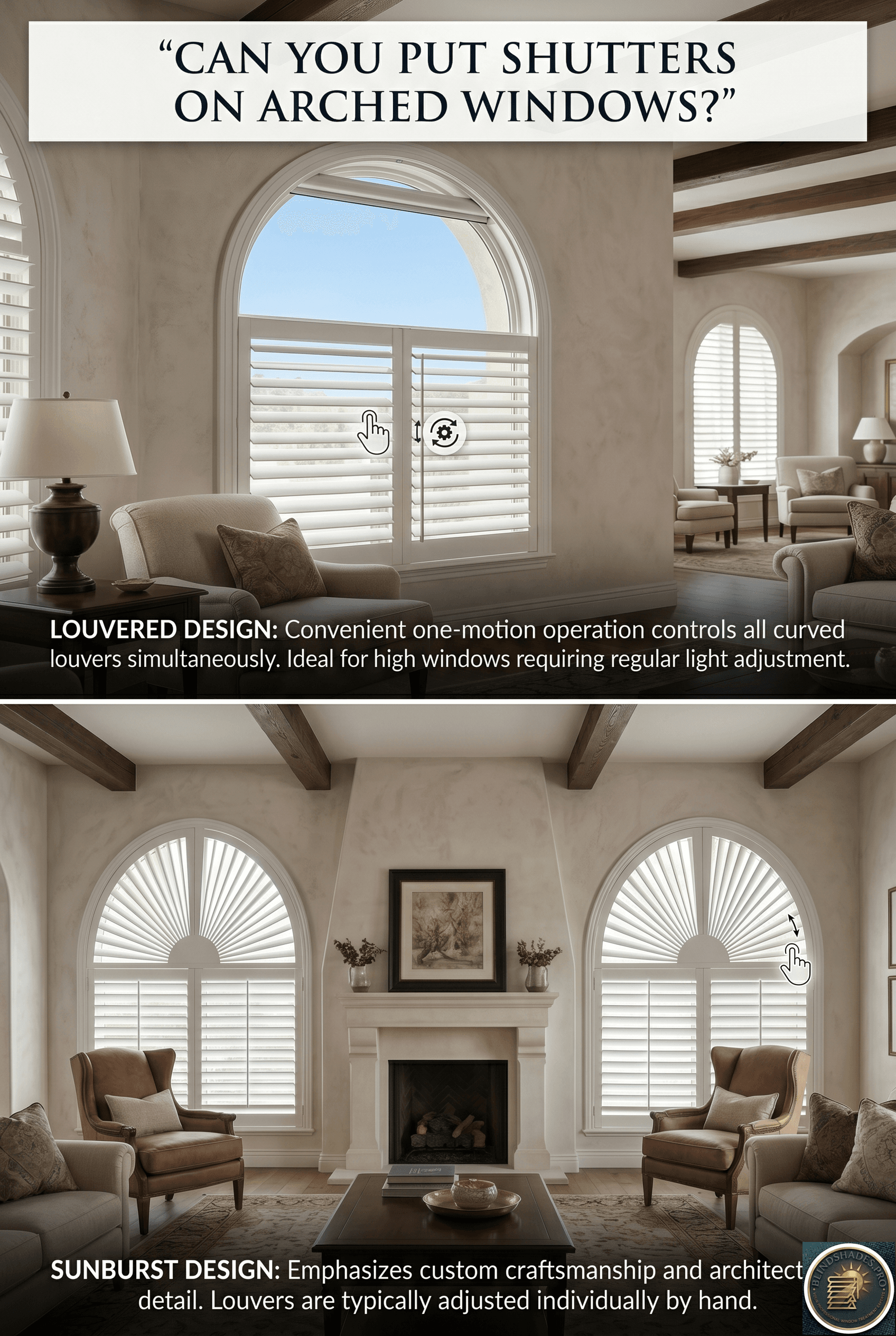
Key Takeaways:
- There are two arch shutter designs and they operate very differently: louvered arch shutters have a single tilt rod that adjusts all louvers simultaneously; sunburst arch shutters have NO tilt rod and each louver must be adjusted individually by hand; for arched windows above eye level or any arch where daily adjustment matters, the louvered arch is far more practical – adjusting a wide sunburst arch requires physically touching 12 to 20 individual blades
- A third design option that most buyers don’t know exists: stacked horizontal louvers that extend from the arch base all the way to the arch peak on a single tilt rod; the stacked design gives the arch a more architectural, uniform look compared to the decorative radiating sunburst pattern; contemporary homes suit the stacked design; traditional Georgian and colonial homes suit sunburst
- Arch shutters cost approximately 30 to 50 percent more than equivalent rectangular plantation shutters because they require a custom-fabricated curved frame member that follows the arch profile; this curved frame is the primary cost driver; perfect arches command a lower premium than non-perfect arches because the frame can be calculated mathematically without a template
- For south-facing and west-facing arched shutters: specify Polywood (PVC composite) over real wood regardless of climate – the stationary arch zone is permanently exposed to the same UV position every day; real wood can warp and crack along the grain under sustained UV in a fixed position; Polywood is dimensionally stable under any UV or thermal exposure
- The arch shutter adds approximately R-3 to R-4.5 of insulation value and reduces solar heat gain coefficient to approximately 0.20 to 0.35 when the louvers are closed – performance comparable to a custom cellular arch shade, but with a 50-year lifespan vs 7 to 10 years for cellular fabric
⭐ Quick Answer — Can You Put Shutters on an Arched Window?
- Yes — Two Designs, Very Different to Operate: Shutters for arched windows come in two primary designs with a critical operational difference. Louvered arch shutter: horizontal louvers connected by a single tilt rod; pulling the rod adjusts ALL louvers simultaneously in one motion. Sunburst arch shutter: blades radiate from the base center in a fan pattern; there is NO tilt rod; each blade must be adjusted individually by hand. For a 48-inch wide sunburst arch with 3.5-inch blades — approximately 10 to 12 blades — adjusting the arch requires physically touching and tilting each blade separately. For arched windows above eye level or any arch where daily light adjustment matters: the louvered arch is far more practical. The sunburst is best treated as a stationary decorative element set once at installation
- The Third Design — Stacked Louvers to the Arch Peak: A third arched window shutter design most buyers never hear about: stacked horizontal louvers that extend from the arch base all the way to the highest point of the arch, tapering in length as the arch narrows, and operated by a single tilt rod. Unlike the sunburst’s radiating fan blades, the stacked design maintains the same horizontal louver orientation as the rectangular shutters below — creating visual continuity across the full window height. Design comparison: sunburst (radiating blades; no tilt rod; decorative fan; best for traditional, Georgian, Victorian, colonial); louvered arch (horizontal uniform; single tilt rod; structured; transitional); stacked to peak (horizontal tapering; single tilt rod; architectural unified look; best for contemporary, craftsman, and modern homes)
- Arch Shutters Cost 30–50% More Than Rectangular — The Reason: Shutters for arched windows command a 30 to 50 percent premium over equivalent rectangular plantation shutters because they require a custom-fabricated curved frame member that follows the arch profile precisely. A standard rectangular shutter uses four straight frame members. An arch shutter requires the top frame member to be curved — cut, bent, or CNC-shaped to match the exact arch curve. For a perfect arch: the curve is mathematically defined (radius = base width ÷ 2) and the frame can be fabricated without a template. For a non-perfect arch: a cardboard template must be submitted before fabrication. Resulting cost ranges: Polywood/faux wood arch shutter $300–$600 per window; real wood arch shutter $500–$1,200; rectangular plantation shutter equivalent $200–$400; arch fabrication premium approximately $100–$300 per window
- Polywood for South/West-Facing Arches — The UV Rule: For any arched window shutter on a south-facing or west-facing window: specify Polywood (PVC composite) or faux wood composite rather than real wood. The arch zone of a plantation shutter is stationary — it never moves or rotates. On a high-sun exposure window, the center of the arch receives the same intense UV radiation every day. Real wood warps and cracks along the grain under sustained UV in a fixed stationary position — the same UV degradation mechanism that causes yellowing in stationary cellular arch shades. Polywood is dimensionally stable regardless of UV or thermal cycling and will not warp, crack, or fade. For north-facing and east-facing arch shutters in low-humidity climates: real wood is acceptable if preferred aesthetically
- Energy Performance and the Worth-It Verdict: Arch shutters add approximately R-3 to R-4.5 of insulation and reduce solar heat gain coefficient to approximately 0.20 to 0.35 when louvers are closed — performance comparable to a custom cellular arch shade. The key advantage is lifespan: arch shutters last 50+ years at approximately $15–$30 per year; cellular arch shades last 7–10 years at approximately $15–$57 per year. For homeowners staying 10+ years: shutters are the lower long-term cost. For short-term owners: cellular arch shade is the lower total expenditure. DIY note: perfect arches (height = width ÷ 2) are viable for experienced DIY installers; non-perfect arch shutters with custom curved frames are recommended for professional installation at $130–$210 per window additional
- Best Sources: Louvered vs sunburst specifications, Polywood and Ovation options → Polywood Shutter Company arched shutters · Full custom arch shutter system with professional installation → Sunburst Shutters arched windows · Compare arch shutters vs cellular arch shades → Blindsgalore arched windows
⚠️ Arch-Only vs Full-Panel Specification and the Sunburst Operability Detail: When ordering shutters for arched windows, confirm whether the specification is arch-only or full-panel. Arch-only shutter: covers only the arch zone above the spring line; the rectangular section below uses a separate treatment (cellular shade, roller blind, or other operable treatment); the arch shutter is stationary; appropriate for Palladian windows where each section is treated separately, or for arches above windows that already have shutters. Full-panel shutter: covers both the arch zone and the rectangular section below in a coordinated system; the arch portion is stationary and the rectangular panels swing open on hinges for daily light control; appropriate for standalone arched windows where visual continuity between the arch and rectangle is the priority. Regarding sunburst operability: Polywood Shutter Company confirms the sunburst arch section is stationary — only the rectangular bottom half of the full-panel shutter opens and closes on its hinge. The sunburst louvers themselves can be tilted individually by hand to adjust the angle, but the arch panel does not swing. This means the sunburst arch section provides a fixed louver angle; adjusting the light through the arch requires physically reaching each blade. For the precise measurement protocol needed before ordering any arch shutter — including the perfect arch test, non-perfect arch template creation, and the four-measurement Palladian protocol — see What Are the Best Blinds for Arched Windows. See the full louvered vs sunburst comparison below.
💡 The Cost Breakdown and the Worth-It Comparison Table: Full cost breakdown for arched window shutters: standard rectangular plantation shutter (faux wood) $200 to $400 per window. Polywood or faux wood arch shutter (arch only): $300 to $600. Full-panel arch shutter (arch plus rectangle, faux wood): $400 to $800. Real wood arch shutter: $500 to $1,200. Arch fabrication premium above equivalent rectangular shutter: approximately $100 to $300. Professional installation adds $130 to $210 per window (20 to 40 percent of material cost). Sunburst Shutters national pricing: $20 to $30 per square foot installed. Hunter Douglas: $20 to $26 per square foot. Worth-it comparison: Shutters win on lifespan ($15 to $30 per year over 50 years vs cellular arch shades at $15 to $57 per year over 7 to 10 years); shutters win on durability and child safety (no cords, no fabric); cellular shades win on upfront cost; both provide equivalent insulation performance (R-3 to R-4.5) and equivalent solar heat gain reduction (SHGC 0.20 to 0.35). The break-even point where shutters become the lower cumulative cost compared to two cellular arch shade replacement cycles is approximately 12 to 15 years. For homeowners staying less than 5 years: cellular arch shade. For homeowners staying 10 or more years: shutters. For the full Palladian window three-strategy guide including arch-only, hybrid, and full unified treatment systems and the spring line drapery rule, see What Are the Best Window Treatments for Palladian Windows. See the full worth-it assessment table below.
📖 Read the complete guide below for: the louvered arch vs sunburst arch operational difference (single tilt rod vs no tilt rod; 10 to 12 individual blade adjustments for typical sunburst arch), the stacked horizontal louvers to arch peak design (third option; single tilt rod; architectural look for contemporary homes), arch-only vs full-panel specification, the curved frame fabrication cost explanation (30 to 50 percent arch premium; $100 to $300 above rectangular; perfect arch lower premium than non-perfect), Polywood vs real wood UV stability for stationary south/west arch positions, the full cost breakdown ($300 to $1,200 depending on material and scope), DIY viability for perfect vs non-perfect arches ($130 to $210 professional installation), the arch shutter energy performance (R-3 to R-4.5; SHGC 0.20 to 0.35; equivalent to cellular arch shade), and the complete worth-it comparison table by ownership duration.
Shutters for Arched Windows – Louvered Arch vs Sunburst Design
The operational difference between the two arch shutter types — the most important specification decision absent from all competitor guides.
All arch shutter suppliers offer two distinct arch shutter designs. The choice between them affects daily operation permanently.
Louvered Arch Shutter
How it operates: A louvered arch shutter has horizontal louvers running across the width of the arch. All louvers are connected by a horizontal tilt rod. Pulling the tilt rod adjusts all louvers simultaneously — one motion tilts every louver in the arch to the same angle. This is the same operating mechanism as a standard rectangular plantation shutter.
The operational advantage: A single pull of the tilt rod — one action — adjusts all louvers in the arch from fully open to fully closed. For an arch positioned above eye level (common in two-story foyers, stairwell landings, or bedroom clerestory windows), the tilt rod can be reached from standing height with an extension rod without needing a ladder.
The visual result: All louvers in the arch are at the same angle simultaneously, creating a uniform light pattern across the arch. The visual appearance is clean and structured.
Best for:
- Arches above eye level where daily adjustment is needed
- Homes where consistent light control across the arch is desired
- Contemporary and modern architectural styles where the structured horizontal louver pattern suits the aesthetic
Sunburst Arch Shutter
How it operates: A sunburst arch shutter has blades radiating outward from the base center of the arch — like the rays of the sun. There is NO tilt rod. Each individual blade must be adjusted by hand to change its angle.
As confirmed by Polywood Shutter Company: “The louvers on every shutter are adjustable. Unlike with normal louvers, there’s no tilt rod to operate the louvers on a Sunburst-style arch, but they can be adjusted individually by hand.”
The operational implication: For a 48-inch wide sunburst arch with 3.5-inch blades: the arch has approximately 10 to 12 individual blades. To fully close the sunburst arch, each blade must be touched and adjusted individually — 10 to 12 separate manual adjustments. For an arch above eye level, this requires a ladder for each blade adjustment.
The practical reality: The sunburst arch is best treated as a stationary decorative element once the initial louver angle is set. Most homeowners set the sunburst louvers at their preferred angle during installation and do not adjust them daily. Polywood confirms: “the Sunburst arch is stationary, with only the bottom-half being able to swing open and closed on its hinge.”
Best for:
- Purely decorative arch positions where daily adjustment is not needed
- Arches at reachable height where the decorative radiating blade pattern suits the architectural style
- Traditional, Victorian, Georgian, colonial, and Mediterranean homes where the sunburst pattern is architecturally period-appropriate
The Third Option — Stacked Louvers to the Arch Peak
The alternative design most buyers don’t know exists — absent from all competitor guides.
Polywood Shutter Company mentions this option: “Louvers can be stacked to the top of the arch.” This is a louvered arch variant where horizontal louvers run from the base of the arch all the way up to the arch peak, tapering in length as the arch narrows.
Unlike the sunburst where blades radiate in a fan pattern, the stacked design maintains the same horizontal orientation as the rectangular shutters below — creating visual continuity between the arch zone and the lower shutter panels.
The design comparison:
| Design | Blade Direction | Tilt Mechanism | Visual Character | Best Home Style |
|---|---|---|---|---|
| Sunburst | Radiating from base center | Individual by hand (no rod) | Decorative, fan-shaped | Traditional, Victorian, Georgian |
| Louvered arch | Horizontal, all same angle | Single tilt rod (all simultaneous) | Structured, uniform | Contemporary, transitional |
| Stacked to peak | Horizontal, tapering at sides | Single tilt rod | Architectural, unified | Modern, contemporary, craftsman |
Arch-Only vs Full-Panel Shutters
The specification distinction absent from all guides.
Arch-only shutter: Covers only the arch zone above the spring line. The rectangular section below uses a different treatment — cellular shade, roller blind, or other operable treatment. The arch shutter is typically stationary.
When to specify arch-only:
- Palladian windows where each zone (arch, center rectangle, flanking rectangles) is treated separately
- Arches above rectangular windows where the lower section already has shutters or blinds
- When budget constraints require partial treatment and the arch is the primary visual priority
Full-panel shutter: Covers both the arch zone and the rectangular section below in a coordinated single-frame system. The arch portion is stationary; the rectangular panels below swing open on hinges and operate for daily light and privacy control.
When to specify full-panel:
- Standalone arched windows where the arch and rectangle are one continuous frame
- When visual continuity between the arch and the rectangular section is the priority
- When all light and privacy control is managed exclusively through shutters (no secondary treatment)
The Curved Frame — Why Arch Shutters Cost More
The technical explanation for the arch shutter cost premium — absent from all competitor guides.
Standard rectangular plantation shutters mount in a rectangular frame. The frame has four straight members and is dimensionally simple to fabricate.
An arch shutter requires a frame where the top member follows the arch curve. This curved frame member must match the arch profile precisely — any deviation creates a visible gap between the shutter frame and the arch.
How the curved frame is fabricated:
- For a perfect arch: the curve is mathematically a semicircle; the radius equals half the base width; the frame member is cut to this exact radius
- For a non-perfect arch: a cardboard template of the arch curve must be provided; the frame member is hand-shaped or CNC-cut to match the template
The cost premium: The curved frame fabrication adds approximately 30 to 50 percent to the cost of the equivalent rectangular shutter for the same window width. This premium reflects:
- The additional material required for the curved frame member (waste from cutting the curve)
- The additional labor for custom curve cutting or hand-shaping
- For non-perfect arches: the template submission and measurement verification step
The resulting cost range:
- Rectangular plantation shutter (faux wood): $200 to $400 per window
- Arch shutter (faux wood/Polywood, arch only): $300 to $600 per window
- Full-panel arch shutter (arch + rectangle, faux wood): $400 to $800 per window
- Real wood arch shutter: $500 to $1,200 per window
- Sunburst charges $20 to $30 per square foot; Hunter Douglas charges $20 to $26 per square foot
Material Selection — Polywood vs Faux Wood vs Real Wood for Arched Shutters
The UV stability argument for Polywood in the stationary arch zone — absent from all competitor guides.
All arch shutter guides recommend Polywood for wet rooms (bathrooms, kitchens) because of moisture resistance. The more important specification consideration for arched shutters is UV exposure.
The stationary arch zone UV problem: The arch zone of a plantation shutter is stationary — it stays in the same position permanently. On south-facing and west-facing windows that receive direct sun, the center of the arch receives the highest UV intensity every day.
This is the same mechanism as the UV yellowing problem identified for stationary cellular arch shades in Article 44-1: concentrated UV on a permanently fixed surface causes degradation faster than on operable treatments that are moved or stored.
For real wood arch shutters in high-UV positions: Real wood can warp and crack along the grain when repeatedly exposed to intense UV radiation while remaining stationary. The grain structure of natural wood makes it vulnerable to differential expansion and contraction when one face (the room side) is in shade and the other (the glass side) is in direct sun.
The specification: For arched shutters in any south-facing or west-facing position: specify Polywood (PVC composite) or faux wood (composite/engineered wood). These materials are dimensionally stable under any UV or thermal cycling exposure and will not warp or crack regardless of orientation.
For north-facing and east-facing arched shutters: real wood is acceptable if preferred for aesthetic reasons and climate permits.
Arch Shutter Energy Performance
Quantified for the first time for arched shutters — absent from all competitor guides.
Plantation shutters on rectangular windows add approximately R-3 to R-4.5 of insulation value to the window glass when fully closed. Polywood Shutter Company has published data on its Polywood Shutter Insulating System that demonstrates insulation performance comparable to cellular shades.
For the arch zone specifically:
- Closed louvered or sunburst arch louvers + sealed frame + dead-air space between louvers and glass: R-value addition approximately R-3 to R-4.5
- Solar Heat Gain Coefficient with closed arch shutters: approximately 0.20 to 0.35
The comparison with cellular arch shades:
| Treatment | R-value Added | SHGC Closed | Lifespan |
|---|---|---|---|
| Cellular arch shade | R-3 to R-4 | 0.20 to 0.40 | 7 to 10 years |
| Arch shutter (closed louvers) | R-3 to R-4.5 | 0.20 to 0.35 | 50+ years |
| No treatment (single pane) | R-0 | 0.86 | N/A |
The finding: Arch shutters and cellular arch shades provide approximately equivalent insulation and solar heat gain performance in the closed position. The arch shutter has the significant advantage of a 50+ year lifespan versus 7 to 10 years for cellular fabric — making the higher upfront cost of shutters the lower per-year cost investment over 20+ years.
DIY vs Professional Installation
The practical guidance absent from all competitor guides.
For perfect arches (mathematically defined): An experienced DIY installer can install arch shutters from a perfect arch specification because the curved frame is mathematically defined and the fit is verifiable. The installation process follows the same principles as rectangular shutter installation with the additional step of fitting the curved frame member to the arch opening.
For non-perfect arches (custom template): Professional installation is strongly recommended. The custom curved frame member must be precisely aligned with the arch profile — a misalignment creates visible gaps. For first-time arch shutter installers, professional installation is the lower-risk option.
The cost of professional installation: Professional shutter installation adds approximately $130 to $210 per window, depending on location and complexity. For arch shutters, expect the higher end of this range ($180 to $210) for the additional time required to fit the curved frame.
This installation premium adds approximately 20 to 40 percent to the material cost for professional projects.
The Worth-It Assessment — Are Shutters Worth It for Arched Windows?
| Factor | Shutters Win | Cellular Arch Shade Wins |
|---|---|---|
| Upfront cost | Cellular shade | Shutters |
| Per-year cost over 20 years | Shutters ($15-$30/yr) | Cellular loses ($15-$57/yr) |
| Lifespan | Shutters (50+ years) | Cellular (7-10 years) |
| Energy performance | Tie | Tie |
| Architectural enhancement | Shutters (follows arch precisely) | Cellular (also follows curve) |
| Daily operation ease | Shutters (louvered: single tilt rod) | Cellular (TDBU adjustable) |
| Period home aesthetics | Shutters | Cellular acceptable |
| Contemporary home aesthetics | Either | Either |
| Child/pet safety | Shutters (no cords, no fabric) | Cellular (cordless) |
Verdict: Shutters are worth the cost for arched windows for homeowners who intend to stay in the property for 10 or more years. The 50+ year lifespan at $15 to $30 per year is a fundamentally better investment than cellular shades at $15 to $57 per year with replacement cycles every 7 to 10 years. For short-term homeowners (moving within 5 years): cellular arch shade is the lower total expenditure.
Where to Order
For Polywood and faux wood arched shutters (best for south and west-facing arches): Polywood Shutter Company at polywoodsc.com/specialty-window-treatments/arched-shutters — both louvered arch and sunburst arch available; 2.5-inch, 3.5-inch, and 4.5-inch louvers; confirms the operational difference between louvered and sunburst; find a retailer for quotes.
For full custom arch shutter systems with professional installation: Sunburst Shutters at sunburstshutters.com/window-types/arched-shutters — in-home measurement, custom fabrication, and professional installation; Polywood and Ovation wood options; $20-$30 per square foot installed.
For comparing cellular arch shades vs arch shutters across the same window dimensions: Blindsgalore arched windows at blindsgalore.com/arched-windows — enables side-by-side cost comparison of cellular arch shades against the equivalent arch shutter system.
Frequently Asked Questions
Can you put shutters on an arched window? Yes – shutters can be put on arched windows and they are one of the most architecturally appropriate treatments because they are custom-fabricated to follow the exact curve of the arch rather than obscuring it with a flat rectangular treatment. Two designs are available: louvered arch shutters with a single tilt rod that operates all louvers simultaneously, and sunburst arch shutters where each radiating blade is adjusted individually by hand with no tilt rod. Arch shutters cost approximately 30 to 50 percent more than equivalent rectangular shutters because of the custom curved frame fabrication required.
What is the difference between a louvered arch shutter and a sunburst arch shutter? A louvered arch shutter has horizontal louvers connected by a tilt rod that operates all louvers simultaneously with a single pull, making it easy to adjust light levels from any position including above eye level. A sunburst arch shutter has blades that radiate from the base center in a decorative fan pattern with no tilt rod, requiring each blade to be adjusted individually by hand. For arched windows above eye level or where daily light adjustment is needed, the louvered arch is the more practical specification. The sunburst arch is best treated as a stationary decorative element set to a preferred louver angle at installation and rarely adjusted afterward.
What is the stacked louver design for arch shutters? The stacked louver design extends horizontal louvers from the arch base all the way to the arch peak, tapering in length as the arch narrows, and operates with a single tilt rod like the louvered arch. Unlike the sunburst where blades radiate in a fan pattern, the stacked design maintains the same horizontal orientation as the rectangular shutters below, creating visual continuity across the full window height. The stacked design is architecturally appropriate for contemporary, transitional, and craftsman homes where the decorative radiating sunburst pattern conflicts with the clean horizontal aesthetic.
Are arch shutters worth the cost? Arch shutters are worth the cost for homeowners staying in the property for 10 or more years. At approximately 15 to 30 dollars per year over a 50-year lifespan, arch shutters are a lower per-year cost than cellular arch shades at 15 to 57 dollars per year with 7 to 10 year replacement cycles. The arch shutter also provides equivalent insulation and solar heat gain performance to cellular arch shades in the closed position, adding R-3 to R-4.5 and reducing solar heat gain coefficient to approximately 0.20 to 0.35. For short-term homeowners, a cellular arch shade is the lower total expenditure for a shorter ownership period.
Should arch shutters be Polywood or real wood? For south-facing and west-facing arched windows, Polywood or faux wood composite is the correct material specification regardless of climate. The stationary arch zone is permanently exposed to the same UV position every day, and real wood can warp and crack along the grain under sustained UV radiation in a fixed position. This is the same UV degradation mechanism that causes yellowing in stationary cellular arch shades. Polywood is dimensionally stable under any UV or thermal cycling and will not warp or crack regardless of sun exposure. Real wood is acceptable for north-facing and east-facing arch shutters in low-humidity climates where UV exposure is minimal.
Related Guides on BlindShades.pro
- The Best Arched & Specialty Windows Buying Guide
- What Are the Best Blinds for Arched Windows
- What Are the Best Window Treatments for Palladian Windows
- How Do You Measure Arched Windows for Blinds
- Is a Custom Arch Shade Worth the Cost
By Michael Turner | 30 Years Home Improvement Expertise | Updated 2026 | BlindShades.pro
