What Are the Best Window Treatments for Palladian Windows?

Authored By Michael Turner -30 Years Home Improvement Expertise | Updated 2026 | BlindShades.pro
Updated on June 1, 2026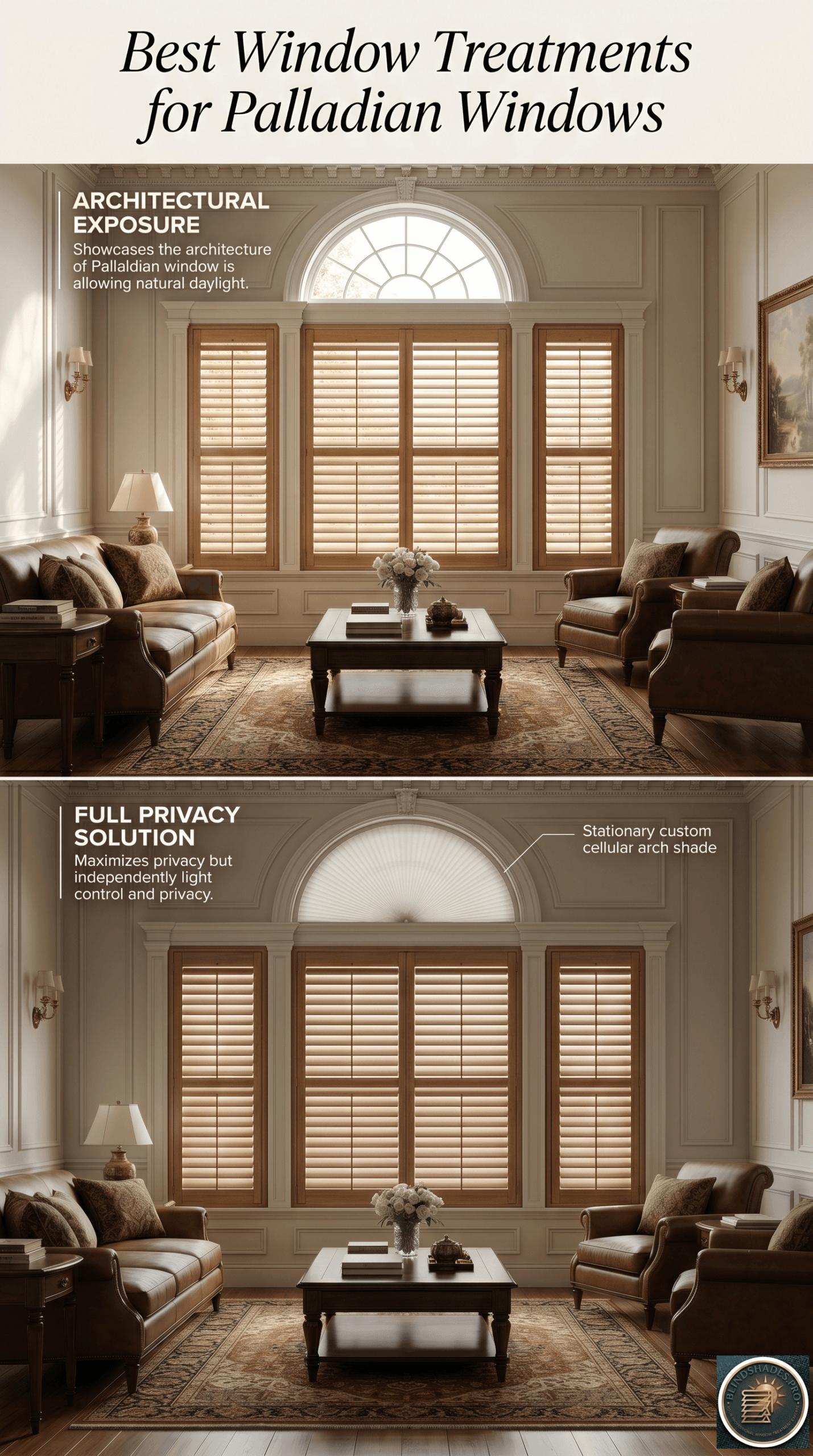
Key Takeaways:
- A Palladian window system has four distinct glass zones requiring separate measurements: the arch at the top of the center section, the rectangular center section below the arch, and the two flanking rectangular side windows; the flanking windows are typically 3 to 4 feet wide and 5 to 6 feet tall while the center section is typically 5 feet wide and 7 to 8 feet tall including the arch; ordering three identical-sized treatments for all sections is the most common Palladian window treatment mistake
- The arch in a Palladian window is almost always a perfect arch – classical Palladian proportions place the arch height at exactly half the arch base width; this means the Palladian arch can usually be ordered online without a template, unlike the majority of residential arched windows where 60 to 70 percent are non-perfect segment arches requiring a template
- The most practical and cost-effective treatment for most Palladian windows is to leave the arch uncovered and treat only the rectangular sections below; the arch functions as the primary light source and architectural feature; operable cellular shades or plantation shutters on the lower rectangular sections provide full daily light and privacy control at significantly lower cost than a full three-part shutter system
- Install drapery rods at the spring line (where the arch meets the rectangular section below, typically at 70 to 75 percent of the total window height) rather than above the arch; draperies hung at the spring line frame the rectangular sections while leaving the arch fully visible; rods installed above the arch cover the architectural feature entirely
- A typical Palladian window system covers approximately 73 square feet of glass – equivalent to 6 standard double-hung windows; for south-facing and west-facing installations, the total glass area creates significant solar heat gain; covering only the arch with a stationary cellular shade and adding cellular shades on all rectangular sections is the most thermally effective treatment for energy-conscious homeowners
⭐ Quick Answer — What Are the Best Window Treatments for Palladian Windows?
- Four Measurement Zones — All Different Sizes: The first rule of Palladian window treatments is that the window has four distinct glass zones requiring separate measurements. (1) The arch — typically 5 feet wide and 2.5 feet tall. (2) The central rectangle below the arch — typically 5 feet wide and 4.5 to 5.5 feet tall. (3) The left flanking rectangle — typically 3 to 4 feet wide and 5 to 6 feet tall. (4) The right flanking rectangle — same as left. The flanking windows are narrower and shorter than the center. Ordering three identical treatments across all sections is the most common Palladian treatment mistake. Measure each zone independently and place four separate orders — or provide all four measurements to a single supplier
- The Palladian Arch Is Almost Always a Perfect Arch — No Template Needed: Unlike most residential arched windows where 60 to 70 percent are non-perfect arches requiring a cardboard template, the arch in a Palladian window is almost always a perfect arch. Classical Palladian proportions place the arch height at exactly half the arch base width — a true semicircle. This means the arch can be ordered online by providing only the base width; no template is needed. Verification test: measure the arch base width and arch height; if height equals base width divided by 2 (within 1/4 inch), it is a perfect arch. Order online. Only modern “Palladian-inspired” windows with shallower decorative arches may deviate from this and require a template
- Leave the Arch Uncovered — The Most Practical Strategy: Most guides default to recommending full shutter systems for Palladian window treatments. The more practical and cost-effective recommendation for most homeowners is to leave the arch uncovered and treat only the three rectangular sections below. The arch is the defining architectural feature of the Palladian window — it provides natural light from above and creates the visual focal point from inside and outside the home. Daily light and privacy control is handled entirely by the lower operable rectangular treatments. Full three-part shutter system: $1,200 to $3,000+. Arch uncovered plus rectangular sections only: $600 to $1,500. Leaving the arch uncovered saves 30 to 50 percent of the treatment cost while preserving the window’s primary design intent
- The Hybrid Approach and the Spring Line Drapery Rule: When full coverage is needed for a Palladian window, the hybrid approach is best: a stationary custom cellular arch shade on the arch (following the arch curve) plus independently operable cellular shades or shutters on all three rectangular sections. This preserves the arch’s curved form while giving full operational control below. For draperies: install the rod at the spring line — the point where the arch begins to curve above the rectangular section — which sits at approximately 70 to 75 percent of the total window height. For a 10-foot tall Palladian window, the spring line is at approximately 7 to 7.5 feet. Draperies hung at the spring line frame the lower rectangles elegantly while leaving the arch fully visible above. Rods installed above the arch keystone cover the arch entirely when draperies are closed
- The 73 sq ft Heat Gain Problem and Flanking Window Hardware: A typical Palladian window covers approximately 73 square feet of glass — the equivalent of 6 standard double-hung windows. For south-facing and west-facing installations, uncovered single-pane glass with a Solar Heat Gain Coefficient of approximately 0.86 on 73 sq ft creates potential solar heat gain of 25,000 to 37,000 BTU per hour — equivalent to a medium portable air conditioner running continuously. Even if the arch is left uncovered, treating all rectangular sections with cellular shades reduces total SHGC to approximately 0.20 to 0.40. And the hardware note: the flanking windows are operated more often than the center — they control lateral sun and privacy while the center is often left open for the view; specify robust cordless or motorized hardware for the flanking treatments specifically
- Best Sources: Custom cellular arch shades and rectangular shades coordinated → Blindsgalore arched windows · Plantation shutter Palladian window system guide → Sunburst Shutters Palladian guide · Palladian window dimensions and cost planning → Modernize Palladian windows guide
⚠️ The Four-Measurement Protocol in Detail: Before ordering any Palladian window treatment, complete four independent measurements. Measurement 1 (arch): arch base width at the spring line; arch height from spring line to highest interior point; verify height = base width divided by 2 for a perfect arch. Measurement 2 (central rectangle): interior width (same as arch base width); interior height from the spring line down to the inside bottom of the frame. Measurement 3 (left flanking rectangle): interior width (typically 3 to 4 feet — do not assume this matches the center); interior height (typically 5 to 6 feet). Measurement 4 (right flanking rectangle): same protocol as left; measure independently as older homes with settled frames can have minor dimensional differences between the two sides. Record as four sets: Arch (W x H); Center Rect (W x H); Left Flank (W x H); Right Flank (W x H). A typical real-world example: Arch (60″ x 30″); Center Rect (60″ x 54″); Left Flank (42″ x 66″); Right Flank (42″ x 66″). Note that the flanking height (66″) in this example is taller than the center rectangle height (54″) because the center measurement stops at the spring line while the flanking windows run the full height of their frame. For the complete arch identification test, template protocol, and UV yellowing specification for arched window treatments, see What Are the Best Blinds for Arched Windows. See the full four-zone treatment guide below.
💡 The Three Treatment Strategies and the Style Matching Guide: Three strategies for Palladian window treatments: Strategy 1 (Most Recommended — Arch Uncovered): leave arch bare; treat center rectangle and two flanking rectangles with matching plantation shutters or cellular shades; preserves architectural intent; $600 to $1,500. Strategy 2 (Hybrid — Best Full Coverage): stationary cellular arch shade on arch; independently operable cellular shades or shutters on all rectangles; arch character preserved with full coverage capability; $900 to $2,200. Strategy 3 (Full Unified — Maximum Privacy): floor-to-ceiling draperies above arch keystone or full-height shutters covering all zones; arch concealed when closed; $1,200 to $3,000+. Treatment by home style: Classical and Colonial revival: sunburst arch shutter or stationary cellular arch + plantation shutters on rectangles. Georgian and Federal: stationary cellular in ivory + cellular shades on rectangles. Craftsman: cellular in linen + matching cellular shades. Contemporary transitional: leave arch uncovered + roller shades in white or grey on rectangles. Mediterranean: sunburst shutter in espresso + wood shutters or cellular on rectangles. For the curtain-specific installation options including curved rods, shower-curtain-rod workarounds, and spring line vs above-arch placement by room type, see Can You Put Curtains on an Arched Window. See the full three-strategy comparison below.
📖 Read the complete guide below for: the four glass zone identification with typical dimensions (arch 5 ft wide x 2.5 ft tall; center rect 5 ft x 4.5-5.5 ft; flanking rects 3-4 ft x 5-6 ft), the Palladian perfect arch verification test (height = base width divided by 2; no template needed), the four-measurement protocol with a worked real-world example, the three treatment strategies (arch uncovered $600-$1,500 / hybrid $900-$2,200 / full unified $1,200-$3,000+), the spring line drapery rod placement at 70 to 75 percent of window height, the total glass area calculation (approximately 73 sq ft; 6 standard windows equivalent; 25,000-37,000 BTU per hour solar heat gain south-facing), the flanking window operational usage pattern, and the home style matching guide for all five architectural types.
Window Treatments for Palladian Windows – The Three-Part System
Definition: A Palladian window is a three-part window system consisting of a large central arched window flanked by two narrower rectangular windows. Named for Italian Renaissance architect Andrea Palladio (1508-1580), the style is characterised by its classical proportions: a central semicircular arch above a rectangular pane, flanked by two shorter rectangular sections.
The four glass zones and their typical dimensions:
| Zone | Typical Width | Typical Height | Treatment Type |
|---|---|---|---|
| Central arch (above spring line) | Same as center rectangle, typically 5 ft | Approximately 2.5 ft (radius = half width) | Stationary arch shade or leave uncovered |
| Central rectangle (below arch) | Typically 4 to 5 ft | Typically 4.5 to 5.5 ft | Operable blind, shade, or shutter |
| Left flanking rectangle | Typically 3 to 4 ft | Typically 5 to 6 ft | Operable blind, shade, or shutter |
| Right flanking rectangle | Typically 3 to 4 ft | Typically 5 to 6 ft | Operable blind, shade, or shutter |
The critical ordering rule: These four zones require four separate measurements and typically four separate orders. The flanking rectangles are narrower and shorter than the center rectangle. The most common ordering mistake is measuring only the center window and ordering three identical treatments for all sections — the flanking windows are a different size.
The Palladian Arch Is Almost Always a Perfect Arch
The ordering shortcut absent from all competitor guides.
As established in Article 44-1, approximately 60 to 70 percent of residential arched windows are non-perfect arches requiring a cardboard template for ordering. The Palladian window is the important exception.
Why the Palladian arch is almost always perfect: Palladian architectural proportions, derived from Andrea Palladio’s classical ratio system, position the central arch as a true semicircle. The arch height equals exactly half the arch base width. A 5-foot wide center opening has a 2.5-foot arch height — a perfect half-circle.
The verification test: Measure the arch base width and the arch height. Divide the base width by 2. If arch height equals this result within 1/4 inch, it is a perfect arch — order online with the base width only, no template required.
The exception: Some modern “Palladian-inspired” windows use shallower or decorative arches that are not true semicircles. If the arch height is noticeably less than half the base width, treat it as a non-perfect arch and follow the template protocol from Article 44-1.
The Three Treatment Strategies for Palladian Windows
Strategy 1 — Leave the Arch, Cover the Rectangles (Most Recommended)
The practical approach absent from all competitor guides — which default to recommending full shutter systems.
The most cost-effective and architecturally appropriate treatment for the majority of Palladian windows is to leave the arch section uncovered and treat only the three rectangular sections below.
Why this works:
- The arch is the defining architectural feature of the Palladian window — it provides natural light from above and creates the visual focal point from both inside and outside
- Daily light and privacy control is handled entirely by the lower rectangular sections — raising and lowering the center and flanking treatments provides all the light adjustment needed
- The arch’s light contribution is consistent and unobstructed — it brightens the room without the glare angles that affect lower windows
What to specify for the rectangular sections:
- Center rectangle: plantation shutter or cellular shade, sized to the center opening width and height below the arch spring line
- Left and right flanking rectangles: matching treatment in the narrower flanking width
The cost comparison:
- Full three-part shutter system (arch + center + flanks): $1,200 to $3,000+
- Arch uncovered + rectangular sections only (center + flanks): $600 to $1,500
- Arch uncovered reduces the order from four pieces to three and eliminates the arch’s custom curved fabrication cost
Strategy 2 — The Hybrid Approach (Best for Full Coverage With Arch Preserved)
The operationally correct system no guide explains.
The hybrid approach uses a stationary custom cellular arch shade on the arch zone combined with independently operable treatments on all three rectangular sections below.
Why this is the correct full-coverage specification:
A fully unified treatment covering all four zones — one large fabric panel or one set of full-height shutters — provides maximum privacy but obscures the arch’s classical form. The arch disappears behind a flat shade or a uniform shutter panel.
The hybrid approach preserves the arch’s visual character (the stationary arch shade follows the arch curve) while giving independent operational control over the rectangular sections. When the lower treatments are raised, the arch shade remains visible as an architectural accent.
The operational logic:
- Arch zone: stationary custom cellular arch shade — never moved; provides consistent UV protection for the arch glass
- Center rectangle: independently operable cellular shade or plantation shutter
- Flanking rectangles: independently operable matching cellular shades or shutters
This hybrid system is what plantation shutter installations naturally produce: arch shutters with fixed sunburst louvers above, independently operable panel shutters below on each section.
Strategy 3 — Full Unified Coverage (Maximum Privacy, Arch Concealed)
When to use it and what the guides don’t tell you.
For rooms requiring complete blackout (home theaters, bedrooms in a primary suite), a full unified treatment covering all four zones makes sense. The arch’s visibility is sacrificed for function.
Options:
- Floor-to-ceiling draperies installed above the arch: single rod above the arch keystone; panels cover the entire window system including the arch; provides full privacy when closed; arch is hidden when treatments are closed
- Full-height plantation shutters across all three sections: shutters are custom-built to cover the arch and all rectangles as a coordinated system; most expensive option
The drapery rod placement for full coverage: Install the drapery rod 4 to 6 inches above the keystone (highest point of the arch). Panels should stack wide enough when open to expose the full window opening. For a typical Palladian window 10 feet wide: each panel stack should be approximately 20-24 inches wide when fully open.
The Spring Line Rule for Draperies
Where to mount the drapery rod for arch-preserving coverage.
The spring line is the point where the arch begins to curve — the junction between the arch zone and the rectangular section below. Installing the drapery rod at the spring line rather than above the arch is the correct placement for most Palladian window drapery installations.
The spring line height: For a Palladian window with a total height of 10 feet (including arch):
- The arch portion is approximately 2.5 feet tall (radius of a 5-foot-wide arch)
- The spring line is at approximately 7.5 feet from the floor (10 feet – 2.5 feet)
- This is approximately 70 to 75 percent of the total window height
Why the spring line is the correct rod position:
- Draperies hung from the spring line fall along the rectangular sections, framing the lower windows elegantly
- The arch remains fully visible above the drapery top
- The arch continues to provide natural light from above the drapery panels
- The architectural character of the window is preserved
The alternative (rod above the arch): Installing the rod above the keystone covers the arch entirely when the draperies are closed. Use this position only when full coverage is the priority and the arch can be concealed.
The Four-Measurement Protocol
The measurement system absent from all competitor guides — preventing the most common Palladian window treatment ordering error.
A Palladian window requires four separate measurements before any treatment order:
Measurement 1 — The arch:
- Arch base width: measure the interior width of the central opening at the point where the arch begins to curve (the spring line)
- Arch height: measure from the spring line to the highest interior point of the arch
- Verify: arch height should equal arch base width ÷ 2 for a perfect arch
Measurement 2 — The central rectangle:
- Interior width: same as the arch base width
- Interior height: from the inside top of the center frame (at the spring line) down to the inside bottom of the center frame
- Note: this is the rectangle BELOW the arch; the arch is a separate order
Measurement 3 — Left flanking rectangle:
- Interior width: typically 3 to 4 feet; narrower than the center
- Interior height: typically 5 to 6 feet; shorter than the full center height including arch
- Note: measure independently — do NOT assume the flanking width matches the center width
Measurement 4 — Right flanking rectangle:
- Same protocol as the left flanking rectangle
- Note: verify both flanking windows are the same width — settlement can cause minor dimensional differences in older installations
Recording the measurements: Record as: Arch (W × H); Center Rect (W × H); Left Flank (W × H); Right Flank (W × H) Place four separate orders — or provide all four sets of measurements to a single supplier who can build all four pieces as a coordinated system.
The Total Glass Area and Heat Gain Calculation
The energy efficiency argument for treating all rectangular sections — absent from all competitor guides.
A typical Palladian window covering these dimensions:
- Central arch (5 ft wide, 2.5 ft radius): half-circle area = π × 2.5² ÷ 2 = approximately 9.8 sq ft
- Central rectangle (5 ft × 5 ft): 25 sq ft
- Two flanking rectangles (2 × 3.5 ft × 5.5 ft): approximately 38.5 sq ft
- Total glass area: approximately 73 sq ft
For context: a standard 3 × 4 ft double-hung window has 12 sq ft of glass. A typical Palladian window has the equivalent glass area of approximately 6 standard windows.
The south-facing heat gain: Uncovered single-pane glass with SHGC of approximately 0.86 on 73 sq ft of south-facing glass in peak summer sun (400-600 BTU/hr/sq ft solar radiation): potential solar heat gain of 25,000 to 37,000 BTU/hr — equivalent to a medium-sized portable air conditioner running continuously.
For south-facing and west-facing Palladian windows: treating all rectangular sections with cellular shades (even if the arch is left uncovered) reduces total SHGC to approximately 0.20 to 0.40 — a meaningful reduction in cooling load.
Flanking Rectangle Treatment — The Most-Used Section
The operational usage insight absent from all guides.
In daily Palladian window operation, the flanking rectangular windows are typically operated more frequently than the center section. The center rectangle is often left open to preserve the view through the large center pane — the visual reason for installing a Palladian window in the first place.
The flanking windows, being narrower and positioned at the sides of the primary view, are more often adjusted for:
- Morning east-sun control (east-facing flanking window raised; center left open)
- Afternoon west-sun control (west-facing flanking window raised; center left open)
- Privacy adjustment at the room’s edges while maintaining the central view
The specification implication: Flanking rectangle treatments should be specified with robust, frequently-operated hardware — cordless lift or motorized. Avoid inexpensive or lightweight hardware on the flanking windows specifically, as they will sustain more operating cycles than any other section of the Palladian treatment system.
The Recommended Specification by Home Style
| Home Style | Arch Treatment | Center Rectangle | Flanking Rectangles | Drapery Position |
|---|---|---|---|---|
| Classical / Colonial revival | Sunburst arch shutter or stationary cellular | Matching plantation shutter | Matching plantation shutter | Spring line if added |
| Georgian / Federal | Stationary cellular arch shade in white or ivory | Cellular shade or shutter | Matching cellular shades | Spring line; full-height panels |
| Craftsman | Stationary cellular in linen or warm white | Cellular shade | Matching cellular shades | Spring line if added |
| Contemporary transitional | Leave arch uncovered | Roller shade in white/grey | Matching roller shades | Not typical |
| Mediterranean | Sunburst arch shutter in espresso | Wood shutter or cellular | Matching shutters or cellular | Spring line if added |
Where to Order
For custom arch cellular shades (Palladian arch portion): Blindsgalore arched windows at blindsgalore.com/arched-windows — Palladian arches are typically perfect arches orderable online; provide the arch base width and confirm height = width ÷ 2; specify stationary cellular arch shade in matching fabric to the rectangular sections below.
For plantation shutter Palladian window system: Sunburst Shutters guide at sunburstshuttersatlanta.com — the most detailed single-treatment guide for plantation shutters on Palladian windows; arch shutter proportioning and frame style options.
For Palladian window dimensions and cost planning: Modernize Palladian windows guide at modernize.com/windows/types/palladian-windows — standard dimensional ratios, installation cost ranges ($2,300 to $10,000 for window installation), and treatment overview.
Frequently Asked Questions
What are the best window treatments for Palladian windows? The best window treatments for Palladian windows depend on the coverage goal. For most homeowners, the most practical approach is to leave the arch uncovered and treat the three rectangular sections with matching plantation shutters or cellular shades. The arch is the defining architectural feature and provides natural light from above without needing a treatment. When full coverage is needed, the hybrid approach works best: a stationary custom cellular arch shade on the arch zone paired with independently operable cellular shades or shutters on all three rectangular sections below. This preserves the arch’s visual character while giving daily operational control over light and privacy.
How many separate treatments does a Palladian window need? A Palladian window requires measurements for four separate zones: the arch at the top of the center section, the rectangular center section below the arch, and the two flanking rectangular side windows. Each zone requires its own measurement and typically its own order. The flanking windows are typically 3 to 4 feet wide and 5 to 6 feet tall while the center rectangle is typically 4 to 5 feet wide and 4.5 to 5.5 feet tall. Ordering three identical treatments assuming all sections are the same size is the most common Palladian window treatment measurement mistake.
Is the arch on a Palladian window a perfect arch? Yes, in most cases. Classical Palladian proportions place the arch height at approximately half the arch base width, making it a true semicircle that can be ordered online without a cardboard template. This is different from many other residential arched windows, where approximately 60 to 70 percent are non-perfect arches requiring a template. To verify, measure the arch base width and arch height and confirm that arch height equals base width divided by 2 within 1/4 inch. Some modern Palladian-inspired windows use shallower decorative arches that are not true semicircles and require a template.
Where should you hang a drapery rod on a Palladian window? For arch-preserving drapery installation on a Palladian window, hang the rod at the spring line, which is the point where the arch begins to curve above the rectangular section. The spring line is typically at 70 to 75 percent of the total window height from the floor. For a 10-foot tall Palladian window, this is approximately 7 to 7.5 feet up. Draperies hung at the spring line fall along the rectangular sections while leaving the arch fully visible above. For complete coverage including the arch, install the rod 4 to 6 inches above the keystone at the top of the arch instead.
How much glass does a typical Palladian window cover? A typical Palladian window covers approximately 73 square feet of total glass area, including the central arch, central rectangle, and two flanking rectangles. This is the equivalent glass area of approximately 6 standard double-hung windows. For south-facing and west-facing Palladian windows, uncovered single-pane glass with a solar heat gain coefficient of approximately 0.86 can create significant cooling loads. Treating all rectangular sections with cellular shades reduces the total solar heat gain coefficient to approximately 0.20 to 0.40 across the full window system.
Related Guides on BlindShades.pro
- The Best Arched & Specialty Windows Buying Guide
- What Are the Best Blinds for Arched Windows
- Can You Put Shutters on an Arched Window
- How Do You Measure Arched Windows for Blinds
- Can You Put Curtains on an Arched Window
By Michael Turner | 30 Years Home Improvement Expertise | Updated 2026 | BlindShades.pro
