How Do You Measure Arched Windows for Blinds?

Authored By Michael Turner -30 Years Home Improvement Expertise | Updated 2026 | BlindShades.pro
Updated on June 1, 2026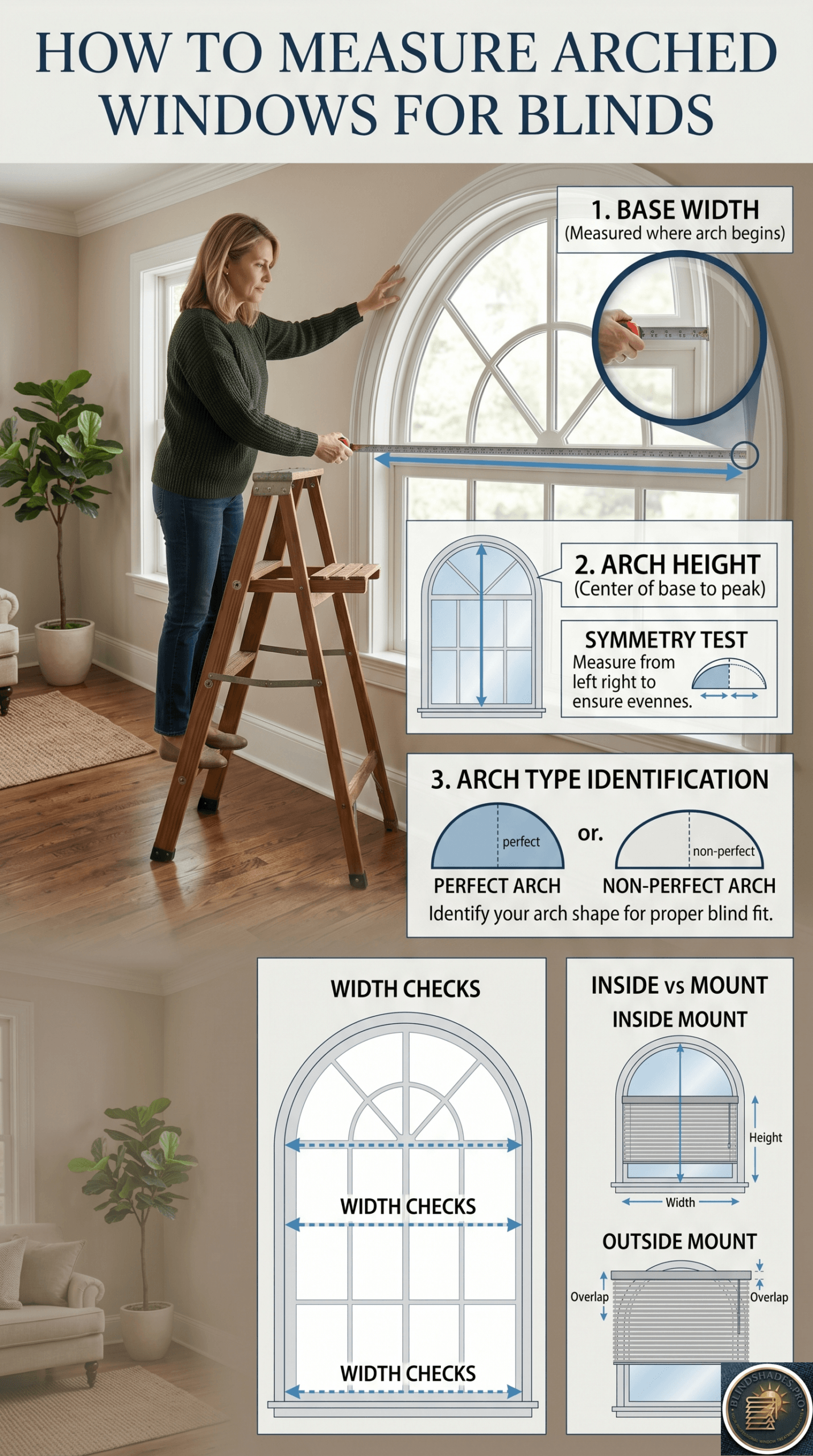
Key Takeaways:
- To measure arched windows accurately, take the base width at three points across the bottom of the arch and use the narrowest measurement to the nearest 1/8 inch; arched frames experience differential settlement stress from the arch thrust that can make one side narrower than the other; a 60-inch arch measured at three points as 60, 60, and 59.75 inches should be ordered at 59.75 inches wide
- Run the arch symmetry check before ordering online: measure the arch height from the left quarter of the base width and from the right quarter of the base width; if these two heights differ by more than 1/4 inch, the arch is asymmetric and a template is required regardless of whether the center height equals half the base width
- Never measure to the top of the arch frame’s outside edge; always measure to the inside of the arch opening; measuring to the outside frame edge adds 1/2 to 1 inch incorrectly and results in a shade too tall for inside mount with visible gaps at the sides
- The spring line is the point where the arch curve begins above the straight frame sides; arch height is measured FROM the spring line up to the arch peak; rectangular treatment height is measured FROM the spring line down to the window base; for eyebrow arches with legs the spring line is above the legs and both the arch zone and the leg zones must be measured separately
- When an arch sits above a rectangular window with a blind below, specify the arch treatment with a 3 to 6 inch extension below the spring line; this extension trim serves as the decorative valance for the rectangular blind and creates a unified visual system instead of two separate-looking treatments
⭐ Quick Answer — How Do You Measure Arched Windows for Blinds?
- The 6-Measurement Protocol — What Every Guide Skips: To measure arched windows correctly, six measurements are needed — not two. (1) 3-point base width: measure the arch base at left, center, and right positions; use the narrowest measurement to the nearest 1/8 inch. Arch frames experience horizontal outward thrust that can cause the frame to splay unevenly; a 60-inch arch measured at 60 / 60 / 59.75 should be ordered at 59.75 inches. (2) Center height to the highest INTERIOR point of the arch (not the outside frame edge). (3) Arch type identification (Perfect / Palladian / Eyebrow / Eyebrow with legs / Quarter). (4) Symmetry check. (5) Spring line height for combined arch-and-rectangle windows. (6) Extension length if the arch shade will serve as a valance for the blind below
- The Inside Frame Height Error — Most Common Return Cause: When measuring arched windows, always measure to the highest point of the inside of the arch opening — never to the top of the outside frame edge. An arch window frame has 3/4 to 1 inch of frame thickness. Measuring to the outside top edge adds 1/2 to 1 inch to the height incorrectly. An arch shade ordered that much too tall for an inside mount cannot seat into the opening — it bows outward at the sides where the frame narrows. For inside mount: measure the interior surface only. For outside mount: take the interior measurement first, then add 2 inches to both width and height for the ordered size (minimum 1 inch flat surface required; for a 32-inch wide arch outside mount, order at 36 inches)
- The Symmetry Check — Required Before Ordering Online: Measuring an arched window once at the center is not enough. Even an arch that passes the perfect arch ratio test (height = base width ÷ 2) can be asymmetric — with one side curving higher than the other. Symmetry check protocol: (1) Find the left quarter point of the base width (one quarter of the way from the left edge to center). (2) Measure the arch height from this point straight up to the arch above it. (3) Repeat on the right quarter point. (4) Compare the two heights: if the difference is under 1/4 inch, the arch is symmetric and can be ordered online. If the difference is more than 1/4 inch, the arch is asymmetric — a template is required regardless of the center height ratio. An asymmetric arch ordered without a template produces a shade that does not follow the actual curve on one side
- The Spring Line and the Valance Extension Technique: The spring line is the point where the arch curve begins above the straight vertical frame sides. It is the critical reference point for measuring arched windows in a combined arch-and-rectangle configuration. Arch height is measured FROM the spring line upward to the arch peak. Rectangle height is measured FROM the spring line downward to the window base. For eyebrow arches with legs: the spring line is above the legs; the arch zone and the leg zone must each be measured separately with the spring line as the dividing point. The valance extension technique: when an arch treatment sits above a rectangular blind, add 3 to 6 inches to the arch height measurement; this extension hangs below the spring line and serves as the decorative valance for the rectangular blind below — creating a unified visual system instead of two separate-looking treatments. Example: a perfect arch at 48 inches wide x 24 inches tall with a 4-inch extension = order at 48 x 28 inches
- The 5 Arch Types and the Width-Height Confusion Warning: The five arch types for measuring arched windows: Perfect arch (height = base width ÷ 2; order online). Palladian arch (height MORE than base width ÷ 2; taller/more dramatic; order online if symmetric — note: this is a measurement TYPE, different from a Palladian window which is an architectural three-part system). Eyebrow arch (height LESS than base width ÷ 2; shallow flat curve; usually template required). Eyebrow arch with legs (shallow arch above vertical “legs”; four measurements: base width + center height + left leg height + right leg height; both legs may differ). Quarter arch (quarter circle; base width = height for a perfect quarter arch). And the critical warning: never mix up width and height when submitting measurements; reporting the height as the width causes the factory to calculate a perfect arch based on the height dimension, producing a shade wrong on both dimensions
- Best Sources: Full 5-type arch measurement guide with diagrams → American Blinds arch measurement guide · Outside mount arch specifications and minimum flat surface requirements → SelectBlinds arch measure guide · Custom arch treatment orders with measurement verification → Blindsgalore arched windows
⚠️ The Complete Measurement Recording Format and Eyebrow Arch with Legs Protocol: Use this format when measuring arched windows before placing any order: Arch Type (Perfect / Palladian / Eyebrow / Eyebrow with Legs / Quarter). Base Width three-point: Left = __ / Center = __ / Right = __ / Use = __ inches (narrowest). Center Height = __ inches (inside frame, to highest interior point only). Perfect Arch Test: Height [equals or does not equal] base width divided by 2 = __. Symmetry Check: left-quarter height = __ / right-quarter height = __ / difference = __ (pass if under 1/4 inch). Leg Height Left = __ inches (eyebrow with legs only; from base to spring line). Leg Height Right = __ inches (same; measure independently as legs may differ). Spring Line Height = __ inches from base (for combined arch-and-rectangle ordering). Mount Type (Inside or Outside). Extension Below Spring Line = __ inches. Final Order Width = __ / Final Order Height = __ inches. For an eyebrow arch with legs specifically: American Blinds confirms four measurements are required; the leg height is measured from the base to the point where the curve begins; always measure both legs independently because settlement can cause the left and right legs to differ; submitting only the taller leg measurement results in a shade that is too tall on the shorter leg side. For the arch identification test, non-perfect arch template protocol, and the arch treatment selection guide by arch type, see What Are the Best Blinds for Arched Windows. See the full 6-measurement protocol below.
💡 Outside Mount Interference and the Five Most Common Measurement Mistakes: When specifying an outside mount arch treatment, the shade extends 2 inches below the spring line on all sides including the bottom. Any rectangular window treatment installed below the arch must have its top mounting hardware positioned at least 2 inches below the spring line to avoid interference with the arch shade’s extended bottom edge. For a cellular shade or shutter on the rectangular section below: the measurement for that treatment starts 2 inches below the spring line, not at the spring line itself. The five most common measurement mistakes for arched windows: (1) Single base width measurement instead of three-point — shade buckles at the wide side. (2) Measuring to the outside frame edge instead of the inside opening — shade 1/2 to 1 inch too tall; bows outward at sides. (3) No symmetry check — asymmetric arch ordered as symmetric; shade does not follow the actual curve on one side. (4) Width and height confused in the order form — factory builds wrong dimensions on both axes. (5) Omitting both leg heights for eyebrow arch with legs — arch shade does not cover the full window including the leg zones. For the arch shutter measurement considerations including louvered vs sunburst proportioning, the curved frame fabrication measurement requirements, and the arch premium cost breakdown, see Can You Put Shutters on an Arched Window. See the full error prevention table below.
📖 Read the complete guide below for: the 6-measurement protocol with full step-by-step instructions (3-point base width with arch thrust explanation; center height inside-frame only; arch type identification; symmetry check left-quarter vs right-quarter within 1/4 inch; spring line measurement for combined windows; valance extension 3 to 6 inches below spring line), the inside frame vs outside frame height error and its 1/2 to 1 inch consequence, the 5 arch type identification table with online vs template ordering status, the symmetry check protocol with pass/fail threshold, the spring line measurement with eyebrow-arch-with-legs four-measurement requirement, the valance extension calculation with worked example (48×24 arch plus 4-inch extension = order at 48×28), the outside mount addition (+2 inches each dimension) and the rectangular treatment interference check, the complete measurement recording format, and the five most common arch measurement mistakes with prevention rules.
How to Measure Arched Windows – The 6-Measurement Protocol
Tools required:
- Steel tape measure (not fabric tape — steel measures do not stretch or sag)
- Step ladder (for high arches)
- Pencil and paper
- Level (for the symmetry check)
Measurement 1 — Base Width (Three-Point Method)
Why three points matter for arched windows — the differential settlement problem.
All measurement guides say “measure the width at the base of the arch.” None explain why arched windows are more susceptible to dimensional inconsistency than rectangular frames.
An arch transmits loads in a fundamentally different direction from a rectangular lintel. The arch generates horizontal outward thrust at its base — a force that tends to push the two sides of the arch frame outward and can cause the frame to splay. Building settlement over years amplifies this asymmetric dimensional change.
The three-point measurement: Take the base width at three horizontal positions:
- At the left portion of the arch base (approximately one third of the way from left to center)
- At the center of the arch base
- At the right portion of the arch base (approximately one third of the way from right to center)
Record all three measurements. Use the narrowest measurement, rounded down to the nearest 1/8 inch.
Example from practice: An arch measuring 60 inches, 60 inches, and 59.75 inches at three base positions: order at 59.75 inches wide. This ensures the arch shade seats fully within the narrowest point of the frame without buckling or forcing.
Measurement 2 — Arch Height (From Center of Base to Highest Interior Point)
The single most important arch measurement — and the inside frame error to avoid.
Measure from the center of the base width (exactly halfway across the base width) to the highest interior point of the arch. This is the arch height.
The inside frame vs outside frame error: All arch measurement guides say “measure to the highest point.” None warn about the frame edge error.
An arch window frame has thickness. The inside surface of the arch frame (the surface the treatment will cover) is lower than the outside surface of the arch frame (the exterior face). For a typical arch frame with 3/4-inch to 1-inch frame thickness: measuring to the outside top of the frame adds approximately 1/2 to 1 inch to the height measurement.
The consequence: An arch shade ordered 1/2 inch too tall for inside mount cannot seat fully into the arch opening — the shade will bulge outward at the sides where the frame is narrower than the shade. The shade appears to bow and does not lie flat against the glass.
The rule: Always measure to the inside of the arch opening — the interior surface you will see from inside the room. For inside mount, this is the measurement point that determines fit.
Measurement 3 — Arch Type Identification
The five arch types and their measurement implications.
| Arch Type | Height vs Width | Online Order? | Template? |
|---|---|---|---|
| Perfect arch | Height = base width ÷ 2 (within 1/4 inch) | YES | No |
| Palladian arch (tall) | Height > base width ÷ 2 | YES if symmetric | No if symmetric |
| Eyebrow arch (flat) | Height < base width ÷ 2 | Call supplier | Usually yes |
| Eyebrow arch with legs | Height < base width ÷ 2; has vertical “legs” | Call supplier | Usually yes |
| Quarter arch | Width at base = height (for perfect quarter arch) | YES if perfect | No if perfect |
Measuring each type:
Perfect arch and Palladian arch (tall arch): Two measurements: base width + center height. Both orderable online if symmetric.
Eyebrow arch: Two measurements: base width + center height. Height is less than half the base width. Usually requires a template for custom cellular shade or shutter; may be orderable from specific suppliers by dimensions if they have experience with eyebrow profiles.
Eyebrow arch with legs: Four measurements: base width + center height + left leg height + right leg height. The leg height is measured from the base to the point where the curve begins (the spring line). Measure BOTH legs — they may differ by 1/4 inch or more in older homes with settlement.
Quarter arch: Two measurements: base width + side height (measured on the straight vertical side, from the base to the highest point). For a perfect quarter arch: base width equals side height.
Measurement 4 — The Arch Symmetry Check
The test absent from all competitor guides — prevents returns from asymmetric arches ordered as if they were perfect.
A perfect arch passes the height-to-width ratio test (height = base width ÷ 2). But a perfect arch can still be ASYMMETRIC — with one side curving higher or steeper than the other.
An asymmetric arch cannot be ordered online even if the center height equals half the base width. If the factory builds a symmetric shade to a center height that matches only the center of an asymmetric arch, the shade will not follow the actual curve on the left or right side.
The symmetry check:
- Find the left quarter point of the base width (one quarter of the way from the left edge to the center)
- Measure the arch height from this left quarter point to the arch directly above it
- Find the right quarter point of the base width (one quarter of the way from the right edge to the center)
- Measure the arch height from this right quarter point to the arch directly above it
- Compare these two left-quarter and right-quarter heights
The result: If left-quarter height equals right-quarter height within 1/4 inch: the arch is symmetric. Order online. If left-quarter height differs from right-quarter height by more than 1/4 inch: the arch is asymmetric. A cardboard template is required regardless of the center height ratio.
Measurement 5 — The Spring Line (for Combined Arch-and-Rectangle Windows)
The measurement reference point absent from all competitor guides.
The spring line is the point where the arch curve begins — the transition from the straight vertical frame sides to the curved arch above.
For a simple arch (no legs): the spring line is at the base of the arch opening, coinciding with the base width measurement position.
For an eyebrow arch with legs: the spring line is above the straight vertical legs. The measurements for the arch zone and the leg zone are taken separately using the spring line as the dividing point.
Why the spring line matters for ordering: When an arch sits above a rectangular window:
- The arch shade height is measured FROM the spring line UPWARD to the arch peak (this is the arch zone)
- The rectangular treatment height is measured FROM the spring line DOWNWARD to the window base (this is the rectangle zone)
- The two treatments mount at the spring line as their common boundary
For an eyebrow arch with legs: the spring line is above the legs. The arch zone height (from spring line to peak) must be measured separately from the leg zone height (from window base to spring line). The factory needs both measurements to build a shade that follows the full window profile.
Measurement 6 — The Extend-for-Valance Option
The arch shade extension technique absent from all competitor guides.
When an arch treatment sits above a rectangular blind or cellular shade below, the arch shade and the rectangular treatment often look like two separate unrelated pieces — the arch shade ends abruptly at the spring line and the rectangular blind starts separately below it.
The solution: extend the arch shade below the spring line.
Specify the arch shade with a 3 to 6 inch extension below the spring line. This extension creates a decorative bottom trim that hangs below the arch opening and serves as the valance (decorative top treatment) for the rectangular blind below.
The visual result: the arch shade and the rectangular blind below appear as a unified system — as if the arch treatment flows seamlessly into the blind below.
The measurement adjustment: For arch height measurement when specifying the extension:
- Measure the arch height from the center of the base to the highest point as normal
- Add the desired extension length (3 to 6 inches recommended) to the arch height measurement
- The total ordered arch height = arch zone height + extension length
Example: A perfect arch with base width 48 inches and center height 24 inches; specifying a 4-inch extension below the spring line:
- Normal arch height: 24 inches
- Extension: 4 inches
- Order arch shade at: 48 inches wide × 28 inches tall
The rectangular blind below the arch is then mounted with its top edge approximately 1 to 2 inches below the spring line (to provide clearance behind the arch shade’s extended trim).
Inside Mount vs Outside Mount for Arched Windows
The measurement adjustments by mount type.
| Mount Type | Width Measurement | Height Measurement | Deductions |
|---|---|---|---|
| Inside mount | Exact inside frame base width (narrowest of three) | Exact inside frame center height | None — factory applies deductions |
| Outside mount | Inside frame base width + 2 inches each side (4 inches total) | Inside frame height + 2 inches | None — order at the final larger size |
For outside mount: the rectangular treatment interference check. When the arch is outside-mounted, the shade extends 2 inches below the spring line. Any rectangular window treatment below the arch must have its top hardware mounted at least 2 inches below the spring line to avoid interference with the arch shade’s extended bottom edge.
SelectBlinds specifies: “at least 1 inch of flat surface for outside mount; add minimum 2 inches on each side (4 inches total).” For a 32-inch wide arch: order at 36 inches wide for outside mount.
Complete Measurement Recording Format
Record measurements in this format before placing any order:
Arch Type: [Perfect / Palladian / Eyebrow / Eyebrow with Legs / Quarter]
Base Width (three-point): L=__ / C=__ / R=__ | Use: __ inches (narrowest)
Center Height: __ inches (inside frame, to highest interior point)
Perfect Arch Test: Height [=] or [<] or [>] Base Width ÷ 2 = __
Symmetry Check: Left-quarter height = __ | Right-quarter height = __ | Difference = __ (pass if under 1/4 inch)
Leg Height Left: __ inches (eyebrow with legs only; from base to spring line)
Leg Height Right: __ inches (eyebrow with legs only; from base to spring line)
Spring Line Height: __ inches from base (for combined arch-and-rectangle ordering)
Mount Type: [Inside / Outside]
Extension Below Spring Line: __ inches (0 if no extension needed)
Final Order Width: __ inches | Final Order Height: __ inches
The Five Most Common Arch Measurement Mistakes
| Error | Consequence | Prevention |
|---|---|---|
| Measuring only one base width point | Arch shade fits at center but buckling at sides | Three-point base measurement; use narrowest |
| Measuring to outside frame edge rather than inside arch opening | Shade 1/2 to 1 inch too tall; bows outward at sides | Always measure inside opening surface |
| Ordering an asymmetric arch as if it were symmetric | Shade curve does not follow actual arch profile on one side | Symmetry check: compare left-quarter and right-quarter heights |
| Confusing width and height in submission form | Factory builds wrong dimensions; shade correct size but wrong orientation | Label measurements clearly before submitting; double-check |
| Omitting leg heights for eyebrow arch with legs | Arch shade does not cover the full window including legs | Four measurements: base width + center height + left leg + right leg |
Where to Measure and Order
Comprehensive arch measurement guides with ordering: American Blinds arch measurement guide at americanblinds.com/help/how-to-measure/arches — the most detailed arch type guide available online; all five arch types with diagrams; inside and outside mount instructions; direct order for perfect and perfect quarter arches; call for non-perfect types.
SelectBlinds arch measuring guide: SelectBlinds at selectblinds.com/measure/measure-arches.html — clear outside mount instructions; minimum 1 inch flat surface; 2-inch minimum addition each side; inside and outside mount measurement steps for all arch types.
For custom arch treatment orders based on accurate measurements: Blindsgalore arched windows at blindsgalore.com/arched-windows — provides measurement verification as part of the order process for perfect arches; design team consultation for non-perfect and asymmetric arches.
Frequently Asked Questions
How do you measure arched windows for blinds? To measure arched windows for blinds, take three measurements: the base width at the bottom of the arch where the curve begins using the narrowest of three horizontal measurement points, the arch height from the center of the base to the highest interior point of the arch frame, and the arch type to confirm whether it is a perfect arch that can be ordered online or a non-perfect arch requiring a template. For inside mount, order exact measurements with no deductions. For outside mount, add 2 inches to both the width and height.
What is the three-point base width measurement for arched windows? The three-point base width measurement for arched windows involves measuring the base width at three horizontal positions across the bottom of the arch and using the narrowest measurement for ordering. Arched frames experience horizontal outward thrust from the arch load that can cause one side to splay slightly more than the other over time, making the three-point check important for ensuring the treatment fits the narrowest point without buckling. Take the width at the left portion, the center, and the right portion of the arch base. If the three measurements are 60, 60, and 59.75 inches, order at 59.75 inches to the nearest 1/8 inch.
What is the arch symmetry check and why does it matter? The arch symmetry check confirms that both sides of the arch curve equally, which is required for online ordering without a template. Measure the arch height from the left quarter of the base width and from the right quarter of the base width. If these two heights differ by more than 1/4 inch, the arch is asymmetric and a template must be submitted even if the center height equals half the base width. An asymmetric arch ordered as a symmetric arch produces a shade that does not follow the actual curve on one side.
What is the spring line in arch window measurement? The spring line is the point where the arch curve begins, marking the transition from the straight vertical frame sides to the curved arch above. For measuring combined arch-and-rectangle windows, the arch height is measured from the spring line upward to the arch peak, and the rectangular treatment height is measured from the spring line downward to the window base. For eyebrow arches with legs, the spring line is above the legs and the arch zone and leg zone must be measured separately with the spring line as the dividing reference point.
What is the arch shade valance extension and how do you measure for it? The arch shade valance extension is a 3 to 6 inch downward extension of the arch shade below the spring line that creates a decorative trim serving as the valance for the rectangular blind below. To measure for the extension, take the normal arch height from the center of the base to the highest interior point, then add the desired extension length of 3 to 6 inches to the arch height before submitting the order. For a 48-inch wide perfect arch with 24-inch center height and a 4-inch extension, the order dimensions are 48 inches wide by 28 inches tall. The rectangular blind below is then mounted approximately 1 to 2 inches below the spring line to provide clearance behind the arch shade extension.
Related Guides on BlindShades.pro
- The Best Arched & Specialty Windows Buying Guide
- What Are the Best Blinds for Arched Windows
- How Do You Cover a Half-Round Window
- Can You Put Shutters on an Arched Window
- Is a Custom Arch Shade Worth the Cost
By Michael Turner | 30 Years Home Improvement Expertise | Updated 2026 | BlindShades.pro
