How Do You Cover a Half-Round Window?

Authored By Michael Turner -30 Years Home Improvement Expertise | Updated 2026 | BlindShades.pro
Updated on May 31, 2026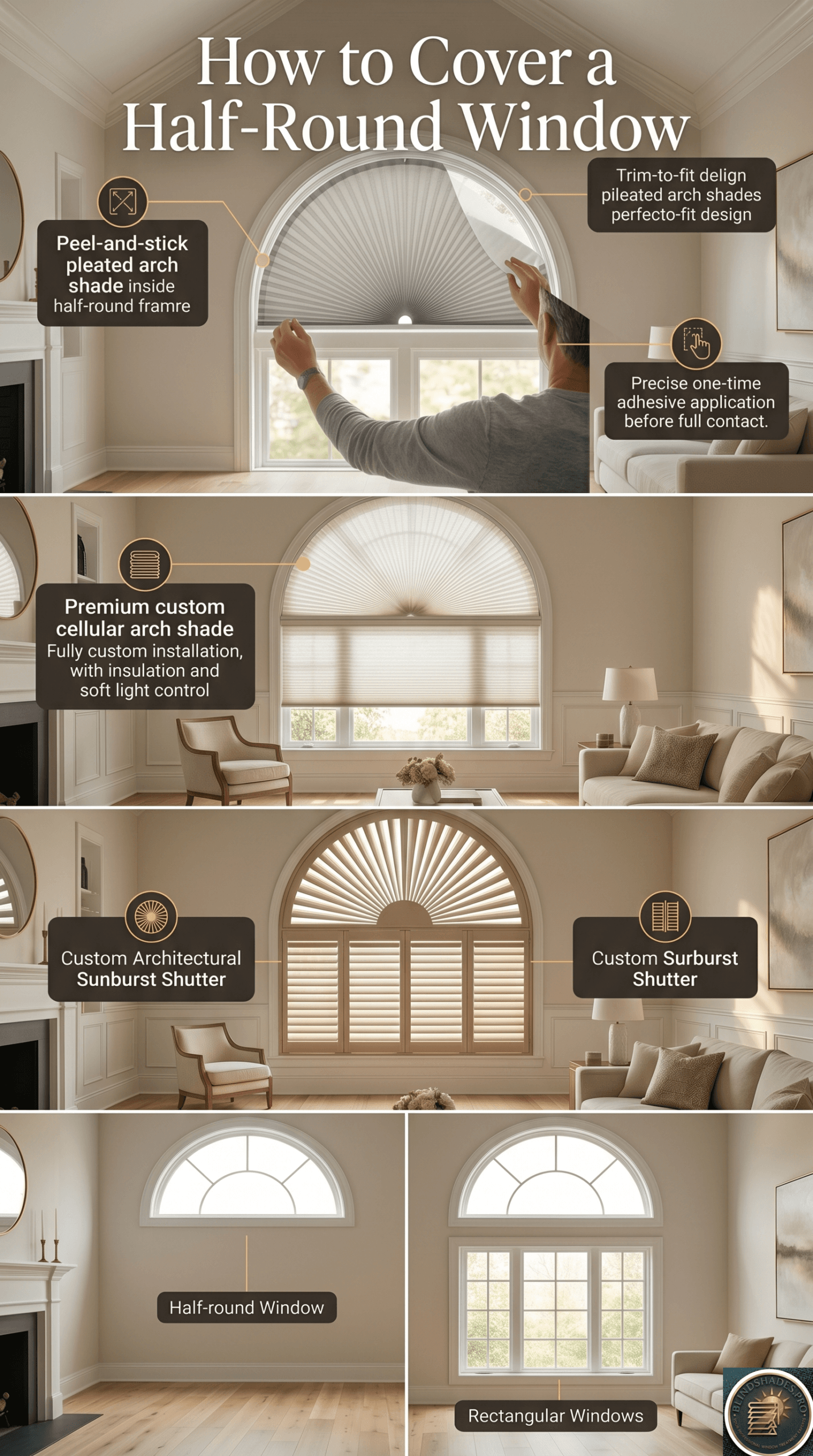
Key Takeaways:
- Redi Shade peel-and-stick adhesive is a one-time application – once the adhesive contacts the glass it cannot be repositioned; the correct sequence is to fold back the adhesive strip, position the shade exactly in the frame without touching adhesive to glass, confirm alignment, then press firmly; a crooked or misaligned application ruins the shade
- Before ordering any peel-and-stick or cut-to-fit half-round arch shade, confirm whether the product is specified by radius or diameter – a product labelled “Radius: 24 inches” fits a window 48 inches wide and 24 inches tall; a product labelled “72 x 36” describes the same window; confusing radius and diameter is the most common sizing mistake
- The Redi Shade arch holder system only functions for true half-round windows where the flat edge is horizontal at the bottom; for quarter-arch windows (where the straight edge is vertical at the side), the arch holder cannot be used and the shade must be secured with tape only
- Covering a half-round window is not always the right choice: north-facing half-round windows in temperate climates receive minimal direct solar radiation and covering them reduces natural light with no thermal benefit; only south-facing and west-facing half-round windows in air-conditioned spaces have meaningful solar heat gain worth treating
- For cut-to-fit arch shades, trim only the curved top edge using the printed radius guide lines on the backing – never trim the flat bottom edge; over-trimming the curved edge by cutting inside the guide line is irreversible
⭐ Quick Answer — How Do You Cover a Half-Round Window?
- The 4 Methods — From $14 to $800: To cover a half-round window, choose from four methods by budget and permanence. (1) Peel-and-stick cut-to-fit pleated shade (Redi Shade and equivalents): $14–$40, no tools, 15–30 minutes. (2) Custom cellular arch shade: $112–$358, R-3 to R-4 insulation, 30–60 minutes. (3) Custom arch shutter (sunburst pattern): $300–$800, 50+ year lifespan, professional install. (4) Window film: $20–$80, permanent, no hardware — only option for very shallow eyebrow arches below 6 to 8 inches height. The critical distinction: Redi Shade only works for perfect half-round arches (flat edge horizontal at bottom); for quarter-arch windows (straight edge vertical at the side), the arch holder system fails and tape is the only securing option
- The Redi Shade One-Time Adhesive Warning — Position Before Pressing: The most important installation note for covering a half-round window with a peel-and-stick shade: the adhesive is a one-time application. Once the adhesive strip contacts the glass or frame, it cannot be repositioned. Pressing and peeling off a misaligned shade creases or tears the fabric. The correct sequence: (1) trim the curved edge to the matching radius guide line on the backing; (2) fold back the adhesive strip WITHOUT letting it touch the glass; (3) hold the shade in the frame and confirm it is centered and symmetrical before pressing anything; (4) press the adhesive firmly from the center outward. And the trimming rule: cut only the curved top edge along the printed radius guide line; never trim the flat bottom edge; cutting inside the guide line over-trims — irreversible
- Radius vs Diameter — The Most Common Sizing Error: When ordering any half-round window covering, confirm whether the product is specified by radius or diameter. A product labelled “Radius: 24 inches” fits a window 48 inches wide and 24 inches tall. A product labelled “72 × 36” fits a window 72 inches wide and 36 inches tall (radius = 36 inches). These are different sizes. Formula: radius = window width ÷ 2. A “72 × 36” window has radius 36 — not 24. To confirm before ordering: measure your window width, divide by 2 to get the radius, then match the product’s radius specification to that number. Buyers who confuse radius and diameter consistently order a shade half the size they need
- The Three Positions and the “Leave It Uncovered” Decision: A half-round window appears in three positions requiring different treatments. Arch over rectangle (most common): arch is above a rectangular window; cellular arch shade can span both in a single piece, or the arch gets a stationary shade while the rectangle below operates independently. Standalone arch in a high wall: typically 8–16 feet up; stationary cellular or Redi Shade pressed in from a ladder — no daily operation needed. Arch transom over a door: 12–24 inches tall, 30–36 inches wide; Redi Shade smallest sizes or window film appropriate. And the orientation decision: north-facing half-round in a temperate climate — leave it uncovered. North-facing arches receive minimal direct solar radiation; covering them reduces natural light with zero thermal benefit. Only south-facing and west-facing half-round windows in air-conditioned spaces have meaningful solar heat gain worth treating
- Architectural Context and the Heat Gain Trade-Off: Match the treatment to the home’s style. Victorian, Georgian, and colonial revival homes: sunburst arch shutter or custom cellular in warm white or ivory — white polyester Redi Shade looks visually wrong against period architecture. Craftsman and arts and crafts: cellular arch shade in natural linen or warm ivory. Contemporary and modern: frosted film or minimal-profile cellular in white or grey. And the heat gain trade-off: an uncovered south-facing single-pane half-round window has a Solar Heat Gain Coefficient of approximately 0.86 — 86% of solar energy enters the room. Redi Shade reduces this to approximately 0.40–0.55 at R-0.5 to R-1. A custom cellular arch shade reduces SHGC to 0.20–0.40 at R-3 to R-4 — a meaningful difference if cooling bills are a concern
- Best Sources: Redi Shade (original peel-and-stick, standard sizes) → Home Depot Redi Shade 72×36 · Custom cellular arch shades (perfect and non-perfect arches) → Blindsgalore arched windows · Operable custom arch treatments for any shape → Arched and Angled Blinds
⚠️ The Quarter-Arch Redi Shade Limitation and the Custom vs DIY Decision Tree: A critical limitation confirmed in the Redi Shade product Q&A: the arch holder bracket included with Redi Shade ONLY works for true half-round windows where the flat edge sits horizontally at the bottom of the arch. For quarter-circle arches (where the straight edge is vertical at the side, such as in a corner window or quarter-round feature window), the arch holder cannot be attached at the correct angle. Redi Shade can still be used on a quarter arch, but the shade must be secured using cellophane or Scotch tape at the curved edge rather than the included holder system. The tape method is less secure and less finished-looking than the holder method. For quarter arches requiring a permanent treatment: custom cellular arch shade from a specialist like Arched and Angled Blinds or window film applied directly to the glass are the better long-term solutions. Decision tree for covering a half-round window: Budget under $40 + perfect half-round + temporary or rental: Redi Shade. Budget under $40 + quarter arch: Redi Shade with tape workaround. Budget $112–$358 + insulation priority + permanent: custom cellular arch shade. Budget $300–$800 + period home + 50-year investment: arch shutter. Arch height below 6–8 inches (eyebrow arch): window film only. For the full measurement protocol including the perfect vs non-perfect arch test (height = width ÷ 2) and the cardboard template method for non-perfect arches, see What Are the Best Blinds for Arched Windows. See the full four-method installation guide below.
💡 The Radius Guide Line Trimming Protocol and the Standard Redi Shade Size Chart: Cut-to-fit arch shades including Redi Shade come with printed radius guide lines on the backing that represent specific trimming sizes. The trimming protocol: (1) measure your window’s radius (width ÷ 2); (2) locate the guide line on the shade backing that corresponds to your radius; (3) cut along that guide line — curved top edge only, flat bottom edge is never cut; (4) do not cut inside the guide line (over-trimming removes too much material and cannot be corrected); (5) if your radius falls between two guide lines, cut along the larger (outer) guide line first and test fit before trimming further. Standard Redi Shade sizes available and their corresponding window dimensions: 36 × 18 inches = radius 18 inches (fits a 36-inch wide by 18-inch tall window). 48 × 24 inches = radius 24 inches (fits a 48-inch wide by 24-inch tall window). 72 × 36 inches = radius 36 inches (fits a 72-inch wide by 36-inch tall window). These are the three most common perfect half-round residential window sizes. If your window does not match these standard dimensions, a cut-to-fit shade must be trimmed from the next largest size or a custom cellular arch shade must be ordered. For the complete architectural style guide for half-round window treatments by home style and orientation, the arch-over-rectangle coordination guide, and the full cost-per-year comparison, see Can You Put Shutters on an Arched Window. See the full position guide below.
📖 Read the complete guide below for: the four method comparison with cost ranges ($14 Redi Shade to $800 arch shutter), the Redi Shade one-time adhesive installation sequence (fold back adhesive, position first, confirm alignment, then press), the DIY trimming protocol (curved top only; never flat bottom; outer guide line first), the radius vs diameter clarification with the conversion formula (radius = width ÷ 2), the quarter-arch holder limitation (tape workaround confirmed from Home Depot product Q&A), the three half-round window positions and their treatment implications (arch over rectangle; standalone high wall; door transom), the orientation-based “leave it uncovered” decision (north-facing = leave uncovered; south/west-facing = cover for SHGC 0.86 reduction), the heat gain trade-off (Redi Shade R-0.5 to R-1 vs cellular R-3 to R-4), and the architectural context matching guide by home style.
How to Cover a Half-Round Window – The Four Methods
Definition: A half-round window (also called a half-moon, semicircular, or fanlight window) has a flat horizontal bottom edge and a curved top forming a half-circle. It is one of the most common arched window types in residential architecture — found above entry doors, above tall windows, and as standalone features in gable walls.
Method 1 — Cut-to-Fit Peel-and-Stick Pleated Shade (Fastest, Budget Option)
Cost: $14-$40 per window Best for: Perfect half-round arches; renters; temporary coverage; budget-first installs Installation time: 15-30 minutes Available at: Home Depot, Walmart, Amazon
How it works: Cut-to-fit arch shades come as pre-shaped semicircular pleated fabric with peel-and-stick adhesive backing. Redi Shade is the original and most widely available brand; similar products from Myshade, SEEYE, Grandekor, and others offer the same principle at lower price points.
The step-by-step installation:
- Measure your arch’s radius (width ÷ 2) and confirm the product is sized for your radius
- Locate the printed guide lines on the shade backing — each guide line represents a specific radius
- Mark and cut the shade along the guide line that matches your arch (curved top only — NEVER cut the flat bottom edge)
- Remove the cardboard backing and fold back — but do NOT peel the adhesive strip yet
- Hold the shade in the arch frame in the exact position you want it — confirm it is centered and aligned
- With alignment confirmed, press the adhesive strip firmly against the window frame
- Press the entire arch border firmly from the center outward
The one-time adhesive warning — the most critical step: Redi Shade’s adhesive is a one-time application. Once the adhesive contacts the glass or frame surface, repositioning is not possible without damaging the shade. The adhesive is strong enough that pulling a misaligned shade off typically tears or creases the fabric.
Confirm alignment completely BEFORE pressing. Use the center bottom of the shade as the anchor point — align center-to-center on the frame base first, then confirm both sides sit symmetrically before pressing any adhesive.
The trimming error to avoid: The most common DIY mistake with cut-to-fit arch shades is cutting inside the guide line (over-trimming) rather than along it. Guide lines on the shade backing represent exact radii — cutting along the line removes just enough material for a snug fit; cutting inside the line removes too much, creating a shade smaller than your arch.
If the guide lines are close together (typically 2-4 inches apart representing different radius sizes), cut along the outermost matching line first; you can always trim more if needed, but you cannot add material back.
Method 2 — Custom Cellular Arch Shade (Best Insulation and Light Control)
Cost: $112-$358 per window Best for: Permanent installation; south and west-facing windows requiring heat control; insulation priority Installation time: 30-60 minutes (hardware mounting required)
Custom cellular arch shades are fabric honeycomb shades built to the exact curve of the half-round arch. The pleated fabric fans outward from the base of the arch, following the semicircular frame precisely. For perfect half-round arches, measurements can be submitted online. For non-perfect arches, a cardboard template is required (see Article 44-1 for the measurement protocol).
The insulation comparison:
| Treatment | R-value Added | Solar Heat Gain Reduction |
|---|---|---|
| No treatment (clear glass) | R-0 | 0% |
| Redi Shade (polyester, reflective layer) | R-0.5 to R-1 | 30-50% |
| Custom light-filtering cellular arch shade | R-3 to R-4 | 50-70% |
| Custom blackout cellular arch shade | R-3 to R-4 | 80-95% |
For south and west-facing half-round windows: a single-pane uncovered window has a Solar Heat Gain Coefficient (SHGC) of approximately 0.86, meaning 86 percent of solar energy enters the room as heat. Adding a custom cellular arch shade reduces SHGC to approximately 0.20-0.40 — a meaningful reduction in cooling load.
The specification for cellular arch shades:
- Specify single cell for minimal raised stack (Article 44-1 stack height guidance applies)
- For perfect arches: order online with base width
- For non-perfect arches: create and mail a cardboard template
Method 3 — Custom Arch Shutter (Most Architectural, Longest Lifespan)
Cost: $300-$800 per window Best for: Traditional, colonial, and craftsman homes; permanent architectural feature; 50+ year lifespan Installation time: Professional installation recommended
Custom arch shutters in sunburst pattern are the premium treatment for half-round windows in period-style homes. The sunburst pattern — louver blades radiating from the base center of the arch — is architecturally consistent with Victorian, Georgian, and craftsman architecture.
For half-round window blade proportioning: the same guidance from Article 44-1 applies — 2.5-inch blades for arches under 36 inches wide; 3.5-inch blades for arches 36-60 inches; 4.5-inch blades for arches over 60 inches.
Arch shutters for half-round windows are stationary (louvers tilt but the shutter panel is fixed). For movable louvers, the tilt mechanism provides approximately 70-80 percent light blocking when fully closed.
Method 4 — Window Film (Most Permanent and Low-Maintenance)
Cost: $20-$80 per window Best for: Standalone half-round windows requiring permanent privacy and UV protection; contemporary homes where fabric treatments conflict with the aesthetic
Window film applied directly to the half-round glass provides permanent privacy and UV protection without any hardware. For eyebrow arches (very shallow half-round curves below the 6-8 inch minimum for cellular shade hardware), window film is typically the only viable treatment.
Frosted film transmits 70-80% of natural light as diffused illumination while permanently obscuring interior visibility. For the detailed film vs blind comparison see Is Frosted Film Better Than Blinds for Sidelights — the same light transmission and privacy principles apply to half-round windows.
The Three Half-Round Window Positions and Their Correct Treatment
The position of the half-round determines the primary function of the treatment — absent from all competitor guides.
Position 1 — Arch Over Rectangle (Most Common)
A half-round arch positioned directly above a rectangular window in the same frame. The rectangular lower section handles daily light and privacy control. The arch is typically a decorative extension of the window system.
The treatment implication: Many cellular arch shade systems can span BOTH the arch and the rectangle below in a single piece — the shade covers the rectangular opening and extends up into the arch. This creates a single continuous treatment rather than two separate pieces.
For split arch-and-rectangle treatment: the arch gets a stationary cellular arch shade; the rectangle below gets a matching cellular shade, roller shade, or blind that operates for daily light control. Match pleat size, fabric color, and light-filtering level for visual continuity.
Position 2 — Standalone Half-Round (Arch Only, No Rectangle)
A half-round window positioned in a wall without a rectangular companion below — typically in a high gable wall, above a door frame, or as a feature window.
The treatment implication: This arch typically stands at high height (8-16 feet above floor in a two-story gable) and receives no daily operation. Stationary cellular arch shade or custom arch shutter is the correct treatment. Redi Shade peel-and-stick is practical for standalone arches because no mechanical hardware is required at height — just press into place from a ladder.
Position 3 — Arch Transom Over Door (Doorway Arch)
A small half-round arch above a door opening — typically 12-24 inches tall and 30-36 inches wide. Common in Victorian, colonial, and craftsman entries above interior passage doors.
The treatment implication: This position is too small for custom cellular arch shade hardware (below the 6-8 inch minimum height for some suppliers). The correct treatments are:
- Redi Shade cut to the arch dimensions (available in small sizes including “Radius: 12 inches”)
- Frosted window film applied to the glass
- Leave uncovered if the door is an interior passage with no privacy concern
The Radius vs Diameter Sizing Problem
The most common ordering mistake for half-round window covering products.
Half-round window covering products are described two different ways depending on the manufacturer:
Diameter-based description (most common for custom treatments): “72 x 36” = 72-inch width (diameter) × 36-inch height (radius) — describes a window 72 inches wide
Radius-based description (common for cut-to-fit and Amazon products): “Radius: 24 inches” = the same 72-inch wide window described above (radius = width ÷ 2 = 72 ÷ 2 = 36… wait — this example is actually a 48-inch wide window)
The clarification:
- Radius = half the width = half the height of a perfect half-round
- A “Radius: 24 inch” window = 48 inches wide and 24 inches tall
- A “72 × 36” window = 72 inches wide and 36 inches tall (radius = 36 inches)
- A “Radius: 36 inch” product fits the 72 × 36 window
The practical conversion: If your window measures 72 inches wide × 36 inches tall:
- Your radius = 36 inches (width ÷ 2 = 72 ÷ 2 = 36)
- Order a product specified as “Radius: 36 inches” or “72 × 36”
If a product is listed as “Radius: 24 inches”:
- It fits a window 48 inches wide × 24 inches tall
- NOT your 72 × 36 window
When to Leave a Half-Round Window Uncovered
The orientation-based decision absent from all competitor guides.
Most buying guides assume covering a half-round window is always desirable. It is not always the correct decision.
When covering is beneficial:
- South-facing or west-facing half-round windows in air-conditioned spaces: solar heat gain through uncovered single-pane glass (SHGC approximately 0.86) increases cooling load meaningfully
- Any half-round window visible from a public area where privacy is needed
- Half-round windows in bedrooms or bathrooms where privacy is the primary function
When leaving uncovered is the better choice:
- North-facing half-round windows in temperate climates: receive minimal direct solar radiation; covering reduces natural light with no thermal benefit
- High gable-wall half-round windows visible only from the exterior: interior privacy is not a concern at this height; covering blocks architectural daylight
- Interior transom arches above interior passage doors: no privacy function; covering blocks borrowed light between rooms
The architectural test: stand inside the room and look at the arch. If the view through the arch is sky or interior space with no direct sun exposure and no exterior visibility concern, the arch is likely better left uncovered.
The Architectural Style Matching Guide
How to choose a half-round window treatment that matches the home’s period style.
A half-round window treatment is architecturally visible — the treatment character must be consistent with the home’s style.
| Home Style | Appropriate Treatment | Conflicting Treatment |
|---|---|---|
| Victorian / Georgian | Sunburst arch shutter; custom cellular in warm white or ivory | White polyester Redi Shade; modern frosted film |
| Colonial revival | Custom arch shutter; cellular arch shade in classic white | Contemporary frosted pattern film |
| Craftsman / Arts and crafts | Cellular arch shade in natural linen or warm ivory; wood shutter | Industrial flat film; commercial-looking polyester shade |
| Contemporary / Modern | Frosted film; minimal profile cellular arch in white or grey | Ornate sunburst shutter; fabric curtain treatments |
| Mediterranean / Spanish | Sunburst arch shutter in espresso or walnut; custom cellular in warm tones | White polyester Redi Shade |
| Farmhouse | Cellular arch shade in linen or greige; simple frosted film | Industrial shutters; blackout polyester |
Where to Order
For peel-and-stick cut-to-fit half-round arch shades: Redi Shade at Home Depot — the original brand; available in standard perfect-half-round sizes (72×36 most common); light-filtering standard; “one-time adhesive” means alignment before pressing is mandatory.
For custom cellular arch shades (perfect and non-perfect arches): Blindsgalore arched windows at blindsgalore.com/arched-windows — custom-built cellular arch shades; Bali Perfect Arch range; design team consultation for non-perfect arches requiring templates.
For fully custom and operable arch treatments: Arched and Angled Blinds at archedandangledblinds.com/arched-blinds — specialist for any arch shape; operable systems available; accepts mailed templates for non-perfect curves.
Frequently Asked Questions
How do you cover a half-round window? To cover a half-round window, choose from four methods based on budget and permanence. Peel-and-stick cut-to-fit pleated shades such as Redi Shade are the fastest at $14 to $40 with no-tool installation; the critical step is positioning the shade exactly before pressing the one-time adhesive. Custom cellular arch shades at $112 to $358 provide R-3 to R-4 insulation and are appropriate for south and west-facing windows with heat gain concerns. Custom arch shutters at $300 to $800 are the architectural option for period-style homes. Window film is appropriate for very shallow arches below the 6 to 8 inch minimum height for cellular shade hardware.
What is the Redi Shade and does it work for half-round windows? Redi Shade is a pleated fabric half-round arch shade that trims to fit and applies to the window frame with peel-and-stick adhesive requiring no tools. It works for perfect half-round windows where the flat edge is horizontal at the bottom. The most important installation note is that the adhesive is a one-time application and cannot be repositioned after contact with the glass. Confirm the shade is centered and aligned in the frame before pressing the adhesive. Redi Shade also works for quarter-arch windows but the included arch holder cannot be used for quarter arches – the shade must be secured with tape at the edges instead.
What is the difference between radius and diameter when ordering half-round window shades? When ordering half-round window shades, radius is half the width and equals the height of a perfect half-circle window. A product specified as Radius 24 inches fits a window 48 inches wide and 24 inches tall. A product specified as 72 by 36 inches describes a window 72 inches wide and 36 inches tall, which has a radius of 36 inches. To convert: radius equals window width divided by 2. To order: match the product radius specification to your window’s measured radius, which is the window width divided by 2.
Should you leave a half-round window uncovered? Leaving a half-round window uncovered is the correct choice for north-facing windows in temperate climates, where minimal direct solar radiation means covering reduces natural light without any thermal benefit. It is also appropriate for high gable-wall arches where interior privacy is not a concern at that height. Covering is beneficial for south-facing and west-facing arches in air-conditioned spaces where uncovered single-pane glass with a solar heat gain coefficient of approximately 0.86 contributes meaningfully to cooling load. Interior transom arches above passage doors with no privacy function are also commonly left uncovered to allow borrowed light between rooms.
How do you trim a cut-to-fit half-round arch shade? To trim a cut-to-fit half-round arch shade, measure your arch radius and locate the matching radius guide line printed on the shade backing. Cut along this guide line from the edge of the shade inward, trimming only the curved top portion of the shade. Never cut the flat bottom edge. The most common trimming error is cutting inside the guide line rather than along it, which removes more material than needed and cannot be corrected. If multiple guide lines are close together, cut along the outermost matching line first as you can trim more if needed but cannot add material back.
Related Guides on BlindShades.pro
- The Best Arched & Specialty Windows Buying Guide
- What Are the Best Blinds for Arched Windows
- How Do You Measure Arched Windows for Blinds
- What Are the Best Window Treatments for Palladian Windows
- How Do You Cover a Round or Circular Window
By Michael Turner | 30 Years Home Improvement Expertise | Updated 2026 | BlindShades.pro
