How Do You Cover a Round or Circular Window?

Authored By Michael Turner -30 Years Home Improvement Expertise | Updated 2026 | BlindShades.pro
Updated on June 1, 2026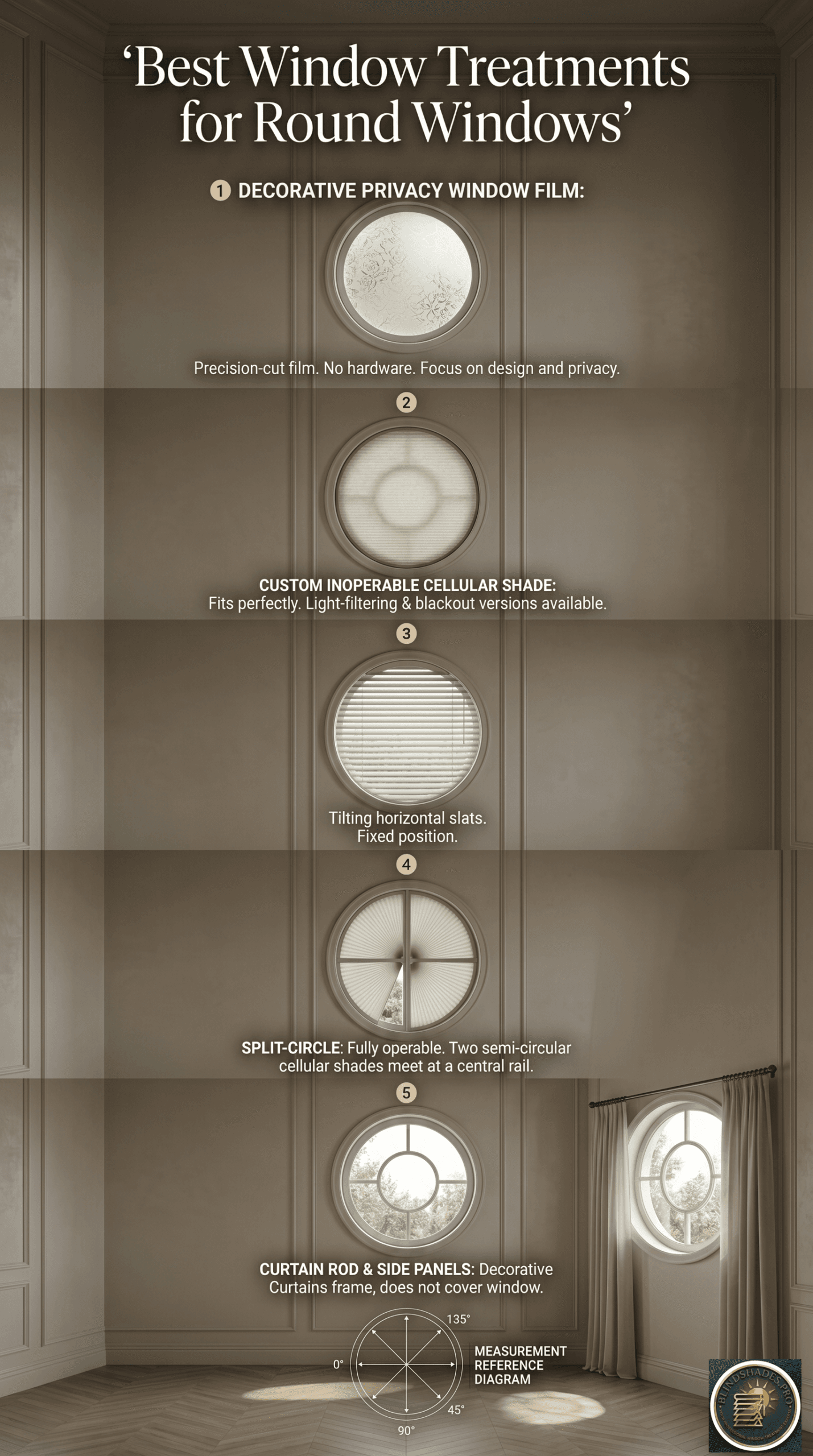
Key Takeaways:
- Circular venetian (slatted) blinds for round windows can TILT but cannot be RAISED beyond the halfway point; the circular geometry prevents the slats from stacking toward the center as they would in a rectangular blind; the only light control operation is tilting the slats open and closed; for anyone expecting to raise the blind fully like a rectangular venetian blind, this is a fundamental operational limitation
- The split-circle approach is the only way to achieve fully operable (raise and lower) coverage of a complete circular window: two matched semi-circular cellular shades are mounted on a central horizontal split rail at the window’s diameter; each half operates independently; both can be raised for a full view or lowered for full coverage
- Before ordering any treatment for a round window, confirm the window is truly circular by measuring the interior diameter at four angles (0, 45, 90, and 135 degrees); if any measurement differs from the others by more than 1/4 inch, the window is oval rather than perfectly circular and a template must be provided to the manufacturer
- A full circular cellular shade (for a complete circle window) is almost always inoperable and sits permanently in the frame as a static privacy treatment; this is different from a half-circle arch shade (for a half-round arched window) which CAN be raised and lowered on operable track systems from suppliers like Blind Corners and Curves
- For most residential circular windows at heights above 8 feet in bathrooms, stairwells, and attics: the correct answer is to leave the window uncovered; the window’s curved surface redirects sightlines at extreme angles from most observer positions, providing natural privacy; covering it reduces natural light with minimal functional benefit
⭐ Quick Answer — How Do You Cover a Round or Circular Window?
- The 5 Methods — From Simplest to Most Complex: To cover a round window, five methods work. (1) Window film ($20–$80): no hardware; cut to glass shape with a straightedge; best for small porthole windows under 24 inches. (2) Inoperable custom cellular shade ($120–$350): permanently seated in the frame; provides privacy and insulation; CANNOT be raised or lowered. (3) Circular venetian blind ($150–$400): slats tilt open and closed — but cannot be raised beyond the halfway point; the circular geometry prevents retraction. (4) Split-circle approach ($240–$700): two matched semi-circular cellular shades on a central split rail — the only method that gives fully operable coverage of a complete circular window. (5) Curtain rod above with flanking panels ($50–$200): decorative framing only; does not cover the glass; best combined with film for privacy
- The Circular Venetian Blind Cannot Be Raised — The Critical Limitation: Every guide lists circular venetian blinds as a round window treatment option, but none explain the fundamental operational constraint. A standard rectangular venetian blind raises by having the slats stack at the top. A circular venetian blind’s slats are curved to follow the circular frame; raising them would require the slats to stack at the center of the circle — which the circular geometry makes impossible. The only operation is tilting: slats rotate to open or closed positions to control light and privacy. The blind is always visible in the window in some form. For anyone who needs to fully clear the window for an open view: the split-circle approach using two semi-circular cellular shades is the only solution. Confirmed by L’Essenziale: “you won’t be able to pull the blinds up beyond the halfway point”
- Full Circular Cellular vs Half-Circle Arch Shade — Critical Distinction: When covering a round window, buyers often assume the custom cellular shade will operate like an arched window shade. It does not. A full circular cellular shade (for a complete circle window) is almost always inoperable and stationary — permanently seated in the circular frame as a fixed privacy and insulation treatment. Blinds.com confirms: “A cellular shade of this style will be inoperable.” A half-circle arch shade (for an arched window with a flat bottom edge) is a completely different product that CAN be raised and lowered on operable track systems. Blind Corners and Curves confirms their half-circle arch blinds “extend up from the bottom when in use and compress to the base when a wide-open view is desired.” If daily operability is required for a complete circular window: specify the split-circle approach, not a single full-circle cellular shade
- The Split-Circle Approach and the Aperture Panel Technique: The split-circle method for covering a round window mounts a central horizontal split rail at the window’s diameter (the line dividing the circle into upper and lower halves). A matched semi-circular cellular shade mounts above and below this rail; each half operates independently. When both are raised: split rail is visible at the diameter but the glass is fully exposed on both sides. When both are lowered: the two semi-circles together cover the full circular opening. And the aperture panel technique (the “aeroplane window” method confirmed by Grand Design Blinds): a standard rectangular blind is mounted behind a decorative panel with a circular opening cut to the window diameter. Only the circular portion shows from inside; the blind operates normally as a rectangle behind the panel. No custom circular fabrication needed
- Measure Diameter at 4 Angles and the “Leave Bare” Threshold: Before ordering any treatment to cover a round window, confirm the window is truly circular. Measure the interior diameter at four angles: horizontal (0 degrees), 45-degree diagonal, vertical (90 degrees), and 135-degree diagonal. If all four measurements are within 1/4 inch of each other: the window is circular — order with the diameter. If any measurement differs by more than 1/4 inch: the window is oval — a template is required. And the leave-bare threshold: for any circular window above 8 feet from the floor in a bathroom, stairwell, or attic: most homeowners correctly leave it uncovered. The circular window’s curved surface redirects exterior sightlines at steep angles; at 8+ feet elevation, interior visibility through the window from street level is minimal. Circular shutter motorization note: only possible if a vertical t-post runs down the center of the shutter panel — specify the t-post from the design stage; single-panel circular shutters without t-post cannot be motorized afterward
- Best Sources: Circular venetian blinds, shutters with t-post motorization, and bottom-rise variant → Avanti Shaped circular windows · Fully operable half-circle arch shades for split-circle approach → Blind Corners and Curves · Full circular window treatment comparison including aperture panel technique → Grand Design Blinds circular windows
⚠️ The Circular Window Size Guide and the Circular Venetian Bottom-Rise Variant: Choosing the right method to cover a round window depends heavily on the window diameter. Porthole and small circular (12 to 24 inches): window film or leave uncovered; no operational treatment needed; hardware cost and complexity exceeds the benefit for windows this small. Medium circular (24 to 36 inches): inoperable custom cellular shade (permanent privacy and insulation) or film; circular venetian blind viable if light adjustment is needed. Large circular (36 to 60 inches): split-circle approach for operability; tilt-only circular venetian blind if daily raise-lower is not required; curtain rod framing plus film if decorative treatment is preferred. Oversized circular (60+ inches): custom shutters with t-post (motorized); split-circle with two large semi-circular shades; or floor-length curtain framing for a decorative approach. The circular venetian bottom-rise variant: Avanti Shaped confirms porthole blinds can be made “so that the bottom section of slats rise up to the centre point” — this variant allows the lower half of the circular venetian to fold up to the midpoint of the window; useful for accessing a window handle or cleaning the glass without removing the entire blind. This is a half-raise capability limited to the bottom half only; the top half still cannot retract. For the measurement protocol including the 4-angle circularity check, the oval-window template protocol, and the non-perfect arch measurement comparison, see How Do You Measure Arched Windows for Blinds. See the full five-method guide below.
💡 The Privacy Geometry and the Circular Shutter T-Post Requirement: Most guides say “most homeowners leave circular windows bare” without explaining why this is often correct. The privacy geometry: a circular window’s curved glass surface does not provide a flat perpendicular face to the observer. A standing observer at street level looking at a circular window 10 feet from the floor views the glass at approximately 30 to 45 degrees below horizontal. At this angle, the curved glass reflects primarily sky and exterior surroundings rather than transmitting interior detail clearly. The effective interior visibility through a circular window from a typical exterior position is significantly lower than through a flat-glass window of the same size at the same height. This is why circular windows in bathrooms, stairwells, and attics (at elevation) are routinely left uncovered without creating privacy concerns. The t-post motorization constraint for circular shutters: Avanti Shaped confirms circular shutter panels can be motorized “only if there is a vertical t-post down the center of the panel.” The t-post is a structural vertical post dividing the circular shutter into two half-circle sections; the motor mechanism requires this post for attachment. Specifying a single-panel circular shutter without a t-post and then requesting motorization after fabrication is not possible. For any installation where circular shutter motorization is desired: confirm and specify the t-post configuration before the shutter is built. For the related half-round window covering options including the Redi Shade one-time adhesive protocol, radius vs diameter measurement, and the three position types, see How Do You Cover a Half-Round Window. See the full leave-bare analysis below.
📖 Read the complete guide below for: the five-method comparison with costs (film $20-$80 / inoperable cellular $120-$350 / circular venetian tilt-only $150-$400 / split-circle operable $240-$700 / curtain rod framing $50-$200), the circular venetian blind cannot-be-raised explanation (slats cannot stack toward center; circular geometry prevents retraction), the full circular cellular ALWAYS inoperable vs half-circle arch shade CAN be operable distinction, the split-circle approach with central split rail details, the aperture panel (aeroplane window) technique, the four-angle diameter measurement protocol (0, 45, 90, 135 degrees; if any differs by more than 1/4 inch = oval = template), the circular size categories (porthole 12-24″ / medium 24-36″ / large 36-60″ / oversized 60+”) with correct treatment by size, the circular shutter t-post motorization requirement, and the privacy geometry argument for leaving circular windows uncovered at elevation.
How to Cover a Round Window – The Five Methods
Definition: A round or circular window is a full-circle window opening with no flat edges. Also called a porthole window, bullseye window, or oculus. Found in bathrooms, stairwells, attics, and as architectural accent features in both traditional and contemporary homes.
Method 1 — Window Film (Simplest; No Hardware)
Film is the most practical treatment for most residential circular windows — particularly small porthole windows under 24 inches in diameter.
Why film works for circular windows: Film applied to circular glass does not require any mounting hardware, headrail, frame bracket, or custom diameter measurement beyond the glass itself. Film is cut to the glass shape with a straightedge or compass and applied directly to the surface.
The cutting process:
- Measure the glass diameter
- Cut a film sheet to a square slightly larger than the diameter
- Apply the film to the glass
- Trim flush to the glass edge using a straightedge and utility knife along the circular frame edge
Cost: $20–$80 per window Best for: Porthole (12–24 inch) windows; bathrooms; windows where permanent privacy is needed without hardware; rental properties
Method 2 — Inoperable Custom Cellular Shade
A circular cellular shade is custom-fabricated to the exact interior diameter of the window opening. The pleated fabric fills the circle and mounts inside the frame in a fixed position.
The critical distinction — circular cellular vs half-circle arch shade:
This point is absent from all competitor guides but is the most important specification clarification for round window buyers:
A full circular cellular shade is almost always INOPERABLE — it sits permanently in the frame and cannot be raised or lowered. Blinds.com confirms: “A cellular shade of this style will be inoperable but can be made with fabrics to match other shades in your home.”
A half-circle arch shade (for an arched window with a flat bottom edge) CAN be operable — it raises and lowers on a track system. Blind Corners and Curves confirms half-circle arch blinds “extend up from the bottom of the Half Circle Arch window when in use, and compress to the base of the Half Circle Arch when a wide-open view is desired.”
The implication: If daily operability is needed for a complete circular window: a single full-circle cellular shade does NOT provide it. Choose the split-circle approach (Method 4) or the circular venetian blind (Method 3) instead.
Cost: $120–$350 per window Best for: Medium (24–36 inch) and large (36–60 inch) circular windows where permanent privacy and insulation are needed without daily operation
Method 3 — Circular Venetian Blind (Tilt Only — Cannot Be Raised)
The operational limitation that all competitor guides miss.
A circular venetian blind is a custom-fabricated venetian blind where the slats are cut in arcs following the circular frame. The slats tilt open and closed to control light angle and privacy — the same as a standard venetian blind.
The fundamental limitation: L’Essenziale confirms: “Because of the round shape you won’t be able to pull the blinds up beyond the halfway point.” Avanti Shaped confirms: “the slats will tilt from the open position to, either backwards away from the room, or forwards into the room.” Grand Design confirms: “although they will not retract, the vanes will tilt fully.”
Why the blind cannot be raised: In a standard rectangular venetian blind, raising causes the slats to stack at the top — they fold over each other vertically. In a circular venetian blind, raising the slats would require them to stack at the center of the circle — which is geometrically impossible; the circular slats converge at the center and cannot stack there.
What this means in practice:
- The circular venetian blind is always visible in the window
- Light control is by tilting: tilt-open allows angled light through; tilt-closed provides full opacity
- At nighttime with interior lighting: tilt-open slats allow some light leakage through the slat angles
- For full blackout with no light leakage: slats must be fully tilted to the closed position
One useful variant: Avanti Shaped confirms: “Porthole blinds can be made so that the bottom section of slats rise up to the centre point (ideal if there’s a window handle to access or for cleaning the window).” This variant allows the lower half-circle of slats to fold up to the midpoint — useful for accessing a window handle or cleaning the glass.
Cost: $150–$400 per window (custom fabrication required) Best for: Large (36–60 inch) and oversized (60+ inch) circular windows where permanent adjustable light control is needed without full coverage removal
Method 4 — Split-Circle Approach (Only Fully Operable Solution)
The one approach that gives a circular window fully operable coverage — absent from all buying guides.
Grand Design Blinds describes the concept: “another solution is to split the window in half, with two semi-circular Duette blinds mounted across.”
How it works: A central horizontal split rail is mounted at the diameter of the circular frame — the line that divides the circle into upper and lower halves. Two matched semi-circular cellular shades are mounted:
- The upper shade: a half-circle arch shade mounted above the split rail, extending upward into the upper half of the circle
- The lower shade: a second half-circle arch shade mounted below the split rail, extending downward into the lower half
Each shade operates independently. Both can be raised to their respective mounting points for a completely open view. Both can be lowered for full circular coverage.
The visual result: When both shades are in the raised/open position: the split rail runs horizontally across the center of the window (the diameter line), visible but minimal. The window glass is fully exposed on both sides of the rail.
When both shades are lowered/closed: the two matched semi-circles together cover the full circular opening.
The supplier: Blind Corners and Curves offers fully operable half-circle arch shades that form the basis for this split-circle system. Their shades “extend up from the bottom of the Half Circle Arch window when in use, and compress to the base of the Half Circle Arch when a wide-open view through the window is desired.”
Cost: $240–$700 per window (two semi-circular shades plus central split rail hardware) Best for: Large (36–60 inch) and oversized circular windows where daily operability is required
Method 5 — Rectangular Blind Behind Circular Aperture Panel
The “aeroplane window” technique — absent from all buying guides.
Grand Design Blinds describes it: “although a roller blind cannot be circular, a solution would be to fit a rectangular blind behind a panel with a round aperture to the size of the window. This would give the impression of a round blind whilst also hiding the workings of the blind, similar to on an aeroplane window.”
How it works: A standard rectangular blind (roller shade, cellular shade) is mounted BEHIND a decorative panel that has a circular opening cut to the window’s diameter. From the room side, only the circular portion of the blind is visible through the aperture. The blind operates normally — raising and lowering as usual — with only the circular section exposed.
The advantage: No custom circular fabrication is needed. Any standard rectangular blind can be used. The circular aperture panel handles the visual shaping.
The limitation: The aperture panel adds depth to the window reveal. This works well for windows set into deep reveals (wall thickness 4+ inches); less well for windows flush with a thin wall.
Cost: $100–$250 (standard rectangular blind + custom aperture panel)
Method 6 — Curtain Rod Above With Flanking Panels (Decorative Only)
A straight curtain rod mounted above the circular window with fabric panels on each side frames the window without covering it. This is the standard approach for large circular feature windows where the architectural element is preserved and light control is not the priority.
For privacy in this method: combine with window film on the glass.
Cost: $50–$200
Before You Order — Confirm the Window Is Truly Circular
The multi-point diameter measurement protocol absent from all guides.
Most “round” windows in residential architecture are close to circular but not perfectly circular. Settlement, thermal cycling, and framing irregularities can cause a nominally circular window to be slightly oval.
The four-point measurement protocol: Measure the interior diameter at four angles:
- Horizontal diameter (0 degrees): left edge to right edge at the center height
- 45-degree diagonal: upper-left to lower-right
- Vertical diameter (90 degrees): top edge to bottom edge at the center width
- 135-degree diagonal: upper-right to lower-left
The result: If all four measurements are within 1/4 inch of each other: the window is truly circular. Order online with the diameter.
If any measurement differs from the others by more than 1/4 inch: the window is oval. A template must be made and submitted to the manufacturer — the same cardboard tracing protocol as for non-perfect arched windows (see What Are the Best Blinds for Arched Windows).
The “Leave It Uncovered” Argument for Circular Windows
Why most residential circular windows do not need treatment — absent from all competitor guides.
Homedit confirms: “most homeowners choose to leave them bare; these circular windows are often high-up, allowing for privacy even with no window covering.”
The privacy geometry: A circular window’s curved glass surface reflects and redirects light at different angles than flat glass. More importantly, a circular window viewed from an exterior angle (not perpendicular to the glass) presents a highly distorted, difficult-to-see-through surface due to the curved geometry. At street level looking up at a circular window 8+ feet from the floor:
- The viewing angle is steep (approximately 20–40 degrees below horizontal for a standing observer)
- The circular glass at this steep angle shows mostly reflected sky, not interior content
- Interior visibility through a circular window at angle is minimal compared to a flat window at the same position
When leaving uncovered is correct:
- Circular window at 8+ feet elevation in any room
- Bathroom circular window at high position (above eye level when standing)
- Stairwell circular window facing a private or unobservable direction
- Attic or loft circular window at gable position
When treatment is needed:
- Circular window at seated or standing eye level in a street-facing position
- Circular window in a bedroom where nighttime privacy from exterior lighting is needed
- Circular window with a southern orientation where solar glare or heat gain is significant
The Circular Window Size Guide
Treatment approach by window diameter — absent from all competitor guides.
| Size Category | Diameter | Typical Location | Best Treatment |
|---|---|---|---|
| Porthole / small | 12 to 24 inches | Bathroom, stairwell, coastal accent | Window film; leave uncovered if elevated |
| Medium | 24 to 36 inches | Living area accent, hallway | Inoperable cellular shade or film |
| Large | 36 to 60 inches | Staircase landing, gable feature | Split-circle approach; or tilt-only circular venetian; curtain rod framing |
| Oversized | 60+ inches | Living room centerpiece, entry hall | Custom shutters with t-post; split-circle; or decorative curtain framing |
The Circular Shutter Motorization — T-Post Requirement
The specification constraint absent from all guides.
Avanti Shaped confirms: “Larger circular shutter panels can be motorised (only if there is a vertical t-post down the center of the panel).”
The t-post is a vertical structural post running down the center of the circular shutter panel. It divides the shutter into two half-circle sections. The motor mechanism requires this central post for attachment and operation.
The implication: For any circular window treatment project where motorization of the shutter is desired: specify the t-post configuration from the design stage. A single-panel circular shutter without a t-post cannot be motorized after fabrication — the motor attachment point does not exist.
For circular shutters under approximately 24 inches in diameter: motorization is typically not practical (the window is accessible by hand); t-post is not needed. For circular shutters over approximately 36 inches at accessible height: motorization is a useful upgrade; confirm t-post specification with the supplier before ordering.
Where to Order
For circular venetian blinds (tilt only) and circular shutters with optional t-post: Avanti Shaped at avantishaped.com/circular-windows — specialist for circular and porthole windows; circular venetian blinds; circular shutters in hardwood (54 colours) and ABS waterproof (12 colours); motorized with t-post; bottom-rise variant for window handle access.
For split-circle operable approach using two semi-circular shades: Blind Corners and Curves at blindcornersandcurves.com — fully operable half-circle arch blinds that form the basis of the split-circle system; motorized and manual options; cellular honeycomb from translucent to blackout.
For comprehensive overview of all circular window treatment approaches: Grand Design Blinds at granddesignblinds.com/circular-window-blinds — the most detailed circular window treatment comparison available; covers all five methods including the aperture panel technique.
Frequently Asked Questions
How do you cover a round window? To cover a round window, choose from five methods: window film (no hardware, cut directly to the glass circle, $20 to $80), inoperable custom cellular shade (permanently seated in the frame, $120 to $350), circular venetian blind (slats tilt but cannot be raised, $150 to $400), split-circle approach using two matched semi-circular cellular shades on a central split rail (the only fully operable solution, $240 to $700), or a straight curtain rod above with flanking panels (decorative framing only). Before ordering any treatment, confirm the window is truly circular by measuring the diameter at four angles and using the narrowest measurement.
Can you raise a circular window blind like a regular venetian blind? No – a circular venetian blind cannot be raised the way a rectangular venetian blind can be raised. In a rectangular blind, slats stack at the top when raised. In a circular blind, the slats are curved to follow the circular frame and cannot stack toward the center; the geometry prevents retraction. The only operation a circular venetian blind offers is tilting the slats open and closed to control light and privacy. If fully operable coverage of a circular window is needed, the split-circle approach using two matched semi-circular cellular shades is the solution.
What is the split-circle approach for covering a round window? The split-circle approach mounts a central horizontal split rail at the diameter of the circular frame, then mounts two matched semi-circular cellular shades – one above and one below the rail. Each shade operates independently and can be raised to its mounting point for a fully open view or lowered for coverage. Together, both shades cover the complete circular opening. This is the only method that gives a full circular window fully operable coverage. The central split rail is visible when both shades are open but is minimal in appearance. It is more expensive than a single inoperable circular cellular shade at approximately 240 to 700 dollars for both shades.
How do you measure a round window for treatment? To measure a round window for treatment, measure the interior diameter at four angles: horizontally (left to right at the center), diagonally at 45 degrees (upper-left to lower-right), vertically (top to bottom at the center), and diagonally at 135 degrees (upper-right to lower-left). If all four measurements are within 1/4 inch of each other, the window is truly circular and can be ordered with the diameter. If any measurement differs from the others by more than 1/4 inch, the window is slightly oval and a cardboard template must be submitted to the manufacturer before ordering.
When should you leave a circular window uncovered? Leave a circular window uncovered when it is positioned above 8 feet from the floor, faces a non-street direction, or is located in a bathroom, stairwell, or attic where exterior visibility is limited. The curved glass surface of a circular window redirects sightlines at steep angles, making interior visibility through the window from street level or most exterior positions minimal. Most homeowners leave residential circular windows bare because privacy is naturally provided by the elevation and geometry of the window.
Related Guides on BlindShades.pro
- The Best Arched & Specialty Windows Buying Guide
- What Are the Best Blinds for Arched Windows
- How Do You Cover a Half-Round Window
- What Window Treatment Options Work on Triangular Windows
- Is a Custom Arch Shade Worth the Cost
By Michael Turner | 30 Years Home Improvement Expertise | Updated 2026 | BlindShades.pro
