What Window Treatment Options Work on Triangular Windows?

Authored By Michael Turner -30 Years Home Improvement Expertise | Updated 2026 | BlindShades.pro
Updated on June 1, 2026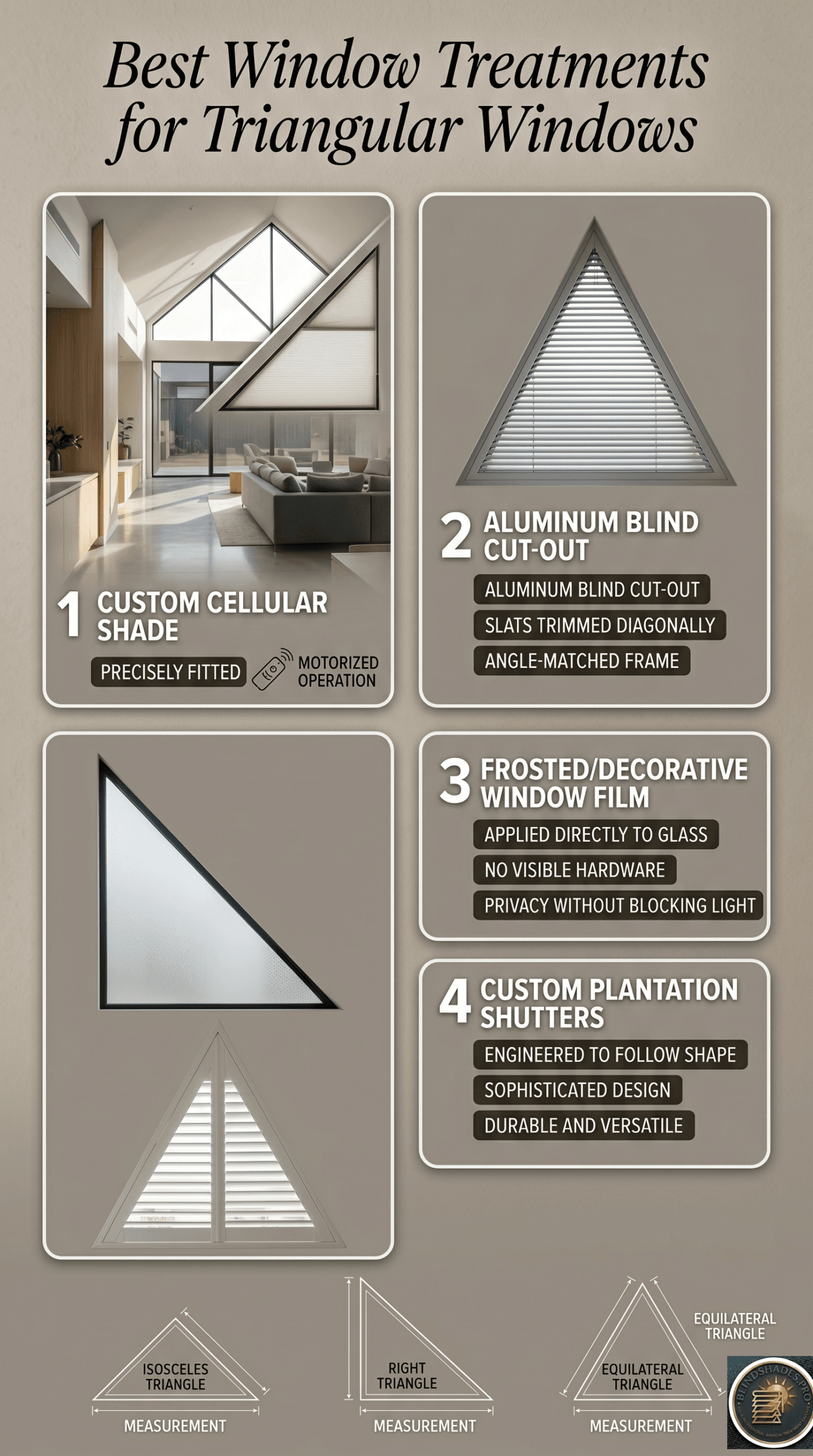
Key Takeaways:
- There are three distinct triangle types in residential windows and each requires a different measurement protocol: an isosceles triangle (peak at top center; both rakes equal) requires base width plus center height; a right triangle (peak at one corner; one vertical side and one diagonal side) requires base width, vertical height, and the rake (diagonal side) length; ordering an isosceles-shaped product for a right triangle window places the peak off-center and creates a visible mismatch
- The most common location for triangular windows in American homes is the gable end wall at the peak of the roofline; south-facing and west-facing gable windows are often the most intense heat gain position in the house because they face maximum solar exposure AND hot air accumulates at the ceiling peak; a 24 square foot south-facing gable window (8 feet wide by 6 feet tall) can add 10,000 to 15,000 BTU per hour of solar heat gain in summer
- Motorization is essentially mandatory for triangular gable windows positioned above 12 feet from the floor; manual cord or rod operation at gable height requires a ladder for every adjustment; battery-powered motorized cellular shades eliminate the accessibility problem entirely and are available for triangular shapes from Arched and Angled Blinds and Graywind
- Window film cut to the triangle shape with a straightedge and utility knife is the only triangular window treatment that requires no custom frame measurement, no mounting hardware, and no bracket installation; film is the practical choice for high-elevation gable windows where interior blind installation would require scaffolding, and for very small triangular windows below the 12 to 18 inch minimum base width for custom cellular shade production
- A standard aluminum mini blind can be fitted to a triangular opening using the cut-out technique: order a rectangular blind at the base width of the triangle, then cut the slats diagonally from the tallest corner down to the shortest corner following the angle of the triangle’s side; the control cords must not be cut; this approach costs $30 to $80 vs $100 or more for a custom cellular shade
⭐ Quick Answer — What Window Treatment Options Work on Triangular Windows?
- Identify the Triangle Type First — It Determines the Measurement Protocol: Before selecting any triangular window treatment option, identify which of the three triangle types the window is. Isosceles triangle (peak at top center; both angled sides equal): 2 measurements — base width and center height; both rakes are equal and the manufacturer calculates them. Right triangle (one 90-degree corner; peak at one upper corner): 3 measurements — base width, vertical height (the straight side), and rake length (the diagonal side). Equilateral triangle (all sides equal; all angles 60 degrees; rare in residential): 1 measurement — any one side. The most common ordering mistake: treating a right triangle window as an isosceles and ordering a centered-peak product — the installed treatment has the peak off-center with a visible gap along one side and an overlap on the other
- The 4 Treatment Options Ranked by Cost and Complexity: Four triangular window treatment options work. (1) Custom cellular shade ($100–$300): most popular; mounts at the PEAK of the triangle and extends downward; isosceles descent is symmetric; right triangle descent is asymmetric (one side clears vertical frame, the other clears the diagonal hypotenuse); available motorized — essential for gable windows above 12 feet. (2) Aluminum blind cut-out ($30–$80): standard rectangular blind with slats cut diagonally to fit the triangular opening; cheapest approach; control cords must not be cut; works best for right triangles where only one diagonal cut is needed. (3) Window film ($20–$80): no mounting hardware; cut to glass shape with a straightedge; only viable option for very high-elevation gable windows and windows below the 12 to 18 inch minimum base width for custom shade production. (4) Custom shutters ($400–$900 plus installation): premium; best for accessible windows under 10 feet; impractical at gable height
- The Gable Window — Motorize Above 12 Feet, Treat South/West for Heat: The most common residential triangular window location is the gable end wall at the peak of the roofline — typically 14 to 18 feet from the floor. For gable windows above approximately 12 feet: motorized treatment is essentially mandatory; manual cord operation at gable height requires a ladder for every adjustment. Battery-powered motorized cellular shades for triangular windows are available from Arched and Angled Blinds. And the heat gain case: south-facing and west-facing gable windows are often the most intense heat gain position in the home — they face maximum solar radiation AND hot air from the entire floor rises to accumulate at the ceiling peak. A typical south-facing gable window 8 feet wide by 6 feet tall (24 sq ft) can add approximately 10,000 to 15,000 BTU per hour of solar heat gain in summer; a cellular shade reduces this by 55 to 75 percent
- Window Film — The No-Hardware Option for High-Elevation and Sub-Minimum Windows: Window film is the only triangular window treatment option that requires no frame measurements, no mounting hardware, and no bracket installation. Film is cut to the glass dimensions and applied directly to the glass surface using a straightedge. Two specific situations where film is the correct primary choice: (1) High-elevation gable windows above 12 to 14 feet where interior blind installation would require scaffolding — applying film from a ladder is significantly simpler than installing interior hardware at that height; (2) Very small triangular windows with a base width under 12 to 18 inches — most custom cellular shade manufacturers require a minimum base width in this range for triangular shape production; below the minimum, film is the only viable treatment. Film cost: $20 to $80 per window
- The Aluminum Cut-Out Technique and the “Leave Uncovered” Threshold: The aluminum blind cut-out for triangular windows: order a rectangular aluminum mini blind at the base width of the triangle; install the headrail at the peak or top corner; lower the blind fully; mark the diagonal cut line along the slats following the angle of the triangle’s angled side; cut each slat with tin snips from bottom to top; control cords must not be cut. Cost: $30 to $80 vs $100+ for custom cellular. Best for right triangles (one diagonal cut); isosceles triangles require cuts on both sides and the shortest center slats may not hold shape well. And the leave-uncovered threshold: for a north-facing triangular gable window above 8 feet with glass area under 6 square feet — leave uncovered. North-facing gables receive minimal direct solar radiation; the cool northern daylight they admit is high-quality ambient interior light; the thermal benefit of covering a small north-facing gable is minimal
- Best Sources: Motorized and manual custom cellular shades for all triangle types → Arched and Angled Blinds angled shades · Cellular shades, pleated shades, and aluminum blind cut-out guide for angled windows → Graber Blinds angled window guide · Equilateral triangle window blinds specifically → Blind Corners and Curves
⚠️ Right Triangle Measurement Protocol and the Asymmetric Descent Problem: When measuring a right triangle window for a triangular window treatment, three independent measurements are required: (1) Base width — full horizontal width from the 90-degree corner to the far corner. (2) Vertical height — the straight vertical side from the 90-degree base corner straight up to the peak; verify this side is truly vertical with a level. (3) Rake length — the diagonal hypotenuse from the far base corner up to the peak. Record all three separately. Do not attempt to calculate the rake from the base and height alone unless you have confirmed the right angle is exactly 90 degrees with a level; even a small deviation from 90 degrees will make the calculated rake inaccurate by a measurable amount. And the asymmetric descent issue for right-triangle cellular shades: when the shade extends downward from the upper corner peak, one side clears the vertical frame (straight clearance) while the other side clears the diagonal hypotenuse frame (angled clearance). This asymmetric movement means right-triangle shades travel down-and-sideways as they lower, rather than purely downward. Confirm with the specific supplier that the right-triangle shade design is engineered for this asymmetric movement and that the frame clearance on the diagonal side is confirmed for the submitted rake measurement. For the full 6-measurement protocol for all arched and specialty window types including three-point base width, symmetry check, spring line measurement, and the extend-for-valance technique, see How Do You Measure Arched Windows for Blinds. See the full triangle type identification guide below.
💡 The South-Facing Gable Heat Gain Calculation and the Worth-It Assessment: The case for treating south-facing and west-facing gable triangular windows with cellular shades rests on two compounding factors not present at any other window position. First, the window faces south or west — maximum annual solar exposure. Second, hot air from the entire floor below rises by convection to accumulate at the ceiling peak where the window is positioned — intensifying the heat concentration beyond what solar gain alone would create. For a south-facing isosceles gable window 8 feet wide by 6 feet tall: glass area = (8 x 6) divided by 2 = 24 square feet. At peak summer solar radiation of approximately 400 to 600 BTU per hour per square foot and single-pane SHGC of 0.86: solar heat gain = approximately 10,000 to 15,000 BTU per hour. A custom cellular shade with SHGC reduced to 0.20 to 0.40 cuts this contribution to 4,000 to 6,000 BTU per hour maximum — reducing the gable’s heat load contribution by 55 to 75 percent. At an annual cooling cost of $0.12 per kWh, this heat reduction can save $100 to $300 per cooling season in a home where the upper floor air conditioning must overcome this solar load. The $100 to $300 custom cellular shade amortizes its cost in one to three cooling seasons. For the broader arched and specialty window energy efficiency comparison including R-values, SHGC data, and per-year costs for cellular shades vs shutters vs film, see What Are the Best Blinds for Arched Windows. See the full gable window heat gain analysis below.
📖 Read the complete guide below for: the three triangle type identification protocol (isosceles 2 measurements / right triangle 3 measurements / equilateral 1 measurement; peak off-center error for wrong type), the four treatment options with cost ranges (cellular $100-$300 / aluminum cut-out $30-$80 / film $20-$80 / shutters $400-$900+), the aluminum blind cut-out technique (diagonal slat cut; control cord constraint; best for right triangles), the gable window position analysis (14-18 feet typical; motorize above 12 feet; south/west gable = most severe heat gain position; 24 sq ft x 10,000-15,000 BTU/hr calculation), the right-triangle asymmetric descent mechanics (vertical vs diagonal clearance), the window film no-hardware protocol (glass measurements only; cut with straightedge; exterior application viable), the leave-uncovered threshold (north-facing + above 8 ft + under 6 sq ft = leave uncovered), and the minimum size threshold (12-18 inch base width minimum; film only below threshold).
Triangular Window Treatment Options – The Four Approaches
Definition: A triangular window is any window with three straight sides meeting at angled corners. Unlike arched windows (which have one curved side), triangular windows have only straight sides and pointed corners. The most common residential triangular window is the gable-end window at the peak of a roof.
The Three Triangle Types — Identify Before Ordering
The most important step before selecting any triangular window treatment — the measurement protocol depends on the triangle type.
Type 1 — Isosceles Triangle (Most Common Decorative Triangular Window)
Shape: Two equal sides rising from the base corners to meet at a peak directly above the center of the base. Both angled sides (rakes) are the same length and angle.
Where found: Contemporary homes, A-frame structures, decorative gable accents, modern vaulted ceiling windows.
Measurement protocol:
- Base width: measure the full width of the window at the base
- Center height: measure from the center of the base to the peak
- Note: both rakes are equal; the manufacturer calculates the rakes from base width and center height
Online ordering: If the manufacturer can confirm isosceles geometry from base + height, the window may be orderable online. Verify by measuring each rake side independently — if left rake equals right rake within 1/4 inch, the window is a true isosceles.
Type 2 — Right Triangle (Most Common Residential Gable Window)
Shape: One angle is exactly 90 degrees — the vertical side and the base form a right angle at one bottom corner. The angled side (hypotenuse) rises diagonally from the opposite corner to the peak.
Where found: Gable walls adjacent to a vertical wall; windows at the junction of a roof slope and an interior wall; staircase landing windows following the stair slope.
Measurement protocol (three measurements required):
- Base width: measure the full horizontal base
- Vertical height: measure the straight vertical side (the 90-degree corner side)
- Rake length: measure the diagonal angled side (the hypotenuse)
The critical ordering error: Ordering an isosceles-shaped product for a right triangle produces a shade where the peak is centered over the base — not at the corner where the right angle meets the diagonal. The installed shade will sit off-center, with a visible gap along one side and an overlap on the other. A right triangle window requires a right-triangle-shaped shade with the peak at one corner, not the center.
Type 3 — Equilateral Triangle (Contemporary/Architectural Accent)
Shape: All three sides equal length; all three angles equal 60 degrees. A perfect equilateral triangle is relatively rare in residential architecture but appears in contemporary loft designs, A-frame cabin gables, and modern architectural accent windows.
Measurement protocol:
- Measure any one side — all three sides will be equal
- Confirm equilateral: all three sides within 1/4 inch of each other
Product note: Blind Corners and Curves offers equilateral triangle blinds specifically; the shade mounts at the top point and extends downward, compressing back to the top when open. Available in honeycomb/cellular materials in translucent, semi-opaque, and blackout options.
The Four Treatment Options
Option 1 — Custom Cellular Arch Shade (Most Popular; Best Insulation)
How it works for triangular windows: Unlike arched windows where the shade fans outward from the base, triangular window cellular shades are typically designed to mount at the PEAK of the triangle and extend downward. The shade hangs from the peak and the base bar rests against the base frame when fully extended.
Operation:
- Isosceles triangle: shade descends symmetrically from the peak; both sides clear their respective rake frames evenly
- Right triangle: shade descends asymmetrically; one side clears the vertical frame and the other clears the diagonal hypotenuse frame; the descent motion requires different clearances on each side
- This operational asymmetry means right triangle cellular shades are more complex to specify and operate than isosceles designs; confirm with the supplier that the right-triangle descent is confirmed functional for the specific window dimensions
The gable window insulation benefit: As detailed below, cellular shades at gable window positions are disproportionately valuable for energy efficiency because hot air accumulates at the ceiling peak and solar radiation on south-facing and west-facing gables is maximum intensity.
Cost: $100-$300 per window depending on size and complexity Available motorized: YES — essential for gable windows above 12 feet
Option 2 — Aluminum Blind Cut-Out (Cheapest Option)
The DIY technique absent from all competitor guides.
A standard rectangular aluminum mini blind can be fitted to a triangular window opening using a diagonal cut. This is the cheapest approach for triangular windows and does not require a custom order.
The technique:
- Order a rectangular aluminum mini blind at the base width of the triangular window and at a height matching or slightly exceeding the peak height
- Install the headrail at the top of the triangular opening (at the peak for an isosceles; at the top corner for a right triangle)
- Lower the blind fully
- Mark the diagonal line along the slats that follows the angle of the triangle’s angled side
- Cut each slat along this marked diagonal line using tin snips or aviation snips — working from the bottom up
- The result: a rectangular blind with a diagonal cut-out on one or both sides that fits inside the triangular opening
The control cord constraint: The control cords must not be cut. Plan the diagonal cut line to stay clear of the cord positions. If the cord runs through the zone that needs to be cut, either relocate the cord (some blinds allow this) or use a blind with side-mounted cords.
Cost: $30-$80 for an aluminum mini blind vs $100+ for custom cellular shade
The limitation: The cut-out approach works best for right triangles where only one diagonal cut is needed. For isosceles triangles, both sides need diagonal cuts, and the center slats at the peak are very short — they may not hold their shape. Custom cellular is more reliable for isosceles and equilateral shapes.
Option 3 — Window Film (No Mounting Hardware Required)
The only triangular window treatment that requires no custom frame measurement — absent from all competitor guides as a primary option.
Window film — frosted, solar control, or reflective — can be applied to triangular glass without any mounting hardware, headrails, brackets, or custom dimensions. Film is cut to the glass dimensions and applied directly to the glass surface.
Why film is the correct choice in two specific situations:
Situation 1 — High-elevation gable windows above 12-14 feet: A triangular gable window at 14 feet from the floor requires either scaffolding for interior blind installation or an exterior ladder approach for film application. Applying film from the exterior using an extension ladder is significantly simpler than installing interior blind hardware at that height. Frosted or solar control film applied to the exterior (or interior with an interior ladder) requires only a clean glass surface and a straightedge cut.
Situation 2 — Very small triangular windows below minimum shade dimensions: Most custom cellular shade manufacturers require a minimum base width of approximately 12 to 18 inches for triangular shape production. Small decorative triangular accent windows with a base width under 12 inches typically fall below this minimum. Film applied to the glass is the only viable treatment for these sub-minimum windows.
The film cutting process for triangular windows:
- Measure the glass dimensions: base width, center height (for isosceles), or base + vertical height (for right triangle)
- Cut a piece of film to a rectangle that encompasses the entire triangle
- Apply the film sheet to the glass surface
- Using a straightedge held against the angled edge of the glass frame, score and trim the film flush with the frame edge
- The film follows the exact glass edge with no frame measurement required
Cost: $20-$80 per window (film material; no installation cost)
Option 4 — Custom Shutters
Custom plantation-style shutters can be fabricated for triangular window openings. The shutter panels follow the angled sides of the triangle, creating a fixed-louver treatment that provides light control and insulation.
Best for:
- Large triangular windows at accessible heights (under 10 feet)
- Traditional, craftsman, and contemporary homes where shutters are used on other windows
- Windows where the triangular shape is a prominent architectural feature that deserves a premium treatment
The limitation for gable windows: For triangular gable windows positioned at the peak of a two-story roof (12+ feet), shutter installation requires scaffolding and professional installation. The cost of custom triangular shutters ($400-$900) plus professional installation at gable height ($300-$500) makes this the most expensive approach.
The Gable Window — Special Considerations
The most common and most heat-critical triangular window position — absent from all competitor guides.
Position and access: A gable window sits in the triangular end wall at the peak of a roofline. In a typical two-story home, the gable peak is 14 to 18 feet above the floor. This height makes any form of manual window treatment operation impractical — a ladder is required every time the treatment is adjusted.
The motorization threshold: For triangular gable windows above approximately 12 feet from the floor: motorized treatment is essentially mandatory for practical daily use. Battery-powered motorized cellular shades eliminate all manual access requirements. Arched and Angled Blinds and Graywind both offer motorized triangular cellular shades. The motor mounts at the peak with the shade; the battery pack recharges via USB at the base of the shade when the shade is extended.
The heat gain problem: South-facing and west-facing gable windows receive the most intense solar radiation of any window position in the house for two reasons:
- They face the sun directly — same as any south/west-facing window
- Hot air from the entire floor rises to the ceiling peak — the gable window position is where the hottest room air accumulates
For a typical south-facing isosceles gable window 8 feet wide and 6 feet tall: glass area = (base × height) ÷ 2 = (8 × 6) ÷ 2 = 24 sq ft. Uncovered single-pane glass SHGC approximately 0.86 in peak summer sun (400-600 BTU/hr/sq ft): potential solar heat gain = 24 × 500 × 0.86 = approximately 10,000-15,000 BTU/hr.
Adding a cellular shade reduces SHGC to approximately 0.20-0.40, cutting the heat gain contribution by 55-75%.
The “leave uncovered” threshold for gable windows: For north-facing gable windows at high elevation (above 8 feet) with a glass area under 6 sq ft: leaving uncovered is the correct specification. North-facing gables receive minimal direct solar radiation; the daylight they admit is cool northern light that improves interior quality; the thermal benefit of covering a small north-facing gable is minimal.
For north-facing gable windows over 6 sq ft in cold climates: winter heat loss becomes significant; a cellular shade is appropriate for insulation even though solar gain is not a concern.
How to Measure a Triangular Window
The measurement by type:
Isosceles triangle:
- Base width: full width at the bottom
- Center height: from the center of the base to the peak
- Verify isosceles: measure left rake (left corner to peak) and right rake (right corner to peak) — must be within 1/4 inch of each other
Right triangle:
- Base width: full horizontal width
- Vertical height: straight vertical side from the base-right-angle corner straight up to the peak
- Rake length: the diagonal hypotenuse from the far base corner to the peak
- Confirm right angle: the vertical side and base should form exactly 90 degrees — check with a level
For all triangle types: Submit measurements in the format specified by the supplier. Most suppliers want base width × height for isosceles; base width × vertical height × rake for right triangles. Always use a steel tape measure, not fabric tape.
Where to Order
For fully operable motorized triangular cellular shades (isosceles, right triangle, equilateral): Arched and Angled Blinds at archedandangledblinds.com/angled-blinds — specialist for all triangle types; motorized and manual options; cellular honeycomb materials; the most comprehensive triangular window shade supplier in the US.
For DIY aluminum blind cut-out and standard shade options: Graber Blinds angled window guide at graberblinds.com/inspiration/window-treatments-101/blinds-for-angled-windows — cellular shades, pleated shades, and aluminum blinds for angled windows; Graber’s aluminum blinds are the primary source for the cut-out technique.
For equilateral triangle window blinds specifically: Blind Corners and Curves at blindcornersandcurves.com — the only specialist supplier specifically listing equilateral triangle window blinds; cellular honeycomb in translucent to blackout; motorized available.
Frequently Asked Questions
What window treatment options work on triangular windows? Four triangular window treatment options work: custom cellular shades (the most popular; mounts at the peak and extends downward; available motorized for hard-to-reach gable windows; R-3 to R-4 insulation); aluminum blind cut-out (rectangular blind with slats cut diagonally to fit the triangle shape; $30 to $80; best for right triangles); window film (no mounting hardware; cut directly to glass shape; best for very high elevation windows or windows below the 12 to 18 inch minimum for custom shade production); and custom shutters (fixed louver panels built to the triangle shape; most expensive; best for accessible windows under 10 feet). Before ordering any treatment, identify the triangle type: isosceles, right triangle, or equilateral.
What is the difference between a right triangle and an isosceles triangle window? An isosceles triangle window has two equal sides meeting at a peak directly above the center of the base; the window is symmetric with both angled sides at the same angle. A right triangle window has one angle of exactly 90 degrees where the vertical side meets the base; the peak is at one upper corner rather than centered, and the diagonal side (hypotenuse) runs from the far base corner to the peak. Ordering an isosceles-shaped product for a right triangle window is a common mistake that places the peak off-center, creating a visible gap along one side and an overlap on the other.
Why are gable triangular windows important to treat? South-facing and west-facing gable windows are among the highest heat gain positions in a home because they face maximum solar radiation and hot air from the entire floor rises to accumulate at the ceiling peak where the window is positioned. A 24 square foot south-facing gable window (8 feet wide by 6 feet tall) can contribute approximately 10,000 to 15,000 BTU per hour of solar heat gain in summer. Treating this window with a cellular shade reduces solar heat gain coefficient from approximately 0.86 to 0.20 to 0.40, cutting the heat contribution by 55 to 75 percent.
When should you leave a triangular window uncovered? Leave a triangular window uncovered when it is north-facing, at high elevation (above 8 feet), and has a glass area under 6 square feet. North-facing gable windows receive minimal direct solar radiation, and the northern light they admit is the best quality ambient interior light. The thermal benefit of covering a small north-facing triangular window is minimal compared to the daylight and view it provides uncovered. For north-facing gable windows over 6 square feet in cold climates, a cellular shade is appropriate for winter heat loss reduction even though solar gain is not a concern.
Can you use window film on a triangular window? Yes – window film is the only triangular window treatment that requires no custom frame measurement, no mounting hardware, and no bracket installation. Film is cut to the glass dimensions and applied directly to the glass surface. It is the most practical option for high-elevation gable windows above 12 to 14 feet where interior blind installation would require scaffolding, and for very small triangular windows with a base width under 12 to 18 inches that fall below the minimum production dimensions for custom cellular shades. Film costs $20 to $80 per window with no installation complexity.
Related Guides on BlindShades.pro
- The Best Arched & Specialty Windows Buying Guide
- What Are the Best Blinds for Arched Windows
- How Do You Measure Arched Windows for Blinds
- How Do You Cover a Round or Circular Window
- Is a Custom Arch Shade Worth the Cost
By Michael Turner | 30 Years Home Improvement Expertise | Updated 2026 | BlindShades.pro
