Can You Put Curtains on an Arched Window?

Authored By Michael Turner -30 Years Home Improvement Expertise | Updated 2026 | BlindShades.pro
Updated on June 1, 2026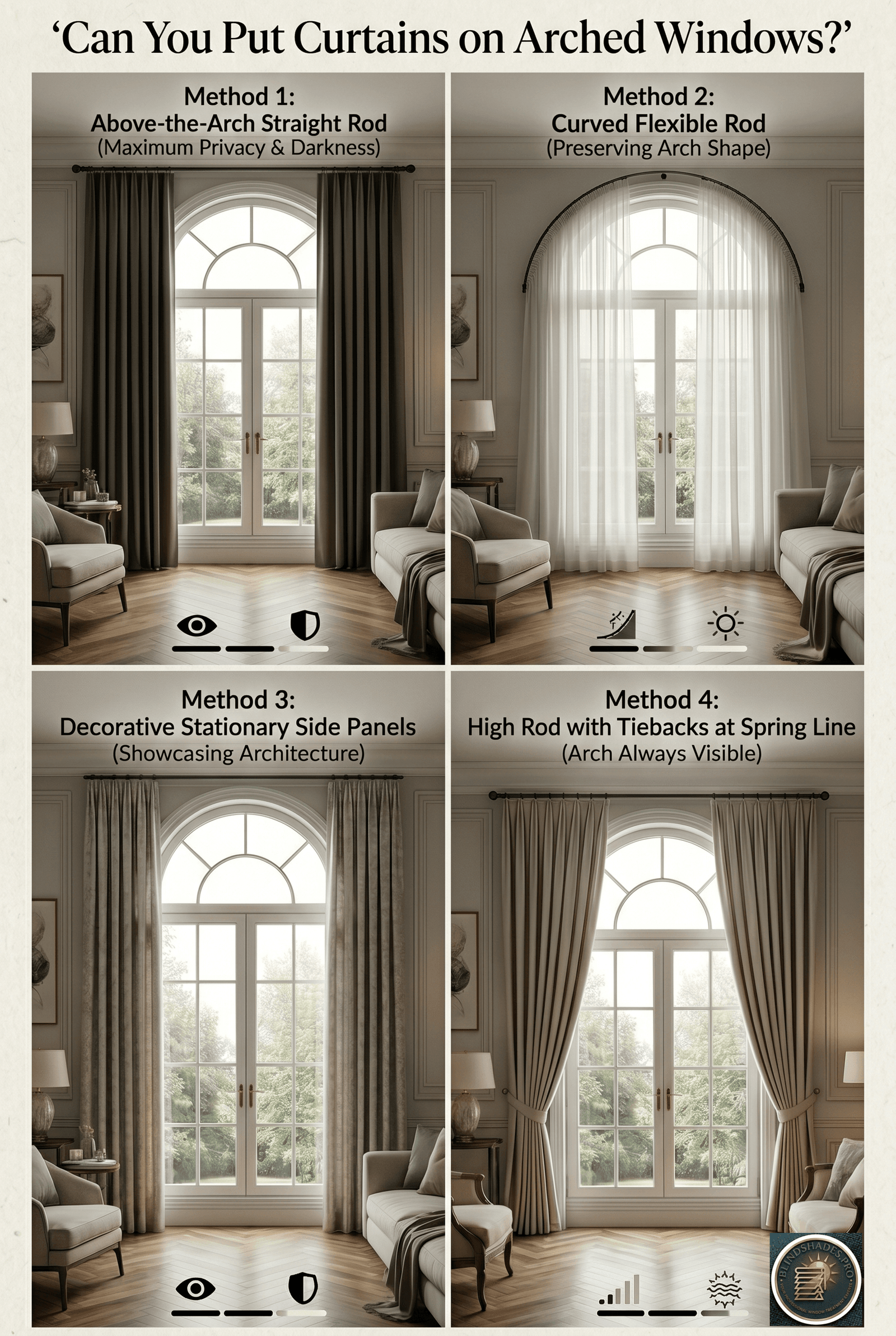
Key Takeaways:
- There are four methods for hanging curtains on arched windows, not three as most guides state: (1) straight rod high above the arch with floor-length closing panels; (2) curved or flexible rod following the arch curve with lightweight stationary panels; (3) stationary side panels flanking a bare arch; and (4) floor-length panels on a high straight rod tied back at the spring line (70 to 75 percent of window height) to reveal the arch while framing the rectangular section below
- When using the high straight rod method, calculate the required panel length as the rod height from the floor minus 0.5 to 1 inch for hem clearance; a rod at 102 inches (8.5 feet) from the floor requires a 101-inch panel; standard panels come in 84, 96, and 108 inches; choose the next size up and hem, or use 108-inch panels with a puddle finish if the room style allows
- The rod must extend far enough beyond the arch frame on each side to fully clear the arch opening when panels are open; calculate the stack-back as the single panel width multiplied by 1.5 for standard fullness divided by 2 (approximately 12 to 18 inches for heavyweight panels; 8 to 12 inches for lightweight sheers); if the rod extends only 6 inches past the frame but the stack-back is 15 inches, the panel will partially cover the arch when open
- Flexible plastic curved rods such as the Kirsch adjustable arch rod ($20 to $40, 24 to 48 inches) are designed for lightweight sheer or linen fabrics only; heavy drapes such as lined blackout, velvet, or brocade panels will cause a flexible plastic track to sag and deform under the arch curve; heavyweight fabrics require a custom aluminium curved track
- Only the high straight rod method with closing opaque panels provides reliable night privacy and blackout for arched windows; curved rods with lightweight panels produce light leakage at the curve; stationary side panels provide zero privacy at any time; if night privacy or blackout is required, the high straight rod is the only curtain method that achieves it
⭐ Quick Answer — Can You Put Curtains on an Arched Window?
- Yes — 4 Methods, Not 3: Curtains for arched windows work using four methods. (1) High straight rod above arch: rod mounted between arch peak and ceiling; floor-length closing panels; 85% of arched window curtain installations; the only method that provides night privacy and blackout. (2) Curved flexible rod following the arch: arch shape visible when panels are closed; lightweight sheers only; limited privacy. (3) Stationary side panels: decorative only; zero privacy or light control. (4) Spring line tieback: panels on a high rod tied back at the spring line (70 to 75 percent of window height); arch permanently visible above the tiebacks; rectangular section framed below; release tiebacks for full coverage. Most guides show only 3 methods — the spring line tieback as Method 4 is absent from all competitor guides
- The Panel Length Formula and the Floor Style Decision: For arched window curtains using the high straight rod (Method 1), panel length = rod height from the floor minus 0.5 to 1 inch for hem clearance. Example: rod mounted at 102 inches (8.5 feet) from the floor requires a 101-inch panel. Standard panels come in 84, 96, and 108 inches — none match exactly; order 108-inch panels and choose the floor style before ordering. Float (0.5 to 1 inch above floor): practical for entry halls and dining rooms; must be hemmed or ordered precisely. Break (1 to 2 inch fold at floor): classic formal look; slightly more forgiving. Puddle (3 to 12 inches pooling): formal and romantic; appropriate for low-traffic sitting rooms. For arched windows where the rod is placed high above the arch, floor-length panels naturally puddle unless intentionally shortened
- The Stack-Back Rule — Rod Extension Must Match the Stack-Back: All guides say extend the rod 6 to 10 inches past the frame on each side. This generic rule fails for wide arches with heavyweight panels. The correct rule: rod extension must equal or exceed the stack-back depth. Stack-back per side = single panel width x fullness factor divided by 2. For two heavyweight panels each 54 inches wide at double fullness: stack-back per side = approximately 12 to 14 inches compressed. If the rod extends only 6 inches past the arch frame and the stack-back is 14 inches: 8 inches of stacked panel will overlap the arch opening even when “open” — the arch is partially covered. For lightweight sheers (thinner stack): 8 to 12 inches per side. For heavyweight lined drapes: 12 to 18 inches per side. Calculate and spec accordingly before ordering the rod
- Flexible Curved Track — Fabric Weight Limit and 2-Inch Clearance Rule: Flexible plastic curved rods such as the Kirsch adjustable arch curtain rod ($20 to $40; adjustable 24 to 48 inches) are designed for lightweight sheer or linen panels only — under approximately 0.5 lb per linear foot of fabric. Heavyweight curtains for arched windows — lined blackout, velvet, brocade, or interlined drapes — exceed the load capacity of flexible plastic tracks; the track sags and deforms under the arch curve over time. For heavyweight opaque arched window curtains: specify a custom aluminium curved track ($200 to $500+). And the installation rule: maintain at least 2 inches of clearance between the curved rod and the wall or arch frame; insufficient clearance causes the curtain fabric to bind and wear along the curve
- Header Type Is a Functional Decision, Not Just Aesthetic: The header style on curtains for arched windows determines method compatibility. Wave/track eyelet header: ONLY compatible with curved track systems; do not use with standard straight rods. Rod pocket: cannot be moved; stationary panels only; not for daily operation. Grommet: rod-and-ring only; NOT compatible with curved track systems. Pinch pleat (3-finger): best at the spring line position — creates a visual break between arch and rectangle; suitable for daily operation on straight rods. Goblet pleat: purely decorative stationary; formal period-style homes. Matching the header type to the rod type and method BEFORE ordering prevents a mismatch that renders the curtains incompatible with the chosen installation method
- Best Sources: Header type guide and custom arched window drapery → The Shade Store curtains for arched windows · 3-method installation guide with rod placement specs → JoeyZ Shopping arched window curtains · Flexible plastic arch rod for DIY lightweight installations → Kirsch adjustable arch curtain rod
⚠️ The Spring Line Tieback in Detail and the Night Privacy Decision Tree: The spring line tieback method for arched window curtains mounts full-length panels on a standard straight rod above the arch and positions tiebacks at the spring line — the point where the arch begins to curve above the rectangular frame, at approximately 70 to 75 percent of the total window height from the floor. For a 10-foot window, this is approximately 7 to 7.5 feet up. The tiebacks hold the panels open to reveal the arch above while the panels hang naturally, framing the rectangular section below. When privacy is needed, releasing the tiebacks closes the panels over the full window. This approach is historically consistent with Victorian, Georgian, and colonial revival interior drapery tradition where curtains were tied back to reveal the window form rather than obscuring it. Night privacy decision tree for arched window curtains: Does the arch face a street, a neighbouring property, or any position visible from outside at night? YES: specify Method 1 (high straight rod with closing opaque or room-darkening panels) only. Methods 2 and 3 cannot provide night privacy. Does the arch face a private garden, a high exterior wall, or any position with no exterior visibility concern? YES: any of the four methods is appropriate based on aesthetic preference alone. For the Palladian window spring line drapery rod placement at 70 to 75 percent of total window height, the three treatment strategies (arch uncovered / hybrid / full unified), and the four-zone measurement protocol, see What Are the Best Window Treatments for Palladian Windows. See the full four-method guide below.
💡 The Worth-It Assessment — Curtains vs Cellular Arch Shades vs Shutters: How do curtains for arched windows compare to the other treatment types? Curtains win on: softness and fabric warmth; design versatility (fabric, colour, pattern options); the ability to hang standard off-the-shelf panels from a high straight rod without any custom fabrication for the arch zone; floor-length drama when rod is placed above the arch. Curtains lose on: privacy (Methods 2, 3, and 4 provide limited or no privacy); light control precision (open or closed only; no partial adjustment); arch visibility when closed (Method 1 covers the arch entirely); hardware cost for curved track systems ($200+ for custom aluminium). Cellular arch shade wins on: consistent full-time privacy in the arch zone; precise light control; following the arch curve without covering the arch shape; R-3 to R-4 insulation. Shutters win on: 50-year lifespan; R-3 to R-4.5 insulation; adjustable light control via louvers; no fabric degradation. The practical verdict: curtains are the best choice for homeowners who primarily want a fabric softness and height-emphasising effect, and who will mostly keep the curtains open with the arch visible. For privacy-focused and energy-focused installations: cellular arch shades or shutters outperform curtains on every functional metric. For the full cellular arch shade vs shutter worth-it comparison, see Can You Put Shutters on an Arched Window. See the full privacy comparison table below.
📖 Read the complete guide below for: the four-method overview with privacy capability by method (only Method 1 provides night privacy/blackout), Method 1 high straight rod placement (halfway between arch peak and ceiling molding; 6-10 inches minimum past frame), the panel length formula (rod height minus 0.5 to 1 inch hem clearance; 102-inch rod requires 101-inch panel; use 108-inch with floor style choice), the floor style options (float 0.5-1 inch / break 1-2 inch fold / puddle 3-12 inch pool), the stack-back calculation (single panel width x fullness divided by 2; rod extension must equal or exceed this), Method 2 curved rod fabric weight limit (flexible plastic = sheers under 0.5 lb per foot; custom aluminium for heavyweight), the 2-inch clearance requirement for curved track installation, the spring line tieback method with placement at 70-75 percent of window height, the header compatibility table (wave for curved track only; rod pocket stationary only; pinch pleat best at spring line), and the worth-it comparison of curtains vs cellular arch shades vs arch shutters.
Curtains for Arched Windows – The Four Methods
Most guides cover three methods. The fourth — spring line tieback — is absent from all competitor guides and is one of the most architecturally elegant approaches for period homes.
Method 1 — High Straight Rod Above the Arch (Most Popular)
The method used by approximately 85% of homeowners with arched window curtains.
A straight curtain rod is mounted on the wall above the arch — typically between the top of the arch and the ceiling molding. The panels are floor-length, hanging from the rod all the way to the floor (or near it). The arch is covered when the curtains are closed and visible when they are open.
Rod placement:
- Mount the rod approximately halfway between the top of the arch and the ceiling molding
- This position draws the eye upward, creating the illusion of height
- Rod extends 6-10 inches beyond the window frame on EACH side (for stack-back clearance — see Gap #2 below)
- Minimum rod height: above the arch peak by at least 4 inches
The panel length calculation — absent from all guides: Panel length = (rod height from floor) – (desired hem clearance, typically 0.5 to 1 inch)
Example: A window where the arch peak is at 8 feet (96 inches). The rod is placed 8 inches above the arch peak = at 104 inches from the floor. Desired float hem clearance: 1 inch. Required panel length: 104 – 1 = 103 inches.
Standard panel lengths: 84 inches, 96 inches, 108 inches. The 103-inch requirement means ordering 108-inch panels and either hemming to 103 inches or accepting a slight puddle at the floor.
The floor style options:
- Float: Panel clears the floor by 0.5 to 1 inch. Practical for high-traffic rooms (entry halls, dining rooms). Clean appearance. Must be ordered or hemmed precisely.
- Break: Panel touches the floor with a 1 to 2 inch fold. Classic drapery appearance. Slightly more forgiving on measurement.
- Puddle: Panel extends 3 to 12 inches onto the floor. Formal and romantic. Appropriate for low-traffic formal living rooms and studies. Requires 108-inch or longer panels for most arched window installations.
For arched windows where the rod is placed high (above 8 feet), floor-length panels inherently require extra-long measurements that result in a puddle unless the panels are shortened. Decide the floor style BEFORE ordering panels to avoid waste.
Privacy and blackout capability: When closed: the panels fully cover the arch and the window below — providing maximum privacy and blackout (depending on fabric opacity). This is the ONLY curtain method for arched windows that achieves full night privacy and blackout.
Method 2 — Curved Flexible Rod Following the Arch (Architectural Look)
The method that preserves the arch shape — with an important fabric weight constraint absent from all guides.
A curved or flexible rod is installed following the profile of the arch curve. Fabric panels hang from this curved rod, following the arch shape. The arch is visible (from outside and from inside when panels are closed) because the panels follow rather than cover the arch’s curve.
Rod types available:
| Rod Type | Cost | Max Fabric Weight | Best For |
|---|---|---|---|
| Flexible clear plastic (Kirsch, 24-48 inch) | $20-$40 | Lightweight sheers only (under 0.5 lb per linear foot) | DIY; small arches; casual style |
| Flexible aluminium track (manual bend) | $60-$150 | Light to medium fabrics | Mid-range; versatile |
| Custom aluminium curved track (TWOPAGES, similar) | $200-$500+ | All fabric weights | Heavyweight drapes; premium installations |
| Pre-formed semicircular rod (perfect arches only) | $80-$200 | Medium fabrics | Standard radius arches |
The fabric weight constraint — absent from all guides: Flexible plastic curved rods such as the Kirsch adjustable arch rod are designed for lightweight sheer or linen fabrics only. Heavyweight fabrics — lined blackout panels, velvet, brocade, or interlined drapes — exceed the load capacity of flexible plastic tracks. Over time, the weight causes the track to sag at the arch center, destroying the curve profile and causing the panels to bunch unevenly.
For heavyweight or functional opaque curtains on a curved arch track: specify a custom aluminium track.
The clearance requirement: Engineer Fix confirms: maintain approximately 2 inches of clearance between the curved rod and the wall or arch frame. This clearance allows the curtain fabric to move along the track without binding against the wall surface. Standard straight curtain rod brackets project 3 to 5 inches from the wall — verify the curved track bracket projects at minimum 2 inches.
Privacy limitation: Lightweight panels on a curved track do not provide full privacy because the panel fabric is not heavy enough or opaque enough to block view-through. At night with interior lighting, light leakage occurs at the seams where panels meet the curved track. For privacy requirements: Method 1 is more effective.
Method 3 — Stationary Side Panels Flanking a Bare Arch (Purely Decorative)
The simplest approach — and the one with zero privacy or light control capability.
Two curtain panels are mounted on a straight rod positioned at the sides of the arch, framing the window as a focal point without covering any glass. The arch and window remain fully exposed at all times.
Best for:
- Arches that are purely decorative and face a private orientation (not street-facing)
- Formal living rooms where curtains are architectural accessories rather than functional coverings
- Homeowners who want the softness of fabric drapery without covering the arch
Hardware: Standard straight curtain rod mounted above or at the arch; panels are held at the sides with tiebacks or holdbacks. Alternatively, decorative medallions or holdbacks are mounted at intervals along the arch frame and fabric is draped between them for a swag effect.
Method 4 — Spring Line Tieback (The Architectural Framing Method)
The fourth curtain method for arched windows — absent from all competitor guides.
Floor-length curtain panels hang from a high straight rod (same as Method 1). Instead of being allowed to hang free or being fully closed, the panels are tied back at the spring line — the point where the arch begins to curve above the rectangular section.
The visual effect:
- The full arch above the tiebacks is permanently visible and exposed
- The panels frame the rectangular section of the window below the spring line
- When looking at the window: the arch reads as the top architectural feature; the panels frame it elegantly on both sides
- The tied panels create a softened, structured framing that is more formal than stationary side panels
The tieback position: As established in the spring line guidance from Article 44-3, the spring line is at approximately 70 to 75 percent of the total window height from the floor. For a 10-foot tall window: the spring line tiebacks are at approximately 7 to 7.5 feet.
Why this is architecturally superior for period homes: In Victorian, Georgian, and colonial revival homes — the architectural styles where arched windows are most common — draperies have historically been tied back to reveal the window rather than covering it. The spring line tieback references this historical treatment pattern while also respecting the arch’s role as a room focal point.
Privacy limitation: Same as Method 3 — when the curtains are tied back, the window is exposed. For privacy: release the tiebacks and the panels close over the window (now functioning as Method 1).
The Header Type — Functional Determinant, Not Just Aesthetic Choice
How each header style affects compatibility with arched window curtain methods — absent from all competitor guides.
The Shade Store confirms specific header-to-method compatibility for arched windows:
| Header Type | Compatibility | Best Arched Window Application |
|---|---|---|
| Rod pocket | Rod-and-ring only; CANNOT move; stationary use only | Stationary decorative panels above or below arch; NOT for closing curtains |
| Grommet | Rod-and-ring only; NOT compatible with curved track | Decorative panels above arch as accent; not for curved rod Method 2 |
| Pinch pleat (3-finger) | Rod-and-ring and track; operable | Best hung at the spring line — pleats create a visual break between arch and rectangle |
| Wave/track eyelet | Track system ONLY; not compatible with standard rods | Method 2 curved track installations; contemporary casual style |
| Goblet pleat | Rod-and-ring; best for formal stationary | Purely decorative panels; formal period-style homes |
| Tab top / back tab | Rod only; limited operability | Stationary decorative; not for daily operation |
The practical implication: If the planned arched window curtain method is a curved track system (Method 2): specify wave/track eyelet header only. Grommets, rod pockets, and pleat headers are incompatible with track systems. If the planned method is a closing high-rod (Method 1) with daily operation: specify pinch pleat or wave header (compatible with ring gliders on the rod). If the planned method is purely decorative: rod pocket or grommet is acceptable (both create attractive stationary panels without daily operation).
The Stack-Back Calculation — How Far the Rod Must Extend
The clearance calculation that determines whether the arch opening is fully visible when curtains are open.
When curtain panels are pushed open, they stack into a section of compressed fabric along the rod. This “stack-back” takes up horizontal space on the rod beyond the window edge.
The calculation: Stack-back per side = (single panel width) × fabric fullness factor ÷ 2
For two panels each 54 inches wide with 2× fullness (standard): Stack-back per side = 54 × 2 ÷ 2 = 54 inches per side
In practice: a panel that is 54 inches wide fully compressed when fully stacked takes up approximately 10 to 14 inches of rod space for medium-weight fabric.
The rule: Rod extension past the arch frame on each side must be at least equal to the stack-back depth. If the stack-back is 12 inches per side, the rod must extend at least 12 inches past the frame edge on each side.
If the rod extends only 6 inches past the arch frame and the stack-back is 12 inches: when the panels are open, the inner 6 inches of panel stack will overlap the edge of the arch opening — partially covering the arch even when the curtains are “open.”
The Blackout and Privacy Limitation by Method
The critical functional decision that determines which curtain method is appropriate — absent from all guides.
| Method | Night Privacy | Blackout Capable | Light Control |
|---|---|---|---|
| Method 1 (high rod, closing panels) | Full (when closed) | YES (with opaque fabric) | Full range (open to closed) |
| Method 2 (curved rod, lightweight panels) | Partial — light leaks at curve seams | NO (lightweight fabric + curve gaps) | Reduced glare only |
| Method 3 (stationary side panels) | ZERO | NO | Reduced glare at sides only |
| Method 4 (spring line tieback) | Full only when released/closed | YES when released/closed | Full range (open or closed) |
The decision: If the arched window faces a street, a neighbour’s property, or a position where privacy at night is needed: specify Method 1 with opaque or room-darkening panels. Methods 2 and 3 cannot provide functional privacy.
If the arched window faces a private garden, a high-set exterior wall, or a position where privacy is not needed: any of the four methods is appropriate based on aesthetic preference.
Where to Buy Curtains and Hardware for Arched Windows
For design consultation and custom arched window curtain planning: The Shade Store at theshadestore.com/blog/curtains-for-arched-windows — the most detailed header-type guide for arched windows; Tailored Pleat, Goblet Pleat, and Wave header options; custom panels from $325; design consultation available.
For step-by-step arched window curtain installation: JoeyZ Shopping guide at joeyzshopping.com/blogs/news/how-to-hang-curtains-on-arched-window — three-method guide with rod placement specifications; stack-back and rod extension guidance; common mistakes section.
For flexible curved arch rod for DIY lightweight installations: Kirsch adjustable arch curtain rod at amazon.com — flexible clear plastic; adjustable 24 to 48 inches; $20 to $40; appropriate for sheer and lightweight panels only; includes brackets and screws.
Frequently Asked Questions
Can you put curtains on an arched window? Yes – curtains can be put on arched windows using four methods. The most popular is mounting a straight rod above the arch with floor-length panels that close over the arch and window below; this is the only method that provides full night privacy and blackout. Hanging curtains on a curved rod that follows the arch shape keeps the arch visible when panels are closed but is limited to lightweight fabrics due to flexible track load capacity. Stationary side panels flanking the arch are purely decorative with no privacy function. A fourth method is panels on a high straight rod tied back at the spring line, which permanently reveals the arch while framing the rectangular section below.
How far above the arch should you hang curtains? For arched window curtains using the high straight rod method, mount the rod approximately halfway between the top of the arch and the ceiling molding. Extend the rod at least 6 to 10 inches beyond the window frame on each side as a minimum, but calculate the actual required extension based on the stack-back depth of the chosen panels. A typical heavyweight panel with standard double fullness has a stack-back of approximately 12 to 18 inches per side; the rod extension must be at least this distance to fully clear the arch opening when panels are open.
What type of curtain rod works on a curved arch? A flexible plastic curved rod such as the Kirsch adjustable arch curtain rod (adjustable 24 to 48 inches; approximately $20 to $40) works for lightweight sheer or linen panels on small to medium arches. A flexible aluminium track works for light to medium fabric weights. A custom aluminium curved track is required for heavyweight or blackout panels. For a straight rod above the arch rather than following the curve: any standard curtain rod is appropriate as the rod does not need to follow the arch shape.
What is the spring line tieback method for arched window curtains? The spring line tieback method mounts floor-length panels on a straight rod above the arch and ties the panels back at the spring line, which is the point where the arch begins to curve above the rectangular section at approximately 70 to 75 percent of the total window height. The tiebacks reveal the full arch above while the panels frame the rectangular section below. This creates an architectural framing effect that is historically appropriate for Victorian, Georgian, and colonial revival homes where arched windows are most common. When privacy is needed, releasing the tiebacks allows the panels to close over the full window.
What curtain header works best for arched windows? The best curtain header for arched windows depends on the installation method. For a curved track system (Method 2): only a track-compatible header such as wave or eyelet is appropriate; grommets and rod pockets are incompatible with track systems. For a high straight rod with closing panels (Method 1): pinch pleat works best at the spring line position; grommets work for high-rod decorative stationary applications. Rod pocket headers are difficult to operate on any rod and are appropriate only for stationary arched window panels that will not be moved after installation.
Related Guides on BlindShades.pro
- The Best Arched & Specialty Windows Buying Guide
- What Are the Best Blinds for Arched Windows
- What Are the Best Window Treatments for Palladian Windows
- Can You Put Shutters on an Arched Window
- How Do You Measure Arched Windows for Blinds
By Michael Turner | 30 Years Home Improvement Expertise | Updated 2026 | BlindShades.pro
