Can You Put Plantation Shutters on Sidelights?

Authored By Michael Turner -30 Years Home Improvement Expertise | Updated 2026 | BlindShades.pro
Updated on July 10, 2026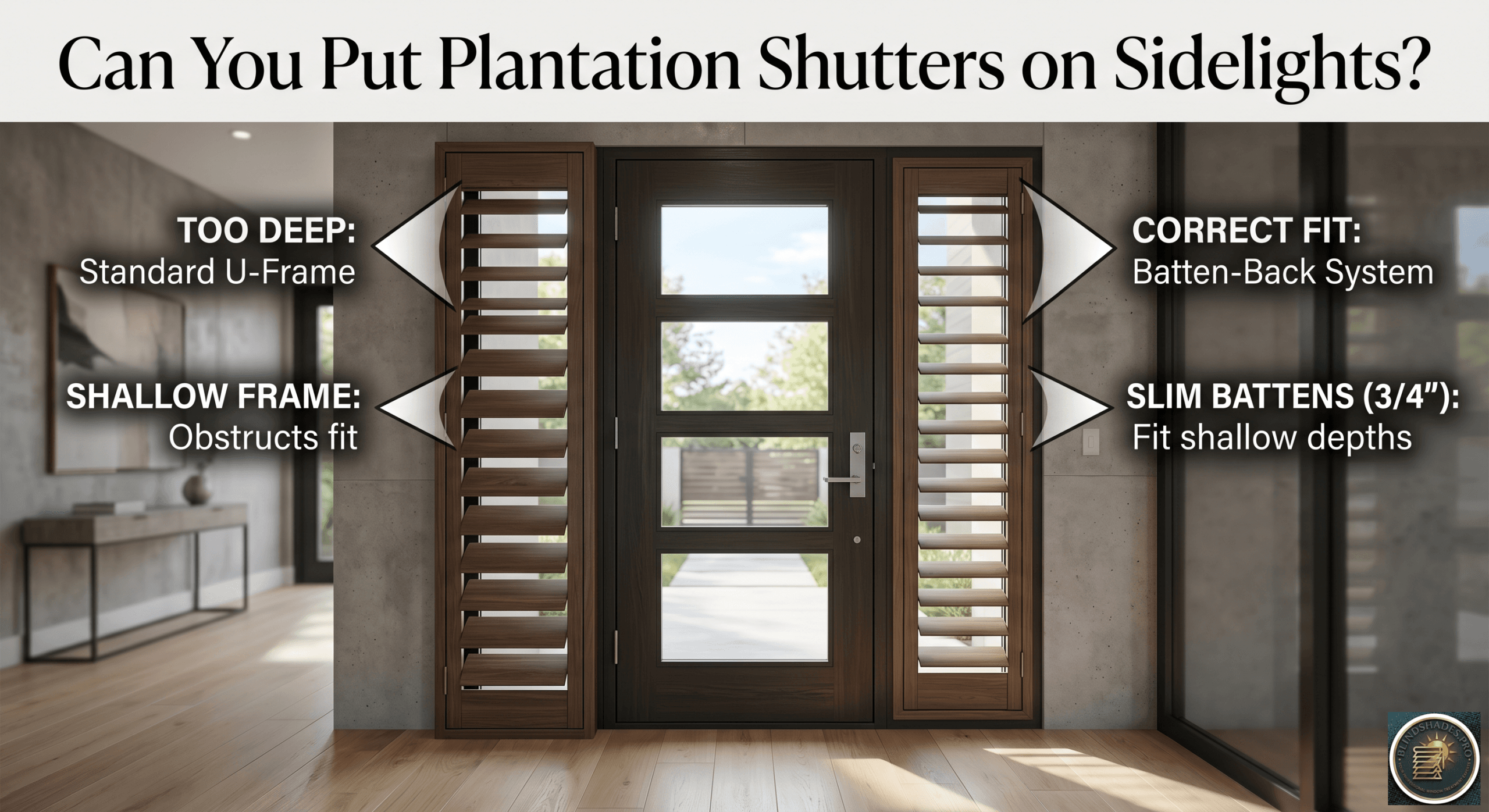
Key Takeaways:
- Plantation shutters can be installed on most sidelights using the batten-back mounting system, which requires only 3/4 inch of frame depth versus 2.5 to 3.5 inches for a standard U-frame – making shutters viable for most sidelights that would reject standard shutter hardware
- For sidelights under 12 inches wide, specify 2.5-inch louvers only – the standard U-frame leaves only 7 inches of louver area on a 10-inch sidelight, and a 3.5-inch louver in this space provides only 2 louvers, which looks blocky and cage-like; the batten-back system with 2.5-inch louvers provides 3 to 4 louvers for correct proportion
- Specify hidden tilt (invisible tilt rod) for all sidelight plantation shutters – a visible tilt rod on a 7 to 9 inch wide louver panel occupies a proportionally large portion of the narrow panel face; hidden tilt makes narrow sidelight shutters look clean rather than divided
- On a cost-per-year basis, plantation shutters at approximately $450 installed over 22 years cost approximately $20 per year – less than cellular shades at approximately $275 over 8.5 years at approximately $32 per year; despite higher upfront cost, shutters are the lower long-term cost option
- Specify polyvinyl (PVC) construction for all front door sidelight shutters regardless of climate – multiple daily door openings create temperature and humidity cycling that wood shutters accumulate over years at the door perimeter more severely than any interior window position
⭐ Quick Answer — Can You Put Plantation Shutters on Sidelights?
- Yes — With the Batten-Back System (3/4 Inch Depth, Not the Standard 2.5–3.5 Inch Frame): Plantation shutters for sidelights are viable on most front door sidelights using the batten-back mounting system. Standard plantation shutter U-frames require 2.5 to 3.5 inches of frame depth — most sidelights have only 1/2 to 1.5 inches, which is too shallow. Batten-back shutters use narrow 3/4-inch wooden or PVC strips fixed to the sidelight frame instead of a full surrounding U-frame, requiring as little as 3/4 inch of mounting depth. When requesting quotes, specifically ask: “Do you offer batten-back or frameless sidelight shutter mounting?” — a supplier who does not know this term likely does not offer it
- Specify 2.5-Inch Louvers — Not the Standard 3.5-Inch — for Sidelights Under 12 Inches: The louver size rule for sidelight plantation shutters contradicts standard guides. A standard plantation shutter frame consumes 2 to 3 inches of width (left and right stiles). On a 10-inch sidelight with a standard frame: the louver area is only 7 inches wide. A 3.5-inch louver in 7 inches = only 2 louvers — a blocky, cage-like appearance. The batten-back system on the same 10-inch sidelight gives approximately 9 inches of louver area. A 2.5-inch louver in 9 inches = 3 to 4 louvers — the minimum for a proportionally correct sidelight shutter. For sidelights 12 to 16 inches: 3.5-inch becomes viable. Above 16 inches: full louver size range appropriate
- Specify Hidden Tilt and Polyvinyl — Both Critical for Sidelights: For all narrow sidelight plantation shutters: hidden tilt rod (invisible, stile-integrated) is strongly preferred over a visible center tilt rod. On a 7–9-inch louver panel, a visible tilt rod running vertically through the center occupies a proportionally large fraction of the panel face — the shutter looks industrial rather than architectural. Specify hidden tilt for clean sidelight appearance. And for material: specify polyvinyl (PVC) for all front door sidelights regardless of climate — multiple daily door openings create 7,000 to 10,000 temperature and humidity cycling events per year at the door perimeter. Real wood shutters accumulate significant moisture cycling at this position over 20 years; polyvinyl is dimensionally stable indefinitely
- Shutters Cost $20/Year vs Cellular Shades $32/Year — Shutters Are Cheaper Long-Term: Plantation shutters for sidelights have a higher upfront cost at approximately $300 to $600 per sidelight versus $150 to $400 for cellular shades. But on a cost-per-year basis: shutters at $450 average over a 22-year lifespan = approximately $20 per year. Cellular shades at $275 average over an 8.5-year lifespan = approximately $32 per year. Over 20 years, shutters cost approximately $450 installed once; cellular shades cost approximately $550 (two replacement cycles). For homeowners staying 15+ years: shutters are the lower long-term cost option despite the higher upfront price. For short-term homeowners moving within 5 to 7 years: cellular shade is the lower total expenditure
- Tier-on-Tier (TDBU Equivalent) and the Security Signal Function: Tier-on-tier plantation shutters divide the panel into upper and lower independently operating sections — the TDBU equivalent for sidelights. Upper tier closed for privacy, lower open for light — same configuration as TDBU cellular. Tier-on-tier is viable for sidelights above 12 inches only: below 12 inches each tier has only 1 to 2 louvers at 2.5-inch specification, which is not functionally useful. For sidelights under 12 inches: full-height single panel with adjustable louvers. And the security signal: solid closed plantation shutters at a front door sidelight present a definitive solid surface — cannot be made transparent by exterior lighting conditions (unlike film or solar shades that fail at night) and cannot be pushed aside; the strongest privacy visual signal available for a front door position
- Best Sources: Batten-back sidelight shutter installation → Shade Craft Shades sidelight guide · Full plantation shutter range → Blindsgalore plantation shutters · Frame styles and tilt rod options → Polywood Shutter Company options
⚠️ The Louver-to-Panel Width Ratio Table and the Minimum Viable Width for Sidelight Shutters: Before ordering plantation shutters for any sidelight, calculate the louver count at your specific width to confirm the proportion is acceptable. Standard frame system: subtract 2 to 3 inches from the sidelight width for frame stiles; divide the remaining louver area by the louver size. Batten-back system: subtract approximately 1 inch from the sidelight width; divide the remaining louver area by the louver size. Reference table: 10-inch sidelight, standard frame, 3.5-inch louver = 2 louvers (not acceptable); 10-inch sidelight, batten-back, 2.5-inch louver = 3 to 4 louvers (minimum acceptable); 12-inch sidelight, batten-back, 2.5-inch louver = 4 to 5 louvers (good proportion); 14-inch sidelight, standard frame, 3.5-inch louver = 3 louvers (acceptable); 16-inch sidelight, standard frame, 3.5-inch louver = 3 to 4 louvers (good). Minimum viable sidelight width for shutters: 10 inches with batten-back system and 2.5-inch louvers. Below 10 inches, the louver count falls to 2 or fewer with any system — at this width, the 9/16-inch cellular shade or 1-inch aluminium mini blind from the narrow sidelight guide are better specifications than shutters. For the full narrow sidelight treatment comparison by width category, see What Are the Best Window Treatments for Narrow Sidelights. See the full batten-back system guide below.
💡 The Full Cost-Per-Year Comparison and the 15-Year Break-Even Calculation: The cost comparison for plantation shutters versus other sidelight window treatments: Plantation shutters (polyvinyl, installed): $300 to $600 per sidelight (average $450) over 20 to 25 years = approximately $20 per year. Cellular shade (custom narrow): $150 to $400 (average $275) over 7 to 10 years = approximately $32 per year — more expensive per year than shutters. Roller shade (custom narrow): $100 to $300 (average $200) over 5 to 8 years = approximately $31 per year. 1-inch aluminium mini blind: $60 to $150 (average $105) over 5 to 8 years = approximately $16 per year — the lowest per-year cost option. Break-even calculation: shutters become the lower cumulative cost option at approximately 15 years when compared to cellular shades (two full replacement cycles by year 17 at average pricing). For homeowners who have lived in the home more than 3 years and plan to stay at least 12 more: the break-even makes shutters the financially superior choice. For those expecting to move within 5 to 7 years: cellular or mini blind is the lower total expenditure. For the complete first-buy specification guide covering frame depth, mount type, approach-angle privacy, and hold-down brackets for all sidelight treatment types, see What Are the Best Blinds for Sidelights. See the full cost-per-year table below.
📖 Read the complete guide below for: the batten-back mounting system (3/4-inch depth; makes shutters viable for most sidelights), the louver-to-panel width ratio problem (standard frame: 10-inch sidelight = 7-inch louver area = 2 louvers at 3.5-inch = unacceptable), the louver count table (standard frame vs batten-back at 10/12/14/16-inch widths), the louver size rule (2.5-inch for under 12 inches; 3.5-inch from 12-16 inches), the hidden tilt rod advantage for narrow panel proportions, tier-on-tier viable above 12 inches only, the polyvinyl specification for door-perimeter cycling (7,000-10,000 events per year), the cost-per-year comparison (shutters $20/yr vs cellular $32/yr; break-even at approximately 15 years), and the security signal function of solid closed shutters at a front door.
Plantation Shutters for Sidelights – The Batten-Back System
The installation method that makes plantation shutters viable for most sidelights – absent from all competitor guides except a single specialist blog post.
Definition: A batten-back shutter mounting system uses narrow wooden or PVC strips (battens) fixed to the sidelight frame as the mounting surface for the shutter panel, rather than a traditional U-shaped surrounding frame.
The standard U-frame limitation: A traditional plantation shutter installs in a U-frame that wraps around all four sides of the window opening. This frame requires a mounting depth of 2.5 to 3.5 inches from the wall surface to the glass face to accommodate:
- The frame thickness (approximately 1-1.5 inches)
- The louver clearance behind the frame (the louvers must tilt without touching the glass)
- The mounting hardware
Most front door sidelights have only 1/2 to 1.5 inches of frame depth — a standard U-frame cannot be installed.
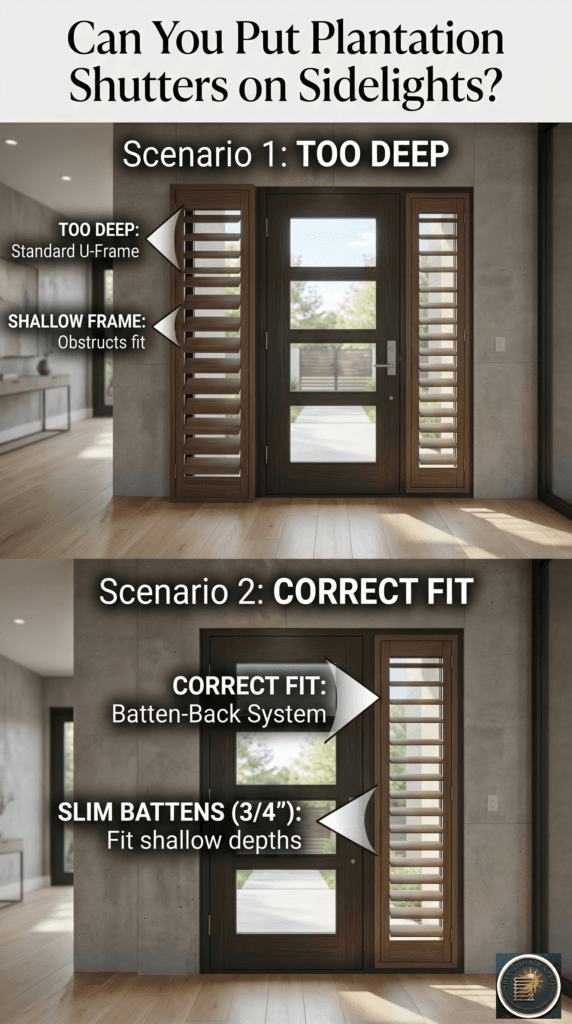
The batten-back solution: Batten-back shutters mount using narrow wooden or PVC strips (typically 3/4 inch wide) fixed directly to the existing sidelight frame surfaces. The shutter panel hinges or clips to these battens. Required depth: as little as 3/4 inch.
The practical consequence: Plantation shutters are viable for virtually all sidelights — including those with the shallow frame depth that prevents standard U-frame installation — when specified with batten-back mounting. This is the key insight that unlocks shutters for the majority of residential front door sidelights.
Finding a batten-back installer: Not all shutter suppliers offer the batten-back system. When requesting a quote for plantation shutters on sidelights, specifically ask: “Do you offer batten-back or frameless sidelight shutter mounting?” A supplier who does not know what this means likely does not offer it.
The Louver-to-Panel Width Ratio Problem
The proportioning challenge that determines which louver size is correct for sidelights – absent from all guides.
The standard frame width consumption: A standard plantation shutter panel has frame stiles (vertical members) of approximately 1 to 1.5 inches on each side. Total frame material consumption: 2 to 3 inches of the panel width.
On a 10-inch sidelight with standard U-frame:
- Total panel width: 10 inches
- Frame stile width (left + right): 2 to 3 inches
- Remaining louver area: 7 to 8 inches
The louver count at different sizes:
| Sidelight Width | Frame System | Louver Area | 3.5″ Louver Count | 2.5″ Louver Count |
|---|---|---|---|---|
| 10 inches | Standard U-frame | 7 inches | 2 louvers | 2-3 louvers |
| 10 inches | Batten-back | 9 inches | 2-3 louvers | 3-4 louvers |
| 12 inches | Standard U-frame | 9 inches | 2-3 louvers | 3-4 louvers |
| 12 inches | Batten-back | 11 inches | 3 louvers | 4-5 louvers |
| 14 inches | Standard U-frame | 11 inches | 3 louvers | 4-5 louvers |
| 16 inches | Standard U-frame | 13 inches | 3-4 louvers | 5 louvers |
The appearance consequence: A sidelight shutter with only 2 louvers looks blocky and cage-like — the louvers are so few and wide relative to the narrow panel that the shutter looks structural rather than decorative. The minimum for a visually acceptable sidelight shutter is approximately 3 louvers per panel.
The specification guidance:
- Sidelights under 12 inches with standard U-frame: NOT recommended for shutters (2 louvers at 3.5-inch = unacceptable proportion)
- Sidelights under 12 inches with batten-back: viable with 2.5-inch louvers (3-4 louvers)
- Sidelights 12-16 inches with either system: 2.5-inch louvers preferred; 3.5-inch acceptable
- Sidelights 16 inches and above: full louver size range appropriate; 3.5-inch is the standard recommendation
Louver Size Selection for Sidelights
The guidance absent from all competitor guides that contradicts the standard “3.5-inch is most popular” recommendation.
Standard plantation shutter guides recommend 3.5-inch louvers as the most popular choice for most windows. For sidelights, this recommendation is incorrect for narrow widths.
Why 2.5-inch is the correct specification for narrow sidelights:
At narrow sidelight widths (under 12 inches), the 2.5-inch louver provides:
- More louvers per panel (3-4 vs 2 louvers at 3.5-inch) — better visual proportion
- Better light control — more louvers means finer adjustment of light angle
- Better privacy — more louver layers create tighter closure with less gap between tilted louvers
- One important note from Naka’s Drapery research: small louvers (under 2 inches) obstruct the view when open because there are too many of them; at 2.5-inch on a 10-inch sidelight (3-4 louvers), the view-through when open is adequate
The hidden tilt rod specification: For any sidelight plantation shutter, specify hidden tilt (also called invisible tilt, stile-integrated tilt, or no visible tilt bar) rather than a visible center tilt rod. On a standard wide shutter panel, the visible tilt rod is a minor element. On a 7-9 inch wide louver area, the visible tilt rod running vertically through the center occupies a proportionally large fraction of the narrow panel’s visual area, making the shutter look industrial rather than architectural.
Tier-on-Tier Shutters for Sidelights — The TDBU Equivalent
The plantation shutter equivalent of the TDBU cellular configuration established in Article 45-1.
Tier-on-tier shutters divide the shutter panel into two independently operating sections — an upper tier and a lower tier. Each tier can be opened, closed, or louver-adjusted independently, providing the same light-plus-privacy flexibility as a TDBU blind.
Tier-on-tier configuration for sidelights:
- Upper tier closed (louvers angled for privacy) + lower tier open: privacy at the upper sightline zone (where the approaching visitor’s view enters) + light entry at the lower
- Upper tier open + lower tier closed: maximum light entry at the upper zone + solid privacy at the lower
This configuration mirrors the Article 45-1 TDBU recommendation: cover the upper portion of the sidelight (where the 20-30 degree downward sightline from a standing visitor enters) while allowing light entry at the lower portion.
The sidelight width minimum for tier-on-tier: Tier-on-tier shutters are viable for sidelights above 12 inches wide. Below 12 inches, each tier has only 1-2 louvers at 2.5-inch specification. A single louver per tier on a narrow sidelight is not functionally useful — the tier cannot be adjusted in a meaningful way with one louver.
For sidelights under 12 inches: full-height single-panel shutter with adjustable 2.5-inch louvers. The louver angle provides adequate light and privacy control without the mechanical complexity of tier-on-tier.
Material Choice for Front Door Sidelights
Why polyvinyl is the correct specification for front door sidelights – absent from all competitor guides.
Most shutter guides recommend polyvinyl for humid environments (bathrooms, kitchens) and allow real wood or composite for other applications. For front door sidelights, polyvinyl is the correct specification regardless of climate.
The door-perimeter cycling problem:
A front door sidelight experiences environmental cycling that no interior window experiences:
- Temperature cycling: Each door opening admits exterior air — in winter (20°F exterior vs 68°F interior), the brief cold air exposure creates a sharp temperature differential at the sidelight immediately beside the door
- Humidity cycling: In summer, hot humid air enters briefly with each door opening, creating a humidity spike in the entryway that affects any organic material near the door frame
- Frequency: A residential front door used 20-30 times per day creates 7,000-10,000 cycling events per year — far more than any other environmental cycling at any interior window
Over 20 years:
- Real wood shutters at the front door sidelight: approximately 140,000-200,000 cycling events; grain absorption and release of moisture; eventual warping risk
- Polyvinyl shutters at the same position: cycling events are irrelevant — PVC does not absorb moisture or react to temperature differential; remains dimensionally stable indefinitely
The specification: For all front door sidelights regardless of climate: specify polyvinyl (PVC) plantation shutters. For interior sidelights not adjacent to an exterior door: composite faux wood or real wood are acceptable choices based on personal preference and budget.
The Cost-Per-Year Comparison
The calculation that shows plantation shutters are actually the lower long-term cost option – absent from all competitor guides.
| Treatment | Upfront Cost (typical sidelight, custom) | Expected Lifespan | Annual Cost |
|---|---|---|---|
| Plantation shutters (polyvinyl, installed) | $300-$600 per sidelight (avg $450) | 20-25 years (avg 22 years) | ~$20 per year |
| Cellular shade (custom narrow sidelight) | $150-$400 per sidelight (avg $275) | 7-10 years (avg 8.5 years) | ~$32 per year |
| Roller shade (custom narrow sidelight) | $100-$300 per sidelight (avg $200) | 5-8 years (avg 6.5 years) | ~$31 per year |
| 1-inch aluminium mini blind (custom) | $60-$150 per sidelight (avg $105) | 5-8 years (avg 6.5 years) | ~$16 per year |
The finding: On a cost-per-year basis:
- Plantation shutters at approximately $20 per year are the second-lowest cost option after mini blinds
- Cellular shades at approximately $32 per year are more expensive per year than shutters despite the much lower upfront cost
- The higher upfront cost of shutters is justified purely on financial grounds over a 20-year horizon
The caveat: This calculation uses a 22-year shutter lifespan and 8.5-year cellular lifespan. If the homeowner moves within 5-7 years, the shutter investment may not be fully realised. For long-term homeowners who intend to stay 15+ years: plantation shutters are the lower-cost choice per year. For short-term homeowners: cellular shade or roller shade is the lower upfront cost.
The Security Signal Function
The front-door-specific benefit of solid shutters – absent from all competitor guides.
A front door sidelight with plantation shutters closed presents a solid wooden or polyvinyl surface to anyone approaching the door. Unlike any fabric treatment, a closed plantation shutter:
- Cannot be pushed aside to see in
- Cannot be made transparent by external lighting conditions (unlike solar shades or film that fail at night)
- Gives a visual signal of deliberate, permanent privacy at the primary entry point
This is not a security system claim — plantation shutters do not prevent break-in. The security signal function is the perception-level signal that the home’s primary entry is definitively covered — an occupied and deliberately maintained appearance.
For homeowners where front door security perception matters (urban properties, properties with street-facing front doors, rental properties): solid plantation shutters at the front door sidelight provide the most definitive privacy visual signal available.
Where to Order
For batten-back sidelight shutter installation: Shade Craft Shades batten-back sidelight shutter guide at shadecraftshades.com is the only source that specifically addresses batten-back sidelight shutter mounting and the narrow-width louver ratio problem.
For the full plantation shutter range: Blindsgalore plantation shutters at blindsgalore.com/shutters — specify: polyvinyl construction, 2.5-inch louvers for sidelights under 12 inches, hidden tilt rod, batten-back or frameless mounting if available, full-height or tier-on-tier (for sidelights above 12 inches only).
For shutter options including tilt rod placement and frame styles: Polywood Shutter Company options guide at polywoodsc.com — covers frame styles, tilt rod placement options (visible vs invisible), and louver sizes; hang strip mounting system may be viable for sidelights with adequate frame surface.
Related guides: For complete buying advice, see our plantation shutters buying guide.
Frequently Asked Questions
Can you put plantation shutters on sidelights? Yes – plantation shutters can be installed on most sidelights using the batten-back mounting system, which requires only 3/4 inch of frame depth compared to the 2.5 to 3.5 inches needed for a standard U-frame. Most sidelights have only 1/2 to 1.5 inches of frame depth, which is too shallow for standard shutter frames but adequate for batten-back installation. Specify 2.5-inch louvers for sidelights under 12 inches wide, hidden tilt rod, and polyvinyl material for front door sidelight positions. For sidelights under 10 inches wide, the louver count with any frame system may be too low for a proportionally acceptable result – confirm the louver count at your specific width before ordering.
What size louvers are best for sidelight plantation shutters? 2.5-inch louvers are the correct specification for sidelights under 12 inches wide. On a 10-inch sidelight with a standard frame, the louver area is approximately 7 inches wide. A 3.5-inch louver in this space provides only 2 louvers – a blocky, cage-like appearance. A 2.5-inch louver with batten-back mounting (9-inch louver area) provides 3 to 4 louvers – the minimum for a visually acceptable narrow sidelight shutter. For sidelights 12 to 16 inches wide, 2.5-inch louvers remain the preferred specification though 3.5-inch becomes viable. The standard 3.5-inch recommendation applies to windows wider than 16 inches.
Are plantation shutters more expensive than cellular shades for sidelights? Plantation shutters have a higher upfront cost at approximately $300 to $600 per sidelight compared to $150 to $400 for custom narrow cellular shades. However, on a cost-per-year basis, plantation shutters at approximately $20 per year over a 22-year lifespan are less expensive than cellular shades at approximately $32 per year over an 8.5-year replacement cycle. For homeowners planning to stay in the property for 15 or more years, plantation shutters are the lower long-term cost option despite the higher initial investment. For short-term homeowners expecting to move within 5 to 7 years, cellular shades provide lower total expenditure.
Should sidelight plantation shutters be wood or polyvinyl? Polyvinyl PVC is the correct material specification for all front door sidelight plantation shutters regardless of climate. Front door sidelights experience temperature and humidity cycling each time the exterior door opens – in cold climates, brief cold air exposure creates thermal shock at the sidelight frame; in humid climates, brief exterior humidity spikes affect organic materials near the door. A residential front door used 20 to 30 times per day creates 7,000 to 10,000 cycling events per year. Over 20 years, real wood shutters accumulate significant moisture cycling at this position. Polyvinyl is dimensionally stable regardless of temperature and humidity cycling and is therefore the appropriate specification for the door-perimeter environment specifically.
What is a tier-on-tier shutter and does it work on narrow sidelights? Tier-on-tier plantation shutters divide the shutter panel into upper and lower sections that operate independently, providing the same light-plus-privacy flexibility as a TDBU blind – the upper tier can be closed for privacy while the lower tier remains open for light entry. Tier-on-tier is viable for sidelights 12 inches and wider because at this width, each tier has at least 3 to 4 louvers at 2.5-inch specification. For sidelights under 12 inches, each tier would have only 1 to 2 louvers, which is not functionally useful. Specify full-height single-panel shutters for sidelights under 12 inches and adjust the louver angle for light and privacy control rather than using tier-on-tier.
Related Guides on BlindShades.pro
- The Best Sidelights and Front Door Blinds Buying Guide
- What Are the Best Blinds for Sidelights
- What Are the Best Window Treatments for Narrow Sidelights
- Is Frosted Film Better Than Blinds for Sidelights
- What Is the Best Privacy Treatment for Front Door Sidelights
By Michael Turner | 30 Years Home Improvement Expertise | Updated 2026 | BlindShades.pro
