Best Window Tint Shades (2026): The Home Window Film Guide

Authored By Michael Turner -30 Years Home Improvement Expertise | Updated 2026 | BlindShades.pro
Updated on July 19, 2026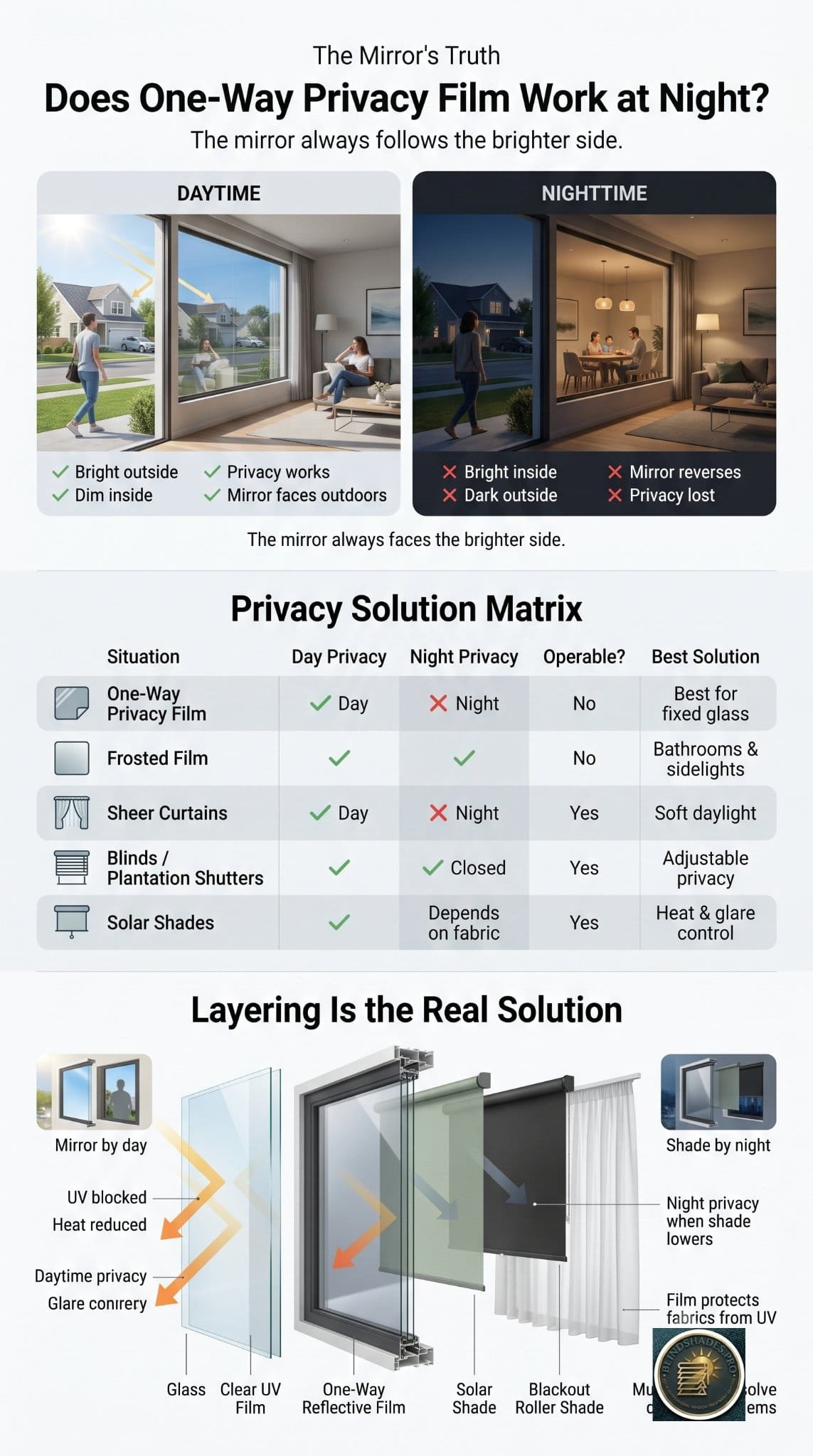
By Michael Turner — 30 years in the window treatment industry
Window tint shades are measured by VLT — visible light transmission, the percentage of light the film passes — and the first honest thing this guide does is split the phrase in two: if you searched it for your CAR, the routing section below hands you the vocabulary and sends you to the specialists; if you searched it for your HOUSE, welcome — this is the residential window film guide nobody else in this market wrote. The home half runs on the Film Test: Glass first (because the wrong film can crack a double-pane window and void its warranty — the rule no product page prints), Goal second (heat, glare, fade, privacy, or frost), Grade third (the VLT number, translated for rooms instead of sedans). Below: the review arithmetic behind films with thousand-review bases, the one-way privacy film’s night truth, and the routing map that finishes what the sidelight and sheer guides started.
Key Takeaways
- Glass before film, always: dark heat-absorbing films on double-pane insulated glass can cause thermal stress cracking and void the window maker’s warranty — check your glass type and the film’s IGU rating before anything else.
- One-way mirror film reverses at night — exactly like sheer curtains: the mirrored side follows the brighter side, so evening lamps turn daytime privacy back into a window. Plan the night layer.
- The category’s biggest review base has its worst score — a twenty-six-hundred-review heat film at three point six — and the critical reviews are overwhelmingly about application, not performance. Film is a skill product; the soap-slip method is half the purchase.
- Homes have no VLT laws — that whole chart belongs to vehicles — but HOAs, leases, and window warranties are the residential rulebook, and reflective exteriors are the clause to check.
- Film is the renter’s tint: static-cling and removable films deliver frost, privacy, and UV control with zero holes and full reversibility — the same no-drill logic that governs rented windows everywhere, at a price where every mistake costs an afternoon instead of a deposit.
⭐ Quick Answer — The Best Window Tint Shades for Home
The best window tint shades for houses pass the Film Test — Glass (double-pane needs IGU-safe films; the wrong tint can crack a sealed unit), Goal (heat, fade, privacy, or frost), Grade (VLT translated for rooms, not sedans):
- The privacy verdict: one-way mirror film at four point one across roughly twenty-two hundred reviews, about twelve — with the night rule attached: the mirror reverses when your lamps come on, the same law as the fabric in the window sheers guide.
- The glass rule first: dark absorptive films stress double-pane units — ceramic and clear classes are the safe lane, and the film aisle at The Home Depot carries both sides of that line unlabeled.
- Frost never flips: frosted film obscures both directions around the clock — the bathroom classic, paired with the wet-room rules in the bathroom window blinds guide.
- Never-operated glass is film’s home turf: the community’s 275-vote entry-glass verdict lives in the sidelights and front door blinds guide.
- Searching for your car? Take the VLT ladder (seventy legal-light to five limo), respect your state’s chart, and read the ceramic-construction canon at TintedAF and All About Tint — vehicle film belongs with specialists.
Quick Specification Reference
| Specification | Home window film reality (2026) |
|---|---|
| The measure | VLT — visible light transmission; lower number, darker film |
| The house rule | No VLT laws indoors — HOAs, leases, and window warranties govern instead |
| The glass rule | Double-pane (IGU) glass restricts absorptive films — thermal stress cracking is real |
| The film families | Dyed · ceramic · reflective one-way · frosted · static-cling · clear UV |
| The privacy physics | One-way film is a daytime mirror that reverses at night — same law as sheers |
| The price band | About twelve (privacy rolls) to three thirty (premium silver-gray) |
| The application truth | Soap-slip solution + squeegee + patience; most bad reviews are bad installs |
| The renter lane | Static cling: zero adhesive, zero holes, full reversibility |
| The removal | Heat gun or sun-warmed peel; stubborn adhesive residue answers to the same soap solution |
Read the complete guide below for: the six home-film picks with their real review bases, the Film Test (Glass · Goal · Grade), the VLT translator for houses, the double-pane safety table this category refuses to print, the one-way film’s night truth, the film-versus-shades-versus-sheers routing map, application and removal done right, and the honest word for the automotive searchers this phrase mostly belongs to.
What Are the Best Window Tint Shades in 2026? — The Home Picks
Review volumes are stated exactly as the market shows them; one pick is recommended conditionally, and the reason is the section after this one.
First, the routing paragraph this SERP demands. Most of what ranks for this phrase is automotive: the best window tint shades for cars conversation — VLT legal charts by state, the 35-percent-most-popular verdict, the LLumar-versus-3M brand question, best car window tint for heat reduction, the Reddit consensus that 50 percent all around is the safe call and one enthusiast forum’s top answer of 20 percent for night drivability. That world is real, regulated, and installed by specialists — take the VLT vocabulary from the translator below, check your state’s legal window tint shades chart, and put vehicle film in professional hands; dyed-versus-ceramic construction matters twice as much at seventy miles per hour. This guide’s lane is the house — where no one else in this market built the guide, and where the products below already carry review bases in the thousands:
| Pick | Product | Rating / reviews | Price (words) | The lane |
|---|---|---|---|---|
| Best Privacy | HIDBEA One-Way Privacy Film | 4.1 across ~2,200 (sibling roll 4.2 across ~1,400) | About twelve to forty-eight by size | The daytime mirror — night rule attached below |
| Best Heat (conditional) | Gila Heat Control Film | 3.6 across ~2,600 | About seventy | The biggest base, the humblest score — an application story, told honestly below |
| Best Ceramic for Home | ComforTech 35 Ceramic Window Film | Specialty home line | About one-oh-nine | The IGU-safer heat lane — UV and infrared without the dark absorptive load |
| Best Budget Privacy | Etokfoks Window Privacy Film | Lowe’s line | About fifty-eight | The mainstream alternative roll |
| Best Frosted | VEVOR Frosted Privacy Film | 5.0 across 3 — flagged thin | About thirteen | The bathroom classic |
| Best Clear UV | Snapguard Clear Heat-Reducing Film | 5.0 across 1 — flagged | About twenty-two | Fade protection with zero visible change |
Also in the grid, stated for completeness: Concord’s home film line (4.0 across eleven hundred), Jackson’s tint (3.7 across one seventy-three), the premium silver-gray tier near three thirty, and smoke sheets in the one-sixty class. The pattern across every big base repeats one lesson: the score gap between four-star and three-star film is almost never the polyester — it is the person with the squeegee, which is why the application section below is longer than the picks.
The Film Test: Glass · Goal · Grade
Three questions in order — what glass you have, what job the film does, and what grade does it — and the first one can save you a window.
| Film Test step | The question | The failure it prevents |
|---|---|---|
| Glass | Single-pane, or double-pane insulated (IGU)? | The cracked seal, the fogged unit, the voided warranty |
| Goal | Heat, glare, UV fade, privacy, or frost? | The dark film bought for a privacy problem frost would solve |
| Grade | Which VLT and which construction? | Limo-dark rooms; mirror film facing the wrong way |
Can Window Film Crack Your Windows? The Double-Pane Rule
Yes — and this is the most important table in the guide: dark absorptive films on insulated glass units create thermal stress the glass was never engineered for, and most window warranties say so in writing.
The mechanism, plainly: a dyed heat-absorbing film works by soaking up solar energy in the film layer — on single-pane glass the heat conducts through and dissipates; on a double-pane IGU the inner pane heats while the outer stays cool, the temperature differential stresses the sealed edges, and the outcomes are edge cracks and fogged (seal-failed) units. Window manufacturers know it, which is why aftermarket film frequently voids glass warranties — read yours before the squeegee comes out.
| Your glass | Safe film classes | Avoid | The note |
|---|---|---|---|
| Single-pane | Everything | — | The film playground; older homes win here |
| Double-pane IGU | Ceramic, clear UV, light reflective, exterior-applied, frost/static-cling | Dark dyed absorptive films | Ceramic rejects infrared without absorbing it — the IGU-safer construction |
| Low-E coated | Check both warranties | Most interior films | The coating already does film’s job; stacking them misbehaves |
| Laminated / specialty | Manufacturer guidance only | Guesswork | Skylights and safety glass have their own rules — overhead film questions belong with our skylight blinds guide |
| Any rented glass | Static-cling only | Adhesive films | Reversibility is the lease’s law — the wider zero-hole toolbox is our no-drill blinds guide |
The escape hatch the table hints at deserves its own paragraph: exterior-applied film. Mounted on the OUTSIDE face of the glass, solar film intercepts and re-radiates heat before it ever loads the sealed unit — which is why exterior grades are the professional answer for IGU-heavy modern homes with real heat problems. The trades: exterior films weather (five-to-ten-year service lives against interior film’s fifteen-plus), installation wants a calm dry day, and upper floors want a professional. It is the same physics that makes exterior shades beat interior ones — stop the energy before the envelope — argued at full scale in our outdoor and patio blinds guide, miniaturized to a film thickness here.
And the money paragraph, because film’s economics are its quietest argument: at roughly twelve to seventy per multi-window roll, film costs one-tenth of the cheapest shade covering the same glass — call it fifty cents to two dollars per square foot installed by your own hands, against ten to forty for fabric on hardware. That math is why film owns three specific jobs on this site: the never-operated glass the sidelight verdict identified, the whole-house UV layer under everything else (a seventy-percent clear film on every sun-facing window protects floors and furniture invisibly for the price of one custom shade), and the rental where holes are forbidden and departure is certain. It is also why film is the wrong place to economize on skill: the product is nearly free by this catalog’s standards, so every failure is an afternoon, not a budget — respect the soap, reread the glass rule, and the cheapest treatment in the house becomes its best-value one.
Which Film Family Fits Which Goal?
Six film families, one table — and the naming sweep this phrase-family needs: home window tint, window tint for home, heat control window film, one way privacy film, frosted window film — all of it maps here.
| Family | The goal it owns | Night behavior | IGU-safe? | The live lane |
|---|---|---|---|---|
| Dyed absorptive tint | Visible darkening, glare | Neutral | ✗ — the cracking class | The classic “tint” look; single-pane only |
| Ceramic (nano-ceramic) | Heat and infrared WITHOUT darkness | Neutral | ✓ | The ComforTech home class — the construction the automotive premium tier proved |
| Reflective one way privacy film | Daytime privacy with a view | REVERSES | Light grades ✓ | The twenty-two-hundred-review bestseller lane |
| Frosted window film | Privacy both directions, always | Holds | ✓ | Bathrooms, sidelights, office glass |
| Static-cling (frost or clear) | Renter-grade everything | Per finish | ✓ | Zero adhesive, seasonal rotation |
| Clear UV / heat control window film | Fade protection, invisible heat trim | Neutral | ✓ (clear grades) | The seventy-percent-VLT whole-house play |
Two rows earn a sentence each. Ceramic is the family the car world’s premium tier validated — the nano-ceramic construction praised for heat rejection, UV protection, durability, and clarity translates to houses as the IGU-safe way to fight west-sun heat without living in sunglasses. And frost is the only family whose privacy never flips: it scatters light identically in both directions at all hours, which is why it owns bathrooms outright and why the routing table further down lists it as the single film with no night asterisk.
What Do VLT Percentages Mean on House Glass? The Translator
The car world’s ladder, translated for rooms — because 35 percent means something very different in a living room than a sedan.
| VLT | In the car world | On house glass |
|---|---|---|
| 70% | The lightest practical shade — near-invisible UV and glare control, the front-window legal standard | The whole-house sweet spot: fade protection and glare relief with no visible change — the clear-UV class |
| 50% | Moderate UV and heat without visible darkening | Sunrooms and west faces — softens without dimming |
| 35% | The most popular everyday choice, per the market’s own summary | Noticeably tinted rooms — media dens and glare-hostile offices; too dark for north light |
| 20% | The dark SUV-and-rear standard | Rarely right indoors — rooms read cave-like; reserve for glass-walled sun traps |
| 5% (“limo”) | Maximum privacy, severely limited night visibility, often restricted | Not a residential product — if the goal is darkness, a blackout shade does it better and reversibly: our blackout blinds guide |
The house-law footnote the chart searchers need: there is no legal window tint chart for homes — VLT law is vehicle law. The residential rulebook is your HOA’s exterior-appearance clauses (mirrored film shows outside), your lease, and your window warranty — three documents, zero statutes.
Does One-Way Privacy Film Work at Night? The Mirror’s Truth
By day, brilliantly. By night, it reverses — the mirrored side follows the brighter side, and your lamps flip the mirror. The bestseller’s twenty-two hundred reviews deserve that sentence on the box.
The physics is the same law that governs sheer curtains, and this site states it the same way in both places: reflective one-way film shows a mirror to the brighter side. Daytime: the street is bright, your room is dim — passersby see sky and their own reflection. Night: your lights are on, the street is dark — the mirror faces inward, and the street sees you fine. No consumer film repeals this; the fix is layering, and the routing table below is where the whole privacy family finally sits in one place:
| You want | Daytime privacy | Night privacy | Operable? | The product |
|---|---|---|---|---|
| Set-and-forget on never-operated glass | ✓ (one-way film) | ✗ — needs a layer | No | THIS guide — film; the sidelight verdict imported: the community’s 275-vote answer for entry glass is film, and our sidelights guide scores when it beats a blind |
| Frost that works both ways, day and night | ✓ | ✓ (frost obscures always) | No | Frosted film — the bathroom answer, paired with the wet-room rules in our bathroom window blinds guide |
| Soft daylight + curtain look | ✓ day only | ✗ | Yes | Sheer curtains — the same night rule, explained in our window sheers guide |
| Tiltable daylight control | ✓ | ✓ closed | Yes | The vane and slat families — the sheer-shades and blinds lanes |
| Engineered heat rejection with a view | ✓ | Fabric-dependent | Yes | Solar shades — openness math meets VLT math in our solar shades guide |
The synthesis the table earns: film wins glass you never operate and rooms that go dark at night anyway; anything you adjust daily, or any room lit after sunset, wants fabric or slats doing the night shift — frost being the one film that never flips. And a combination note the routing table makes possible: film and fabric stack beautifully, because they occupy different layers of the same window. A seventy-percent clear UV film under any shade in this catalog protects the shade’s own fabric from sun-rot along with the floors; frost film behind a café curtain gives a street-level bathroom both modesty tiers; and the one-way mirror under a blackout roller is the sidelight formula scaled up — mirror by day, roller by night, each covering exactly the hours the other cannot. Film is less a competitor to the rest of this site than its invisible first coat.
How Do You Apply and Remove Window Film?
The three-point-six lesson: the category’s bad reviews are bad afternoons, not bad film — here is the install that writes the good ones.
| Step | The method | The mistake it prevents |
|---|---|---|
| Clean like a fanatic | Razor-scrape the glass wet, then re-wash | Every speck becomes a permanent bump |
| The soap-slip solution | Water + a few drops of baby shampoo, sprayed generously on glass AND film | Dry contact = instant creases; slip is repositioning time |
| Peel with tape helpers | Two tape tabs separate liner from film | The static-fused self-stick disaster |
| Squeegee center-out | Firm overlapping strokes, edges last | Trapped water halos |
| Trim with a fresh blade | Straightedge + one-sixteenth edge gap | Peeling corners start at ragged edges |
| The haze patience | Micro-moisture clears over days to weeks | The panic re-peel that ruins good work |
| Removal | Sun-warm or hair-dryer the corner, peel low and slow; soap the residue | Gouged glass and torn shreds |
| Static-cling life | Wash, dry, re-apply seasonally | The renter’s rotation — frost in summer, clear in winter, zero residue |
Where Should You Buy — and the Warning Table
Buy the privacy rolls and frost classes at the big-box film aisles (Home Depot and Lowe’s carry the HIDBEA, Gila, Etokfoks, and VEVOR lanes), the ceramic home tier from the specialty film houses, and treat marketplace listings with the same arithmetic as everywhere else on this site:
| Warning | The listing | The rule |
|---|---|---|
| The biggest-base paradox | 3.6 across ~2,600 on the category’s most famous heat film | Read WHY before judging — application complaints are a skill signal, not a product verdict |
| One-review five-stars | 5.0 across 1 · 5.0 across 3 | Anecdotes at every price |
| The premium no-base | The three-thirty silver-gray tier | Spec-sheet buying — lean on returns |
| The car crossover | Automotive sheets ranking beside home rolls | Vehicle film is a different product AND a regulated one — route per the opening section |
| Discount theater | Thirteen to thirty percent “off” | The recurring sale price is the real price |
Related Buying Guides
- Best Sidelights & Front Door Blinds — where the 275-vote film verdict lives
- Best Window Sheers — the same night-reversal physics, in fabric
- Best Solar Shades — engineered heat rejection with a view
- Best Skylight Blinds & Shades — overhead glass and its own film rules
- Best Bathroom Window Blinds — frost’s home room
- Best Blackout Blinds & Shades — when darkness is the actual goal
- Best No Drill Blinds — the renter’s zero-hole toolbox
- Best Thermal & Insulating Blinds — winter’s answer to summer’s film
- Best Outdoor & Patio Blinds — stopping heat before the glass entirely
- Best Cellular & Honeycomb Shades — the insulation counterpart
FAQ
What are the best window tint shades for a house? By the Film Test: one-way privacy film (four point one across twenty-two hundred reviews, about twelve) for never-operated daytime glass, ceramic home films for heat on double-pane windows, frosted film for bathrooms, and clear UV film for fade protection — with VLT chosen from the house translator, not the car chart.
Can window film damage double-pane windows? Yes — dark heat-absorbing films create thermal stress on insulated glass units that can crack edges and fail seals, and many window warranties exclude aftermarket film in writing. Double-pane glass should take ceramic, clear-UV, light-reflective, frost, or exterior-applied films only.
Does one-way mirror film work at night? No — the mirror follows the brighter side, so when your interior lights exceed the outdoor light, the effect reverses and the street sees in. Frost film obscures around the clock; otherwise plan a night layer — a shade, blind, or drape — for any lived-in evening room.
What VLT should home window tint be? Seventy percent for whole-house fade and glare control with no visible change, fifty for sun-hammered west faces, thirty-five only where a deliberately tinted look is wanted — and nothing darker indoors, because a blackout shade beats limo film at its own game reversibly.
Is window tint legal on house windows? There are no VLT laws for homes — the legal charts belong to vehicles. The residential rulebook is the HOA’s exterior-appearance clauses (mirrored finishes show outside), the lease, and the window manufacturer’s warranty, which the double-pane rule makes the most important read of the three.
How do you apply window film without bubbles? Razor-clean the wet glass, flood glass and film with soap-slip solution, squeegee center-out with the edges last, trim with a fresh blade, and let micro-haze clear on its own over days. The category’s biggest review base scores three point six almost entirely on rushed installs — patience is the missing accessory.
The Bottom Line
Split the phrase, then run the test. Cars: take the VLT vocabulary, respect the legal chart, hire the specialist. Houses: Glass first — the double-pane rule outranks every feature on every box; Goal second — heat, fade, privacy, or frost, each with its own film family; Grade third — seventy for invisible protection, frost for round-the-clock modesty, and the one-way mirror with its night truth printed here since the boxes won’t. Film is the cheapest square-foot treatment this site covers and the most skill-priced — the soap bottle is the real accessory, the warranty PDF is the real spec sheet, and the routing table above will hand you to fabric or slats the moment your window deserves them instead.
