Are Cellular Shades Good for Basement Windows?

Authored By Michael Turner -30 Years Home Improvement Expertise | Updated 2026 | BlindShades.pro
Updated on July 13, 2026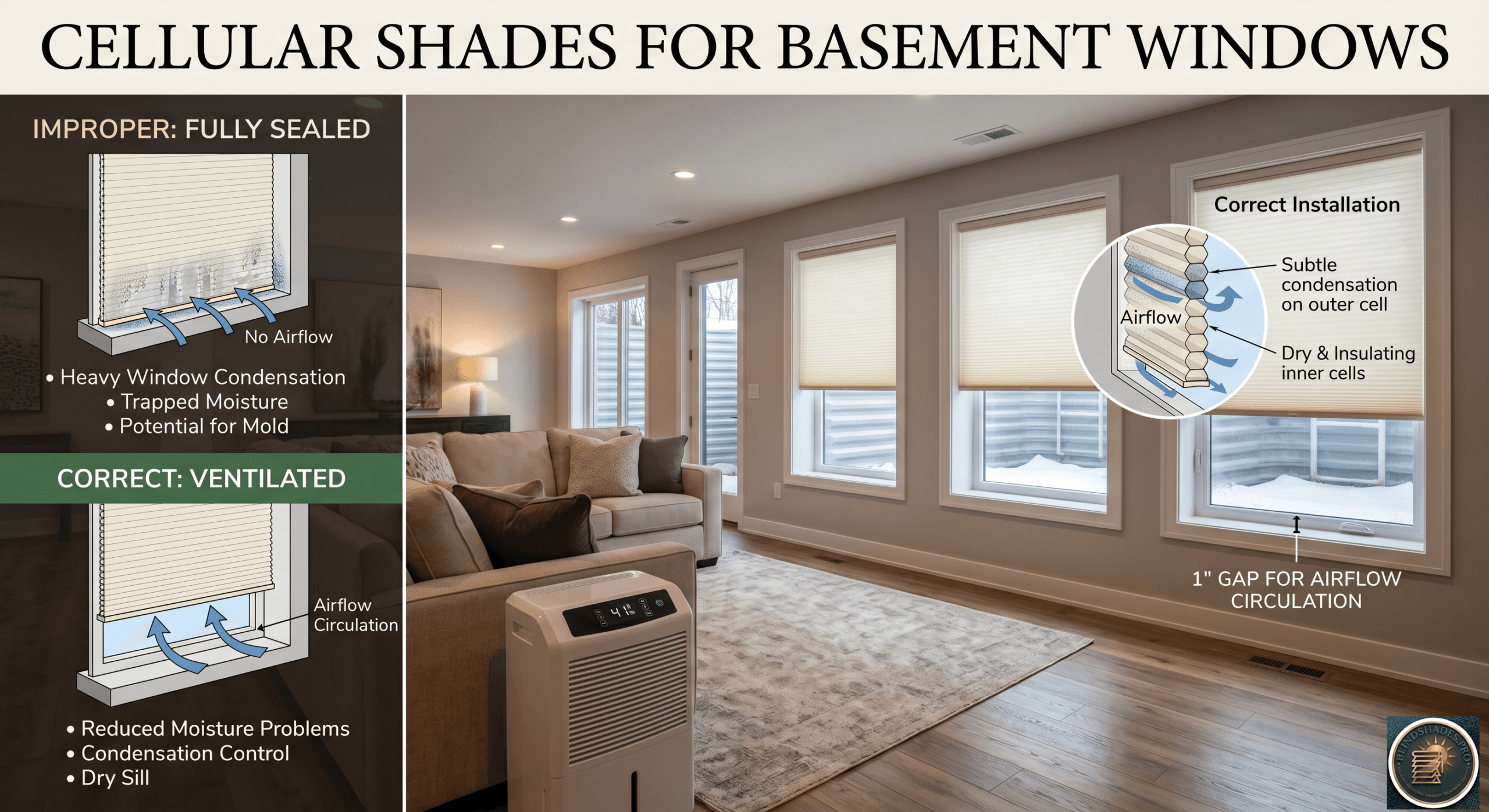
Key Takeaways:
- PNNL-33380 (Pacific Northwest National Laboratory) confirmed that closed cellular shades INCREASE glass condensation by insulating the room-side and allowing the glass to cool further toward exterior temperature — the opposite of what most buyers expect
- Basement cellular shade condensation enters from the GLASS-FACING side (cold glass), not the room-side — moisture accumulates in the outer cell row facing the glass, different from kitchen grease (room-side) and bathroom steam (top-down)
- Specify double-cell construction for basements — the outer cell row contacts the cold glass zone and collects condensation while the inner cell remains dry and continues insulating
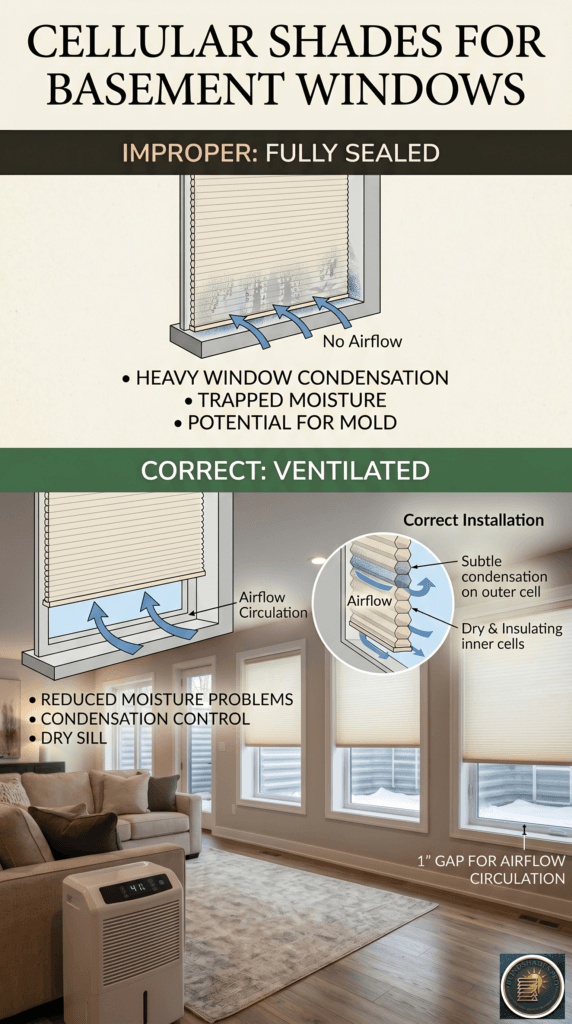
- The PNNL-recommended mitigation: leave a 1-inch air gap at the bottom of the shade (do not close fully to the sill) to allow warm room air to circulate behind the shade and prevent the cold glass microclimate from intensifying
- The correct basement TDBU configuration: lower the top panel for ground-level privacy (cover upper window per Article 46-4 sightline geometry) AND keep the bottom 3 to 6 inches open for PNNL air circulation — both functions simultaneously
⭐ Quick Answer — Are Cellular Shades Good for Basement Windows?
- The PNNL Condensation Paradox — Closing the Shade Makes the Glass Colder: Cellular shades on basement windows are good — but with one critical finding most guides miss. PNNL Report PNNL-33380 (Pacific Northwest National Laboratory, US government study) confirmed that closed cellular shades increase glass condensation by blocking warm room air from reaching the glass. Without the shade, warm room air warms the glass slightly. With the shade closed: room air is blocked; the glass cools further toward exterior temperature (10–12°C year-round in a basement); MORE condensation forms. This effect is worst in basements because the glass is already at the coldest starting temperature of any room in the house
- Condensation Enters From the GLASS-FACING Side — Not the Room Side: Unlike kitchen cellular shade failure (cooking grease enters from the room-facing side during cooking) and bathroom failure (steam descends from above), basement cellular shade condensation enters from the glass-facing side. Cold glass forms condensation droplets that migrate into the glass-facing outer cell row. The mold develops on the invisible side of the shade — visible only when the shade is held up to bright light (dark outer cells = moisture contamination). The room-facing side appears clean while the glass-facing side develops mold for months undetected
- Double-Cell Construction — Outer Cell Takes the Hit, Inner Cell Insulates: For basement window cellular shades, specify double-cell (dual-cell) construction. The outer cell row closest to the cold glass receives condensation; the inner cell row, separated by the outer layer, remains drier and continues insulating. Single-cell: condensation penetrates the entire cell interior. Double-cell: outer cell = condensation buffer; inner cell = clean insulating dead-air layer. R-values: single-cell R-3 to R-4; double-cell R-4.5 to R-6; combined with basement window glass (R-2 to R-3) = R-6.5 to R-9 total with double-cell. A double-cell reducing heat loss from R-2 to R-6.5 cuts window heat loss by approximately 70%
- The PNNL 1-Inch Air Gap — The Non-Negotiable Mitigation: The PNNL study recommends: do not close the cellular shade fully to the sill. Leave a 1-inch air gap at the bottom so warm room air can enter from below, circulate upward behind the shade in a convective loop, slightly warm the glass surface, and prevent the intensified cold microclimate from forming. This 1-inch gap is different from Article 46-1’s 1/4 inch capillary wicking clearance — it is specifically to prevent the PNNL condensation increase. Set the TDBU bottom panel stop position at 1 inch above the sill permanently
- The Dual-Purpose Basement TDBU Configuration: The correct TDBU for basement cellular shades serves two simultaneous functions: top panel LOWERED 12–14 inches from headrail to cover the upper 50–60% of the window (blocking the downward 20–30 degree sightline from a ground-level observer) AND bottom panel RAISED 1 inch above the sill (PNNL air circulation gap). This is the opposite of above-grade TDBU (which raises the bottom for lower-zone privacy). Basement TDBU = top down for privacy + bottom open for condensation management — simultaneously. The RH threshold: below 45% RH confirmed by digital hygrometer (more conservative than the 50% kitchen threshold because the trapped microclimate behind a closed shade approaches 70–80% RH even at ambient 45%)
- Best Sources: PNNL condensation research → PNNL-33380 full report · Basement cellular TDBU guide → Blinds to Go basement guide · Double-cell cellular range → Blindsgalore cellular shades
⚠️ The Zone Verdict and the Window Well Recess Depth Check: The cellular shade basement window zone verdict: Zone B1 finished (below 45% RH): YES — double-cell, moisture-treated, PNNL 1-inch bottom gap, TDBU top-down. Zone B1 (45–55% RH, with active dehumidifier): CONDITIONAL — same spec + monthly condensation check. Zone B3 utility (65–80% RH): NO — aluminium mini blind or PVC vinyl roller only. Zone B5 window well: YES with sizing check — a double-cell cellular shade when raised has a stack depth of approximately 3–4 inches; a typical basement window well window has a recess of only 1.5–2 inches. The raised cell stack will not fit inside the recess. Specify outside mount for window well cellular shades — the headrail mounts above the window frame on the wall surface, and when raised, the cell stack sits on the wall above the glass. Confirm the wall space above the window well window frame is clear before ordering outside mount. For the full basement blind material selection guide by zone and humidity level, see What Are the Best Blinds for Basement Windows. See the full PNNL condensation paradox below.
💡 Egress Compliance for Basement Bedroom Cellular Shades: Cellular shades on basement bedroom egress windows require cordless construction and a smooth-raising mechanism that clears the window with a single upward motion. Cellular shades with stiff fabric tracks that require above-normal force to raise may constitute force beyond what IRC R310 defines as permissible for egress window operation. The 10-second single-hand stress test applies: lower the shade, use one hand without looking, raise and open the window — fully complete in under 10 seconds in the dark. Cellular shades with sticky tracks frequently fail the darkness stage of this test. Specify cordless blackout double-cell cellular for basement bedroom egress windows to satisfy three requirements simultaneously: egress compliance (cordless single-motion raise), blackout for sleeping, and condensation management (double-cell construction). This is the only specification satisfying all three basement bedroom cellular requirements at once. For the full egress window treatment compliance guide including the legal liability framework, see What Window Treatments Work With Egress Windows. See the full dual-purpose TDBU configuration below.
📖 Read the complete guide below for: the PNNL-33380 condensation paradox (closed shade insulates room-side; glass cools further; MORE condensation forms), the basement condensation direction (glass-facing side — mold develops on invisible side), the double-cell outer-cell buffer mechanism (outer takes condensation; inner insulates; R-4.5 to R-6), the PNNL 1-inch bottom air gap mitigation (distinct from 1/4 inch capillary wicking clearance), the R-value table (single R-3/R-4; double R-4.5/R-6; combined with basement glass R-6.5/R-9; 70% heat loss reduction), the basement RH threshold below 45% and why it is more conservative than the 50% kitchen threshold, the dual-purpose basement TDBU configuration (top panel DOWN for sightline privacy + bottom panel 1-inch OPEN for PNNL air circulation), and the window well recess depth check (double-cell raised stack 3–4 inches vs typical 1.5–2 inch recess requires outside mount).
Related guides: for grade-level glass where passersby sit at or above the window, top down bottom up shades solve the sightline with geometry.
Cellular Shades for Basement Windows – The PNNL Condensation Paradox
Definition: A cellular shade, also called a honeycomb shade, is a fabric window treatment with a pleated cross-section forming enclosed air pockets that trap still air, creating a thermal insulating barrier between the window glass and the room interior.
The PNNL research finding every buyer needs to know:
Pacific Northwest National Laboratory (PNNL) Report PNNL-33380: “Evaluation of the Thermal and Moisture Performance of Interior Window Insulating Attachments” documents that insulating window coverings such as cellular shades can increase the potential for moisture to condense on the inside surface of the glass in winter.
Why this happens – the physics:
Without a cellular shade, warm room air circulates freely against the window glass, warming the glass surface slightly above the dew point and preventing condensation (or limiting it).
With a cellular shade CLOSED against the window: the shade acts as a thermal barrier between the warm room air and the cold glass. The warm room air no longer reaches the glass to warm it. The glass temperature drops further toward the exterior temperature. The colder the glass surface becomes, the more moisture from the room air condenses on it.
Why this is particularly important for basements:
A basement window glass is already colder than any above-grade window – maintained near ground temperature (10-12 degrees Celsius) year-round by below-grade soil. The PNNL condensation paradox is most severe for basement windows because:
- The glass is already at the coldest starting temperature
- Closing a cellular shade drops the glass temperature even further
- The basement environment already has higher ambient humidity than above-grade rooms
- The combination – colder glass, higher humidity, trapped moisture microclimate – creates ideal mold conditions inside the cellular shade cells
The Basement Condensation Direction – Different From Kitchen and Bathroom
This directional difference is absent from all competitor guides and is fundamental to understanding basement cellular shade failure.
As established in the What Are the Best Blinds for Basement Windows guide:
Kitchen cellular shade failure (Article 47-8): Cooking grease aerosol enters the cells from the ROOM-FACING side during cooking. The outer cell wall exposed to cooking vapour accumulates grease on the room-facing surface. The failure comes from the room.
Bathroom cellular shade failure: Steam rises from the shower and deposits on the top and room-facing surface of the blind. The failure comes from above in the room.
Basement cellular shade failure: Cold glass at 10-12 degrees Celsius causes condensation. Moisture drips or migrates from the GLASS-FACING side into the cells. The PNNL effect intensifies this: closing the shade makes the glass colder, increasing condensation on the glass-facing cell surfaces. The failure comes from the glass side.
The practical implication: A basement cellular shade can appear clean on the room-facing side while accumulating moisture and mold in the glass-facing cells. The mold is on the invisible side, developing for months before it becomes apparent.
The Double-Cell Solution for Basement Condensation Management
Definition: A double-cell (dual-cell) cellular shade has two layers of honeycomb cells bonded together – an outer cell row closest to the window glass and an inner cell row closest to the room.
Why double-cell is the correct basement specification:
Single-cell cellular shade: one cell row spans the full shade depth. When condensation enters from the glass-facing side, it penetrates directly into the single cell interior. The entire cell is contaminated.
Double-cell cellular shade: two cell rows bonded together. The OUTER cell row is closest to the glass and is the first point of condensation contact. The INNER cell row is separated from the glass by the outer cell layer.
The basement advantage: When the PNNL condensation effect causes moisture to form on the cold glass and migrate into the shade:
- Outer cell row: receives the condensation; may show moisture staining and eventual mold on glass-facing surface
- Inner cell row: remains separated from the direct condensation source by the outer cell layer; stays drier; continues to provide insulating dead-air layer
The double-cell construction creates a sacrificial outer zone that takes the condensation impact while the inner zone maintains insulation performance. When the outer cell row becomes contaminated, the shade can be held up to bright light and checked (using the diagnostic from Article 47-8 – dark inner cell interiors indicate grease or moisture contamination).
Additionally: double-cell provides approximately R-4.5 to R-6 insulating value compared to single-cell R-3 to R-4. For the same condensation risk, double-cell delivers more insulation per condensation event.
The PNNL Air Gap Mitigation – The Bottom 1-Inch Rule
This is the most actionable finding from the PNNL research and is absent from all blind guides.
PNNL-33380 tested multiple mitigation strategies for cellular shade condensation in cold conditions. The most effective practical mitigation: allow air circulation between the shade and the glass by not closing the shade fully to the sill.
The recommended air gap: Leave approximately 1 inch between the bottom rail of the cellular shade and the window sill. This 1-inch gap allows warm room air to circulate in a convective loop behind the shade:
- Warm room air enters the gap at the bottom
- Circulates upward behind the shade
- Warms the glass surface slightly
- Prevents the full cold glass microclimate from developing
- Exits back into the room at the top of the shade
The distinction from Article 46-1’s 1/4 inch clearance: Article 46-1 specified 1/4 inch clearance to prevent CAPILLARY WICKING (condensation on the sill wicking upward into the bottom rail). The PNNL 1-inch gap is different – it is specifically to prevent the CONDENSATION INCREASE caused by the shade’s insulating effect. The 1-inch gap satisfies both the anti-wicking requirement (1/4 inch minimum) and the PNNL anti-condensation requirement (1-inch air circulation gap).
Implementation with TDBU: A TDBU cellular shade with the bottom panel held 1 inch above the sill automatically maintains the PNNL air circulation gap without daily manual adjustment. Set the TDBU bottom panel stop position at 1 inch above the sill and leave it there as the permanent operating position.
The Basement TDBU Configuration for Cellular Shades
The basement TDBU configuration serves two simultaneous functions, differently from all other room applications:
Function 1 – Privacy (following Article 46-4 sightline geometry): Lower the TOP panel from the headrail downward to cover the upper 50-60% of the window. This blocks the primary 20-30 degree downward sightline from a ground-level observer, who looks through the UPPER portion of the basement window. This is the opposite of above-grade TDBU guidance (which raises the bottom for lower-zone privacy).
Function 2 – PNNL condensation mitigation: Keep the BOTTOM panel raised 1 inch above the window sill. This maintains the PNNL air circulation gap that prevents the closed-shade cold glass microclimate from intensifying.
The combined basement TDBU position:
- Top panel: lowered 12-14 inches from headrail (covers upper 50-60% of a 24-inch window)
- Bottom panel: raised 1 inch above the sill (maintains PNNL air gap)
- Result: upper window covered for ground-level privacy; lower window has 1-inch air gap for condensation management; light enters through the small lower opening
This is the only basement cellular TDBU configuration that simultaneously addresses privacy and condensation. No other guide provides this dual-function configuration.
The R-Value Case for Basement Cellular Shades
All guides mention energy savings. None quantify the basement-specific R-value benefit.
| Specification | R-Value | Combined with Basement Window Glass (R-2 to R-3) |
|---|---|---|
| No treatment (baseline) | R-0 | R-2 to R-3 total |
| Single-cell cellular shade | R-3 to R-4 | R-5 to R-7 total |
| Double-cell cellular shade | R-4.5 to R-6 | R-6.5 to R-9 total |
| Triple-cell cellular shade | R-6 to R-8 | R-8 to R-11 total |
The basement significance: Basements are typically 10-15 degrees Fahrenheit cooler than the rest of the house in winter. This temperature differential means heat loss through basement windows is proportionally significant even though the windows are small. A double-cell cellular shade reducing heat loss through a basement window from R-2 to R-6.5 is cutting window heat loss by approximately 70%.
However: this R-value benefit is fully realised only when the PNNL condensation problem is managed. A cellular shade with moisture-contaminated cells has a degraded insulation value because moisture-filled cells conduct heat more readily than air-filled cells. The condensation must be managed to maintain the R-value.
The RH Threshold for Basement Cellular
The basement RH threshold for cellular shades is more conservative than for other rooms.
For kitchens (Article 47-8): 50% RH threshold for cellular shade approval.
For basements, the threshold is lower: When a cellular shade is closed against a cold basement window, the microclimate between the shade and the glass becomes significantly more humid than the ambient basement air. At ambient 45-50% RH, the trapped-air microclimate against the cold glass can approach 70-80% RH as moisture is drawn toward the cold glass surface.
The basement cellular RH specification:
- Below 40-45% RH consistently (confirmed with digital hygrometer in summer): cellular shades appropriate with double-cell specification and PNNL 1-inch bottom gap
- 45-55% RH: cellular appropriate only with active dehumidifier running and PNNL air gap; monitor for condensation in first month
- Above 55% RH: not recommended; specify non-porous faux wood Venetian or PVC vinyl roller instead
Summer vs winter threshold: Take the critical measurement in winter (when the glass is coldest and the PNNL effect is most severe). A dehumidified basement that reads 42% RH in winter is at a lower condensation risk than one that reads 48% RH in summer — because the cold glass temperature in winter intensifies the PNNL effect more than the slightly warmer glass in summer.
For the full basement material selection guide by RH level, see Do Basement Blinds Get Moldy.
The Window Well Recess Depth Check
This sizing check is absent from all competitor guides.
Cellular shades in window well windows require a specific recess depth check before ordering:
The cellular shade raised depth: A cellular shade when fully raised stacks the folded cells into a compact bundle at the top of the window. For a 24-inch tall window:
- Single-cell cellular: raised stack approximately 2-3 inches deep
- Double-cell cellular: raised stack approximately 3-4 inches deep
- Triple-cell cellular: raised stack approximately 4-5 inches deep
The window well constraint: Window well windows typically have a shallow recess (the window frame depth from the wall surface to the glass surface). A typical basement window frame may have only 1.5-2 inches of recess depth.
The problem: A double-cell cellular shade with a 3-4 inch raised stack cannot fit inside a 1.5-inch window recess when raised. The shade would protrude beyond the window frame into the room, which is acceptable for operation but aesthetically poor.
The solution: For window well windows with shallow recesses: specify outside mount with the headrail positioned above the window frame on the wall. When raised, the cellular stack sits above the window frame on the wall surface and does not conflict with the window recess or the window well profile. Confirm the wall space above the window frame is clear of obstructions before ordering outside mount cellular for window well positions.
The Verdict Table – Zone-by-Zone Basement Cellular Assessment
| Zone | Humidity | Cellular Appropriate? | Specification |
|---|---|---|---|
| B1 finished living (below 45% RH) | Low | YES | Double-cell, moisture-treated, PNNL 1-inch bottom gap, TDBU top-down configuration |
| B1 finished living (45-55% RH) | Moderate | CONDITIONAL | Same as above + active dehumidifier + monthly condensation check |
| B2 basement bedroom | Varies | YES if below 45% RH | Double-cell blackout cellular + egress-compliant cordless mechanism |
| B3 utility/laundry | 65-80% | NO | Aluminium mini blind or PVC vinyl roller only |
| B4 home theater | Varies | CONDITIONAL | Blackout double-cell if RH below 45%; side channels to eliminate light gap |
| B5 window well | Varies | YES with sizing check | Outside mount (recess depth may be too shallow for inside mount); confirm wall space for headrail |
Where to Order
For double-cell moisture-treated basement cellular (primary Zone B1 specification): Blinds to Go basement cellular guide at blindstogo.com covers the moisture-resistant fabric selection and TDBU configuration for basement cellular shades. Blindsgalore cellular shade range at blindsgalore.com/cellular-shades – specify: double-cell, cordless, moisture-treated fabric, white or off-white, TDBU configuration.
For the condensation science: PNNL Report PNNL-33380 at pnnl.gov provides the full testing documentation for cellular shade condensation effects and mitigation strategies, including the air gap circulation recommendation.
Related guides: For complete buying advice, see our basement window blinds buying guide and thermal and insulated blinds guide.
Frequently Asked Questions
Are cellular shades good for basement windows? Cellular shades are good for basement windows in Zone B1 finished living areas with below 45 percent relative humidity confirmed by digital hygrometer, with three specific requirements. First, specify double-cell construction so the outer cell row takes condensation impact while the inner cell maintains insulation. Second, never close the shade fully to the sill – the PNNL-33380 study recommends leaving a 1-inch air circulation gap at the bottom to prevent the intensified cold glass microclimate caused by the shade’s insulating effect. Third, use TDBU configuration with the top panel down for ground-level privacy and the bottom held 1 inch above the sill for condensation management. For basements above 55 percent relative humidity, specify non-porous faux wood or PVC vinyl instead.
Do cellular shades cause condensation in basements? Closed cellular shades can increase condensation on basement windows. Pacific Northwest National Laboratory Report PNNL-33380 confirmed that insulating window attachments such as cellular shades increase the potential for moisture to condense on the inside of the glass by blocking warm room air from reaching and warming the glass surface. In a basement where the glass is already cold from below-grade ground temperature at approximately 10 to 12 degrees Celsius, this intensified condensation effect can cause moisture to enter the glass-facing cells of the cellular shade from the cold glass side. The PNNL mitigation is to leave a 1-inch air circulation gap at the bottom of the shade so warm room air can circulate behind the shade and prevent the glass from cooling excessively.
Why is double-cell cellular shade better than single-cell for basement windows? Double-cell cellular shades are better than single-cell for basement windows because they create a two-layer structure where the outer cell row closest to the cold glass receives the condensation impact while the inner cell row remains separated from the direct condensation source and continues providing insulating dead-air. With single-cell construction, condensation entering from the glass side penetrates the entire cell interior. With double-cell, the outer cell acts as a condensation buffer for the insulating inner cell. Double-cell also provides R-4.5 to R-6 insulating value compared to single-cell R-3 to R-4, so for the same condensation management effort, double-cell delivers more insulation.
What is the PNNL air gap for cellular shades in basements? The Pacific Northwest National Laboratory (PNNL) recommended air gap for cellular shades in cold conditions is approximately 1 inch between the bottom rail of the shade and the window sill. This gap allows warm room air to enter from below, circulate upward in a convective loop between the shade and the glass, slightly warm the glass surface, and exit back into the room above the shade. This circulation prevents the glass from cooling as severely as it does when the shade is fully closed to the sill, reducing the condensation effect documented in PNNL Report PNNL-33380. For basement TDBU cellular shades, set the bottom panel stop position at 1 inch above the sill as the permanent operating position.
Can cellular shades be used in a basement bedroom egress window? Cellular shades can be used on basement bedroom egress windows if they are cordless construction with a TDBU mechanism that can be raised fully with a single upward motion to clear the window opening. Standard corded cellular shades may not satisfy the IRC R310 requirement that the window be operable without tools or special knowledge. Cellular shades with sticky fabric tracks may require above-normal force to raise, which could also be non-compliant. Test the egress compliance using the 10-second single-hand stress test described in the egress window treatment guide. Specify cordless blackout double-cell cellular for basement bedrooms to satisfy egress compliance, blackout for sleeping, and condensation management simultaneously.
Related Guides on BlindShades.pro
- The Best Basement Window Blinds and Shades Buying Guide
- What Are the Best Blinds for Basement Windows
- Do Basement Blinds Get Moldy
- What Window Treatments Work With Egress Windows
- How Do You Add Privacy to Ground-Level Basement Windows
By Michael Turner | 30 Years Home Improvement Expertise | Updated 2026 | BlindShades.pro
