How Do You Add Privacy to Ground-Level Basement Windows?

Authored By Michael Turner -30 Years Home Improvement Expertise | Updated 2026 | BlindShades.pro
Updated on May 26, 2026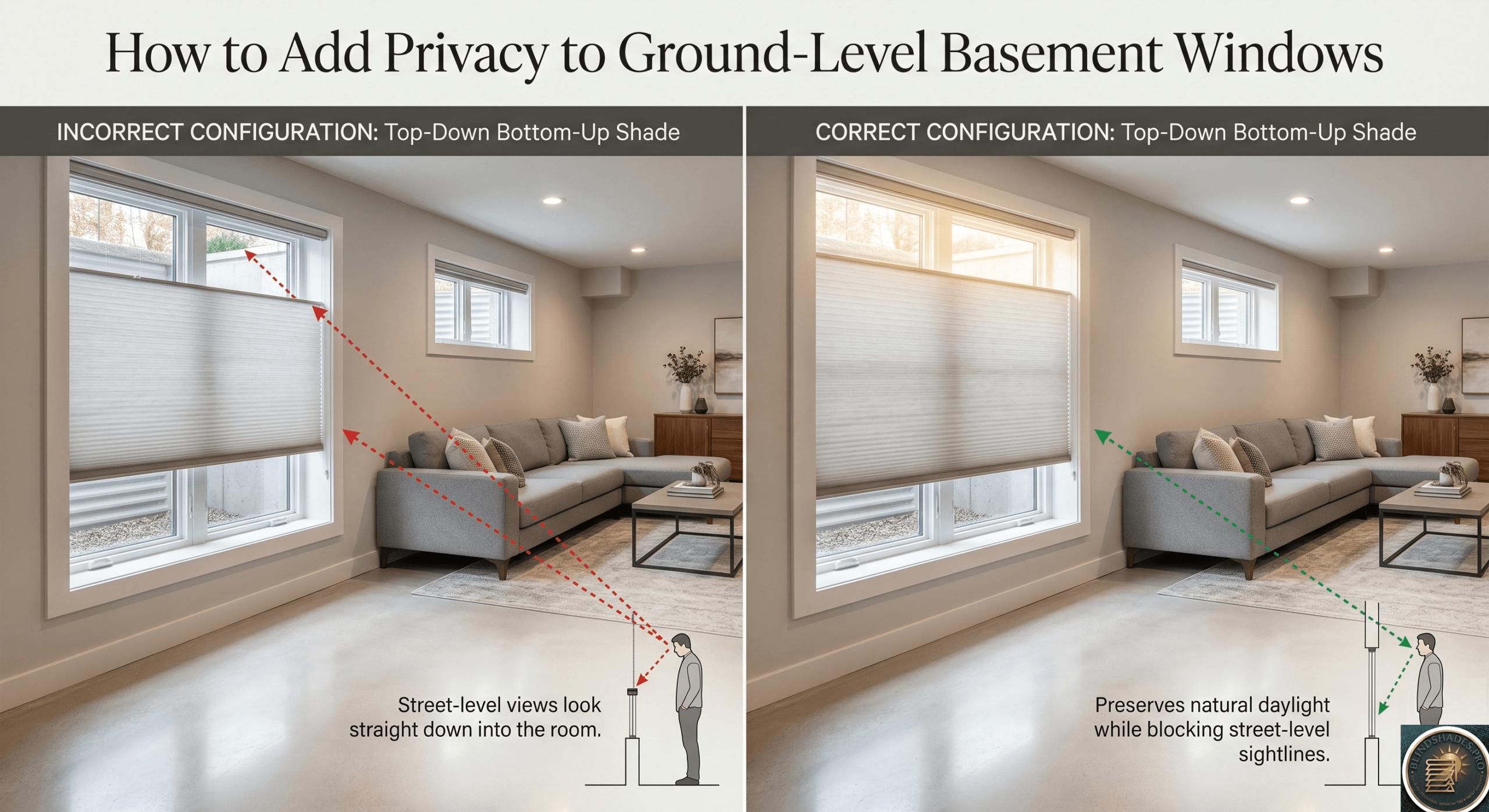
⭐ Quick Answer — How Do You Add Privacy to Ground-Level Basement Windows?
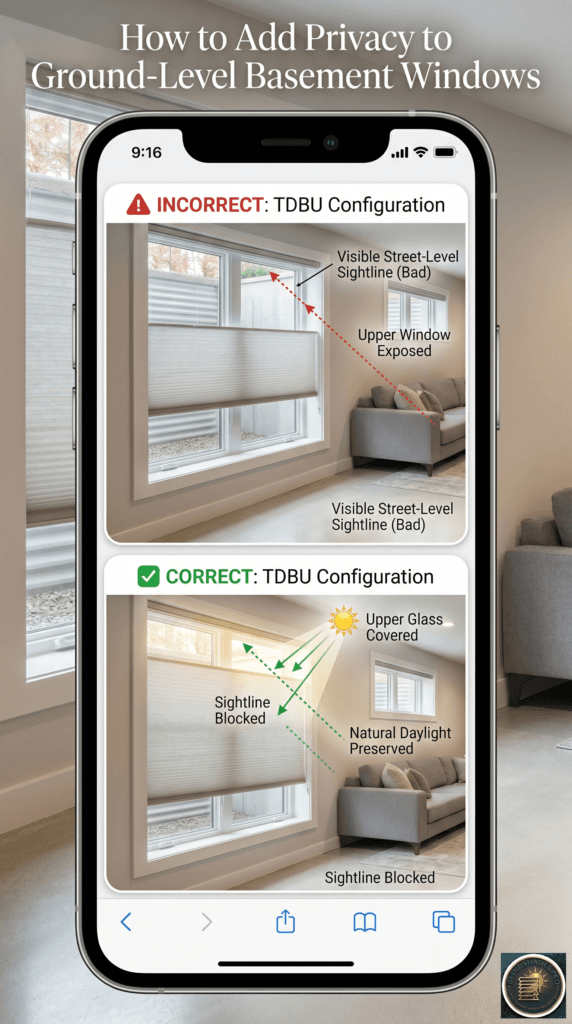
- The Standard Advice Is Backwards — Cover the Top, Not the Bottom: For basement window privacy at ground level, every guide recommends raising the bottom of a TDBU shade to cover the lower half. This is wrong for basement windows. A standing observer at grade (60–66 inches tall) looking toward a basement window with its top at only 18–24 inches above grade must look DOWN at 20–30 degrees. This sightline enters through the UPPER portion of the window — not the lower portion. Cover the top 50–60% of the window by lowering the TDBU top panel from the headrail; leave the lower portion open for light
- The Correct TDBU Configuration for Basement Windows: Above-grade windows: raise the bottom panel to cover lower sightlines (standard advice, correct). Basement windows: lower the TOP panel from the headrail to cover the upper 50–60% of the window. For a 24-inch tall basement window: balanced privacy = top panel lowered 12–14 inches; lower 10–12 inches open for light. Maximum privacy = top panel lowered 18–20 inches; narrow 4-inch light strip at the bottom. This blocks the actual 20–30 degree downward sightline angle from a street-level observer
- Solar Shades Fail at Night — The Luminance Reversal: Solar shades work for daytime ground level basement window privacy because bright exterior light prevents interior visibility. After dark: interior artificial lights (100–500 lux) are brighter than the dark exterior (0–5 lux). The luminance differential reverses — the solar shade becomes a glowing display. Any basement living area or bedroom used in the evening requires a secondary blackout layer: dual roller (solar shade + blackout behind), TDBU faux wood with closeable slats, or PDLC smart film that switches opaque at night
- 4 Solutions Ranked by Light Preservation: (1) TDBU top-down — 40–60% of window area open; best light. (2) Solar shade 1–3% — transmits 85–97% of daylight; daytime privacy only; needs night layer. (3) Frosted film on upper portion — upper portion frosted, lower clear; day and night privacy; permanent. (4) PDLC smart film ($50–$100/sq ft) — transparent by day for full light; opaque at night by switch; best for basement bedrooms. (5) Light-filtering roller full window — reduced light, full coverage
- The Window Well Night Light Trap: A basement window well concentrates interior light in the enclosed well cavity at night, making the window appear as a brightly lit cylinder visible from above — more visible than a flat ground-level window. Semi-transparent treatments are significantly more privacy-compromising on window well windows at night. Specify closeable treatments — faux wood Venetian slats fully closed, or blackout roller — for any window well window used in the evening
- Best Sources: Basement privacy without losing light → Blinds Toronto basement privacy guide · Dual roller day/night system → Boca Blinds ground floor guide · TDBU cellular for basement → Blindsgalore TDBU range
⚠️ The Sightline Geometry Calculation and Why the Upper Window Is Always Exposed: The exact sightline angle for basement window privacy at ground level can be calculated for your specific window. Take the observer’s eye height (approximately 62 inches for an average adult) and subtract the window top height above exterior grade. Divide the result by the horizontal distance from the observer to the window: tan(angle) = (62 inches – window top height) / horizontal distance. For a window with its top at 20 inches above grade and an observer at 5 feet (60 inches) distance: tan(angle) = (62 – 20) / 60 = 0.70, giving approximately 35 degrees downward. At that steep angle, the sightline enters aggressively through the upper window and illuminates the basement floor and lower walls most clearly. Increasing the horizontal distance (stepping back from the window) reduces the angle — this is why the landscaping augmentation works: a 12–18 inch hedge 18–24 inches from the window well perimeter forces the observer back, reducing the sightline angle by 5–10 degrees and narrowing the visible interior zone. Combined with a TDBU top panel covering the upper window, this creates layered privacy without blocking any direct daylight path. For the full material guide for moisture-resistant basement window treatments, see What Are the Best Blinds for Basement Windows. See the full sightline geometry below.
💡 PDLC Smart Film — The Best Solution for Basement Bedrooms Requiring Full Day and Night Privacy: For basement bedroom windows at ground level that need maximum natural daylight during the day AND complete privacy at night, PDLC (Polymer Dispersed Liquid Crystal) smart film is the premium solution that no guide covers for basements. Applied to existing window glass, PDLC film switches between fully transparent (clear glass, maximum light, zero privacy) and fully opaque (frosted appearance, complete privacy) via a wall switch, app, or voice command. During the day: switch transparent for full natural light — more light than any blind specification. At night: switch opaque for complete privacy — no luminance reversal problem because the opacity is physical, not dependent on luminance differential. Cost: $50–$100 per square foot installed. For a typical 24×16 inch basement window: approximately $133–$267 total. For a basement bedroom where the window treatment is a long-term installation and the dual challenge of daylight + night privacy is paramount, this cost is comparable to a premium blind specification. For egress compliance requirements for basement bedroom windows (the PDLC film cannot reduce the emergency opening size), see What Window Treatments Work With Egress Windows. See the full night privacy reversal guide below.
📖 Read the complete guide below for: the sightline geometry of ground-level basement windows (observer height, window top height, horizontal distance, angle calculation), the correct TDBU configuration (lower top panel — not raise bottom panel), the privacy zone coverage table for a 24-inch window at different top-panel positions, four solutions ranked by light preservation (TDBU / solar shade / frosted film / PDLC smart film / light-filtering roller), the night luminance reversal mechanism and why solar shades fail after dark, the window well night light trap effect, the landscaping augmentation solution (hedge height and setback calculation), and privacy film options (frosted / one-way mirror / PDLC electrochromic).
Basement Window Privacy at Ground Level – The Sightline Geometry
Definition: A sightline is the unobstructed line of sight from an observer to a specific point. For basement window privacy, the relevant sightline is the path a ground-level observer’s vision travels from their eye position outside the window to the interior of the basement.
The key geometry most guides miss:
A basement window is partially or fully below grade. A standard basement window has its sill at approximately ground level (0-12 inches above finished grade) and its top at 12-24 inches above grade. An adult standing at grade level 3-6 feet from this window:
- Eye height: approximately 60-66 inches above finished grade (5 to 5.5 feet)
- Window top: approximately 18-24 inches above finished grade
- The sightline angle: the observer’s eye at 62 inches (taking average) looking toward a window top at 20 inches must look DOWN at an angle of approximately 20-30 degrees
Where the sightline enters the window:
Because the observer is looking DOWNWARD, their sightline enters through the UPPER portion of the basement window. This downward sightline then illuminates:
- The basement interior floor (most visible)
- The lower walls of the basement interior
- Any person sitting or lying on the basement floor
- The lower portion of furniture
A person standing in the basement near the window is at approximately 60-66 inches above the BASEMENT FLOOR, which is typically 48-72 inches below grade. From the observer’s perspective, the standing basement occupant’s head appears near the top of the window (close to grade) – making them LESS visible than the floor and lower walls.
The practical implication: The most visually exposed area of a ground-level basement window is the UPPER portion – not the lower portion as most guides state. Covering the lower half of a basement window (as TDBU-raise-from-bottom recommends) blocks the view of the floor from above but does NOT block the direct sightline of a pedestrian looking at the window from head height.
The correct coverage: Cover the UPPER 50-60% of the basement window to block the primary sightline angle from a standing ground-level observer. Leave the lower portion open for light entry.
The Correct TDBU Configuration for Basement Windows
This is the single most important correction to standard basement window privacy advice.
Standard TDBU guidance (for above-grade windows): Raise the bottom panel of the TDBU shade upward to cover the lower portion of the window, leaving the upper portion open for sky light. This works for above-grade windows because exterior observers at the same floor level look horizontally or slightly downward into the window – the lower zone is the primary sightline.
Basement TDBU guidance (opposite): Lower the TOP panel of the TDBU shade DOWNWARD from the headrail to cover the upper portion of the window, leaving the lower portion open for light entry. This blocks the actual downward sightline angle from a ground-level observer.
Configuration guide for a 24-inch tall basement window:
| Privacy Level | Top Panel Position | Bottom Panel Position | What Is Covered |
|---|---|---|---|
| Maximum privacy | Top panel lowered 18-20 inches | Bottom panel at sill | Upper 75-85% covered; narrow light strip at bottom |
| Balanced privacy + light | Top panel lowered 12-14 inches | Bottom panel at sill | Upper 50-60% covered; lower half open for light |
| Light priority | Top panel lowered 6-8 inches | Bottom panel at sill | Only top quarter covered; blocks primary sightline at window top |
| No privacy | Top panel at headrail | Bottom panel at sill | Full window open |
For a 24-inch window: the balanced configuration covers the top 12-14 inches, leaving 10-12 inches of clear lower window for light entry. The covered upper zone blocks the primary sightline angle from a standing ground-level observer.
For cellular TDBU specification for basement windows with humidity considerations, see Are Cellular Shades Good for Basement Windows.
The Four Privacy Solutions Ranked by Light Preservation
All competitor guides recommend multiple privacy solutions without ranking them by light preservation. In a basement where natural light is already limited, how much light each solution blocks is the primary selection criterion.
Solution 1 – TDBU Shade Lowered From Top (Best Light Preservation)
Light preserved: 40-60% of window area remains open Privacy: Blocks primary downward sightline during daytime Adjustability: Full adjustment throughout the day Best material for basement: Moisture-treated cellular or faux wood Venetian Night privacy: Requires secondary blackout layer – see night privacy section below
Solution 2 – Solar Shade (1-3% Openness) Full Window
Light preserved: 85-97% of visible light (solar shades transmit most light) Privacy: Daytime one-way privacy through luminance differential Adjustability: Full raise/lower; adjust opacity level with product selection Best openness for basement: 1-3% (tighter weave = more privacy at cost of light) Night privacy: FAILS at night – luminance differential reverses; pair with secondary blackout
Solar shades transmit the most light of any privacy solution. At 1-3% openness, the weave is tight enough to obscure interior detail while transmitting 85-97% of the available daylight.
Solution 3 – Frosted Film Lower Portion (Good Light Preservation with Night Privacy)
Light preserved: Upper clear zone transmits 100%; frosted zone transmits 70-80% Privacy: Day and night – frosted glass provides two-way obscuring Adjustability: None – permanent installation Night privacy: YES – frosted film works in both directions at all times; does not fail at night
For a ground-level basement window: apply frosted film to the LOWER half of the window (the half nearest the ground) while leaving the upper half clear. Wait – this contradicts the sightline analysis above. For a BELOW-GRADE basement window where the sightline enters from above: apply frosted film to the UPPER portion of the window to block the incoming sightline, while leaving the lower half clear for light. For windows at grade level (not below grade): apply to the lower portion.
The correct frosted film application:
- Fully below-grade basement window (sill at grade): frosted film on UPPER portion
- Window with sill at grade and top above grade: frosted film on UPPER portion (blocks head-height sightline)
- Window well window: frosted film on full window (multiple sightline angles from above)
Solution 4 – Smart PDLC Electrochromic Film (Premium, Best Day + Night Solution)
Definition: Smart film (PDLC – Polymer Dispersed Liquid Crystal) is a film applied to existing glass that switches between transparent and opaque states via electrical current, controlled by a wall switch, app, or voice command.
Light preserved: 100% when transparent; near-zero when opaque Privacy: Fully adjustable for any time of day or night Adjustability: Instantaneous switch between transparent and opaque Night privacy: Complete when in opaque mode Cost: $50-$100 per square foot installed (premium specification) Best for: Basement bedroom windows where daytime light and nighttime full privacy are both required
For a basement bedroom window that needs full daylight transparency during the day and complete privacy at night, smart film provides the ideal solution: transparent during the day for maximum light, opaque at night for full privacy – controlled by a switch or linked to the room lighting circuit.
Solution 5 – Light-Filtering Roller Shade or One-Way Mirror Film
Light preserved: 40-70% (light-filtering); 50-60% (one-way mirror) Privacy: Daytime; one-way mirror film provides reflective exterior surface Night privacy: One-way mirror film fails at night (same luminance reversal as solar shades)
The Night Privacy Reversal – The Problem Most Guides Ignore
This is the single most important basement window privacy consideration for inhabited rooms used in the evening.
The daytime luminance differential: During daylight hours, the exterior light intensity is significantly higher than interior artificial light. When looking from bright exterior toward a darker interior through a semi-transparent treatment (solar shade, 1-way mirror film), the brightness differential prevents clear sightline penetration. The observer sees reflected exterior light rather than the transmitted interior image.
The night luminance reversal: After dark, the exterior light intensity drops dramatically. Interior artificial lighting (typically 100-500 lux for a living space) becomes brighter than the dark exterior (typically 0-5 lux on a residential street). The luminance differential reverses: now the INTERIOR is brighter than the EXTERIOR.
The practical consequence: A solar shade that provides adequate daytime privacy becomes a glowing display case at night, illuminating the interior for any exterior observer. A 3% openness solar shade on a lit basement living room at 10pm is effectively transparent from the outside.
The solution: Any basement window in a habitable room used in the evening requires a secondary blackout layer in addition to any daytime privacy treatment:
- Dual roller system: solar shade for daytime + blackout roller behind it for nighttime
- TDBU faux wood Venetian blind: fully closeable slats for nighttime + TDBU top-down configuration for daytime
- PDLC smart film: single solution for both day and night with switch control
The Window Well Privacy Special Case
This specific analysis is absent from all competitor guides.
A basement window with a window well creates a different privacy geometry than a flat ground-level window.
The window well sightline: A window well is a curved metal or concrete enclosure that surrounds a below-grade window. Its top edge is at grade level. An observer must approach to the edge of the window well and look DOWN into the well to see the window directly.
The window well privacy characteristics:
- Street-level horizontal view: The window well wall blocks direct horizontal sightlines. A pedestrian on a pavement does not have direct horizontal view into the window – they must approach and lean over the well edge.
- Downward view from adjacent height: A person on an upper floor of an adjacent building looks directly down into the window well, with a clear vertical sightline into the window. The window well effectively frames the window as a clearly visible element from above.
- Night light trap: Interior light escaping through the window into the window well concentrates in the enclosed space, creating a brightly lit cylinder that is highly visible at night from any elevated position, from garden level, and from anyone approaching the well edge.
Window well privacy specification:
- Daytime: TDBU shade lowered from top to cover the upper portion; window well wall provides lateral privacy from pedestrian-level sightlines
- Nighttime: blackout roller or closeable faux wood slats required – the window well light trap effect makes semi-transparent treatments significantly more privacy-compromising than on a flat ground-level window
The Landscaping Augmentation
This solution for basement window privacy at ground level is absent from all competitor blind guides.
Ground-level basement windows can have their privacy significantly improved through low landscaping that increases the horizontal separation between the public space and the window, forcing any observer to be closer to the window well before the downward sightline angle becomes steeper.
Practical landscaping for basement window privacy:
- Low dense hedge (box hedge, yew, dwarf privet) at 12-18 inches height planted at or just inside the window well perimeter creates a visual barrier at pavement level
- A hedge 18 inches tall planted 18-24 inches from the window well edge forces a standing observer to be at the hedge line to see over it and into the well – adding 18-24 inches of horizontal separation
- This horizontal separation reduces the downward sightline angle by approximately 5-10 degrees, reducing the interior visible zone through the window
- For planted window well surrounds: confirm that plant roots do not disturb the window well drainage or waterproofing
The combined solution: Low hedge (creates initial barrier) + TDBU shade lowered from top (covers the residual exposed upper window zone) + blackout secondary layer (night privacy) = complete ground-level basement window privacy in a dehumidified Zone B1 basement.
For material selection for the blind component of this specification, see What Are the Best Blinds for Basement Windows.
The Full Solution Matrix
| Scenario | Primary Solution | Night Coverage | Light Rating |
|---|---|---|---|
| Finished basement living area | TDBU shade top-down + solar day configuration | Secondary blackout roller | ★★★★☆ |
| Basement bedroom | PDLC smart film + blackout blind | PDLC opaque mode | ★★★★★ |
| Window well window | Faux wood Venetian with closeable slats | Close slats fully | ★★★☆☆ |
| Rental suite basement | Solar 1-3% + secondary blackout | Blackout deployed | ★★★★☆ |
| Utility basement (Zone B3) | Aluminium mini blind + frosted film lower half | Close blind | ★★★☆☆ |
| Egress bedroom window | Cordless TDBU – must not impede egress opening | Secondary inside track | Must maintain IRC opening |
Where to Order
For TDBU cellular shade (basement top-down configuration): Blindsgalore TDBU cellular shade – see blindsgalore.com/cellular-shades/top-down-bottom-up. Specify: cordless, moisture-treated fabric, white or off-white. Set the top panel in the down position (lowered from headrail) for basement sightline configuration.
For the general basement privacy approach: Blinds Toronto basement privacy guide at blindstoronto.ca covers the zone-specific approach with custom fitting options. Boca Blinds ground floor privacy guide at bocablinds.com provides the dual-roller solar/blackout system specification for day and night coverage.
Frequently Asked Questions
How do you add privacy to ground-level basement windows? The most effective way to add basement window privacy at ground level is to lower the top panel of a TDBU shade to cover the upper portion of the window – not raise the bottom panel as standard advice recommends. A ground-level observer looking down into a basement window at 20 to 30 degrees angle sees through the upper portion of the window, not the lower portion. Covering the upper 50 to 60 percent of the window blocks the primary sightline while leaving the lower portion open for light entry.
Should basement window blinds cover the top or bottom half for privacy? Basement windows require the top half to be covered for effective privacy, not the bottom half as most guides recommend. A standing observer at street grade at 60 to 66 inches height looking down into a below-grade basement window at approximately 20 to 30 degrees angle has their sightline enter through the upper portion of the window. A TDBU shade lowered from the top to cover the upper 50 to 60 percent of the window blocks this primary sightline angle. Standard above-grade TDBU guidance (raise from bottom) is correct for main-floor windows but is backwards for basement windows.
Do solar shades provide privacy at night for basement windows? Solar shades do not provide privacy at night for basement windows. During daytime, the bright exterior luminance prevents clear views through the semi-transparent solar shade weave. After dark, interior artificial lighting is brighter than the exterior, reversing the luminance differential and making the interior visible through the solar shade from outside. Any basement window in a habitable room used in the evening requires a secondary blackout layer – a dual roller system with a blackout shade behind the solar shade provides complete night privacy.
Why are basement window wells harder to make private at night? Window wells create a light trap effect at night. Interior light escaping through the basement window into the enclosed window well concentrates in the cylindrical space, making the window appear as a brightly lit cylinder that is more visible from outside at night than a flat ground-level window. Any semi-transparent window treatment on a window well window is significantly more visible at night than the same treatment on a flat wall window. Specify closeable treatments such as faux wood Venetian blinds or blackout rollers for window well windows to eliminate the night light trap.
Can landscaping improve basement window privacy? Yes – low dense hedges planted at 12 to 18 inches height at or just inside the window well perimeter increase the horizontal separation between a pedestrian and the window, reducing the available downward sightline angle into the basement. A hedge 18 inches tall planted 18 to 24 inches from the window well edge forces a standing observer to approach the hedge to see over it and into the well. This horizontal separation reduces the interior visible zone and is most effective when combined with a TDBU shade covering the upper window zone for residual privacy.
Related Guides on BlindShades.pro
- The Best Basement Window Blinds and Shades Buying Guide
- What Are the Best Blinds for Basement Windows
- What Window Treatments Work With Egress Windows
- Are Cellular Shades Good for Basement Windows
- What Are the Best Window Treatments for a Basement Bedroom
By Michael Turner | 30 Years Home Improvement Expertise | Updated 2026 | BlindShades.pro
