What Are the Best Window Treatments for a Basement Bedroom?

Authored By Michael Turner -30 Years Home Improvement Expertise | Updated 2026 | BlindShades.pro
Updated on May 27, 2026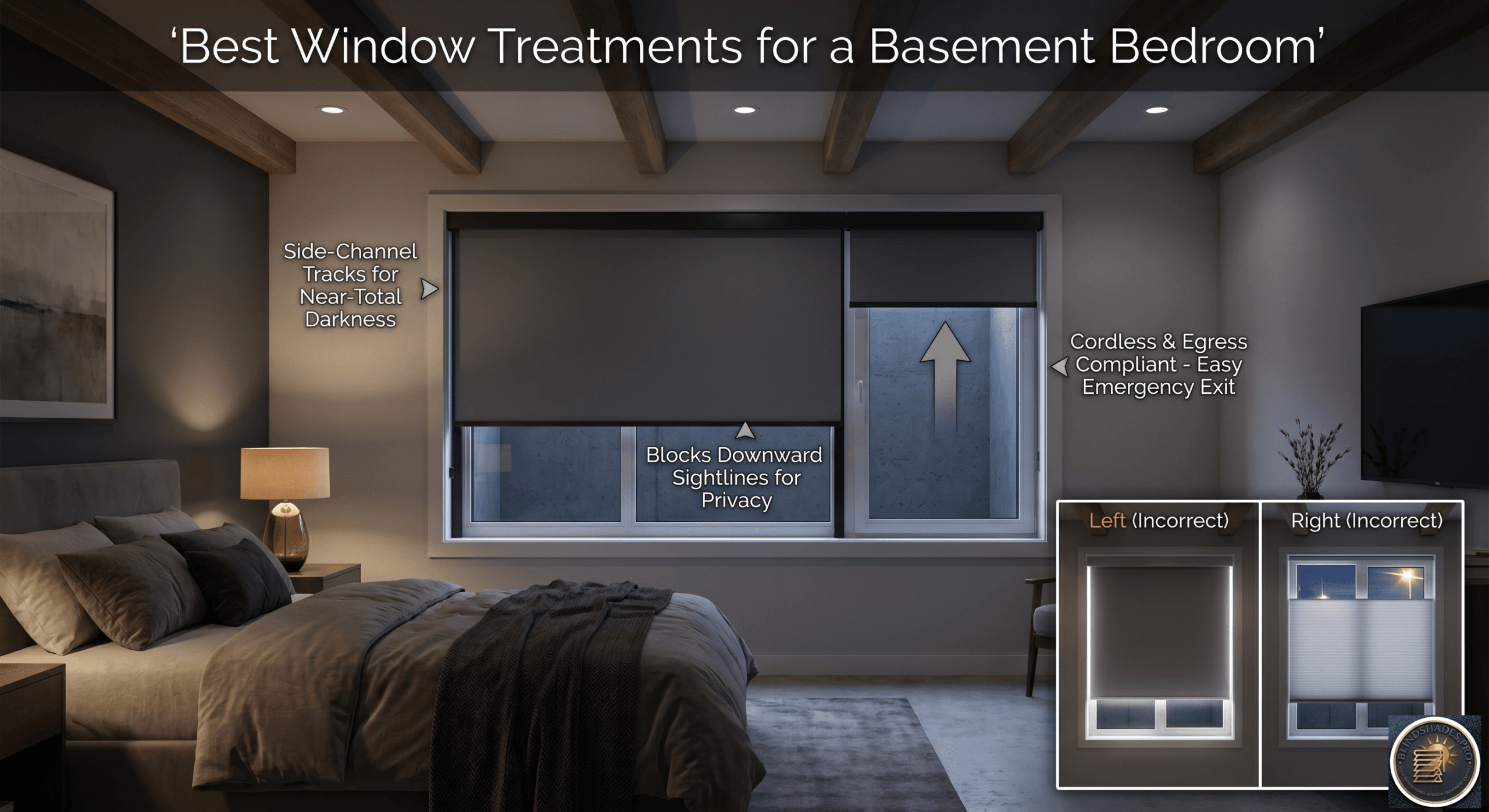
Key Takeaways:
- Basement bedroom window treatments must satisfy three simultaneous requirements: egress compliance (IRC R310 single-motion clearance), true blackout for sleep quality, and ground-level privacy using TDBU top-down configuration — no guide frames all three together
- Human sleep is disrupted by as little as 10 lux; “room darkening” treatments (90-95%) allow 10-80 lux through a basement window at morning peak — only true blackout (99%+) at the fabric plus side channels to eliminate the perimeter gap provides adequate sleep-grade darkness
- The perimeter light gap around a standard inside-mount blackout roller shade creates a visible ring of light even with 99% blackout fabric — side-channel track systems eliminate this gap for true blackout
- East-facing basement bedroom windows are the most challenging: low-angle morning sun from sunrise penetrates deeply into the room at 10-20 degrees and reaches the sleeping position before 7am in summer — side channels are most critical here
- A blackout double-cell cellular shade satisfies three basement bedroom functions simultaneously: blackout for sleep, R-4.5 to R-6 thermal insulation for the consistently cooler basement room, and 10-15 dB sound attenuation from street-level pedestrian activity
⭐ Quick Answer — What Are the Best Window Treatments for a Basement Bedroom?
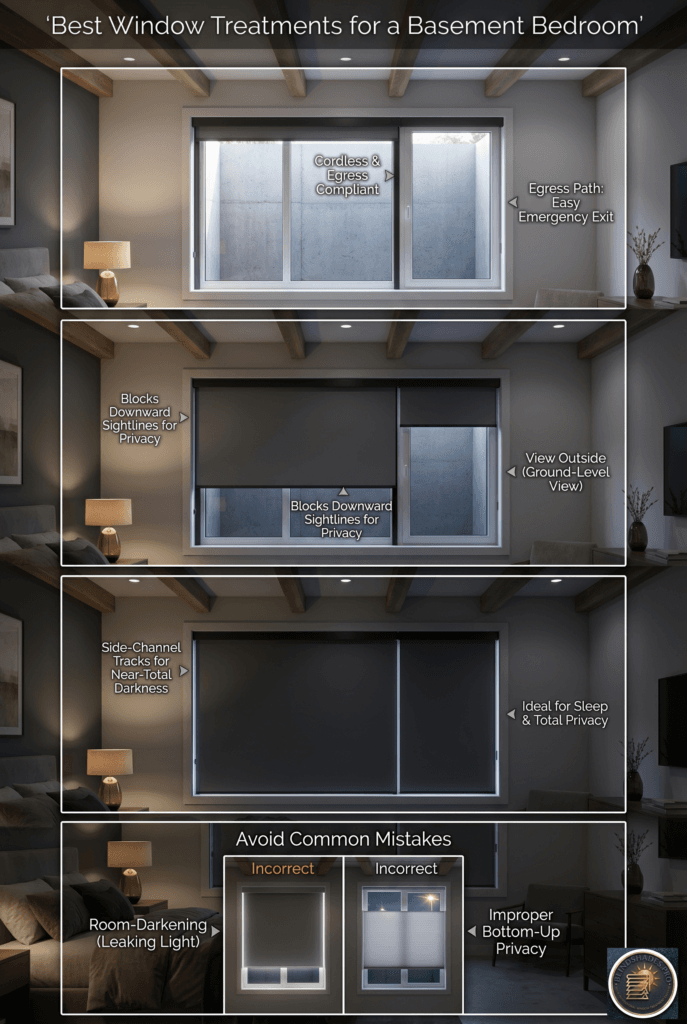
- The Triple Requirement — No Guide Frames All Three Together: The best basement bedroom window treatments must satisfy three simultaneous requirements. (1) Egress compliance (IRC R310): treatment must clear the window with a single cordless upward motion — Roman shade cords and sticky cellular tracks are non-compliant. (2) True blackout (99%+): not room-darkening — human sleep is disrupted by as little as 10 lux; room-darkening at 90–95% allows 10–50 lux through a morning basement window, at or above this threshold. (3) TDBU top-down sightline privacy: lower the TOP panel (not raise the bottom) — the 20–30 degree downward sightline enters through the UPPER window zone
- Why Room-Darkening Is Not Enough for a Basement Bedroom: Every guide recommends “room-darkening” for basement bedrooms. Room-darkening blocks 90–95% but allows 5–10% light transmission. On an east-facing basement window with 300–500 lux of morning sun: 15–50 lux enters the room. Sleep research confirms circadian disruption begins at 10 lux — meaning room-darkening is at or above the disruption threshold all morning. True blackout (99%+) allows only 1.5–5 lux — well below the threshold. For shift workers, infants, and anyone sleeping past sunrise in a basement bedroom: true blackout is the only adequate specification
- The Perimeter Light Gap — Why Side Channels Are Essential: A standard inside-mount blackout roller shade has 1/4 to 1/2 inch gaps at the sides and bottom. On a 24×16 inch basement window, the gap perimeter area is approximately 40 square inches — about 10% of the total glass area. Even 99% blackout fabric leaves effective room blackout at only 90% when accounting for perimeter gaps. In the morning, east-facing low-angle light floods through these side gaps as a visible rectangle of light around the shade. Side-channel track systems run the shade fabric within channels attached to the frame sides, eliminating the side gap entirely and achieving near-complete perimeter blackout
- Blackout Cellular vs Blackout Roller — Why Cellular Wins in Basement Bedrooms: Both satisfy egress and blackout when cordless. But for basement bedroom window treatments, blackout double-cell cellular adds three further benefits a roller shade cannot provide: R-4.5 to R-6 thermal insulation for the consistently 5–10°F cooler basement room; 10–15 dB sound attenuation from street-level pedestrian and traffic noise (10 dB = perceived halving of loudness); and PNNL-compliant double-cell construction for the cold glass condensation environment. A sleeping occupant in a cold, street-level basement bedroom benefits from all three simultaneously — blackout roller delivers only one
- East-Facing Basement Bedroom — The Highest-Risk Specification: Low-angle morning sun enters an east-facing basement bedroom window at just 10–20 degrees above horizontal from sunrise — a near-horizontal beam that penetrates deepest into the room and reaches the sleeping occupant’s position before 7am in summer. This makes east-facing basement bedrooms the most demanding blackout specification: true blackout fabric (99%+) AND a side-channel track system are both mandatory. Motorized blackout cellular with a scheduled raise at 8am provides automated morning sleep protection. North-facing windows (diffuse only, 50–200 lux) have the lowest risk and may not require side channels
- Best Sources: Sleep and light disruption science → Sleep Foundation light and sleep guide · Cordless blackout with side channels → SelectBlinds cordless blackout range · Blackout double-cell cellular → Blindsgalore blackout shades
⚠️ The Legal Bedroom Status Warning and the Ventilation Double Function: The choice of basement bedroom window treatment affects more than sleep quality. A non-egress-compliant window treatment on a basement bedroom window may affect the room’s legal classification as a bedroom in a home sale — inspectors may flag treatments that impede the egress window, triggering disclosure requirements or remediation requests. Landlords who rent basement bedrooms with non-compliant treatments face both civil liability (covered in Article 46-5) and regulatory consequences. Specify cordless single-motion treatments for any basement bedroom being sold, rented, or included in a home’s bedroom count. And the ventilation function: a cordless roller shade raised to the headrail for egress compliance is simultaneously raised for ventilation. IRC requires habitable basement spaces to have natural or mechanical ventilation — a treatment that is inconvenient to clear for ventilation discourages daily window opening for air quality. A cordless roller raised with one motion satisfies egress clearance AND ventilation access simultaneously — Roman shades requiring multiple cord operations impede both. For the full egress compliance framework including the IRC “no special knowledge” clause applied to window treatment mechanisms, see What Window Treatments Work With Egress Windows. See the full triple requirement framework below.
💡 The Complete Treatment Selector for Basement Bedrooms by Orientation and Use Case: For basement bedroom window treatments, the correct specification depends on who sleeps there and which direction the window faces. East-facing, shift workers or daytime sleepers: cordless blackout roller with side-channel cassette track (eliminates perimeter gap) — most demanding specification. East-facing, conventional night sleepers: cordless blackout double-cell cellular with TDBU top-down configuration — blackout + thermal + sound attenuation in one product. South or west-facing, night sleepers: cordless blackout roller with outside-mount overlap (2–3 inches beyond frame) — less critical for side channels since light enters from high angle rather than penetrating low-angle through the sides. North-facing, any sleep schedule: cordless room-darkening cellular (not full blackout required; diffuse light at 50–200 lux at glass level means room-darkening at 90–95% keeps the room below 20 lux — marginal but acceptable for most). For the ground-level privacy sightline calculation and the correct TDBU top-down configuration for all basement windows, see How Do You Add Privacy to Ground-Level Basement Windows. See the full lux calculation table below.
📖 Read the complete guide below for: the triple requirement framework (egress single-motion + true blackout 99%+ + TDBU top-down sightline privacy — no guide frames all three), the legal bedroom status implication (home sale disclosure, insurance, rental compliance), the lux calculation table by window orientation (east 300–500 lux morning; room-darkening allows 10–50 lux above the 10 lux circadian threshold), the perimeter light gap problem (10% of window area; side channels vs outside-mount overlap solution), the blackout cellular vs blackout roller comparison (R-4.5/R-6 thermal + 10–15 dB sound attenuation + PNNL double-cell = three functions roller cannot match), the ventilation and egress double function, and the complete treatment selector by window orientation and sleep schedule.
Basement Bedroom Window Treatments – The Triple Requirement Framework
Definition: A basement bedroom is a sleeping space located below the primary grade level of a dwelling, requiring by IRC Section R310 at least one compliant emergency escape and rescue opening in each bedroom.
Most guides address one or two of the basement bedroom window treatment requirements. No guide frames all three simultaneously.
Requirement 1 – Egress Compliance (IRC R310): The window treatment must be clearable from the window opening with a single motion, in the dark, without cords, special knowledge, or tools. The full egress compliance matrix is covered in What Window Treatments Work With Egress Windows. For the basement bedroom: cordless construction is mandatory. Roman shade cords, sticky cellular tracks, and motorized blinds without manual override are non-compliant.
Requirement 2 – True Blackout for Sleep Quality: Room-darkening treatments (90-95% light blocking) are inadequate for a basement bedroom where daytime light enters at ground level and where shift workers, children, and others sleep during daylight hours. Human sleep quality is disrupted by light levels as low as 10 lux. The lux calculation for a basement window in morning sunlight:
- East-facing basement window peak morning lux: 200-500 lux at glass
- Room-darkening treatment (5-10% transmission): 10-50 lux enters the room
- At 10-50 lux, light reaches or exceeds the circadian disruption threshold
True blackout (99%+) is the only specification for a basement bedroom used during daylight hours.
Requirement 3 – Ground-Level Privacy (TDBU Top-Down): As established in How Do You Add Privacy to Ground-Level Basement Windows, a standing ground-level observer looks DOWN at 20-30 degrees through the UPPER portion of the basement window. The correct privacy specification is TDBU with the top panel LOWERED to cover the upper 50-60% of the window – not the standard TDBU raise-from-bottom used in above-grade rooms.
For a blackout treatment: a blackout roller shade covers the full window (satisfying privacy), or a blackout TDBU cellular with the top panel in the down position (covering the exposed upper zone while leaving the lower zone clear in daytime).
The Legal Bedroom Status Implication
This connection between window treatment compliance and legal bedroom status is absent from all competitor guides.
A basement room’s legal classification as a “bedroom” in a home sale depends on meeting building code requirements, including egress window compliance. Many jurisdictions require sellers to disclose whether basement bedrooms have code-compliant egress windows.
The window treatment connection: A window treatment installed on the egress window that impedes emergency exit may affect the legal status of the room in several ways:
- Home sale disclosure: If a buyer’s inspector notes that the egress window treatment impedes operation, it may trigger a disclosure requirement or remediation request during the sale process.
- Insurance coverage: Homeowner’s insurance policies may differentiate between legal bedrooms (with compliant egress) and converted spaces. A non-compliant treatment may affect coverage claims arising from fire incidents in the bedroom.
- Rental compliance: A landlord who rents a basement bedroom with a non-egress-compliant window treatment may face regulatory consequences beyond civil liability if the tenant cannot escape a fire.
The practical guidance: For any basement bedroom being sold, rented, or added to a home’s legal bedroom count – the window treatment is part of the egress compliance picture. Cordless single-motion treatments are not just a safety preference – they are part of the room’s legal qualification as a bedroom.
Why “Room Darkening” Is Not Enough for Basement Bedrooms
The distinction between room-darkening and true blackout is commercially significant and absent from all competitor guides.
Definition: Room-darkening window treatments block 90-95% of incident light. True blackout treatments block 99% or more of incident light.
The circadian rhythm threshold: Research published in the Journal of Clinical Endocrinology and Metabolism documents that the human circadian clock begins to register suppression from light exposure at approximately 10 lux during sleep hours. Even 10 lux of light during sleep can delay melatonin release and reduce sleep quality.
The lux calculation for a basement bedroom:
| Window Orientation | Morning Peak Lux at Glass | Room-Darkening (5-10% transmission) | True Blackout (0.5-1% transmission) |
|---|---|---|---|
| East-facing (6-9am summer) | 300-500 lux | 15-50 lux in room | 1.5-5 lux in room |
| South-facing (midday) | 200-400 lux | 10-40 lux in room | 1-4 lux in room |
| West-facing (3-6pm summer) | 300-500 lux | 15-50 lux in room | 1.5-5 lux in room |
| North-facing (any time) | 50-200 lux | 2.5-20 lux in room | 0.25-2 lux in room |
The finding: For east, south, and west-facing basement bedroom windows, room-darkening treatments allow 10-50 lux into the room during peak daylight hours – within or above the circadian disruption threshold. True blackout (99%+) reduces this to 1.5-5 lux – below the sleep disruption threshold.
The shift worker and child sleep implication: For households where occupants sleep during daylight hours (shift workers, infant nap schedules, teenager sleep patterns), the difference between room-darkening and true blackout in a basement bedroom is the difference between adequate and inadequate sleep quality.
The Perimeter Light Gap Problem
This is the most common practical failure of basement bedroom blackout installations and is absent from all competitor guides.
A standard inside-mount blackout roller shade has:
- Blackout fabric: 99%+ light blocking at the fabric surface
- Side gaps: 1/4 to 1/2 inch between the roller shade edge and the window frame
- Bottom gap: 1/4 to 1/2 inch between the bottom rail and the window sill
- Top gap: light may enter above the rolled fabric where the tube sits
The perimeter effect: In a basement bedroom at night with exterior streetlighting, or in the morning with direct sun on the window, these 1/4 to 1/2 inch perimeter gaps create a visible rectangle of light around the entire blind. For a sleeping occupant, this perimeter light is often more disruptive than diffuse transmitted light because it creates contrast – the room is dark except for bright perimeter lines.
The effective blackout calculation: A 24×16 inch basement window with 1/2 inch gaps on all sides has a gap perimeter area of approximately 40 square inches. The total window area is 384 square inches. The gap area represents approximately 10% of the total area – meaning even with 99% blackout fabric, the gap contribution means effective room blackout is closer to 90%.
The solutions:
Option 1 – Side-channel track system: Side channels (also called tracks or cassettes) are narrow plastic or metal channels attached to the sides of the window frame. The roller shade fabric slides within these channels, eliminating the side gap entirely. Combined with a bottom seal on the bottom rail, a side-channel roller shade provides near-complete blackout including perimeter.
Option 2 – Outside mount with overlap: An outside-mount roller shade positioned 2-3 inches beyond the window frame on each side eliminates the side gap by covering the frame itself. The fabric extends beyond the frame edge so there is no exposed gap at the sides. Combined with the bottom rail resting on the wall below the window sill, this achieves close to full perimeter coverage.
Option 3 – Blackout cellular shade with snug track: Some cellular shades in blackout specification with snug-fitting side tracks eliminate most of the side gap. Less effective than dedicated side-channel roller systems but better than standard inside-mount roller without channels.
The Ventilation and Egress Double Function
The basement bedroom window serves two emergency and comfort functions simultaneously, and the treatment must accommodate both.
Function 1 – Emergency egress: As covered in Article 46-5, the treatment must be clearable in a single motion for emergency exit. A cordless roller shade raised to the headrail satisfies this requirement.
Function 2 – Ventilation: IRC requires habitable basement spaces to have either natural ventilation (an openable window) or mechanical ventilation. For a basement bedroom relying on natural ventilation through the egress window, the window treatment must also allow the window to be opened for air circulation without requiring the treatment to be fully removed or extensively operated.
The dual-function treatment: A cordless roller shade raised to the headrail position satisfies BOTH functions simultaneously:
- Egress: window is fully accessible with the shade raised
- Ventilation: window can be opened with the shade raised
A Roman shade requiring multiple cord operations to clear the window impedes both egress AND ventilation convenience. A treatment that takes 30 seconds to clear for ventilation discourages the occupant from opening the window for daily air circulation.
The practical specification: Cordless roller shade or cordless Venetian blind – both raise with a single motion that satisfies egress AND ventilation simultaneously.
The Thermal and Sound Case for Blackout Cellular in Basement Bedrooms
Blackout cellular shades satisfy the basement bedroom triple requirement AND provide two additional benefits that a blackout roller shade cannot match.
Thermal benefit: Basements are consistently cooler than the rest of the house in winter – typically 5-10 degrees Fahrenheit below the main floor temperature. A sleeping occupant generates minimal body heat. The window is the primary heat loss point in the room.
- Blackout roller shade: R-value approximately 0 to R-1 (minimal insulation)
- Blackout single-cell cellular: R-3 to R-4 combined insulation
- Blackout double-cell cellular: R-4.5 to R-6 combined insulation
For a basement bedroom in a cold climate: a blackout double-cell cellular shade provides both sleeping darkness AND thermal comfort that a blackout roller shade cannot. The sleeping occupant in a basement bedroom is not generating cooking heat (as in a kitchen) or shower heat (as in a bathroom) – the window treatment is the primary source of thermal modification available.
Sound attenuation benefit: Basement bedroom windows at ground level are directly adjacent to pedestrian activity, vehicle traffic, and outdoor noise. For sleeping quality: sound is as important as light.
Cellular shades, due to their multi-layer honeycomb fabric construction, dampen sound transmission compared to single-layer roller shades. Studies on cellular shade acoustic performance indicate approximately 10-15 dB reduction in transmitted sound compared to an uncovered window. For reference, 10 dB represents a perceived halving of loudness.
For a basement bedroom window at street level: the combination of blackout performance and 10-15 dB sound attenuation from a blackout cellular shade provides a measurably better sleep environment than a blackout roller shade – which provides full visual blackout but minimal sound attenuation.
The Orientation Guide for Basement Bedroom Blackout Specification
East-facing basement bedroom window (highest sleep disruption risk): Low-angle morning sun enters at 10-20 degrees above horizontal from sunrise (approximately 5am in summer). This shallow angle penetrates deepest into the basement room along a near-horizontal path, reaching the sleeping occupant’s position even when the sun is still low. For east-facing windows:
- True blackout fabric (99%+) is mandatory
- Side-channel track system is mandatory (perimeter gap allows concentrated low-angle sunlight in)
- Motorized blackout cellular with scheduled raise at 8am provides automated morning sleep protection
- This is the most demanding basement bedroom window specification
West-facing basement bedroom window: Afternoon and evening light entry (approximately 2-7pm). Less problematic for conventional sleep schedules but critical for night-shift workers sleeping in the afternoon and for children with afternoon nap schedules. Same specification as east-facing for shift-worker households.
South-facing basement bedroom window: High-angle midday sun enters steeply (50-70 degrees) through the narrow window area. Less penetrating than low-angle east/west sun. True blackout still required for shift workers. Standard inside-mount blackout roller with outside-mount overlap (rather than side channels) may be adequate for south-facing where light enters from above rather than from the sides.
North-facing basement bedroom window: Diffuse sky light only – no direct sun at any time. True blackout less critical but still recommended. Standard inside-mount blackout roller shade without side channels may provide adequate darkness for most sleeping schedules. Lower priority for side-channel specification.
Where to Order
For true blackout with side-channel track system (east-facing or shift-worker specification): SelectBlinds cordless blackout range – see selectblinds.com/cordless-blinds. Specify: blackout fabric, cordless, side-channel cassette track system, inside mount for egress window compliance. Confirm the side-channel specification eliminates the perimeter light gap with the supplier before ordering.
For blackout double-cell cellular (triple-function: blackout + thermal + sound): Blindsgalore blackout shades range at blindsgalore.com/blackout-blinds – specify: double-cell blackout cellular, cordless TDBU, white or off-white fabric, confirm egress single-motion raise mechanism before ordering.
For the sleep and light disruption science: Sleep Foundation light and sleep guide at sleepfoundation.org covers the melatonin suppression threshold (10 lux) and sleep disruption evidence for daytime light exposure.
Frequently Asked Questions
What are the best window treatments for a basement bedroom? The best window treatments for a basement bedroom satisfy three simultaneous requirements. Cordless construction for egress compliance — the treatment must clear the window with a single upward motion per IRC R310. True blackout fabric (99% or more) plus side channels to eliminate the perimeter light gap — room-darkening at 90 to 95 percent allows 10 to 50 lux through a basement window in morning sun, exceeding the 10 lux circadian disruption threshold. And TDBU top-down configuration covering the upper 50 to 60 percent of the window for ground-level sightline privacy. The cordless blackout roller shade with side-channel track satisfies all three simultaneously.
Why is room darkening not enough for a basement bedroom? Room-darkening treatments block 90 to 95 percent of light but allow 5 to 10 percent transmission. On an east-facing basement window receiving 300 to 500 lux of morning sunlight, this means 15 to 50 lux enters the room — at or above the 10 lux threshold at which human circadian rhythm begins to experience disruption according to sleep research. True blackout treatments blocking 99 percent or more of light reduce this to 1.5 to 5 lux, below the disruption threshold. For shift workers, infants, and anyone sleeping during daylight hours in a basement bedroom, the difference between room-darkening and true blackout is the difference between adequate and disrupted sleep.
What is the perimeter light gap in basement bedroom blackout treatments? The perimeter light gap is the 1/4 to 1/2 inch gap between the edges of an inside-mount roller shade and the window frame. Despite using 99 percent blackout fabric, this gap allows light to enter around the perimeter of the shade, creating a visible rectangle of light in an otherwise dark room. For a 24 by 16 inch basement window, the gap area is approximately 10 percent of the total window area, reducing effective blackout to approximately 90 percent. Side-channel track systems eliminate this gap by running the shade fabric through channels attached to the frame sides, achieving near-complete perimeter blackout.
Does window treatment orientation affect basement bedroom sleep quality? Yes – east-facing basement bedroom windows create the greatest sleep disruption risk because low-angle morning sun enters the room at 10 to 20 degrees above horizontal from sunrise, penetrating deeply along a near-horizontal path to the sleeping occupant’s position. This makes side-channel track systems and true blackout fabric most critical for east-facing basement bedroom windows. North-facing windows receive only diffuse sky light at 50 to 200 lux and have the lowest sleep disruption risk. South-facing windows receive high-angle midday light rather than penetrating low-angle morning light, making them intermediate in sleep disruption severity.
Should basement bedroom window treatments be cellular or roller shade? For a basement bedroom, a blackout double-cell cellular shade satisfies more requirements simultaneously than a blackout roller shade. Both satisfy egress compliance when cordless and true blackout when correctly specified. But blackout double-cell cellular additionally provides R-4.5 to R-6 thermal insulation for the consistently cooler basement room temperature and approximately 10 to 15 dB sound attenuation from street-level noise. A blackout roller shade provides no meaningful thermal insulation and minimal sound attenuation. In a basement bedroom at street level where both temperature and noise are sleep quality factors, the blackout double-cell cellular is the superior specification.
Related Guides on BlindShades.pro
- The Best Basement Window Blinds and Shades Buying Guide
- What Are the Best Blinds for Basement Windows
- What Window Treatments Work With Egress Windows
- How Do You Add Privacy to Ground-Level Basement Windows
- Are Cellular Shades Good for Basement Windows
By Michael Turner | 30 Years Home Improvement Expertise | Updated 2026 | BlindShades.pro
