What Window Treatments Work With Egress Windows?

Authored By Michael Turner -30 Years Home Improvement Expertise | Updated 2026 | BlindShades.pro
Updated on May 27, 2026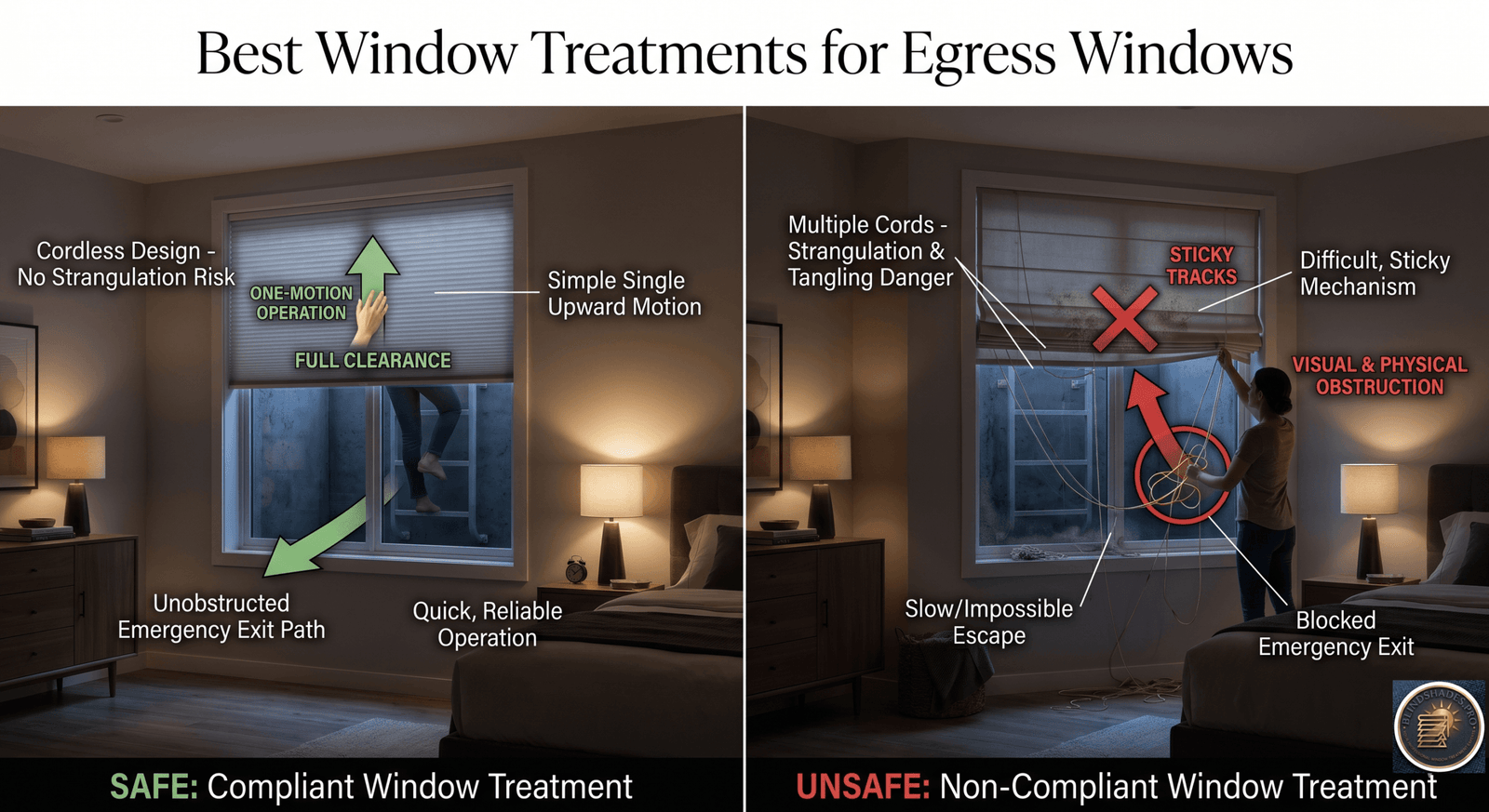
Key Takeaways:
- IRC R310 requires the egress window to open to a minimum 5.7 sq ft, 24 inches tall, and 20 inches wide — the window treatment must not reduce this when fully raised
- The “no tools or special knowledge” clause of IRC R310 applies to window treatments — Roman shade cord sequences, sticky cellular tracks, and cord locks may constitute non-compliant impediments under emergency stress
- Cordless faux wood Venetian blinds and cordless blackout roller shades are the two treatments that satisfy both egress compliance and blackout for sleeping
- A property owner who installs a non-compliant window treatment on an egress bedroom window may face legal liability if an occupant cannot escape a fire
- The single-person stress test: can the treatment be fully raised in 5 to 10 seconds, in the dark, with one hand? If not, it is not appropriate for an egress window
⭐ Quick Answer — What Window Treatments Work With Egress Windows?
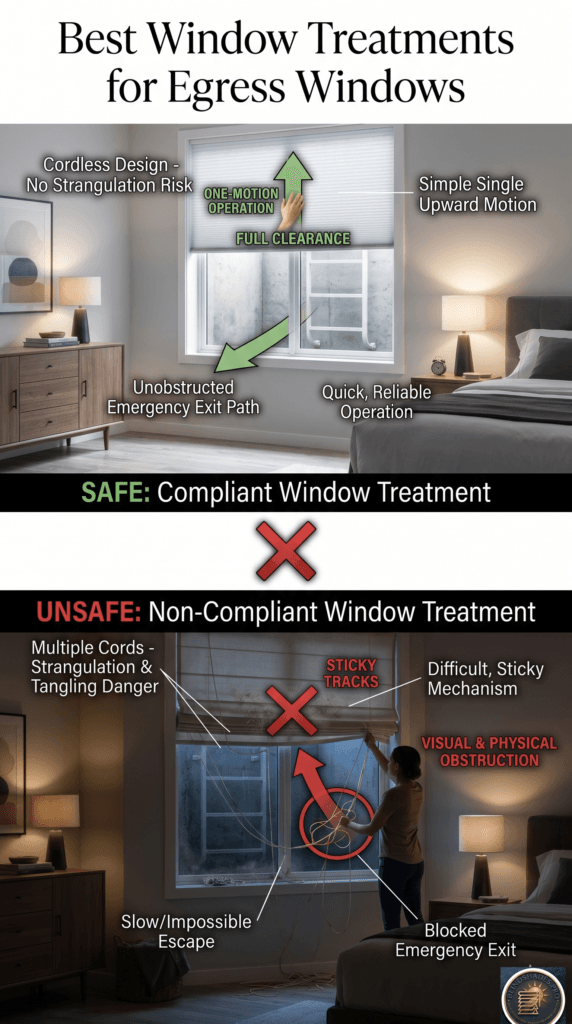
- The Compliance Matrix — What Passes and What Fails: Window treatments for egress windows are assessed against IRC R310’s requirement that the opening be operable “without the use of a key, tool, or special knowledge.” PASS: cordless faux wood Venetian blind (single upward lift, no cords); cordless blackout roller shade (single upward push); window film applied to glass (no separate mechanism); between-glass integral blind (window opens independently). FAIL: Roman shade with multiple cords (specific cord sequence = special knowledge); cellular shade with stiff sticky track (force beyond normal operation); motorized blind with no manual override (power-out = non-operable); shutters hinged across window opening (cannot be cleared instantly)
- The Dual-Spec Solution — Egress Compliance AND Blackout Simultaneously: The core basement bedroom challenge: the window treatment for an egress window must be clearable in an emergency AND provide blackout for sleeping. A cordless faux wood Venetian blind satisfies egress but NOT full blackout (light enters through slat gaps). A corded blackout roller satisfies blackout but NOT egress (cord operation). The one product satisfying both: cordless blackout roller shade — single upward push clears the window; full blackout when lowered; no cords; no sequence. The dual-spec solution no guide identifies
- The 10-Second Stress Test — The Practical Compliance Check: For any window treatment on an egress window: lower the blind fully, set a stopwatch for 10 seconds, use only ONE hand without looking at the mechanism — raise the blind and open the window. If the blind is fully raised and the window is open in under 10 seconds: PASS. If it requires two hands, a specific cord sequence, or fumbling in the dark: FAIL. Then repeat the test in complete darkness. Corded blinds whose cords are not immediately tactile in the dark frequently fail this test
- The Legal Liability Warning for Property Owners: A property owner — particularly a landlord renting a basement bedroom — who installs a non-compliant window treatment on an egress window may face civil liability if a tenant cannot escape a fire in adequate time. The window treatment is the first obstacle between an occupant and the emergency exit. If it cannot be cleared rapidly by a person acting alone under stress, in the dark, in potential smoke, the treatment has impeded the legally required escape path. Roman shades with cord sequences, sticky cellular tracks, and motorized blinds with no power-out manual raise are the three most common non-compliant specifications in basement bedrooms
- The Sprinkler Exception — What Most Homeowners Don’t Know: IRC R310 provides: in a dwelling equipped with a full automatic sprinkler system (NFPA 13D), sleeping rooms in basements may not require an egress window at all, provided the basement has one means of egress plus one egress opening, or two means of egress. If the egress window requirement is removed by this exception, the window treatment compliance requirement is also removed — any treatment is acceptable. Verify with the local building department before relying on this provision
- Best Sources: Egress window + blind safety → Blinds Chalet egress fire safety guide · Cordless blackout egress spec → SelectBlinds cordless range · IRC R310 dimensions → WindowWell Experts IRC code guide
⚠️ The IRC R310 Dimensions and the “No Special Knowledge” Clause Applied to Window Treatments: IRC R310 requires every basement bedroom egress window to provide a net clear opening of at least 5.7 square feet (5.0 sq ft at grade level), 24 inches minimum clear height, and 20 inches minimum clear width, with a maximum sill height of 44 inches from the finished floor. The window treatment must not reduce any of these dimensions when fully raised. The “no tools, keys, or special knowledge” clause is the critical provision for window treatments on egress windows: a Roman shade with a specific left-cord-then-right-cord raising sequence constitutes “special knowledge” under stress; a cordless cellular shade with a two-handed bottom-rail tilt-release mechanism constitutes “special knowledge”; a motorized blind whose wall switch is not adjacent to the window constitutes “special knowledge” for an occupant who did not install it. The correct test: if a person who has never operated this treatment before — waking from sleep, in darkness, potentially in smoke — cannot raise it in under 10 seconds with one hand, it is not appropriate for an egress window. For window well egress windows with a fixed ladder (required for wells over 44 inches deep), specify inside mount only — an outside-mount blind in the lowered position may cover the well ladder access, adding a sequential operation requirement before the escape route can be used. For the full basement specification guide, see What Are the Best Blinds for Basement Windows. See the full treatment compliance matrix below.
💡 The Window Well Ladder Interference and the Raised Floor Sill Height Warning: Two basement-specific interactions no guide covers for window treatments on egress windows. First: window well ladder interference. IRC R310 requires a permanently fixed ladder in any window well over 44 inches deep. An outside-mount blind — headrail mounted above the window frame on the wall — may cover the window well aperture when lowered. This means an occupant must first raise the outside-mount blind before accessing the ladder, creating a sequential operation requirement that effectively makes the blind an impediment to the escape route. Specify inside mount for all egress window well windows — the blind sits within the frame and does not extend over the well. Second: the raised floor warning. A basement renovation that adds a subfloor and finished flooring can raise the effective finished floor level by 1.5 to 3 inches (typical subfloor + flooring depth). This reduces the measurement from the finished floor to the window sill, pushing the sill toward or beyond the 44-inch maximum allowed under IRC R310. Always remeasure the sill height from the NEW finished floor level after any basement floor renovation before selecting the window treatment and confirming egress compliance. For the full egress + blackout dual-spec bedroom window treatment guide, see What Are the Best Window Treatments for a Basement Bedroom. See the full stress test protocol below.
📖 Read the complete guide below for: the IRC R310 compliance framework applied to window treatments (5.7 sq ft / 24 inch / 20 inch / 44 inch sill), the treatment-by-treatment compliance matrix (12 treatment types assessed: cordless faux wood, cordless roller, corded Venetian, Roman shade, cellular, motorized, window film, between-glass, shutters, and more), the “no tools or special knowledge” IRC clause applied to cord sequences and sticky tracks, the dual-spec challenge (egress + blackout simultaneously — cordless blackout roller is the only single product satisfying both), the legal liability framework for property owners, the 10-second single-hand darkness stress test, the window well ladder interference and inside-mount requirement, the sprinkler exception (NFPA 13D), and the raised basement floor sill height warning.
Window Treatments for Egress Windows – The IRC R310 Compliance Framework
Definition: An egress window is a window designated as an emergency escape and rescue opening under IRC Section R310. It must provide a minimum net clear opening of 5.7 square feet (5.0 square feet at grade level), at least 24 inches in clear height, at least 20 inches in clear width, and must be operable from the inside without the use of a key, tool, or special knowledge.
Why window treatments are a compliance concern:
IRC Section R310 requires the window to be operable “without the use of a key, tool, or special knowledge or force greater than that required for normal operation.” This requirement applies not just to the window mechanism itself – it applies to any element in front of the window that an occupant must operate to access the window during an emergency.
A window treatment installed on an egress window that slows, impedes, or requires special operation to remove creates a de facto compliance problem even if the window itself meets all dimensional requirements. The window is technically compliant; the window treatment makes it effectively non-compliant at the moment it is most needed.
The legal liability consequence:
A property owner – particularly a landlord renting a basement bedroom – who installs a non-compliant window treatment on an egress window may face civil liability if a tenant is unable to escape a fire in adequate time. The window treatment is the occupant’s first interaction with the escape route in an emergency. If it cannot be cleared rapidly by an occupant acting alone under stress, in the dark, potentially in smoke, the treatment has impeded the legally required escape path.
For the general basement window specification guide, see What Are the Best Blinds for Basement Windows.
The Treatment-by-Treatment Compliance Matrix
This is the guide that no competitor provides.
| Window Treatment | Egress Compliant? | Reason | Blackout Capable? |
|---|---|---|---|
| Cordless faux wood Venetian blind | YES | Single upward lift; no cords; clears window fully when raised | Partial (light through slat gaps and pivot holes) |
| Cordless blackout roller shade | YES | Single upward push clears window; no cords; full window clearance | YES – full blackout |
| Corded Venetian blind | BORDERLINE | Cord operation required; cord may tangle in dark or smoke; two-hand operation | Partial |
| Roman shade (corded) | NO | Multiple cords; specific lift sequence required; cannot be cleared with one hand under stress | YES but irrelevant |
| Roman shade (cordless) | BORDERLINE | Single pull mechanism; fabric stacks at top; headrail must not impede window | YES |
| Cellular shade (standard track) | NO | Stiff track resistance may prevent rapid raising; bottom rail may stick | YES if blackout spec |
| Cellular shade (light-duty track) | BORDERLINE | Requires testing – if raises smoothly with one upward motion, may be acceptable | Partial |
| Motorized blind (power only) | NO | If power fails in fire, motorized-only blind cannot be manually raised | YES |
| Motorized blind (manual override) | YES if manual works | Must test manual raise under no-power conditions | YES |
| Window film (frosted, PDLC) | YES | Applied to glass; does not impede window mechanism at all | PDLC: YES |
| Between-glass integral blind | YES | Blind inside sealed unit; window opens independently | Partial |
| Shutters (hinged across window) | NO | Cannot be cleared instantly; multiple panels must be moved | YES but irrelevant |
| Outside-mount blind (window well window) | REVIEW REQUIRED | If lowered blind covers window well ladder access, creates additional egress impediment | YES |
The “No Tools or Special Knowledge” Clause Applied to Window Treatments
This clause directly governs window treatment selection for egress windows yet is applied by no guide.
IRC Section R310 states: “Emergency escape and rescue openings shall be operational from the inside of the room without the use of keys, tools, or special knowledge.”
Applied to window treatments:
“Keys”: A window well cover with a padlock is clearly non-compliant. A window treatment with a locking mechanism that requires a key to release is non-compliant.
“Tools”: A window treatment that requires scissors or a cord cutter to release in an emergency is non-compliant. No standard window treatment requires tools, but damaged or tangled cords can create this condition.
“Special knowledge”: This is the most relevant clause for window treatments. “Special knowledge” means any operational sequence that is not immediately intuitive to an occupant who did not install the treatment.
Examples of potential “special knowledge” impediments:
- A Roman shade with a specific cord-pull sequence (left cord first, then right cord) that must be followed to raise the shade evenly
- A cordless cellular shade with a specific bottom-rail push-and-tilt release that requires knowing the mechanism
- A motorized blind with a wall switch that is not adjacent to the window and whose location may not be known by all occupants
- A dual roller shade with two separate raise mechanisms that must both be cleared before the window can be opened
The practical test: Could a person who has never operated this window treatment before, waking from sleep, in darkness, potentially in smoke with limited visibility, raise the treatment and open the window in under 10 seconds? If the honest answer is no – the treatment is not appropriate for an egress window.
The Dual-Spec Challenge – Egress Compliance + Blackout for Sleeping
This challenge – absent from all competitor guides – is the core practical problem for basement bedroom window treatments.
A basement bedroom window has two simultaneous requirements:
- Egress compliance: The treatment must be fully clearable from the window opening with a single rapid motion
- Blackout for sleeping: The treatment must block sufficient light for quality sleep (basement windows at grade level let in ambient light, streetlight, and early morning sun)
The challenge: A cordless faux wood Venetian blind satisfies egress compliance but does NOT provide full blackout – light enters through slat gaps and through routeless slat pivot holes.
A standard corded blackout roller shade provides full blackout but its cord mechanism creates a potential egress compliance concern.
The two correct dual-spec solutions:
Solution 1 – Cordless Blackout Roller Shade (recommended): A cordless blackout roller shade with a spring-loaded or friction-hold cordless mechanism can be raised with a single upward push that requires no cord, no sequence, and no special knowledge. It provides 100% blackout when lowered. This is the single product that satisfies both requirements simultaneously.
Specification: Cordless blackout roller shade, inside mount, bottom rail positioned minimum 1/4 inch above window sill (condensation prevention). Confirm the cordless mechanism raises smoothly with one upward motion – test in store or immediately upon installation.
Solution 2 – Cordless Faux Wood Venetian + Blackout Secondary Layer: A cordless faux wood Venetian blind on the egress window (primary, egress-compliant) plus a secondary blackout panel on a separate track inside the window recess. In an emergency: raise the faux wood blind (one motion, egress clear). The blackout panel sits on a separate track that does not impede window operation.
Not acceptable: A Roman shade with cords paired with any blackout layer. The Roman shade’s cord mechanism remains non-compliant regardless of the secondary treatment.
For the full basement bedroom specification, see What Are the Best Window Treatments for a Basement Bedroom.
The Window Well Ladder Compliance Issue
This interaction between egress ladders and outside-mount window treatments is absent from all guides.
The IRC requirement: Window wells over 44 inches deep must have a permanently fixed ladder or built-in steps to allow emergency exit from the well. This ladder must be accessible and not blocked by the window’s operation.
The window treatment interaction: An outside-mount window treatment – particularly a faux wood Venetian or roller shade with a headrail mounted above the window frame on the wall – may extend over the aperture of the window well when lowered.
If the outside-mount blind in the lowered position covers or partially covers the window well opening, an occupant who opens the egress window and needs to use the well ladder must first:
- Raise the outside-mount blind (operating the window treatment under stress)
- Then access the ladder in the well
This sequential operation – raise the treatment, then use the ladder – potentially constitutes the window treatment creating an impediment to “normal operation” of the egress path, since the treatment must be operated before the escape route can be fully used.
The correct specification for window well egress windows: Inside mount only. The blind sits entirely within the window frame recess and does not extend over the window well aperture when lowered. An occupant who opens the window finds the inside-mount blind already clear of the well opening.
The Sprinkler Exception
This exception is mentioned in IRC R310 but is unknown to most homeowners considering basement bedroom window treatments.
IRC Section R310 provides an exception: where a dwelling unit is equipped with an automatic sprinkler system installed in accordance with Section P2904 (or NFPA 13D), sleeping rooms in basements are not required to have emergency escape and rescue openings, provided that:
- The basement has one means of egress complying with Section R311 AND one emergency escape and rescue opening; OR
- The basement has two means of egress complying with Section R311
The practical implication for window treatments:
In a fully sprinklered dwelling (NFPA 13D), a basement bedroom may not require a fully compliant egress window at all. This removes the window treatment compliance requirement entirely for that window – any treatment is acceptable because the window’s egress function is not legally mandated.
Who this applies to: Homeowners who have installed a complete automatic sprinkler system (not just a partial or hardwired smoke alarm system – a full NFPA 13D sprinkler system with heads in all habitable spaces) may find that their basement bedroom window treatment selection is unconstrained by IRC R310.
Always verify with the local building department before relying on this exception – local codes may modify or exclude this provision.
The Single-Person Stress Test
The practical compliance test for any window treatment on an egress window:
Before installing any window treatment on a basement egress window, perform this test:
- Lower the blind fully
- Set a stopwatch for 10 seconds
- Without looking at the mechanism and using only one hand, raise the blind to fully clear the window
- Open the window
If the blind is clear of the window opening and the window is fully open in under 10 seconds with one hand and no fumbling – the treatment passes the stress test.
If the blind requires two hands, a specific cord sequence, more than 10 seconds, or any moment of searching for the mechanism in the dark – the treatment should not be installed on an egress window.
The darkness test: Perform the same test in complete darkness. Corded blinds whose cords are not immediately tactile in the dark fail this additional test. A cordless bottom rail that can be found by touch and lifted upward passes.
Where to Order
For cordless blackout roller shade (recommended egress + blackout dual-spec): SelectBlinds cordless blinds range – see selectblinds.com/cordless-blinds. Specify: cordless operation, blackout fabric, inside mount for egress windows, bottom rail 1/4 inch clearance above sill. Test the cordless mechanism immediately on delivery before permanent installation.
For the egress window + window treatment safety context: Blinds Chalet egress window and fire safety guide at blindschalet.com is the only blind supplier to specifically address egress window blind safety – the source of the “make sure all window blinds are easy to remove or move aside” guidance.
For IRC R310 code specifics and window well requirements: WindowWell Experts IRC code guide at windowwellexperts.com covers the egress dimension requirements and window well ladder specifications that directly affect outside-mount window treatment positioning.
Frequently Asked Questions
What window treatments work with egress windows? Window treatments that work with egress windows are those that can be fully raised to clear the window opening with a single motion, in the dark, without cords or special operational sequences. Cordless faux wood Venetian blinds and cordless blackout roller shades are the two treatments that satisfy IRC R310 egress compliance for basement bedroom windows. Window film applied directly to the glass is also fully compliant as it does not add any separate mechanism to the window. Roman shades with multiple cords, cellular shades with sticky tracks, and motorized blinds without functional manual override do not satisfy egress compliance requirements.
Are corded blinds safe for egress windows? Corded blinds are borderline non-compliant for egress windows. IRC R310 requires the window to be operable without tools, keys, or special knowledge – and a corded blind’s operation requires locating and pulling a cord that may be tangled or invisible in smoke and darkness during an emergency. Standard corded blinds also require two-handed operation to raise evenly without the slats twisting. Cordless blinds – which can be raised with a single upward push of the bottom rail – are significantly more appropriate for egress windows. Specify cordless for all basement bedroom egress window treatments.
Can a Roman shade be used on an egress window? A corded Roman shade should not be used on an egress window. Roman shades with multiple operating cords require a specific cord-pull sequence to raise evenly and typically cannot be raised with one hand under emergency stress conditions. A cordless Roman shade is borderline – it can be raised with a single pull mechanism – but the stacked fabric at the headrail position must not impede the window mechanism or frame. The safest specification for any egress window is a cordless roller shade or cordless Venetian blind rather than any fabric shade type.
Do outside-mount blinds work on egress windows with window wells? Outside-mount blinds require careful assessment for egress windows with window wells. If the window well is over 44 inches deep and has a permanently fixed ladder as required by IRC R310, an outside-mount blind in the lowered position may cover or partially cover the window well ladder access. This creates a sequential operation requirement – raise the blind, then use the ladder – which may constitute an impediment to the escape path. Inside-mount blinds are the correct specification for window well egress windows because the blind sits entirely within the window frame and does not extend over the well aperture.
Does the sprinkler exception remove egress window treatment requirements? In a dwelling equipped with a full automatic sprinkler system installed under NFPA 13D, IRC R310 may not require a basement bedroom to have an egress window at all, provided the basement has one means of egress and one egress opening or two means of egress. If the egress window requirement is removed by the sprinkler exception, the window treatment compliance requirement is also removed. Verify with the local building department before relying on this exception, as local amendments may modify the IRC provision.
Related Guides on BlindShades.pro
- The Best Basement Window Blinds and Shades Buying Guide
- What Are the Best Blinds for Basement Windows
- What Are the Best Window Treatments for a Basement Bedroom
- How Do You Add Privacy to Ground-Level Basement Windows
- What Are the Best Blinds for a Hopper Window
By Michael Turner | 30 Years Home Improvement Expertise | Updated 2026 | BlindShades.pro
