




What Are the Best Blinds for a Hopper Window ?

Authored By Michael Turner -30 Years Home Improvement Expertise | Updated 2026 | BlindShades.pro
Updated on May 26, 2026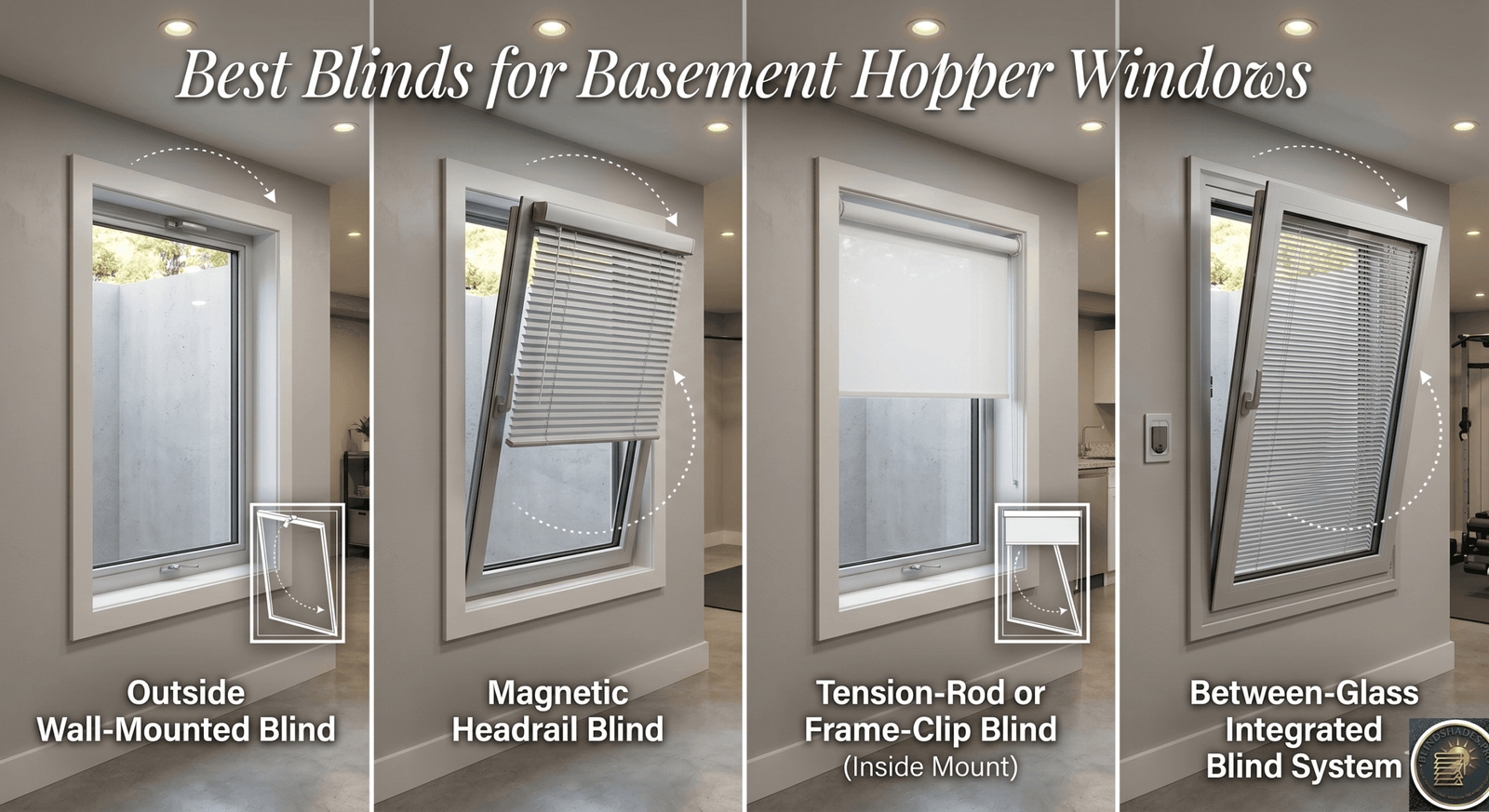
⭐ Quick Answer — What Are the Best Blinds for a Hopper Window?
- The Swing Path Problem — Why Standard Blinds Block the Window: Blinds for a basement hopper window must account for the fundamental hopper geometry: hinged at the bottom, the top of the sash swings INWARD. For a 16-inch tall hopper opening to 45 degrees: the top travels window height × sin(angle) = 16 × 0.707 = 11.3 inches into the room. Any blind material hanging in this path blocks the window from opening. Standard inside-mount blinds in the lowered position are always in the swing path
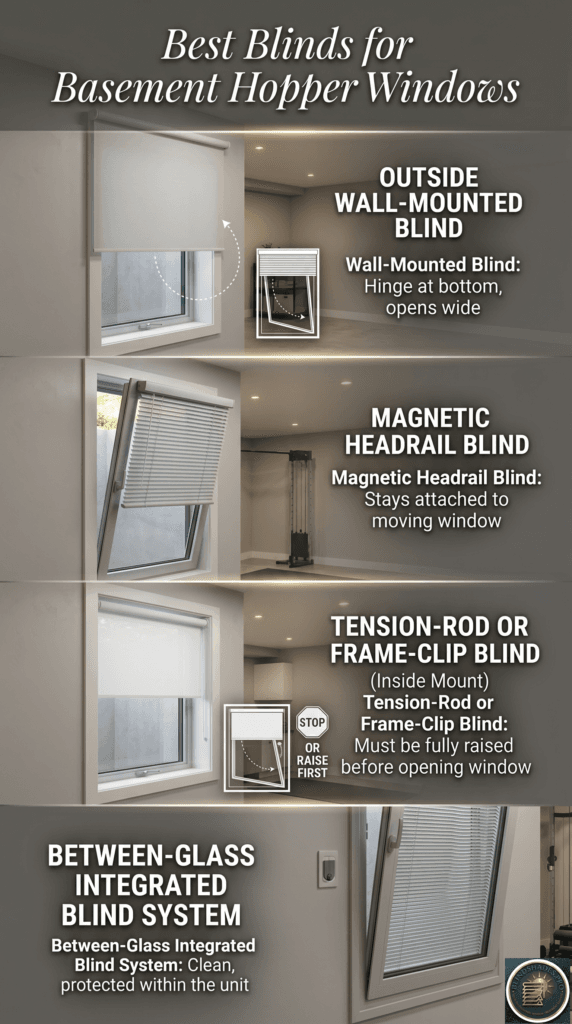
- 4 Mounting Solutions — Ranked by Privacy + Ventilation Performance: (1) Outside wall mount — the ONLY solution that maintains privacy while the window is open (blind stays lowered, window tilts inward underneath). (2) Magnetic headrail mount — attaches to ferromagnetic frame; blind moves with the window when it opens. (3) Tension rod inside mount — must be fully raised before opening; zero privacy during ventilation. (4) Between-glass integral blind — best long-term solution for new window installation; blind is inside the sealed unit, window opens independently with blind protected
- The Outside Mount Advantage — Privacy AND Ventilation Simultaneously: For any basement hopper window blind, outside wall mount is the most practical long-term specification. The headrail mounts 2–3 inches above the window frame on the wall, and the blind hangs in front of the frame. When the window tilts inward for ventilation, the sash swings underneath the lowered blind. The basement ventilates while the blind remains down and private. Every inside-mount solution requires raising the blind fully before opening — creating a privacy gap every time the window is used for ventilation
- The Magnetic Mount — How It Works and When It Fails: Neodymium magnets (grade N52) attached to the blind headrail bond directly to the ferromagnetic metal of the window sash frame. The blind moves with the window when it tilts inward. Requires 4–6 magnets for a lightweight aluminium mini blind (0.5–1 lb), 6–8 for a faux wood Venetian. Critical test: hold a strong magnet to the window frame — if it holds firmly, magnetic mounting works. Vinyl-framed hopper windows without steel reinforcement do not attract magnets reliably and are not suitable for magnetic mount
- Top-Hinged vs Bottom-Hinged — The Distinction That Changes the Clearance Zone: Most basement hoppers are bottom-hinged (top swings in) — the swing path hazard is at the UPPER slats of a lowered inside-mount blind. Reverse top-hinged hoppers (less common) have the hinge at the top and the BOTTOM of the sash swings in — the hazard is at the LOWER slats. Identify your hinge position before measuring clearance: hinges at the bottom = top swings in; hinges at the top = bottom swings in
- Best Sources: Inward-opening blind solutions → DotcomBlinds inward-opening guide · Hopper window covering options → SunGard hopper window guide · Full basement specification → SmartBlindsPro basement guide
⚠️ The Minimum Raised-Position Clearance Calculation and the Between-Glass Permanent Solution: For inside-mount blinds for a basement hopper window, the raised position must clear the entire inward swing arc. For a 16-inch hopper at 45 degrees: the sash top travels 11.3 inches inward. A Venetian blind slat stack when fully raised extends approximately 1–1.5 inches per slat set below the headrail. Confirm the slat stack depth when fully raised does not extend below the inward-travel clearance point — for most 12–16 inch shallow hoppers, this means the fully-raised slat stack must compress to less than 3–4 inches total depth. PVC vinyl roller shades solve this more simply: the rolled tube is only 1.5–2 inches in diameter, well clear of any standard hopper swing path. And for those considering window replacement: between-glass integral blinds ($100–$250 premium per window) from suppliers such as ABE Doors and Windows eliminate every mounting, clearance, and humidity problem permanently — the blind is sealed between the glass panes, unaffected by basement humidity, operated by a magnetic frame control, and the window opens independently with zero swing path interference. See The Best Integral and Between-Glass Blinds Buying Guide for the full specification. See the full four mounting solution comparison below.
💡 The Ventilation-Privacy Paradox and the Outside Mount Specification: The most overlooked practical problem with blinds for a basement hopper window is that inside-mount solutions create a fundamental trade-off: you can have privacy (blind lowered) OR ventilation (blind raised) — but not both at the same time. Every inside-mount solution requires the blind to be fully raised to allow the window to open. An outside wall-mount blind resolves this permanently. Specify the headrail 2–3 inches above the window frame top on the wall surface. Specify the blind 2–3 inches wider than the window frame on each side. When the window tilts inward for ventilation, the sash swings in the plane of the wall behind the blind, and the blind continues to hang in front of the wall covering the window opening. This geometry means: window open = ventilation active AND blind lowered = privacy maintained. For the full ground-level basement window privacy specification including sightline angle calculations, see How Do You Add Privacy to Ground-Level Basement Windows. See the full swing path geometry below.
📖 Read the complete guide below for: the hopper window swing path geometry (height x sin(opening angle) = inward travel in inches), the four mounting solutions ranked by privacy-and-ventilation performance (outside wall mount / magnetic headrail / tension rod / between-glass), the top-hinged vs bottom-hinged hopper distinction and its effect on clearance zone, the magnetic mount neodymium magnet specification (N52 grade, 4–8 magnets, steel frame requirement), the minimum raised-position clearance calculation for inside-mount Venetian blinds, the between-glass integral blind permanent solution with $100–$250 premium, and the ventilation-privacy paradox with the outside-mount resolution.
Blinds for a Basement Hopper Window – The Swing Path Problem
Definition: A hopper window is a window that is hinged at the bottom of the frame and opens by the top of the sash swinging inward into the room. This is the opposite of an awning window which hinges at the top and opens outward.
Why standard inside-mount blinds do not work for hopper windows:
A conventional inside-mount blind – whether a Venetian blind, roller shade, or cellular shade – is mounted with the headrail at the top of the window recess and the blind material hangs downward. When the hopper window is opened:
- The bottom of the sash remains hinged at the frame
- The TOP of the sash swings INWARD into the room
- The incoming top edge of the sash contacts any blind material hanging in the lowered position
- The window cannot open past the point of contact with the blind
The geometry:
For a standard 16-inch tall basement hopper window opened to 45 degrees:
- The top of the sash travels: 16 × sin(45°) = approximately 11 inches into the room
- A Venetian blind in the lowered position has its top rail approximately 1-2 inches below the headrail and its slats hanging the full 16-inch window height below
- The window cannot open without pushing the blind inward or damaging the blind slats
For the same window opened to its maximum angle (typically 30-45 degrees for basement hoppers):
- The inward travel of the top = window height × sin(max opening angle)
- A 16-inch window at 30 degrees: 16 × sin(30°) = 8 inches inward
- A 16-inch window at 45 degrees: 16 × sin(45°) = 11.3 inches inward
The minimum clearance for inside-mount operation: Any inside-mount blind installed in a hopper window must be capable of being raised to a position where the blind slat stack or rolled fabric sits ABOVE the inward travel arc of the window top. For a 16-inch window at 45 degrees maximum opening, the raised blind must fully retract to within the top 4-5 inches of the window frame to clear the 11-inch inward swing of the window top.
The Four Mounting Solutions – Ranked by Practicality
Option 1 – Outside Wall Mount (Best for Privacy + Ventilation Simultaneously)
Mechanism: The blind headrail is mounted on the WALL ABOVE the window frame – not inside the window recess. The blind hangs in front of the window frame and extends several inches beyond the frame on each side.
The key advantage unique to hopper windows: When the window is opened for ventilation, the window sash swings INWARD – but UNDERNEATH the outside-mounted blind. The blind remains in the lowered position covering the window opening while the window sash is tilted inward below it. This means:
- The window is open and ventilating
- The blind is still lowered and providing privacy
- Air enters through the open window, passes through or under the blind, and ventilates the space
This is the only mounting solution that maintains privacy during ventilation. Every inside-mount solution requires the blind to be raised fully before the window can open, creating a privacy gap while ventilating.
Specification for outside wall mount:
- Headrail positioned at least 2-3 inches above the window frame top
- Blind width specified 2-3 inches wider than the window frame on each side
- Bottom rail drops to at least 1-2 inches below the window sill
- PVC vinyl roller shade or faux wood Venetian blind (faux wood preferred for aesthetics in Zone B1 finished basements)
The clearance consideration: With outside mount, the blind hangs in front of the wall. When the hopper window sash swings inward, the sash top travels into the room space behind the blind. Confirm the wall between the window frame and the blind headrail bracket position provides adequate depth for the sash to swing inward without contacting the blind’s back face.
Option 2 – Magnetic Headrail Mount (Moves With the Window)
Mechanism: Strong rare-earth neodymium magnets are attached to the blind headrail. The magnets bond the headrail directly to the metallic surface of the window frame or sash. When the window opens, the blind moves with the window.
How it works for hopper windows: The headrail is magnetically attached to the UPPER PORTION of the window sash frame – the frame area just below the top opening edge. When the window tilts inward, the headrail and blind fabric tilt inward with it, hanging from the tilted sash. The blind remains covering the window opening at all angles.
Requirements:
- The window frame or sash must contain ferromagnetic metal (steel or iron) that neodymium magnets can bond to
- Vinyl-framed hopper windows without steel reinforcement in the frame channel do NOT attract magnets reliably
- Steel-reinforced vinyl frames, aluminium frames, and steel frames are all compatible
- To test: hold a strong magnet to the window frame; if it holds firmly, magnetic mounting is feasible
Magnet strength: For a lightweight aluminium mini blind on a 24-inch wide hopper window (weight approximately 0.5-1 lb): 4-6 neodymium magnets of N52 grade provide adequate hold. For a heavier faux wood Venetian blind: 6-8 magnets required. Spread magnets evenly across the headrail length for consistent contact.
Limitation: The magnetic mount is not suitable for very heavy blinds or for windows that vibrate significantly when ventilating.
Option 3 – Tension Rod or Frame-Clip Inside Mount (Must Raise Before Opening)
Mechanism: A tension rod is spring-loaded to press outward against the window recess walls, holding the blind without drilling. The blind is mounted inside the frame using the tension rod as a substitute headrail.
How it works: The blind hangs from the tension rod inside the window frame. When the window needs to be opened, the blind must be FULLY RAISED first – lifting the blind above the swing path of the incoming window top.
The minimum raised position calculation: For a 16-inch tall hopper window opening to 45 degrees:
- Window top travels 11 inches inward
- For a roller shade: the fabric must be fully rolled onto the tube; the tube sits at the top of the frame
- For a Venetian blind: the slat stack when fully raised extends approximately 1-1.5 inches per slat set; confirm the stack height is no more than 3-4 inches (to stay above the swing path)
Practical limitation: This solution requires the occupant to remember to raise the blind before opening the window every time. In an unfinished utility basement (Zone B3) where ventilation is opened and closed multiple times, this becomes the primary operational inconvenience.
For Zone B1 finished living areas where the hopper window is opened infrequently: tension rod inside mount is adequate.
Option 4 – Between-Glass Integral Blind (New Window or Replacement Only)
Mechanism: Between-glass or integral blinds are factory-installed within the sealed unit of a double-glazed window. The blind is permanently enclosed between the two glass panes. A magnetically-operated control on the window frame adjusts the blind without any physical contact with the blind itself.
Why this is the ideal hopper window blind solution:
- No mounting hardware required
- No swing path interference (the blind is inside the sealed unit, the sash opens independently)
- No basement humidity contact (the blind is within the sealed glazing unit)
- No cleaning required (the blind is protected from dust, grease, and moisture)
- No operational discipline required (the blind does not need to be raised to open the window)
The limitation: Between-glass blinds can only be specified at the time of window purchase or replacement. They cannot be retrofitted into an existing sealed glazing unit. For homeowners considering hopper window replacement: specifying integral blinds at installation eliminates all mounting and operational challenges permanently.
ABE Doors and Windows offers integral blind basement hopper windows as a standard specification. The premium over a standard double-glazed hopper window is typically $100-$250 per window.
For the full integral blind overview, see The Best Integral and Between-Glass Blinds Buying Guide.
The Top-Hinged vs Bottom-Hinged Hopper Distinction
This distinction is absent from all competitor hopper window blind guides – yet it changes the clearance calculation.
Standard bottom-hinged hopper (most common in basements):
- Hinge at the BOTTOM of the frame
- TOP of the sash swings INWARD
- A lowered inside-mount blind is contacted at its UPPER SLATS by the incoming top edge of the sash
- The swing path hazard is at the TOP of the blind
Reverse top-hinged hopper (less common, used in some newer construction):
- Hinge at the TOP of the frame
- BOTTOM of the sash swings INWARD (tilts in from below)
- A lowered inside-mount blind is contacted at its LOWER SLATS by the incoming bottom edge of the sash
- The swing path hazard is at the BOTTOM of the blind
- A raised blind (headrail up, slats up) clears the opening bottom without any raised position requirement – but a lowered blind’s bottom section is at risk
How to identify your hopper type: Look at where the hinges are positioned on the window frame. Hinges at the bottom = standard hopper (top swings in). Hinges at the top = reverse hopper (bottom swings in). The handle or tilt latch is typically on the opposite side from the hinge.
The Ventilation and Privacy Paradox
Every inside-mount solution for hopper window blinds creates a privacy gap during ventilation. This is one of the most important practical limitations and is absent from all competitor guides.
The paradox: A basement window is opened for ventilation – to clear moisture, cooking odours from above, or to cool the space. Ventilation is one of the primary reasons hopper windows are installed in basements. But any inside-mount blind must be RAISED to allow the window to open. When the blind is raised and the window is open, there is no privacy coverage.
The consequence in practice: Ground-level basement windows opened for ventilation expose the basement interior to ground-level sightlines from outside. This is the opposite of the purpose of installing a blind. Many homeowners with inside-mount hopper window blinds choose between ventilation and privacy rather than having both.
The outside-mount solution: As described in Option 1, an outside wall-mount blind positioned in front of the window frame remains in the lowered position while the window sash tilts inward underneath it. The window ventilates while the blind maintains privacy. This is the definitive solution to the hopper window ventilation-and-privacy paradox.
For the full ground-level basement privacy specification, see How Do You Add Privacy to Ground-Level Basement Windows.
Material Selection for Basement Hopper Window Blinds
Hopper windows are found in Zone B3 utility basements and Zone B1 finished basements. Material selection follows the general basement humidity guidelines:
For Zone B3 utility basement hopper windows (65-80% RH):
- Aluminium mini blind: best practical choice; cut to custom 12-16 inch height if needed; minimal weight is best for magnetic or tension rod mounting
- PVC vinyl roller shade: cleanest operation; single surface wipe; minimal weight
For Zone B1 finished basement hopper windows (below 65% RH):
- Faux wood Venetian blind: appropriate aesthetic for finished space; moisture-resistant; outside mount preferred
- PVC vinyl roller shade: light and easy to raise/lower; appropriate for tension rod mount
Not appropriate for any hopper window position:
- Real wood (warps in basement humidity)
- Heavy fabric Roman shade (too heavy for tension rod or magnetic mount; multiple cords create safety issues in Zone B2)
- Cellular shade (grease-trap problem if near kitchen; overkill for utility basement)
For the full material selection guide with humidity thresholds, see What Are the Best Blinds for Basement Windows.
Where to Order
For outside wall mount faux wood blind (primary Zone B1 recommendation): SmartBlindsPro basement window treatments guide at smartblindspro.com covers the outside-mount faux wood specification for hopper and other non-standard basement windows.
For frame-clip and inward-opening blind solutions: DotcomBlinds inward-opening window guide at dotcomblinds.com/blog/best-blinds-for-inward-opening-windows covers Perfect Fit clip systems and tension rod mounting for inward-opening window types.
For Hunter Douglas motorized options for hopper windows: SunGard hopper window covering guide at peoriablinds.com/blog/2025/window-coverings-for-hopper-windows covers PowerView motorized specification for basement hopper window positions.
Frequently Asked Questions
What are the best blinds for a basement hopper window? The best blinds for a basement hopper window depend on the mounting solution. Outside wall mount is the best overall solution because it is the only mounting approach that maintains privacy while the window is open for ventilation – the window sash tilts inward underneath the blind while the blind remains lowered. Magnetic headrail mount is the best inside-mount solution because the blind moves with the window. Tension rod inside mount works for windows that are opened infrequently but requires the blind to be fully raised before opening. Between-glass integral blinds are the best long-term solution for new window installations.
Why do standard blinds not work on a hopper window? Standard blinds mounted inside a hopper window frame block the window from opening when in the lowered position. A hopper window is hinged at the bottom and the top of the sash swings inward into the room. For a standard 16-inch tall hopper window opened to 45 degrees, the window top travels approximately 11 inches into the room. Any blind material hanging in this swing path is contacted by the incoming sash and prevents the window from opening or is damaged by the opening sash.
How do you calculate the swing path clearance for a hopper window blind? The inward travel distance of the hopper window top is calculated as the window height multiplied by the sine of the maximum opening angle. For a 16-inch tall hopper window that opens to 45 degrees, the travel is 16 times the sine of 45 degrees, which equals approximately 11 inches. For a 30-degree maximum opening, the travel is 16 times the sine of 30 degrees, which equals 8 inches. Any inside-mount blind must be raised so that the blind material and slat stack are above the sill by more than this calculated clearance distance, plus the depth of the raised slat stack itself.
Can you have privacy and ventilation simultaneously with hopper window blinds? Yes, but only with an outside wall-mount blind. Inside-mount solutions require the blind to be fully raised to allow the window to open, creating a privacy gap during ventilation. An outside wall-mount blind hangs in front of the window frame and the window sash swings inward underneath the lowered blind when opened for ventilation. The blind remains covering the window opening, maintaining privacy while the window ventilates the basement.
What is a magnetic hopper window blind mount? A magnetic hopper window blind mount uses strong neodymium magnets attached to the blind headrail to bond the headrail directly to the ferromagnetic metal surface of the window sash frame. When the hopper window tilts inward for ventilation, the blind moves with the window because it is attached to the sash rather than to the fixed wall or frame. This solution requires the window frame or sash to contain ferromagnetic metal. To test compatibility, hold a strong magnet to the window frame – if it holds firmly, magnetic mounting is feasible. Vinyl-framed hopper windows without steel reinforcement do not attract magnets reliably.
Related Guides on BlindShades.pro
- The Best Basement Window Blinds and Shades Buying Guide
- What Are the Best Blinds for Basement Windows
- How Do You Add Privacy to Ground-Level Basement Windows
- What Window Treatments Work With Egress Windows
- The Best Integral and Between-Glass Blinds Buying Guide
By Michael Turner | 30 Years Home Improvement Expertise | Updated 2026 | BlindShades.pro
