What Are the Best Blinds for Basement Windows

Authored By Michael Turner -30 Years Home Improvement Expertise | Updated 2026 | BlindShades.pro
Updated on May 26, 2026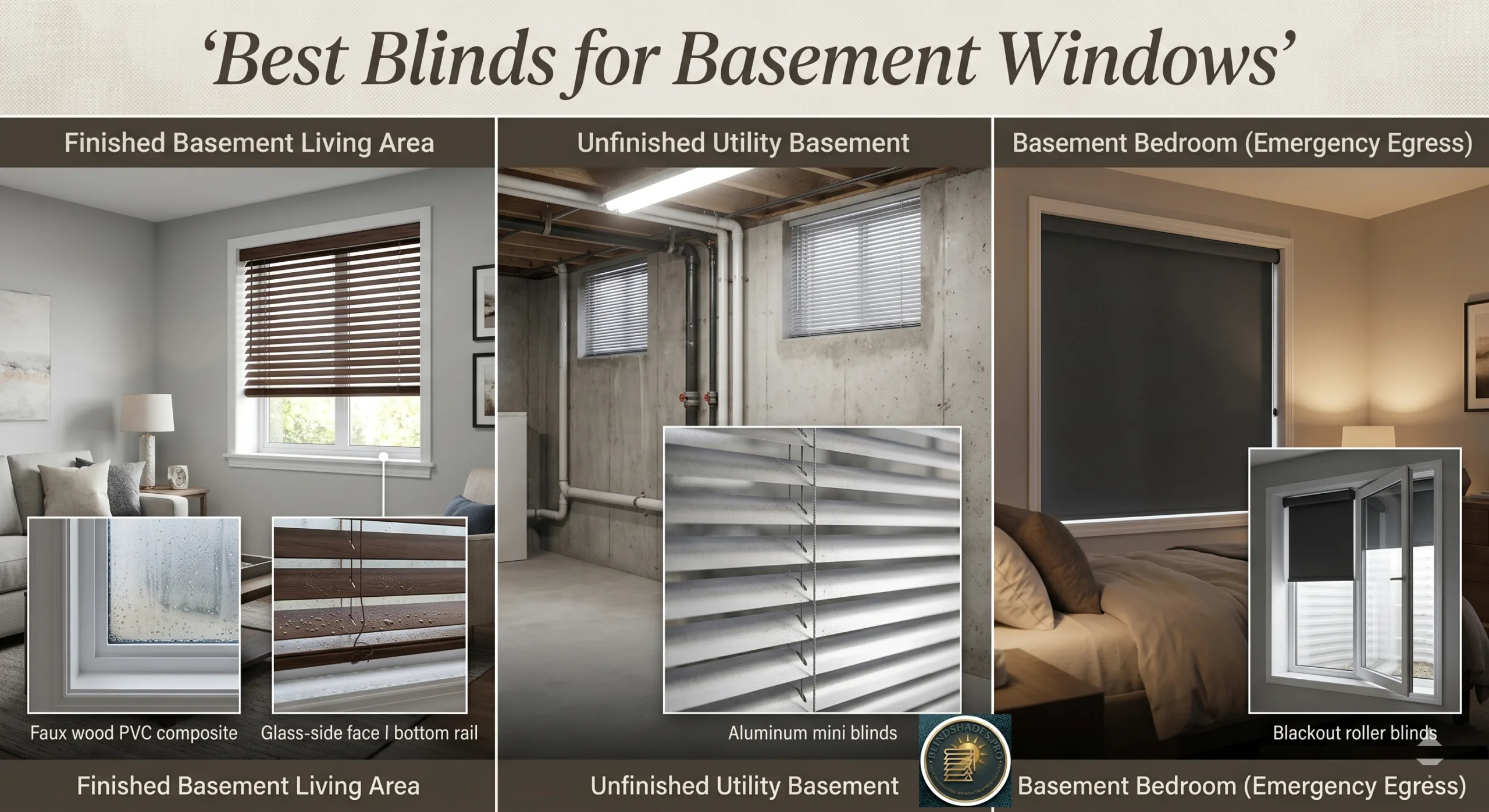
⭐ Quick Answer — What Are the Best Blinds for Basement Windows?
- The Five-Zone Framework — One Answer Does Not Fit All: The best blinds for basement windows depend entirely on the zone. Zone B1 (finished living area): faux wood PVC composite Venetian — moisture-resistant and aesthetically appropriate. Zone B2 (bedroom — egress required): cordless faux wood or cordless blackout roller — must allow full emergency exit unobstructed. Zone B3 (utility/laundry): aluminium mini blind — maximum moisture tolerance at lowest cost. Zone B4 (home theater): blackout roller with side-channel track — fabric blackout alone is insufficient, side gaps remain visible. Zone B5 (window well): inside mount only — headrail cannot be positioned in the narrow well space
- The Condensation Direction — Why Basement Blinds Fail Differently Than Bathroom Blinds: In a bathroom, hot steam rises and deposits on the room-facing surface of the blind from the top down. In a basement, the glass is cold (ground temperature 10–12°C year-round). Warm indoor air contacts the cold glass and forms condensation on the glass-facing side of the blind. This condensation runs down to the sill and wicks upward into the bottom rail by capillary action. Specify the bottom rail with at least 1/4 inch clearance above the window sill — this air gap breaks the capillary path and prevents mold forming at the bottom of the blind where it is least visible
- The 50% RH Threshold — Measure Before You Specify: A digital hygrometer ($10–$20) gives your actual basement relative humidity. Below 50% RH (well-finished, dehumidified): cellular fabric and treated polyester are acceptable. 50–65% RH: faux wood, aluminium, and PVC vinyl only — no fabric. Above 65% RH (unfinished or poorly ventilated): non-porous only — aluminium mini blind or PVC vinyl roller shade. The summer reading during humid weather is the specification-defining figure
- How to Maximise Natural Light With the Blind Specification: Basements receive the least natural light of any habitable room. Three techniques that no guide mentions: (1) White or off-white blind colours reflect significantly more diffuse light than walnut or dark tones. (2) Angle horizontal slats 45 degrees toward the ceiling — light bounces upward across the ceiling and distributes through the whole room rather than hitting the floor. (3) Install outside mount 3–4 inches wider than the actual window frame on each side — the window appears larger and allows the full glass area to be unobstructed when the blind is raised
- Shallow Hopper Window Sizing — The Cut-Down Solution: Most basement hopper windows are 24–32 inches wide and only 12–16 inches tall — far below the minimum drop length of most stock blinds (typically 24–36 inch minimum). Aluminium mini blinds are the practical solution: they can be trimmed to custom heights using a hacksaw for the side rails and tin snips for the aluminium slats. Most hardware stores also offer in-store cut services. No other blind type offers this on-site adjustability for non-standard shallow basement windows
- Best Sources: Full basement zone specification → SmartBlindsPro 2026 basement guide · Faux wood and custom sizing → Blindsgalore faux wood range · Hopper window sizing and cut-down guide → Factory Direct Blinds basement sizing guide
⚠️ The Finished vs Unfinished vs Dehumidified Specification Matrix: The best blinds for basement windows change materially based on basement finish level. Unfinished basement (65–80% RH): aluminium mini blind only — any other material risks mold or warp within 12 months. Partially finished (drywall, no dehumidifier, 55–70% RH): faux wood PVC composite or aluminium — no fabric, no cellular. Fully finished with dehumidifier (40–55% RH): near-standard indoor specification — faux wood, cellular shade, treated polyester roller all acceptable. Dehumidifier verified below 50% RH: any moisture-resistant indoor material is appropriate. The single most important action before ordering: measure your actual basement RH with a digital hygrometer in summer and use the summer reading to select your material. Never assume a finished basement is dry enough for fabric without measuring. For the complete mold mechanism and prevention guide, see Do Basement Blinds Get Moldy. See the full RH threshold guide below.
💡 The Window Well Cover Compatibility Issue and the Egress Compliance Check: For basement windows with a window well, the best blinds specification requires checking well compatibility before ordering. A window well is the curved metal or plastic barrier holding back soil around below-grade windows. Inside mount is almost always required for window well windows — an outside-mount headrail positioned above a window-well window may be blocked by the well profile, or the headrail may interfere with removing or opening the well cover for egress. Always measure the depth between the window frame and the front edge of the window well before specifying outside mount. And the egress check: if the basement window is in a bedroom or habitable sleeping space, the window treatment must comply with IRC Section R310 — the window opening must remain at minimum 5.7 square feet, 24 inches tall, and 20 inches wide with the treatment fully raised. A cordless faux wood Venetian blind raised to the headrail position satisfies this requirement; a Roman shade with multiple cords that slow emergency operation does not. For the complete egress compliance specification, see What Window Treatments Work With Egress Windows. See the full five-zone framework below.
📖 Read the complete guide below for: the five-zone basement framework (B1 finished living / B2 bedroom-egress / B3 utility / B4 home theater / B5 window well) with material specification for each, the basement condensation direction (glass-side outward vs bathroom steam top-down) and the 1/4 inch bottom-rail sill clearance spec, the 50% and 65% RH material threshold table with digital hygrometer measurement guidance, three natural light maximisation techniques (white blinds, 45-degree ceiling slat, wider outside mount), the finished vs unfinished vs dehumidified three-tier specification matrix, window well cover compatibility and inside-mount preference, egress compliance requirements (IRC R310) for Zone B2 bedroom windows, and the aluminium mini blind cut-down solution for 12–16 inch hopper windows.
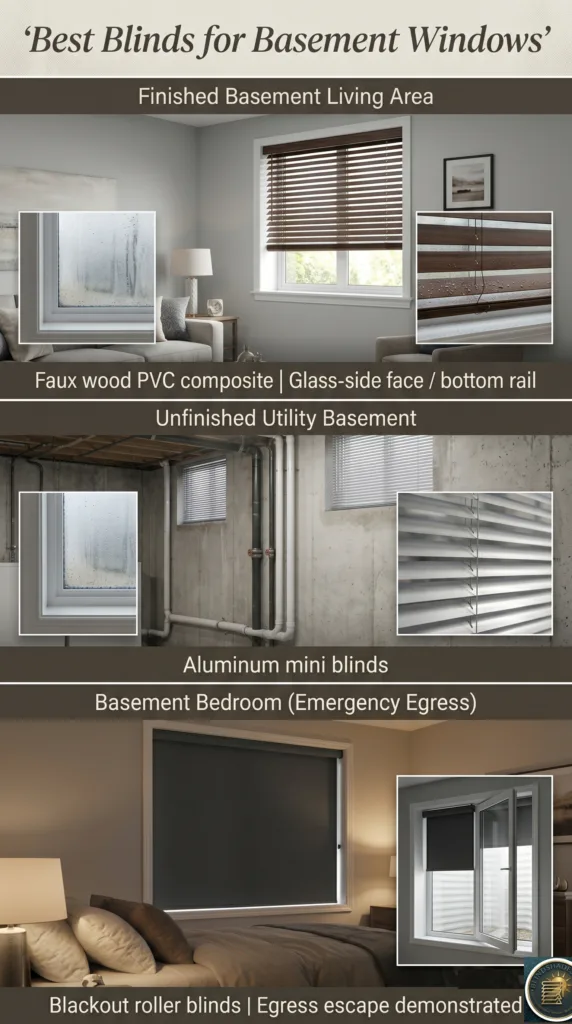
The Best Blinds for Basement Windows – The Five-Zone Framework
Definition: A basement window zone is a classification of the basement window position based on the room use, humidity level, egress requirement, and light management priority – each zone requiring a materially different blind specification.
All competitor guides treat the basement as a single environment. The five basement zones have meaningfully different specifications – and this is the framework no other guide provides.
Zone B1 – Finished Living Area (Rec Room, Lounge, Open-Plan Basement)
Description: A finished, potentially dehumidified basement room used as a rec room, family room, or general living space. The primary specification drivers are aesthetics, light control, and moisture resistance.
RH level: Typically 45-60% with dehumidifier; 60-80% without.
Best specification:
- Faux wood PVC composite Venetian blind: moisture-resistant, warm appearance, adjustable light control, appropriate for finished living space aesthetic
- PVC vinyl roller shade: clean modern profile, total moisture resistance, blackout or light-filtering options
Key consideration: If the basement has a functioning dehumidifier maintaining below 50% RH consistently, the specification can extend to cellular shades and treated polyester roller shades.
Zone B2 – Basement Bedroom (Egress Required by Code)
Description: Any basement room used as a sleeping space requires an egress window under IRC Section R310. The window treatment in this zone must satisfy TWO simultaneous requirements: egress compliance (full window opening unobstructed) AND blackout capability for sleeping.
The dual-spec challenge: A window treatment that blocks all light typically uses a fabric panel, roller shade, or mounted blind. Any of these can block or slow egress if positioned in a way that interferes with the window mechanism or requires two-handed removal under stress. For the full egress compliance guide, see What Window Treatments Work With Egress Windows.
Best specification for Zone B2:
- Cordless faux wood Venetian blind with a TDBU configuration: can be raised fully above the window opening with one pull; does not impede window opening; routeless slats do not have cord loops that could catch
- Cordless PVC vinyl blackout roller shade: single upward motion clears the window; no loose cords
Not appropriate for Zone B2:
- Roman shades with multiple operating cords
- Cellular shades with sticky tracks that slow emergency opening
- Any treatment that attaches to the window glass or sash directly
Zone B3 – Utility Basement (Laundry Room, Mechanical Room, Workshop)
Description: The unfinished or utility portion of the basement with the highest sustained humidity (often 70-80%+ RH) and the lowest aesthetic requirement.
Best specification for Zone B3:
- Aluminium mini blind: zero moisture absorption, budget-friendly, easy wipe-clean, tolerates the highest humidity levels of any blind material
- PVC vinyl roller shade: simplest clean surface for a utility environment
Not recommended for Zone B3:
- Any fabric material
- Faux wood composite (adequate but overkill for a utility space)
- Cordless mechanisms with internal springs that can corrode in very high-RH environments
Zone B4 – Home Theater or Media Room
Description: A basement converted for home theater or media use requires total blackout – not just room-darkening. The difference: room-darkening fabric blocks 90-95% of light; total blackout blocks 99%+. In a subterranean position with limited light entry, even a small light gap around a standard blind is visible in a darkened theater.
The light gap problem: Standard blinds and shades have a gap between the slat/fabric and the window frame at the sides and bottom. In a media room, this gap allows visible light infiltration around the perimeter of the shade even if the shade fabric itself is 100% blackout.
Best specification for Zone B4:
- Blackout roller shade with side channels: the side channel track eliminates the side gap, achieving true light seal
- Blackout cellular shade with light-blocking side channels
- Custom blackout panel with complete light seal gasket
For the full home theater basement blind specification, see What Are the Best Blinds for a Home Theater Basement.
Zone B5 – Window Well Window
Description: Any basement window with a window well – the curved corrugated metal or plastic barrier embedded in the soil around below-grade windows.
The window well specification constraints:
- The blind must fit within or clear the window well profile – deep window wells may restrict outside-mount headrail positioning
- The window well cover (if present) must remain removable or openable without the blind interfering
- Window wells concentrate condensation: the trapped cold air in the well cools the glass more severely than a non-welled window; condensation is heavier in window well windows
- Inside mount is almost always required for window well windows – outside mount headrail cannot typically be positioned in the narrow space between window and well wall
The Condensation Mechanism – Why Basement Blinds Fail Differently Than Bathroom Blinds
This mechanism is absent from all competitor basement blind guides yet it determines the most important specification decision.
Definition: Condensation is the process by which water vapour in warm air deposits as liquid water on a cold surface when that surface is below the dew point temperature of the adjacent air.
The bathroom blind failure mechanism (for comparison): In a bathroom, hot shower steam rises from above and deposits on all surfaces including the top and front face of the blind. The blind fails from the room-side face downward.
The basement blind failure mechanism: In a basement, the window glass is cold (the glass is in contact with below-grade soil at ground temperature – typically 10-12 degrees Celsius year-round even in summer). Warm humid indoor air from the house contacts this cold glass surface and forms condensation on the GLASS-SIDE FACE of the blind.
This condensation runs down the glass-side of the blind to the window sill. If the blind’s bottom rail or any fabric touches the window sill:
- The condensation water puddles on the sill
- Capillary action wicks the water upward into the blind fabric or into any gap in the bottom rail seal
- The mold begins at the BOTTOM of the blind on the GLASS-FACING SIDE – not on the visible room-facing surface
The practical implication: A homeowner who checks their basement blind for mold by looking at the room-facing surface may miss the early mold growth on the glass-facing bottom section of the blind.
The specification fix:
- Specify the bottom rail of any basement blind with a minimum 1/4 inch clearance above the window sill – this air gap breaks the capillary wicking path
- Specify non-porous bottom rail materials (aluminium, PVC) rather than fabric bottom rail trims that wick more readily
- Periodically wipe the glass-facing side of basement blind bottom sections
The Humidity Threshold – The 50% RH Rule
Definition: Relative humidity (RH) is the percentage of water vapour in the air relative to the maximum amount the air can hold at that temperature.
The material selection threshold:
- Below 50% RH consistently: Any moisture-resistant indoor blind material is appropriate, including cellular fabric shades and treated polyester roller shades. This is typical of a well-finished, actively dehumidified basement.
- 50-65% RH: Non-porous or semi-porous materials only. Faux wood PVC composite (low porosity), aluminium, PVC vinyl are safe. Standard cellular fabric and untreated polyester become marginal.
- Above 65% RH: Non-porous materials only: aluminium, PVC vinyl roller shade. Faux wood composite acceptable if the composite percentage is high PVC. No fabric of any kind.
How to measure your basement’s actual RH: A digital hygrometer (available online for $10-20) gives the actual RH reading. Leave the hygrometer in the basement for 24-48 hours to get a representative reading during typical usage. Check in summer (typically highest RH) and winter (typically lowest RH). The summer reading during humid weather is the specification-defining figure.
For the mold risk and moisture management guide for basement blinds, see Do Basement Blinds Get Moldy.
The Light Maximisation Specification
Basements receive the least natural light of any habitable room. The blind specification can increase or decrease the effective light in the space.
Technique 1 – Colour selection: White and off-white blind surfaces reflect diffuse light back into the room. A white faux wood blind in a basement reflects significantly more light than a walnut-coloured blind of identical specification. For basement living areas where natural light is valuable: specify white, off-white, or pale grey blind colours rather than dark wood tones.
Technique 2 – Slat angle: On a horizontal Venetian blind, slat angle determines where reflected light goes. At 45 degrees angled upward (toward the ceiling): the slats reflect diffuse light upward to the ceiling, which then bounces the light broadly across the room – illuminating the full basement volume. At 45 degrees angled downward: light is directed to the floor. At the angled-up position, the basement feels significantly brighter with the same amount of incoming light.
Technique 3 – Outside mount wider than the frame: Installing an outside-mount blind 3-4 inches wider than the actual window frame on each side, and 2-3 inches higher than the frame top, makes the window appear larger and allows the full glass area to be unobstructed when the blind is raised. A blind installed inside the frame (inside mount) necessarily covers part of the frame reveal when raised, reducing the effective light aperture.
Technique 4 – Light-filtering vs blackout: For Zone B1 living areas and Zone B3 utility spaces in basements: specify light-filtering rather than blackout. A light-filtering roller shade or light-filtering cellular shade transmits and diffuses the limited daylight entering the basement, distributing it more evenly than a bare window. Blackout specification should be reserved for Zone B2 bedrooms (where sleep requires it) and Zone B4 theaters.
The Finished vs Unfinished vs Dehumidified Specification Matrix
| Basement Type | Typical RH | Primary Spec | Secondary Spec | Avoid |
|---|---|---|---|---|
| Unfinished (no climate control) | 65-80% | Aluminium mini blind | PVC vinyl roller shade | All fabric, cellular, real wood, faux wood in very high-humidity |
| Partially finished (drywall, no active dehumidifier) | 55-70% | Faux wood PVC composite | Aluminium or PVC vinyl | Cellular fabric, cotton/linen, real wood |
| Fully finished (climate-controlled, dehumidifier) | 40-55% | Faux wood Venetian OR cellular shade | Treated polyester roller | Real wood |
| Finished with active dehumidifier (below 50% RH confirmed) | Below 50% | Near-standard indoor spec: cellular, faux wood, treated polyester | Any moisture-resistant material | Real wood only |
Custom Sizing for Non-Standard Basement Windows
Basement windows are frequently outside standard window treatment dimensions. This sizing guidance is absent from all competitor guides.
Common basement window sizes:
- Hopper window: typically 24-32 inches wide, 12-16 inches tall — very shallow height
- Sliding basement window: typically 32-48 inches wide, 14-18 inches tall
- Egress window: minimum 20 inches wide, 24 inches tall (IRC minimum) — often custom size
- Window well window: any type but constrained by well profile dimensions
The shallow height challenge: A 12-inch tall hopper window blind requires a very short drop. Many stock blinds have minimum drop lengths of 24-36 inches. For a 12-inch window:
- Order custom-cut blind to exact height (most online suppliers accommodate)
- Aluminium mini blind cut-down: standard aluminium mini blinds can be trimmed with a hacksaw and tin snips to custom heights – the most budget-friendly solution for non-standard shallow basement windows
- Tension rod with a short cafe curtain or fabric panel: a no-drill, no-cut solution for shallow windows
The width challenge: Very narrow basement windows (under 14 inches wide) may be below the minimum width of standard Venetian blinds. Options: aluminium mini blind (available in very narrow widths from 10 inches), window film (no width minimum), or custom-ordered blind.
Where to Order
For Zone B1-B2 faux wood Venetian (primary basement specification): Blindsgalore faux wood Venetian blind – see blindsgalore.com faux wood range. Specify: routeless (no cord holes in slats), PVC composite construction, white or off-white for light maximisation. Cordless lift for egress compliance in Zone B2.
For Zone B3 aluminium mini blind (utility basement specification): Factory Direct Blinds basement guide – see factorydirectblinds.com basement guide for the full aluminium mini blind sizing guidance including cut-down instructions for non-standard basement window heights.
For the full basement zone specification reference: SmartBlindsPro 2026 basement window treatment guide at smartblindspro.com covers the egress-compliant specification and window well considerations in detail.
Frequently Asked Questions
What are the best blinds for basement windows? The best blinds for basement windows depend on the zone and the basement finish level. For finished living area basement windows (Zone B1), faux wood PVC composite Venetian blinds are the primary specification – moisture-resistant, aesthetically appropriate for finished spaces, and providing precise light control. For basement bedroom windows (Zone B2), any specification must be both egress-compliant and blackout-capable – cordless faux wood Venetian or cordless blackout roller shade. For unfinished utility basement windows (Zone B3), aluminium mini blinds provide the maximum moisture resistance at the lowest cost. For all basement zones: avoid real wood, untreated cotton fabric, and standard polyester in basements with above 65% relative humidity.
How does basement window moisture differ from bathroom moisture? Basement window moisture comes from condensation forming on cold glass and running down to the window sill – it originates at the glass surface and moves outward. This is different from bathroom moisture which is hot steam rising from above and depositing on the room-side surface of the blind from the top downward. Basement blinds fail at the bottom rail on the glass-facing side through capillary wicking of condensation water. Specifying the bottom rail with a minimum 1/4 inch clearance above the window sill prevents this capillary path.
What is the humidity threshold for basement blind material selection? Below 50% relative humidity (typical in actively dehumidified finished basements): any moisture-resistant indoor material including cellular fabric shades and treated polyester is appropriate. Between 50 and 65% RH: non-porous or semi-porous materials only – faux wood, aluminium, PVC vinyl. Above 65% RH: non-porous materials only – aluminium mini blind or PVC vinyl roller shade. A digital hygrometer costing $10 to $20 measures the actual basement RH and is the correct tool for making this material selection decision.
How do you maximise natural light in a basement with blinds? Specify white or off-white blind colours rather than dark wood tones – light-coloured surfaces reflect significantly more diffuse light back into the basement room. On horizontal Venetian blinds, angle the slats 45 degrees upward toward the ceiling to reflect incoming light up and across the ceiling surface, distributing it more broadly than floor-directed light. Use outside mount installation 3 to 4 inches wider than the actual window frame on each side to allow the full glass area to be unobstructed when the blind is raised. Specify light-filtering rather than blackout for all non-bedroom, non-theater basement windows.
Can you cut aluminium mini blinds to fit a small basement window? Yes – aluminium mini blinds can be trimmed to custom heights using a hacksaw for the side rails and tin snips for the aluminium slats. This makes aluminium mini blinds one of the most practical specifications for shallow hopper basement windows that fall below the minimum drop length of standard stock blinds. Many hardware and home improvement stores also offer in-store cut services. The cut-down blind should have a new bottom rail secured after trimming.
Related Guides on BlindShades.pro
- The Best Basement Window Blinds and Shades Buying Guide
- What Are the Best Blinds for a Hopper Window
- How Do You Add Privacy to Ground-Level Basement Windows
- What Window Treatments Work With Egress Windows
- Do Basement Blinds Get Moldy
By Michael Turner | 30 Years Home Improvement Expertise | Updated 2026 | BlindShades.pro
