What Are the Best Blinds for a Home Theater Basement?

Authored By Michael Turner -30 Years Home Improvement Expertise | Updated 2026 | BlindShades.pro
Updated on May 27, 2026
Key Takeaways:
- The basement is the superior location for a home theater: smaller windows (typically 24 by 16 inches vs above-grade 36 by 48 inches), lower available lux (200 to 800 vs 5,000 to 10,000 above grade), and fewer windows mean the same 99% blackout treatment achieves better effective contrast ratio than in any above-grade room
- 99% blackout fabric alone is not enough for a home theater — the perimeter gap around standard inside-mount shades (1/4 to 1/2 inch sides and bottom) channels light past the fabric; side-channel tracks or outside mount with 2 to 3 inches of overlap are both required
- The window well night light funnel: at night, exterior streetlights and headlights enter the window well from above, bounce off the corrugated steel interior, and reach the glass edge — bypassing inside-mount blinds through the perimeter gap; outside mount is the definitive solution
- Specify dark charcoal or black on the interior-facing surface of blackout blinds for windows in front of or beside the viewing position — white interior-facing surfaces reflect projector light as stray illumination, reducing effective contrast ratio
- The Theater Mode smart home scene must run in pre-show sequence: dim lights to 20%, close all blinds, dim lights to 5%, then power projector — never lower shades against a lit screen
⭐ Quick Answer — What Are the Best Blinds for a Home Theater Basement?
- The Basement Is the Best Room in the House for a Theater — Not a Compromise: The most important fact for home theater basement blind buyers: the basement has an inherent contrast ratio advantage over every above-grade room. A typical basement window measures 24×16 inches (384 sq in) and provides only 200–800 lux of available daylight. A typical above-grade media room window measures 36×48 inches (1,728 sq in) and provides 5,000–10,000 lux. The same 99% blackout fabric on the basement window allows only 2–8 lux of ambient light into the theater room. The same fabric on the above-grade window allows 50–100 lux. Lower ambient light produces a higher effective projector contrast ratio. The basement theater is contrast-superior to any above-grade room with identical treatment
- 99% Blackout Fabric + Side Channels or Outside Mount — Both Required: For home theater basement blinds, 99% blackout fabric alone is insufficient. The perimeter gap around a standard inside-mount roller shade (1/4 to 1/2 inch on each side and bottom) represents approximately 10% of the window area on a 24×16 inch basement window. Even with 99% blackout fabric, effective room blackout is only approximately 90%. In a dark theater, this perimeter gap creates a visible rectangle of light far more disruptive than diffuse ambient light would be in a brighter room. Solution A: Side-channel tracks (U-shaped aluminium channels with fibre brush seals) eliminate the side gap from an inside-mount position. Solution B: Outside mount with 2–3 inch overlap on each side covers the frame entirely from the wall surface
- Outside Mount Solves the Window Well Night Light Funnel: At night when the basement home theater is in use, exterior streetlights and passing vehicle headlights illuminate the window well from above. Inside the well, the corrugated galvanised steel lining bounces exterior light around the enclosed space toward the glass edge. An inside-mount blind, even with side channels, can allow this bounced light to reach the window glass perimeter. An outside-mount shade hangs flat against the wall, covering the frame completely — no gap exists between blind and wall for window well light to enter. Outside mount is the definitive solution for window well night light elimination in a basement home theater
- Dark Interior-Facing Fabric and the Theater Mode Pre-Show Sequence: The interior-facing surface of a home theater basement blind is a reflector. A white or silver interior-facing surface reflects projector light that reaches the blind face back into the room as stray illumination, reducing effective contrast. Specify dark charcoal or black interior-facing fabric for all windows in front of or beside the screen position. Windows behind the audience are less critical — white interior-facing acceptable. And the Theater Mode sequence matters: dim lights to 20% → close all blinds fully → dim lights to 5% → power projector on. Never lower shades against a lit screen. The blind close must run BEFORE the projector activates or the audience watches the shade lower against a bright screen, breaking cinema immersion
- Acoustic Specification and AV Equipment Humidity Protection: For home theater basement blinds, the acoustic choice matters. A blackout double-cell cellular shade provides 5–10 dB of high-frequency sound absorption at the window surface — reducing projector fan noise reflections and flutter echo. A single-layer blackout roller shade provides only 1–3 dB. Layering a roller shade with heavy blackout drapes adds 8–15 dB of HF absorption. And the humidity warning: basement home theaters at 60–80% RH create condensation risk for AV circuit boards. Maintain the basement theater below 50% RH consistently. Outside-mount roller shade specification avoids the PNNL closed-shade condensation increase (from Article 46-7) that adds humidity to the basement environment — protecting the projector, receiver, and speaker investment
- Best Sources: Home theater window treatment overview → Blinds Chalet home theater guide · Side-rail track blackout system → SmartWings side-rail blackout · Custom blackout for basement theater → Blindsgalore blackout range
⚠️ The Screen-Window Geometry Guide — Match the Specification to the Position: For home theater basement blinds, the correct specification depends on which wall the window is on relative to the screen. Window directly opposite the projector screen (front light): every lumen of ambient light from this window falls directly on the screen face and degrades contrast — full specification required: 99% blackout + side channels + dark interior-facing fabric. Window on the side wall: lateral light washes the near screen edge — 99% blackout + side channels for the side nearest the screen. Window behind the viewing audience: light hits audience backs; less screen impact — 99% blackout fabric sufficient; perimeter seal less critical; white interior-facing acceptable. Window in a window well (any position): outside mount always preferred to eliminate the night light funnel — inside mount with side channels acceptable only if the window well interior is white-painted and no direct external light source illuminates the well top. For the full window well light funnel analysis and privacy sightline calculation that also applies to basement home theater windows, see How Do You Add Privacy to Ground-Level Basement Windows. See the full screen-window geometry guide below.
💡 The Matter-Compatible Motorization Recommendation and the Acoustic Priority Order: For motorized home theater basement blinds, specify Matter over Thread compatible motors in 2026 — Hunter Douglas PowerView Gen 3 and Eve MotionBlinds respond simultaneously to Alexa, Google Home, and Apple Home without bridges or adapters and provide the lowest-latency response for Theater Mode scene activation. Program the pre-show sequence with timed delays: 0 seconds = lights dim to 20%; 2 seconds = all blinds lower; 8 seconds (when all blinds are fully closed) = lights dim to 5%; 10 seconds = projector powers on. The 2-second delay after lighting dim gives the audience a visible cue that the show is starting before the room goes dark. And for the acoustic priority order: blackout double-cell cellular shade first (5–10 dB HF, combined blackout + acoustic in one product); add heavy blackout drapes if the room has audible flutter echo between the glass and the opposite wall after the cellular is installed; upgrade to a full acoustic treatment panel behind the drapes if the projector fan noise floor at 25–35 dB SPL remains audible during quiet scenes. For the full perimeter gap analysis and side-channel vs outside-mount comparison that also applies to basement bedroom egress windows, see What Are the Best Window Treatments for a Basement Bedroom. See the full Theater Mode sequence below.
📖 Read the complete guide below for: the basement geometry contrast advantage (24×16 at 200–800 lux vs above-grade 36×48 at 5,000–10,000 lux; same 99% fabric = 2–8 lux basement vs 50–100 lux above-grade), the two perimeter seal solutions (side-channel track vs outside mount 2–3 inch overlap), the window well night light funnel and why outside mount is the definitive solution, the screen-window geometry guide (front/side/behind positions), the dark interior-facing fabric specification for contrast preservation, the Theater Mode pre-show sequence (lights 20% → blinds → lights 5% → projector), the acoustic specification by treatment type (roller 1–3 dB / cellular 5–10 dB / drapes 8–15 dB), the AV equipment humidity protection (PNNL condensation link; below 50% RH for equipment longevity), and the Matter-compatible motorization recommendation.
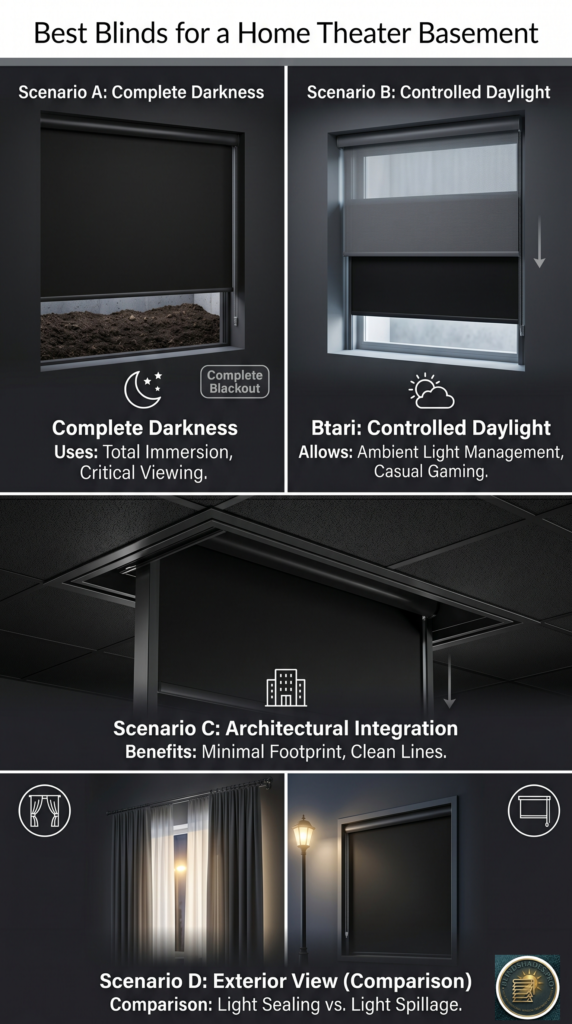
Home Theater Basement Blinds – Why the Basement Is the Best Room for a Theater
This insight is absent from all competitor home theater blind guides — and it is the single most commercially valuable fact for basement home theater owners.
Definition: A home theater or media room requires controlled ambient light to achieve an adequate contrast ratio on the projection surface. Contrast ratio is the ratio of the brightest white the projector can produce to the darkest black — a higher contrast ratio produces a more vivid, cinematic image.
The basement geometry advantage:
| Window Property | Basement Window | Above-Grade Window |
|---|---|---|
| Typical dimensions | 24×16 inches (384 sq in) | 36×48 inches (1,728 sq in) |
| Available daylight lux | 200-800 lux at glass | 5,000-10,000 lux at glass |
| Solar entry angle | Steep downward angle (limited direct entry) | Near-horizontal morning/evening (maximum penetration) |
| Number of windows | Typically 1-2 (exterior wall only) | Typically 4-8 (multiple exposures possible) |
The contrast ratio consequence:
A projector producing 1,000 ANSI lumens in a room where the ambient light is 5 lux (from 99% blackout on a 24×16 inch basement window) has a dramatically higher effective contrast ratio than the same projector in a room where ambient light is 50 lux (from 99% blackout on a 36×48 inch above-grade window with the same treatment percentage).
The basement home theater achieves better darkness with less treatment — and the darkness that is achieved with correct treatment is deeper than any above-grade room can match with the same specification.
The practical implication: Do not over-invest in the most premium blackout specification for a basement theater until you have confirmed that the standard specification is inadequate. A 99% blackout roller shade on a 24×16 inch basement window may be completely sufficient without side channels in a room where no projector is directly opposite the window.
The Two Non-Negotiable Requirements
Requirement 1 – True Blackout Fabric (99%+) With Perimeter Seal
The fabric: True blackout fabric blocks 99% or more of incident light. Standard “room darkening” at 90-95% allows 1-10 lux through a basement window at peak — adequate for most uses but not for a high-quality home theater projection setup where ambient light of even 2-5 lux reduces effective contrast.
The perimeter seal problem: As established in What Are the Best Window Treatments for a Basement Bedroom, a standard inside-mount blackout roller shade has a perimeter gap of 1/4 to 1/2 inch at the sides and bottom. On a 24×16 inch basement window, this gap area represents approximately 10% of the total window area — meaning effective blackout is approximately 90% even with 99% fabric.
For a home theater: this 10% perimeter gap contribution is the most visually disruptive element because the ambient theater is otherwise dark. A thin line of light around the blind perimeter in an otherwise dark room is more disturbing than diffuse light would be in a brighter room.
The two perimeter seal solutions:
Option A – Side-Channel Track System (Inside Mount): U-shaped aluminium or plastic channels with internal fibre brush seals are attached to the window frame sides. The roller shade fabric runs within these channels. The brush seals make contact with the fabric face, eliminating the side gap. A bottom seal rail at the window sill eliminates the bottom gap. Combined: near-complete perimeter blackout from a clean inside-mount installation.
Option B – Outside Mount with Overlap (2-3 Inches Each Side): The roller shade headrail mounts on the wall above the window frame. The shade fabric extends 2-3 inches beyond the window frame on each side and sits against the wall surface, covering the frame edges. A wider outside mount specification eliminates the side gap by covering it with fabric rather than sealing it. Recommended: 2-3 inches of overlap on each side minimum.
Requirement 2 – Dark Interior-Facing Fabric Color
This specification detail is absent from all competitor guides for basements specifically.
A blackout blind in a home theater does not just block light from outside — its interior-facing surface is also a reflector within the room. For a room with a ceiling-mounted projector:
White or light interior-facing fabric: Reflects projector light that hits the shade face back into the room. In a small basement theater where the projector light path may sweep across the window area during a wide-angle shot, a white-faced blind adds a visible hot spot or backscatter to the viewing environment.
Dark charcoal, dark grey, or black interior-facing fabric: Absorbs projector light that reaches the blind face. No backscatter. Minimum contribution to ambient light in the theater environment.
The specification:
- Windows in FRONT of the viewing position or on SIDE WALLS: specify dark charcoal or black interior-facing fabric
- Windows BEHIND the viewing audience: white interior-facing fabric is acceptable because projector light does not reach these blinds
Most blackout roller shades have a white or silver back-coating designed to reflect heat. For home theater application, request a dark interior-facing fabric from the supplier — some manufacturers offer dual-colour blackout fabric (dark interior / white exterior) specifically for media rooms.
The Window Well Night Light Funnel – The Basement Theater Problem
This is the most overlooked light control failure for basement home theaters and is absent from all guides.
A basement home theater window is typically in a window well. At night during film viewing:
The problem: Exterior light sources — streetlamps, passing vehicle headlights, security lighting from adjacent buildings — illuminate the window well from above. Inside the window well, the corrugated galvanised steel lining bounces this exterior light around the enclosed cylindrical space. Some of this bounced light reaches the window glass edge.
An inside-mount blackout blind sits inside the window frame — but there is a gap between the window glass and the blind face where the window well light enters around the perimeter. At night in a dark theater, this light entering around the perimeter of the inside-mount blind is visible as a faint glow at the blind edge.
The outside-mount solution: An outside-mount blind positioned 2-3 inches above the window frame and 2-3 inches wider on each side hangs in front of the wall surface. When lowered, the blind fabric covers the wall area around the window frame and sits flat against the wall. No window well light can enter between the blind and the wall because the blind is against the wall rather than inside the window recess.
For a basement home theater: outside mount is the definitive solution for the window well night light funnel. The fabric sits against the wall and covers the frame completely, with no gap for window well light to reach.
The Acoustic Specification for Basement Home Theater Blinds
All guides mention “sound absorption.” None give the specific acoustic performance comparison by treatment type for basement theaters.
The acoustic problem in a small basement theater: A basement home theater room is typically smaller than above-grade media rooms. Smaller rooms have shorter reverberation times and more pronounced flutter echo from parallel surfaces. A window with hard glass presents a highly reflective surface for high-frequency sound (above 2,000 Hz). In a small basement theater, flutter echo between the glass window and the opposite wall creates an audible coloration that smears dialogue clarity.
Acoustic performance by treatment type:
| Window Treatment | HF Absorption (above 2,000 Hz) | LF Absorption (below 500 Hz) | Effect on Reverb |
|---|---|---|---|
| Uncovered glass | Near-zero | Near-zero | Maximum flutter echo from glass |
| Blackout roller shade (single layer) | 1-3 dB improvement | Negligible | Minor HF reduction |
| Blackout double-cell cellular shade | 5-10 dB improvement | Marginal | Noticeable HF echo reduction |
| Blackout roller shade + heavy drapes | 8-15 dB improvement | 2-5 dB | Significant HF and moderate LF |
| Full acoustic drape (layered) | 10-20 dB improvement | 5-10 dB | Maximum treatment-level absorption |
The practical specification for a basement theater: A blackout double-cell cellular shade provides the best single-product combination of blackout performance and acoustic absorption. If budget allows, layering a blackout roller shade (for the cleanest perimeter seal with side channels) with heavy blackout drapes in front provides the maximum acoustic benefit in addition to the light control.
Note: window treatments contribute to acoustic character but do not replace room acoustic treatment (panels, diffusers, bass traps). The window is one surface; a complete basement theater acoustic treatment addresses all parallel surfaces.
The Theater Mode Smart Home Sequence
The correct motorized blind scene for a basement home theater — absent from all guides.
When motorized blinds are specified for a home theater basement, the programming sequence matters for the viewing experience.
The wrong sequence:
- Audience seated
- Someone says “Alexa, Theater Mode”
- Shades lower — audience watches the shades lower against the lit room lights
- Projector turns on while shades are still moving
The correct sequence (pre-show programming):
- Audience seated — full room lighting
- Voice command: “Alexa, Theater Mode”
- Room lighting dims to 20%
- Blinds lower to fully closed (3-5 seconds for a small basement window)
- Room lighting dims to 5%
- Projector powers on
- AV receiver activates
The blind close must run BEFORE the projector activates — this prevents the audience seeing the shade lower against a lit screen (visible to all in the room and disrupts the transition to cinema mode).
For window well TDBU blinds: If using a TDBU configuration, close the top panel first (covering the window well light funnel from above) before closing the bottom section. Programme a TDBU “theater close” sequence that closes the top panel fully before closing the bottom.
Compatible smart home configurations:
- Amazon Alexa: create a Routine named “Theater Mode” that chains all shade, lighting, and AV actions in sequence
- Google Home: create a Scene with time delays between each action
- Apple Home: Shortcut automation with action delays
- Matter/Thread compatible blinds (Hunter Douglas PowerView Gen 3, Eve MotionBlinds 2026): the fastest and lowest-latency option for immediate scene response
The Screen-Window Geometry Guide
Match the blind specification to the position of each window relative to the screen.
Window directly opposite the projector screen (front light — most critical): Light entering through this window falls directly on the screen face, washing out the image. Require full specification: 99% blackout fabric + side-channel track system + dark interior-facing fabric. Every lumen of ambient light from this window directly degrades the effective contrast ratio.
Window on the SIDE WALL adjacent to the screen: Light from a side wall window hits the near edge of the screen and creates lateral wash. Specify 99% blackout + side channels for the side nearest to the screen. The opposite side wall window is less critical if the screen is positioned centrally.
Window BEHIND the viewing audience: Light from a window behind the audience hits the audience from behind and potentially creates a backlight halo effect. Specify 99% blackout fabric; perimeter seal is less critical here because light hitting audience backs is less disturbing than light hitting the screen. White interior-facing fabric acceptable for these positions.
Window in a WINDOW WELL (any position): Outside mount is required regardless of position to eliminate the night light funnel effect. Inside-mount blind with side channels is acceptable if the window well is painted white (maximising light reflection downward rather than toward the glass edge) and if no direct external light source illuminates the well top.
For window well specification details, see How Do You Add Privacy to Ground-Level Basement Windows.
The AV Equipment Humidity Protection
This connection between window treatment and AV equipment protection is absent from all home theater blind guides.
A basement home theater contains significant investment in AV equipment: projectors (typically $1,000-$10,000+), receivers ($500-$3,000), and speaker systems ($500-$5,000+). This equipment is sensitive to moisture.
The humidity threshold for AV equipment: Consumer AV equipment typically has an operating humidity rating of 10-85% RH without condensation. Long-term storage above 70% RH accelerates corrosion on circuit board contacts and solder joints. The practical recommendation for AV equipment longevity: maintain basement theater below 50% RH consistently.
The window treatment contribution:
- Closing a cellular shade tightly to the sill in a basement increases glass condensation (PNNL effect from Article 46-7) — the increased condensation adds to the overall basement humidity
- An outside-mount blackout roller shade does not create a PNNL-style closed microclimate because air circulates freely between the shade and the wall it hangs against
- For a basement home theater: outside-mount blackout roller shade is preferred over inside-mount cellular shade both for the window well night light funnel solution AND for minimising the PNNL condensation increase that adds to basement humidity and AV equipment risk
Where to Order
For side-channel blackout roller shade system (primary home theater basement specification): SmartWings blackout with Side Rail Tracks at smartwingshome.com — the Side Rail system uses U-shaped aluminium channels with internal fibre brush seals. Specify dark charcoal or black interior-facing fabric for windows in front of or beside the screen position.
For the general home theater window treatment overview: Blinds Chalet home theater window treatments guide at blindschalet.com covers the layering approach (blackout roller + drapes) and motorization scene control configuration. Blindsgalore blackout range at blindsgalore.com/blackout for custom-sized blackout roller shades with inside-mount side-channel options.
Frequently Asked Questions
What are the best blinds for a home theater basement? The best blinds for a home theater basement are cordless blackout roller shades with side-channel track systems or outside mount with 2 to 3 inches of frame overlap on each side. The basement location provides an inherent advantage for home theater darkness because basement windows are smaller (typically 24 by 16 inches versus 36 by 48 inches above grade), provide lower available lux (200 to 800 versus 5,000 to 10,000 above grade), and the same 99 percent blackout treatment achieves a better effective contrast ratio than in any above-grade room. Specify dark charcoal or black interior-facing fabric for all windows in front of or beside the screen position to absorb projector light rather than reflecting it as stray illumination.
Why is a basement better for a home theater than an above-grade room? A basement is better for a home theater because its windows are smaller, fewer, and receive lower ambient daylight than above-grade windows. A typical basement window at 24 by 16 inches provides 200 to 800 lux of available daylight. A typical above-grade media room window at 36 by 48 inches provides 5,000 to 10,000 lux. The same 99 percent blackout fabric on the basement window allows only 2 to 8 lux of ambient light into the room. The same fabric on the above-grade window allows 50 to 100 lux. Lower ambient light produces a higher effective projector contrast ratio and a more cinematic image quality.
How do you seal the window well light gap in a basement home theater? Outside mount installation seals the window well night light funnel most effectively. An outside-mount blackout roller shade positioned 2 to 3 inches above the window frame and extending 2 to 3 inches beyond the frame on each side hangs flat against the wall surface. When lowered, the fabric covers the wall area around the window including the frame edges, leaving no gap for window well light to enter. An inside-mount blind with side channels reduces but does not fully eliminate the window well light funnel because light bouncing off the corrugated steel well interior can still reach the glass edge through very narrow gaps between the side channel and the wall surface.
Does the color of the blind face matter for home theater contrast? Yes – the interior-facing color of a home theater blind affects effective contrast ratio in the room. A white or light interior-facing surface reflects projector light that reaches the blind face back into the room as stray illumination, contributing to ambient light and reducing the projector’s effective contrast ratio. A dark charcoal, dark grey, or black interior-facing surface absorbs projector light. For any window positioned in front of or to the side of the viewing position where projector light can reach the blind face, specify dark interior-facing fabric. Windows behind the viewing audience do not receive direct projector light and white interior-facing fabric is acceptable there.
What smart home setup works best for motorized home theater basement blinds? Matter-compatible motorized blinds in a basement home theater provide the most reliable and lowest-latency response for Theater Mode automation. The correct Theater Mode sequence closes the blinds BEFORE the projector activates: lights dim to 20%, blinds lower fully, lights dim to 5%, projector powers on. This sequence prevents the audience from watching the shades lower against a lit screen. Hunter Douglas PowerView Gen 3 and Eve MotionBlinds are Matter over Thread compatible in 2026 and respond to Alexa, Google Home, and Apple Home simultaneously without bridges or adapters.
Related Guides on BlindShades.pro
- The Best Basement Window Blinds and Shades Buying Guide
- What Are the Best Blinds for Basement Windows
- What Are the Best Window Treatments for a Basement Bedroom
- Are Cellular Shades Good for Basement Windows
- How Do You Add Privacy to Ground-Level Basement Windows
By Michael Turner | 30 Years Home Improvement Expertise | Updated 2026 | BlindShades.pro
