Do Basement Blinds Get Moldy !

Authored By Michael Turner -30 Years Home Improvement Expertise | Updated 2026 | BlindShades.pro
Updated on May 27, 2026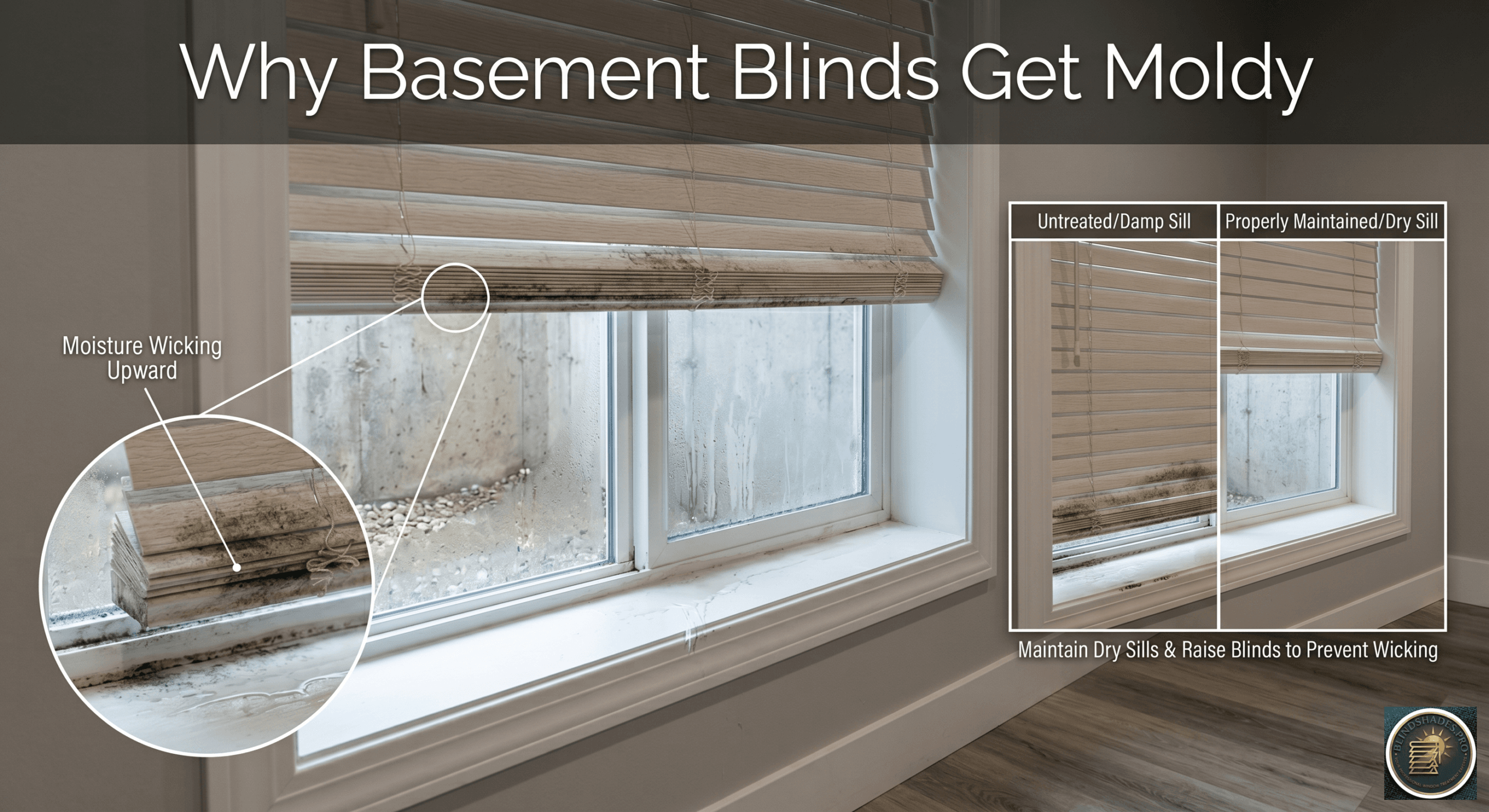
Key Takeaways:
- Basement blind mold starts at the BOTTOM of the blind, not at the glass-facing surface midway up — condensation from cold glass runs down to the sill, pools there, and wicks UPWARD into the bottom rail by capillary action
- Non-porous PVC vinyl and aluminium blinds do not absorb moisture but can still develop surface mold — dust accumulated on the surface provides the organic food source; weekly wiping removes this food and prevents surface mold even on moisture-resistant materials
- There are four distinct basement mold pathways (sill-pool wicking, glass-facing condensation, PNNL closed-shade microclimate, ambient RH absorption) — identifying the active pathway determines the correct prevention strategy
- The glass-facing diagnostic: pull the bottom rail forward and inspect with a flashlight — mold grows on the INVISIBLE glass-facing side months before it becomes visible on the room-facing side
- If mold returns within 2 to 4 weeks of cleaning, the blind material is permanently contaminated and replacement is required; never reinstall a new blind without first treating the window sill which is the condensation pooling point
⭐ Quick Answer — Do Basement Blinds Get Moldy?
- Yes — But Mold Starts at the BOTTOM, Not the Glass Surface: Basement blinds get moldy through a different mechanism than bathroom or kitchen blinds. The primary pathway is capillary sill-pool wicking: condensation from cold basement glass (10–12°C year-round) runs DOWN the glass to the window sill, pools there, and wicks UPWARD into the blind’s bottom rail. Mold begins at the bottom 2–4 inches of the blind — not at the glass surface midway up. This is why mold returns immediately after cleaning if the window sill is not treated first. The sill is the moisture source; the blind is the symptom
- The Four Basement Mold Pathways — Each Needs a Different Prevention: Basement blinds moisture and mold form through four distinct pathways: (A) Sill-pool wicking (bottom rail wicks from pooled sill condensation — fix: 1/4 inch bottom-rail clearance above sill). (B) Glass-facing surface condensation (cold glass deposits moisture directly on the glass-facing blind surface — fix: non-porous materials). (C) PNNL closed-shade microclimate (closed cellular shade makes glass colder → MORE condensation — fix: 1-inch air gap per PNNL-33380). (D) Ambient RH absorption (sustained 65–80% RH in unfinished basements absorbed by porous materials — fix: aluminium or PVC vinyl only above 65% RH)
- Non-Porous PVC and Aluminium Still Get Surface Mold — Here’s Why: PVC vinyl and aluminium do not absorb moisture into their material structure — they cannot develop structural mold. But basement blinds of all materials still develop surface mold when dust accumulates. Dust on any surface (including PVC and aluminium) is an organic food source. When condensation wets dust-covered blind surfaces, mold colonises the dust layer ON the blind. Solution: weekly wipe with a damp cloth removes the dust food source before it can feed mold. “Mold-resistant” means resistant to structural penetration — not maintenance-free
- The Glass-Facing Diagnostic — Finding Invisible Mold Before It Spreads: Basement blind mold grows on the glass-facing side for months before it appears on the visible room-facing side. To find it: pull the bottom rail 6–8 inches forward from the glass and shine a flashlight on the glass-facing surface. For Venetian blinds: twist each lower slat to expose the glass-facing surface — inspect the bottom 6–8 slats. For cellular shades: hold up to bright light — dark cell interiors confirm moisture contamination. A musty smell stronger near the blind than in general basement air indicates active glass-facing mold even when the visible surface appears clean
- Replace vs Clean — When Cleaning Stops Working: For basement blind mold: clean first, but replace when any of these conditions are met. Mold returns within 2–4 weeks: the material is permanently contaminated — replace. Dark cell interiors in cellular shade: cannot be cleaned without destroying the shade — replace immediately. More than 20% of surface area covered: beyond effective cleaning. Musty smell persists after drying: spores have penetrated fibre interior — replace. Black slimy mold for 2+ weeks: likely Stachybotrys (toxic black mold) — do not self-clean, call a professional remediator
- Best Sources: Mold prevention for all blind types → VelaBlinds mold prevention guide · Mold cleaning and warping guide → Hestia Blinds mold guide · Moisture-resistant basement replacement → Blindsgalore faux wood range
⚠️ The Window Sill Pre-Treatment Warning and the Mold Species Risk Guide: The most common cause of immediate mold recurrence on replacement basement blinds is failing to treat the window sill before reinstalling. The sill is the terminal pooling point for condensation water from the cold glass. If the sill harbours active mold, any new blind installed over an untreated sill will be re-inoculated with spores and moisture within days. Timber sills: apply 10% hydrogen peroxide, scrub, allow to dry 24–48 hours, then seal with waterproof timber primer. Masonry/concrete sills: scrub with 1:10 bleach solution, dry, apply waterproof masonry sealant. Soft or spongy timber sill: the wood has rotted — replace the sill before any blind installation. And the species risk guide: most basement blind mold is Cladosporium (black/olive-green, grows at temperatures as low as 14°F — one of the few molds active on cold glass-facing surfaces). Stachybotrys chartarum (toxic black mold) only establishes after 7–10 days of continuously wet organic material — found on basement blinds when sill-pool wicking is sustained long-term without drying. If you see dark black SLIMY mold (not dry spots) that has been present for 2+ weeks: do NOT disturb it — call a professional. For the full RH material selection guide by zone, see What Are the Best Blinds for Basement Windows. See the full four pathway analysis below.
💡 The Mold Removal Protocol by Material — Take It Outside First: When cleaning basement blind mold, always take the blind outside before cleaning — this prevents spore dispersal into the basement air. Then apply the correct solution by material: PVC vinyl roller shade: 1:10 bleach in a spray bottle; spray glass-facing surface; leave 10 minutes; scrub; rinse; dry in direct sunlight (UV kills residual spores). Faux wood Venetian: 1:1 white vinegar and water (safer for composite than bleach); wipe each glass-facing lower slat individually; air dry fully. Aluminium mini blind: submerge lower section in diluted dish soap; wipe each slat; rinse; hang to dry in sunlight. Cellular shade with dark cell interiors: do NOT clean — replace. Real wood with glass-facing mold: do NOT clean — replace. After any cleaning, treat the window sill before reinstalling and reinstall with 1/4 inch clearance above the treated sill. For the full cellular shade condensation mechanism and how mold enters cells from the glass-facing side, see Are Cellular Shades Good for Basement Windows. See the full glass-facing diagnostic below.
📖 Read the complete guide below for: the four basement mold formation pathways (A sill-pool wicking / B glass-facing condensation / C PNNL closed-shade microclimate / D ambient RH absorption) and their different prevention strategies, the capillary wicking mechanism explaining why mold starts at the bottom of the blind, why non-porous PVC and aluminium still develop surface mold from dust accumulation (and how weekly wiping prevents it), the glass-facing diagnostic protocol (pull-forward flashlight / slat twist / cellular light test / smell localisation), the mold species guide (Cladosporium common at 14°F / Stachybotrys after 7–10 days sustained wet = professional remediation), the window sill pre-treatment protocol by sill type before installing any replacement blind, the mold removal protocol by blind material (take outside / bleach vs vinegar vs dish soap / UV sun-dry), and the replace vs clean decision framework.
Basement Blinds Mold and Moisture – The Four Formation Pathways
Definition: Mold is a fungal growth that requires three conditions simultaneously: moisture, an organic food source, and viable mold spores (which are ubiquitous in all air). Controlling any one of these three conditions prevents mold growth.
No guide covering basement blind mold distinguishes the four separate moisture pathways active in below-grade environments. Identifying which pathway is causing mold determines the correct prevention strategy.
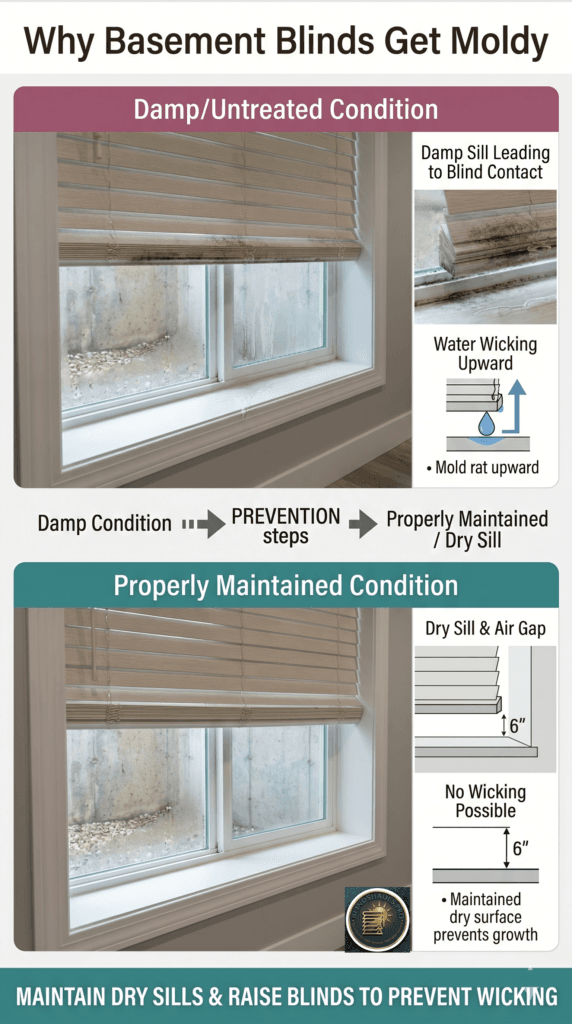
Pathway A – Sill-Pool Wicking (Most Common in Basements)
Mechanism:
- Cold basement glass at 10-12°C causes warm indoor air to condense on the glass surface
- Condensation droplets run DOWN the glass face toward the window sill
- The sill acts as a collection point for condensation water
- The blind’s bottom rail sits on or near the sill
- Water from the sill pool wicks UPWARD into the blind material by capillary action
- Mold begins at the BOTTOM of the blind, in the bottom rail and the lowest 2-4 inches of material
The diagnostic sign: Mold or moisture staining concentrated at the BOTTOM of the blind, on both the room-facing and glass-facing surfaces of the bottom rail.
The prevention: Bottom rail positioned minimum 1/4 inch above the sill — this air gap breaks the capillary path. Established in What Are the Best Blinds for Basement Windows.
Pathway B – Glass-Facing Surface Condensation
Mechanism:
- The cold glass surface is in close proximity to the blind’s glass-facing surface
- Moisture from the basement air deposits directly on the glass-facing surface of the blind material (not via sill pooling)
- This glass-facing surface is the cooler side of the blind — it is in the temperature gradient between the cold glass (10-12°C) and the warmer room air
- Mold grows on the glass-facing surface of the blind, particularly on the lower slats that are closest to the cold glass
The diagnostic sign: Mold or moisture staining on the GLASS-FACING SIDE of the blind, typically on the lower 6-12 inches. The room-facing surface may appear clean. This is the invisible-side mold that develops for months undetected.
The prevention: Non-porous materials (PVC vinyl, aluminium) whose glass-facing surface cannot absorb moisture. Real wood, cotton fabric, and bamboo are most susceptible.
Pathway C – PNNL Closed-Shade Microclimate
Mechanism: As documented in Are Cellular Shades Good for Basement Windows, PNNL Report PNNL-33380 confirmed that a closed cellular shade intensifies the cold glass condensation by blocking warm room air from warming the glass surface. The glass becomes colder still, and the moisture microclimate between the shade and the glass approaches 70-80% RH even when ambient basement air is at 45%.
The diagnostic sign: Mold on the glass-facing cell interiors of cellular shades (hold to bright light — dark cell interiors confirm contamination). Condensation water trails on the window frame immediately inside the shade position.
The prevention: PNNL 1-inch air gap at the bottom of the shade; double-cell construction; maintaining ambient basement RH below 45%.
Pathway D – Ambient RH Absorption
Mechanism: In unfinished or poorly ventilated basements at sustained 65-80% RH, porous blind materials (cotton, linen, bamboo, real wood) absorb moisture directly from the humid air until they reach their equilibrium moisture content. No visible condensation event is required — the material simply absorbs moisture from the air continuously until mold conditions are met.
The diagnostic sign: Mold developing across the FULL BLIND SURFACE, not concentrated at the bottom or glass-facing side. The blind appears generally damp or has a persistent musty smell.
The prevention: Non-porous materials only for Zone B3 basements above 65% RH. Aluminium mini blind or PVC vinyl roller shade. Digital hygrometer measurement before material selection.
The Non-Porous Blind Mold Problem – Why “Mold-Resistant” Is Not “Mold-Proof”
This explanation is absent from all competitor guides and confuses many homeowners who install “moisture-resistant” blinds and still find mold.
PVC vinyl and aluminium blinds are correctly described as mold-resistant because their non-porous material cannot absorb moisture into its structure. Mold cannot penetrate INTO these materials.
However: mold grows ON surfaces, not only IN them. The equation for surface mold on a non-porous blind:
- Dust accumulates on the PVC vinyl or aluminium surface over days and weeks
- Dust is an organic material containing dead skin cells, fabric fibres, and other organic debris — this is the food source for mold
- Condensation water (from Pathway A or B) wets the dust-covered surface
- Mold spores in the basement air land on the now-moist organic dust surface
- Surface mold colonies begin growing ON the PVC or aluminium surface within days
The key insight: Non-porous blinds prevent structural mold (deep material penetration) but they do not prevent surface mold from forming on the accumulated dust layer. The prevention is removing the food source: weekly wiping of the blind surface with a damp cloth removes the dust before it can serve as mold substrate.
The practical consequence: A PVC vinyl basement blind that is never cleaned will eventually develop surface mold. A PVC vinyl blind that is wiped weekly will not. The material provides structural protection but not maintenance-free protection.
The Glass-Facing Diagnostic – Finding Invisible Mold
This diagnostic is absent from all competitor guides. It is the single most important inspection step for basement blinds because mold develops on the side you cannot see.
As established throughout Guide #46, basement blind mold develops on the glass-facing surfaces because that is where cold glass condensation contacts the blind. The room-facing surface may appear clean while the glass-facing side has been developing mold for months.
The inspection protocol:
Step 1 – The pull-forward test: Grasp the bottom rail of the blind and pull the bottom of the blind approximately 6-8 inches forward from the glass surface. Using a flashlight, shine the light along the glass-facing surface of the bottom 12 inches of the blind. Look for:
- Black, grey, or green spotting on the glass-facing surface of slats or fabric
- Water staining marks running vertically up the glass-facing surface from the sill area
- White mineral deposits (efflorescence) where sill water has wicked upward and dried
Step 2 – The slat twist test (for Venetian blinds): For horizontal Venetian or faux wood blinds: while the pull-forward is maintained, twist the tilt rod to rotate the slats so the glass-facing surface is visible from the room. Inspect the bottom 6-8 slats specifically – these experience the highest condensation exposure.
Step 3 – The cellular shade light test: For cellular shades: hold the shade up to a bright window or lamp. Clean cells appear lighter than the cell walls. Dark or grey cell interiors confirm moisture contamination as established in Article 46-7.
Step 4 – The smell test: A musty smell that is localised to the blind area (stronger when you lean close to the blind than in the general basement air) indicates active mold on the glass-facing surface or inside cellular cells. The musty odour from active mold is produced by microbial volatile organic compounds (MVOCs) from fungal metabolism.
The Mold Species Guide for Basement Blinds
Identifying the species helps assess health risk and remediation urgency.
Cladosporium (most common): Appearance: black, olive-green, or brown spots; often forms irregular clusters. Growth temperature: as low as 14°F (-10°C) — one of the few mold species that grows at refrigerator temperatures. Found most commonly on the glass-facing lower slats of basement blinds where the cold glass surface temperature promotes growth even without high ambient humidity. Health risk: moderate – respiratory irritation, allergy trigger.
Penicillium (fabric blinds): Appearance: blue-green or grey-green colonies with a powdery texture. Found on cotton, linen, and organic fabric basement blinds absorbing moisture (Pathway D). Health risk: moderate – significant allergen.
Aspergillus (high-humidity environments): Appearance: varied colours (black, green, white, yellow) depending on species. Found in basements above 65% RH on any porous material. Health risk: moderate to significant – includes species that produce mycotoxins.
Stachybotrys chartarum (toxic black mold): Appearance: dark black, slimy texture when wet, dusty when dry. Growth requirement: continuously wet organic material for at least 7-10 days. Found on basement blinds only when Pathway A sill-pool wicking is sustained long-term – a sill pool that does not dry between condensation cycles. Health risk: HIGH – produces trichothecene mycotoxins; requires professional remediation.
When to call a professional: If the basement blind mold is dark black AND slimy in texture AND has been present for more than 2 weeks, do not attempt self-remediation. Disturbing Stachybotrys spores without professional containment can spread the contamination.
The Window Sill Pre-Treatment – The Step No Guide Mentions
Installing a new blind without treating the window sill first is the most common cause of immediate mold recurrence on replacement blinds.
The window sill is the terminal collection point for condensation water from cold basement glass. Over months and years, the sill accumulates concentrated moisture and becomes the primary mold growth site from which the blind is continuously re-inoculated with spores and moisture.
Sill type treatment protocols:
Timber window sill:
- Remove the existing blind
- Inspect the sill surface – if soft or spongy to touch probe: the timber has rotted and must be replaced, not just cleaned
- For surface mold on intact timber: apply 10% hydrogen peroxide solution (undiluted 3% pharmacy hydrogen peroxide provides a safer alternative); leave for 10 minutes; scrub with a stiff brush; wipe dry
- Allow to dry completely (minimum 24-48 hours in ventilated conditions)
- Apply a waterproof timber primer and sealant to seal the sill surface
- Install new blind with 1/4 inch clearance above the SEALED sill
Concrete or masonry window sill:
- Remove existing blind
- Scrub sill with diluted bleach solution (1 part bleach to 10 parts water)
- Allow to penetrate for 15 minutes; rinse; allow to dry completely
- Apply waterproof masonry sealant to seal the sill surface against future condensation pooling
- Install new blind with 1/4 inch clearance above the SEALED sill
Vinyl-clad or aluminium sill:
- Clean with 10% white vinegar solution
- Rinse and dry
- Inspect the sill-to-frame junction for any gaps where water infiltrates — seal with silicone caulk if gaps present
- Install new blind with 1/4 inch clearance
The Mold Removal Protocol for Basement Blinds
Take the blind OUTSIDE for cleaning — this prevents mold spores from dispersing into the basement air during the cleaning process.
PVC vinyl roller shade:
- Take outside; hang or lay flat
- Mix 1:10 bleach solution in a spray bottle
- Spray the glass-facing surface thoroughly, focusing on the lower section
- Leave for 10 minutes
- Scrub with a soft brush
- Rinse with clean water
- Allow to dry in direct sunlight (UV radiation kills residual mold spores)
- Reinstall with 1/4 inch bottom clearance above the treated sill
Faux wood Venetian blind:
- Take outside
- Mix 1:1 white vinegar and water solution (safer for composite materials than bleach)
- Twist each lower slat to expose glass-facing surface; wipe with solution using a cloth
- Focus on bottom 6-8 slats and the glass-facing surface specifically
- Allow to dry fully in ventilated conditions
- Do NOT reinstall until bone dry
Aluminium mini blind:
- Take outside; submerge lower section in bucket of diluted dish soap solution
- Wipe each slat individually on both surfaces
- Rinse with clean water
- Hang to dry fully in sunlight
Cellular shade: If the glass-facing cell interiors show dark contamination (confirmed by the light test): do NOT attempt to clean. The cells cannot be accessed without destroying the shade structure. Replace immediately.
Real wood blind: If glass-facing mold is present: do NOT attempt to clean and reinstall. The hollow cellulosic wood fibres have absorbed mold into their interior where surface cleaning cannot reach. Replace.
The Replace vs Clean Decision Framework
When cleaning is no longer the answer for basement blinds:
| Condition | Action |
|---|---|
| Mold returns within 2-4 weeks of thorough cleaning | Replace — material is permanently contaminated |
| Dark cell interiors in cellular shade (light test) | Replace immediately — cells cannot be cleaned |
| Mold covers more than 20% of blind surface area | Replace — cleaning removes surface mold but not internal spores |
| Musty smell persists after thorough cleaning and drying | Replace — spores have penetrated fibre interior |
| Black slimy mold present for more than 2 weeks | Professional remediation — do not self-clean |
| Window sill shows soft/spongy rot under probe | Replace sill first, then replace blind |
| Real wood blind with glass-facing mold | Replace — hollow wood fibres are permanently contaminated |
Where to Order
For moisture-resistant basement blind replacement (primary mold-resistant specification): Blindsgalore faux wood Venetian blind at blindsgalore.com/blinds/faux-wood-blinds — specify: routeless, PVC composite construction, inside mount with 1/4 inch clearance above treated sill.
For the mold prevention mechanism on all blind types: VelaBlinds mold prevention guide at velablinds.com covers the three-condition mold equation and air gap installation guidance. Hestia Blinds mold guide at hestiablinds.com covers the material-specific cleaning and replacement assessment.
Frequently Asked Questions
Do basement blinds get moldy? Yes – basement blinds get moldy through four distinct pathways. The most common is capillary wicking where condensation from cold basement glass runs down to the window sill, pools there, and wicks upward into the blind’s bottom rail. Mold begins at the bottom of the blind, not at the glass surface. The other pathways are direct glass-facing surface condensation, the PNNL closed-shade microclimate intensification, and ambient humidity absorption in basements above 65 percent relative humidity. Non-porous materials such as PVC vinyl and aluminium resist structural mold but can still develop surface mold from dust accumulation and require weekly cleaning.
Why does mold keep coming back on my basement blinds? Mold recurs on basement blinds for two main reasons. First, the window sill is moldy and continues to supply moisture and spores to the new or cleaned blind – always treat the sill before reinstalling. Second, the ambient basement humidity is above 50 percent, meaning the environment supports ongoing mold growth regardless of material choice. If mold returns within 2 to 4 weeks of thorough cleaning, the blind material is permanently contaminated and must be replaced, and the basement humidity must be brought below 50 percent with an active dehumidifier.
How do you find mold on the invisible side of basement blinds? To find mold on the glass-facing side of a basement blind, pull the bottom rail forward from the glass 6 to 8 inches and inspect the glass-facing surface with a flashlight. For Venetian blinds, twist each slat to view its glass-facing surface – inspect the bottom 6 to 8 slats specifically. For cellular shades, hold the shade up to a bright light source – dark cell interiors indicate moisture contamination from the glass-facing cells. A musty smell localised to the blind direction stronger than the general basement air indicates active glass-facing mold even before it is visible.
Can you clean mold off basement blinds? Mold can be cleaned from PVC vinyl, faux wood, and aluminium basement blinds when caught early and when the conditions that caused the mold are corrected before reinstalling. Take the blind outside before cleaning to prevent spore dispersal. Use a 1:10 bleach solution for PVC vinyl, a 1:1 vinegar and water solution for faux wood composite, and dish soap for aluminium. Allow to dry completely in direct sunlight before reinstalling with 1/4 inch clearance above the treated window sill. Cellular shades with contaminated cell interiors and real wood blinds with glass-facing mold cannot be effectively cleaned and must be replaced.
What is the most dangerous mold on basement blinds? Stachybotrys chartarum, commonly called toxic black mold, is the most dangerous species that can colonise basement blinds. It requires continuously wet organic material for at least 7 to 10 days to establish and is found on basement blinds when sill-pool wicking creates a sustained wet environment at the bottom rail. It appears as dark black and slimy when wet. If dark black slimy mold has been present for more than two weeks on a basement blind, do not attempt self-remediation as disturbing the spores without professional containment can spread contamination. The most common basement blind mold is Cladosporium – black or olive-green spots that grow even at near-freezing temperatures on cold glass-facing slat surfaces.
Related Guides on BlindShades.pro
- The Best Basement Window Blinds and Shades Buying Guide
- What Are the Best Blinds for Basement Windows
- Can You Use Real Wood Blinds in a Basement
- Are Cellular Shades Good for Basement Windows
- What Are the Best Window Treatments for a Basement Bedroom
By Michael Turner | 30 Years Home Improvement Expertise | Updated 2026 | BlindShades.pro
