Can You Use Real Wood Blinds in a Basement?

Authored By Michael Turner -30 Years Home Improvement Expertise | Updated 2026 | BlindShades.pro
Updated on July 16, 2026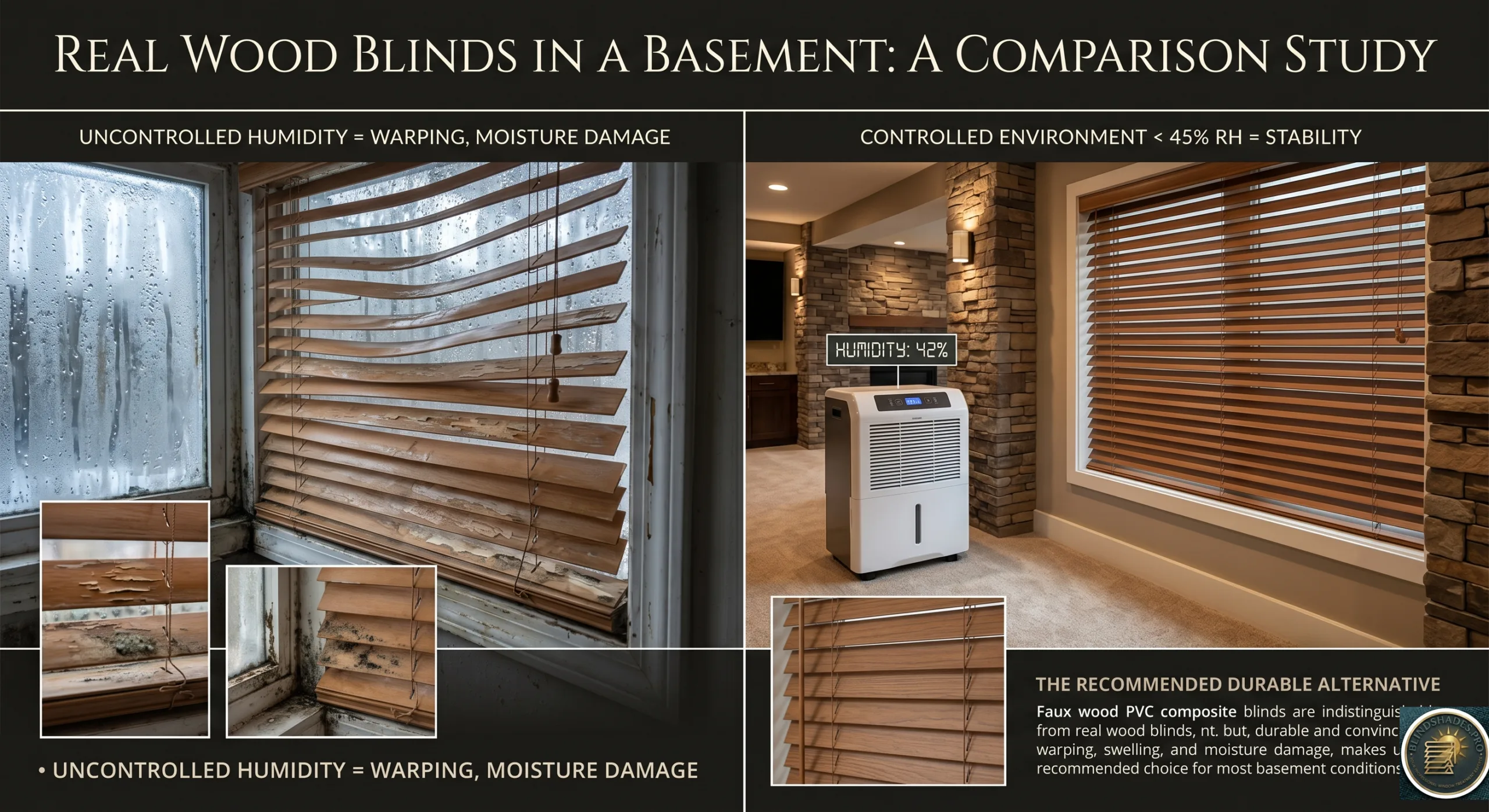
⭐ Quick Answer — Can You Use Real Wood Blinds in a Basement?
- The Basement Is the Worst Room for Real Wood — Worse Than Bathrooms and Kitchens: Real wood blinds in a basement fail faster than in any other room. Bathroom: humidity is episodic (during showers only) — wood has drying cycles between uses. Kitchen: humidity is episodic + heat cycling damages lacquer. Basement: humidity is sustained 60–80% continuously, 24 hours per day, year-round in unfinished basements — there are no drying cycles. The wood absorbs moisture toward its equilibrium moisture content and stays there until it warps
- Why “Lacquer-Sealed” Does NOT Mean Moisture-Proof — The EMC Mechanism: Kiln-dried real wood starts at 6–8% moisture content. The lacquer sealant on real wood blinds in a basement slows moisture absorption — it does NOT prevent it. At 70% RH, wood equilibrates to approximately 13% moisture content by weight. At 80% RH: 16%. This equilibration happens through every pivot hole, lacquer micro-crack, and end-grain exposure — slowly but inevitably. The swelling from 7% to 13% moisture content causes the characteristic cupping and warping that makes basement real wood blinds fail
- The Failure Timeline: Unfinished basement (70–80% RH): visible slat cupping in 3–6 months; mechanism failure by 12–18 months. Partially finished (55–70% RH): cupping in 6–12 months; failure by 18–24 months. Dehumidified Zone B1 (40–55% RH): 5–8 years before cupping becomes visually unacceptable. Zone B5 window well (any humidity): not recommended — concentrated condensation from trapped cold air accelerates failure regardless of dehumidification
- The Annual Cost Reality: Zone B3 unfinished basement: real wood $80–$400/year (6–12 month lifespan) vs aluminium mini blind $0.75–$4/year (15–20 year lifespan) — 20–100 times more expensive per year. Zone B1 dehumidified: real wood (teak/oak) $15–$55/year vs faux wood $2.50–$10/year. Even in the best-case basement scenario, real wood costs 6–22 times more per year than faux wood
- The One Acceptable Scenario: Real wood blinds are acceptable in a basement only when ALL four conditions are met: (1) fully finished Zone B1 with an active dehumidifier maintaining below 45% RH confirmed by hygrometer; (2) NOT a Zone B5 window well window — window wells concentrate cold-air condensation; (3) teak or dense oak — not basswood (most commercial real wood blinds); (4) inside mount with 1/4 inch bottom-rail clearance above sill. Expected lifespan under all conditions: 5–8 years
- Best Sources: Faux wood vs real wood technical comparison → SmartBlindsPro faux vs real wood guide · Faux wood basement range → Blindsgalore faux wood range · Wood vs faux wood overview → Budget Blinds comparison guide
⚠️ The Cold Glass Condensation Accelerator and the Wood Species Factor: For real wood blinds in a basement, there is an additional failure mechanism unique to below-grade installations that no guide covers. Basement window glass is kept cold by below-grade soil at ground temperature — approximately 10–12°C year-round. Cold glass chills the air immediately around the window and causes condensation to form on the glass-facing side of the blind slats. The glass-facing slats therefore experience BOTH the ambient high humidity of the basement AND condensation droplets on their glass-facing surface — absorbing moisture faster on one side than the other and causing cupping (slat bends toward the drier room-facing side). This cupping pattern is characteristic of basement real wood failure and does not occur in kitchen or bathroom positions. And the species factor: most commercial real wood blinds are basswood — the most porous common blind wood and the fastest to absorb moisture in basement conditions. For the one acceptable Zone B1 dehumidified scenario: always specify teak or dense oak — never basswood. For the full mold mechanism and how basement condensation affects all blind types, see Do Basement Blinds Get Moldy. See the full EMC mechanism below.
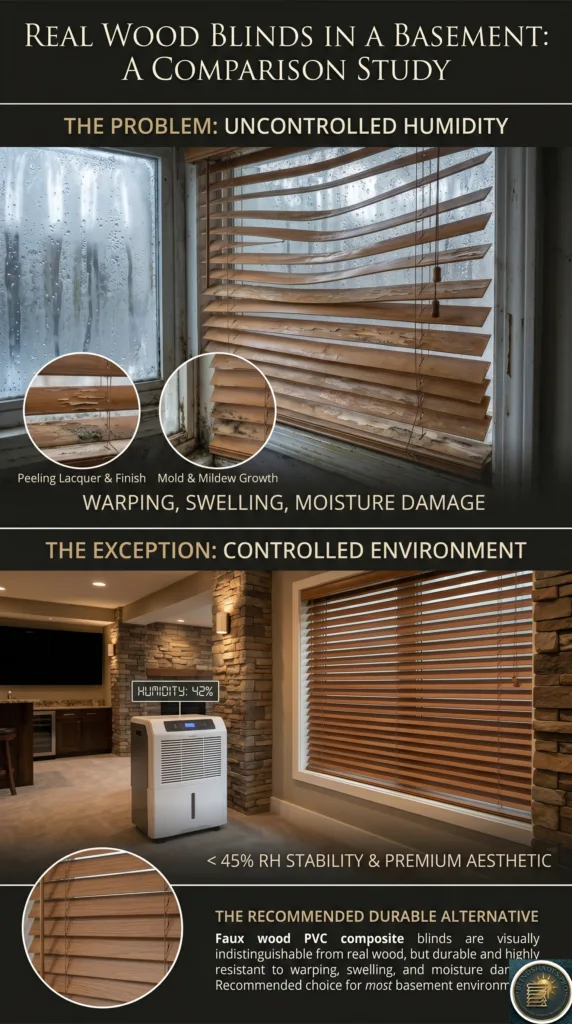
💡 What Basement-Aged Real Wood Looks Like — and Why It Looks Worse Than Faux Wood After Year One: The visual failure mode of real wood blinds in a basement is different from kitchen failure (greasy darkening) and bathroom failure (pivot-hole staining). Basement real wood failure is physical and dimensional: slats show visible cupping (bent across the width), bowing (bent along the length), or twisting, and the glass-facing surface shows dark moisture staining and potentially mold spotting at the bottom rail area. After 12–18 months in an unfinished basement, the tilt mechanism is typically stiff or seized from swollen slats pressing against the ladder cord, and the slats no longer lie flat in any tilt position. A quality faux wood PVC composite blind in the same position maintains its original flat appearance and smooth tilt operation throughout its 15–20 year lifespan because PVC composite is non-porous and does not absorb moisture. The aesthetic argument for real wood over faux wood is valid only at the time of purchase — after 6–18 months in a basement, real wood looks structurally compromised while faux wood looks unchanged. For the full basement specification and material guide, see What Are the Best Blinds for Basement Windows. See the full failure timeline below.
📖 Read the complete guide below for: the three failure environment comparison (bathroom episodic vs kitchen heat cycling vs basement sustained continuous), the equilibrium moisture content mechanism (70% RH equilibrates wood to 13% moisture — lacquer only delays this), the cold glass condensation accelerator unique to basement positions, the failure timeline by humidity level (3–6 months Zone B3 / 5–8 years dehumidified Zone B1), the wood species factor (basswood worst / teak best for basement), the one acceptable basement scenario (dehumidified below 45% RH, Zone B1 only, no window well, teak/oak, 1/4 inch sill clearance), the annualised cost comparison (20–100x more expensive per year in Zone B3), and the visual failure comparison (cupping/warping/mold vs faux wood unchanged).
Related guides: the basement is the edge case — the full system (species, slat sizes, the Span rule and every room verdict) is in the complete real wood blinds guide.
Real Wood Blinds in a Basement – The Three Failure Environments Compared
Definition: Real wood blinds are window blinds manufactured from solid timber slats – most commonly basswood – that have been kiln-dried and finished with lacquer or urethane sealant.
This guide covers the basement specifically. To understand how the bathroom compares, see Can You Use Real Wood Blinds in a Bathroom. To understand the kitchen comparison, see Can You Use Real Wood Blinds in a Kitchen.
The three environments compared:
| Environment | Humidity Type | RH Level | Primary Failure Mechanism |
|---|---|---|---|
| Bathroom | Episodic (during showers only) | 70-80% peak, drops to 50-60% otherwise | Moisture penetration at pivot holes; wet-dry cycling |
| Kitchen | Episodic + heat cycling | 40-60% ambient; higher during cooking | Lacquer micro-cracks from heat cycling; grease penetration |
| Basement (unfinished) | Sustained continuous | 60-80% year-round, 24 hours/day | Continuous moisture absorption to equilibrium; cold glass condensation |
Why the basement is the worst environment for real wood:
A bathroom real wood blind experiences elevated humidity during a 15-30 minute shower, then the humidity drops as the room ventilates. The wood absorbs moisture during the shower and dries between showers – a wet-dry cycle that damages wood over months.
A kitchen real wood blind experiences heat cycling that cracks lacquer, allowing grease penetration – a different mechanism covered in the kitchen guide.
A basement real wood blind experiences neither episodic humidity nor heat cycling – it experiences continuous, sustained humidity at the same elevated level 24 hours per day. There is no drying cycle. The wood absorbs moisture continuously until it reaches its equilibrium moisture content for that humidity level – and it stays there.
The Equilibrium Moisture Content Problem – Why “Lacquer-Sealed” Does Not Mean Moisture-Proof
This is the most commonly misunderstood concept about real wood blinds in basements – and it is absent from all competitor guides.
Definition: Equilibrium moisture content (EMC) is the moisture level that wood reaches when it is in balance with the humidity of its surrounding environment. Wood will always absorb or release moisture until it reaches this equilibrium.
The EMC values relevant to basement conditions:
| Relative Humidity | Wood EMC (approximate) | Typical Impact |
|---|---|---|
| 30% RH | 6% EMC | Dry indoor conditions; kiln-dried wood is stable |
| 45% RH | 8-9% EMC | Comfortable baseline; most finished basements |
| 60% RH | 11% EMC | Begins to affect dimensional stability |
| 70% RH | 13% EMC | Significant swelling; visible warping begins |
| 80% RH | 16% EMC | Severe swelling; mechanism failure; mold risk |
Kiln-dried real wood used in window blinds typically starts at 6-8% moisture content. The lacquer or urethane sealant on the slat surface slows the rate at which the wood absorbs moisture from the air – but it does NOT prevent absorption.
Every real wood slat has:
- Exposed end grain at the pivot holes where the ladder cord passes through
- Microscopic cracks in the lacquer finish from the manufacturing process and handling
- Uncoated areas at cut edges
Through these exposure points, basement humidity slowly penetrates the wood and the slat moisture content rises toward the EMC for that humidity level. At 70% RH (a typical unfinished basement), a kiln-dried basswood slat will absorb enough moisture to reach approximately 13% EMC – more than double its starting moisture content.
This moisture increase causes the wood to swell dimensionally. The swelling is not uniform (end-grain absorbs faster than face-grain), creating internal stress that causes the slat to bow, cup, or twist – the characteristic warping of basement-damaged real wood blinds.
The practical implication: A lacquer-sealed real wood blind is not moisture-proof in a basement – it is merely moisture-delayed. Given sufficient time at 70%+ RH, it will fail.
The Cold Glass Condensation Accelerator
This basement-specific failure mechanism is absent from all competitor real wood blind guides.
The bathroom real wood failure (covered in the bathroom guide) occurs primarily at pivot holes where steam penetrates end-grain. The kitchen failure occurs from lacquer damage by heat cycling. The basement has an additional failure mechanism that is unique to below-grade installations.
The cold glass mechanism: Basement window glass is kept cold by its contact with below-grade soil at ground temperature – approximately 10-12 degrees Celsius year-round. This cold glass surface chills the air in its immediate vicinity, creating a microclimate near the window that is cooler and more humid than the ambient basement air.
The effect on real wood slats nearest the glass: Real wood slats in the inside-mount position sit close to the cold glass surface. These slats experience:
- The ambient basement humidity (60-80% RH)
- PLUS a cooler temperature microclimate that increases the local relative humidity further
- PLUS direct condensation droplets that form on the glass and can splash or drip onto the glass-facing slat surface
The real wood slats in a basement are not just exposed to high ambient humidity – they are also exposed to a condensation source on their glass-facing surface. This concentrated moisture exposure on the glass-facing side causes the glass-side face of the slat to absorb moisture faster than the room-facing side, creating differential moisture content across the slat thickness – which causes cupping (the slat bends toward the drier room-facing side).
This cupping failure pattern is characteristic of basement real wood blind damage and is not seen in kitchen or bathroom real wood failures to the same degree.
The Failure Timeline for Basement Real Wood Blinds
This basement-specific timeline is absent from all competitor guides.
Unfinished basement (70-80% RH, no climate control):
- Month 1-2: Lacquer appears intact; moisture absorption begins through end-grain and micro-cracks
- Month 3-6: Visible slat cupping begins, particularly on slats nearest the cold glass; pivot holes show the first visible staining from moisture infiltration
- Month 6-12: Progressive warping across all slats; tilt mechanism becomes stiff as swollen slats press against the ladder cord; slats may stick together when tilted
- Month 12-18: Mechanism failure – tilt rod cannot rotate properly; mold may appear on the glass-facing side of lower slats near the sill; slats show significant cupping and potential splitting at end-grain
Partially finished basement (55-70% RH, drywall but no dehumidifier):
- Month 1-3: EMC absorption is slower; lacquer delays penetration
- Month 6-12: Visible slat cupping begins in the glass-facing position
- Month 12-18: Progressive warping; mechanism stiffness
- Month 18-24: Mechanism failure
Fully finished, dehumidified basement (40-55% RH, Zone B1):
- Year 1-3: Minimal visible change if RH is maintained consistently below 50%
- Year 3-5: Gradual accumulation of pivot hole moisture over time; slight cupping begins at glass-facing slats
- Year 5-8: Visible cupping and possible mechanism stiffness; still aesthetically acceptable in Zone B1 at this age
Zone B5 (window well) – any humidity level: Not recommended regardless of dehumidification. Window well windows experience concentrated condensation from the trapped cold air in the well – even in a dehumidified basement, the window well window glass is significantly colder than other basement windows and condensation forms more readily.
The Wood Species Factor in Basement Performance
All guides treat real wood blinds as one category. As established in the kitchen and bathroom guides, the wood species significantly affects moisture resistance.
| Species | Grain Density | Basement EMC Absorption Rate | Warp Timeline at 70% RH | Basement Suitability |
|---|---|---|---|---|
| Basswood | Very low density, open porous grain | Fast | 3-6 months visible | Poor |
| Poplar | Low-medium density | Fast-moderate | 6-9 months | Poor |
| Oak | Medium-high density | Moderate | 9-15 months | Poor-Fair in Zone B1 dehumidified only |
| Teak | High density, natural oils | Slow | 18-36+ months (with maintenance) | Fair in Zone B1 dehumidified below 45% RH |
The practical implication: Most commercial real wood blinds are basswood – the cheapest and most open-grained species. If real wood is being considered for a Zone B1 dehumidified basement, basswood is the worst possible choice. Requesting teak or dense oak is the minimum requirement for any basement real wood application.
The One Acceptable Basement Scenario
Every guide says never use real wood in a basement. The specific exception:
A Zone B1 window meeting ALL of the following conditions:
- Fully finished basement (drywall, flooring, climate-controlled)
- Active dehumidifier maintaining below 45% RH consistently – confirmed with a digital hygrometer reading
- Not a Zone B5 window well window (concentrated condensation from well makes real wood inappropriate even in dehumidified basements)
- Not a Zone B2 bedroom window (the investment in real wood is wasted behind egress compliance requirements)
- Teak or high-density species – not basswood or poplar
- Inside mount with 1/4 inch bottom-rail clearance above sill – to prevent capillary wicking from condensation
Expected lifespan under these conditions: 5-8 years before visible cupping becomes aesthetically unacceptable. This is shorter than the kitchen Zone K3 acceptable real wood lifespan of 5-8 years because basement cold glass condensation adds moisture to the glass-facing surface even in dehumidified conditions.
The Annualised Cost Comparison for Basement Real Wood Blinds
| Position | Blind | Upfront Cost | Realistic Lifespan | Annual Cost |
|---|---|---|---|---|
| Zone B3 unfinished (70-80% RH) | Real wood | $80-$200 | 6-12 months | $80-$400/yr |
| Zone B3 unfinished (70-80% RH) | Aluminium mini blind | $15-$60 | 15-20 years | $0.75-$4/yr |
| Zone B1 partially finished (55-70% RH) | Real wood | $80-$200 | 12-24 months | $40-$200/yr |
| Zone B1 partially finished (55-70% RH) | Faux wood PVC | $50-$150 | 15-20 years | $2.50-$10/yr |
| Zone B1 dehumidified (40-50% RH) | Real wood (teak/oak) | $120-$280 | 5-8 years | $15-$55/yr |
| Zone B1 dehumidified (40-50% RH) | Faux wood PVC | $50-$150 | 15-20 years | $2.50-$10/yr |
The finding: Real wood in an unfinished basement Zone B3 costs 20-100 times more per year than aluminium mini blinds in the same position. Even in the most favourable basement scenario (dehumidified Zone B1, teak species), real wood costs 6-22 times more per year than faux wood.
The Visual Comparison – What Basement-Aged Real Wood Looks Like
This visual comparison is absent from all competitor guides.
Kitchen-aged real wood: Greasy, darkened grain lines; overall colour shift to amber/brown; grease staining at pivot holes – the failure is cosmetic discolouration.
Bathroom-aged real wood: Pivot holes discoloured and water-stained; slats may show slight cupping at the uncoated end-grain areas – the failure begins at specific structural weak points.
Basement-aged real wood: Slats show visible physical distortion – cupping (slat bends across its width), bowing (slat bends along its length), or twisting (slat rotates along its axis). The glass-facing side of slats shows darker moisture staining and possible mold spotting. The failure is dimensional and structural rather than cosmetic.
After 12-18 months in an unfinished basement, real wood blinds that are still structurally intact have visibly warped slats that do not lie flat, a stiff or failed tilt mechanism, and possible mold on the glass-facing surface. Quality faux wood PVC composite blinds in the same position maintain their original flat appearance and smooth tilt operation throughout their 15-20 year lifespan.
Where to Order – The Correct Basement Alternative to Real Wood
For Zone B1-B2 faux wood (primary basement specification, the real wood alternative): SmartBlindsPro faux wood vs real wood comparison at smartblindspro.com provides the technical comparison including the moisture absorption mechanism. Blindsgalore faux wood Venetian blind at blindsgalore.com/blinds/faux-wood-blinds – specify: routeless (no cord holes), white or off-white for light maximisation in below-grade rooms.
For the general basement window specification guide: Budget Blinds wood vs faux wood guide at budgetblinds.com provides the Zone B3 utility basement specification recommendation alongside the Zone B1 finished basement comparison.
Related guides: For complete buying advice, see our basement window blinds buying guide and real wood blinds buying guide.
Frequently Asked Questions
Can you use real wood blinds in a basement? Real wood blinds can be used in a basement only in a fully finished, actively dehumidified Zone B1 position maintaining relative humidity below 45 percent consistently, with a teak or high-density species specification and no window well. In all other basement positions including unfinished basements above 65 percent RH and window well windows, real wood blinds fail within 6 to 24 months from sustained moisture absorption to equilibrium moisture content. The basement is the worst environment for real wood of the three problem rooms – worse than bathrooms (episodic humidity) and kitchens (heat cycling) because basement humidity is continuous and year-round with no drying cycles.
Why is the basement worse for real wood blinds than the bathroom? Bathroom humidity is episodic – it peaks during showers and drops to near-normal levels between uses, creating wet-dry cycles that damage wood over months. Basement humidity is sustained – an unfinished basement maintains 60 to 80 percent relative humidity continuously, 24 hours per day, year-round. There are no drying cycles for wood to release moisture. Additionally, basement window glass is kept cold by below-grade ground temperature, concentrating condensation on the glass-facing side of real wood slats and accelerating failure through a mechanism that does not occur in bathroom or kitchen positions.
What happens to real wood blinds in an unfinished basement? Real wood blinds in an unfinished basement at 70 to 80 percent relative humidity show visible slat cupping within 3 to 6 months as wood absorbs moisture toward its equilibrium moisture content of approximately 13 to 16 percent at that humidity level. The glass-facing slat surfaces develop moisture staining and possibly mold spotting from condensation. The tilt mechanism becomes stiff within 6 to 12 months as swollen slats press against the ladder cord. By 12 to 18 months, the mechanism typically fails and slats show visible physical distortion. Aluminium mini blinds in the same position last 15 to 20 years.
What is equilibrium moisture content and why does it matter for real wood blinds in a basement? Equilibrium moisture content is the moisture level that wood reaches when in balance with the humidity of its surrounding environment. At 70 percent relative humidity, wood equilibrates to approximately 13 percent moisture content by weight. A lacquer-sealed real wood blind starts at 6 to 8 percent moisture content but the sealant only slows moisture absorption – it does not prevent it. Through pivot holes, lacquer micro-cracks, and end-grain exposure, basement humidity gradually penetrates the slat and the moisture content rises toward equilibrium. The resulting swelling causes dimensional distortion and warping.
Is there any scenario where real wood blinds are acceptable in a basement? The one acceptable basement scenario requires all four conditions to be met simultaneously: a Zone B1 finished living area position with no window well, an active dehumidifier maintaining below 45 percent relative humidity confirmed by digital hygrometer measurement, a teak or oak species specification rather than standard basswood, and inside mount with at least 1/4 inch bottom-rail clearance above the window sill to prevent condensation wicking. Under these conditions, real wood blinds last approximately 5 to 8 years before cupping becomes visually unacceptable. Faux wood PVC composite in the same position lasts 15 to 20 years at lower annual cost.
Related Guides on BlindShades.pro
- The Best Basement Window Blinds and Shades Buying Guide
- What Are the Best Blinds for Basement Windows
- Do Basement Blinds Get Moldy
- Can You Use Real Wood Blinds in a Bathroom
- Can You Use Real Wood Blinds in a Kitchen
By Michael Turner | 30 Years Home Improvement Expertise | Updated 2026 | BlindShades.pro
