Can You Use Real Wood Blinds in a Bathroom — What Happens and What to Use Instead

Authored By Michael Turner -30 Years Home Improvement Expertise | Updated 2026 | BlindShades.pro
Updated on July 16, 2026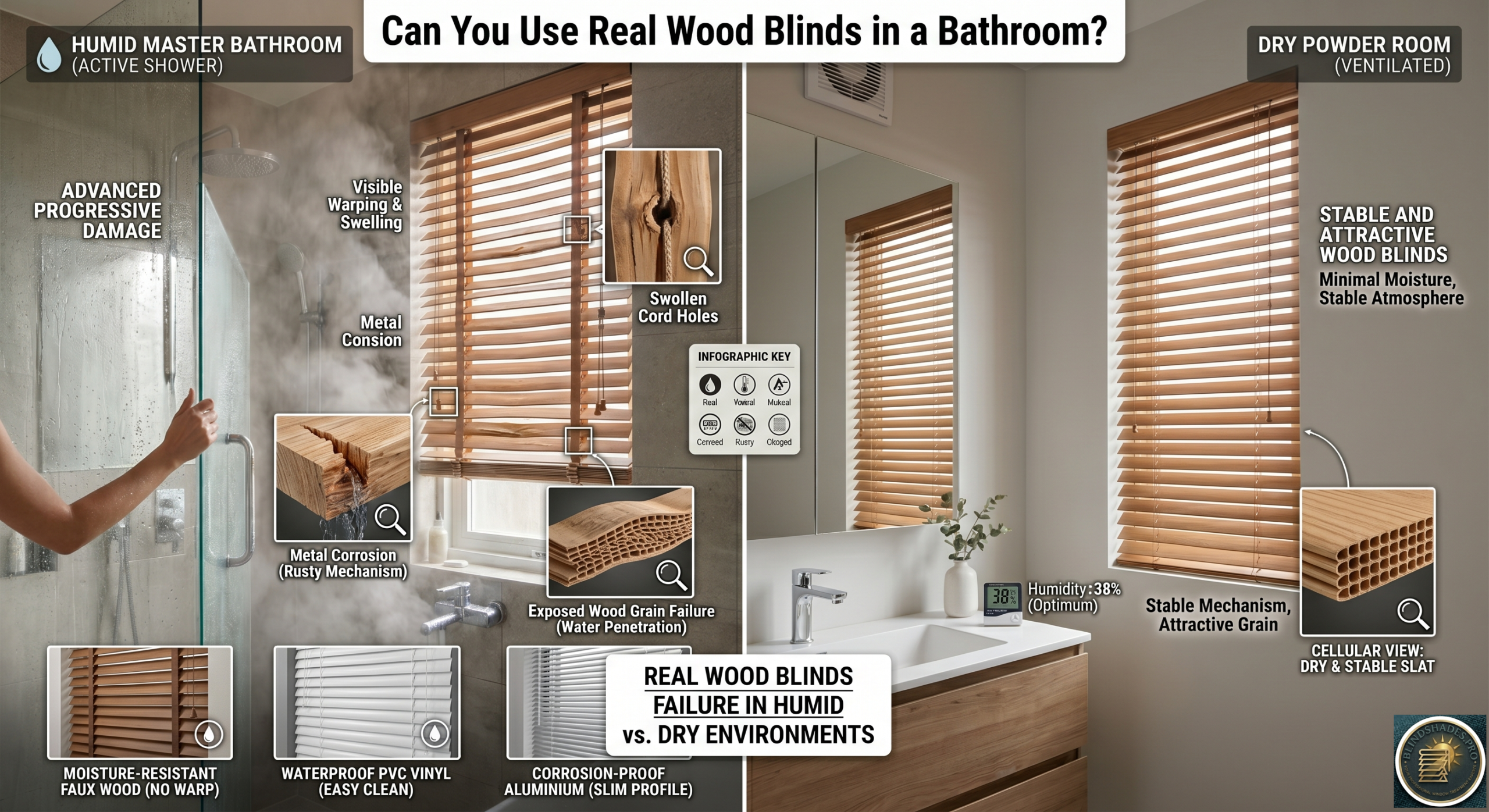
⭐ Quick Answer — Can You Use Real Wood Blinds in a Bathroom?
- The Direct Answer: Real wood blinds in a bathroom fail — and faster than most buyers expect. A full bathroom with a daily shower drives relative humidity to 90–100% every use. Basswood, used in most real wood blinds, begins absorbing moisture and warping at ~60% sustained RH. The gap between what real wood can tolerate and what a bathroom produces is not marginal — it is 30–40 percentage points beyond the safe threshold
- The Month-by-Month Failure Timeline: Months 1–3: slats swell, tilt mechanism stiffens, occasional sticking when operating. Months 3–6: visible bow appears in individual slats; blind no longer closes flat; privacy gaps emerge. Months 6–12: multiple slats warped; mold and dark staining visible in wood grain. Years 1–2: tilt mechanism seizes completely. Year 2+: slats crack, split, detach from ladder cord
- Why Lacquer Sealant Does Not Help: Lacquer covers the flat slat faces — but pivot holes (punched after coating, through which the ladder cord passes) expose raw uncoated end-grain wood. End-grain absorbs moisture 10–15 times faster than across the grain. Every shower cycle introduces moisture directly at the pivot holes, wicking along the grain and causing differential swelling — the primary cause of the characteristic bow-shaped warp
- The Annual Cost Reality: Real wood blind for a standard bathroom window: $80–$200, lifespan 1–2 years = $40–$200/year. Faux wood blind for the same window: $50–$150, lifespan 15–20 years = $2.50–$10/year. Real wood in a full bathroom costs 15–80 times more per year of useful life — before factoring in the $200–$600 window frame repair cost from the moisture pathway created by warped slats that no longer close
- The One Acceptable Scenario: A powder room (toilet + sink only, no shower or bath) with a functioning exhaust fan and the window more than 48 inches from the sink. Peak RH in this scenario stays at 55–70% — below the sustained warp threshold for kiln-dried lacquer-sealed real wood. Expected lifespan: 5–10 years. All other bathroom scenarios: specify faux wood, PVC vinyl, or aluminium instead
- Best Alternatives: Closest aesthetic match → Blindsgalore faux wood Venetian (routeless — no pivot holes, no wicking risk) · Zone 1 shower-adjacent → SelectBlinds PVC vinyl roller · Full faux wood guide → Blinds Direct bathroom faux wood guide
⚠️ The Wood Species No One Mentions — and the Property Damage Risk: Most guides treat real wood blinds for a bathroom as a single category. The species matters: basswood (most common blind material) warps at ~60% sustained RH; oak at ~70%; teak (natural silica and oils, used in marine applications) holds to ~80% RH. None tolerate the 90–100% RH of a shower bathroom. And the warping blind creates a secondary problem: slats that no longer close flat create a continuous moisture pathway directly at the window frame surface. Within 2–4 years of a warped real wood blind failing to close, bathroom window frames commonly show paint peeling, wood sill swelling, and wall plaster damage — costing $200–$600 to repair, often more than the blind itself. Faux wood routeless Venetian blinds (no pivot holes, no uncoated end-grain) eliminate this failure mode entirely. See What Are the Best Blinds for a Bathroom Window for the full zone-by-zone specification. See the full month-by-month failure timeline below.
💡 The Bamboo Alternative and the Visual Reality of Faux Wood at Bathroom Distances: If a natural aesthetic is essential and a powder room is the location, consider bamboo blinds as an intermediate option. Bamboo (Poaceae family — a grass, not a wood) has a more tightly cross-linked cellulose structure than real wood and contains silica particles that slow moisture penetration — it is significantly more dimensionally stable in humidity than basswood or poplar. It is not appropriate for full bathrooms with showers but is an acceptable natural material for well-ventilated powder rooms. And on the aesthetic argument for real wood blinds in a bathroom: modern faux wood grain printing is functionally indistinguishable from real wood at the typical 5–8 foot viewing distance inside a bathroom. The visual difference between quality faux wood and real wood exists at close-range inspection (under 2–3 feet) — not at bathroom viewing distances. The aesthetic case for real wood over faux wood in a bathroom is based on a distinction that does not exist under normal bathroom conditions. For the faux wood vs aluminium comparison for bathroom windows, see Are Faux Wood Blinds Better Than Aluminum Blinds for a Bathroom. See the bamboo specification guide below.
📖 Read the complete guide below for: the wood species moisture tolerance table (basswood to teak), the full month-by-month failure timeline, why lacquer sealant cannot protect pivot holes (end-grain wicking mechanism), the one acceptable bathroom scenario (powder room specification), the annualised cost comparison (15–80x higher annual cost for real wood), the property damage risk from warped blind moisture pathways, why faux wood is visually identical at bathroom viewing distances, and the bamboo intermediate option for natural-aesthetic powder rooms.
Related guides: for the rooms where wood belongs without caveats, see the real wood blinds guide.
Can You Use Real Wood Blinds in a Bathroom?
The direct answer: Not in any full bathroom with a shower or bath. Technically possible in a well-ventilated powder room. The rest of this guide explains why — including the specific failure mechanism that even sealed real wood cannot escape.
Definition: Real wood blinds are window blinds manufactured from solid timber slats, most commonly basswood (Tilia americana), a lightweight, straight-grained hardwood that machines cleanly into uniform 1-inch or 2-inch slats. Other species used include poplar, oak, maple, and occasionally teak.
The wood species matters — this is the insight no competitor guide provides.
Wood Species Moisture Tolerance — The Bathroom Specification Variable Nobody Explains
Definition: Hygroscopicity is the tendency of a material to absorb water molecules from surrounding air. All real wood is hygroscopic — the degree varies significantly by species.
Moisture tolerance comparison by species:
| Wood Species | Density | Natural Oil Content | Warp Threshold (Sustained RH) | Bathroom Suitability |
|---|---|---|---|---|
| Basswood | Low | None | Begins at ~60% RH | ❌ Not suitable — most common blind material |
| Poplar | Low-Medium | Minimal | Begins at ~62% RH | ❌ Not suitable |
| Maple | Medium | Low | Begins at ~65% RH | ❌ Not suitable for full bathroom |
| Oak | Medium-High | Low | Begins at ~70% RH | ❌ Not suitable for full bathroom |
| Teak | High | High (natural silica and oils) | Begins at ~80% RH | ⚠️ Most moisture-resistant real wood; used in marine applications |
| Bamboo | Medium | Low | Significantly more stable than wood | ⚠️ Better than real wood; moderate bathroom tolerance |
The practical implication: Most real wood blinds are made from basswood — the cheapest, lightest, and easiest to machine into slats. Basswood is also the least moisture-resistant common species. A bathroom with a shower reaches 90–100% RH during every shower cycle — more than 40% above the point at which basswood begins to absorb moisture and warp.
Even premium real wood blind species (oak, teak) cannot be specified for a full bathroom with a shower.
Real Wood Blinds in a Bathroom — The Specific Failure Timeline
This is the most important information for anyone who has already installed, or is considering installing, real wood blinds in a bathroom. Every guide says “they will warp.” None tell you when and in what sequence.
The failure sequence in a full bathroom with a daily shower:
Weeks 1–4 (Imperceptible phase): The slats absorb moisture during each shower and release it as the bathroom dries. Microscopic grain swelling and contraction begins. No visible damage. The slats feel and operate normally.
Months 1–3 (Sticking phase): Repeated wet-dry cycling causes cumulative dimensional change. Slats begin to swell slightly beyond their manufactured width. The slat edges begin to contact each other when tilted — tilt mechanism becomes noticeably stiffer. Occasional catching when raising or lowering. Most homeowners attribute this to a manufacturing issue rather than moisture damage.
Months 3–6 (Visible warping phase): Individual slats develop a visible bow along their length — the concave side is toward the window (the cooler side that stays more consistently moist from condensation). When the blind is lowered and closed, gaps are visible between warped slats. Privacy is compromised.
Months 6–12 (Privacy failure and mold phase): Multiple slats are warped sufficiently that the blind no longer closes flat. Light and sightline gaps are permanently present regardless of slat angle. Mold and dark staining appear in the wood grain — particularly at the pivot holes and cut slat ends where moisture penetrates deepest.
Years 1–2 (Mechanism failure phase): The ladder cord becomes stiff and the tilt mechanism seizes completely. Raising and lowering the blind becomes difficult, then impossible. The headrail hardware may begin to show rust from moisture exposure.
Year 2+ (Structural failure): Individual slats crack or split along the grain. Some slats detach from the ladder cord. At this point the blind is non-functional and must be replaced.
For the correct alternative materials that do not have this failure sequence, see What Are the Best Blinds for a Bathroom Window — Privacy and Moisture Guide.
Why Lacquer Sealing Does Not Save Real Wood Blinds in a Bathroom
This is the specific failure mechanism no guide explains:
All quality real wood blinds are manufactured with kiln-dried lumber (moisture content reduced to 6–8%) and finished with a lacquer or urethane sealant. The sealant provides a vapour barrier on the flat slat surfaces. Homeowners who choose real wood for a bathroom sometimes believe this sealant makes the blind moisture-resistant. It does not — for one critical structural reason.
The pivot hole problem: Each real wood slat has two to four holes punched through it for the ladder cord that controls tilting. These holes are punched after the slat is coated — the interior of the hole is uncoated, raw wood end-grain. End-grain is the most moisture-absorbent part of any wood — moisture wicks along the grain structure 10–15 times faster than across the grain.
Every shower cycle:
- Steam contacts the slat surface — largely repelled by the lacquer
- Steam contacts the pivot holes — directly absorbed into uncoated end-grain
- Moisture wicks along the grain from the pivot hole outward toward both ends of the slat
- On drying, the moisture-affected zone contracts while the dry zones remain stable
- Differential contraction creates the characteristic bow-shaped warp
This is why even fully lacquered real wood blinds fail in bathrooms — the lacquer covers the face but cannot cover the pivot holes through which the ladder cord must pass.
The Annual Cost Comparison No Guide Calculates
Every guide notes faux wood is 20–30% cheaper upfront. None calculate what real wood in a bathroom actually costs per year.
Real wood blind in a full bathroom (36 x 48 inch window):
- Upfront cost: $80–$200
- Expected usable lifespan in a bathroom with daily shower: 1–2 years before warping compromises privacy
- Annual cost: $40–$200 per year
Faux wood blind in the same bathroom:
- Upfront cost: $50–$150
- Expected usable lifespan in a bathroom: 15–20 years per Blinds Direct’s analysis
- Annual cost: $2.50–$10 per year
The hidden property damage cost: A warped real wood blind that no longer closes flat creates a continuous moisture pathway to the window frame surface. The slat gaps channel humid shower air directly at the window frame, sill, and surrounding wall:
- Window frame paint peeling: 1–2 years after installation
- Window sill wood swelling or rot: 2–3 years after installation
- Wall paint damage and potential plaster damage: 2–4 years
Repair cost for a bathroom window frame, sill, and surrounding wall affected by moisture concentration: $200–$600 — often more than the cost of the blinds themselves.
The annualised cost of choosing real wood over faux wood for a bathroom window is not 20–30% higher — it is 15–80 times higher when calculated on a per-year-of-useful-life basis, and potentially much higher when property damage costs are included.
The One Scenario Where Real Wood Blinds Are Acceptable in a Bathroom
Every guide says “never use real wood in a bathroom” universally. The nuanced answer:
Real wood blinds may be used in a powder room (toilet and sink only — no shower, no bath) under the following specific conditions:
Condition 1 — No shower or bath in the room: A powder room never reaches the 90–100% RH of a full bathroom with a shower. Peak RH during hand-washing and toilet use with an exhaust fan: 55–70%.
Condition 2 — Functioning exhaust fan: The fan must run during use and 10 minutes after to prevent humidity from accumulating above 65–70%.
Condition 3 — Window more than 48 inches from the sink: Closer than 48 inches and direct splash risk and concentrated steam proximity increase the local RH at the blind surface significantly.
Condition 4 — Temperate climate (not extreme humidity or cold): In climates with sustained outdoor humidity above 70% or in rooms without climate control, even a powder room can approach 75–80% RH — above the threshold for some wood species.
Condition 5 — Kiln-dried, lacquer-sealed specification: Specify a premium kiln-dried real wood blind with lacquer or urethane sealant. This will not prevent moisture failure in a full bathroom but extends useful life in a powder room environment.
Expected lifespan under these conditions: 5–10 years — significantly shorter than faux wood (15–20 years) in the same room, but acceptable if the wood aesthetic is a priority.
The Visual Reality — Why the Aesthetic Argument Does Not Hold in a Bathroom
The most common reason homeowners choose real wood blinds for a bathroom is aesthetic — the warmth and authenticity of natural wood grain. This preference is valid. The visual reality is not.
Modern faux wood grain printing at bathroom viewing distances: Modern faux wood blind slats are manufactured with rotogravure-printed wood grain patterns on PVC composite surfaces. The grain depth, colour variation, and surface texture closely replicate real wood. At distances greater than 2–3 feet — which is most of the viewing distance from inside a bathroom — the visual difference between quality faux wood and real wood is functionally imperceptible.
A bathroom blind is not a piece of furniture viewed at close range. It is viewed from across a small room, typically 5–8 feet from the window, often in bathroom lighting conditions. Under these conditions, the aesthetic preference for real wood over faux wood is based on a distinction that does not visually exist at typical bathroom distances.
This is not the case for larger rooms — in a living room or dining room, real wood’s natural grain variation and tactile quality are genuinely superior to faux wood at normal viewing and touching distances. For a bathroom window: the aesthetic argument for real wood does not withstand the visual reality.
The Bamboo Alternative — The Natural Option Nobody Mentions
Definition: Bamboo blinds are manufactured from strips of Moso or other bamboo species (Poaceae family — a grass, not a wood) woven or pressed into slat form. Bamboo’s cellular structure differs fundamentally from wood.
Why bamboo has better bathroom tolerance than real wood:
- Bamboo’s cellulose fibres are more tightly cross-linked than wood cellulose — it is less hygroscopic (absorbs less moisture per unit of exposed surface)
- Bamboo reaches dimensional equilibrium in humidity more quickly than wood — it swells and contracts faster, reducing the differential stress that causes warping
- Bamboo contains silica particles in its cellular structure (similar to teak) that reduce moisture penetration rate
The limitation: Bamboo is not a full bathroom substitute — it is still an organic material and will degrade over time with daily shower exposure. It is an intermediate option for:
- Powder rooms where a natural aesthetic is strongly preferred
- Bathrooms with exceptional ventilation
- Moderate-humidity climates
Bamboo should not be specified for any Zone 1 or Zone 2 full bathroom window. For those applications — faux wood or PVC vinyl are the correct specifications.
For the faux wood vs aluminium comparison for a bathroom, see Are Faux Wood Blinds Better Than Aluminum Blinds for a Bathroom which covers the specific Zone 2 specification in detail.
What to Use Instead of Real Wood Blinds in a Bathroom
Faux Wood Venetian Blinds — The Closest Alternative
Definition: Faux wood blinds are manufactured from PVC composite or recycled polymer materials, surface-finished with a wood-grain texture. They are dimensionally stable in humidity, non-porous, and moisture-resistant across all bathroom zones.
Specification for Zone 2 (vanity) and Zone 3 (powder room) bathrooms: 2-inch faux wood slats in a stain that matches other wood elements in the bathroom. Routeless specification (no cord holes in slats) eliminates the pivot hole moisture problem that affects real wood — the absence of holes through the slats means there are no uncoated raw wood end-grain surfaces for moisture to enter. See the Blindsgalore faux wood buying guide and Blinds Direct faux wood for bathrooms guide for current product recommendations.
PVC Vinyl Roller Shade — For Zone 1 (Shower-Adjacent)
For windows within 36 inches of a shower or bath — faux wood composite is not appropriate as it contains wood fibre filler. Specify a solid PVC vinyl roller shade. Fully waterproof, zero organic content, and suitable for direct splash exposure. See What Are the Best Blinds for a Window Inside a Shower for the complete Zone 1 specification.
Polymer Composite Shutters — Premium Alternative
Polymer composite shutters (ABS or polycarbonate) provide the warmth of louvred shutters without the moisture vulnerability of real wood. Available in white or painted finishes rather than wood-grain, but provide excellent light control, privacy adjustment, and ventilation through the louvre tilt. Premium specification for Zone 1 and Zone 2 applications.
Related guides: For complete buying advice, see our real wood blinds buying guide.
Frequently Asked Questions
Can you use real wood blinds in a bathroom? Real wood blinds cannot be used in any full bathroom with a shower or bath. Basswood, the most common real wood blind material, begins absorbing moisture and warping at sustained relative humidity above 60 to 65 percent — a full bathroom with a daily shower reaches 90 to 100 percent relative humidity during every shower cycle. Even lacquer-sealed real wood blinds fail because the pivot holes through each slat are uncoated raw end-grain wood that absorbs moisture directly regardless of the surface sealant. The one acceptable scenario is a powder room with a functioning exhaust fan, no shower or bath, and a window more than 48 inches from the sink.
How quickly do real wood blinds warp in a bathroom? In a full bathroom with a daily shower, real wood blinds typically begin showing sticking and mechanism stiffness within 1 to 3 months. Visible slat warping appears within 3 to 6 months. Privacy gaps from warped slats appear within 6 to 12 months. Mold staining in the wood grain also develops within this period. Mechanism failure and inability to raise or lower the blind typically occurs within 1 to 2 years. Slat cracking and structural failure follow in years 2 and beyond.
Why do lacquer-sealed real wood blinds still warp in bathrooms? Lacquer sealant covers the flat face of each real wood slat but cannot cover the pivot holes through which the ladder cord passes. These holes are punched after the slat is coated, exposing raw end-grain wood inside the hole. End-grain wood absorbs moisture 10 to 15 times faster than across the grain. Every shower cycle introduces moisture directly into the pivot holes, which wicks along the grain and causes differential swelling and contraction that produces the characteristic warp shape. This failure mechanism applies to all lacquer-sealed real wood blinds regardless of brand or quality.
What is the annual cost of using real wood blinds in a bathroom? A real wood blind for a standard bathroom window costs $80 to $200 and has a practical lifespan of 1 to 2 years in a full bathroom with a shower before warping compromises privacy — an annual cost of $40 to $200. A faux wood blind for the same window costs $50 to $150 and lasts 15 to 20 years — an annual cost of $2.50 to $10. Real wood blinds in a full bathroom cost 15 to 80 times more per year of useful life than faux wood. Additionally, the warped blind’s inability to close creates a moisture pathway to the window frame that can cause paint peeling, wood rot, and wall damage costing $200 to $600 to repair.
Is bamboo a better natural alternative to real wood blinds in a bathroom? Bamboo has better dimensional stability in humidity than most real wood species because its cellulose structure is more tightly cross-linked and it contains silica particles that slow moisture penetration. It reaches dimensional equilibrium in humidity more quickly than wood, reducing the differential stress that causes warping. Bamboo is an acceptable intermediate option for well-ventilated powder rooms and moderate-humidity environments where a natural aesthetic is strongly preferred. It is not appropriate for full bathrooms with showers — for those applications, faux wood or PVC vinyl are the correct specifications.
Related Guides on BlindShades.pro
- The Best Bathroom Window Blinds & Shades Buying Guide
- What Are the Best Blinds for a Bathroom Window — Privacy and Moisture Guide
- Are Faux Wood Blinds Better Than Aluminum Blinds for a Bathroom
- Do Bathroom Blinds Get Moldy — How to Prevent Mold on Bathroom Blinds
- What Are the Best Blinds for a Window Inside a Shower
By Michael Turner | 30 Years Home Improvement Expertise | Updated 2026 | BlindShades.pro
