Do Bathroom Blinds Get Moldy — How to Prevent Mold on Bathroom Blinds

Authored By Michael Turner -30 Years Home Improvement Expertise | Updated 2026 | BlindShades.pro
Updated on May 14, 2026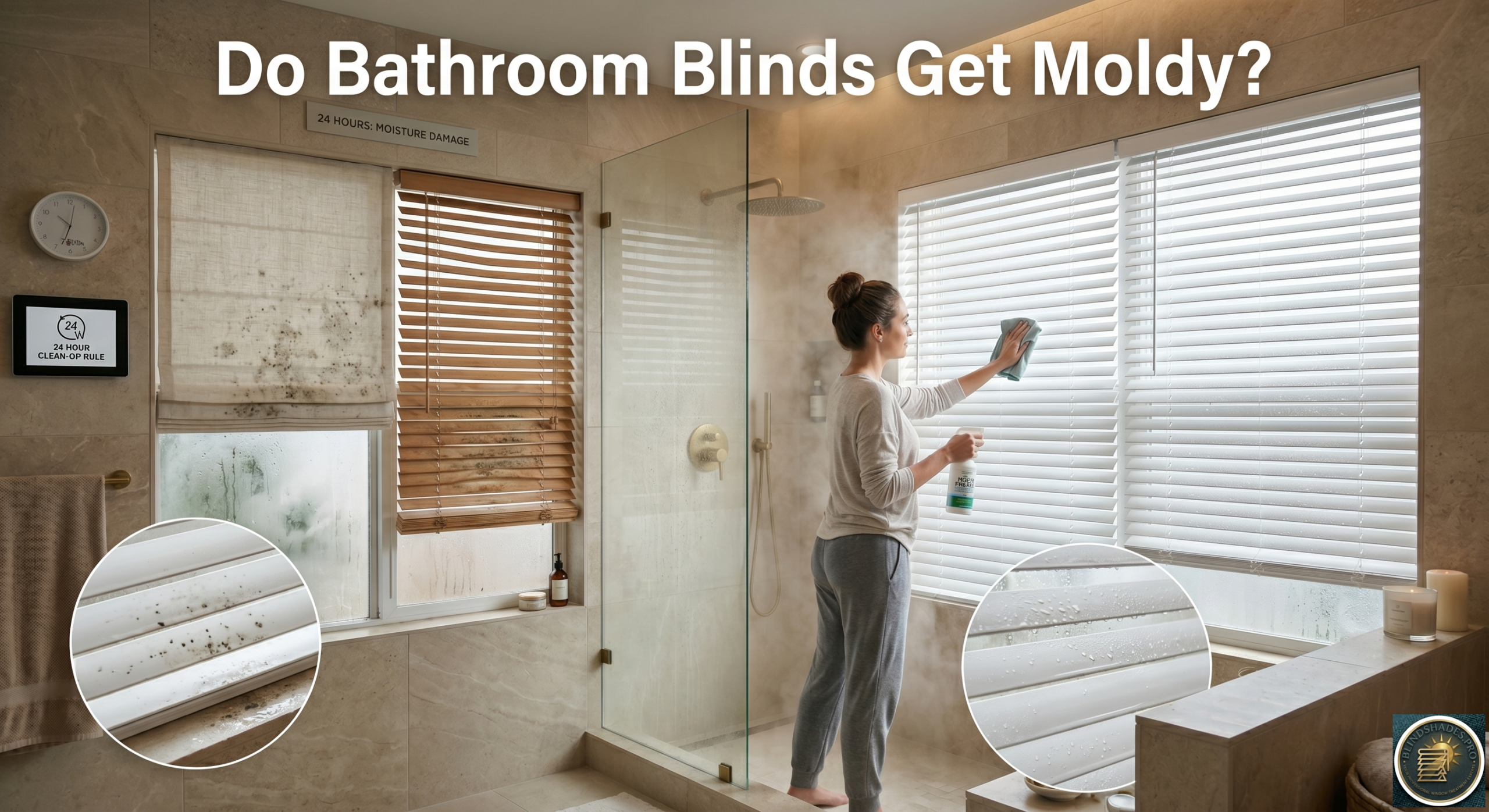
⭐ Quick Answer — Do Bathroom Blinds Get Moldy and How Do You Prevent It?
- The 24-Hour Rule Every Guide Misses: Effective bathroom blinds mold prevention starts with the correct cleaning frequency — not weekly, but within 24 hours of any significant moisture contact. Mold spores germinate on wet organic surfaces within 24–48 hours at bathroom temperatures. Once germinated, wiping removes visible growth but not embedded mycelium. The “clean weekly” advice assumes daily moisture is insufficient for germination — in a shower bathroom it is not
- Why PVC Blinds Still Get Moldy — The Organic Dust Film: PVC provides no food source for mold in its own material. But bathroom dust deposits an organic film on every surface — composed of skin cells (~30,000–40,000/hr in bathroom air), soap residue, hair, and dust mite debris. This organic film on PVC is the actual food source for Cladosporium and Aspergillus. Clean every 1–2 weeks to remove this film before mold colonies establish — not monthly
- ASHRAE Fan Protocol — 20 Minutes, Before AND After: The ASHRAE Standard 62.2 bathroom ventilation requirement is 20 minutes post-shower (not the commonly cited 15). And start the fan 2–3 minutes BEFORE the shower — this establishes airflow toward the extraction point so steam follows the established path rather than drifting to the window and blind. Starting the fan after the shower has begun means the first 2–3 minutes of steam have already settled on blind surfaces
- The Pull Cord — Highest-Mold-Risk Component: The first component to mold on any manual bathroom blind is the pull cord. It hangs in the most humid zone of bathroom air, cools and concentrates condensation, and receives organic deposit from hands with every use. Specify cordless or motorized to eliminate this component — or wipe the cord weekly as part of the cleaning routine
- The Mold Colour Diagnostic: Black/dark green spots = Cladosporium (most common, surface-cleanable with vinegar) · White/grey patches = Aspergillus (clean from PVC; replace fabric blinds) · Pink/orange film = Serratia marcescens (bacterium, not mold; indicates soap residue buildup) · Circular black fuzzy growth = Stachybotrys (black mold; replace blind immediately, investigate sustained moisture source)
- Best Material Sources: PVC vinyl roller (inorganic, wipe-clean) → SelectBlinds PVC range · Faux wood routeless (no pivot-hole mold) → Blindsgalore routeless faux wood · ASHRAE reference → ASHRAE Standard 62.2
⚠️ The Microclimate Trap and the Source Control Approach — Two Things No Guide Covers: For the best bathroom blinds mold prevention in cold climates, the microclimate trap is often the primary mold driver. When a closed blind is pressed against a cold window glass in winter, the trapped air pocket cools against the glass surface — warm bathroom air at 75% RH cools to approximately 17°C (the dew point) and deposits liquid water on the blind backing and window frame. Fix: raise blinds immediately after every shower to break the microclimate and allow both surfaces to dry. And upstream prevention reduces moisture reaching the blind in the first place: (1) reduce shower temperature by 5°C — this cuts steam production by approximately 50% · (2) keep shower screen or curtain closed — concentrates steam at the extraction point · (3) run fan 2–3 minutes before starting shower to establish airflow pattern. See What Are the Best Blinds for a Bathroom Window for the zone-specific material guide. See the full microclimate physics below.
💡 The Cleaning Agent Guide by Material — and When to Replace Instead of Clean: Effective bathroom blinds mold prevention uses the right cleaning agent for the specific material. PVC vinyl: white vinegar 1:1 with water (pH 2.5, effective against Cladosporium, safe for PVC) — do NOT use bleach (discolours and embrittles PVC). Aluminium Venetian: mild detergent or baking soda solution (avoid acidic vinegar on anodised aluminium finish). Faux wood: dilute vinegar or mild detergent — never soak (water ingresses composite joints). When to replace rather than clean: Any circular black fuzzy growth pattern (Stachybotrys — black mold) on any material; any mold on a cotton or linen fabric blind (mycelium penetrates fibres, surface cleaning insufficient); any blind showing structural deformation from moisture damage. The NCBI indoor mold research documents the respiratory health risks of sustained mold exposure. See the full cleaning agent table below.
📖 Read the complete guide below for: the mold lifecycle on bathroom blinds (24–48 hour germination window), the organic dust film composition that feeds mold on PVC, the microclimate trap physics (closed blind on cold glass → RH 100%), the ASHRAE 20-minute fan standard and pre-shower start protocol, the pull cord as the highest-risk component, the source control approach (cooler shower, closed screen, pre-start fan), the full mold colour diagnostic guide (4 species), the cleaning agent comparison by material, and the complete bathroom blinds mold prevention checklist.
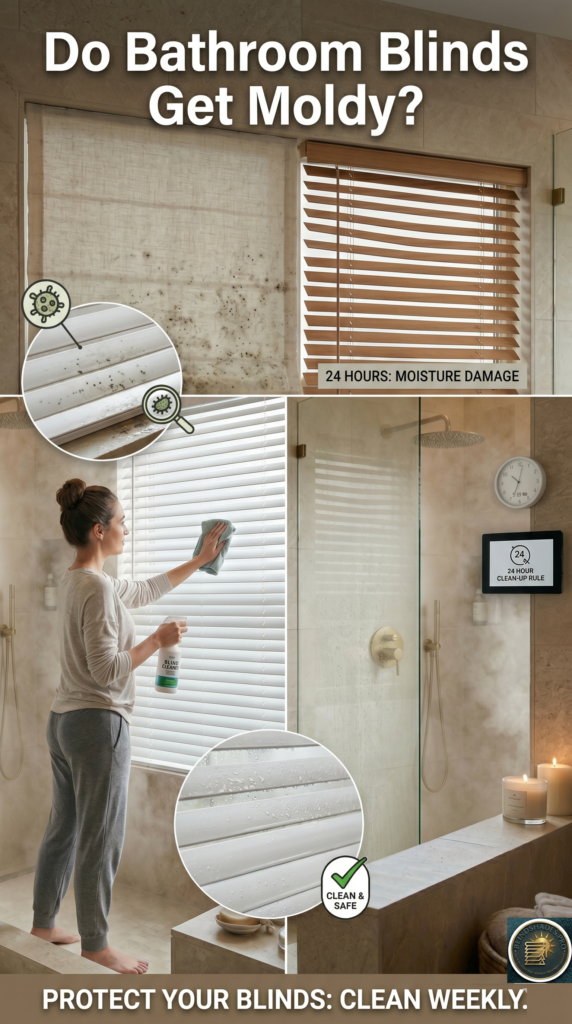
Do Bathroom Blinds Get Moldy?
Yes — but whether they get moldy depends almost entirely on the material. The same bathroom environment produces very different outcomes across different blind materials.
The mechanism of mold growth on bathroom blinds: Mold requires three conditions: a food source, moisture, and stagnant warm air. In a bathroom:
- Moisture: provided by shower steam and condensation, reaching 90–100% RH during shower use
- Stagnant warm air: provided by an unventilated or poorly ventilated bathroom
- Food source: the critical variable — this is what makes material selection the primary mold prevention strategy
The Mold Lifecycle on Bathroom Blinds — The 24–48 Hour Window
Definition: Mold (the collective term for various fungal species) reproduces via spores — microscopic particles dispersed through household air at concentrations typically between 50 and 5,000 spores per cubic metre.
The specific timeline no guide provides:
- Hours 0–24: Mold spores deposit on the blind surface constantly. On dry surfaces — no germination. Spores remain dormant until moisture is available.
- Hours 0–24 wet: On a wet organic surface at bathroom temperature (22–28°C), the first spores begin germination within 24 hours. Germination is the point of no return — once germinated, the mold mycelium begins extracting food from the substrate.
- Hours 72–168 (3–7 days): Visible small colonies become apparent on organic substrates (fabric, real wood). On inorganic PVC and aluminium with organic dust film — colonies may begin forming in the dust film.
- Weeks 2–4: Established colonies are visible to the naked eye as dark spots, white patches, or pink film depending on species.
The 24-hour cleaning protocol implication: The standard advice across all guides is “wipe bathroom blinds weekly.” This is inadequate for bathroom blinds mold prevention if the blinds are significantly wet daily. Once mold has germinated (24–48 hours), wiping removes visible growth but not the mycelium embedded in the surface. The correct protocol is: any time a bathroom blind is significantly wetted by shower steam or condensation — wipe it down within 24 hours. The weekly clean is for maintenance of lightly used bathroom windows.
Bathroom Blinds Mold Prevention — The Material and Protocol Guide
Material Category 1 — PVC Vinyl and Aluminium (No Mold Food Source)
PVC (polyvinyl chloride) and aluminium are inorganic materials — they contain no cellulose, protein, or other organic compounds that serve as mold food. No mold species can colonise a clean PVC or aluminium surface regardless of humidity level.
Why PVC and aluminium blinds still get moldy: The mold food source is not the material itself but the organic film that accumulates on the surface — a combination of:
- Skin cells shed by bathroom occupants (approximately 30,000–40,000 per hour in close-contact bathroom air)
- Soap residue and shampoo splatter
- Hair and hair product residue
- Dust mite debris
This organic film, deposited daily on the blind surface, is food for Cladosporium and Aspergillus mold species. The surface of a PVC roller shade after 2 weeks without cleaning in a used bathroom has sufficient organic loading to support mold growth when combined with moisture.
The correct cleaning schedule for PVC and aluminium: Clean every 1–2 weeks in regularly used bathrooms — not monthly as commonly recommended. Use a 1:1 white vinegar solution (pH 2.5 is effective against most bathroom mold species without damaging PVC) or mild detergent and warm water. Wipe the surface, then dry completely.
For a full breakdown of which blind materials to specify for each bathroom zone, see What Are the Best Blinds for a Bathroom Window — Privacy and Moisture Guide.
Material Category 2 — Faux Wood (PVC Composite — Low Risk)
Faux wood blinds are manufactured from PVC composite material — PVC blended with chalk filler and sometimes wood fibre to achieve the wood-grain appearance. The degree of mold risk depends on the specific formulation:
High-PVC faux wood (90%+ PVC content): Very similar mold resistance to solid PVC. The organic film on the surface is still the primary mold risk, not the material itself. Clean every 2 weeks.
Lower-PVC faux wood with wood fibre filler: The wood fibre content can absorb moisture in very humid conditions. This creates a localised organic food source within the material, not just on the surface. For Zone 1 or Zone 2 bathroom windows — specify high-PVC composite to minimise this risk.
Slat pivot mechanism: Faux wood Venetian blind slats pivot on a small cord passing through holes in each slat. The pivot cord holes are organic (cord material) and collect moisture and dust at the narrowest point of the slat — this is the first location to show mold on faux wood Venetian blinds. Clean pivot holes specifically with a soft brush or pipe cleaner during weekly maintenance.
Material Category 3 — Fabric, Cotton, and Linen (High Mold Risk)
Fabric blinds — whether roller shades, Roman shades, or cellular shades made from cotton or linen — provide direct organic food sources within the material structure. Cotton and linen fibres are cellulose — one of the primary food sources for Cladosporium, Stachybotrys, and Aspergillus.
A cotton Roman shade in a full bathroom with a shower can begin showing mold within 2–4 weeks of installation in poorly ventilated conditions. The deep folds of Roman shades trap humid air against the fabric long after the shower ends, extending the mold germination window significantly.
The only fabric-safe bathroom blind specification: Synthetic polyester or fibreglass solar shade fabric (inorganic fibres) with moisture-treatment coatings. These provide the insulation and aesthetic of fabric with significantly lower mold risk than cotton or linen — appropriate for Zone 3 powder rooms with good ventilation. Not appropriate for Zone 1 or Zone 2 full bathrooms with showers.
For the complete materials guide and which zone each applies to, see What Are the Best Blinds for a Bathroom Window — Privacy and Moisture Guide.
The Microclimate Trap — Why Closed Blinds Against Cold Glass Create Mold
Definition: The microclimate trap occurs when a closed bathroom blind is pressed against a cold window glass surface, creating a sealed air pocket between the blind backing and the glass that concentrates moisture to dew-point conditions.
The physics: When warm, humid bathroom air (22°C, 75% RH) is trapped in a pocket against a cold window pane (winter glass surface at 5–10°C), the air in the pocket cools by conduction. As air temperature drops, its capacity to hold water vapour decreases. The same air at 75% RH at 22°C reaches 100% RH when cooled to approximately 17°C — the dew point — and begins depositing liquid water on both the blind backing and the window surface.
The practical consequence: A closed PVC roller shade pressed against a cold bathroom window during winter creates a microclimate where liquid water forms behind the shade every night the window is cold. This daily cycle of wetting and partial drying is the primary mold condition for Zone 2 and Zone 3 bathroom windows in cold climates — even when the blind material is non-porous PVC.
The bathroom blinds mold prevention protocol for cold climates:
- Raise or open blinds to the fully open position after every shower — this breaks the trapped microclimate and allows the window glass and blind backing to dry by air circulation.
- Open the bathroom window for 5–10 minutes after showering (where privacy permits) to replace saturated air with drier exterior air.
- Keep the blind at least 2–3 cm away from the glass surface when closed — if the blind does not contact the glass, the microclimate cannot form. Outside mount specification naturally achieves this.
The Pull Cord — The Highest-Risk Component Nobody Mentions
Every VelaBlinds article correctly identifies the pull cord as the first component to mold on a manual blind. None explain the specific mechanism:
Why the pull cord is the highest mold risk:
- Material: Pull cords are typically braided polyester or cotton cord — both are textured, water-absorbent surfaces.
- Position: The cord hangs vertically in the most humid zone of the bathroom air, directly below the window where shower steam concentrates.
- Thermal effect: The cord cools rapidly in air movement, concentrating condensation from passing humid air.
- Contact: Every pull of the cord deposits skin oils and organic debris from hands — precisely the organic food source that enables mold on an otherwise clean surface.
- Texture: The braided surface has many crevices that trap moisture and debris, creating a concentrated mold microhabitat.
The prevention protocol for pull cords: Wipe the pull cord with a 1:1 vinegar solution weekly as part of the regular blind cleaning routine. Or specify a cordless or motorized blind to eliminate this component entirely. For Zone 1 and Zone 2 bathroom blinds — motorized or cordless specification eliminates the highest-risk mold component in addition to providing the safety benefits described in Are Motorized Blinds Safe for a Bathroom — Waterproofing, IP Ratings and Smart Home.
The Exhaust Fan Protocol — 20 Minutes, Not 15
The ASHRAE ventilation standard for bathrooms: ASHRAE Standard 62.2 (Ventilation and Acceptable Indoor Air Quality in Residential Buildings) specifies bathroom ventilation at a minimum continuous rate of 20 CFM or an intermittent rate of 50 CFM operated for 20 minutes per shower use. The commonly cited “15 minutes” figure is derived from general ventilation guidance and is below the specific ASHRAE bathroom standard.
The three-phase exhaust fan protocol for bathroom blinds mold prevention:
Phase 1 — Before the shower begins (2–3 minutes before turning on the water): Run the exhaust fan before starting the shower. This creates a slight negative air pressure in the bathroom, establishing an airflow pattern that draws air toward the extraction point rather than allowing steam to drift toward the window area. Shower steam follows the established airflow path — starting the fan after the shower has begun means the first 2–3 minutes of steam have already reached all surfaces including the blind.
Phase 2 — During the shower: Keep the fan running throughout. Do not open the bathroom door during the shower — this breaks the negative pressure and allows steam to escape into the house rather than being extracted.
Phase 3 — After the shower (20 minutes): Continue running the fan for 20 minutes after the shower ends. The ASHRAE 20-minute post-shower standard accounts for moisture that has settled on surfaces continuing to evaporate after the shower has stopped. The fan removes this secondary evaporation load.
The Source Control Approach — Reducing Steam Before It Reaches the Blind
All guides focus on what happens after steam reaches the blind. These upstream interventions reduce the moisture load before it contacts the blind surface:
1. Cooler shower temperature: Shower water at 40°C produces significantly more steam than water at 35°C. A 5°C reduction in shower water temperature reduces steam production by approximately 50%. For steam-sensitive bathroom blinds — adjusting the shower thermostat slightly cooler significantly reduces the moisture load on blind surfaces during each shower.
2. Keep the shower screen or curtain closed: An open shower screen disperses steam throughout the bathroom. A closed shower screen or curtain concentrates steam within the shower enclosure where the exhaust fan is closest — the steam is extracted before it can travel to the window and blind area.
3. Run the fan before starting the shower: As described above — establish airflow pattern before steam is generated.
The Mold Colour Diagnostic Guide
When mold appears on bathroom blinds, the colour and growth pattern indicates the species — which determines the appropriate response.
Black or dark green spots: Almost certainly Cladosporium or Alternaria — the most common bathroom mold species. These are surface molds that grow in the organic film on PVC and aluminium surfaces. Cleanable with white vinegar or hydrogen peroxide 3% solution. Does not indicate a serious remediation requirement.
White or grey fluffy patches: Aspergillus — grows on wet organic substrates including damp fabric and organic film on PVC. Surface colonies are cleanable from PVC surfaces. On fabric blinds — indicates the material is compromised and replacement is required.
Pink or orange film: Not a mold — Serratia marcescens, a bacterium. Commonly found in bathrooms on soap scum and mineral deposits. Thrives in slightly alkaline conditions created by soap residue. Cleanable with white vinegar (acid disrupts the alkaline environment) or hydrogen peroxide. Does not indicate a mold problem but indicates significant soap residue buildup on the blind surface.
Circular black growth pattern with fuzzy texture: Stachybotrys chartarum — black mold. Grows on cellulose-rich organic substrates (real wood, cotton, paper) that have been sustainably wet for 72+ hours. If Stachybotrys appears on a bathroom blind: replace the blind immediately, clean and dry the window frame and surrounding area thoroughly, and investigate the source of sustained moisture. Do not attempt to clean Stachybotrys from fabric — the mycelium penetrates the material and cannot be effectively surface-cleaned. The NCBI documents the health risks of indoor mold exposure including respiratory and immune effects associated with Stachybotrys.
The Cleaning Agent Guide by Material
| Blind Material | Safe Cleaning Agent | Concentration | Avoid |
|---|---|---|---|
| PVC vinyl roller | White vinegar | 1:1 with water | Bleach (discolors, embrittles) |
| Aluminium Venetian | Mild detergent or baking soda | 1 tsp per 500ml water | Acidic solutions on anodised finish |
| Faux wood Venetian | White vinegar or mild detergent | 1:1 vinegar or dilute detergent | Soaking (composite joint water ingress) |
| Fabric (moisture-treated polyester) | Mild detergent, air dry | Very dilute | Vinegar (degrades moisture treatment coating over time) |
| Polymer composite shutter | Any neutral cleaner | Dilute | Abrasive cleaners |
For existing mold on any surface — the 3-step protocol:
- Dry-vacuum with brush attachment to remove loose spores without spreading
- Apply white vinegar 1:1 solution, leave 10 minutes
- Wipe with dry microfibre cloth — do not rinse with water (re-introduces moisture)
The Complete Bathroom Blinds Mold Prevention Checklist
Material selection (one-time decision):
- ✅ Specify PVC vinyl or aluminium for Zone 1 and Zone 2 bathroom windows
- ✅ Specify synthetic polyester (not cotton or linen) for Zone 3 powder room fabric blinds
- ✅ Specify cordless or motorized to eliminate pull cord mold risk
- ✅ Specify outside mount to prevent microclimate against cold glass
Daily protocol:
- ✅ Run exhaust fan 2–3 minutes before shower
- ✅ Run fan during shower with bathroom door closed
- ✅ Run fan 20 minutes after shower (not 15)
- ✅ Raise or open blinds immediately after showering
- ✅ Wipe any visible moisture from blind surface within 24 hours if significant wetness occurred
Weekly maintenance:
- ✅ Wipe PVC and aluminium surfaces with 1:1 vinegar solution
- ✅ Wipe pull cord if present (or eliminate by upgrading to cordless/motorized)
- ✅ Check pivot holes in Venetian slats for accumulated dust and moisture
Where to Order — Bathroom Blinds Mold Prevention Specification
Best mold-prevention specification (PVC vinyl roller, Zone 1 and Zone 2): SelectBlinds waterproof PVC vinyl roller shade — see selectblinds.com PVC range. Inorganic surface, wipe-clean, no pull cord if cordless. Blindsgalore vinyl roller shade — fully waterproof PVC, available in cordless specification.
Best mold-prevention specification (faux wood Venetian, Zone 2): Blindsgalore Faux Wood Venetian Blind — high-PVC composite, routeless option available (no cord holes in slats = no pivot-cord mold risk). SelectBlinds Premium Faux Wood — routeless specification eliminates the highest-risk slat point.
ASHRAE ventilation standard reference: For the specific bathroom ventilation standard referenced in this article, see ASHRAE Standard 62.2 — the residential ventilation standard for acceptable indoor air quality.
Frequently Asked Questions
Do bathroom blinds get moldy? Yes — but only certain materials and under specific conditions. PVC vinyl and aluminium blinds do not provide a food source for mold in their own material, but the organic film of dust, skin cells, and soap residue that accumulates on any surface can support mold growth when combined with bathroom humidity. Clean PVC and aluminium blinds every 1 to 2 weeks to remove this organic film. Fabric blinds made from cotton or linen provide cellulose food sources within the material itself — these will develop mold in any full bathroom with a shower within weeks to months under normal conditions and should not be used.
How do you prevent mold on bathroom blinds? Bathroom blinds mold prevention requires three concurrent actions. First, specify inorganic non-porous materials — PVC vinyl roller shades or aluminium Venetian blinds — that provide no food source within the blind material. Second, run the exhaust fan for 2 to 3 minutes before the shower, throughout the shower, and for 20 minutes after to remove moisture before it can settle and drive mold germination. Third, wipe blind surfaces with a 1 to 1 white vinegar solution every 1 to 2 weeks to remove the organic dust film that accumulates on even inorganic surfaces and can support mold growth.
Why do mold-resistant PVC blinds still get moldy? PVC blinds get moldy because mold is not feeding on the PVC itself — it feeds on the organic film that accumulates on the surface. This film consists of skin cells shed during showering (approximately 30,000 to 40,000 per hour), soap and shampoo residue, and dust mite debris. This organic layer on an otherwise inorganic surface provides the food source for Cladosporium and Aspergillus when bathroom humidity remains above 55 percent. Cleaning every 1 to 2 weeks removes this film before mold colonies establish.
What does the colour of mold on bathroom blinds indicate? Black or dark green spots indicate Cladosporium or Alternaria — surface molds cleanable with white vinegar. White or grey fluffy patches indicate Aspergillus — cleanable from PVC but indicates fabric blind material needs replacement. Pink or orange film is Serratia marcescens, a bacterium not a mold, forming on soap residue — cleanable with white vinegar. A circular black growth pattern with fuzzy texture indicates Stachybotrys chartarum (black mold) — replace the blind immediately, thoroughly dry and clean the surrounding area, and investigate the sustained moisture source. Stachybotrys cannot be effectively cleaned from fabric surfaces.
How long should I run the bathroom exhaust fan to prevent mold on bathroom blinds? Run the bathroom exhaust fan for 20 minutes after each shower — this is the ASHRAE Standard 62.2 recommendation for residential bathroom ventilation, not the commonly cited 15 minutes. Also run the fan for 2 to 3 minutes before starting the shower to establish airflow toward the extraction point, and throughout the entire shower duration. Starting the fan after the shower has already produced steam means the first 2 to 3 minutes of steam have already settled on blind surfaces and window frames.
Contextual Internal Links — Used in Article Body
| Anchor Text | Links To | Location in Article |
|---|---|---|
| What Are the Best Blinds for a Bathroom Window | /guide/best-blinds-for-bathroom-window/ | PVC section + Faux wood section |
| Are Motorized Blinds Safe for a Bathroom | /guide/motorized-blinds-bathroom-safe/ | Pull cord section |
Related Guides on BlindShades.pro
- The Best Bathroom Window Blinds & Shades Buying Guide
- What Are the Best Blinds for a Bathroom Window — Privacy and Moisture Guide
- What Are the Best Blinds for a Window Inside a Shower
- Can You Use Real Wood Blinds in a Bathroom — What Happens and What to Use Instead
- Are Motorized Blinds Safe for a Bathroom — Waterproofing, IP Ratings and Smart Home
By Michael Turner | 30 Years Home Improvement Expertise | Updated 2026 | BlindShades.pro
