Are Faux Wood Blinds Better Than Aluminum Blinds for a Bathroom

Authored By Michael Turner -30 Years Home Improvement Expertise | Updated 2026 | BlindShades.pro
Updated on May 15, 2026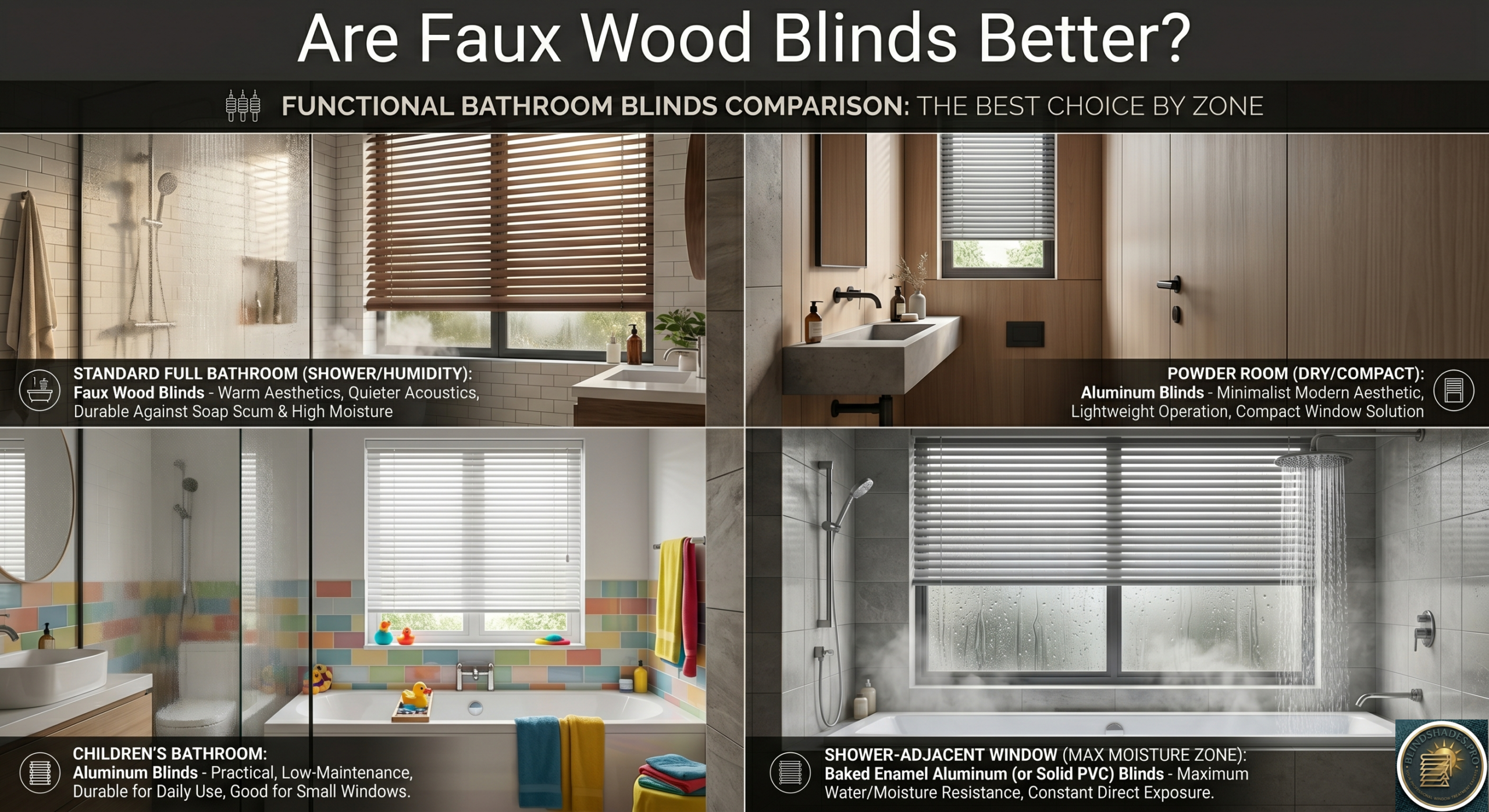
⭐ Quick Answer — Are Faux Wood Blinds Better Than Aluminum Blinds for a Bathroom?
- The Zone-Specific Verdict: For faux wood vs aluminum bathroom blinds — the answer depends on the bathroom zone. Full bathroom with shower (Zone 2): faux wood wins on 4 criteria — quieter in tile, vinegar-safe cleaning, 1,000x better thermal retention, and proportionally correct for windows 36 inches and wider. Powder room / small window (Zone 3): aluminium wins — lighter, 20–30% cheaper, 1-inch slat proportionally correct for narrow windows. Zone 1 (shower-adjacent): neither standard faux wood nor spray-painted aluminium — specify baked enamel aluminium or PVC vinyl only
- The Aluminium Finish Type Nobody Specifies: “Aluminium is moisture-resistant” only applies to baked enamel (powder-coated) finish — cured at 180–200°C, fused corrosion-resistant. Spray-painted aluminium (the default if unspecified) corrodes at chip points within 12–24 months of Zone 1 or Zone 2 bathroom exposure. Always confirm “powder-coated” or “baked enamel” in writing before ordering aluminium bathroom blinds
- The Tiled Bathroom Acoustic Factor: A tiled bathroom has a reverberation time of 0.8–1.5 seconds — similar to a small concert hall. In this environment, aluminium slats rattling against each other during raising or lowering are significantly amplified. Faux wood PVC slats produce a softer, duller contact sound. In a tiled bathroom, the noise difference is far more noticeable than in a carpeted living room where soft surfaces absorb reflected sound
- The Thermal Conductivity Gap: Aluminium thermal conductivity: 205 W/m·K. Faux wood PVC: 0.15–0.25 W/m·K — approximately 1,000 times lower. A closed aluminium blind allows rapid heat transfer from warm bathroom air to cold winter glass, accelerating post-shower cooling. Faux wood provides meaningful thermal resistance, keeping the bathroom warmer between shower cycles
- The Soap Scum Cleaning Warning: Vinegar (pH 2.5) removes soap scum from both materials. But repeated weekly vinegar cleaning degrades the anodised oxide layer on aluminium, exposing the bare metal to corrosion. Faux wood PVC composite has no protective oxide layer — it tolerates repeated vinegar cleaning safely. For hard water bathrooms requiring weekly soap scum removal: faux wood is the safer long-term cleaning specification
- Best Sources: Faux wood Zone 2 (routeless) → Blindsgalore faux wood Venetian · Baked enamel aluminium → Hunter Douglas Modern Precious Metals · Full comparison → SelectBlinds faux wood vs aluminum guide
⚠️ The Slat Width and Window Size Relationship — and the Bathroom-Type Verdict Nobody Provides: The correct slat width for faux wood vs aluminum bathroom blinds depends on the window size. 1-inch aluminium mini-blinds are proportionally correct for small bathroom windows up to 24 inches wide — a 2-inch faux wood slat on a small window looks oversized. For windows 36 inches and wider, 2-inch faux wood is proportionally appropriate and 1-inch aluminium appears busy and undersized. And the bathroom-type specific verdict: Powder room = aluminium wins (narrower slat, lighter, cheaper, modern fit) · Standard full bathroom = faux wood wins (4 criteria above) · Master en-suite = faux wood wins (premium aesthetic, thermal comfort, acoustic quiet) · Children’s bathroom = aluminium wins (cheaper to replace if damaged, lighter for children to operate independently). For the full zone specification guide, see What Are the Best Blinds for a Bathroom Window. See the full zone-specific verdict below.
💡 The Weight Factor for Bathroom Operation Frequency: In the faux wood vs aluminum bathroom blinds weight comparison, a 36-inch faux wood blind weighs approximately 8–12 lbs; the equivalent aluminium blind weighs 3–5 lbs. A bathroom blind may be raised and lowered 4–6 times per day (privacy for each shower, ventilation afterward). Over time, the weight of a faux wood blind is noticeably more effortful in high-frequency operation than aluminium. Two mitigations: (1) Cordless lift mechanisms reduce perceived weight for faux wood. (2) Motorized specification eliminates the weight factor entirely and adds the circadian management benefits covered in Are Motorized Blinds Safe for a Bathroom. For any bathroom blind raised more than 3 times daily: cordless or motorized specification is recommended regardless of material. See the full weight comparison table below.
📖 Read the complete guide below for: the zone-specific bathroom verdict (Zone 1/2/3 specification), the aluminium finish type guide (baked enamel vs spray-painted with 12–24 month corrosion timeline), the weight comparison table by window width (faux wood 8–12 lbs vs aluminium 3–5 lbs at 36 inches), the slat width and window size proportionality table, the soap scum vinegar cleaning warning (anodised aluminium oxide layer degradation), the tiled bathroom acoustic amplification factor (reverberation 0.8–1.5 seconds), the thermal conductivity comparison (205 vs 0.15–0.25 W/m·K), and the bathroom-type specific verdict (powder room / full bathroom / master en-suite / children’s bathroom).
Faux Wood vs Aluminum Bathroom Blinds – The Zone-Specific Verdict
The faux wood vs aluminum bathroom blinds comparison is decided differently depending on which zone of the bathroom the window is in. This is the bathroom-specific decision framework no competitor article provides.
Zone 1 (within 36 inches of shower or bath – direct splash risk): Neither standard faux wood composite nor spray-painted aluminium is the first-choice specification here. Faux wood composite contains wood fibre filler that, while moisture-resistant, is not fully waterproof under direct splash contact. Spray-painted aluminium corrodes at chip points under daily direct water exposure. The correct Zone 1 specification is baked enamel (powder-coated) aluminium or solid PVC vinyl roller shade. Between the two standard options – baked enamel aluminium is marginally more appropriate for Zone 1 than faux wood composite because it contains no organic filler whatsoever.
Zone 2 (vanity window, 36-72 inches from water sources – steam exposure): Faux wood wins clearly. The thermal performance advantage (faux wood retains bathroom heat better between shower cycles), the soap scum vinegar-cleaning safety advantage, and the quieter operation in a tiled bathroom all favour faux wood. Aluminium is acceptable in Zone 2 but not the better specification.
Zone 3 (powder room or bathroom window more than 72 inches from water): The decision is based primarily on aesthetic preference, budget, and window size. Aluminium for modern interiors, small windows, children’s bathrooms, and budget-first decisions. Faux wood for traditional or transitional aesthetics, larger windows, and master en-suite applications.
For the full bathroom zone framework including materials for each zone, see What Are the Best Blinds for a Bathroom Window – Privacy and Moisture Guide.
The Aluminium Finish Type – The Most Overlooked Bathroom Factor
Definition: Aluminium Venetian blind slats are finished with one of two coating types – baked enamel (powder-coated) or spray-painted finish – and this distinction matters significantly for bathroom use.
Baked enamel (powder-coated) aluminium: The coating is electrostatically applied as a powder and then cured at high temperature (180-200 degrees Celsius), fusing the coating permanently to the aluminium surface. This creates a hard, corrosion-resistant finish that tolerates repeated moisture exposure, soap scum, and cleaning without peeling or chipping. Appropriate for Zone 1 and Zone 2 bathroom applications.
Spray-painted aluminium: The coating is applied as a liquid paint and dried at lower temperatures. The adhesion is mechanical rather than fused – the paint remains susceptible to chipping from impact or prolonged moisture exposure. In a Zone 1 or Zone 2 bathroom environment, spray-painted aluminium develops corrosion at chip points within 12-24 months of daily exposure.
How to verify before ordering: Request the finish type from the supplier. Product descriptions will typically state “powder-coated” or “baked enamel” for the appropriate specification. If the finish type is not stated – it is almost certainly spray-painted. For any bathroom window in Zone 1 or Zone 2: specify powder-coated baked enamel aluminium only.
This is why the generic statement “aluminium blinds are moisture-resistant” is misleading – only baked enamel aluminium is genuinely appropriate for sustained bathroom humidity exposure.
The Weight Comparison – Why It Matters for Bathroom Operation
All guides note that faux wood blinds are heavier than aluminium. For a bathroom window, this has specific operational implications no guide addresses.
The weight data:
| Window Width | Faux Wood (2-inch slat) | Aluminium (1-inch slat) | Weight Difference |
|---|---|---|---|
| 24 inches | 4-6 lbs | 1.5-2.5 lbs | Faux wood 2-3x heavier |
| 36 inches | 8-12 lbs | 3-5 lbs | Faux wood 2-3x heavier |
| 48 inches | 12-18 lbs | 4-7 lbs | Faux wood 2-3x heavier |
The bathroom operation frequency context: A bathroom blind is typically operated more frequently than a living room blind. Privacy during showering, ventilation afterward, privacy again the next shower – a bathroom blind in a two-person household may be raised and lowered 4-6 times per day. The weight of a faux wood blind becomes noticeably more effortful over this operational frequency compared to aluminium.
The cordless and motorized mitigation: Cordless lift mechanisms partially reduce the perceived weight difference – cordless faux wood blinds are easier to raise than corded faux wood of the same weight. Motorized specification eliminates the weight factor entirely. For bathrooms where operation frequency is high – either specify aluminium for lighter manual operation, or specify motorized faux wood to eliminate the weight concern while retaining the faux wood advantages.
The Slat Width and Window Size Relationship
Definition: Venetian blind slat width is the horizontal measurement of each individual slat. Standard aluminium mini-blinds are 1 inch wide. Standard faux wood Venetian blinds are 2 inches wide. Some faux wood ranges offer 2.5-inch slats.
The bathroom window size context:
| Window Size | Appropriate Slat Width | Recommended Material |
|---|---|---|
| Small (up to 24 inches wide) | 1 inch | Aluminium mini-blind |
| Standard (24-36 inches wide) | 1 inch or 2 inch | Either – based on aesthetic preference |
| Medium (36-48 inches wide) | 2 inch | Faux wood |
| Large (48 inches wide and above) | 2 inch or 2.5 inch | Faux wood |
The proportional visual logic: A 1-inch slat on a 24-inch wide window presents a fine, layered pattern appropriate for a small bathroom or powder room window. The same 1-inch slat on a 48-inch wide window appears busy and visually undersized for the window scale. A 2-inch faux wood slat on a small 24-inch window appears oversized and heavy, reducing the apparent amount of window visible when the blind is open.
Standard bathroom windows in residential construction are typically 24×36 inches – a size where both 1-inch aluminium and 2-inch faux wood are proportionally acceptable and the aesthetic preference determines the choice. For narrower bathroom windows below 24 inches wide – aluminium 1-inch is almost always the correct specification.
The Soap Scum Cleaning Comparison
Definition: Soap scum is a calcium and magnesium stearate deposit formed when hard water minerals react with soap. It appears as a white or grey film on bathroom surfaces exposed to soap and water.
Why soap scum matters for faux wood vs aluminum bathroom blinds: A vanity window adjacent to a sink in a hard water area accumulates soap scum on the blind surface from splash during hand-washing. Both faux wood and aluminium can be cleaned with white vinegar (pH 2.5 – dissolves the calcium stearate deposits effectively).
The critical difference for repeated cleaning: White vinegar applied repeatedly to anodised aluminium gradually degrades the anodic oxide layer that provides corrosion protection. The aluminium beneath the anodised layer, exposed by repeated acid contact, becomes susceptible to corrosion. For a bathroom vanity window in a hard water area requiring weekly vinegar cleaning – faux wood (PVC composite) is more appropriate because PVC has no protective oxide layer to degrade. Vinegar cleaning of PVC faux wood removes soap scum without any cumulative surface damage.
The recommended cleaning protocol: For faux wood: 1:1 white vinegar with water, wipe, dry. Repeat weekly if hard water area. No surface damage. For aluminium: dilute mild detergent (not acidic vinegar) for regular cleaning. Use vinegar only occasionally for stubborn soap scum. Dry thoroughly after each cleaning.
For the complete mold prevention and cleaning protocol for bathroom blinds, see Do Bathroom Blinds Get Moldy – How to Prevent Mold on Bathroom Blinds.
The Tiled Bathroom Acoustic Comparison
This is the most practically noticeable operational difference between faux wood vs aluminum bathroom blinds that no guide addresses.
The ceramic tile acoustic environment: A bathroom with ceramic tile floor, tile walls, and a hard ceiling is one of the most acoustically reflective rooms in a home. Sound bounces between hard surfaces with minimal absorption – reverberation time in a typical tiled bathroom is 0.8-1.5 seconds (similar to a small concert hall). In this environment, the metallic rattling of aluminium slats during raising or lowering is amplified and extended by the room’s reflective surfaces.
The specific sound events: When an aluminium Venetian blind is raised quickly in a tiled bathroom, the aluminium slats strike each other and the headrail with a metallic clattering that lasts for 1-2 seconds in a reflective tile room. When raised slowly, the sound is reduced but not eliminated.
Faux wood PVC slats produce a softer, duller contact sound when raised – the dense PVC material dampens impact sounds compared to thin aluminium. In a tiled bathroom, the noise difference between aluminium and faux wood is significantly more noticeable than in a carpeted living room where soft surfaces absorb reflected sound.
The practical implication: In a household where the bathroom is used before others wake (early morning shower), the noise of raising an aluminium blind to ventilate the room after showering may be a genuine nuisance. Faux wood is the quieter specification for tiled bathroom environments.
The Thermal Retention Comparison for Bathroom Temperature Cycling
The bathroom-specific thermal context: Bathrooms experience rapid temperature cycling that living rooms and bedrooms do not. A cold bathroom in winter heats rapidly during a shower, then cools when the shower ends and the door is opened. The window is the primary heat loss pathway in this cycle.
Thermal conductivity comparison: Aluminium has a thermal conductivity of approximately 205 W/m*K – one of the highest of any common material. A closed aluminium blind allows rapid heat transfer between the warm bathroom air and the cold window glass, accelerating the post-shower cooling of the bathroom.
Faux wood (PVC composite) has a thermal conductivity of approximately 0.15-0.25 W/m*K – roughly 1,000 times lower than aluminium. A closed faux wood blind provides meaningful thermal resistance between the bathroom air and the cold window.
The practical outcome: In a cold climate bathroom in winter, a closed faux wood blind after the shower ends keeps the bathroom noticeably warmer for longer – reducing the chill of entering a bathroom that has cooled since the previous shower. Aluminium blinds provide essentially no thermal benefit in this context.
This thermal retention advantage is more significant in cold climates and older homes with single-pane windows. In warm climates or homes with modern double-pane windows, the thermal difference between faux wood and aluminium is marginal.
The Bathroom-Type Specific Verdict
Powder room (toilet and sink only, no shower): Aluminium wins for a modern or contemporary powder room. The smaller window size (typically 20-24 inches wide) is proportionally better suited to 1-inch aluminium slats. The lower operational humidity means the thermal and acoustic advantages of faux wood are minimal. Aluminium is typically 20-30% cheaper – a meaningful saving in a room where the premium performance of faux wood is not required.
Standard full bathroom (shower, bath, or both): Faux wood wins on four criteria: quieter in a tiled room, better soap scum cleaning tolerance, better thermal retention between showers, and proportionally appropriate for standard 30-36 inch bathroom windows. Baked enamel aluminium is acceptable but does not match faux wood on any of these four criteria in a full bathroom context.
Master en-suite bathroom: Faux wood wins. The premium aesthetic of 2-inch faux wood slats with coordinated stain finish suits the elevated specification typically applied to master en-suite rooms. The thermal and acoustic advantages of faux wood over aluminium are most relevant in a larger bathroom where the occupant spends the most time and where ambient comfort matters most.
Children’s bathroom: Aluminium wins. Children’s bathrooms experience higher rates of blind mechanism damage from pulling cords, climbing, and general rough handling. Aluminium blinds at 20-30% lower cost are more economical to replace when damaged. The lighter weight of aluminium is also appropriate for smaller children who operate the blind independently. Specify baked enamel finish for adequate moisture resistance.
Where to Order – By Bathroom Type
For faux wood specification (Zone 2, standard and master en-suite bathrooms): Blindsgalore faux wood Venetian blind – routeless specification recommended for no cord holes. See the Blindsgalore faux wood guide for the full range including stain and colour options. SelectBlinds Premium Faux Wood – cordless or motorized for easier operation of heavier faux wood in high-frequency bathroom use.
For baked enamel aluminium specification (Zone 1, powder room, children’s bathroom): Hunter Douglas Modern Precious Metals aluminium blinds – see hunterdouglas.com/style/blinds/aluminum for baked enamel finish options. Confirm powder-coated finish at ordering.
For the independent faux wood vs aluminium comparison from SelectBlinds, see the SelectBlinds comparison guide for additional product context.
Frequently Asked Questions
Are faux wood blinds better than aluminum blinds for a bathroom? Faux wood vs aluminum bathroom blinds depends on the bathroom type. For a standard full bathroom with a shower, faux wood wins on quietness in a tiled room, soap scum cleaning tolerance, thermal retention between shower cycles, and proportional aesthetics on windows 36 inches and wider. For a powder room, small windows below 24 inches wide, children’s bathrooms, and modern or contemporary aesthetics – aluminium wins on lower cost, lighter weight, and proportional 1-inch slat scale for small windows. Neither material is appropriate for Zone 1 shower-adjacent windows in standard residential specification – those require baked enamel aluminium or solid PVC vinyl.
What finish should aluminum bathroom blinds have? Aluminium bathroom blinds should have a baked enamel (powder-coated) finish, not spray-painted finish. Baked enamel is applied electrostatically and cured at high temperature, creating a fused corrosion-resistant coating that tolerates repeated moisture exposure and cleaning. Spray-painted aluminium develops corrosion at chip points within 12 to 24 months of daily bathroom humidity exposure. When ordering aluminium blinds for a bathroom, confirm the finish is powder-coated or baked enamel – if the finish type is not specified, assume it is spray-painted and unsuitable for Zone 1 or Zone 2 bathroom windows.
Why is aluminium noisier than faux wood in a bathroom? Aluminium slats produce a metallic rattling sound when they contact each other during raising or lowering. In a standard carpeted living room, soft surfaces absorb this sound. In a bathroom with ceramic tile floor, tile walls, and hard ceiling, the reflective surfaces amplify and extend this sound – the reverberation time in a tiled bathroom is 0.8 to 1.5 seconds. Faux wood PVC slats produce a softer, duller contact sound because dense PVC dampens impact noise compared to thin aluminium sheet. The noise difference between aluminium and faux wood is significantly more noticeable in a tiled bathroom than in any other room.
Which is better for a powder room – faux wood or aluminum blinds? Aluminium is generally the better specification for a small powder room with a window below 24 inches wide. The 1-inch aluminium slat is proportionally appropriate for small bathroom windows where a 2-inch faux wood slat would appear oversized. Aluminium is 20 to 30 percent cheaper, lighter to operate, and appropriate for the lower humidity of a powder room without the Zone 2 full bathroom factors that favour faux wood. Specify baked enamel finish aluminium for adequate moisture resistance. If a traditional or warm aesthetic is strongly preferred in the powder room, faux wood is acceptable and will perform well in the 55 to 70 percent relative humidity of a powder room with an exhaust fan.
Can you use vinegar to clean aluminum bathroom blinds? White vinegar can be used occasionally to remove soap scum from aluminium bathroom blinds, but repeated weekly application degrades the anodised oxide layer that provides corrosion protection. For regular aluminium blind cleaning in a bathroom, use dilute mild detergent instead, reserving vinegar for stubborn soap scum buildup only. Faux wood (PVC composite) blinds tolerate repeated weekly vinegar cleaning without cumulative surface damage because PVC has no protective oxide layer to degrade. For a hard water bathroom area requiring weekly soap scum cleaning, faux wood’s tolerance for repeated vinegar cleaning is a meaningful maintenance advantage over aluminium.
Related Guides on BlindShades.pro
- The Best Bathroom Window Blinds and Shades Buying Guide
- What Are the Best Blinds for a Bathroom Window – Privacy and Moisture Guide
- Can You Use Real Wood Blinds in a Bathroom – What Happens and What to Use Instead
- Do Bathroom Blinds Get Moldy – How to Prevent Mold on Bathroom Blinds
- What Are Top-Down Bottom-Up Shades – Are They Good for a Bathroom
By Michael Turner | 30 Years Home Improvement Expertise | Updated 2026 | BlindShades.pro
