What Are Top-Down Bottom-Up Shades – Are They Good for a Bathroom

Authored By Michael Turner -30 Years Home Improvement Expertise | Updated 2026 | BlindShades.pro
Updated on May 15, 2026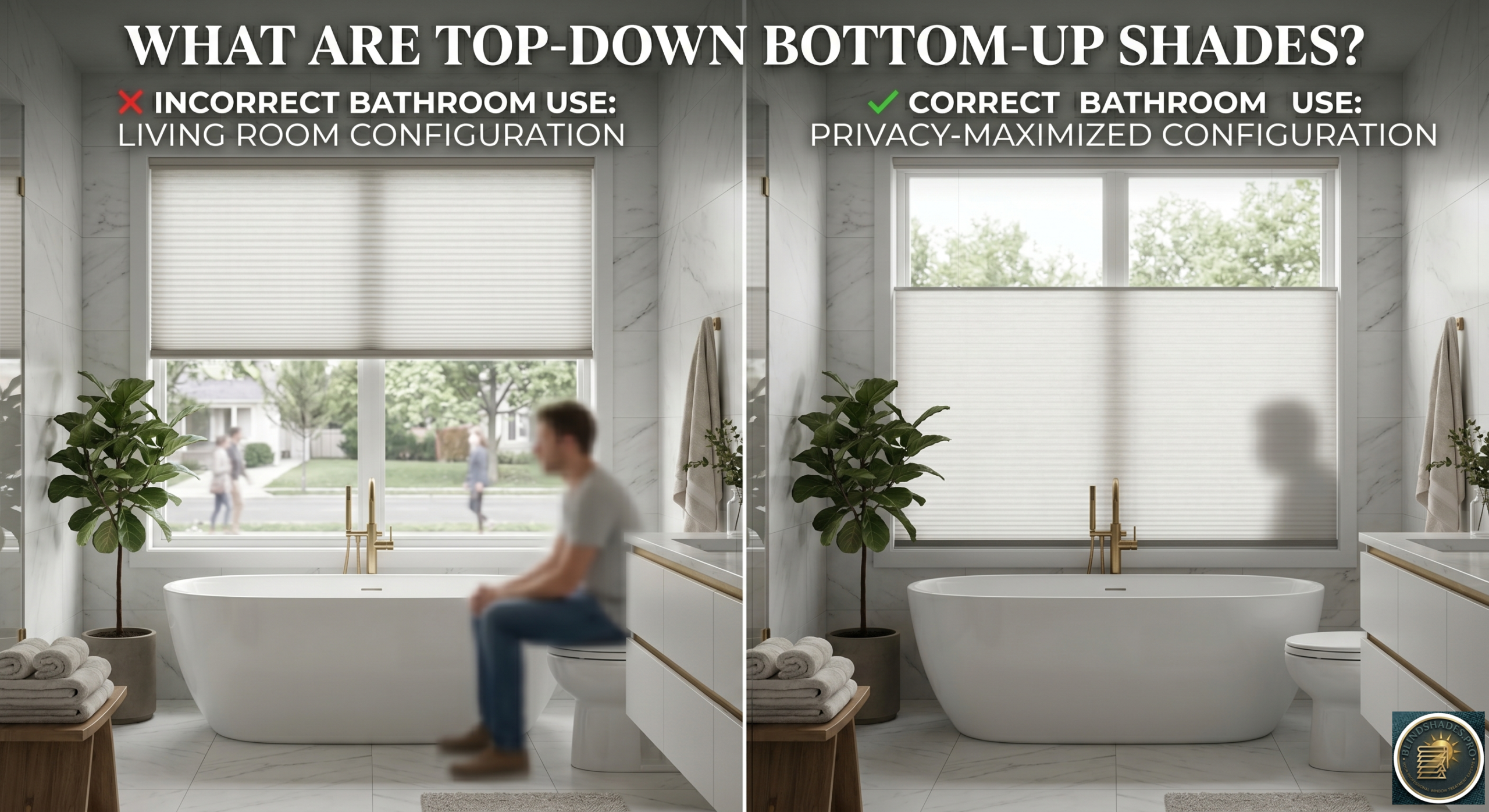
⭐ Quick Answer — What Are Top-Down Bottom-Up Shades and Are They Good for a Bathroom?
- What They Are: Top down bottom up shades for a bathroom are window shades with a dual-rail system — a floating middle rail that lowers from the headrail to open the top of the window, and a bottom rail that raises from the sill to open the bottom. This creates any combination: top open + bottom closed, bottom open + top closed, or a middle zone covered with both top and bottom open. The standard cellular honeycomb is the most popular style
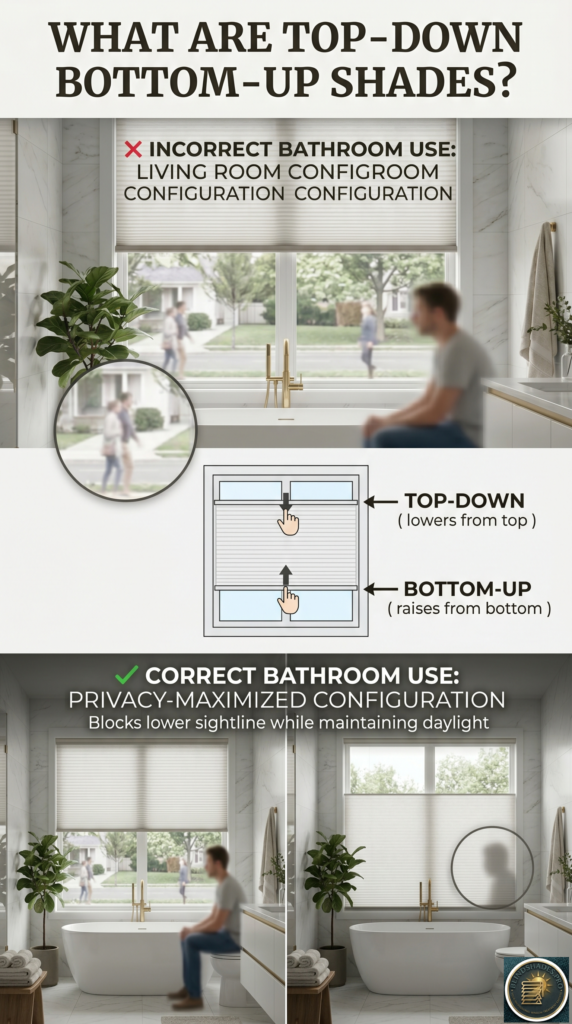
- The Configuration Every Guide Gets Wrong: All guides say “lower the middle rail for sky view while keeping the bottom closed for privacy.” That is the living room configuration — wrong for a bathroom. A seated toilet user is at 35–40 inch height. The sightline enters through the lower window, not the middle. Correct bathroom operation: raise the bottom rail upward to block the lower window sightline, leaving the upper zone open for natural light from above
- The Middle Rail Gap: A TDBU shade has three rails — headrail, floating middle rail, and bottom rail. The middle rail sits slightly proud of the fabric surface by 1/4 to 3/8 inch, creating a narrow light strip at its position. At each end of the middle rail, a small gap exists where it approaches the window jamb. For a bathroom: outside mount minimises end-gaps; inside mount creates tighter clearances but more pronounced middle-rail light at each side
- Single-Cell vs Double-Cell for TDBU: Single-cell (R-2.0 to 3.0): lighter middle rail, holds set position more reliably through 2–4 daily bathroom adjustments. Double-cell (R-3.5 to 5.0): heavier middle rail more prone to drifting downward from set position under fabric weight. For a bathroom operated frequently: single-cell TDBU is the more stable daily-use specification
- The Triple Function No Guide Mentions: Top down bottom up shades in a bathroom provide three simultaneous functions no other single window treatment achieves: (1) Privacy — raise bottom to block sightline zone (2) Natural light — leave upper zone open for diffuse sky light (3) Ventilation — open the window in the upper zone where the shade is already open; fresh air enters while lower shade maintains privacy
- Best Sources: Cordless single-cell TDBU cellular → Blindsgalore TDBU range (confirm moisture-treated fabric) · Mid-range TDBU cellular → SelectBlinds cordless TDBU · Premium motorized → Hunter Douglas Duette with PowerView
⚠️ The Material Hierarchy and the Depth Requirement Every Buyer Misses: Not all top down bottom up shades work well in a bathroom. Material hierarchy: (1) Moisture-treated single-cell cellular – best (hydrophobic coating reduces steam absorption in honeycomb cells; specify this explicitly) (2) Moisture-treated pleated – second best (single layer, less condensation trap risk) (3) Roman TDBU – NOT recommended (fold gap problem + most complex mechanism) (4) Woven wood/bamboo TDBU – Zone 3 powder room only. And the depth issue: a TDBU cellular shade headrail is deeper than a standard shade headrail because of the dual-rail mechanism. Minimum inside-mount recess depth: 3–4 inches for single-cell TDBU, 3.5–4.5 inches for double-cell. Many bathroom windows have 2.5–3.5 inch recesses — measure before ordering. If recess is too shallow, specify outside mount above the window casing. See What Are the Best Blinds for a Bathroom Window for the full zone-by-zone bathroom blind specification. See the full material hierarchy below.
💡 Is TDBU Worth the 15–25% Premium Over Standard Cellular for a Bathroom? For top down bottom up shades in a bathroom, the premium is justified when: the window sill is below 48 inches (ground-floor or basement bathroom where lower sightline privacy is a real daily concern); the bathroom faces a public footpath or neighbouring window; or the household uses the window for both privacy and active ventilation. The premium is NOT justified for: a high bathroom window with sill above 64 inches (standing privacy inherent, TDBU provides no functional advantage); a Zone 1 shower-adjacent window (PVC vinyl is the correct material, not available in TDBU); or a very small window under 24 inches wide where the dual mechanism cost is disproportionate. For the privacy and ventilation analysis including sightline height calculations, see How Do I Get Privacy in a Bathroom Without Losing Natural Light. See the full cost-benefit analysis below.
📖 Read the complete guide below for: the full TDBU mechanism explanation (three rails, two independent axes), the bathroom-specific configuration guide by activity (toilet vs shower vs vanity), the middle rail gap problem and outside-mount mitigation, the TDBU bathroom material hierarchy (cellular, pleated, Roman NOT recommended, woven wood Zone 3 only), single-cell vs double-cell middle rail position stability, moisture-treated vs standard cellular honeycomb trap, the triple function of TDBU (privacy + light + ventilation simultaneously), the inside-mount recess depth requirements (3–4 inches single-cell, 3.5–4.5 double-cell), and the cost-benefit analysis by bathroom window type.
What Are Top-Down Bottom-Up Shades?
Definition: A top-down bottom-up (TDBU) shade is a window shade with a dual-rail system that allows the shade fabric to be positioned from two independent control points: the shade can be lowered from the top of the window downward (lowering the middle rail from the headrail), or raised from the bottom of the window upward (raising the bottom rail). Both rails can be operated simultaneously to position the shade fabric in any zone of the window.
The three mechanical components:
- Headrail: fixed mounting rail at the top of the window, attached to the wall or frame as standard
- Middle rail (floating rail): the upper edge of the visible shade fabric; can be disengaged from the headrail and lowered to any position in the window
- Bottom rail: the lower weighted edge of the shade fabric; can be raised from the sill to any position in the window
The positions available: A standard shade has two positions: fully raised or fully lowered (plus positions in between on a single axis). A TDBU shade has effectively infinite positions on two independent axes, allowing the shade fabric to cover any zone of the window: the top half only, the bottom half only, the middle zone only, or any combination.
Top Down Bottom Up Shades Bathroom – The Configuration Guide Every Article Gets Wrong
This is the most important section of this article – and it directly contradicts the advice given in every competitor guide.
The standard guidance (correct for living rooms, wrong for bathrooms): All guides instruct: “Lower the middle rail from the headrail to let sky light in from the top while keeping the bottom rail closed for privacy.” This creates an open zone at the top of the window and a closed zone at the bottom.
Why this is wrong for a bathroom:
In a living room, the primary sightline from outside enters through the middle of the window toward a person seated on a sofa. The seated sofa occupant is at approximately 42-48 inches height. For a window with a sill at 30 inches, the middle portion of the window aligns with the sightline. Keeping the bottom closed and opening the top means the open zone is above the sightline zone – correct.
In a bathroom, the sightline analysis differs by activity:
For toilet privacy (the most common bathroom sightline concern): A person seated on a standard toilet is at approximately 35-40 inches height. For a window with a sill at 36-48 inches from the floor, the sightline from a standing observer outside at street level enters through the LOWER portion of the window. The correct TDBU configuration for toilet privacy is: RAISE the bottom rail upward to cover the lower window zone where the sightline enters, while leaving the UPPER portion of the window fully open for natural light from above.
For shower privacy (standing occupant): A standing shower occupant is at approximately 60-66 inches height. The sightline enters through the MIDDLE to UPPER portion of the window. The correct configuration: position the middle rail at approximately two-thirds of the window height from the top, and keep the bottom rail lowered to the sill. This leaves only the very top zone (above 60-66 inches) open for light.
For vanity privacy (standing occupant at mirror): Similar to shower – close the upper and middle zones, leave the very top open for sky light.
For the complete sightline analysis including window sill height and observer geometry, see How Do I Get Privacy in a Bathroom Without Losing Natural Light.
The Middle Rail Gap – The TDBU-Specific Privacy Issue
Definition: The middle rail gap is a small light-admitting gap that exists at the point where the floating middle rail of a TDBU shade rests within the window zone.
Why the middle rail creates a gap: When a TDBU shade is set with the middle rail at a mid-window position (covering, for example, the bottom half of the window), the middle rail itself is slightly proud of the shade fabric surface by approximately 1/4 to 3/8 inch. At each end of the middle rail, where it approaches the window frame or jamb, a small gap exists between the rail end and the window surface.
For a bathroom window in Zone 2 or Zone 3 where the shade is the primary privacy treatment, this middle rail gap can admit:
- A visible strip of light along the middle rail position when bright daylight is outside
- A narrow sightline gap at each end of the middle rail
Mitigating the middle rail gap: Outside mount installation with the headrail mounted above the window casing – rather than inside the frame – allows the middle rail to travel across the full window width without approaching the side jambs closely, reducing the end-gap exposure. Inside mount TDBU shades in bathrooms have inherently tighter side clearances but more pronounced middle rail end-gaps.
For the full bathroom window light gap analysis, see Why Is Light Coming Through the Sides of My Blackout Blinds.
Wait — that’s a Guide #49 bedroom article, not bathroom. Use a better contextual link. See what I have for bathroom articles that mention gaps.
What Are the Best Blinds for a Bathroom Window – Privacy and Moisture Guide covers edge gaps and their relationship to mount type.
The TDBU Bathroom Material Hierarchy
Not all TDBU shade styles are equally appropriate for a bathroom. This is the bathroom-specific ranking no guide provides.
Best for Bathroom – Moisture-Treated Cellular (Honeycomb) TDBU
Cellular shades are the best TDBU material for a bathroom because:
- Synthetic polyester fabric (not organic cotton or linen)
- Moisture-treated specification reduces moisture absorption by the honeycomb cells
- Best insulation (single-cell R-2.0 to 3.0; double-cell R-3.5 to 5.0)
- Best light-filtering performance
- Available in light-filtering, room-darkening, and full blackout opacities
The moisture-treated specification is critical for a bathroom TDBU: Standard cellular shade fabric absorbs shower steam in the honeycomb cells, creating a trapped humid air microclimate as discussed in What Are the Best Blinds for a Bathroom Window – Privacy and Moisture Guide. Moisture-treated cellular fabric has a hydrophobic coating on the polyester fibres that reduces steam absorption and promotes faster drying between shower exposures.
The condensation trap warning: A TDBU cellular shade positioned close to a cold bathroom window in winter creates a microclimate between the honeycomb cells and the cold glass. The air trapped in the cells cools and concentrates condensation on the window surface behind the shade. For cold-climate bathrooms: specify outside mount (or leave a 2-3 cm gap between the shade and glass surface) to allow air movement between the cellular shade and the window glass.
Second – Moisture-Treated Pleated TDBU
Pleated shades have a simpler single-fold structure than cellular honeycomb – one layer of fabric in a zigzag pleat, rather than two layers forming cells. For a bathroom TDBU:
- Better than cellular for condensation trapping (single layer allows more air movement)
- Less insulation than cellular (no trapped air cells)
- Specify moisture-treated polyester
- Lighter weight, which provides better middle rail stability (see single-cell vs double-cell section below)
Not Recommended – Roman Shade TDBU for a Full Bathroom
Roman shade TDBU combines two problematic specifications for a bathroom:
- Roman shade fold gaps (covered in detail in Can You Use Real Wood Blinds in a Bathroom – actually this is not the right article. The Roman shade fold gap is from the bedroom guide. Let me reference the correct article from guide 48 or 49.)
- The TDBU Roman mechanism requires two separate cord systems threading through the Roman shade fabric folds – the most complex and failure-prone TDBU mechanism available
- Roman shade fabric (typically cotton or linen) is not appropriate for bathroom moisture exposure
- If Roman shade TDBU is available in moisture-resistant PVC fabric, the fold gap problem remains (structural geometry, not material) and the mechanism complexity remains
Specify cellular or pleated TDBU for a bathroom instead.
Not Recommended – Woven Wood or Bamboo TDBU for Full Bathrooms
Woven wood and bamboo TDBU shades are appropriate for Zone 3 powder rooms only. The natural material does not tolerate Zone 1 or Zone 2 full bathroom humidity well enough for long-term TDBU specification. Specify moisture-treated cellular or pleated for full bathrooms with showers.
Single-Cell vs Double-Cell Cellular TDBU for a Bathroom
Definition: Single-cell cellular shades have one layer of hexagonal honeycomb cells; double-cell cellular shades have two stacked layers. Both are available in TDBU configuration.
Why cell count matters for TDBU operation in a bathroom:
The middle rail of a TDBU shade must stay in position after the user sets it. The position is held by friction in the shade’s lift mechanism. The heavier the shade fabric and middle rail, the more the rail tends to drift downward over time under its own weight.
| Specification | Middle Rail Weight | Position Stability | Insulation (R-value) |
|---|---|---|---|
| Single-cell TDBU | Lighter | Better – holds position more reliably | R-2.0 to 3.0 |
| Double-cell TDBU | Heavier | Slightly more prone to drift | R-3.5 to 5.0 |
The bathroom implication: For a bathroom window that is operated 2-4 times daily (privacy during shower, then open for light and ventilation), the middle rail position stability matters. A single-cell TDBU cellular shade with a lighter middle rail holds its set position more reliably through repeated daily adjustment cycles than a heavier double-cell version.
For bathroom applications where insulation is a priority (cold climate, bathroom over an unheated garage or exterior wall), the double-cell’s thermal performance may justify accepting slightly less middle rail position stability.
The Triple Function of TDBU Shades in a Bathroom
Every guide describes two functions: light and privacy. Top down bottom up shades in a bathroom serve three functions:
Function 1 – Privacy: Raise the bottom rail to block the sightline zone for the bathroom activity being performed (toilet: raise bottom to 35-40 inch height; shower: position middle rail to leave only very top open).
Function 2 – Natural light: Leave the upper zone above the sightline open to admit diffuse sky light from above, providing bathroom ambient light without artificial lighting during daytime.
Function 3 – Ventilation (the function no guide mentions): For bathroom windows that open (casement, tilt-and-turn, or sash windows): position the TDBU shade with the bottom rail raised to cover the lower portion of the window and the middle rail leaving the upper window zone open. Then open the window in the upper zone where the shade is already open. Fresh air enters through the open upper window zone while the bottom shade provides sightline privacy.
This triple function (privacy + light + ventilation simultaneously) is available only with TDBU shades – no other single window treatment provides all three functions at the same time.
The Installation Depth Requirement
The detail no TDBU guide mentions for bathroom windows:
A standard cellular shade headrail (non-TDBU) requires approximately 2.5-3 inches of window recess depth for inside-mount installation.
A TDBU cellular shade headrail is deeper than a standard headrail because it contains the dual-rail mechanism that allows the middle rail to disengage and lower. The TDBU headrail depth requirements:
| TDBU Cellular Type | Minimum Inside-Mount Recess Depth |
|---|---|
| Single-cell TDBU | 3-4 inches |
| Double-cell TDBU | 3.5-4.5 inches |
| Motorized double-cell TDBU | 4-5 inches |
The bathroom window recess implication: Many residential bathroom windows have shallow recesses of 2.5-3.5 inches. At this depth, a standard TDBU single-cell cellular shade may fit inside mount, but a double-cell or motorized TDBU will not. Measure the window recess depth before ordering any TDBU cellular shade for bathroom inside-mount installation. If the recess is too shallow – specify outside mount with the headrail mounted above the window casing.
Is a TDBU Shade Worth the Premium Over a Standard Shade for a Bathroom?
The cost premium: TDBU cellular shades typically cost 15-25% more than equivalent standard (single direction) cellular shades of the same material and size. For a 36×48 inch bathroom window:
- Standard single-cell cellular: $80-$150
- TDBU single-cell cellular: $95-$190
- Standard double-cell cellular: $120-$200
- TDBU double-cell cellular: $140-$250
When TDBU is worth the premium for a bathroom:
- Ground-floor bathroom or basement-level bathroom where the window sill is below 48 inches and privacy at the lower window zone is genuinely needed while natural light from above is also desired
- Bathroom window facing a public space, pavement, or neighbouring property where sightline privacy is a daily concern
- Bathroom used by multiple household members with different privacy and light preferences throughout the day
When standard cellular is adequate:
- High-window bathroom (sill above 64 inches) where the window provides inherent standing privacy and TDBU provides no functional privacy advantage over standard cellular
- Shower-adjacent Zone 1 window where PVC vinyl is the correct material (PVC vinyl is not available in TDBU configuration)
- Very small bathroom window (under 24 inches wide) where the TDBU mechanism adds cost and complexity disproportionate to the window size
Where to Order – TDBU Bathroom Specification
For moisture-treated single-cell TDBU cellular (Zone 3 and Zone 2 bathrooms): Blindsgalore cordless TDBU cellular shade – see blindsgalore.com/top-down-bottom-up for the full TDBU range with moisture-treated fabric options. Specify cordless, single-cell, moisture-treated polyester.
For standard performance TDBU cellular: SelectBlinds cordless TDBU cellular – see selectblinds.com TDBU range. Confirm moisture-treated fabric specification.
For premium motorized TDBU cellular: Hunter Douglas Duette with TDBU and PowerView motorization – allows independent programming of the middle rail and bottom rail via smartphone app. Available with EasyRise cordless for manual operation. See the Blindster TDBU worth it guide for an independent cost-benefit assessment.
Frequently Asked Questions
What are top-down bottom-up shades and are they good for a bathroom? Top-down bottom-up shades are window shades with a dual-rail system that allows the shade fabric to be positioned from two independent control points – the middle rail can be lowered from the headrail to open the top of the window, and the bottom rail can be raised from the sill to open the bottom of the window. For a bathroom, TDBU shades are excellent but must be operated differently than the standard guidance suggests. The correct bathroom configuration raises the bottom rail to block the lower sightline to a seated toilet user while leaving the top zone open for natural light – the opposite of the living room configuration described in most guides.
How should I operate a top-down bottom-up shade in a bathroom? For toilet privacy in a bathroom, raise the bottom rail upward to cover the lower portion of the window where the sightline to a seated occupant at 35 to 40 inch height enters. Leave the upper portion of the window open for natural light from above. For shower privacy in a standing shower, position the middle rail lower so that only the very top of the window above 60 to 66 inch standing height remains open, blocking the middle and lower zones. Do not use the living room configuration of lowering the middle rail for sky view while leaving the bottom open – this leaves the lower window exposed to the toilet sightline.
What is the best material for top-down bottom-up shades in a bathroom? Moisture-treated single-cell cellular shade is the best TDBU material for a Zone 2 or Zone 3 bathroom. The moisture-treated polyester fabric has a hydrophobic coating that reduces steam absorption by the honeycomb cells and promotes faster drying between shower exposures. Single-cell is preferred over double-cell for TDBU operation in a bathroom because the lighter middle rail holds its set position more reliably through repeated daily adjustments. Avoid Roman shade TDBU for bathrooms – the fold gap problem and complex mechanism make it unsuitable. Avoid woven wood or bamboo TDBU for full bathrooms with showers.
What recess depth does a TDBU shade need for inside mount in a bathroom? A TDBU cellular shade headrail requires more depth than a standard shade because the dual-rail mechanism adds to the headrail dimensions. Single-cell TDBU cellular shades require a minimum inside-mount recess depth of 3 to 4 inches. Double-cell TDBU requires 3.5 to 4.5 inches. Motorized double-cell TDBU requires 4 to 5 inches. Many residential bathroom windows have shallow recesses of 2.5 to 3.5 inches. Measure the window recess depth before ordering inside-mount TDBU for a bathroom. If the recess depth is insufficient, specify outside mount with the headrail mounted on the wall surface above the window casing.
Can top-down bottom-up shades provide ventilation in a bathroom? Yes – this is the function most guides do not mention. For a bathroom window that opens, position the TDBU shade with the bottom rail raised to cover the lower window zone for privacy and the upper zone open above the middle rail position. Then open the window in the upper zone where the shade is already open. Fresh air enters through the open upper window while the lower shade provides sightline privacy. This simultaneous privacy, light, and ventilation from a single window treatment is the unique triple function of TDBU shades in a bathroom – no other single window treatment provides all three at the same time.
Related Guides on BlindShades.pro
- The Best Bathroom Window Blinds and Shades Buying Guide
- How Do I Get Privacy in a Bathroom Without Losing Natural Light
- What Are the Best Blinds for a Bathroom Window – Privacy and Moisture Guide
- What Are the Best Window Treatments for a Bathroom Next to a Bathtub
- Can Solar Shades Be Used in a Bathroom – The Night Privacy Problem
By Michael Turner | 30 Years Home Improvement Expertise | Updated 2026 | BlindShades.pro
