Cordless vs Motorized Roman Shades: Which Lift Is Worth It?

Authored By Michael Turner -30 Years Home Improvement Expertise | Updated 2026 | BlindShades.pro
Updated on July 8, 2026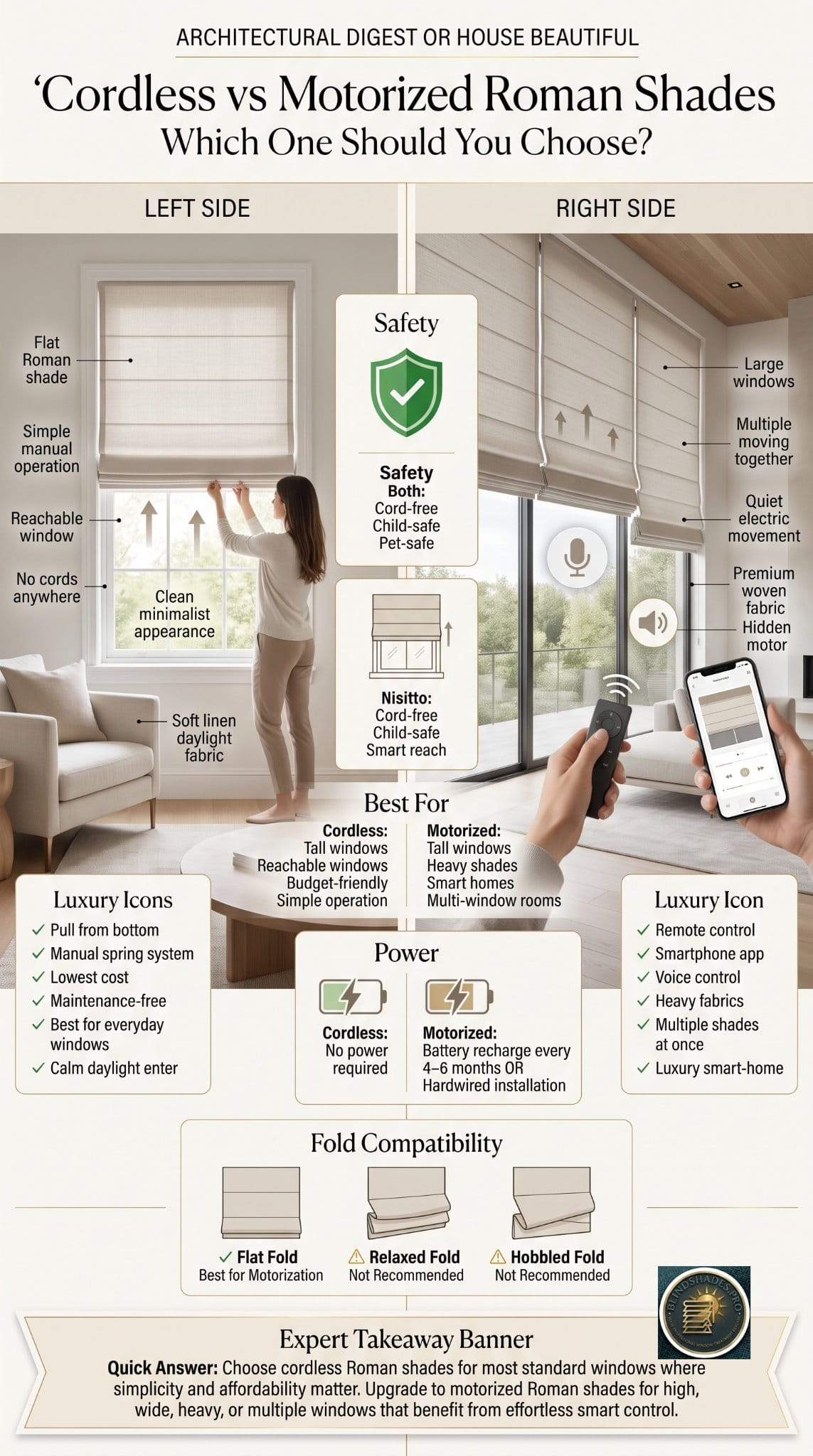
By Michael Turner | 30 years in window treatments
Cordless vs motorized Roman shades is not a safety decision — both are completely cord-free — it is a decision about reach and weight. A cordless Roman shade uses a manual tension spring you operate by gently pulling the bottom hem; a motorized Roman shade lifts and lowers the fabric by remote, app, or voice. Cordless costs less, needs no maintenance, and is the right default for standard windows. Motorized earns its premium the moment a window is too high to reach or a shade too heavy to lift smoothly. And there is one Roman-specific constraint nobody in the comparison articles mentions: your fold style may decide the question for you.
🎯 5 Key Takeaways
- Safety is a tie, so ignore it as a tiebreaker. Both cordless and motorized Roman shades are completely cord-free, eliminating the dangling-cord hazard that the ANSI/WCMA A100.1 standard restricts. Neither is “the safe one.”
- Reach and weight decide it. Cordless requires you to physically reach and guide the shade, which is difficult on high or wide windows and heavy fabrics — exactly where motorized excels.
- Cordless is cheaper and effectively maintenance-free. Blindsgalore notes manual Roman shades cost less upfront with a simpler mechanism and fewer parts; cordless shades are virtually maintenance-free once installed.
- Motorized adds a power decision. Battery motors need recharging or replacement every 4 to 6 months, while hardwired motors require initial electrical wiring but offer zero ongoing power maintenance.
- Your fold may make the choice for you. Relaxed and hobbled folds are generally not recommended for motorized lifting because their non-linear folds do not stack predictably — a Roman-specific constraint the generic blind comparisons miss.
⭐ Quick Answer
Cordless vs motorized Roman shades: both are completely cord-free, so safety is a tie. Reach and weight decide it. The short version:
- Cordless uses a manual tension spring you pull at the bottom hem, as The Shade Store explains; it is the cheapest, simplest, and virtually maintenance-free choice for reachable windows.
- Motorized lifts by remote, app, or voice and earns its premium on high, wide, heavy, or multiple windows; Blindsgalore notes manual Roman shades cost less upfront with fewer parts.
- Power matters: battery motors need recharging every 4 to 6 months, while hardwired needs wiring but offers zero ongoing power maintenance, per Graywind.
- Your fold may decide it: flat folds motorize cleanly, but relaxed and hobbled folds are not recommended for motors; see which fold to choose.
- Motorize selectively, not whole-house; the full lift and liner picture is in our Roman shades guide and the motorization scorecard.
Best Sources: Blindsgalore (motorized vs manual Roman shades, real cost); The Shade Store (how cordless Roman shades work); Graywind (battery vs hardwired motorized); Blinds Chalet (hardwired vs battery); Stoneside Blinds & Shades (cordless lift safety); Window Covering Manufacturers Association (ANSI/WCMA A100.1 cordless standard).
What Is the Difference Between Cordless and Motorized Roman Shades?
A cordless Roman shade uses a manual tension spring that you adjust by gently pulling the bottom hem, while a motorized Roman shade uses a motor to lift and lower the fabric automatically by remote control, smartphone app, or voice command.
The mechanisms differ, but the outcome they share is the important one. Both are completely cord-free, with no dangling chain or pull cord, which is why both are recommended for homes with young children or pets. The Shade Store explains the cordless mechanism as a spring system operated by hand at the hem; motorized systems replace that hand with a motor and a controller.
Here is the head-to-head across every factor the comparison pages measure.
| Factor | Cordless Roman | Motorized Roman |
|---|---|---|
| Operation | Manual tension spring, pull the bottom hem | Remote, app, or voice command |
| Safety | Cord-free | Cord-free (tie) |
| Best for | Standard, reachable windows | High, wide, heavy, or multiple windows |
| Upfront cost | Lower — simpler mechanism, fewer parts | Higher — motor, controller, power system |
| Maintenance | Virtually maintenance-free | Battery recharge every 4 to 6 months, or wiring |
| Fabric wear | You touch the fabric each time | No contact; fabric stays cleaner longer |
| Fold compatibility | Any fold | Flat folds recommended; not relaxed or hobbled |
That last row is the Roman-specific factor the generic blind comparisons skip entirely, and it can settle the decision before budget does.
The Reach-and-Weight Rule: How to Decide
The Reach-and-Weight Rule: cordless is the correct default until the window is too high to reach or the shade too heavy to lift smoothly — at that point, motorize. Budget breaks ties; it does not make the decision.
Because both options are cord-free, the safety argument that dominates the search results cancels out. What is left is mechanical. A cordless Roman shade demands that you physically reach the bottom hem and guide it, which is straightforward on a bedroom window at arm’s height and awkward on a stairwell window or a wide, heavy blackout-lined shade. Motorized shades are excellent for hard-to-reach windows, heavy fabrics, and operating multiple windows simultaneously.
So work the rule in order. Can you comfortably reach the hem? Is the shade narrow and light enough to rise smoothly by hand? If yes to both, cordless is the smarter buy and you keep the money. If no to either, motorize that window — and only that window. The single most expensive mistake in this category is motorizing an entire house when three windows needed it.
Which Fold Styles Can You Motorize?
Flat and pleated folds motorize cleanly; relaxed and hobbled folds are generally not recommended for motorization because their non-linear folds do not stack predictably and need hand-dressing.
This is the constraint that makes Roman shades different from roller shades or blinds, and it is absent from every ranked page — several of which are not even about Roman shades. A motor raises fabric in a straight, repeatable stack. A flat fold cooperates. A relaxed fold, with its soft bottom curve and no bottom stiffener, and a hobbled fold, with its permanent cascading loops, both fall unpredictably and need occasional hand-dressing to sit correctly, which defeats the purpose of a motor.
| Fold style | Motorize? | Why |
|---|---|---|
| Flat (plain) | Recommended | Stacks in a straight, repeatable line |
| Pleated / front-slat | Recommended | Structured sewn pleats stack predictably |
| Relaxed (soft wave) | Not recommended | Non-linear curve needs hand-dressing |
| Hobbled (soft-fold) | Not recommended | Cascading loops stack unpredictably |
The practical consequence: if you want a motorized Roman shade, specify a flat fold. If you have your heart set on a relaxed or hobbled fold, plan on cordless. We work through this in detail in our guide to flat vs relaxed vs hobbled Roman shades.
Battery or Hardwired: Which Motorized Roman Shade Should You Choose?
Battery motors suit renters and retrofits because they install without wiring; hardwired motors suit new builds and renovations because they need no ongoing power maintenance.
If you land on motorized, a second decision follows, and it is the one the battery-versus-hardwired articles exist to answer. Graywind puts the trade plainly: battery-powered shades require you to recharge or replace the batteries every 4 to 6 months, while hardwired shades require initial electrical wiring but offer zero ongoing power maintenance. Blinds Chalet reaches the same conclusion — hardwired is better for long-term use and requires less maintenance, while battery shades are easier to install and more flexible.
| Power type | Best for | The trade-off |
|---|---|---|
| Battery / rechargeable | Renters, retrofits, no-wiring situations | Recharge or replace every 4 to 6 months |
| Hardwired | New builds, renovations, long-term installs | Requires electrical work upfront |
| Solar-assisted | Sunny windows | Depends on light exposure to top up |
Decide this before you shop brands, because you wire a home once. If you are weighing motorization across your whole house rather than one Roman shade, the broader scorecard is in our guide on whether motorized roller shades are worth it.
What Are the Disadvantages of Cordless and Motorized Roman Shades?
Cordless shades demand reach and hand contact and struggle on wide, heavy shades; motorized shades cost more upfront, add batteries or wiring, and introduce electronics that can eventually fail.
Both sides have honest drawbacks, and the search results skew toward selling motorization, so here is the balanced list.
| Option | Disadvantage | The workaround |
|---|---|---|
| Cordless | You must reach and guide the hem | Motorize only the hard-to-reach windows |
| Cordless | Difficult on high or wide windows | Motorize wide or heavy shades |
| Cordless | Hand contact soils fabric over time | Clean hands; spot-clean the hem |
| Cordless | Spring tension can weaken with age | Retension or service the mechanism |
| Motorized | Higher upfront premium (motor, remote, power) | Motorize selectively, not whole-house |
| Motorized | Battery recharge every 4 to 6 months | Choose hardwired or solar-assist |
| Motorized | Electronics add failure points | Buy quality; check warranty terms |
| Motorized | Not suited to relaxed or hobbled folds | Specify a flat fold |
The motor-failure fear deserves a direct answer, because a long-running Houzz thread captures it well: an owner worries that when the motor dies, the whole blind system must be replaced. In practice, quality motors are rated for high cycle counts and last for years, the battery is the serviceable part, and reputable manufacturers supply replacement motors under warranty. The electronics are a new failure point, not a common one.
Are Cordless Roman Shades Good, and Are Motorized Ones Worth It?
Cordless Roman shades are excellent for most windows — safe, affordable, and maintenance-free — while motorized shades are worth it specifically for high, wide, heavy, or multiple windows and for anyone who wants scheduling or voice control.
Both PAA questions have the same answer from opposite ends. Cordless is good, and for a standard reachable bedroom or living-room window it is the right call: Blindsgalore confirms manual Roman shades cost less upfront with a simpler mechanism and fewer parts, and cordless versions eliminate the dangling cord entirely. Motorized is worth it when the window’s height, width, or weight makes manual operation a chore, when you want several shades to move together, or when the shade is on a feature window where never touching the fabric keeps it cleaner for longer.
One aesthetic bonus for motorization worth knowing: because you never physically touch the fabric, the material stays cleaner over its life — a small but real advantage on a pale linen Roman. And whichever lift you choose, the liner and fold decisions matter more to your satisfaction than the motor; see our best Roman shades buying guide and our guide on blackout vs light-filtering Roman shades.
Related Buying Guides
- The Best Roman Shades Buying Guide — where lift fits the full spec
- Flat vs Relaxed vs Hobbled Roman Shades — which folds motorize
- Blackout vs Light-Filtering Roman Shades — the liner decision
- Are Motorized Roller Shades Worth It? — the whole-house scorecard
Frequently Asked Questions
Are motorized Roman shades worth it? They are worth it for high or hard-to-reach windows, wide or heavy shades, multiple windows you want to move together, and anyone who wants scheduling or voice control. They are not worth it on a standard reachable window where a cordless shade does the same job for less. Because both options are cord-free, safety is not a reason to upgrade — reach and weight are.
Are cordless Roman shades good? Yes. Cordless Roman shades are safe, affordable, and virtually maintenance-free once installed, using a manual tension spring you operate by pulling the bottom hem. They cost less upfront than motorized shades because the mechanism is simpler with fewer parts. Their limits are practical rather than safety-related: reaching high windows and lifting wide or heavy shades by hand.
What are the disadvantages of motorized blinds? Motorized shades carry a higher upfront premium for the motor, remote controller, and power system; battery-powered units need recharging or replacement roughly every 4 to 6 months; hardwired units require electrical work; and the added electronics introduce failure points, though quality motors last for years. For Roman shades specifically, relaxed and hobbled folds are generally not recommended for motorization.
What are the disadvantages of cordless blinds? Cordless shades require you to physically reach and guide the shade, which is difficult on high or wide windows and with heavy fabrics. Repeated hand contact with the fabric can soil the hem over time, and the tension spring can weaken with age and may need servicing. They also cannot be scheduled or voice-controlled the way a motorized shade can.
Should I choose battery or hardwired motorized Roman shades? Choose battery for renters, retrofits, and situations where wiring is impractical, accepting that batteries need recharging or replacement every 4 to 6 months. Choose hardwired for new builds and renovations, where the initial electrical work buys zero ongoing power maintenance and better long-term reliability. Decide before you shop, because a home is wired once.
Can you motorize any Roman shade fold? No. Flat and pleated folds motorize cleanly because they stack in a straight, repeatable line. Relaxed and hobbled folds are generally not recommended for motorization: their non-linear folds do not stack predictably and need occasional hand-dressing, which defeats the purpose of a motor. If motorization matters, specify a flat fold.
