Blackout vs Light-Filtering Roman Shades: Which Liner Do You Need?

Authored By Michael Turner -30 Years Home Improvement Expertise | Updated 2026 | BlindShades.pro
Updated on July 8, 2026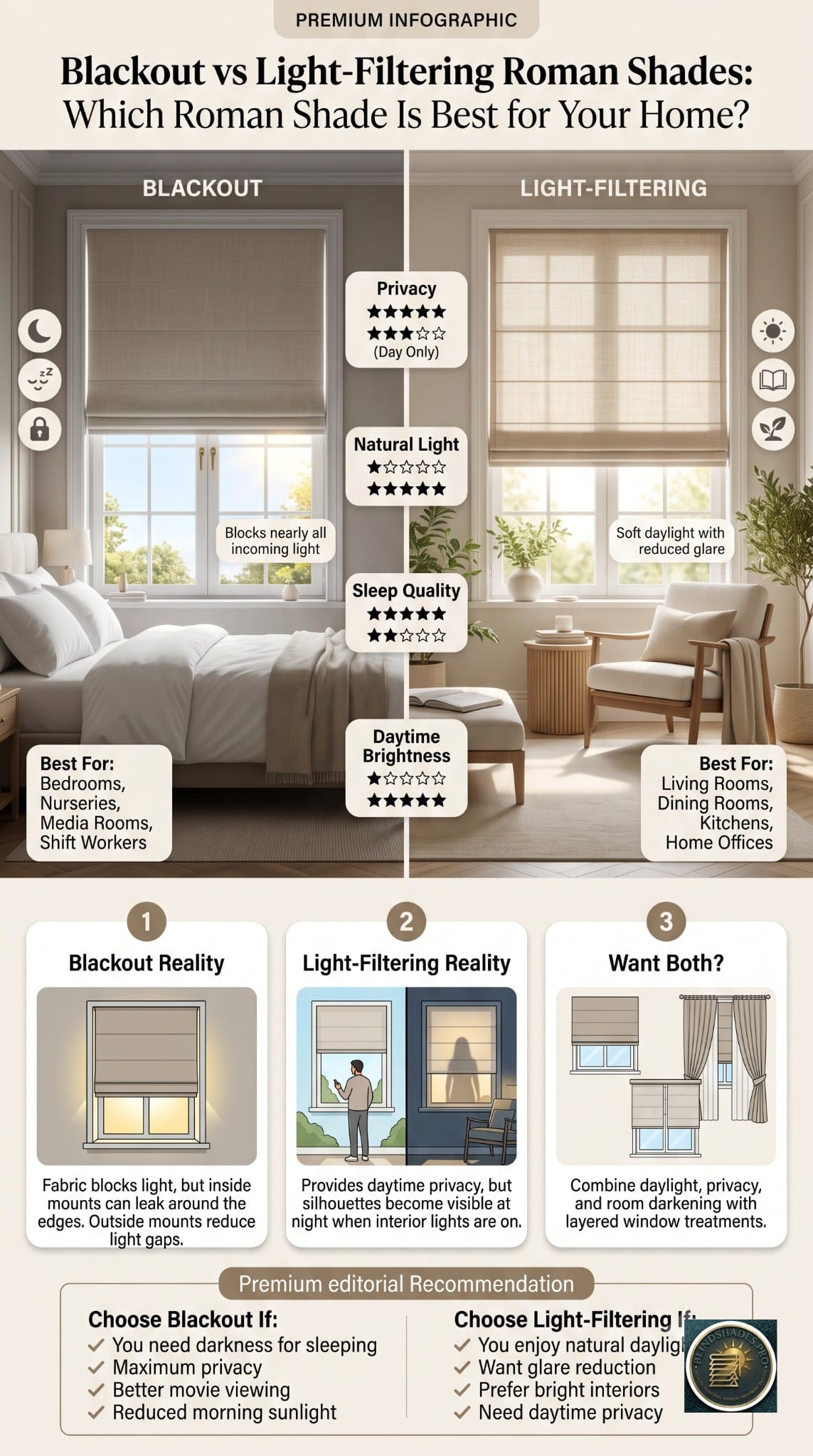
By Michael Turner | 30 years in window treatments
Blackout vs light-filtering Roman shades comes down to the liner: a blackout liner uses opaque fabric to block essentially 100% of the light passing through it and delivers privacy day and night, while a light-filtering shade uses an unlined or translucent fabric to soften daylight, cut glare, and keep a room bright. Choose blackout for bedrooms, media rooms, and nurseries; choose light-filtering for living rooms, dining rooms, kitchens, and home offices. But two things the comparison pages gloss over will decide whether you are happy: a blackout Roman does not make a room fully dark on an inside mount, and a light-filtering Roman loses its privacy the moment you turn the lights on at night.
🎯 5 Key Takeaways
- The liner decides everything, not the face fabric. In a Roman shade the liner determines light control, privacy, and insulation; the fabric you fall in love with is mostly a looks decision.
- “Blocks 100% of light” applies to the fabric, not the room. North Solar Screen states blackout shades block 100% of light through the material, but an inside-mounted Roman still leaks around the edges — only an outside mount closes those gaps.
- Light-filtering shades reverse at night. They give excellent daytime privacy, but once interior lights are on, shadows and silhouettes are visible from outside — the single most common regret with this liner.
- Blackout costs more and stacks bulkier. TheHues notes light-filtering is the most affordable tier and blackout the priciest because of the extra fabric and lining, and that added weight produces bulkier folds when the shade is raised.
- There is a middle tier and a both-in-one answer. Room-darkening sits between the two, blocking roughly 95% of light per Blinds.com, and a privacy lining, a dual shade, or layering with drapery gives you daylight and darkness in one window.
⭐ Quick Answer
Blackout vs light-filtering Roman shades: blackout uses an opaque liner for total darkness and round-the-clock privacy, while light-filtering softens daylight and gives daytime privacy only. The short version:
- The liner decides everything, not the face fabric: it governs light control, privacy, and insulation in any Roman shade.
- Blackout blocks 100% of light through the fabric, per North Solar Screen, but an inside-mounted shade still leaks at the edges, so use an outside mount, as our guide on blocking all light explains.
- Light-filtering loses privacy at night, showing silhouettes once interior lights are on; add a privacy lining, which The Shade Store recommends, or layer with drapery.
- There is a middle tier: room-darkening blocks roughly 95% of light, and Norman USA notes blackout uses denser, solid-colored fabrics while light-filtering uses lighter woven ones.
- Choose by room: blackout for the bedroom, nurseries, and media rooms; light-filtering for living rooms, kitchens, and offices.
Best Sources: The Shade Store (light-filtering vs blackout guidance); 3 Day Blinds (blackout vs light-filtering comparison); Norman USA (blackout vs room-darkening vs light-filtering); Blindsgalore (cordless Roman liner options); North Solar Screen (light-blocking figures); U.S. Department of Energy (window energy loss).
What Is the Difference Between Blackout and Light-Filtering Roman Shades?
Blackout Roman shades use an opaque liner to block essentially all light passing through the fabric and provide privacy around the clock, while light-filtering Roman shades use unlined or translucent fabric to diffuse daylight, reduce glare, and keep the room bright.
The distinction is the liner, and it governs every practical difference. A blackout Roman is built with a denser, solid-colored fabric or an opaque lining, which Norman USA contrasts with light-filtering shades constructed from lighter woven materials. A light-filtering Roman is often unlined or lined only for privacy, letting soft natural daylight through, as The Shade Store recommends for anyone wanting a bit more coverage without full darkness.
Here is the head-to-head across every dimension the comparison pages measure.
| Attribute | Blackout Roman | Light-filtering Roman |
|---|---|---|
| Light through the fabric | Blocks essentially 100% | Diffuses; lets soft daylight through |
| Daytime privacy | Total | Good |
| Nighttime privacy | Total, no silhouettes | Poor — silhouettes visible with lights on |
| Insulation | Best — thermal lining blocks drafts and summer heat | Minimal |
| Stack when raised | Bulkier folds (heavier fabric) | Sleeker, more elegant stack |
| Cost | Highest tier | Most affordable tier |
| Best rooms | Bedrooms, media rooms, nurseries | Living, dining, kitchens, offices |
The Liner-Decides Rule
The Liner-Decides Rule: in a Roman shade the liner — not the face fabric — determines light control, privacy, and insulation, so choose the liner for the room’s job first and the fabric you like second.
This is the reframe that prevents the most common Roman shade regret. The same linen face fabric can be a soft daytime glow or a near-blackout bedroom shade depending only on what sits behind it. Buyers shop the swatch, fall for a color, and discover months later that the shade does not do what the room needed. Decide the job first — sleep, glare control, insulation, privacy — and the liner follows; then pick any fabric you like, because the liner is doing the work. This same logic drives fold selection, which we cover in flat vs relaxed vs hobbled Roman shades.
Do Blackout Roman Shades Really Block 100% of the Light?
Through the fabric, yes — but not in the room. An inside-mounted blackout Roman still leaks light around the edges, so only an outside mount, or side channels, gets a room genuinely dark.
This is where the marketing and the physics part ways. North Solar Screen states that blackout shades block 100% of light while light-filtering shades allow a little through for translucent dimming — and that is accurate about the material. The room is a different story. Because the shade must clear the frame to raise and lower, an inside mount leaves gaps at the sides and top, and 3 Day Blinds notes plainly that there can be slight light gaps along the edges unless an outside mount is used, with inside-mount shades needing side channels to seal them.
The fix is mounting, not fabric. Mount the shade outside the frame and extend it several inches past each side, or add side channels. The same physics governs every roller and Roman shade, which we quantify in our guide on whether blackout roller shades block all light. And if darkness is only part of the goal, note the middle tier: a room-darkening liner blocks roughly 95% of light according to Blinds.com — dim, but not black.
| Tier | Light blocked | Room result | Best for |
|---|---|---|---|
| Light-filtering | Diffuses; soft daylight passes | Bright, glare-free | Living, dining, kitchen, office |
| Privacy lining | More coverage than unlined | Softly private by day | Street-facing common rooms |
| Room-darkening | Roughly 95%, per Blinds.com | Dim, edge glow remains | Media rooms, guest rooms |
| Blackout | Essentially 100% through fabric | Dark; outside mount for true dark | Bedrooms, nurseries, shift workers |
Do Light-Filtering Roman Shades Give Privacy at Night?
No — light-filtering shades give excellent privacy during the day, but at night, with interior lights on, shadows and silhouettes are visible from outside.
This is the single most searched worry about this liner, and the honest answer is the one retailers bury. A light-filtering fabric works by letting light pass through it, and that transmission runs both ways. During the day, brighter outside than in, the shade reads as opaque from the street. After dark, with the room lit, that relationship reverses and the fabric shows silhouettes.
There are three real fixes, and none of them is “buy a slightly denser filtering fabric.” Add a privacy lining, which The Shade Store recommends for light-filtering Romans wanting more coverage. Choose a room-darkening or blackout liner for any room used at night. Or layer: keep the light-filtering Roman for daytime softness and add drapery panels you close at night. For rooms where evening privacy is non-negotiable — bedrooms above all — go straight to blackout; our best Roman shades for a bedroom guide covers that setup.
Which Should You Choose for Your Room?
Match the liner to how the room is used: blackout wherever sleep, screens, or nighttime privacy matter, and light-filtering wherever daylight and brightness are the point.
Here is the mapping, drawn from the same room logic every ranked page follows.
| Room | Choose | Why |
|---|---|---|
| Primary bedroom | Blackout | Darkness for sleep, total nighttime privacy |
| Nursery | Blackout, cordless | Naps plus the cord-free safety standard |
| Media room | Blackout or room-darkening | Kills screen glare and ambient light |
| Living room | Light-filtering | Bright, welcoming, glare-free daylight |
| Dining room | Light-filtering | Soft natural light for daytime meals |
| Kitchen | Light-filtering | Brightness; keep fabric away from moisture |
| Home office | Light-filtering | Cuts screen glare, keeps the room bright |
| Street-facing room | Light-filtering + privacy liner | Daylight with real daytime coverage |
The nursery row carries a safety note worth stating: under the ANSI/WCMA A100.1 standard from the Window Covering Manufacturers Association, corded products are restricted, so cordless or motorized operation is the default for children’s rooms regardless of liner.
What Are the Disadvantages of Each?
Blackout shades cost the most, stack bulkier, and shut out all daylight; light-filtering shades lose privacy at night and cannot darken a room — both are manageable once you know them.
Honest drawbacks, with the fix for each.
| Liner | Disadvantage | The fix |
|---|---|---|
| Blackout | Slight edge light gaps on inside mount | Outside mount or side channels |
| Blackout | Heavier fabric makes bulkier raised folds | Choose a flat fold; mount higher |
| Blackout | No daylight or view when lowered | Pair with a sheer, or use a dual shade |
| Blackout | Highest cost tier | Reserve for the rooms that need it |
| Light-filtering | Silhouettes visible at night | Privacy liner, or layer with drapery |
| Light-filtering | Cannot darken a room | Use blackout where sleep matters |
| Light-filtering | Minimal insulation | Add a thermal liner on drafty glass |
On the energy point, a blackout shade’s thermal lining is a genuine performance feature, not just a light story: the U.S. Department of Energy reports that windows account for roughly 25% to 30% of residential heating and cooling energy use, so a lined Roman on a drafty or sun-blasted window pays back in comfort. And on cost, TheHues summarizes the tiers cleanly — light-filtering is the most affordable, room-darkening sits in the middle, and blackout costs the most because of the extra fabric and lining.
Can You Get Blackout and Light-Filtering in One Window?
Yes — with a privacy-lined light-filtering shade, a dual or day-and-night system, or by layering a light-filtering Roman with drapery you close at night.
The “both in one” search deserves a direct answer, because you should not have to choose brightness or darkness for a room you use around the clock. Three approaches work. A privacy lining behind a light-filtering fabric adds daytime coverage without killing the daylight. A dual or day-and-night system puts two fabrics on one window so you switch between them. And layering — a light-filtering Roman for the day, drapery panels for the night — is the designer default, giving you softness, night privacy, and extra insulation in one setup. Blindsgalore stocks Roman shades in both blackout and light-filtering fabrics precisely because most homes need both across different rooms. The full specification picture, including fold and mount, is in our best Roman shades buying guide.
Related Buying Guides
- The Best Roman Shades Buying Guide — where the liner fits the full spec
- Flat vs Relaxed vs Hobbled Roman Shades — the fold decision
- The Best Roman Shades for a Bedroom — the blackout setup
- Do Blackout Roller Shades Block All Light? — the edge-gap physics
Frequently Asked Questions
Should I get light-filtering or blackout Roman shades? Choose blackout for bedrooms, nurseries, and media rooms, where you need darkness for sleep and total privacy day and night. Choose light-filtering for living rooms, dining rooms, kitchens, and home offices, where you want to keep the room bright while softening daylight and cutting glare. If a room is used both day and night, a privacy liner or layering with drapery gives you both.
What’s better to get in Roman shades, total blackout or the light filter? Neither is universally better; it depends on the room’s job. Blackout is better for sleep, screen glare, and nighttime privacy, and its thermal lining adds insulation. Light-filtering is better for brightness, softened daylight, and a sleeker stack when raised, and it costs less. Match the liner to how the room is used rather than to the fabric you like.
What are the disadvantages of blackout shades? Blackout shades cost the most, use heavier fabric that produces bulkier folds when raised, block all daylight and view when lowered, and still leak light around the edges on an inside mount. The fixes are an outside mount or side channels for the edge gaps, a flat fold to reduce stack bulk, and pairing with a sheer if you want daytime light.
Are Roman shades good for blackout? Yes, when specified with a blackout liner and an outside mount. The blackout liner blocks essentially all light through the fabric, and the outside mount extended past the frame closes the edge gaps that leave an inside-mounted shade short of true darkness. An unlined or light-filtering Roman will not darken a room no matter how dark the face fabric looks.
Do light-filtering shades provide privacy at night? No. Light-filtering shades give strong privacy during the day, but at night, when interior lights are on, shadows and silhouettes become visible from outside because the fabric transmits light both ways. Add a privacy lining, switch to a room-darkening or blackout liner, or layer the shade with drapery you close after dark.
Can you have both blackout and light-filtering shades in one window? Yes. Use a light-filtering fabric with a privacy lining for daytime coverage, install a dual or day-and-night system with two fabrics on one window, or layer a light-filtering Roman with drapery panels you close at night. Layering is the most flexible option, adding nighttime privacy and insulation on top of daytime softness.
