Why Won’t My Roller Blind Stay Up?

Authored By Michael Turner -30 Years Home Improvement Expertise | Updated 2026 | BlindShades.pro
Updated on June 17, 2026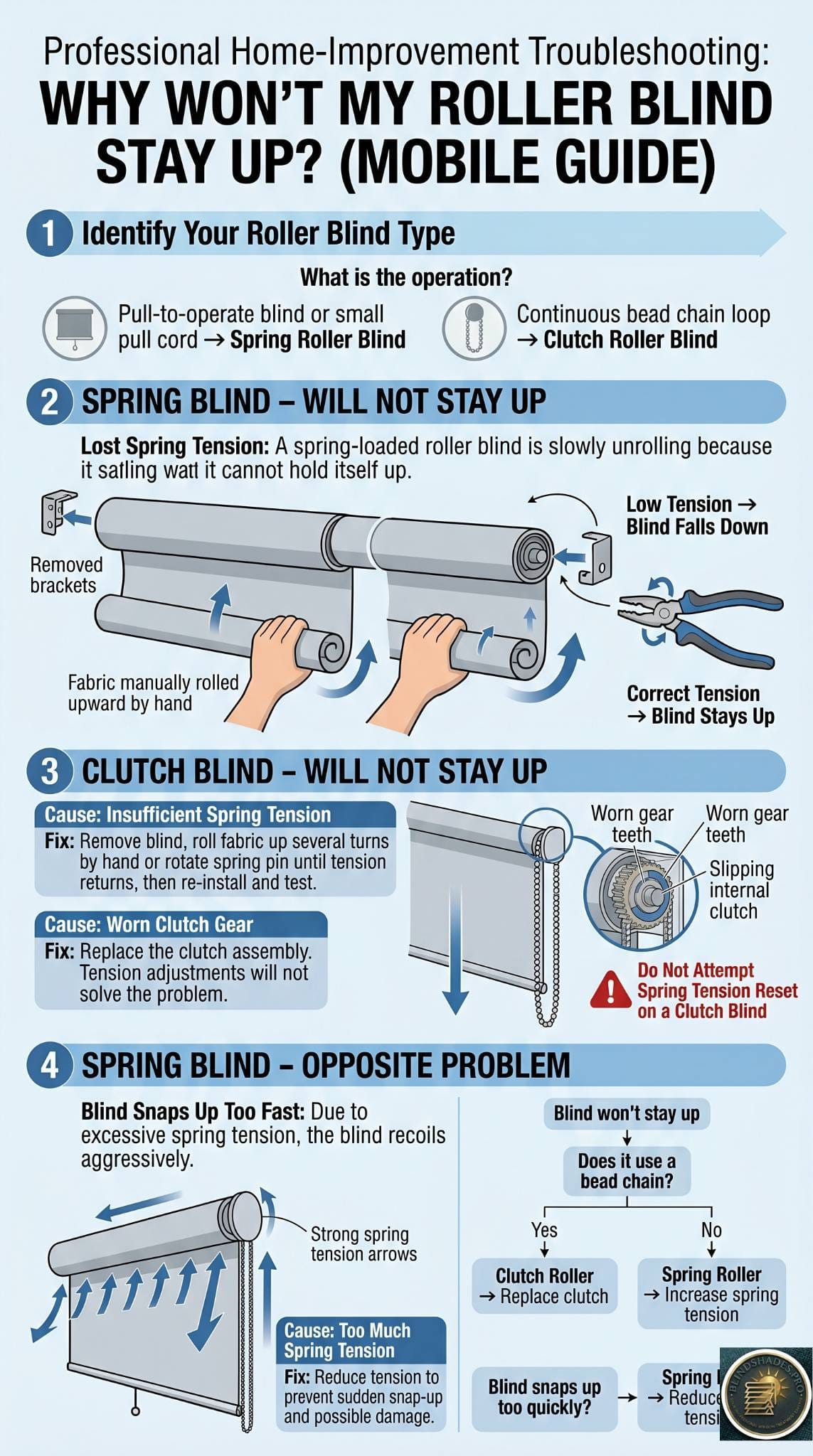
Authored by Michael Turner — 30 Years of Home Improvement Expertise | Updated 2026 | BlindShades.pro
A roller blind that won’t stay up has either lost spring tension or is slipping its chain clutch — and the fix is completely different for each. The first step almost no guide takes: work out which mechanism you have before you touch anything.
Key Takeaways
- A roller blind that won’t stay up is creeping or falling back down from the raised position, and there are only two mechanisms it can be: a spring-loaded roller or a continuous-chain clutch roller. The fix is completely different for each, which is why the first and most important step is to identify which one you have — something almost every troubleshooting guide skips. If your blind is operated by pulling the fabric or a small cord, it is spring-loaded. If it is operated by a continuous bead chain on one side, it is a clutch.
- On a spring-loaded blind, “won’t stay up” means the spring has lost tension. The spring no longer has enough stored energy to hold the fabric raised, so it slowly unwinds and the blind creeps down. The fix is to add tension: take the blind down, roll the fabric up by hand, and re-hang, repeating until it holds. This is the opposite of a blind that snaps up violently, which is too much tension.
- On a chain-clutch blind, “won’t stay up” means the clutch is slipping. The clutch is a geared mechanism that should hold the blind at any height; when the internal teeth wear, it slips and the weight of the fabric pulls it back down. You cannot fix a worn clutch with a tension reset — but unlike a heat-sealed spring tube, the clutch is usually a replaceable unit, so the repair is a new clutch rather than a new blind.
- Diagnose by symptom: creeps down slowly = under-tension spring or worn clutch; snaps up hard = over-tension spring; stops randomly or feels gritty = a dusty ratchet, common in kitchens. Matching the symptom to the mechanism before you start prevents the most common mistake — overwinding a spring that was never the problem.
- The spring stores real energy, so respect it. When adjusting a spring roller, never let it unwind freely out of the brackets, and be careful with the pin: a wound spring can snap the blind up unexpectedly. If a budget spring tube is heat-sealed and the mechanism is dead, it cannot be rebuilt and replacement is the answer — a good moment to consider a cordless or motorized upgrade.
⭐ Quick Answer
A roller blind won’t stay up because it has lost the force that holds it raised — but the cause and the fix depend on the mechanism, so identify that first.
- Step 1 — spring or clutch? A continuous bead chain means a clutch. Pull-to-operate with no chain (including cordless) means a spring. This single check decides which fix below applies; applying the wrong one wastes time.
- Spring blind — add tension: “won’t stay up” means too little spring tension, so the blind creeps down. Take it down, roll the fabric up by hand a few turns (or turn the pin on the spring side with pliers until you feel tension), re-hang, and repeat until it holds. This is the method published by Fix My Blinds and SelectBlinds.
- Clutch blind — replace the clutch: a slipping clutch is worn internal gear teeth, and a tension reset does nothing. The clutch is usually a replaceable unit at one end of the tube, so you swap the clutch rather than the whole blind. A worn or skipping chain may also need replacing — see Indesign Blinds.
- Holds then slips? The pawl or clutch is likely dusty or grimy (common on kitchen blinds). Open the end cap and clear it with compressed air or a soft brush rather than adjusting tension. If it instead snaps up hard, that is too much tension — unroll by hand to release it, as Canisteo Blinds explains.
- Beyond repair? A fully dead, heat-sealed spring tube cannot be rebuilt — replace it, and consider a cordless or motorized upgrade that removes the tension problem entirely. See are motorized roller blinds worth it and the Roller Blinds Buying Guide.
What Does It Mean When a Roller Blind Won’t Stay Up?
When a roller blind won’t stay up, you raise it and it slowly creeps — or quickly drops — back down instead of holding where you left it. It is the opposite of the other classic complaint, where the blind snaps violently to the top and won’t stay down. Both are about the force inside the roller, but they point in opposite directions: “won’t stay up” is too little holding force, while “won’t stay down” is too much.
Before you fix anything, it helps to be precise about the symptom, because each one points to a different cause:
- Creeps down slowly from the raised position — the most common “won’t stay up.” Under-tension spring, or a clutch starting to slip.
- Drops straight back down the moment you let go — a fully uncoiled spring with no tension left, or a badly worn clutch.
- Holds for a while, then lets go — a ratchet or clutch that engages weakly, often from dust and grime.
- Snaps up hard and won’t stay down — the opposite problem, too much spring tension (covered briefly below).
Naming your exact symptom now will save you from the single most common mistake: adjusting the spring on a blind whose real problem is a worn clutch.
Is Your Roller Blind Spring-Loaded or Clutch-Operated?
This is the step almost every guide skips, and it determines everything that follows. Roller blinds use one of two completely different lifting mechanisms, and they fail and get fixed in completely different ways.
- Spring-loaded — you operate it by pulling the fabric or a short cord, and it has no continuous chain. Inside the tube is a coiled spring and a small gravity-fed latch called a pawl that drops into a ratchet to hold the blind in place. Cordless roller blinds are spring-assisted versions of this.
- Continuous-chain clutch — you operate it with a looped bead chain on one side. Inside is a geared clutch that grips and holds the tube at any height you stop at.
How to tell at a glance: if there is a bead chain, it is a clutch; if you pull the fabric or a cord and there is no chain, it is a spring. This single distinction tells you which of the two sections below applies to you. Applying the spring fix to a clutch blind, or vice versa, simply wastes time.
Why Won’t a Spring-Loaded Roller Blind Stay Up?
On a spring-loaded blind, “won’t stay up” almost always means the spring has lost tension. The coiled spring inside the tube stores the energy that holds the fabric raised; over time, through normal wear, heavy use, or a previous over-aggressive adjustment, that spring can partially or fully uncoil. Repair specialists at Fix My Blinds and SelectBlinds describe the same mechanism: a small one-way latch, the pawl, is supposed to catch in a ratchet to hold the blind, but with too little spring tension it cannot hold the fabric’s weight and the blind creeps down.
The fix is to put tension back into the spring. There are two ways, depending on the blind.
How Do You Add Tension to a Spring Roller Blind?
The hand-rolling method works on most spring rollers and needs no tools:
- Lower the blind to about halfway down its drop.
- Lift the roller out of its brackets, keeping the fabric from unwinding freely.
- Roll the fabric up by hand, evenly, keeping it square on the tube — this winds tension back into the spring.
- Re-hang and test. If it now holds, you are done.
- Repeat if it still creeps, rolling up a little more each time until it holds.
For blinds with an exposed pin on the spring side, you can instead grip that pin with pliers and turn it (it turns only one way) until you feel tension build, then back off slightly so the pawl can catch — the method SelectBlinds and Fix My Blinds both publish. Cordless cassette rollers sometimes have a small tension dial or screw under an end cap that you turn with a flathead screwdriver. Go in small increments and test often; it is easy to overshoot from “won’t stay up” to “snaps up.”
Why Won’t a Chain-Clutch Roller Blind Stay Up?
On a continuous-chain blind, “won’t stay up” means the clutch is slipping, and this is a different problem with a different fix. The clutch is a geared mechanism designed to hold the tube at any height; you pull the chain to raise or lower, and the clutch locks when you stop. When the internal gear teeth wear down — or when a stripped gear or a worn chain lets the chain skip — the clutch can no longer hold the fabric’s weight and the blind slips back down. Australian repair guides such as Indesign Blinds note that a chain that slips when you pull it usually indicates a worn or stripped gear inside the mechanism, not a tension issue.
Critically, a tension reset does nothing for a slipping clutch — there is no adjustable spring to wind. The good news is that the clutch is typically a self-contained unit at one end of the tube, so unlike a heat-sealed spring it can usually be replaced on its own. Replacement clutches are sold by repair-parts suppliers, and swapping one is a straightforward job: pop the end cap, slide out the worn clutch, and fit the matching replacement. That makes a slipping clutch far more economical to repair than a dead spring tube. If the chain itself is worn or jumping off, replacing the bead chain and confirming the chain guide is intact often restores the hold.
The Roller Blind “Won’t Stay Up” Diagnostic Tree
Match your symptom and mechanism to the cause and fix:
| Symptom | Mechanism | Cause | Fix |
|---|---|---|---|
| Creeps down slowly | Spring | Under-tension spring | Add tension (hand-roll or pin) |
| Drops straight down | Spring | Fully uncoiled spring | Re-tension; replace if dead |
| Slips back down | Clutch | Worn clutch gear | Replace the clutch unit |
| Chain slips/skips | Clutch | Worn chain or guide | Replace chain; check guide |
| Holds then lets go | Either | Dusty/grimy ratchet or clutch | Clean with compressed air |
| Snaps up hard | Spring | Over-tension spring | Release tension (unroll by hand) |
What If It Snaps Up Instead of Staying Down?
The mirror-image problem is a blind that won’t stay down — you pull it to the sill and it rockets back to the top. That is too much spring tension, not too little. As Canisteo Blinds puts it, the spring has more stored energy than the locking pawl can handle, and pulling harder only winds it tighter and risks stripping the plastic teeth. The fix is the reverse of adding tension: take the blind down, unroll the fabric by hand about halfway to release some of the coil, and re-hang. Repeat until it holds at the sill instead of snapping up. Never fix this by yanking — overwound springs are how brackets get torn out of the wall.
Why Does the Ratchet Stop Holding Over Time?
Sometimes a blind that used to hold fine starts letting go intermittently, even though the tension seems right. The usual culprit is a dirty pawl or clutch. English Blinds notes that the holding mechanism can get grimy or dusty over time, and that this happens faster on kitchen blinds because humidity plus airborne fat and oil particles attract dirt that gums up the latch. When the pawl cannot drop cleanly into the ratchet, the blind holds weakly and then slips.
The fix is cleaning, not adjustment: take the blind down, open the end cap to expose the mechanism, and blow it out with compressed air or work a soft brush through it to clear the dust and grime. Avoid heavy oils, which attract more dust; a dry clean or a light dry lubricant is better. Once the pawl or clutch can move freely again, the blind holds as it should.
When Is the Mechanism Beyond Repair?
Not every roller is worth saving. Replace rather than repair when:
- The spring is fully dead and re-tensioning achieves nothing — on budget blinds the spring tube is often heat-sealed and cannot be rebuilt, as Canisteo Blinds points out, so replacement is the only route.
- The clutch is worn and no replacement fits your tube, though a matching clutch unit is usually available and cheaper than a new blind.
- The plastic ratchet teeth are stripped from overwinding during previous fixes.
- The fabric is also failing — frayed edges, sun-yellowed vinyl, or a curled hem — in which case a new blind makes more sense than repairing the mechanism alone.
If you are replacing, treat it as a chance to upgrade. A cordless spring-assist blind is the most reliable manual option and is child-safe, and for large or hard-to-reach windows a motorized roller removes the tension problem entirely — see are motorized roller blinds worth it. The full specification is in the Roller Blinds Buying Guide.
How Do You Stop a Roller Blind From Failing to Stay Up Again?
Most “won’t stay up” problems are preventable with gentle habits and the right spec:
- Operate gently. Don’t yank a spring blind or snap a chain; rough operation accelerates spring fatigue and clutch wear.
- Don’t overwind during fixes. Adjust tension in small increments and test, so you never strip the pawl teeth chasing “perfect.”
- Keep the mechanism clean, especially in kitchens and bathrooms where grease and humidity gum up the ratchet.
- Respect the spring’s stored energy. Never let a spring roller unwind freely out of the brackets, and be cautious turning the pin — a wound spring can snap the blind up unexpectedly.
- Buy the right mechanism for the use. Clutch blinds hold any height precisely and suit frequently adjusted windows; cordless spring-assist suits standard windows; motorized suits large or high windows.
For a related tracking problem — a blind that rolls up crooked rather than failing to hold — see why your roller blind won’t roll up straight.
Frequently Asked Questions
Why won’t my roller blind stay up when I raise it?
On a spring-loaded blind it has lost spring tension, so it creeps back down; add tension by taking it down, rolling the fabric up by hand a few turns, and re-hanging until it holds. On a chain-clutch blind the clutch is slipping from worn gear teeth, which a tension reset won’t fix — the clutch needs replacing as a unit.
How do I know if my roller blind is spring-loaded or clutch-operated?
If you operate it with a continuous bead chain, it is a clutch. If you pull the fabric or a short cord and there is no chain, it is spring-loaded. Cordless roller blinds are spring-assisted. The mechanism determines the fix, so check this first.
How do I add tension to a roller blind spring?
Lower the blind halfway, lift it out of the brackets, roll the fabric up by hand keeping it even, then re-hang and test. Repeat until it holds. On blinds with an exposed pin, grip the pin on the spring side with pliers and turn it until you feel tension, then back off slightly so the pawl can catch.
Can a slipping roller blind clutch be fixed?
A slipping clutch is caused by worn internal gear teeth and cannot be fixed by adjusting tension. The clutch is usually a replaceable unit at one end of the tube, so the repair is to fit a matching replacement clutch, which is far cheaper than buying a new blind. A worn or skipping chain may also need replacing.
Why does my roller blind hold for a while then slip down?
This usually means the pawl or clutch is dusty or grimy and cannot engage cleanly, a problem that is common on kitchen blinds where grease and humidity gum up the mechanism. Take the blind down, open the end cap, and clear the mechanism with compressed air or a soft brush rather than adjusting the tension.
This article is part of the Roller Blinds Buying Guide cluster on BlindShades.pro. Related: Why won’t my roller blind roll up straight? · Why is light coming through the sides of my roller blind? · Are motorized roller blinds worth it?
