How to Measure for Vertical Blinds for Windows and Sliding Doors.

Authored By Michael Turner -30 Years Home Improvement Expertise | Updated 2026 | BlindShades.pro
Updated on June 23, 2026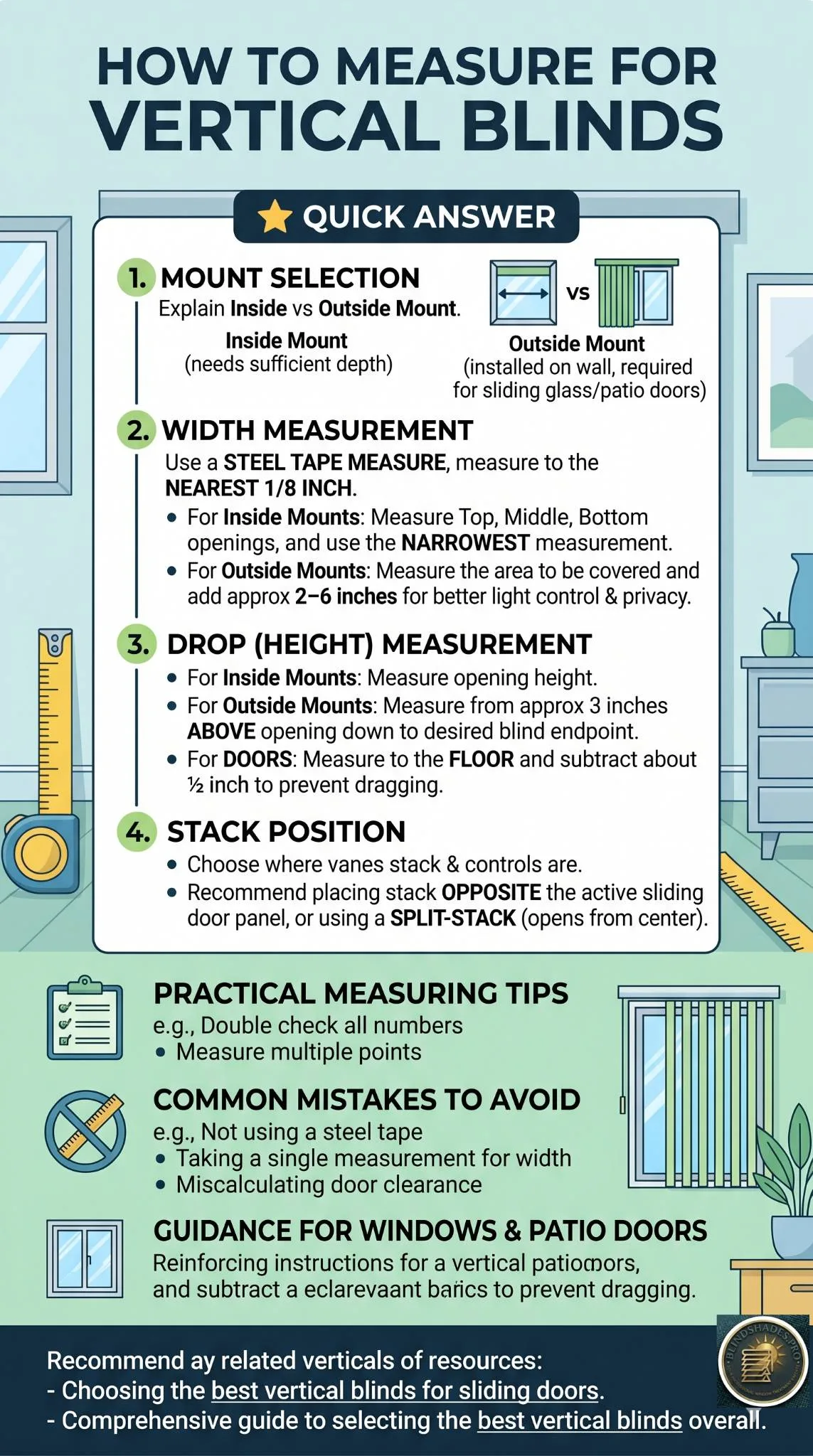
Authored by Michael Turner — 30 Years of Home Improvement Expertise | BlindShades.pro
To measure for vertical blinds, work through four things in order: the mount, the width, the drop, and the stack. First decide on an inside mount (inside the window recess, which needs enough frame depth) or an outside mount (on the wall, the standard choice for sliding and patio doors). Measure the width at three points and the drop with a steel tape to the nearest one-eighth inch, adding 2 to 6 inches of overlap for an outside mount. Then plan which way the vanes will stack and on which side the controls sit. Get those four right and your blinds fit cleanly and operate smoothly, especially on the wide doors verticals are made for. This guide covers each step, with a dedicated section for sliding doors.
Key Takeaways
- Decide the mount first, because everything else follows from it. An inside mount sits in the recess and needs sufficient depth; an outside mount fixes to the wall and is the standard for sliding and patio doors. Inside mounts do not work on doors at all.
- Inside and outside mounts use opposite width rules. For an inside mount, measure three points and submit the narrowest width; for an outside mount, measure the area to cover and add 2 to 6 inches of overlap. Mixing these up is the most common ordering error.
- The stack eats part of your window, so plan for it. When the vanes gather to one side, that stack covers a band of glass. A 3.5-inch vane stacks roughly 7 to 8 inches on a 40-inch window and 25 to 30 inches on a very wide one, so position the stack where it matters least.
- Know who takes the deductions. On an inside mount, you submit the exact opening and the factory deducts for clearance; on an outside mount, no deductions are taken and the blind is made to your exact numbers. Confusing these ruins the fit.
- For doors, subtract about half an inch at the floor and add hold-down brackets. Vanes should hover just above the floor to avoid dragging, and hold-down brackets stop the bottom swaying when the door is used.
⭐ Quick Answer
Learning how to measure for vertical blinds means working through four things in order: the mount, the width, the drop, and the stack.
- Mount first: inside the recess (needs enough depth) or outside on the wall — the standard for sliding and patio doors, since Lowe’s notes inside mounts will not work on doors.
- Width: use a steel tape to the nearest one-eighth inch. Inside mount, measure top, middle, and bottom and use the narrowest, as Blinds.com advises; outside mount, add 2 to 6 inches of overlap.
- Drop: outside mount, measure from about 3 inches above the opening down to where the vanes end; on a door, measure to the floor and subtract about half an inch so they do not drag.
- Stack: the gathered vanes cover glass, so plan their side. A 3.5-inch vane stacks roughly 7 to 8 inches on a 40-inch window, per 3 Day Blinds; set it opposite the active door panel.
- Submit the right numbers: inside mount, the factory deducts; outside mount, give the exact finished size. Then choose the blind in our best vertical blinds guide or, for doors, best vertical blinds for sliding doors. Replacing vanes only? See how to fix vertical blind vanes.
Before You Start: Tools and Ground Rules
A few habits prevent almost every measuring mistake.
Gather a steel tape measure (never cloth or plastic, which stretch), a pencil, and a notepad, plus a step ladder for tall windows. Then follow four rules that apply to every measurement: always use a steel tape and record to the nearest one-eighth inch; always measure each window individually, even if they look identical; always write width first, then height, in the standard width by height (W x H) format; and always measure the bare opening, not an existing blind. With those in place, work through the four steps below.
Step 1: Inside or Outside Mount?
Decide where the blind sits first, because it changes every measurement that follows.
Your first decision is whether the blind mounts inside the window recess or outside on the wall. Each suits different situations:
| Factor | Inside mount | Outside mount |
|---|---|---|
| Where it sits | Inside the window recess | On the wall above and around the opening |
| Depth needed | Yes, must meet the product minimum | No |
| Works on doors | No | Yes, the standard for sliding and patio doors |
| Look | Clean, built-in | Larger, covers more, hides an off-square opening |
| Light gaps | Larger gaps at the sides | Smaller, overlap blocks more light |
| Deductions | Factory deducts for clearance | None, made to exact size |
To check whether an inside mount is even possible, measure the recess depth from the front of the opening back to the glass and compare it to the minimum depth listed for your chosen blind. If the recess is too shallow, you must outside mount or choose another treatment. Because vertical blinds are so often used on sliding doors, where there is no recess to mount in, the outside mount is the more common choice.
Step 2: How to Measure the Width
The width rule flips depending on your mount, so use the right one.
For an inside mount, measure the width inside the recess at three heights, the top, middle, and bottom, because windows are rarely perfectly square. Record the narrowest of the three as your width so the blind clears the sides; some retailers have you submit that exact figure for the factory to deduct from, while others suggest subtracting about a quarter inch yourself for a snug fit, so follow your supplier’s instruction.
For an outside mount, measure the width of the area you want to cover, then add overlap so the vanes clear the glass and block side light: 2 to 3 inches on each side is typical, and up to 4 inches each side (8 inches total) gives maximum light control. If the window has trim, you can measure from the outer edge of the trim on each side instead.
Step 3: How to Measure the Drop (Height)
Measure the hanging length from where the headrail sits to where the vanes should end.
For an inside mount, measure the height of the opening at the left, center, and right, from the top of the recess to the sill, and follow your supplier’s rule on which figure to submit. Remember the total drop includes the headrail height plus a small gap above the vanes.
For an outside mount, decide where the top of the headrail will sit, usually about 3 inches above the opening to allow for the mounting brackets and to let the stack rise clear of the glass, then measure down to where you want the vanes to end. For a window, measuring to just below the sill maximizes coverage. For a sliding or patio door, measure all the way to the floor and then subtract about half an inch so the vanes hover just above it without dragging.
Step 4: Plan the Stack
The gathered vanes take up space and cover glass, so decide where they go before you order.
The stack is the band of gathered vanes when the blind is fully open, and it is the detail generic guides skip. It matters for two reasons: it covers part of the window, and you must choose which side it sits on. Use these approximate figures to picture how much space the stack takes:
| Window width | Approximate stack width (3.5-inch vanes) |
|---|---|
| 40 inches | About 7 to 8 inches |
| 80 inches | About 14 to 16 inches |
| 120 inches | About 20 to 24 inches |
| 160 inches | About 25 to 30 inches |
These are approximations that vary by vane and design. On an inside mount, that stack permanently covers a band of your glass when open, so factor it into how much view you keep. On an outside mount, you can mount wider so the stack parks on the wall beside the glass rather than over it. Then choose the stack and control direction: position the stack on the opposite side from the active panel of a sliding door so it never blocks your path, or away from nearby furniture, and consider a split-stack that divides to both sides for a centered, symmetrical opening on very wide spans.
How to Measure for Sliding and Patio Doors
The number-one use for vertical blinds, and it has its own rules.
Sliding and patio doors are where vertical blinds shine, and they are almost always an outside mount because there is no usable recess. To measure a slider:
- Width: measure the full width of the door opening, including any moulding, then add 2 to 6 inches of total overlap for privacy and to block side light. If measuring from outside the moulding, work edge to edge.
- Height: if there is moulding, measure from the floor to about 2 inches above the moulding; with no moulding, measure from the floor to about 2 inches above the opening. Then subtract about half an inch at the floor so the vanes clear it.
- Stack side: set the stack to gather on the opposite side from the door panel you slide open, so the blind never blocks the doorway.
- Hold-down brackets: on a door, fit hold-down brackets at the bottom to stop the vanes swaying each time the door is used.
If you want two blinds on one wide slider, measure each one from the outer moulding to the center of the door and add 1 to 3 inches per blind for overlap, ordering both as outside mounts.
What Measurements Do You Submit?
Submit the right numbers for your mount, and know who applies the deductions.
This is where costly reorders happen, so be clear on it:
| Mount | What you submit | Who deducts |
|---|---|---|
| Inside mount | The exact recess opening (or narrowest width per supplier) | The factory deducts for clearance |
| Outside mount | The full size you want the blind to be, including overlap | No one, it is made to your exact size |
The rule to remember: an inside-mount order is the opening size and the factory makes the blind slightly smaller to fit; an outside-mount order is the finished size and the factory makes exactly what you ask. Never apply your own deductions to an outside-mount order, or the blind will come up short. When in doubt, confirm the deduction policy with your supplier before ordering.
Common Measuring Mistakes to Avoid
Most fit problems trace back to the same handful of errors.
| Mistake | Consequence | Fix |
|---|---|---|
| Using a cloth or plastic tape | Stretches, gives wrong sizes | Use a steel tape |
| Ignoring recess depth on an inside mount | Blind will not fit in the recess | Check depth against the product minimum first |
| Forgetting the stack width | Stack blocks view or doorway | Plan stack side and width before ordering |
| Mixing up width and height | Wrong-shaped blind ordered | Always label W x H and double-check |
| Deducting on an outside mount | Blind comes up too short | Submit the exact finished size |
| Not checking for handles or trim | Headrail or vanes catch on obstructions | Measure around obstacles; use spacer or extension brackets |
| Measuring an existing blind | Inherits old errors | Always measure the bare opening |
How to Measure for Replacement Vanes
Replacing vanes on a blind you keep needs just one measurement.
If you are not buying a whole new blind but replacing worn or torn vanes on an existing one, you only need the vane length: measure from the top of the headrail to the bottom of the existing vane and order replacements to that drop, matching the vane width (commonly 3.5 inches) and material. For how to swap them in without cracking the clips, see how to fix vertical blind vanes.
What to Do With Your Measurements
Measuring is the bridge to buying — now choose the blind.
With accurate width, drop, mount, and stack decided, you are ready to order. Choose the material and style that suit the room and use in our best vertical blinds guide, and if the window is a sliding or patio door, our best vertical blinds for sliding doors guide narrows it further. If your window is wide, remember that blinds over about 4 feet need extra mounting support, as covered in vertical blinds won’t open or close. And if a precise fit feels daunting, many retailers offer free professional measuring to guarantee it.
Best Sources
- Blinds.com — on the narrowest-width rule for inside mounts, overlap for outside mounts, spacer and extension brackets for obstructions, and measuring replacement vanes.
- 3 Day Blinds — on stack-width figures by window size, the common measuring mistakes, and free professional measuring.
- Lowe’s — on inside mounts not working on doors, adding up to 8 inches total overlap for light control, hold-down brackets, and French-door measuring.
- Ambiance Window Coverings — on checking recess depth, and measuring sliding-door height to the floor.
- Blinds Chalet — on outside-mounting sliders, adding 2 inches above the moulding, and fitting two blinds on one wide door.
- Pugerudes — on subtracting a quarter inch for a snug inside mount, half an inch for floor clearance, and choosing the control side around furniture.
Related Guides
- Best Vertical Blinds Buying Guide
- Best Vertical Blinds for Sliding Doors
- How to Fix Vertical Blind Vanes
- Vertical Blinds Won’t Open or Close
Frequently Asked Questions
How do you measure for vertical blinds on a sliding glass door?
For a sliding glass door, use an outside mount. Measure the full width of the door opening including any moulding and add 2 to 6 inches of total overlap for privacy and light control. For height, measure from the floor to about 2 inches above the moulding or opening, then subtract about half an inch so the vanes clear the floor. Set the stack to gather on the opposite side from the panel you slide open, and add hold-down brackets at the bottom.
Should vertical blinds be inside or outside mount?
Choose an inside mount for a clean, built-in look on a window with enough recess depth to meet the product minimum. Choose an outside mount when the recess is too shallow, the opening is out of square, you want maximum light control, or, most commonly, you are covering a sliding or patio door, since inside mounts do not work on doors. Outside mounts also let the stack park on the wall rather than over the glass.
How much should I add for an outside-mount vertical blind?
For an outside mount, add overlap so the vanes clear the glass and block side light. Two to three inches on each side is typical, and up to four inches each side, eight inches total, gives maximum light control and privacy. Add height too, mounting the headrail about three inches above the opening so the stack rises clear of the glass. Submit these as the exact finished size, since no deductions are taken on outside mounts.
How do you account for the stack on vertical blinds?
The stack is the band of gathered vanes when the blind is open, and it covers part of the window. A 3.5-inch vane stacks roughly 7 to 8 inches on a 40-inch window and 25 to 30 inches on a very wide one. On an inside mount, that stack permanently covers some glass, so factor it into your view. On an outside mount, mount wider so the stack sits on the wall beside the glass, and position it on the opposite side from the active door panel.
What measurements do I submit when ordering vertical blinds?
It depends on the mount. For an inside mount, submit the exact recess opening (or the narrowest width per your supplier), and the factory will deduct slightly for clearance. For an outside mount, submit the full finished size you want, including your overlap, and no deductions are taken. Never apply your own deductions to an outside-mount order, or the blind will come up short. Always list width before height.
