Fabric vs PVC Vertical Blinds: Which Should You Choose?

Authored By Michael Turner -30 Years Home Improvement Expertise | Updated 2026 | BlindShades.pro
Updated on July 10, 2026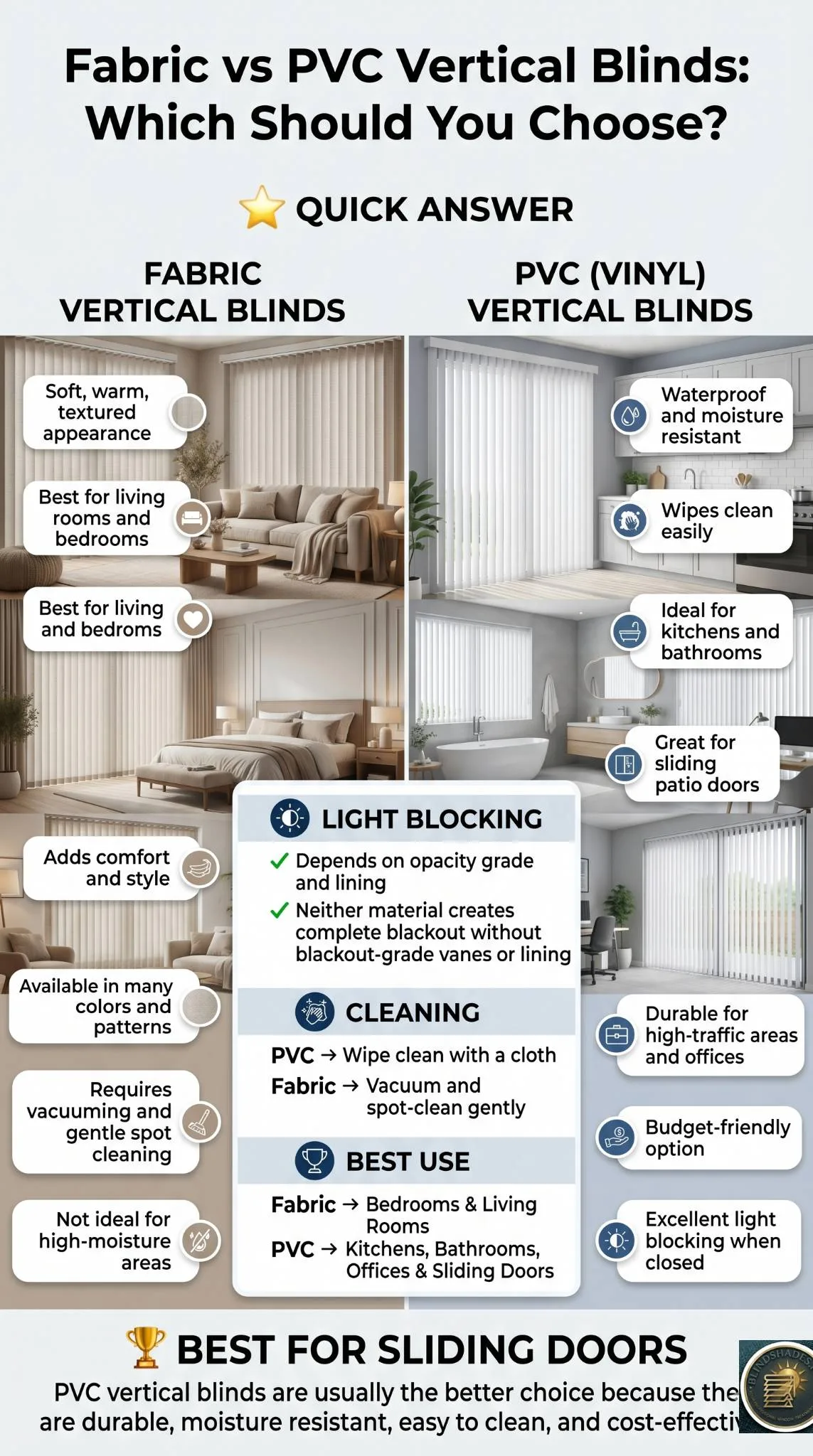
Authored by Michael Turner — 30 Years of Home Improvement Expertise | BlindShades.pro
The choice between fabric and PVC vertical blinds comes down to style versus practicality. PVC vanes, also sold as vinyl, are the practical pick: waterproof, wipe-clean, durable, budget-friendly, and the better choice for kitchens, bathrooms, sliding doors, and high-traffic or commercial spaces. Fabric vanes, made of polyester, are the stylish pick: soft, warm, textured, and available in more patterns, suited to living rooms and bedrooms where appearance matters more than moisture resistance. Neither fully blacks out a room, both have real aging weaknesses, and the line blurs once you factor in moisture-resistant fabrics and softer PVC grades. This guide compares them honestly across look, light, moisture, cleaning, cost, and durability.
Key Takeaways
- PVC and vinyl are the same material. Vinyl vanes are made of PVC (polyvinyl chloride), so the real choice is PVC/vinyl versus fabric (polyester), not three separate options. Different sellers simply use the words PVC and vinyl interchangeably.
- PVC wins on practicality; fabric wins on style. PVC is waterproof, wipe-clean, durable, and cheaper, making it the better all-round and wet-room choice. Fabric is softer, warmer, and more decorative, making it better for style-led living rooms and bedrooms.
- Neither fully blacks out, and claims that fabric blocks far more heat are marketing. How much light or heat a vane blocks depends on its opacity grade and any lining, not simply whether it is fabric or PVC. Rigid PVC with curved vanes can actually close tighter for better darkness.
- Both age, just differently. PVC can yellow, warp, or buckle under prolonged sun, losing its flush fit, while fabric fades, stains, and absorbs odours over time. Choose with the room’s light and use in mind.
- The choice is not strictly binary. Moisture-resistant fabrics and softer PVC grades exist, so you can get a fabric that tolerates some damp or a PVC that feels less stiff.
⭐ Quick Answer
The fabric vs PVC vertical blinds choice is practicality versus style — and note that PVC and vinyl are the same material, so the real split is plastic versus polyester.
- Choose PVC (vinyl) for kitchens, bathrooms, sliding doors, offices, and tight budgets: it is waterproof, wipes clean, durable, and cheaper, as Shade Love notes.
- Choose fabric (polyester) for living rooms and bedrooms where you want a soft, warm, textured look and do not need moisture resistance.
- On light blocking, it depends on the opacity grade and any lining, not just the material, and Unbeatable Blinds notes rigid PVC closes tighter while fabric diffuses — neither fully blacks out alone.
- Both age differently: PVC can yellow or warp in sun, while fabric fades and stains, a trade-off Home Fair Blinds covers. Cleaning each differs too — see how to clean vertical blinds.
- For sliding doors, PVC usually wins; see best vertical blinds for sliding doors, or compare every material in our best vertical blinds guide.
PVC, Vinyl, or Fabric — What’s the Difference?
PVC and vinyl are the same thing; the real choice is plastic versus polyester.
Before comparing, clear up the terms, because sellers use them loosely. PVC stands for polyvinyl chloride, a rigid synthetic plastic, and vinyl vanes are made from exactly that, so PVC and vinyl vertical blinds are the same material under two names. Fabric vanes, by contrast, are made from woven or non-woven polyester. So the genuine decision is PVC/vinyl versus fabric, not three competing options. You may also see “rigid PVC” and “soft PVC,” which simply describe how stiff the plastic is, and “moisture-resistant fabric,” a polyester treated to tolerate some damp. With the terms settled, here is how the two compare.
Fabric vs PVC Vertical Blinds at a Glance
The quick verdict before the detail.
| Category | Winner | Why |
|---|---|---|
| Moisture resistance | PVC | Waterproof, will not warp or mould |
| Easy cleaning | PVC | Wipes clean with a damp cloth |
| Durability and cost | PVC | Cheaper and tougher in high-traffic spots |
| Soft, warm look | Fabric | Textured, drapery-like, more patterns |
| Quiet operation | Fabric | Does not clatter like rigid PVC |
| Light diffusion | Fabric | Softens and diffuses incoming light |
| Holding its shape | Fabric | Flexes rather than warping over time |
PVC takes the practical categories; fabric takes the aesthetic and comfort ones. The rest of this guide explains each.
Which Looks Better?
PVC is sleek and modern; fabric is soft and warm — this one is down to taste.
PVC vanes are solid, structured, and crisp, giving a sleek, minimalist, contemporary look, usually in solid colors for a clean, uniform appearance. Fabric vanes are softer and more textured, available in a wider range of patterns, colors, and weaves, lending a warm, elegant, drapery-like feel that reads as more homely. Neither is objectively better looking; PVC suits modern, functional, and commercial spaces, while fabric suits style-led rooms where you want texture and warmth.
Which Controls Light and Privacy Better?
It depends on the opacity grade, not simply the material — and no vertical blind fully blacks out.
This is where you should be skeptical of marketing. Some sources claim fabric blocks far more heat and UV than PVC, or vice versa, as if the material alone decides it. In reality, how much light and heat a vane blocks depends mainly on its opacity grade and any backing or lining, not just whether it is fabric or PVC. That said, a few honest generalizations hold: rigid PVC vanes, especially curved or S-shaped ones, tend to close tightly for stronger room-darkening and privacy, while fabric vanes diffuse incoming light for a softer, glare-reducing ambience and may need a blackout lining for full darkness. Crucially, neither material fully blacks out a window on its own, because of the small gaps between vanes; for total darkness, choose a blackout grade, add a lining, or pair with drapery.
Which Is Better for Moisture and Different Rooms?
PVC for wet and busy rooms; fabric for dry, style-led ones.
Moisture is the clearest dividing line. PVC is waterproof and will not warp, stain, or grow mould, making it the obvious choice for kitchens, bathrooms, and humid or condensation-prone rooms, as well as high-traffic doors. Fabric absorbs moisture and can stain, hold odours, or grow mildew in damp rooms, so plain polyester is better kept to dry spaces. Here is the room-by-room guide:
| Room or use | Better choice |
|---|---|
| Kitchen | PVC (grease and steam wipe off) |
| Bathroom | PVC (humidity and mildew resistance) |
| Bedroom | Fabric, or PVC if you want darker room-darkening |
| Living room | Fabric (soft, textured look) |
| Sliding or patio door | PVC (durable, high-traffic) |
| Office or commercial | PVC (low maintenance, hard-wearing) |
| Nursery or low-traffic | Fabric (soft look, cordless for safety) |
For the dedicated door comparison, see best vertical blinds for sliding doors.
Which Is Easier to Clean?
PVC is far lower-maintenance; fabric needs more care.
PVC is the easy winner here. Its hard, non-porous surface does not attract dust and wipes clean with a damp cloth, which makes it ideal for busy households, pet owners, allergy sufferers, and commercial spaces. Fabric collects more dust and can stain, so it needs regular vacuuming with a brush attachment, gentle spot-cleaning, and occasionally professional cleaning for deep stains, and it must never be soaked, which ruins its shape and coating. The full method for each material is in how to clean vertical blinds.
Cost, Durability, and How Each Ages
PVC is cheaper and tougher, but both wear in their own way.
PVC is generally the more budget-friendly option, while fabric tends to cost more because of the material and the wider range of finishes and customization. On durability, PVC is harder-wearing and moisture-proof, while fabric is more delicate and wears faster in high-traffic homes. But neither is immortal, and they age differently:
| Material | How it ages | Watch for |
|---|---|---|
| PVC / vinyl | Can yellow, warp, or buckle under prolonged direct sun, losing its flush fit | Sun-facing windows; choose UV-stabilized vinyl |
| Fabric | Fades, stains, and can absorb odours over time | High-traffic rooms; sun fading on bright windows |
The honest summary: PVC outlasts fabric in moisture and impact terms but can discolor and distort on a very sunny window, whereas fabric keeps its shape and flush fit better thanks to its woven give but fades and soils sooner. On a sun-drenched window, UV-stabilized vinyl resists yellowing better than cheap PVC.
What About Noise and Weight?
Rigid PVC can clatter; fabric hangs quieter — but weight cuts both ways.
PVC vanes are stiffer and heavier, which helps them hang straight and resist a breeze, but they can clatter against each other and, being heavy, put more stress on the carrier stems that hold them, a common failure point covered in how to fix vertical blind vanes. Fabric vanes are lighter and quieter, flexing with the wind rather than knocking, though very light fabric can flap unless weighted at the hem. If quiet operation by a frequently used door matters to you, weighted fabric or S-shaped vanes are the calmer choice.
The Middle Ground: Moisture-Resistant Fabric and Soft PVC
You do not always have to choose between practical and pretty.
The fabric-versus-PVC split is not as rigid as it sounds. Moisture-resistant and PVC-coated fabric vanes exist that tolerate more humidity than plain polyester, letting you get a softer look in a slightly damp room. And softer PVC grades feel less stiff and clattery than rigid PVC while keeping the wipe-clean benefit. There are even fabric vanes inserted into vinyl carriers that combine a fabric face with vinyl backing for extra light blocking and a neutral exterior. If you like the look of fabric but worry about upkeep, ask about these hybrid and treated options before defaulting to plain PVC.
Full Comparison: Fabric vs PVC Vertical Blinds
Every axis side by side.
| Attribute | Fabric (polyester) | PVC / vinyl |
|---|---|---|
| Look | Soft, warm, textured, more patterns | Sleek, crisp, modern, solid colors |
| Light control | Diffuses light, softer | Closes tighter, better darkening |
| Moisture | Absorbs, not for wet rooms | Waterproof, ideal for wet rooms |
| Cleaning | Vacuum and spot-clean | Wipe with a damp cloth |
| Cost | Generally higher | Generally lower |
| Durability | More delicate, wears faster | Tougher, moisture-proof |
| Ageing | Fades, stains, holds shape | Can yellow and warp, keeps color |
| Noise | Quiet, especially weighted | Can clatter |
| Weight | Lighter, flexes with wind | Heavier, hangs straight |
| Best for | Living rooms, bedrooms, style | Kitchens, baths, doors, commercial |
Which Should You Choose?
Match the material to the room and what you value most.
Choose PVC (vinyl) if you want practicality: a waterproof, wipe-clean, durable, affordable vane for a kitchen, bathroom, sliding door, office, rental, or any high-traffic or humid space, or if you want stronger room-darkening. Choose fabric (polyester) if you want style: a soft, warm, textured, patterned vane for a living room or bedroom where appearance matters more than moisture resistance, and you do not mind the extra upkeep. If you are torn, look at moisture-resistant fabrics or fabric-in-vinyl vanes for a middle path. To compare every material and pick a brand, see our best vertical blinds guide, weigh other styles in alternatives to vertical blinds, or settle the dated-look question in are vertical blinds outdated.
Related guides: For complete buying advice, see our plastic and vinyl window covers guide.
Best Sources
- Shade Love — on fabric versus vinyl across style, maintenance, cost, and environmental factors.
- Unbeatable Blinds — on rigid PVC versus fabric, blackout and privacy, and moisture-resistant fabric and soft PVC options.
- Home Fair Blinds — on light diffusion versus light blocking, upkeep differences, and room suitability.
- Blinds To Go — on 3.5-inch vanes that rotate 180 degrees, room-by-room recommendations, and matching valances and stack direction.
- Love is Blinds (GA) — on PVC pros and cons, including yellowing under sun and environmental considerations.
Related Guides
- Best Vertical Blinds Buying Guide
- How to Clean Vertical Blinds
- Best Vertical Blinds for Sliding Doors
- Alternatives to Vertical Blinds
- Are Vertical Blinds Outdated?
Frequently Asked Questions
Are PVC and vinyl vertical blinds the same thing?
Yes. Vinyl vanes are made from PVC, which stands for polyvinyl chloride, so PVC and vinyl vertical blinds are the same material under two names that sellers use interchangeably. The real material choice is between PVC or vinyl, a rigid synthetic plastic, and fabric, which is woven or non-woven polyester. You may also see rigid PVC and soft PVC, which just describe how stiff the plastic is.
Are fabric or PVC vertical blinds better for blocking light?
It depends more on the vane’s opacity grade and any lining than on the material itself, and neither fully blacks out a window because of the gaps between vanes. As a generalization, rigid PVC vanes, especially curved S-shaped ones, close tightly for stronger room-darkening, while fabric vanes diffuse light for a softer effect and may need a blackout lining for full darkness. For total darkness, choose a blackout grade or pair with curtains.
Which is better for a bathroom or kitchen, fabric or PVC vertical blinds?
PVC is much better for bathrooms and kitchens because it is waterproof, wipes clean of grease and steam, and resists the warping and mildew that affect fabric in humid rooms. Plain fabric vanes absorb moisture and can stain or grow mildew in damp spaces, so they are better kept to dry rooms. If you want a softer look in a slightly damp room, look for moisture-resistant fabric vanes instead.
Do PVC vertical blinds turn yellow?
PVC vertical blinds can yellow, fade, or warp over time under prolonged direct sunlight, especially cheaper grades, which can also lose their flush fit as the plastic distorts. UV-stabilized vinyl resists this much better and is worth choosing for sun-facing windows and patio doors. Fabric vanes do not yellow in the same way but fade and can stain over time, so both materials age, just differently.
Are fabric or PVC vertical blinds cheaper?
PVC vertical blinds are generally the cheaper option, which is part of why they are popular for large windows, rentals, and budget-conscious projects. Fabric vertical blinds usually cost more because of the material and the wider range of textures, patterns, and customization. Prices vary widely by size, brand, and finish, so compare current quotes rather than relying on a fixed figure.
