




Vertical Blinds vs Panel Track Blinds: Which Is Better?

Authored By Michael Turner -30 Years Home Improvement Expertise | Updated 2026 | BlindShades.pro
Updated on June 24, 2026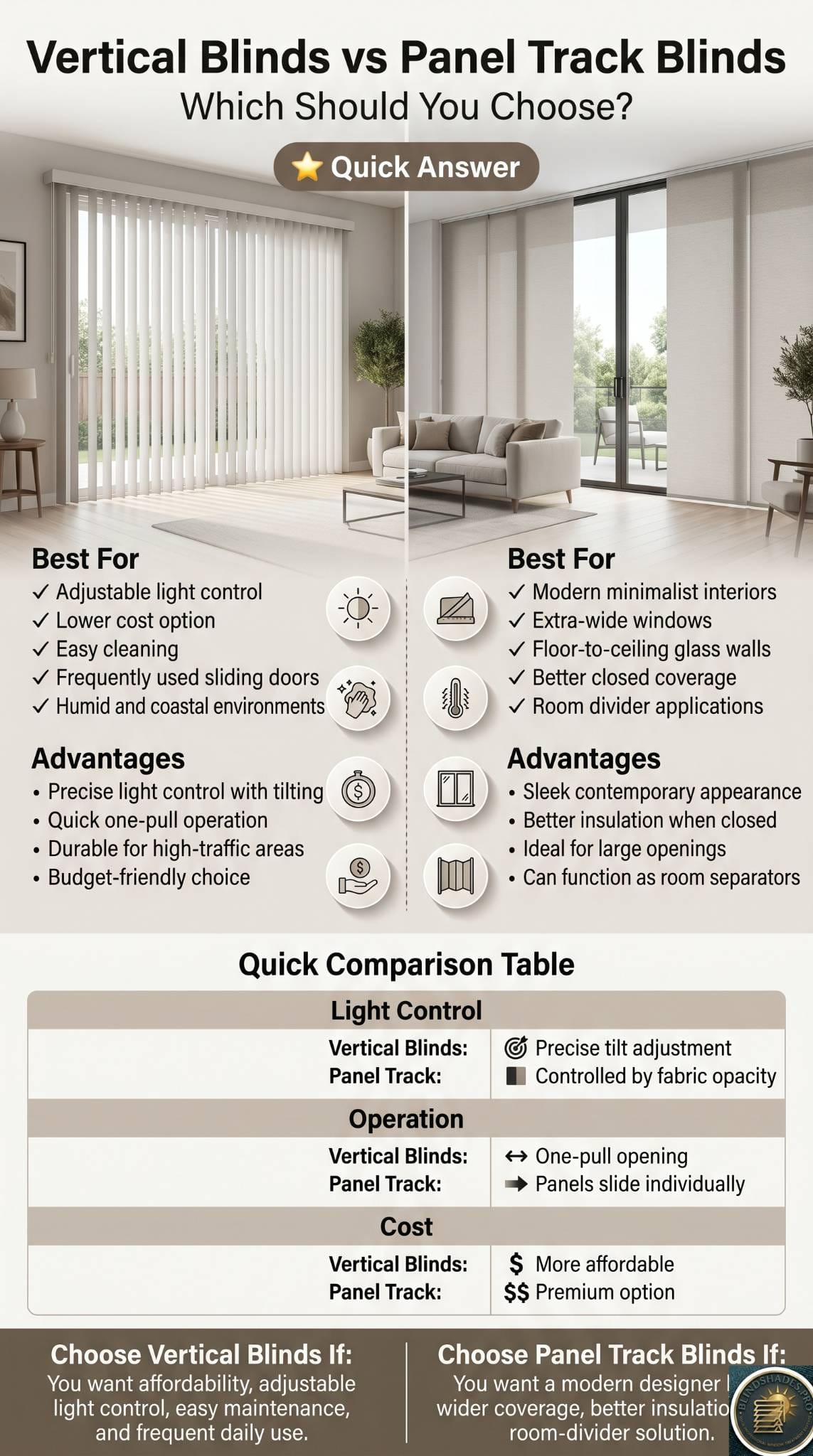
Authored by Michael Turner — 30 Years of Home Improvement Expertise | BlindShades.pro
The choice between vertical blinds and panel track blinds comes down to one question: do you want to tilt for light, or just slide open and closed? Vertical blinds use narrow slats that both rotate for precise light control and slide aside for access, and they are cheaper, easier to clean, and quicker to open on a door you use constantly. Panel track blinds use wide fabric panels that only slide, giving a sleek, modern, gallery-like look, better full-closed coverage, and a system that doubles as a room divider, at a higher price. Vertical blinds win on flexibility, value, and high-traffic doors; panel track wins on modern style, very wide windows, and rooms where you want a clean, contemporary statement. This guide compares them across every factor.
Key Takeaways
- The core difference is tilt versus slide. Vertical blinds rotate their slats for adjustable light and also slide aside; panel track blinds only slide open or closed, so their light control depends entirely on the fabric opacity you choose.
- Vertical blinds are quicker on a door you use often. One pull stacks all the slats aside instantly, while panel track panels must be slid one after another to clear the opening, which makes verticals better for high-traffic patio doors and panel track better for occasional-access, statement doors.
- Panel track looks more modern; vertical blinds are more versatile and cheaper. Wide fabric panels give a clean, contemporary, gallery-like finish, while vertical blinds offer more precise light control, easier cleaning, and a noticeably lower price.
- Climate can decide it. In humid or coastal homes, vertical slats let air and moisture escape and resist salt corrosion better, while panel track’s large fabric panels can trap humidity; for insulation on big glass, panel track seals tighter.
- Panel track doubles as a room divider. Beyond covering windows, panel track can partition open-plan spaces, a job vertical blinds cannot do.
⭐ Quick Answer
The vertical blinds vs panel track blinds choice comes down to one question: do you want to tilt for light, or just slide open and closed?
- Core difference: vertical slats both tilt for adjustable light and slide aside (two controls); panel track panels only slide (one control), as Blinds Chalet explains.
- Choose vertical blinds for adjustable light control, lower cost, easy cleaning, humid or coastal rooms, and high-traffic doors — one pull stacks every slat aside instantly.
- Choose panel track for a sleek modern look, very wide windows, better full-closed coverage and insulation, and double duty as a room divider, a strength Boca Blinds notes for big glass.
- Door access: vertical opens in one pull, while panel track must be slid panel by panel — so 1 Click Blinds recommends vertical for doors you use often.
- Cost: vertical is the budget pick; panel track is premium. For door picks see best vertical blinds for sliding doors, the wider field in alternatives to vertical blinds, or compare brands in our best vertical blinds guide.
The Core Difference: Tilt vs Slide
Vertical blinds give you two controls; panel track gives you one.
Strip away the marketing and the entire decision rests on one mechanical difference. Vertical blinds have narrow slats, around 3.5 inches wide, that hang from a headrail and do two things: they rotate on their axis to tilt open or closed for light and privacy, and they slide to one side to clear the opening. Panel track blinds use wide fabric panels, often around 18 to 24 inches across, that do just one thing: they slide along a track to open or close. They do not tilt, so a panel track is either open or closed, and how much light it lets through when closed depends entirely on the fabric opacity you choose. So the first question to ask yourself is simple: do you want to fine-tune light with a tilt, or are you happy with open-or-closed plus your choice of fabric?
At a Glance: Which Wins Each Category?
The honest scorecard before the detail.
| Category | Winner | Why |
|---|---|---|
| Light-control flexibility | Vertical | Slats tilt for precise adjustment |
| Full-closed coverage | Panel track | Solid panels, no slat gaps |
| Modern look | Panel track | Sleek, gallery-like fabric panels |
| Quick door access | Vertical | One pull stacks all slats |
| Quiet operation | Panel track | Glides smoothly, no clatter |
| Cost and value | Vertical | More affordable |
| Easy cleaning | Vertical | Wipe-clean PVC slats |
| Humid / coastal durability | Vertical | Slats let moisture escape |
| Insulation | Panel track | Covers more glass, seals tighter |
| Room divider | Panel track | Partitions open-plan spaces |
Vertical blinds take the practical and budget categories; panel track takes the modern-style and big-glass categories. The sections below explain each.
Which Has Better Light Control and Privacy?
Vertical wins on adjustability; panel track wins on full-closed darkness.
Because vertical slats tilt, they give you precise, all-day light control: angle them to filter sunlight while keeping a view, or close them for privacy, without ever fully opening the blind. Panel track cannot tilt, so it offers full light or full privacy and nothing in between except partially sliding a panel aside, with its closed-state darkness depending on whether you chose a light-filtering or blackout fabric. The trade-off: vertical blinds show tiny gaps between slats when tilted closed, while solid panel track fabric closes seamlessly for slightly better full coverage. Neither fully blacks out a large opening on its own; for total darkness choose a blackout fabric or pair with drapery.
Which Is Easier to Operate on a Door You Use Often?
Vertical blinds open in one pull; panel track must be slid panel by panel.
This is the most underrated practical difference. A vertical blind opens with a single pull of the wand or chain that stacks all the slats neatly to one side in seconds, giving instant, one-handed door access, which matters when you are carrying groceries, letting the dog out, or supervising children in the yard. A panel track must have its panels slid across one after another to fully clear the opening, which is more deliberate and slower. So for a patio door used many times a day, vertical blinds are the more convenient choice; for a door that mostly serves as a window with occasional access, panel track’s slower operation is no real drawback and its looks may win out. Panel track does glide more quietly, while older or vinyl vertical slats can clatter in a breeze.
How Much Glass Does Each Cover When Open?
Vertical blinds stack more compactly; panel track takes more space open.
When fully opened, vertical slats stack tightly to one side, clearing most of the glass for the view. Panel track panels are much wider, so even stacked behind one another they take up more space and cover more of the glass when open. On a window where you want the maximum unobstructed view, vertical blinds give it back more completely. Both can be ordered to split-stack, opening from the center to both sides, and both need their stack space planned at the measuring stage, covered in how to measure for vertical blinds.
Which Looks Better?
Panel track reads modern; vertical blinds have shed their dated reputation.
Panel track’s wide fabric panels create a clean, contemporary, gallery-like look that suits modern and minimalist interiors, which is its biggest draw. Vertical blinds once carried an “office-like” reputation, but today’s options in warm wood tones, soft fabrics, bamboo textures, and sheer styles have moved well beyond the plastic strips of the past, and they suit traditional and transitional spaces well. If you are weighing whether vertical blinds still look current, the full discussion is in are vertical blinds outdated. In short, panel track is the safer pick for a strictly modern aesthetic, while modern vertical blinds are far more stylish than their reputation suggests.
Which Holds Up Better in Humidity, and Which Insulates Better?
Vertical blinds win in humid and coastal rooms; panel track insulates big glass better.
Climate can tip the decision. In humid, steamy, or coastal homes, vertical blinds in PVC or aluminum hold up better, because the gaps between slats let air and moisture escape rather than trapping it, and the hard surfaces resist salt corrosion and wipe clean of mildew. Panel track’s large fabric panels offer more surface for humidity and salt to collect and generally need occasional professional cleaning. On the other hand, for insulation on a big glass door or wall, panel track tends to seal tighter and cover more glass continuously, reducing heat transfer, whereas vertical slats leak more air. So choose vertical for a bathroom, kitchen, or coastal room, and lean panel track where winter insulation on expansive glass is the priority. For cleaning either, see how to clean vertical blinds.
Which Is Safer to Operate and Easier to Repair?
Panel track has fewer dangling parts; vertical blinds are cheaper to repair piece by piece.
For homes with children and pets, panel track has fewer dangling components and nothing to twist or tangle, making it a tidy, low-risk choice, though cordless and motorized versions of both remove cord hazards entirely. On repairs, vertical blinds have the edge in cost: a single damaged slat or carrier can be replaced cheaply without touching the rest of the blind, as covered in how to fix vertical blind vanes, whereas a damaged panel track panel is a larger, costlier replacement. Vertical slats can twist or tangle over time, but the fix is usually quick and inexpensive.
Can They Work as a Room Divider?
Only panel track can — a real point in its favor.
One job panel track does that vertical blinds cannot is act as a room divider. Because the wide panels glide on a track and stack neatly aside, panel track can partition open-plan spaces, screen a home office, separate a sleeping area in a studio, or define a dining zone, then retract completely when you want open flow. If you have an open-plan space as well as a wide window or door to dress, that dual purpose can be the deciding factor for panel track.
What About Cost?
Vertical blinds are the budget choice; panel track is the premium one.
Vertical blinds are generally the more affordable option and offer strong value, which is why they are popular for large openings, rentals, and budget-conscious projects. Panel track systems are usually positioned as a premium product, costing more but offering a higher-end, contemporary look that many homeowners treat as a design investment. Exact prices vary widely by size, material, fabric, and motorization, so compare current quotes for your specific opening rather than relying on a fixed figure.
Full Comparison: Vertical Blinds vs Panel Track Blinds
Every factor side by side.
| Factor | Vertical blinds | Panel track blinds |
|---|---|---|
| Mechanism | Slats tilt and slide | Wide panels slide only |
| Light control | Precise, adjustable tilt | Open or closed, fabric-dependent |
| Full-closed coverage | Small gaps between slats | Solid, seamless panels |
| Look | Traditional to transitional, now modern too | Sleek, contemporary, gallery-like |
| Door access | Instant, one pull | Slide panels in sequence |
| Operation noise | Can clatter (vinyl) | Quiet glide |
| Stack space when open | Compact | Wider, covers more glass |
| Humid / coastal | Holds up well | Fabric traps moisture |
| Insulation | Lower | Higher |
| Cleaning | Wipe-clean PVC | Dust, occasional pro clean |
| Repair | Replace one slat cheaply | Whole panel replacement |
| Room divider | No | Yes |
| Cost | More affordable | Premium |
Room-by-Room: Which Should You Choose?
Match the system to the room and how you use it.
| Room or use | Better choice |
|---|---|
| High-traffic patio door | Vertical (instant access) |
| Occasional-access statement door | Panel track (modern look) |
| Very wide or floor-to-ceiling window | Panel track (wide panels) |
| Kitchen or bathroom | Vertical (moisture-resistant PVC) |
| Bedroom | Vertical (tilt + blackout option) |
| Modern living room | Panel track (contemporary style) |
| Open-plan space needing division | Panel track (room divider) |
| Coastal or humid home | Vertical (air escapes, resists salt) |
| Tight budget or rental | Vertical (best value) |
In short, choose vertical blinds for flexibility, value, easy care, and doors you use constantly, and choose panel track for modern style, very wide windows, better insulation, and double duty as a room divider. If you want a softer, more decorative middle ground, sheer vertical shades blend a drapery look with vertical function, and vertical cellular shades add insulation, both covered in alternatives to vertical blinds. To compare the full range and brands, see our best vertical blinds guide.
Best Sources
- Blindsgalore — on the honest practical comparison, vertical blinds’ modular slat replacement, and panel track’s contemporary look.
- Vertical Vic’s — on category-by-category winners, including panel track’s quieter, smoother operation.
- Blinds Chalet — on vertical blinds offering more precise tilt-based light control versus panel track’s fabric-dependent opacity.
- 1 Click Blinds — on the door-access-frequency difference, sequential panel operation, room-divider use, and hybrid approaches.
- Boca Blinds — on vertical blinds holding up better in humid, coastal conditions and panel track’s tighter insulation.
- SunBlinds — on stack-back space, fewer dangling components for child and pet safety, and panel-track maintenance.
Related Guides
- Best Vertical Blinds Buying Guide
- Best Vertical Blinds for Sliding Doors
- Alternatives to Vertical Blinds
- How to Measure for Vertical Blinds
- Are Vertical Blinds Outdated?
Frequently Asked Questions
What is the difference between vertical blinds and panel track blinds?
The core difference is that vertical blinds have narrow slats that both tilt for light control and slide aside, while panel track blinds have wide fabric panels that only slide open or closed. That means vertical blinds let you fine-tune light by angling the slats, whereas a panel track is either open or closed, with its light control set by the fabric opacity you choose. Vertical blinds are also more affordable and easier to clean, while panel track looks more modern.
Are panel track blinds better than vertical blinds for sliding doors?
It depends on how you use the door. Panel track blinds give a sleeker, more modern look and better full-closed coverage, but they must be slid panel by panel to clear the doorway. Vertical blinds open in a single pull, stacking all the slats aside instantly, which is far more convenient on a door you use many times a day. For a high-traffic patio door choose vertical; for an occasional-access statement door, panel track’s looks may win.
Which is more expensive, vertical blinds or panel track blinds?
Panel track blinds are generally the more expensive, premium option, while vertical blinds are more affordable and offer strong value, which is why they are popular for large openings and rentals. Panel track’s higher cost buys a contemporary, gallery-like look that many treat as a design investment. Prices vary widely by size, fabric, material, and motorization, so compare current quotes for your specific window rather than a fixed figure.
Which is better for a humid or coastal home?
Vertical blinds usually hold up better in humid and coastal homes. The gaps between their slats let air and moisture escape rather than trapping it, and PVC or aluminum slats resist salt corrosion and wipe clean of mildew. Panel track’s large fabric panels offer more surface for humidity and salt to collect and often need occasional professional cleaning. For insulation on big glass, though, panel track seals tighter and reduces heat transfer better.
Can panel track blinds be used as a room divider?
Yes, and it is one of panel track’s standout advantages. Because the wide panels glide on a track and stack neatly to one side, panel track can partition open-plan spaces, screen a home office, separate a studio sleeping area, or define a dining zone, then retract completely for open flow. Vertical blinds cannot serve this dual purpose, so if you need both a window covering and a room divider, panel track is the clear choice.
