Aluminum vs Vinyl Mini Blinds

Authored By Michael Turner -30 Years Home Improvement Expertise | Updated 2026 | BlindShades.pro
Updated on June 26, 2026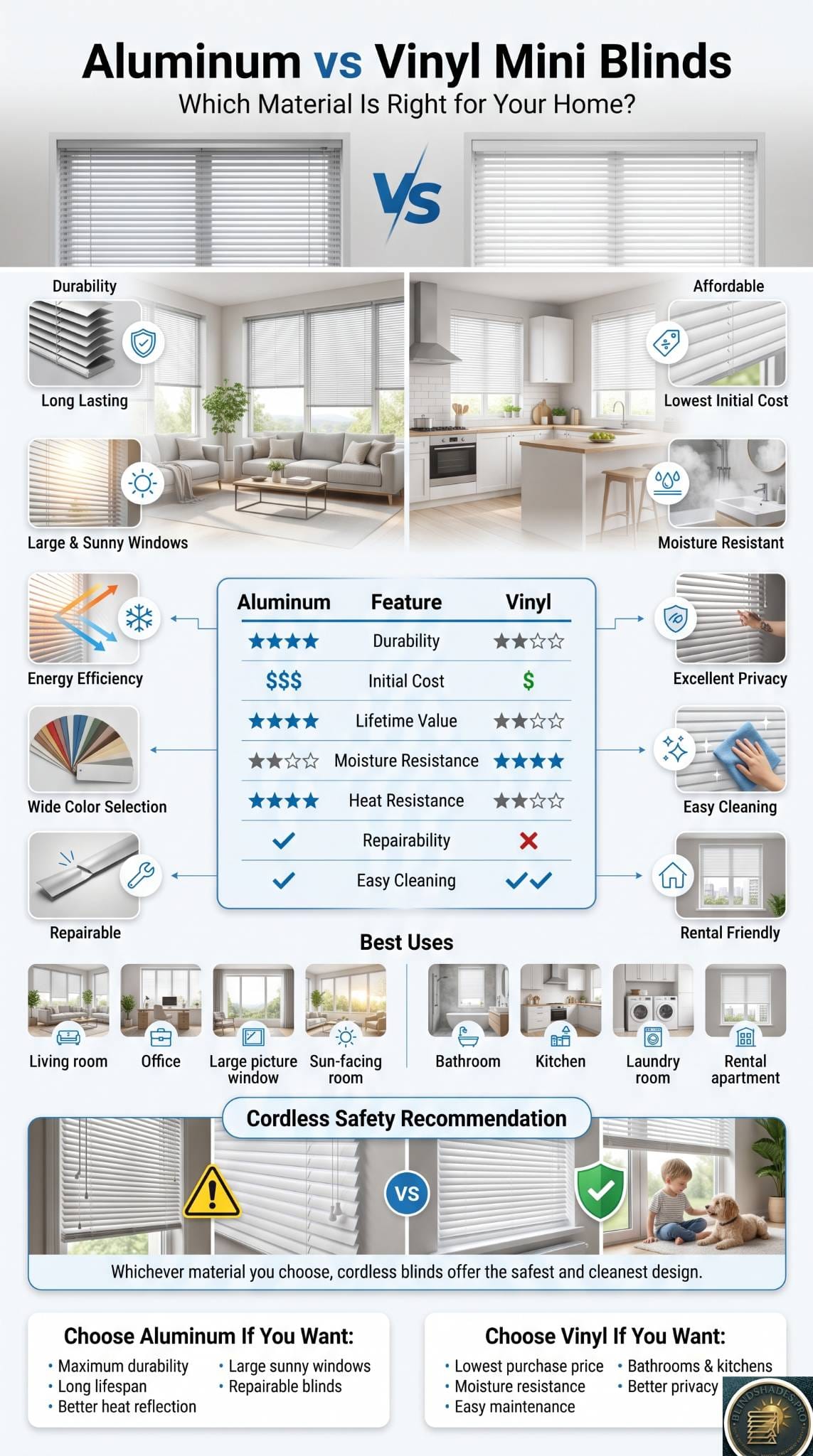
Authored by Michael Turner — 30 Years of Home Improvement Expertise | BlindShades.pro
The choice between aluminum and vinyl mini blinds comes down to strength versus versatility. Aluminum mini blinds are stronger, last longer, reflect heat for better energy efficiency, come in more colors, and can be repaired, making them the better long-term choice for sun-facing windows, large openings, and high-traffic rooms. Vinyl mini blinds are cheaper, resist moisture better, flex without denting, block light and noise more tightly, and are easier to clean, making them ideal for bathrooms, kitchens, rentals, and tight budgets. Aluminum costs more upfront but often less over its lifetime because it lasts roughly twice as long. This guide compares both across durability, cost, moisture, energy, light control, and more, with a clear winner for each room.
Key Takeaways
- Aluminum is the durability and longevity pick. It resists warping, reflects heat for lower summer bills, comes in the widest color range, and can be repaired, lasting many years longer than vinyl.
- Vinyl is the value and moisture pick. It costs less, excels in humid bathrooms and kitchens, flexes without denting, and is the easiest to clean, though it has a shorter lifespan.
- They fail in opposite ways. Aluminum bends and dents but rarely snaps, and a bend is often fixable; vinyl resists denting but eventually grows brittle and breaks, and a break usually means replacement.
- Vinyl actually seals tighter. Counter to expectations, flexible vinyl slats close more snugly than stiff aluminum, blocking light and dampening noise slightly better, while aluminum gives more precise tilt control.
- Think lifetime cost, not just sticker price. Vinyl is cheaper to buy, but aluminum’s longer life can make it the better long-term value, especially in demanding spots.
⭐ Quick Answer
The aluminum vs vinyl mini blinds choice comes down to strength versus versatility: aluminum for durability and longevity, vinyl for low cost and moisture resistance.
- Choose aluminum for durability, sun-facing and large windows, energy efficiency, a wider color range, and repairability, as House Digest notes it reflects heat.
- Choose vinyl for the lowest price, bathrooms and kitchens, rentals, and a tighter slat seal that blocks light and noise slightly better.
- They fail differently: aluminum bends or dents but is often fixable, while vinyl grows brittle and snaps and is usually replaced. See how to fix bent mini blind slats.
- Cost: vinyl is cheaper upfront, but aluminum can last roughly twice as long for a lower lifetime cost, as VelaBlinds explains.
- By room: vinyl wins bathrooms, aluminum wins sunny windows, per Blinds Chalet. Whichever you pick, choose cordless mini blinds for safety, or see the full range in our best mini blinds guide.
The Core Trade-Off: Strength vs Versatility
Aluminum brings structural strength; vinyl brings environmental versatility and value.
At first glance aluminum and vinyl mini blinds look almost identical, both offering slim 1-inch slats at an affordable price. The real difference is what each is good at. Aluminum is a metal, so it is inherently stronger, more stable in heat, and longer-lasting, which is why it suits demanding spots like sunny or large windows and busy rooms. Vinyl, a flexible PVC, trades some of that strength for lower cost, excellent moisture resistance, and a soft flexibility that resists denting, which is why it shines in bathrooms, kitchens, and budget-conscious projects. Neither is simply better; the right pick depends on the room and your priorities.
Aluminum vs Vinyl Mini Blinds: Full Comparison
Every factor side by side.
| Factor | Aluminum | Vinyl (PVC) |
|---|---|---|
| Strength | Stronger, resists snapping | Flexes, resists denting |
| Failure mode | Bends or dents | Grows brittle, snaps |
| Lifespan | Longer, often many years | Shorter |
| Upfront cost | Higher | Lower |
| Lifetime value | Often better | Good for short term |
| Moisture resistance | Good | Excellent |
| Heat and energy | Reflects heat, more efficient | Absorbs heat, can warp |
| Light and privacy | Slight gaps when closed | Tighter seal, more privacy |
| Noise | Lets in a little more | Dampens better |
| Color range | Widest, bold and gloss | Fewer colors, more textures |
| Style | Sleek, modern | Traditional, versatile |
| Maintenance | Needs more dusting | Easier, stain-resistant |
| Repairability | Repairable | Usually replaced |
| Best rooms | Sun-facing, large, high-traffic | Bathrooms, kitchens, rentals |
Durability: How Each One Fails
The key is not which is tougher, but how each gives way.
Both materials are durable, but they fail in opposite ways, and that difference matters more than raw toughness:
| Material | How it fails | Repairable? |
|---|---|---|
| Aluminum | Bends, dents, or creases | Yes, a bend can be straightened |
| Vinyl | Grows brittle and snaps | No, usually replaced |
Aluminum is stronger and less likely to break, but its slats can bend or dent under impact, and a sharp crease may be permanent. The upside is that a bent aluminum slat can often be straightened or swapped, as covered in how to fix bent mini blind slats. Vinyl resists denting thanks to its flexibility, but over years of sun it grows brittle and the slats snap, at which point most people simply replace the blind. So aluminum is the more repairable, longer-lived material, while vinyl trades repairability for flexibility and low cost.
Lifespan and Cost: Upfront vs Lifetime
Vinyl is cheaper to buy; aluminum can be cheaper to own.
The honest cost picture is not just the sticker price:
| Material | Upfront cost | Lifespan | Lifetime value |
|---|---|---|---|
| Vinyl | Lower | Shorter | Good for the short term |
| Aluminum | Higher | Longer | Often better over time |
Vinyl mini blinds are typically the more affordable option upfront, which makes them popular for rentals and for outfitting many windows at once. Aluminum costs more to buy, by a meaningful margin according to industry sources, but because it lasts considerably longer, often around twice as long, its lifetime cost can actually be lower, as VelaBlinds notes in its material analysis. So for a short-term need or a rental, vinyl is the sensible spend, while for a long-term home, aluminum’s longevity can make it the better value despite the higher upfront price.
Which Handles Moisture Better?
Vinyl is the bathroom and kitchen champion.
Both materials resist moisture, but vinyl handles humidity better. Vinyl PVC will not rust or corrode and shrugs off the steam of bathrooms and the splashes of kitchens without warping or growing mildew, which is exactly why it dominates those rooms. Aluminum is fine in normal humidity, but in constantly damp conditions it can develop water spots or, if the finish wears, eventually corrode. For a bathroom, kitchen, or laundry room, vinyl is the safer long-term choice; for drier rooms, either works.
Which Is More Energy Efficient?
Aluminum reflects the sun; vinyl absorbs it.
For sun-facing and large windows, aluminum has a real edge. Because it is metal, aluminum reflects the sun’s heat, helping keep rooms cooler in summer and reducing the load on your cooling system, and tilted aluminum slats can even help retain warmth in winter. Vinyl, by contrast, tends to absorb heat, and in strong, direct sun it can warp over time. If you are covering a hot, south- or west-facing window or a large span of glass, aluminum is the more energy-efficient and heat-stable choice; you can even use aluminum only on your sunniest windows to save money elsewhere.
Which Blocks Light and Noise Better?
Surprisingly, vinyl’s flexible slats seal tighter.
This one runs counter to the assumption that metal must be better. Because vinyl slats are flexible, they form a tighter seal when fully closed, which blocks outside light more completely, gives more privacy, and dampens noise more effectively. Stiff aluminum slats leave small gaps between them when closed, letting a little daylight filter through, though aluminum offers very precise tilt control for fine-tuning light. So for a bedroom or media room where darkness, privacy, and quiet matter most, vinyl’s tighter seal is an advantage; for adjustable daytime light control, aluminum’s crisp tilt is excellent.
Color and Style
Aluminum for bold and modern, vinyl for textures and tradition.
Aluminum offers the widest range of colors, including rich, bold tones and glossy or matte metallic finishes, giving a sleek, modern look that suits contemporary and minimalist rooms. Vinyl comes in fewer core colors, often whites and neutrals, but offers more textures and finishes, including faux-wood looks, lending a softer, more traditional feel. If you want a bold accent color or a crisp modern edge, aluminum delivers; if you want a warm, understated look or a wood-like finish on a budget, vinyl has the texture options.
Maintenance and Repair
Vinyl is easier to clean; aluminum is easier to repair.
The two materials split the upkeep categories. Vinyl is the lower-maintenance choice day to day: it is naturally stain-resistant and needs less frequent cleaning, while aluminum collects dust more visibly and benefits from more regular dusting and wiping. Both are water-resistant and can be spot-cleaned gently, with the full method in how to clean mini blinds. On repair, the roles reverse: aluminum is the more repairable, since bent slats can be straightened and individual slats replaced, whereas broken vinyl is usually discarded. So vinyl wins routine cleaning, and aluminum wins fixability.
Quality Within Each Material
Not all aluminum or vinyl is equal — check the grade.
The aluminum-versus-vinyl choice is only half the story, because quality varies within each. For aluminum, look at the slat gauge: thicker gauges, such as 8-gauge over 6-gauge, resist denting better and are worth choosing if you have kids or pets, and a quality baked finish holds color and resists corrosion. For vinyl, the density of the PVC matters: high-density, virgin PVC keeps its shape, while cheap, low-density vinyl with more filler is far more likely to sag or warp in a hot window. A simple test is to hold a slat horizontally; a low-quality one droops noticeably. So compare grades, not just materials.
Safety and Environment
Vinyl flexes softer; aluminum recycles cleaner.
Two final considerations round out the picture. On impact safety, soft, flexible vinyl bends rather than breaking, while damaged aluminum can develop sharp edges, a small point in homes with young children, though for either material the bigger safety factor is choosing cordless, covered in best cordless mini blinds. On the environment, aluminum is non-toxic and recyclable, while vinyl is a PVC plastic that is not recyclable, and although United States-made vinyl is lead-free, some imported vinyl can contain trace amounts. Neither factor is decisive on its own, but both can tip a close decision.
Which Should You Choose? Winner by Room
Match the material to the room’s demands.
| Room or use | Winner | Why |
|---|---|---|
| Bathroom | Vinyl | Best moisture resistance |
| Kitchen | Vinyl | Moisture and easy cleaning |
| Bedroom | Vinyl | Tighter seal for darkness |
| Sun-facing window | Aluminum | Reflects heat, will not warp |
| Large window | Aluminum | Stronger, more stable |
| Living or high-traffic room | Aluminum | Durable, repairable |
| Home office | Aluminum | Modern look, precise light |
| Rental or many windows | Vinyl | Lowest cost |
For most homes, the smartest approach is to mix the two: vinyl in the bathrooms and kitchen, aluminum on the sunny and large windows. To choose a set in either material, see our best mini blinds guide; if neither material suits a room, compare mini blinds vs cellular shades or browse alternatives to mini blinds.
Best Sources
- Blinds Chalet — on aluminum costing slightly more but offering better durability, and vinyl being the affordable, moisture-resistant choice.
- House Digest — on aluminum reflecting heat for better energy efficiency, the 6- and 8-gauge thickness options, and aluminum being easier to repair than vinyl.
- VelaBlinds — on aluminum costing more upfront but lasting roughly twice as long for a lower lifetime cost, slat gauge, and high-density versus low-density PVC.
- Love is Blinds TX — on room-by-room choices, vinyl for moisture and aluminum for sun, lifespan differences, and recyclability.
- Creative Windows — on vinyl’s flexible slats forming a tighter seal for better light blocking, privacy, and noise dampening, and vinyl’s lower maintenance.
- Budget Blinds — on aluminum reflecting the sun for energy efficiency and vinyl flexing without denting.
Related Guides
- Best Mini Blinds Buying Guide
- Best Cordless Mini Blinds
- How to Fix Bent Mini Blind Slats
- Mini Blinds vs Cellular Shades
Frequently Asked Questions
Are aluminum or vinyl mini blinds better?
Neither is simply better; it depends on the room. Aluminum mini blinds are stronger, last longer, reflect heat for energy efficiency, come in more colors, and can be repaired, making them the better choice for sun-facing windows, large openings, and high-traffic rooms. Vinyl mini blinds are cheaper, resist moisture better, flex without denting, and block light and noise more tightly, making them ideal for bathrooms, kitchens, and rentals. Many homes use both, matching the material to each room.
Which lasts longer, aluminum or vinyl mini blinds?
Aluminum mini blinds generally last longer than vinyl. Aluminum resists warping and holds its color in sunlight, and a bent slat can often be straightened or replaced, extending its life considerably. Vinyl flexes without denting but tends to grow brittle over years of sun exposure and eventually snaps, at which point it is usually replaced rather than repaired. Industry sources suggest aluminum can last roughly twice as long as vinyl, which is why it often has a lower lifetime cost despite a higher purchase price.
Are vinyl or aluminum blinds better for bathrooms?
Vinyl is the better choice for bathrooms. Vinyl PVC is highly moisture-resistant and will not rust, corrode, warp, or grow mildew in the steam and humidity of a bathroom, and it wipes clean easily. Aluminum tolerates normal humidity but can develop water spots or corrode in constantly damp conditions if its finish wears. For bathrooms, kitchens, and laundry rooms, vinyl is the safer long-term pick, while aluminum is better suited to drier, sunnier rooms.
Do aluminum mini blinds block light better than vinyl?
Surprisingly, no; vinyl usually blocks light slightly better. Because vinyl slats are flexible, they form a tighter seal when fully closed, blocking more outside light and giving more privacy and quiet. Stiff aluminum slats leave small gaps between them when closed, letting a little daylight filter through, though aluminum offers more precise tilt control for adjusting daytime light. For a dark bedroom, vinyl’s tighter seal is an advantage; for fine daytime light control, aluminum’s crisp tilt works well.
Which is cheaper, aluminum or vinyl mini blinds?
Vinyl mini blinds are cheaper to buy upfront, which makes them popular for rentals and for covering many windows on a budget. Aluminum costs more initially, but because it lasts considerably longer, its lifetime cost can actually be lower, making it the better long-term value in a home you plan to stay in. For a short-term need, vinyl is the economical choice; for a lasting investment, aluminum’s durability can justify the higher purchase price.
