How to Fix Bent Mini Blind Slats

Authored By Michael Turner -30 Years Home Improvement Expertise | Updated 2026 | BlindShades.pro
Updated on July 10, 2026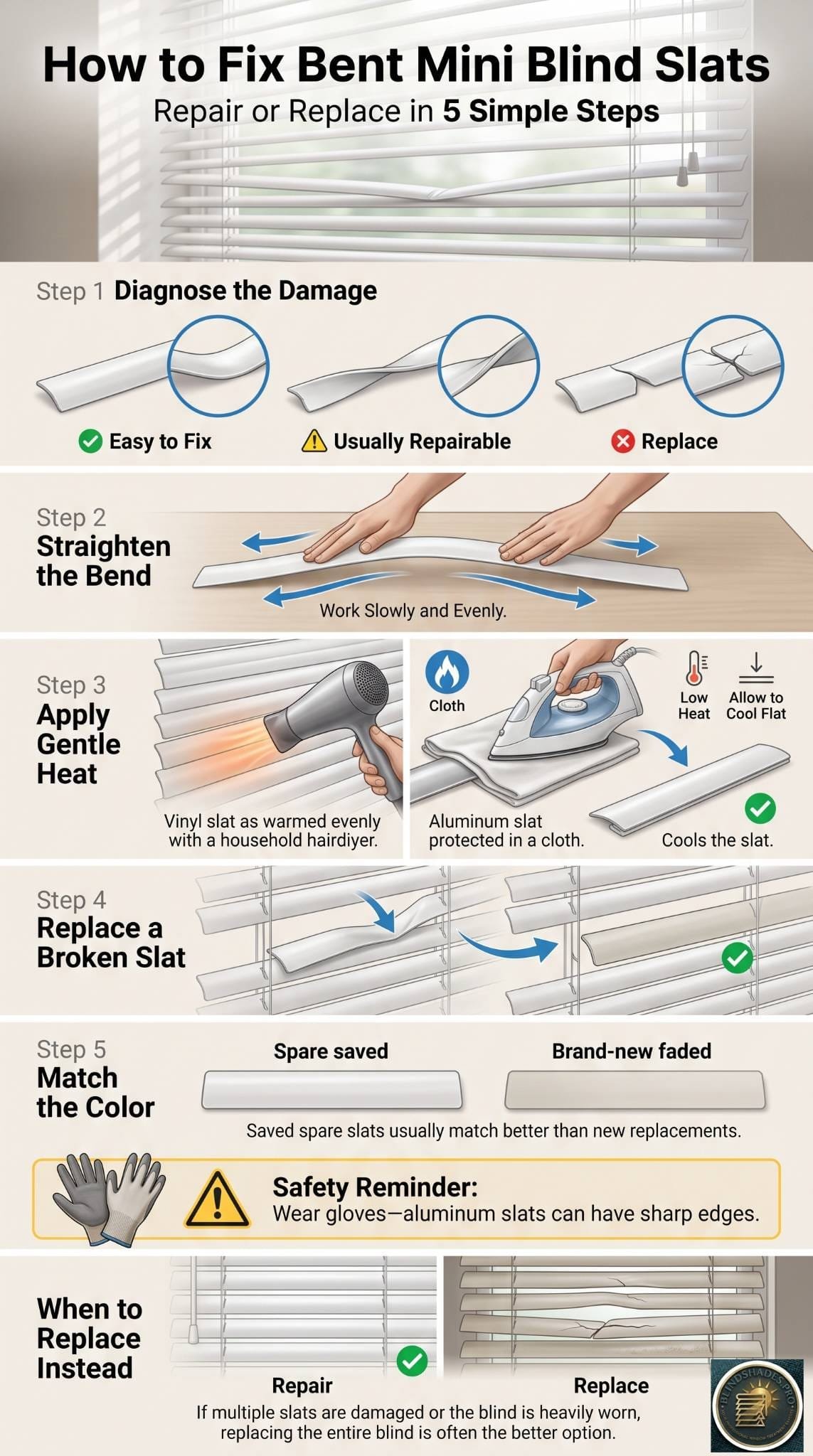
Authored by Michael Turner — 30 Years of Home Improvement Expertise | BlindShades.pro
To fix bent mini blind slats, first diagnose the damage. A smooth bend or twist can usually be straightened, because aluminum has a natural give; a sharp crease where the metal has folded is much harder and sometimes permanent; and a crack or break cannot be repaired at all and needs a replacement slat. For a bend, lay the slat on a flat surface and press it firmly back into shape, using a hairdryer on vinyl or a low iron on stubborn aluminum kinks. For a break, slide the damaged slat out and swap in a spare. Most fixes take minutes with no special tools. This guide covers straightening, replacing, matching colors, and knowing when a whole new blind makes more sense.
Key Takeaways
- Diagnose before you fix. A gentle bend straightens well, a sharp crease may not, and a crack or break cannot be repaired, so identify which you have before deciding to straighten or replace.
- Aluminum bends back; vinyl needs heat. Aluminum has enough memory to be pressed flat by hand or over a dowel, while vinyl is better softened with a hairdryer first, then reshaped and left to cool flat.
- Work gradually to avoid creating a crease. Several small corrections are safer than one hard bend, which can fold the metal permanently or crack it.
- Keep curved slats curved. Flat slats press flat, but curved slats should be supported over a three-quarter-inch dowel so they keep their curve rather than going flat and mismatching the others.
- A spare slat solves the color-match problem. New slats rarely match sun-faded old ones, so the slats you kept from shortening a blind are the ideal exact-match replacement.
⭐ Quick Answer
Knowing how to fix bent mini blind slats starts with diagnosing the damage, because that decides whether you straighten the slat or replace it.
- Diagnose first: a smooth bend or twist is fixable, a sharp crease is hard to remove, and a crack or break needs replacing.
- Straighten aluminum: lay the slat on a flat surface and press firmly from the center outward, working gradually; Blinds Chalet recommends a three-quarter-inch dowel to keep curved slats curved.
- Fix vinyl with heat: soften the bend with a hairdryer, reshape it flat, and let it cool, which Engineer Fix notes makes the plastic pliable.
- For stubborn aluminum kinks, use a low iron over a cloth for 5 to 10 seconds and press flat while warm, as Home Fair Blinds advises.
- Replace a broken slat by sliding in a spare with its curve facing the same way; a slat kept from shortening the blind matches the color exactly. If a cord is also frayed, see how to restring mini blinds, or choose a new set in our best mini blinds guide.
First, Diagnose the Damage: Bend, Crease, or Break?
The type of damage decides whether you straighten or replace.
Before reaching for tools, look closely at the slat, because the kind of damage determines the fix:
| Damage | Fixable? | Action |
|---|---|---|
| Smooth bend or twist | Usually yes | Straighten by pressing flat |
| Sharp crease or kink | Sometimes, often imperfect | Heat and press; accept slight marks |
| Crack, tear, or break | No | Replace the slat |
| Multiple damaged slats | Not worthwhile | Consider a new blind |
A smooth bend or gentle twist, the most common damage from pets, kids, or daily use, straightens well because aluminum has a slight memory. A sharp crease, where the metal has actually folded, can be improved with heat but may never look perfect. A crack or break cannot be repaired, since thin aluminum does not bond with glue or welding, so a snapped slat needs replacing. And if many slats are damaged or the blind is old and brittle, fixing one at a time stops being worthwhile.
How to Straighten a Bent Slat in Place
For a quick fix, you can straighten without removing anything.
If you want a fast repair and the bend is mild, you can straighten the slat while the blind hangs:
- Close the blinds fully so the slats stack tightly together and support one another.
- Slide a length of support through the ladder strings just below the bent slat: a three-quarter-inch dowel or a one-by-one length of lumber about as long as the slat works well, pushed through to the other side.
- Press firmly upward against the underside of the bent slat, running your hand back and forth along its length to work out the bend.
- Check and repeat with light pressure until the slat matches its neighbors.
Pressing along the full width, and across the stacked slats together, helps restore the matching curve rather than just flattening the bent spot. This in-place method is quick but less thorough than removing the slat.
How to Straighten a Removed Slat
For a proper job, take the slat out and work it on a flat surface.
Removing the slat gives you the control to straighten it fully:
- Lower the blind and tilt the slats open, then remove the bottom rail by prying out the plugs and freeing the lift cords.
- Slide the damaged slat out from the side, through the ladder cords.
- Lay it on a flat, hard surface, bent side up, and press firmly with both palms, working from the center of the bend outward toward the edges.
- Flip and check the underside, repeating if a slight curve transferred, and hold the slat to eye level to judge straightness; a faint bow is fine and will not affect operation.
- Rethread and reinstall the slat, re-tie the cords, replace the bottom rail, and test.
One key point on curved slats: support them over a three-quarter-inch dowel as you press, so they keep their gentle curve rather than going dead flat and standing out from the others. Flat slats can simply be pressed flat.
Using Heat on Stubborn Bends
Heat softens the material so kinks work out more easily — but go gently.
When a bend resists pressing, gentle heat makes the slat pliable. The method differs by material:
| Material | Straightening technique | Heat source | Caution |
|---|---|---|---|
| Aluminum | Press flat by hand or over a dowel | Low iron over a cloth, 5 to 10 seconds | Too much force creases or cracks it |
| Vinyl | Soften, then reshape by hand | Hairdryer on warm | Too much heat melts or warps it |
For aluminum, set a clothes iron to its lowest setting, lay a clean cotton cloth over the kink, press for five to ten seconds, then firmly flatten the slat by hand while it is still warm. For vinyl, warm the slat with a hairdryer until it is pliable, reshape it flat, and let it cool completely before reinstalling so it holds its new shape. In both cases, do not overdo the heat, and let the slat cool before judging the result.
In-Place or Removed: Which Method?
Quick touch-up versus thorough repair.
| Method | Best for | Trade-off |
|---|---|---|
| In place | A mild bend, a fast fix | Less control, harder to perfect |
| Removed | A pronounced bend or kink | More steps, but a cleaner result |
Use the in-place method for a small bend you want gone in a couple of minutes, and remove the slat when the bend is pronounced, near the end, or needs heat, since you have far more control on a flat surface.
When to Replace the Slat Instead
Cracks, tears, and breaks are replace-only.
If the slat is cracked, torn, or snapped, no amount of straightening will fix it, because thin aluminum and brittle vinyl do not bond reliably with glue or tape for the long term. Clear packing tape on the back of a cracked slat is a temporary cosmetic patch that may last weeks to months, but the real fix is a replacement slat. The good news is that swapping a single slat is straightforward.
How to Replace a Broken Mini Blind Slat
Slide the old one out, thread a matching one in.
- Pry the plugs from the bottom rail and untie the lift-cord knots, freeing the cords.
- Pull the lift cords out of the slats down to just above the damaged slat.
- Slide the damaged slat out from the side, through the ladder cords.
- Thread in the replacement slat, making sure its curve faces the same direction as all the others, so it sits flush.
- Re-insert any removed slats, rethread the lift cords through every slat and the bottom rail, tie off, replace the plugs, and test.
The cords here are the same ones involved in restringing, so if a cord is also frayed, handle both at once using how to restring mini blinds.
Solving the Color-Match Problem
A new slat rarely matches a faded one — so use a spare.
The biggest frustration with replacing a slat is color: a brand-new slat almost never matches slats that have faded in years of sunlight, especially on west- and south-facing windows. There are three honest ways around it. Best, use a slat you kept when shortening the blind, since those are an exact match in color and age. Second, order a replacement from the original manufacturer, which gets you closest on color. Third, if a visible slat is damaged and you have no spare, move a slat from a hidden spot, low behind furniture or at the very bottom, up to the visible position and put the slightly mismatched new slat where it will not be seen. To compare slat materials when sourcing replacements, see aluminum vs vinyl mini blinds.
When to Replace the Whole Blind
Past a certain point, a new blind beats endless slat repairs.
Fixing a slat or two makes sense on an otherwise good blind, but there is a tipping point:
| Situation | Better move |
|---|---|
| One or two smooth bends | Straighten them |
| A single cracked or broken slat | Replace that slat |
| Several damaged slats | Replace the blind |
| Blind over 5 to 10 years old | Replace the blind |
| Vinyl gone brittle from sun | Replace the blind |
If multiple slats are bent or broken, if the blind is more than five to ten years old, or if vinyl slats have gone brittle and crack at a touch from sun exposure, replacing the whole blind is usually the better use of time and money, and gives you a fresh, matching set. Mini blinds are inexpensive, so this is rarely a big outlay. For alternatives if you want a different style, see alternatives to mini blinds, or choose a new set in our best mini blinds guide.
Preventing Bent Slats
A little care keeps slats straight far longer.
Most bent slats come from avoidable knocks, so a few habits help. Tilt the slats fully closed before dusting or cleaning so they support each other and flex less, the gentle method being in how to clean mini blinds. Raise the blind out of the way when opening a window behind it, keep pets from using the slats as a perch or lookout, and operate the lift and tilt smoothly rather than yanking. Aluminum and vinyl both bend most easily when handled roughly, so gentle, deliberate operation is the best prevention there is.
Related guides: For complete buying advice, see our cordless blinds and shades guide.
Best Sources
- Blinds Chalet — on the difference between flat-slat and curved-slat repair, using a three-quarter-inch dowel, and wearing gloves against sharp aluminum edges.
- Engineer Fix — on pressing aluminum over a dowel or ball, softening vinyl with a hairdryer, and threading a replacement slat with its curve facing the right way.
- JustAnswer — on distinguishing a smooth bend from a sharp crease, pressing across the full width and stacked slats, and making gradual corrections.
- Home Fair Blinds — on removing slats to straighten them and using a low iron over a cloth for five to ten seconds on stubborn kinks.
- Blindsgalore — on when breaks require replacement, the color-match challenge with faded slats, temporary tape patches, and when to replace the whole blind.
- Fix My Blinds — on the step-by-step replacement of a broken slat in a mini blind.
Related Guides
- Best Mini Blinds Buying Guide
- How to Shorten Mini Blinds
- How to Restring Mini Blinds
- How to Clean Mini Blinds
Frequently Asked Questions
Can you straighten bent aluminum mini blind slats?
Yes, smoothly bent or twisted aluminum slats can usually be straightened, because aluminum has a slight memory and is thin enough to reshape. Lay the slat on a flat surface and press firmly from the center of the bend outward, working gradually with several light corrections rather than one hard push. For a stubborn kink, warm it with a low iron over a cloth and press it flat while warm. A sharp crease where the metal has folded may improve but never look perfect.
How do you fix bent vinyl blind slats?
Vinyl slats respond best to gentle heat. Warm the bent area with a hairdryer on a low setting until the vinyl becomes pliable, then reshape the slat flat by hand and hold it until it cools so it keeps the new shape. Avoid too much heat, which can melt or permanently warp the plastic. If the vinyl has become brittle from sun exposure and cracks rather than bends, it cannot be repaired and the slat will need replacing.
When should you replace a slat instead of straightening it?
Replace a slat when it is cracked, torn, or snapped, since thin aluminum and brittle vinyl do not bond reliably with glue or tape for a lasting repair. Also replace rather than straighten when a sharp crease will not press out acceptably. Straightening is best reserved for smooth bends and twists. If several slats are damaged or the blind is old and brittle, replacing the whole blind is usually smarter than fixing them one by one.
How do you match a replacement slat to faded blinds?
Matching color is the hardest part, because new slats rarely match slats faded by years of sun. The best solution is a spare slat kept from when the blind was shortened, which matches exactly. Otherwise, order a replacement from the original manufacturer for the closest color, or move a slat from a hidden position, such as low behind furniture, into the visible spot and place the new, slightly different slat where it will not be noticed.
How do you stop mini blind slats from bending?
Prevent bent slats by handling the blind gently: tilt the slats fully closed before dusting so they support each other, raise the blind before opening a window behind it, keep pets from perching on the slats, and operate the lift and tilt smoothly instead of yanking. Aluminum and vinyl both bend most easily when handled roughly, so careful, deliberate operation and gentle cleaning are the most effective prevention.
