Are Panel Track Blinds Worth It?

Authored By Michael Turner -30 Years Home Improvement Expertise | Updated 2026 | BlindShades.pro
Updated on June 29, 2026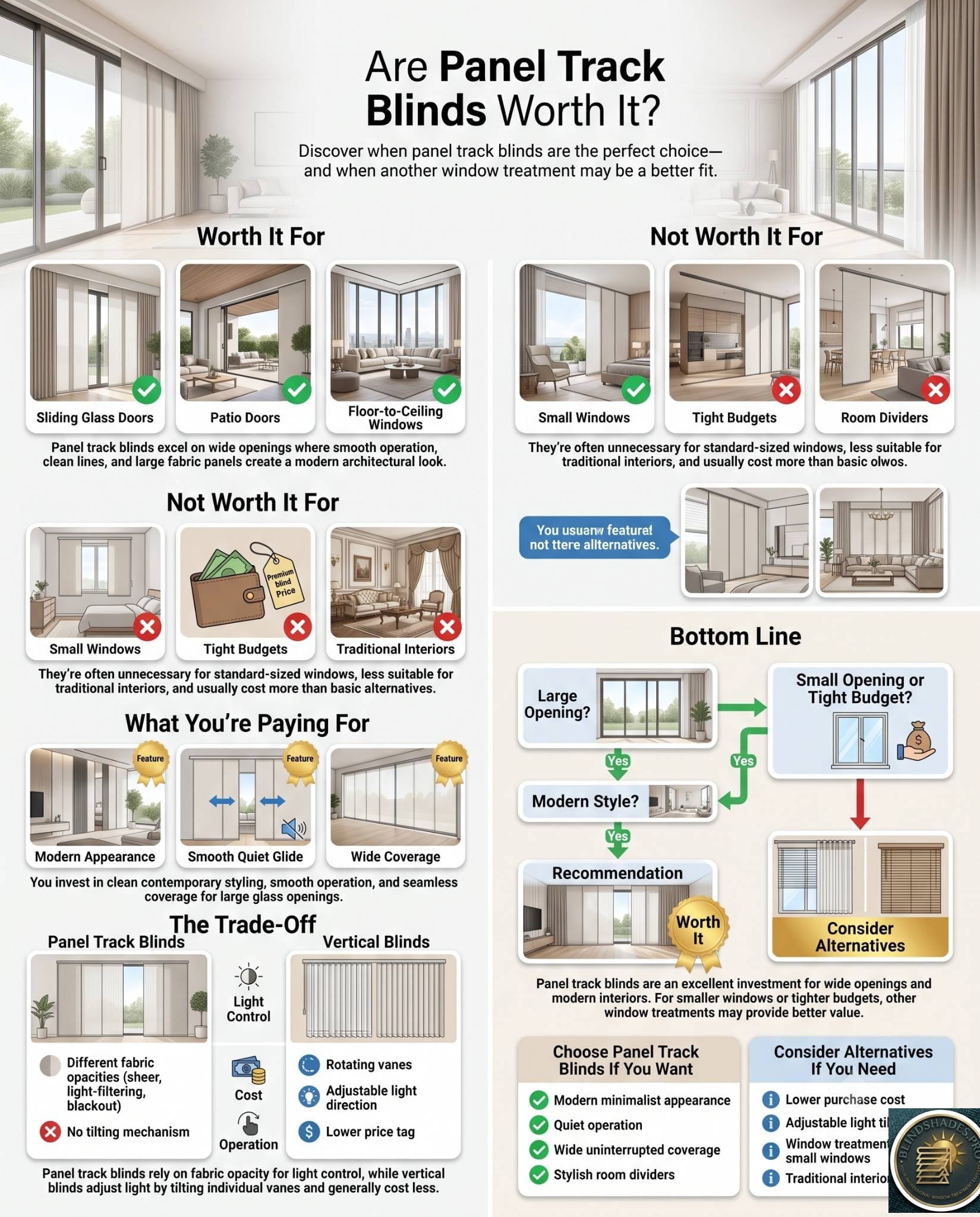
Authored by Michael Turner — 30 Years of Home Improvement Expertise | BlindShades.pro
Panel track blinds are worth it for the right opening, but not for every window. They are an excellent, often the best, choice for sliding glass doors, patio doors, wide or floor-to-ceiling windows, and modern room dividers, where their clean look, smooth quiet glide, and seamless coverage genuinely outperform the alternatives. They are not worth it for small or standard windows, very tight budgets, traditional interiors, or anyone who wants precise, all-day light adjustment, since the panels do not tilt and they cost more than vertical blinds. So the honest answer is: worth it when you have a wide opening and value a modern, low-fuss look, and not worth it when you do not. This guide weighs both sides so you can decide.
Key Takeaways
- Worth it for wide openings. Panel track blinds are well worth it for sliding doors, patio doors, and large windows, where they cover seamlessly and look modern.
- Not worth it for small windows. On small or standard windows, simpler, cheaper treatments make more sense, and panel track is overkill.
- You pay for the look and the glide. The premium over vertical blinds buys a cleaner, more modern look, quieter operation, and gap-free coverage.
- The main limit is no tilt. Because panels do not tilt, light control comes from the fabric you choose, not from adjusting slats through the day.
- A flexible bonus: room dividers. Their ability to double as a sliding room divider adds value no slatted blind matches.
⭐ Quick Answer
Are panel track blinds worth it? Yes for the right opening, no for the wrong one. They are worth it on wide openings and a modern look, and not worth it on small windows or tight budgets.
- Worth it for: sliding glass doors, patio doors, wide or floor-to-ceiling windows, and modern room dividers, the uses Blindsgalore highlights.
- Not worth it for: small or standard windows, very tight budgets, or traditional interiors.
- You’re paying for: a clean, modern look, smooth quiet glide, and seamless wide coverage, the upgrade House Digest notes over traditional treatments.
- The main trade-off: panels do not tilt, so fabric sets the light, and they cost more than vertical blinds, as Blinds Chalet explains.
- Bottom line: worth it when you have a wide opening and want a modern, low-fuss treatment. See picks for sliding glass doors, weigh alternatives to panel track blinds, or see our best panel track blinds guide.
The Honest Verdict: Worth It for the Right Opening
The answer depends on the opening, the budget, and the look you want.
There is no single yes or no, because panel track blinds are purpose-built for a specific job: covering wide openings with a clean, modern, gliding treatment. For that job, on a sliding glass door, a patio door, a wall of windows, or as a room divider, they are absolutely worth it and frequently the best option available. Used outside that job, on a small bedroom window, on a tight budget, or in a traditional room, they are an awkward, expensive fit and not worth it. So rather than asking whether panel track blinds are worth it in general, ask whether they are worth it for your opening and priorities. The pros and cons below make that easy to judge.
What You’re Paying For: The Pros
The genuine strengths that justify the choice.
| Benefit | Why it matters |
|---|---|
| Modern, clean look | Architectural, contemporary style on wide glass |
| Seamless wide coverage | One treatment covers a whole sliding door or wall |
| Smooth, quiet glide | One-handed operation, no clattering slats |
| Cordless and child-safe | Removes accessible cords for safety |
| Fabric variety | Light-filtering, solar, blackout, and woven wood |
| Doubles as a room divider | Ceiling-mounts to partition open spaces |
| Few moving parts | Simple, durable carriers and track |
These are real, meaningful advantages. On a wide opening, panel track delivers a clean, gallery-like look that vertical blinds and most shades cannot, glides quietly with one hand, removes cord hazards, and even works as a flexible room divider. For the right space, that combination is genuinely worth paying for.
The Real Drawbacks: The Cons
The honest limitations to weigh.
| Drawback | Who it affects |
|---|---|
| Panels do not tilt | Anyone wanting adjustable, directional light |
| Stack covers part of the glass | Those wanting a fully clear view when open |
| Costs more than vertical blinds | Budget-focused buyers |
| Not suited to small windows | Standard or narrow window owners |
| Fabric needs gentle care | Those wanting a wipe-clean, soak-proof blind |
| Light and privacy set by fabric | Anyone who likes to fine-tune day to day |
These limits are why panel track is not for everyone. The biggest is the lack of tilt: you choose your light level by fabric at purchase rather than adjusting it through the day. The open stack also covers part of the glass unless you extend the track onto the wall, the price sits above vertical blinds, and the system is oversized for small windows. None of these are flaws exactly, they are the trade-offs of the design, but they decide whether it is worth it for you.
Worth It by Room and Situation
Where the value lands, and where it does not.
| Room or situation | Worth it? |
|---|---|
| Sliding glass or patio door | Yes, ideal use |
| Wide or floor-to-ceiling window | Yes, seamless coverage |
| Studio or open-plan divider | Yes, flexible partition |
| Modern living or dining room | Yes, suits the style |
| Small or standard window | No, overkill and oversized |
| Very tight budget | No, vertical blinds cost less |
| Need precise all-day light control | No, panels do not tilt |
| Traditional or period interior | Often no, style mismatch |
The pattern is clear: panel track is worth it wherever the opening is wide and the look is modern, and not worth it on small windows, tight budgets, or where you need adjustable light or a traditional style. Matching the treatment to the situation is the whole decision.
Is the Premium Over Vertical Blinds Justified?
It depends on how much you value the look and feel.
Panel track blinds cost more than vertical blinds, which cover the same openings for less, so the fair question is whether the premium is justified. It is, if you value the modern look, the quiet gap-free glide, and the seamless wide coverage, because those are real, daily-felt upgrades over vertical blinds’ more traditional, slatted, sometimes clattery experience. It is not, if your priority is the lowest price or precise tilt-adjustable light, in which case vertical blinds give you more of what you want for less. The full head-to-head is in panel track blinds vs vertical blinds, which is the single most useful comparison for deciding if the premium is right for you.
Who Should Buy, and Who Should Skip
A clear recommendation by buyer type.
| Buy panel track if you | Skip panel track if you |
|---|---|
| Have a sliding door or wide window | Have only small or standard windows |
| Want a modern, architectural look | Prefer a traditional style |
| Value quiet, gap-free coverage | Want the lowest possible price |
| Want a cordless, child-safe option | Need precise all-day light control |
| Could use a room divider too | Want a wipe-clean, soak-proof blind |
If you land mostly in the left column, panel track blinds are well worth it and you should buy with confidence; choose your set from our best panel track blinds guide and, for the most common use, our picks for sliding glass doors. If you land mostly on the right, you will be happier and spend less with a different treatment, so see alternatives to panel track blinds.
The Bottom Line
Worth it for a wide opening and a modern look, not for everything else.
Panel track blinds are worth it when you have a wide opening, a sliding door, patio door, large window, or a space to divide, and you want a clean, modern, quiet treatment that covers seamlessly and can even partition a room. For that, they are often the best choice on the market and well worth their price. They are not worth it for small windows, the tightest budgets, traditional interiors, or anyone who needs to fine-tune light all day, since they do not tilt and cost more than vertical blinds. Judge them against your own opening and priorities, and the answer becomes obvious.
Best Sources
- Blinds Chalet — on the pros and cons of panel track blinds, the lack of tilt, the stack-back space, and suitability for large openings over small windows.
- House Digest — on panel track shades as a modern, premium upgrade for sliding doors and wide windows versus more traditional treatments.
- Blindsgalore — on panel track’s modern look, fabric range, room-divider use, and cordless options, and where it fits best.
- The Shade Store — on panel track pricing relative to other treatments and how stack-back and fabric choice affect the result.
- Hunker — on panel track using a few wide panels for wide openings and being less suited to small or standard windows.
Related Guides
- Best Panel Track Blinds Buying Guide
- Panel Track Blinds for Sliding Glass Doors
- Panel Track Blinds vs Vertical Blinds
- Alternatives to Panel Track Blinds
Frequently Asked Questions
Are panel track blinds worth it?
Panel track blinds are worth it for the right opening but not for every window. They are an excellent, often the best, choice for sliding glass doors, patio doors, wide or floor-to-ceiling windows, and modern room dividers, where their clean look, smooth quiet glide, and seamless coverage outperform the alternatives. They are not worth it for small or standard windows, very tight budgets, or traditional interiors, since the panels do not tilt and they cost more than vertical blinds. The honest answer is that they are worth it when you have a wide opening and value a modern, low-fuss look.
What are the disadvantages of panel track blinds?
The main disadvantages of panel track blinds are that the panels do not tilt, so you set the light level by fabric choice rather than adjusting it through the day; the open stack covers part of the glass unless you extend the track onto the wall; they cost more than vertical blinds; and they are oversized for small or standard windows. The fabric also needs gentle care rather than soaking. None of these are defects, they are trade-offs of the wide-panel design, but they determine whether panel track is the right choice for your space.
Are panel track blinds better than vertical blinds for the money?
It depends on what you value. Vertical blinds cost less and offer tilt-adjustable light, so they are better value if your priority is price or precise light control. Panel track blinds cost more but deliver a cleaner, more modern look, quieter operation, and gap-free coverage, which is better value if those qualities matter to you. For a contemporary look on a wide sliding door, the panel track premium is usually justified; for a budget project or where adjustable light is key, vertical blinds give more for less. Our panel track versus vertical comparison covers this in full.
Are panel track blinds good for the money on large windows?
Yes, large windows and sliding doors are exactly where panel track blinds are good value. Their wide panels cover a big opening seamlessly with one cohesive treatment, glide smoothly aside, and look modern and architectural, which smaller blinds or multiple shades cannot match as cleanly. On a wide opening, the cost is spread across a treatment that genuinely improves the look and function of the space, so the value is high. It is only on small or standard windows that panel track stops being worth the money.
When are panel track blinds not worth it?
Panel track blinds are not worth it for small or standard windows, where they are oversized and a simpler, cheaper blind or shade works better; for very tight budgets, where vertical blinds cover the same openings for less; for traditional or period interiors, where the modern look clashes; and for anyone who wants precise, adjustable light control throughout the day, since the panels do not tilt. In these cases the cost and design of panel track work against you, and an alternative treatment will leave you happier and spending less.
