Pleated Blinds vs Roller Blinds

Authored By Michael Turner -30 Years Home Improvement Expertise | Updated 2026 | BlindShades.pro
Updated on July 1, 2026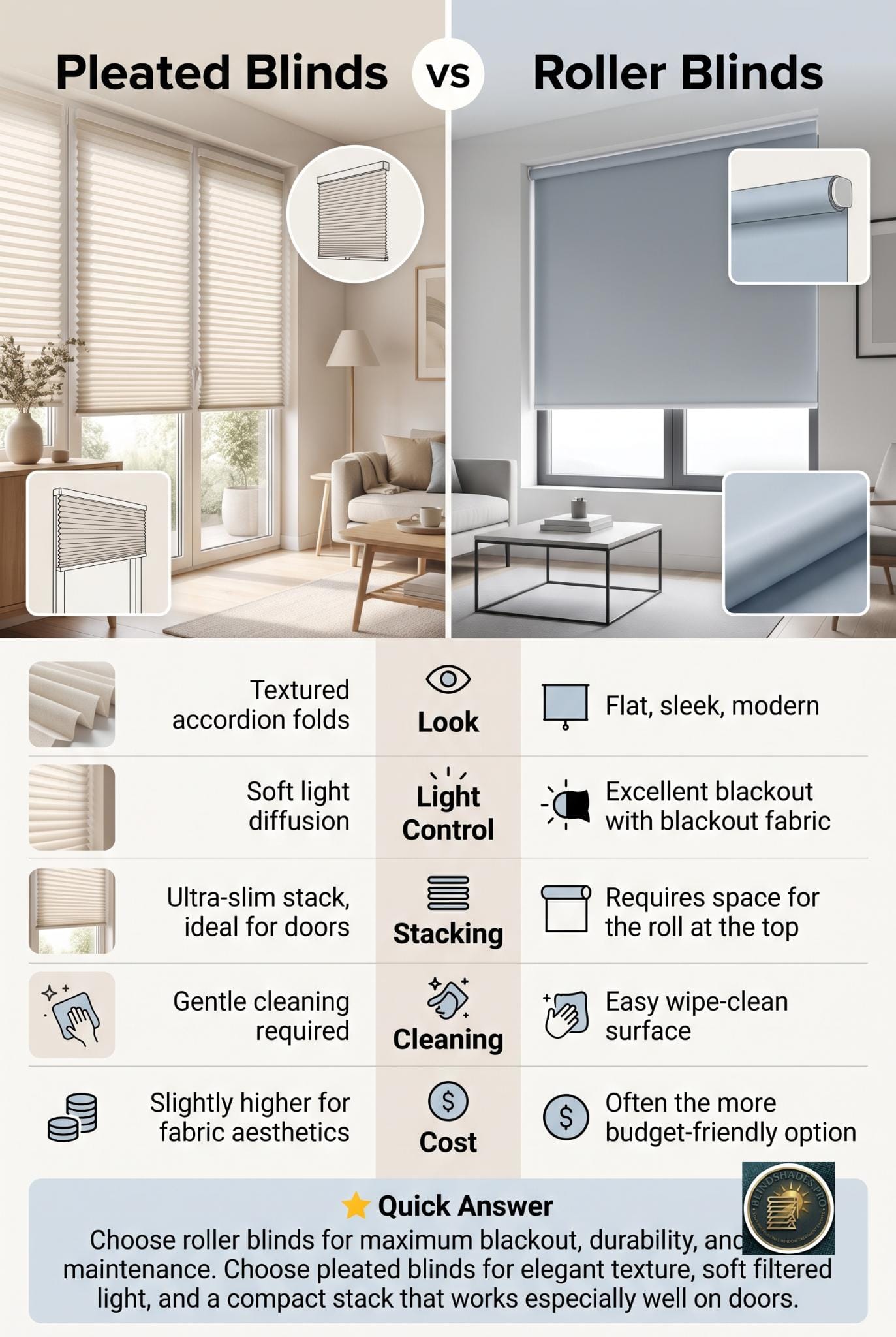
Authored by Michael Turner — 30 Years of Home Improvement Expertise | BlindShades.pro
Pleated blinds and roller blinds solve the same problem in two very different ways: a pleated blind is a single layer of accordion-folded fabric that compresses into a slim stack at the top, while a roller blind is a flat sheet of fabric that wraps around a tube. That difference shapes everything. Roller blinds give a sleek, modern look, block light most completely with a blackout fabric, and wipe clean easily, which makes them the better pick for bedrooms, kitchens, and bathrooms, often at a lower price. Pleated blinds add texture and an architectural fold, stack into a very compact bundle, and suit doors, oddly shaped windows, and living spaces where a soft, layered look matters. Choose roller for blackout, durability, and budget, and pleated for texture, compact stacking, and doors. This guide compares them across look, light, stacking, cleaning, and cost.
Key Takeaways
- Folds vs a flat roll. Pleated blinds are accordion-folded fabric; roller blinds are a flat sheet that rolls around a tube.
- Roller blocks light better. A blackout roller blind seals light more completely, making it the stronger blackout choice for bedrooms.
- Pleated stacks tighter. Pleated shades compress into a very slim stack, often just two to three inches, ideal for doors and clearance.
- Roller is easier to clean. A flat roller wipes down in seconds and is very durable; pleated fabric needs gentler dusting.
- Pleated wins on texture and shapes. Pleated adds architectural softness and handles doors and unusual window shapes better.
⭐ Quick Answer
Pleated blinds vs roller blinds comes down to folds versus a flat roll: pleated adds texture and a compact stack, while roller is sleek and blocks light better.
- Look: pleated has textured accordion folds; roller is a flat, sleek, modern sheet, a contrast The Shade Store describes.
- Light: a blackout roller blocks light most completely; a single-layer pleated shade diffuses light more softly.
- Stacking and doors: pleated compresses to a 2 to 3 inch stack, ideal for patio and bifold doors, while roller needs a little room at the top.
- Cleaning and value: roller wipes clean, is very durable, and is often the budget pick, per Blinds.com; window coverings also cut energy loss, notes the U.S. Department of Energy.
- Choose roller for blackout and durability, pleated for texture and doors. See our best roller blinds guide, best roller shades guide, or best pleated blinds guide.
The Core Difference: Folds or a Flat Roll
One stacks in folds; the other rolls up smooth.
The whole comparison flows from how each one moves. A pleated blind is a single continuous sheet of fabric creased into crisp accordion pleats; when you raise it, the pleats compress into a slim stacked bundle at the top. A roller blind is a flat, uncreased sheet of fabric attached to a tube; when you raise it, the fabric wraps smoothly around the tube. From there, every practical difference follows: the pleated fold adds texture and stacks very compactly, while the flat roller sheet gives a clean modern line, seals light better, and wipes clean more easily. Neither is better in the abstract, they simply suit different rooms and priorities.
Pleated Blinds vs Roller Blinds: Full Comparison
The whole picture in one table.
| Factor | Pleated Blinds | Roller Blinds |
|---|---|---|
| Look | Textured accordion folds | Flat, sleek, modern sheet |
| Light control | Diffuses softly; good with a liner | Blocks light best with blackout fabric |
| Stacking | Very compact, often 2 to 3 inches | Needs a little room at the top |
| Maintenance | Gentler dusting; dust settles in pleats | Wipes clean easily; very durable |
| Doors and shapes | Excellent for doors and odd shapes | Best for standard windows |
| Cost | A little more for the fabric look | Often the budget-friendly option |
| Best for | Living rooms, doors, textured looks | Bedrooms, kitchens, bathrooms |
In short, roller blinds win on blackout, ease of cleaning, durability, and often price, while pleated blinds win on texture, compact stacking, and suitability for doors and unusual shapes. The sections below cover the factors that most often decide the choice.
Light Control and Blackout
For a truly dark room, roller has the edge.
If blocking light is the priority, roller blinds are usually the stronger choice. A roller blind is a single flat sheet that, in a blackout fabric, covers the window in one continuous unbroken panel, sealing light more completely, which is why blackout roller blinds are a go-to for bedrooms and media rooms. A pleated blind diffuses light beautifully and can be ordered in room-darkening or blackout fabric, but its folded single layer rarely achieves total darkness, and it tends to leak a little light at the edges. So for a dark bedroom, a blackout roller has the advantage; for soft, glowing daytime light in a living space, the pleated blind’s diffusion is a genuine plus. If you want the darkest pleated setup, see best blackout pleated blinds.
Stacking Space and Doors
This is where pleated blinds clearly win.
| Opening | Better pick | Why |
|---|---|---|
| Patio or bifold door | Pleated | Compresses to a 2 to 3 inch stack for clearance |
| Tilt-and-turn window | Pleated | Slim stack stays clear of the sash |
| Oddly shaped window | Pleated | Folds adapt where a tube cannot |
| Standard window | Either | Both fit well; choose on look and light |
Here is pleated’s standout advantage. Because a pleated blind compresses its folds into a very slim stack when raised, often just two to three inches, it clears the glass almost completely and takes up minimal space at the top. That compact stack makes pleated blinds especially good for patio and bifold doors, where you need maximum clearance to walk through, and for tilt-and-turn windows and unusual shapes where a bulky treatment would get in the way. A roller blind, by contrast, needs a little more room at the top for the rolled fabric and tube. So if you are covering a door, a window you open frequently, or an oddly shaped opening, the pleated blind’s slim stack is a real, practical benefit that roller cannot match.
Day-and-Night Flexibility
Pleated can combine sheer and blackout in one blind.
One feature that sets pleated apart is day-and-night flexibility. Many pleated blinds can be configured with two fabrics in a single unit, a sheer or light-filtering panel and a room-darkening or blackout panel, so you can enjoy soft daylight in the morning and privacy or darkness in the evening from the same blind. This combination, sometimes called a day-and-night pleated shade, gives a level of adjustable light control that a standard single-fabric roller blind does not offer on its own. For rooms where the light need changes through the day, a living room, a home office, this is a meaningful advantage for pleated.
Maintenance and Durability
Roller blinds are the easier, tougher option.
For cleaning and longevity, roller blinds have the edge. A roller blind is a flat, smooth sheet that you can wipe down in seconds, and many roller fabrics are tough enough for high-traffic, humid, or greasy rooms like kitchens and bathrooms. A pleated blind, with its folds, collects dust in the creases and needs gentler, more careful dusting to avoid crushing the pleats, and it should not be soaked, as covered in how to clean pleated blinds. Neither is high-maintenance, but if effortless cleaning and durability in a busy or damp room are priorities, roller is the more practical choice.
Cost and Value
Roller is often the budget pick.
| Consideration | Pleated Blinds | Roller Blinds |
|---|---|---|
| Upfront price | A little higher for the fabric look | Often the more affordable option |
| Entry level | Mid-range | Basic rollers can start very low |
| Best value when | You want texture or door clearance | You want function on a budget |
On price, roller blinds are frequently the more budget-friendly option, with basic roller shades reported to start as low as around twenty dollars per window, while offering strong function and blackout. Pleated blinds usually cost a little more for the textured fabric look and the compact fold. Both scale up in price with premium fabrics, motorization, and custom sizing, so the gap narrows at the higher end. Treat these as directional rather than exact, since price varies widely by size, fabric, brand, and retailer. If budget is the deciding factor and you do not need pleated’s texture or door clearance, roller usually delivers more function per dollar.
Which Should You Choose?
Match the blind to the room and the priority.
| Choose pleated blinds if | Choose roller blinds if |
|---|---|
| You are covering a door or odd shape | You want the best blackout |
| You want texture and architectural folds | You want easy cleaning and durability |
| You need a very compact stack | You are on a tighter budget |
| You want day-and-night sheer plus blackout | It is a kitchen or bathroom |
| It is a living room or feature window | It is a bedroom or media room |
The decision comes down to the room and what matters most. Choose roller blinds for the best blackout, the easiest cleaning, strong durability, and often the lower price, which makes them ideal for bedrooms, kitchens, and bathrooms. Choose pleated blinds for texture, an architectural folded look, a very compact stack, day-and-night flexibility, and suitability for doors and unusual shapes, which makes them ideal for living spaces and openings you use often. Many homes mix both. To go deeper on rollers, see our best roller blinds guide and best roller shades guide; for the insulated alternative, compare pleated blinds vs cellular shades.
Best Sources
- The Shade Store — on roller shades rolling flat around a tube for a minimal look versus folded fabric shades, and where each style fits.
- Blinds.com — on the price range of shades and blinds, with basic roller shades starting low and premium fabrics and motorized lifts costing more.
- Blindsgalore — on roller blinds staying flat as they wrap a tube, and how pleated and cellular differ from flat shades in structure.
- Blinds Chalet — on roller shades suiting a clean, modern aesthetic and easy maintenance, while pleated shades add texture and traditional charm.
- U.S. Department of Energy — on how window coverings reduce energy loss and improve comfort, and the role of fabric shades in regulating temperature.
Related Guides
- Best Pleated Blinds Buying Guide
- Best Roller Blinds Buying Guide
- Best Roller Shades Buying Guide
- Pleated Blinds vs Cellular Shades
Frequently Asked Questions
What is the difference between pleated blinds and roller blinds?
A pleated blind is a single layer of accordion-folded fabric that compresses into a slim stack when raised, while a roller blind is a flat sheet of fabric that wraps around a tube. That structural difference drives everything else. Pleated blinds add texture and an architectural fold, stack very compactly, and suit doors and odd shapes; roller blinds give a sleek, modern flat look, block light more completely with a blackout fabric, and wipe clean easily. Choose pleated for texture and door clearance, and roller for blackout, durability, and budget.
Which is better, pleated blinds or roller blinds?
Neither is universally better; it depends on the room and your priority. Roller blinds are better for blackout, easy cleaning, durability, and often price, making them ideal for bedrooms, kitchens, and bathrooms. Pleated blinds are better for texture, a compact stack, day-and-night flexibility, and doors or unusually shaped windows, making them ideal for living spaces and openings you use often. For a dark bedroom on a budget, roller usually wins; for a textured living-room look or a patio door, pleated wins. Many homes use both, matching each to the room.
Are roller blinds better than pleated blinds for blackout?
Generally, yes. A roller blind in a blackout fabric covers the window as one continuous flat panel, sealing light more completely, which makes it the stronger choice for a truly dark bedroom or media room. A pleated blind can be ordered in room-darkening or blackout fabric and darkens a room well, but its folded single layer rarely achieves total darkness and tends to leak a little light at the edges. For maximum darkness, a blackout roller, or a pleated shade mounted outside the frame with side channels, gets you closest. For soft daytime light, pleated diffuses beautifully.
Are pleated blinds good for doors?
Yes, pleated blinds are one of the best choices for doors. Because a pleated blind compresses into a very slim stack when raised, often just two to three inches, it clears the glass almost completely and leaves maximum room to walk through, which is exactly what patio and bifold doors need. The compact fold also suits tilt-and-turn windows and unusual shapes where a bulkier treatment would interfere. A roller blind needs a little more space at the top for the rolled fabric, so for doors and frequently opened openings, the pleated blind’s slim stack is a practical advantage.
Are pleated blinds or roller blinds cheaper?
Roller blinds are often the more budget-friendly option, with basic roller shades reported to start as low as around twenty dollars per window while still offering strong function and blackout. Pleated blinds usually cost a little more for the textured fabric look and compact fold. At the premium end, with custom sizing, high-end fabrics, and motorization, both rise in price and the gap narrows. Prices vary widely by size, fabric, brand, and retailer, so treat these as directional. If budget is the main concern and you do not need pleated’s texture or door clearance, roller typically offers more function per dollar.
