Best Blackout Pleated Blinds 2026

Authored By Michael Turner -30 Years Home Improvement Expertise | Updated 2026 | BlindShades.pro
Updated on July 1, 2026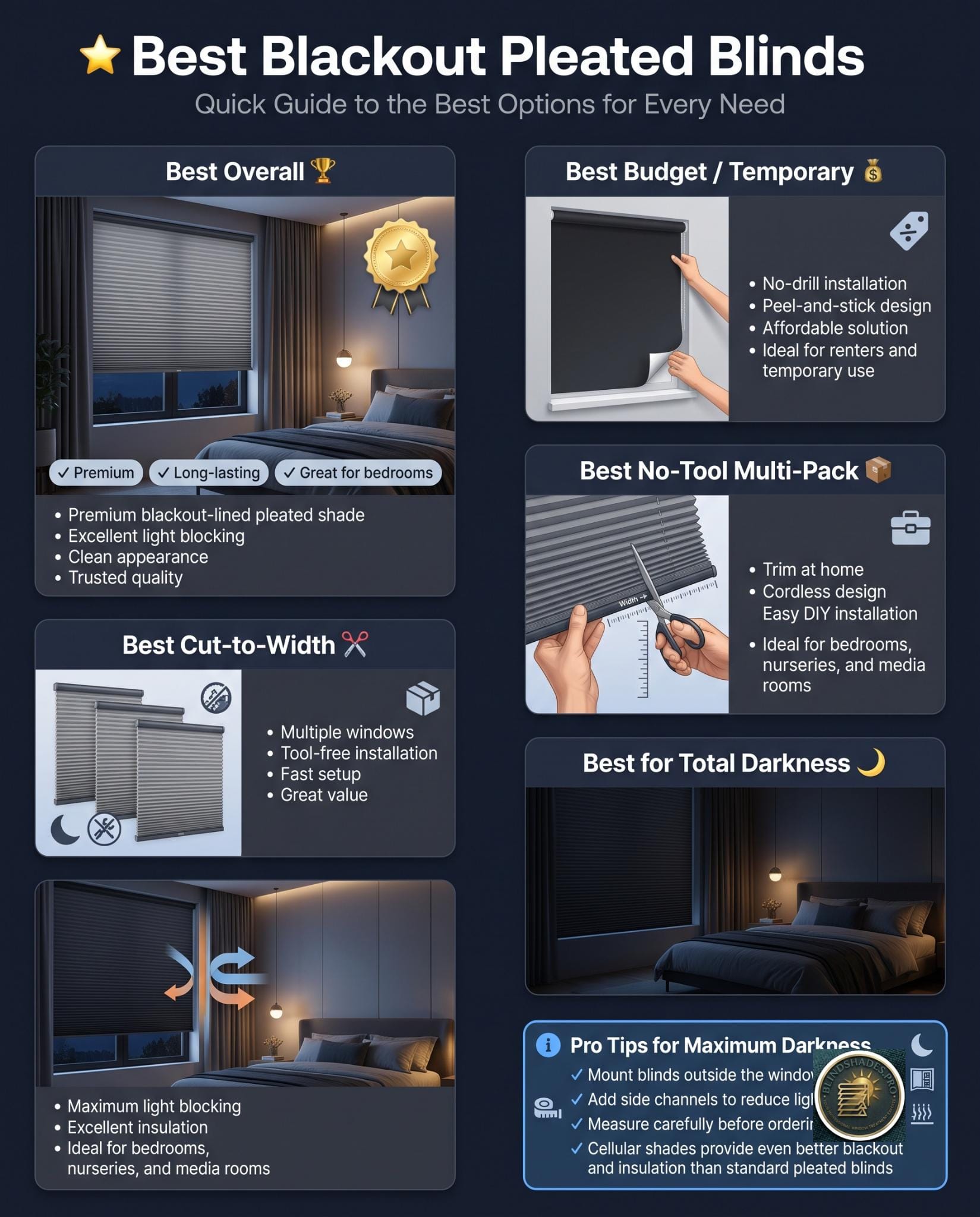
Authored by Michael Turner — 30 Years of Home Improvement Expertise | BlindShades.pro
The best blackout pleated blinds pair a room-darkening or blackout-lined fabric with an outside mount to darken a bedroom affordably, though it is worth being honest up front: a standard pleated shade darkens a room very well but does not fully match a cellular blackout shade or a true blackout roller, because a single fabric layer leaves small light gaps at the edges. For a strong, budget-friendly result, a quality blackout-lined pleated shade from a trusted brand is the best all-round pick; for renters, no-drill options like Redi Shade install in minutes; and for near-total darkness, either mount the shade outside the frame with side channels or step up to a cellular blackout shade. Getting a dark room from pleated blinds comes down to three things: the fabric, the mount, and closing the light gaps. This guide names real picks by category and shows how to get the darkest result honestly.
Key Takeaways
- Fabric sets the darkness. Choose a room-darkening fabric or a blackout liner; the fabric, not the pleat, does the light blocking.
- Outside mount darkens best. Mounting outside the frame, wider and taller than the opening, cuts the light gaps that inside mounts leave at the edges.
- Be realistic about gaps. A standard pleated shade darkens a room well but leaves small edge gaps; it will not fully match a cellular blackout shade.
- Renters have no-drill options. Peel-and-stick shades like Redi Shade give real room darkening with zero tools or brackets.
- For total darkness, size up or add tracks. Side channels, an outside mount, or a cellular blackout shade get you closest to complete blackout.
⭐ Quick Answer
The best blackout pleated blinds pair a blackout-lined fabric with an outside mount to darken a bedroom affordably, though a standard pleated shade leaves small edge gaps and will not fully match a cellular blackout shade.
- Best overall: a quality blackout-lined pleated shade from Hunter Douglas or Graber, the kind of format The Spruce rates for darkening.
- Best budget and renter: Redi Shade Original Blackout, a no-drill peel-and-stick paper shade that trims to fit.
- Best for total darkness: step up to a Bali blackout cellular shade, which blocks light more completely.
- The honest truth: standard pleated shades leak a little light at the edges, so mount outside the frame and add side channels or drapery, a gap Wirecutter notes affects most shades.
- Measure for an outside mount with how to measure for pleated blinds, compare pleated vs cellular shades, or see our best pleated blinds guide.
Best Blackout Pleated Blinds: Our Picks
Real, widely available options chosen by category — not lab-tested by us.
These are real products chosen for how well each suits its purpose, how widely available it is, and its verified reputation. We have not run independent lab tests, and darkness varies with fabric, mount, and window. Confirm current pricing, sizes, and the blackout or room-darkening option before buying.
| Category | Pick | Best for |
|---|---|---|
| Best Overall | Blackout-lined pleated shade (Hunter Douglas or Graber) | Strong darkening with brand quality |
| Best Budget / Temporary | Redi Shade Original Blackout | Renters, quick no-drill darkening |
| Best Cut-to-Width | StyleWell Cordless Cut-to-Width | Fitting odd widths at home |
| Best No-Tool Multi-Pack | Perfect Lift 4-Pack No-Tool | Doing several windows cheaply |
| Best Custom | Blinds.com or American Blinds blackout pleated | Made-to-measure fit and fabrics |
| Best for Total Darkness | Bali Blackout Cellular (step-up) | Near-complete blackout and insulation |
- Best Overall — Blackout-lined pleated shade from Hunter Douglas or Graber. A quality pleated shade with a room-darkening fabric or blackout liner from a trusted brand gives the strongest, most durable darkening in the pleated category, with a wide fabric range and cordless options.
- Best Budget & Temporary — Redi Shade Original Blackout. A no-drill, peel-and-stick blackout paper shade that trims to width and installs in minutes with no tools or brackets, the go-to for renters, move-ins, and temporary darkening.
- Best Cut-to-Width — StyleWell Cordless Cut-to-Width. Classic accordion-style cordless shades that you trim to fit odd widths at home, an easy, affordable middle ground between paper and custom.
- Best No-Tool Multi-Pack — Perfect Lift 4-Pack No-Tool. No-tool blackout polyester fabric pleated shades sold in multi-packs, ideal when you need to darken several windows without a big spend.
- Best Custom — Blinds.com or American Blinds blackout pleated. Made-to-measure blackout pleated shades with a precise fit and a full fabric and lift range, the choice when you want it built to your exact window.
- Best for Total Darkness — Bali Blackout Cellular (honest step-up). If your priority is near-complete darkness and insulation, a cellular blackout shade blocks light more completely than any pleated shade; some brands even fit two shades on one headrail for a cleaner look.
Disclosure: this section contains affiliate links. Prices and discounts vary widely by size, fabric, and retailer, so we quote no fixed figures. We never publish fabricated prices, specifications, or testing claims; picks are real products chosen for suitability.
Blackout vs Room-Darkening: Know the Difference
They are not the same, and retailers often blur the line.
| Term | What it means |
|---|---|
| Light filtering | Softens light, daytime privacy, not for sleep |
| Room darkening | Blocks most light; good for bedrooms, some glow remains |
| Blackout | Blocks nearly all light through the fabric itself |
| True total darkness | Blackout fabric plus sealed edges (mount, tracks, drapery) |
One of the most common points of confusion when shopping is the difference between room darkening and blackout. Room-darkening fabric blocks most light and is enough for many bedrooms, but some glow remains. Blackout fabric blocks nearly all light passing through the material itself. Crucially, even a true blackout fabric only blocks light through the fabric, not around the edges, so total darkness needs the fabric plus a strategy for the gaps. When you see a shade described as blackout, check whether it means the fabric alone or the whole installed result, since the gap at the edges is where most disappointment comes from.
How to Get the Darkest Result
Fabric is only part of it; the mount and the gaps decide the rest.
| Lever | What to do |
|---|---|
| Fabric | Choose a blackout or room-darkening fabric or liner |
| Mount | Mount outside the frame, wider and taller than the opening |
| Side gaps | Add side channels or tracks to seal the edges |
| Layering | Pair with blackout curtains for total darkness |
To get the darkest room from pleated blinds, work all three levers, not just the fabric. First, choose a genuine blackout or room-darkening fabric or liner. Second, mount the shade outside the window frame, extending it wider and taller than the opening so there is less room for light to leak around the sides, this single change makes the biggest difference, and it is why an outside mount is the standard advice for bedrooms. Measure an outside mount carefully using how to measure for pleated blinds, and fit it with how to install pleated blinds. Third, for the darkest possible result, add side channels or pair the shade with blackout curtains to seal the edges completely.
The Honest Truth About Light Gaps
Standard pleated shades leak a little at the edges, and that is worth knowing before you buy.
Here is the part many product pages leave out: a standard pleated shade, even with blackout fabric, will let a thin line of light in around the edges, especially on an inside mount, because a single flat fabric layer cannot seal perfectly against an uneven frame. This is not a defect; it is simply how the format works, and it is the reason forums are full of people asking why their blackout pleated shade is not totally dark. The good news is that it is manageable: an outside mount, side channels, or blackout drapery over the shade close most of the gap. But if your goal is genuine, complete darkness, a nursery for daytime naps, a shift worker’s bedroom, a home theater, be honest with yourself about the format. A cellular blackout shade or a shade with integrated side tracks will get you closer than a standard pleated shade alone.
Pleated Blackout vs Cellular Blackout
For the darkest, most efficient result, cellular wins; for value and style, pleated holds up.
| Factor | Blackout Pleated | Blackout Cellular |
|---|---|---|
| Light blocking | Good, small edge gaps | Best, more complete |
| Insulation | Minimal | Strong (honeycomb) |
| Cost | Lower | Higher |
| Fabric variety | Very wide | Wide |
| Best for | Value, style, budget darkening | Total darkness, energy savings |
If you have read this far and total darkness matters most, it is worth weighing cellular honestly. A cellular blackout shade blocks light more completely and adds real insulation thanks to its honeycomb structure, which is why it is the usual pick for a fully dark, energy-efficient bedroom, at a higher price. A blackout pleated shade, by contrast, gives strong darkening with a wider fabric range at a lower cost, and paired with an outside mount it satisfies most bedrooms. Choose blackout pleated for value and style, and blackout cellular when you want the darkest, most efficient result. The full comparison is in pleated blinds vs cellular shades, and for the wider range of options see our best pleated blinds guide.
Best Sources
- The Spruce — on testing blackout shades across formats, the role of fabric and mount in room darkening, and ease of installation as a buying factor.
- Wirecutter — on which blackout shades block light most effectively and the trade-offs between roller, cellular, and pleated formats.
- UBlockout — on how standard blackout shades still leak light at the edges and why sealed edges or side channels matter for true darkness.
- Bali — on blackout cellular shades, the honeycomb structure’s light-blocking and insulation, and fitting shades for a cleaner, darker result.
- Home Depot — on no-tool and multi-pack blackout pleated shades, cut-to-width options, and room-darkening versus blackout fabric choices.
Related Guides
- Best Pleated Blinds Buying Guide
- Pleated Blinds vs Cellular Shades
- How to Measure for Pleated Blinds
- How to Install Pleated Blinds
Frequently Asked Questions
What are the best blackout pleated blinds?
For most bedrooms, a quality blackout-lined pleated shade from a trusted brand such as Hunter Douglas or Graber is the best all-round choice, giving strong darkening with a wide fabric range. For renters, Redi Shade Original Blackout is a no-drill peel-and-stick option that installs in minutes; StyleWell cut-to-width shades suit odd widths; and Perfect Lift no-tool multi-packs are good for doing several windows cheaply. If your priority is near-total darkness, a Bali blackout cellular shade blocks light more completely than any pleated shade. The best pick depends on your budget, fit, and how dark you need the room.
Do blackout pleated blinds block all light?
Not completely. Blackout pleated blinds block nearly all light through the fabric itself, but a standard pleated shade leaves small gaps at the edges, especially on an inside mount, because a single fabric layer cannot seal perfectly against the frame. This is normal for the format. To get closer to total darkness, mount the shade outside the frame so it extends beyond the opening, add side channels to seal the edges, or pair it with blackout curtains. For genuinely complete darkness, a cellular blackout shade or one with integrated side tracks does better than a standard pleated shade alone.
Are blackout pleated or blackout cellular shades better?
It depends on your priority. Blackout cellular shades block light more completely and add real insulation from their honeycomb structure, making them the better pick for total darkness and energy savings, at a higher price. Blackout pleated shades give strong darkening with a wider fabric range at a lower cost, and paired with an outside mount they satisfy most bedrooms. Choose blackout pleated for value and style, and blackout cellular when you want the darkest, most efficient result. Both leave some edge gap on an inside mount, so mount either outside the frame for the best darkening.
How do I make my blackout pleated blinds darker?
Work three levers: fabric, mount, and edges. Start with a genuine blackout or room-darkening fabric, then mount the shade outside the window frame, wider and taller than the opening, which cuts the edge light gaps and makes the biggest single difference. Finally, seal the remaining gaps with side channels or by pairing the shade with blackout curtains. An inside-mounted pleated shade will always leak a little light at the sides, so if a room needs to be very dark, an outside mount plus edge sealing, or a step up to a cellular blackout shade, is the way to get there.
Are there no-drill blackout pleated blinds for renters?
Yes. No-drill blackout pleated shades like Redi Shade Original Blackout use a peel-and-stick or tension design that installs in minutes with no tools, screws, or brackets, and you trim them to fit your window at home. They are inexpensive, removable, and ideal for rentals, dorms, and temporary setups where drilling is not allowed. Perfect Lift no-tool pleated shades are another multi-pack option for doing several windows. These give real room darkening, though like any pleated shade they leave small edge gaps, so mount them to cover as much of the opening as possible for the darkest result.
