Why Won’t My Roman Shade Stay Up? Causes and Fixes

Authored By Michael Turner -30 Years Home Improvement Expertise | Updated 2026 | BlindShades.pro
Updated on July 9, 2026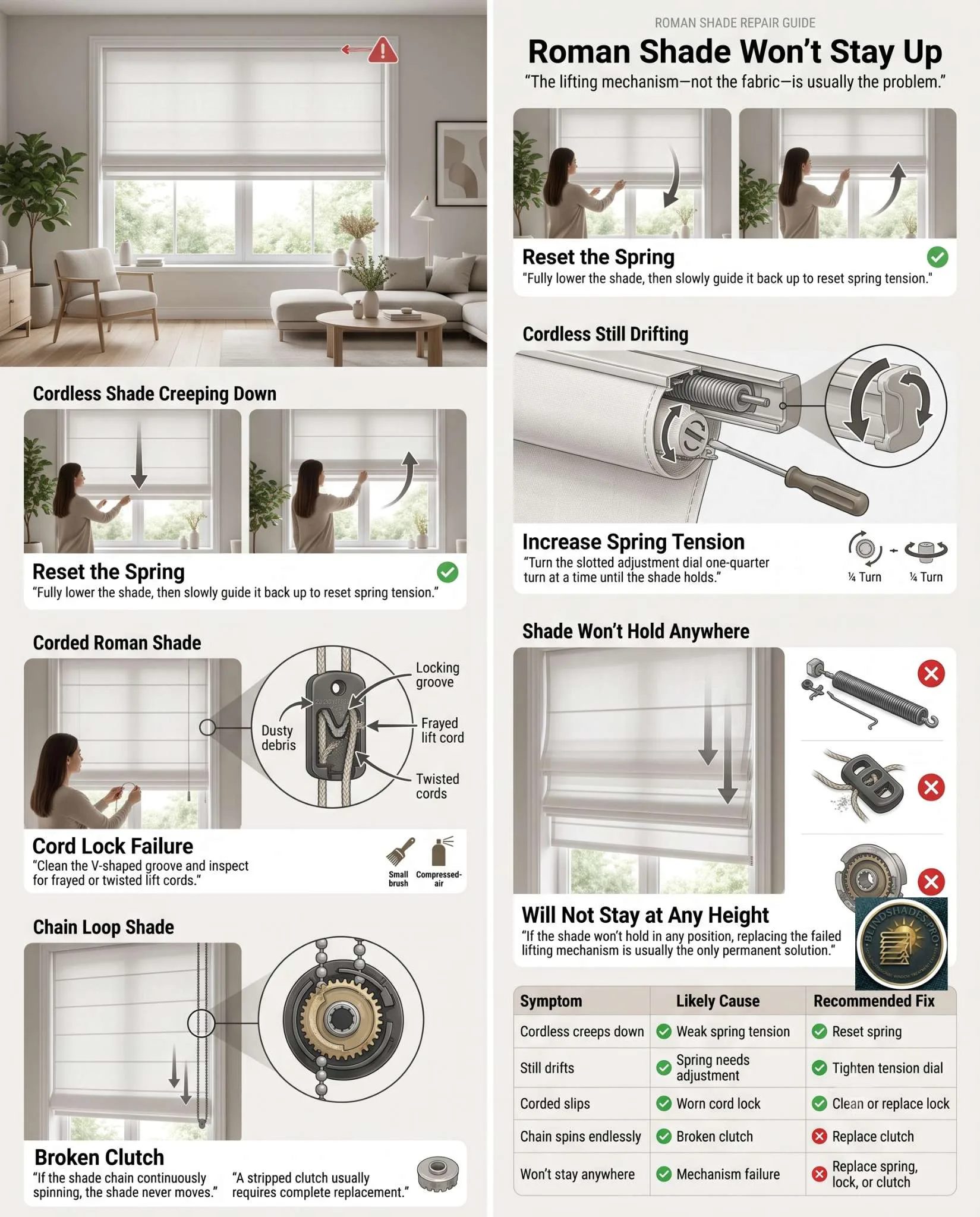
By Michael Turner | 30 years in window treatments
If your Roman shade won’t stay up, exactly one of three mechanisms has failed: a worn-out spring tensioner in a cordless shade, a failing cord lock in a corded shade, or a slipping clutch in a continuous-loop chain shade. Which one you have decides the fix, and most repair guides skip that step — they assume you already know. Look at how your shade operates, match the symptom, and the repair is chosen for you. Many fixes cost nothing and take two minutes.
🎯 5 Key Takeaways
- Identify the mechanism before you touch anything. Cordless shades fail at the spring, corded shades fail at the cord lock, and chain shades fail at the clutch. The symptom tells you which.
- A cordless shade that creeps down usually just needs its spring reset or its tension dial turned. Blinds Chalet advises increasing tension if the shade drifts down or will not hold mid-height, adjusting in quarter-turn increments.
- Over-tightening causes the opposite problem. Turn the dial too far and the shade snaps up too fast — the most common self-inflicted repair error.
- A shade that holds nowhere needs a part, not an adjustment. Fix My Blinds is direct: if the shade will not stay up at any position, the lock needs to be replaced. The same is true of a stripped clutch.
- Know when to stop. A broken cordless spring motor, sometimes called the governor, is a repair-shop job — one owner on r/fixit reported paying about one hundred and twenty dollars to have theirs repaired rather than replacing the shade.
⭐ Quick Answer
Why won’t my Roman shade stay up? One of three mechanisms has failed: a cordless spring, a corded cord lock, or a chain-loop clutch. Identify yours, then fix it:
- Cordless, creeping down: reset the spring by pulling the shade fully down and guiding it slowly back up, then increase the slotted tension dial; Blinds Chalet advises quarter-turn increments.
- Cordless, snapping up: you over-tightened the dial. Decrease tension a quarter-turn at a time until it holds.
- Corded, drops when you lock it: the cord lock is not biting. Clean the V-shaped groove and check the cords for fraying where they pass the sew-on rings.
- Chain loop, spins endlessly: the clutch is stripped and usually needs replacing; if the chain turns but nothing moves, the spool has popped out of the clutch.
- Holds at no position at all? Stop adjusting. Fix My Blinds is clear that the lock needs replacing, and a crooked bottom rail means rebalancing the internal weight, per Hunter Douglas. See uneven folds, our lift guide, or the Roman shades guide.
Best Sources: Fix My Blinds (Roman shade troubleshooter); Blinds Chalet (resetting a cordless tensioner); Hunter Douglas (Vignette Roman shade repair guidance); Weffort Shades (cordless DIY repair); Sense Blinds (uneven shade re-leveling); JustAnswer (stuck Roman shade Q&A).
Why Won’t My Roman Shade Stay Up?
Because the mechanism that holds it — a spring, a cord lock, or a clutch — has lost its grip. The type of shade you own determines which one failed and how to fix it.
Every Roman shade holds position with a mechanism hidden in the headrail, and all three designs fail recognizably. A cordless shade uses a spring tensioner; when it weakens, the shade creeps down under its own fabric weight. A corded shade uses a cord lock that pinches the pull cords in a slanted groove; when it stops biting, the shade drops the moment you let go. A continuous-loop shade uses a clutch that grips a chain; when the clutch strips, the chain spins freely and the fabric slides down. That is the whole diagnosis — the fabric is almost never the problem.
The Three-Mechanism Rule: Diagnose Before You Repair
The Three-Mechanism Rule: a Roman shade that won’t stay up has exactly one of three mechanisms failing — cordless spring, corded cord lock, or loop clutch — so identify the mechanism first and the fix is already decided.
Most repair pages assume you know which shade you own. Start here: match how you operate it to your symptom, then read across.
| How you operate it | Your symptom | What failed | The fix |
|---|---|---|---|
| Pull the bottom hem (cordless) | Creeps down slowly on its own | Spring has lost tension | Reset the spring, then adjust the tension dial |
| Pull the bottom hem (cordless) | Snaps up too fast | Tension dial over-tightened | Decrease tension a quarter-turn at a time |
| Pull the bottom hem (cordless) | Holds at no position at all | Spring motor or governor broken | Repair-shop or replacement part |
| Pull cords (corded) | Rises, then drops when you lock it | Cord lock not biting | Clean the V-groove; check cord for fraying |
| Pull cords (corded) | Lock never engages | Cord frayed, twisted, or snagged on a ring | Free or replace the cord |
| Pull cords (corded) | Holds nowhere | Cord lock failed | Replace the lock |
| Beaded chain loop | Chain spins endlessly, fabric slides | Clutch stripped or broken | Replace the clutch |
| Beaded chain loop | Chain turns but shade does not move | Spool disconnected from clutch | Snap the spool back into the end mechanism |
Find your row, then read the matching section below.
How Do You Fix a Cordless Roman Shade That Won’t Stay Up?
Reset the spring first, and only then adjust the tension dial — most cordless shades that drift down are fixed in under two minutes without tools or parts.
Cordless Roman shades run on a spring tensioner calibrated to the fabric’s weight. Over time the spring relaxes and the shade creeps downward. Work these steps in order, stopping as soon as it holds.
| Step | What to do | Why it works |
|---|---|---|
| 1. Reset the spring | Pull the shade fully down, then guide it slowly back up by the bottom rail. Never let it snap. | Re-seats the spring; fixes many cases free |
| 2. Adjust the tension dial | Find the slotted dial on the headrail end. Increase tension if it drifts down or will not hold mid-height; decrease if it shoots up. | Blinds Chalet advises quarter-turn increments |
| 3. Test after each turn | Raise and lower the shade before turning again. | Prevents over-tightening |
| 4. Diagnose a dead spring | If it holds at no position, or cords will not wind smoothly, the spring motor is broken. | Not a DIY fix on most models |
Step three is where people go wrong: they turn the dial several rotations at once, over-tighten, and create the opposite problem.
If the spring motor itself is dead — the part sometimes called the governor — you are past adjustment. One owner on r/fixit reported paying about one hundred and twenty dollars at a repair shop to fix a broken governor, often cheaper than replacing a custom shade.
A cordless spring is a wear item, not a defect. If your shade is years old, a weakening spring is normal aging, and the tension dial exists precisely for this reason. For how cordless mechanisms compare to motorized ones, see our guide on cordless vs motorized Roman shades.
How Do You Fix a Corded Roman Shade That Won’t Lock?
Clean the cord lock’s V-shaped groove and inspect the cords for fraying — if the shade holds at no position at all, the lock itself needs replacing.
A corded Roman shade holds position when the pull cords slide into a slanted, V-shaped groove in the headrail and the lock pinches them. Two things stop that.
Dust in the groove. If the mechanism cannot bite down, the shade rises and drops the instant you release the cords. Make sure the cords shift freely into the groove, and clean the area.
A damaged or snagged cord. Look behind the shade where the strings run through the sew-on rings. A cord that is frayed, twisted, or caught on a ring will not let the lock engage. Free it, untwist it, and replace it if the fibers are worn.
If neither helps and the shade holds nowhere, Fix My Blinds gives the honest verdict: the lock needs replacing. Match it against a parts catalog by shape rather than brand, since the same locks appear across many manufacturers.
How Do You Fix a Chain-Loop Roman Shade That Won’t Hold?
If the chain spins endlessly the clutch is stripped and needs replacing; if the chain turns but the shade does not move, the spool has disconnected inside the headrail.
Continuous-loop shades use a clutch that grips the beaded chain. Two failures look similar from the floor.
| Symptom | Cause | What to do |
|---|---|---|
| Chain spins freely, shade slides down | Clutch stripped or broken | Replace the clutch; it rarely repairs |
| Chain turns, shade does not move | Inner spool disconnected from the clutch | Take the shade down, snap the spool back in |
| Chain jams or skips | Chain off the sprocket or twisted loop | Reseat the chain; untwist the loop |
The spool fix is the good news here: a silver spool inside the headrail catches the cord and can pop free of the clutch. Snapping it back into the end mechanism restores operation with no parts at all. A genuinely stripped clutch, by contrast, usually needs full replacement.
Why Won’t My Roman Shade Stay Down, or Hang Straight?
A shade that will not stay down has too much spring tension, and one that hangs crooked has a fabric or weight balance problem, not a lock problem.
These sibling symptoms are easy to misdiagnose. If the shade creeps upward, the tension dial has been turned too far — decrease it in quarter-turn increments until it holds. This is the classic over-tightening error, caused by fixing a drifting shade too enthusiastically.
If the shade retracts unevenly, sags on one side, or the bottom rail looks crooked when raised, the cause is different. Sense Blinds notes uneven retraction on cordless shades usually means spring tension is off. Hunter Douglas’s repair guidance for Vignette Roman shades says that when a shade rolls unevenly or the bottom rail appears crooked when fully raised, you can adjust the internal weight to rebalance the fabric. Friction clips can also pull a shade out of true. If your problem is uneven folds rather than an uneven rail, see our guide on how to fix uneven Roman shade folds.
When Should You Repair, Replace, or Call a Professional?
Try the free fixes first, buy a part second, and call a professional only when the spring motor or clutch has failed on a shade worth saving.
Here is the honest escalation ladder, in cost order.
| Step | What it costs | When to do it |
|---|---|---|
| Reset the spring; clean the lock groove | Free, two minutes | Always try this first |
| Adjust the tension dial | Free, needs a flathead | Shade drifts down or snaps up |
| Untwist or replace a cord | Low, a spare cord | Lock will not engage |
| Replace the cord lock or clutch | Moderate, a single part | Shade holds at no position |
| Repair-shop spring motor / governor | Higher; one owner reported about one hundred and twenty dollars | Cordless spring dead on a custom shade |
| Replace the shade | Highest | Fabric is failing too, or the shade is old |
The decision point is whether the fabric is still good. Mechanisms are replaceable; a sun-degraded fabric is not. On a custom size or a fabric you love, repairing the mechanism is almost always better economics. If you are replacing anyway, our best Roman shades buying guide covers what to specify.
Related Buying Guides
- The Best Roman Shades Buying Guide — specifying a replacement
- Cordless vs Motorized Roman Shades — the lift mechanisms explained
- How to Fix Uneven Roman Shade Folds — the fold-specific repair
- Flat vs Relaxed vs Hobbled Roman Shades — how fold affects operation
Frequently Asked Questions
How do you fix a Roman shade that won’t stay up? Identify your mechanism first. For a cordless shade, reset the spring by pulling the shade fully down and guiding it slowly back up, then increase the tension dial in quarter-turn increments. For a corded shade, clean the V-shaped groove in the cord lock and check the cords for fraying or snagging on a ring. For a chain-loop shade, a freely spinning chain means the clutch is stripped and needs replacing.
Why does my cordless Roman shade keep falling down? The internal spring tensioner has lost tension, usually through normal wear. Reset it by pulling the shade all the way down and guiding it slowly back to the top, then increase tension at the slotted dial on the end of the headrail using a flathead screwdriver, turning a quarter at a time. If the shade holds at no position even after adjusting, the spring motor is broken and needs professional repair or replacement.
How do you keep Roman blinds up? A Roman blind holds position through its lifting mechanism, so keeping it up is a matter of keeping that mechanism healthy: reset a cordless spring periodically, keep the cord lock’s groove free of dust, avoid over-tightening the tension dial, and never let a cordless shade snap up. If the mechanism has already failed, the fix is a spring reset, a dial adjustment, or a replacement lock or clutch.
How do you fix a shade that won’t stay down? A shade that creeps upward has too much spring tension, almost always from over-tightening the tension dial while trying to fix a drifting shade. Decrease the tension at the slotted dial in quarter-turn increments, testing after each turn, until the shade holds where you leave it. Turn in small increments to avoid over-correcting in the other direction.
Why is my Roman shade crooked or uneven when raised? A crooked bottom rail or uneven retraction usually indicates a fabric or weight balance issue rather than a lock problem. Hunter Douglas advises that when a shade rolls unevenly or the bottom rail appears crooked when fully raised, the internal weight can be adjusted to rebalance the fabric. Uneven cordless retraction can also mean spring tension is off, and friction clips can pull a shade out of true.
When should you replace a Roman shade instead of repairing it? Repair the mechanism when the fabric is still good, especially on a custom-size or expensive shade, since locks, clutches, and even spring motors are replaceable parts. Replace the shade when the fabric is sun-degraded, stained, or fraying, or when the shade is old and the repair cost approaches the cost of a new one. One owner reported paying about one hundred and twenty dollars to repair a broken governor, which is often less than a custom replacement.
